
A security token offering platform is the software a company uses to sell tokens that count as securities, such as shares, bonds or fund units. It signs up and checks investors, takes their money, issues the tokens and keeps the list of holders up to date. Startups use it to raise funds from more buyers, while banks and fund managers use it to put real assets on a blockchain. The model is no longer a test. Tokenized real-world assets on public chains reached $38.55 billion on 2 October 2026, per the rwa.xyz dashboard, not counting stablecoins.
This guide explains what an STO platform does, how money and tokens move through it, and which platforms lead the market in 2026. It also helps you decide whether to use a hosted platform or launch your own, and it walks you through each launch step with the real costs and time frames.
In this guide:
- What an STO platform does before, during and after a token sale.
- The leading STO platforms in 2026, and what happened to the big names of 2018 to 2020.
- Hosted, white label or custom: a simple decision tree to pick your route.
- Seven launch steps, from the legal route to secondary trading.
- Cost and time: what the software, legal work and partners really cost.
See How Our MVP System Can Launch Your STO Platform Faster
Security Token Offering (STO) Platform Development — done right.
- MVP System:Launch your compliant STO platform 90% faster.
- Investor Dashboard & KYC:Fully integrated investor management and verification tools.
- Smart Contracts:Secure issuance and distribution of security tokens.
- Custom Branding:Your design, your assets, your investors.
- Revenue Engine: Earn from token sales, listings, and investor onboarding.
See a free branded demo of your STO platform in just 48 hours — before you invest a cent.
Book a Free Demo to discover how our Security Token Offering Platform can take you from idea to live launch in just 2–4 weeks.
What Is a Security Token Offering Platform?
A security token offering (STO) platform is the digital system that runs a token sale from start to finish. A security token is a token that stands for a real financial right, such as a share in a company, a loan or a slice of a building. If you are new to the idea, our guide on what a security token is covers the basics.
The STO is a regulated way of raising funds. Unlike an ICO, the tokens are treated as securities from day one, so the sale must follow securities law. One point is often misunderstood. In the US, the Securities and Exchange Commission (SEC) does not “approve” a token. Instead, the issuer either registers the offer or uses an exemption, such as Reg D, Reg A+ or Reg CF, as the SEC’s guide to exempt offerings explains. In January 2026, SEC staff said again that a security in token form is still a security. Other countries follow the same idea through their own regulators.
So the platform’s job is to make the sale follow those rules automatically. It does this at three stages:
| Stage | What the STO platform does |
| Before the sale | Hosts the offer page and documents, runs KYC and AML checks, checks accredited status where needed, adds approved wallets to an allow list |
| During the sale | Takes subscriptions in fiat or stablecoins, enforces caps and country blocks, mints tokens to approved wallets |
| After the sale | Keeps the cap table, pays dividends or interest, runs votes and reports, blocks resale until lock-ups end |
In short, the platform is the engine of the raise. Lawyers, a transfer agent and, for most routes, a licensed broker-dealer or funding portal work alongside it.
Types of Security Tokens
Based on the assets behind them, security tokens fall into four main types. Your platform should support the ones you plan to issue.
Equity Tokens
An equity token stands for shares in a company. Holders may get voting rights and a share of profits, just like normal shareholders. Startups and growing firms use them to raise funds from more investors. Thus, there is a steady demand for equity token development.
Asset Tokens
These tokens are backed by real-world assets like real estate, gold, silver or other commodities. A costly asset can be split into many small units, so more people can invest. Real estate is a popular choice, and our real estate tokenization team builds platforms for it.
Debt Tokens
Debt tokens work like bonds or short-term loans. The token sets the rate, the repay date and the loan terms, and the platform pays holders on time. The issuer, not the regulator, stands behind these promises, so investors should judge the issuer’s credit as they would for any bond.
Fund Tokens
Fund tokens are shares in an investment fund, and tokenized money market funds are among the largest security tokens today. BlackRock’s BUIDL fund, issued with Securitize, holds US Treasury bills and cash and was worth about $2.2 billion in October 2026. The BENJI fund from Franklin Templeton is another known example.
Based on your asset or shares, you can create your security token. Then you need a platform to sell it. Here is how that works in practice.
How an STO Platform Works
Every security token sale follows the same path, whichever platform you use. The chart below follows one investment from sign-up to the first payout.
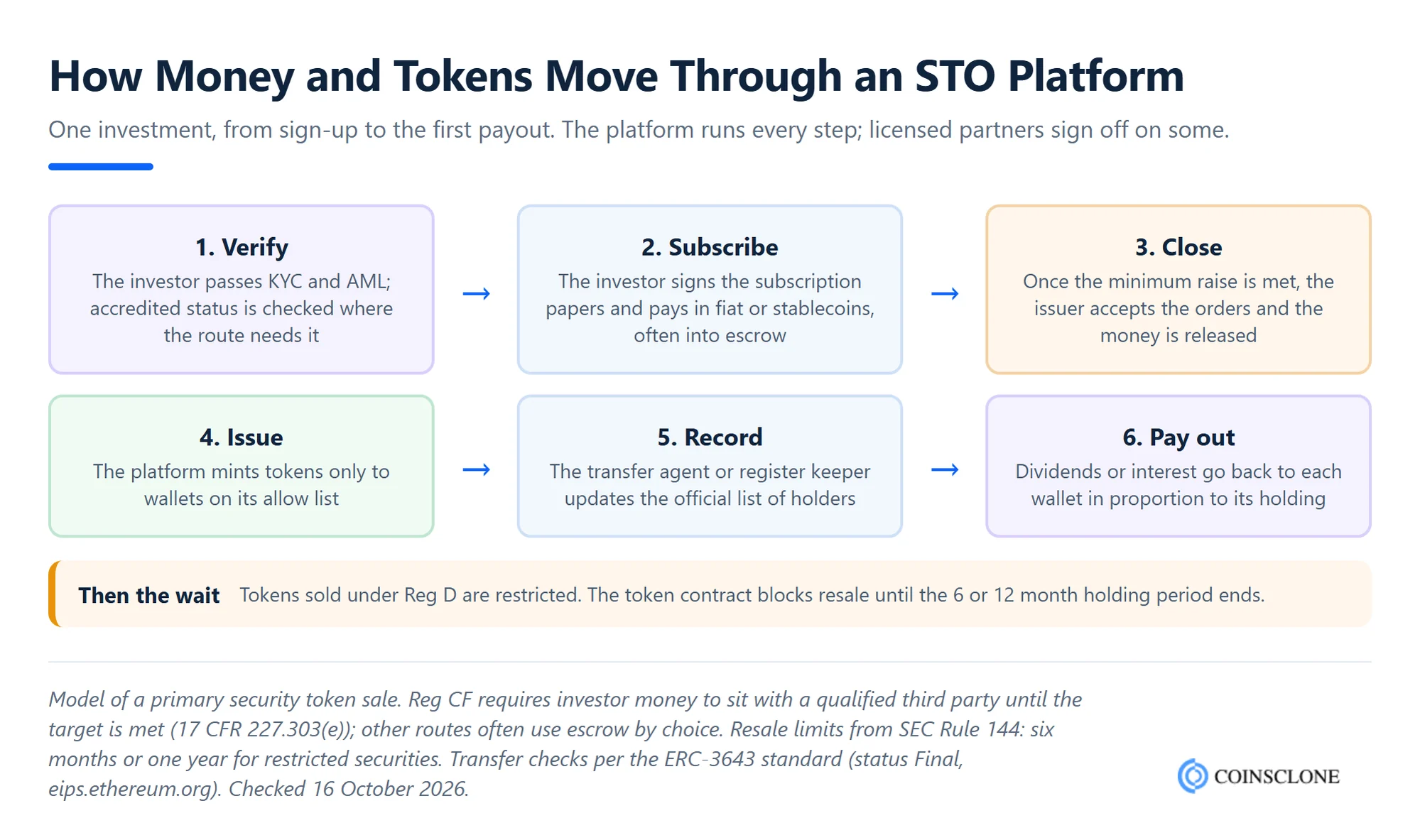
Two details matter most. First, the token can only go to a wallet that passed the checks. Standards such as ERC-3643, now a Final Ethereum standard, check every transfer against an identity list and a rule set. Second, the sale is not the end. Tokens sold under Reg D are “restricted,” so holders usually wait six months to a year before they can resell under the SEC’s Rule 144. Your platform must hold these dates in the token itself, not in a spreadsheet.
Why Is a Security Token Offering Platform a Better Option Than Others?
Most companies choose an STO platform because it is the safer way to raise money with tokens. Investors trust these tokens because the sale follows the law and each buyer is checked. As a result, both sides gain. The company reaches more investors, while investors get legal rights and clear records.
The table below compares an STO with the two other common routes.
| ICO | STO | IPO | |
| What is sold | Tokens, often called utility tokens | Tokens that are securities | Shares listed on a stock exchange |
| Legal status | Often unclear; many faced later enforcement | Registered or exempt securities offer | Fully registered public offer |
| Investor checks | Light or none | KYC, AML and buyer type checks | Through brokers |
| Who can raise | Mostly crypto projects | Startups to large firms | Mostly large, established firms |
| Time and cost | Fast and cheap, but risky | Weeks to months; legal work is the main cost | Long and costly; banks and auditors |
| Trading after the sale | Crypto exchanges | Licensed venues, after lock-ups | Stock exchange from day one |
In short, an STO sits between the two. It costs less than an IPO and carries far less legal risk than an ICO. If you plan a token sale that is not a security, our guide on how to start an ICO is the better fit.
Benefits of Launching a Security Token Offering Platform
You can gain several benefits by launching an STO platform. Here are the main ones.
- Investor trust: Every buyer passes KYC and the sale follows the law, so serious buyers feel safe to join.
- Fractional ownership: A costly asset can be split into small units. As a result, you can reach investors who could never buy the whole asset.
- Global reach: Investors from many countries can join online, as long as your legal route covers their country.
- Automated compliance: Caps, lock-ups and country blocks run inside the token, which cuts manual work and errors.
- Faster payouts: Transfers settle on-chain, and payouts reach each wallet at once.
- A path to liquidity: Once lock-ups end, holders can trade on licensed venues. Trading volumes are still thin for most tokens, so plan for this rather than count on it.
With these benefits in mind, the next question is which platform to use. Let us look at the main players first.
Top Security Token Offering Platforms in 2026
The STO market has changed a lot since the first wave in 2018. Several early leaders were bought, and a few closed. Here is the status of the main platforms as of October 2026.
1. Securitize
Securitize is the best-known name in the field. It holds SEC registrations as a broker-dealer, transfer agent and alternative trading system (ATS), and it issued BlackRock’s BUIDL fund. Its shares began trading on the New York Stock Exchange under the ticker SECZ on 2 July 2026. In Europe, its Spanish arm runs under the EU DLT Pilot Regime.
2. tZERO
tZERO combines issuance with a regulated trading venue. Its ATS is run by its broker-dealer, tZERO Securities, and it added 24/7 order entry in December 2025. tZERO announced plans for a public listing in October 2025, but it has not listed yet.
3. Tokeny
Tokeny built the T-REX protocol behind the ERC-3643 standard, which most new security tokens now use. Apex Group, a large fund services firm, bought a majority stake in Tokeny in May 2025, with a plan to own it fully within three years. Apex says Tokeny’s tools have been used to tokenize more than $32 billion of assets.
4. Polymesh
Polymath was one of the first STO platforms in 2018. It later built Polymesh, a blockchain made only for regulated assets, which went live in October 2021. Today, the team’s work runs through the Polymesh network rather than the old Polymath token platform.
5. DTCC Digital Assets
DTCC, which settles most US stock trades, bought the tokenization firm Securrency and renamed it DTCC Digital Assets. It now offers tools for compliant tokenized assets to banks and fund managers.
What Happened to the Early Names?
Older “best STO platform” lists still name firms that no longer run on their own. Harbor was bought by BitGo in 2020. INX was bought by Republic, the deal closed in November 2025, and INX token trading stopped on 11 November 2025. So check any platform’s current status before you trust an old list.
These hosted platforms suit many issuers. Even so, a growing number of firms want their own platform. The next section helps you choose.
Use a Hosted STO Platform or Launch Your Own?
You have three ways to run an STO. You can list your offer on a hosted platform, launch a white-label platform under your own brand, or build a custom platform from scratch. Work through the questions below to find your fit.
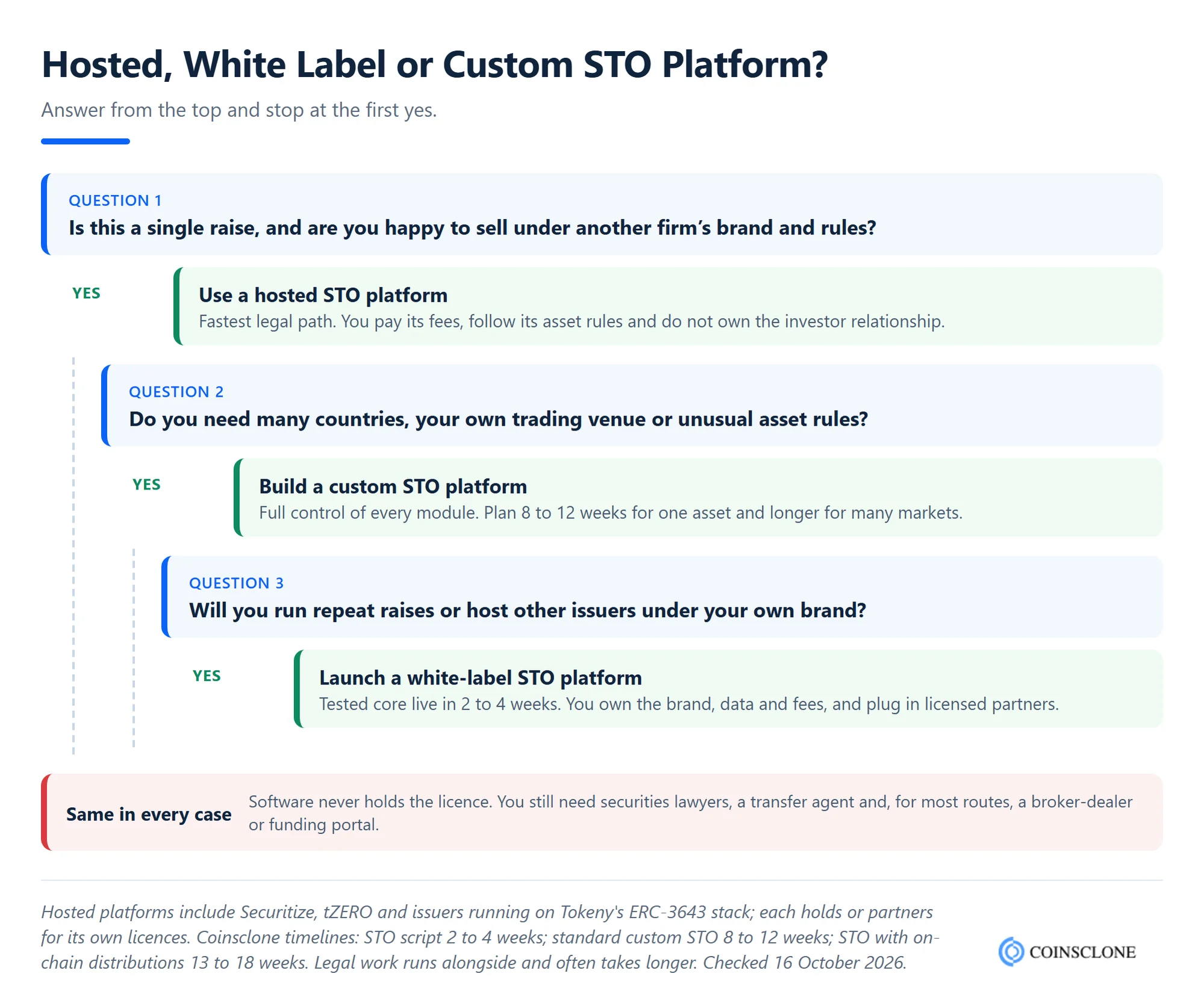
A hosted platform is quick for a single raise, but you follow its rules, pay its fees and share your investor list. On the other hand, your own platform lets you keep the brand, the data and the fees, and you can run raise after raise. For most firms that plan more than one raise, a white-label STO script gives the best mix of speed and control. That guide covers what a script includes and the full rules table for each legal route.
How To Launch an STO Platform Successfully
To launch your security token offering platform successfully, follow these steps in order. Several of them run side by side, so start the legal work on day one.
1. Start With a Strong Business Idea
You need a clear asset and a clear reason for investors to buy. Decide what the token stands for (equity, debt, a fund share or a real asset), how much you want to raise and who your buyers are. A sound offer matters more than a clever token.
2. Pick Your Legal Route
Your lawyers choose the route, and the platform is set up to match it. In the US, the common routes are:
- Reg D: for accredited (wealthy or expert) buyers, with no cap on the raise.
- Reg A+: for public raises of up to $75 million a year.
- Reg CF: for raises of up to $5 million a year through a funding portal.
- Reg S: for sales to buyers outside the US.
For Reg D, you file a short Form D within 15 days after the first sale, while Reg A+ needs the SEC to “qualify” the offer first, which often takes months. In the EU, a public offer of up to €12 million over 12 months can now skip the full prospectus under the EU Listing Act.
3. Prepare Your Legal Papers
A crypto whitepaper is not enough for a securities sale. You need an offer memo (often called a PPM), a signed buy form and clear risk notes. Your whitepaper can still explain the token and the platform, but the legal papers set the investors’ rights.
4. Get Legal and Compliance Advice
You must follow many rules for an STO, so launching one is not as easy as it looks. Hence, work with a securities lawyer in each country where you sell. Also choose your partners early: a KYC provider, a transfer agent, a custodian and, for most routes, a broker-dealer or funding portal.
5. Choose a Reputed STO Development Partner
Next, pick a team that has built compliant token platforms before. Ask to see a live demo, the audit reports and the token standard they use. Coinsclone is a security token development company that builds STO platforms. Our crypto launchpad development team also builds token sale tools.
6. Promote Your Offer Within the Rules
Marketing is where many STOs break the law. Under Reg D Rule 506(b), you cannot market the offer to the public at all. Under 506(c), Reg A+ and Reg CF, you can promote it, but only with the right notices. So check every post, email and ad with your lawyer before it goes out.
7. Plan for Life After the Sale
Your work does not end when the sale closes. You will pay dividends or interest, send reports and hold votes through the platform. Once lock-ups end, holders will also want to trade. For that, plan a link to a licensed venue or your own security token exchange development.
By following these steps, you can launch your STO platform properly. You can build it from scratch or start from a script. Building from scratch is long and costly, so many firms choose a ready-made STO script. Here is what ours includes.
Features of Our STO Script
1. Token Creation and Distribution
Our STO script lets you create security tokens and send them to approved investors in a few clicks. Tokens follow the ERC-3643 standard by default, so the rules travel with the token. This keeps the process clear and safe, which builds investor confidence.
2. Compliance Rules Built Into the Token
Securities rules can be hard to follow by hand. Our script lets you set the rules for your legal route without new code: who may buy, how much, from which countries, and when they may sell. Your lawyers decide the rules, and the platform enforces them on every transfer.
3. Investor Accreditation Checks
Some routes, such as Reg D 506(c), allow only accredited investors. Our STO script has a built-in accreditation step that simplifies this check and keeps a record for your files, saving you time and effort.
4. KYC/AML Integration
Identity (KYC) and money laundering (AML) checks matter in every token sale. Our script plugs into trusted KYC/AML providers to confirm each investor’s identity and cut the risk of fraud.
5. Investor Dashboard
Investors like to be in control, and our dashboard gives them just that. They can track holdings, see payouts, read updates and vote, all in one place. This improves their experience and builds trust.
6. Cap Table and Payouts
The admin panel keeps a live cap table and sends dividends or interest to every holder at once. In addition, you can export records for your transfer agent and auditors.
Now let us talk about the costs involved in launching your STO platform.
Cost To Launch an STO Platform
The cost of an STO platform is not fixed. It depends on how you build it and how many partners you connect. Published 2026 agency cost guides put a tokenization MVP at about $40,000 to $70,000 and a full production platform at $100,000 to $250,000, before legal fees. A white-label STO script usually costs less than a custom MVP, because the tested core already exists.
Time matters as much as money. On our own timelines, an STO script can go live in 2 to 4 weeks. A standard custom STO takes 8 to 12 weeks, and a platform with on-chain payouts takes 13 to 18 weeks.
Also budget for costs outside the software. These often match or beat the platform cost:
- Legal work: offering papers, filings and advice in each country.
- KYC and buyer checks: often a fee per person.
- Smart contract audits: after any change to the token rules.
- Transfer agent and custody: yearly fees to keep the official records and hold assets.
- Broker-dealer or funding portal fees: often a share of the money raised.
- Marketing: within the rules of your legal route.
Costs can also change with custom requests, extra features and support terms. Our team is always ready to discuss your needs and shape your STO platform to fit your budget. To see it in action, ask for a demo of our STO script and decide which features your security token offering website should include.
Launch Your Successfully STO Platform Instantly!
Cost-effective, White-Label Solution, Premium Features, Customizable. Live Demo Available.
Frequently Asked Questions
What is a security token offering platform?
It is the software that runs a security token sale. It checks investors, takes their money, issues the tokens to approved wallets and keeps the list of holders. After the sale, it pays dividends or interest and blocks resale until the lock-up ends. Firms either use a hosted platform such as Securitize or launch their own.
What are security token offerings?
A security token offering is a fundraise where a firm sells tokens that count as securities, such as shares, bonds or fund units. It works like a normal share or bond sale, but the asset is issued and recorded on a blockchain. The issuer must register the sale or use an exemption, such as Reg D or Reg A+ in the US.
What is the difference between an STO and an IPO?
An IPO sells listed shares that trade on a stock market from day one. It needs banks, auditors and a long review. An STO sells securities as tokens, often under an exemption, so it can be faster and cheaper. However, STO tokens usually face resale lock-ups and trade on smaller licensed venues.
What are the top tokenization companies?
In 2026, the best-known names are Securitize, tZERO, Tokeny, Polymesh and DTCC Digital Assets. Apex Group now owns most of Tokeny. Each serves a slightly different need, from fund tokens to regulated trading. Firms that want their own brand often launch a white-label platform instead.
What is an example of a security token?
BlackRock’s BUIDL fund is one of the best-known examples. Each token is a share in a fund that holds US Treasury bills and cash, and it was worth about $2.2 billion in October 2026. The BENJI fund from Franklin Templeton is another.
Wrap Up
We hope you now have a clear picture of how a security token offering platform works and how to launch one. With the right legal route, the right partners and a well-built platform, you can launch your STO with confidence. Coinsclone has built blockchain products since 2018 and has delivered more than 350 platforms for 200+ clients across 20 industries. Our team can guide you from the legal setup to launch day. Get our security token development services to start.
Take the first step to launch your own STO software and change the way you raise capital. Contact us today!
See How Our MVP System Can Launch Your STO Platform Faster
Security Token Offering (STO) Platform Development — done right.
- MVP System:Launch your compliant STO platform 90% faster.
- Investor Dashboard & KYC:Fully integrated investor management and verification tools.
- Smart Contracts:Secure issuance and distribution of security tokens.
- Custom Branding:Your design, your assets, your investors.
- Revenue Engine: Earn from token sales, listings, and investor onboarding.
See a free branded demo of your STO platform in just 48 hours — before you invest a cent.
Book a Free Demo to discover how our Security Token Offering Platform can take you from idea to live launch in just 2–4 weeks.