

A Coinbase Commerce clone script is ready-made software that lets you launch a crypto payment gateway like Coinbase Commerce under your own brand. It gives merchants payment links, invoices, a checkout, an API and a dashboard, so you can start taking crypto payments in weeks instead of building every part from scratch.
The timing matters. Coinbase shut the Commerce portal on 31 March 2026 and moved merchants in the US and Singapore to Coinbase Business. Merchants everywhere else had to find a new provider. This guide explains what the script includes, how a payment moves, what the shutdown changed, and how a gateway like this earns, costs and launches.
In this guide:
- The 2026 gap: What merchants lost when Coinbase Commerce closed, and why that leaves room for a new gateway.
- How it works: One payment from checkout to settlement, step by step.
- What you get: The admin, merchant and security features a Coinbase Commerce clone should ship with, plus add-ons.
- How it earns: A worked example of a gateway with 150 merchants and its monthly fee income.
- Time and budget: 6 to 9 weeks for a standard white label gateway, or 10 to 14 weeks with fiat settlement.
See How Our MVP System Can Launch Your Payment Gateway Faster
Crypto Payment Gateway Development — done right.
- MVP System : Launch your Coinbase Commerce-like gateway 90% faster.
- Wallets & Integration : Pre-built modules for crypto payments, no coding needed.
- Brand & Customization : Your design, your supported coins, your checkout flow.
- Revenue Engine : Earn from transaction fees, subscriptions, and crypto payments.
See a free branded demo of your payment gateway in 48 hours — before you invest a cent.
Book a Free Demo to discover how our Coinbase Commerce Clone Script can take you from idea to live gateway in just 8-12 weeks.
What Is a Coinbase Commerce Clone Script?
A Coinbase Commerce clone script is a ready-made software package that copies the core features of Coinbase Commerce, the crypto checkout Coinbase ran for merchants. With it, you can build your own gateway without starting from zero. It supports many coins, handles payments and invoices, links to wallets and gives shoppers a smooth checkout, all under your own brand.
Most scripts are white label. You get the full, tested product, then add your name, logo, colours, fee rates and rules. Since the core already works, your team can spend its time on what sets you apart: your market, your coins, your payout options and the merchants you sign.
People often mix this up with a Coinbase clone script, which copies the Coinbase exchange. The two are different products. An exchange lets users trade coins. A Commerce clone lets businesses get paid in crypto.
What Happened to Coinbase Commerce in 2026?
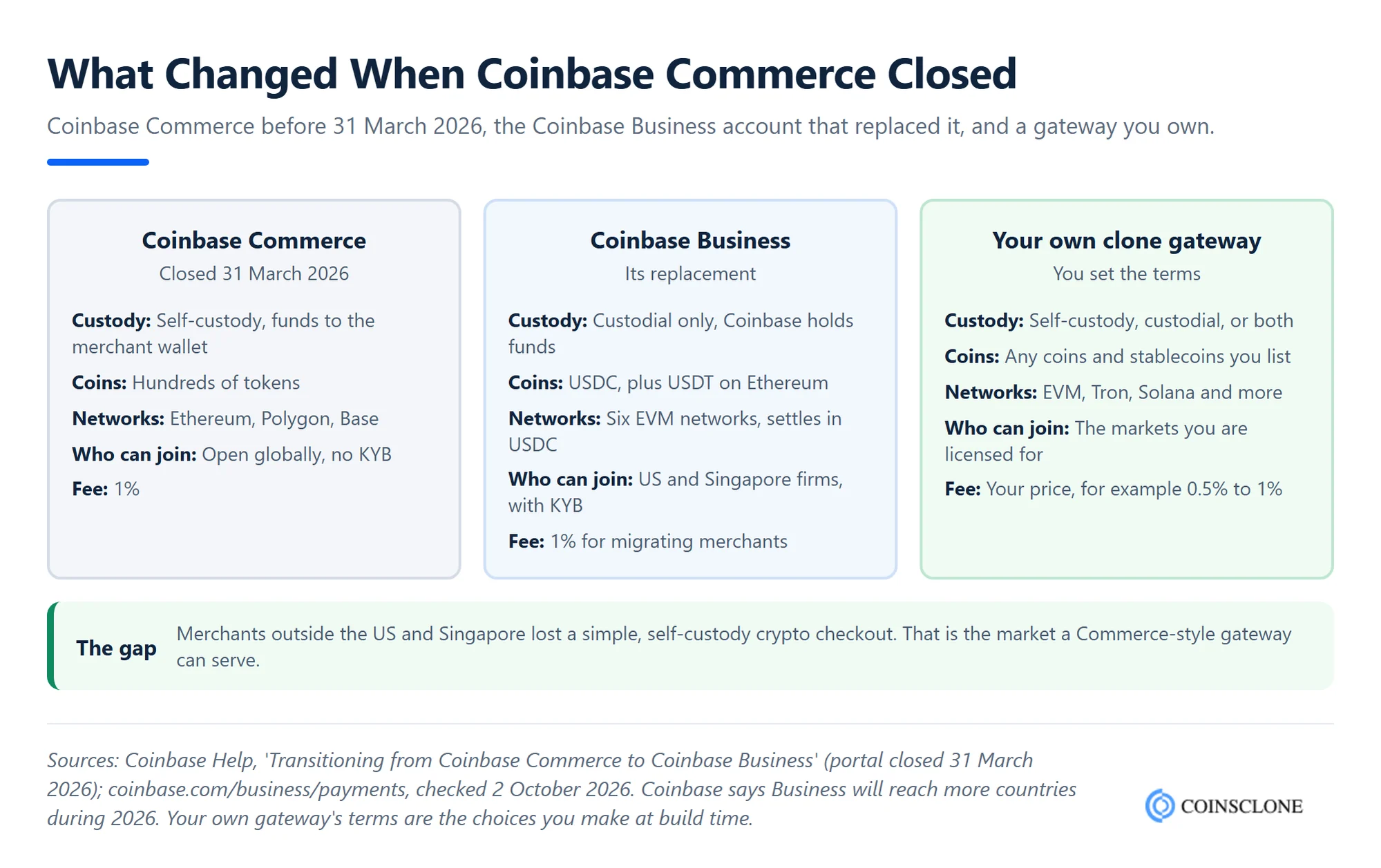
Coinbase Commerce launched in 2018 and grew into one of the best-known ways for shops to take crypto. It was self-custodial, so payments went straight to the merchant’s own wallet. It took hundreds of coins, it was open almost everywhere and it did not ask merchants for business checks (KYB). The fee was a flat 1%.
That ended this year. As Coinbase’s notice explains, Commerce was folded into Coinbase Business, and the Commerce portal closed for good on 31 March 2026. After that date, merchants could no longer create charges or open the dashboard.
The new product works in a very different way:
- Custody: Coinbase Business holds the funds for you. There is no self-custody option.
- Coins: Today, Coinbase Business payments accept USDC on six EVM networks and USDT on Ethereum only. Everything settles in USDC.
- Who can join: Only firms with a legal entity in the US or Singapore, a business bank account and a KYB check. Coinbase says it will add more countries during 2026.
- Fee: 1% for merchants who moved over from Commerce.
Coinbase’s own reason is that Commerce was “built for an earlier phase of crypto.” For US firms that want custody, bank payouts and accounting tools, the new product is a step up. But a merchant in India, the UAE, Nigeria or Brazil lost a simple, global checkout that let them hold their own funds. That is the gap a Coinbase Commerce clone can fill.
Build Like Coinbase Commerce: What Made the Model So Effective?
Even though Commerce is gone, the model behind it still works. Here are the five things that made it popular, and that your clone should keep.
Low Transaction Fee
Coinbase Commerce charged a flat 1% per payment. Card processors often take 2% to 3% plus a fixed fee per sale. For small shops, every point counts, so this low, simple fee was a big draw and helped the brand grow fast.
No Chargeback Headaches
Crypto payments are final. Once a payment is confirmed on chain, the buyer cannot reverse it. As a result, merchants avoid fraud chargebacks, which cost card merchants money and time. Refunds still happen, but the merchant decides when to send them.
Easy Onboarding
Commerce let any business start taking crypto within minutes. There was no long application, and a merchant did not need to know how blockchains work. This mattered most to small firms that wanted crypto sales without a tech team.
Lower Security Risk
Merchants held their own funds, and Coinbase never stored them. Two-factor login and strong encryption protected the account side. With no central pot of merchant money, there was less for hackers to target.
Global Reach
Crypto has no borders, and neither did Commerce. A shop in one country could sell to buyers anywhere, with no currency exchange and no bank delays. In turn, merchants reached new buyers and new revenue.
So cloning this model makes sense: you keep the parts that worked and shape them around your own market. Next, let’s look at why a clone script is the fastest way to do that.
Reasons to Build a Crypto Payment Gateway With a Coinbase Commerce Clone Script
You have a few ways to build a crypto payment gateway, such as a white label crypto payment gateway or a fully custom build. A clone of a proven model like Coinbase Commerce has some clear benefits.
Easy to Customize
The script copies the Commerce flow, but you can change almost everything. You can reshape the design, pick your coins and chains, set your own fees and add your own features. That way you do not end up as one more generic gateway.
Quick Launch
You do not start from a blank page. The script already ships with the main features, tested against what the market needs. You tailor it to your brand and rules, then go live. A standard white label gateway launches in 6 to 9 weeks.
Lower Cost
Building a gateway from scratch means paying for design, coding, testing, audits and launch from zero. A clone script packs most of that into one tested product. So you spend less up front and reach revenue sooner.
A Model Merchants Already Know
Coinbase Commerce taught many merchants and buyers how a crypto checkout works. A familiar flow builds trust faster. As a result, you spend less effort teaching buyers how to pay.
Built for Where Payments Are Going
Crypto payments keep growing. The Crypto.com Market Sizing Report counts 741 million crypto owners in 2025, up 12.4% from 659 million in 2024. Stablecoins are also moving into normal shopping. For example, Shopify merchants can now take USDC on Base through Shopify Payments, with Stripe and Coinbase behind it. A gateway built now sits right in that shift.
How a Coinbase Commerce Clone Processes a Payment
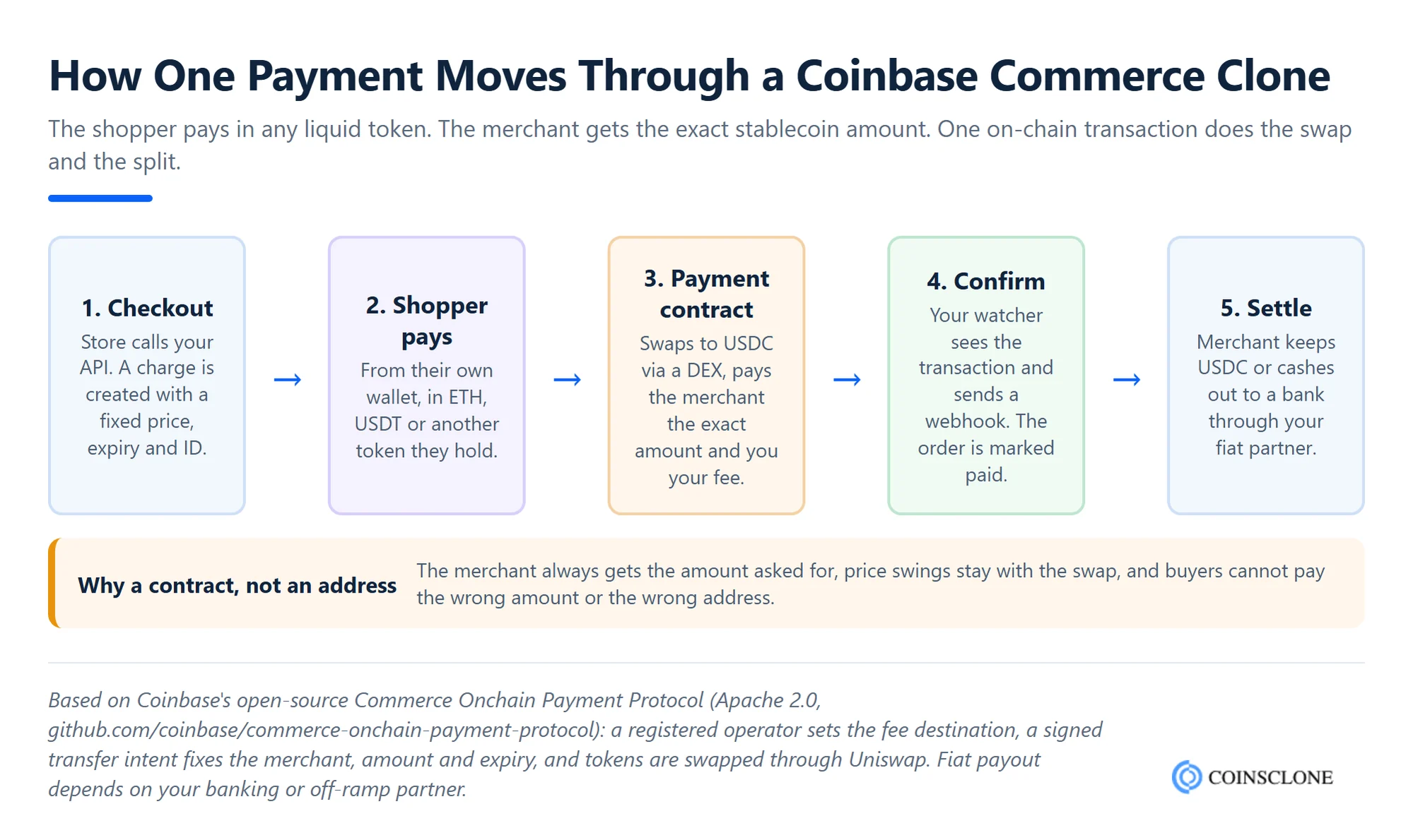
Commerce did not just watch for coins arriving at an address. In its last years it ran on an open payment contract, the Commerce Onchain Payment Protocol, which Coinbase published under the Apache 2.0 licence. A good clone follows the same idea. Here is what happens in one payment:
- Checkout: The merchant’s site calls your API. Your gateway creates a charge with a fixed price, an expiry time and a unique ID.
- Payment: The shopper pays from their own wallet, in the coin they hold.
- Swap and transfer: The payment contract swaps the coin to the merchant’s chosen stablecoin through a DEX such as Uniswap. It then sends the exact amount to the merchant and your fee to your wallet, all in one transaction.
- Confirm: Your blockchain watcher sees the transaction. It then marks the charge as paid and sends a webhook to the merchant’s store.
- Settle: The merchant keeps the stablecoin, or cashes out to a bank through your fiat partner.
This design solves the three biggest problems with older crypto checkouts. The merchant always gets exactly the amount asked for. Buyers can pay with any token that has enough liquidity, and price swings do not hit the merchant. Moreover, nobody can pay the wrong amount or send funds to the wrong address.
Features of Coinsclone’s Coinbase Commerce Clone Script
Coinsclone’s Coinbase Commerce clone script comes with a full set of features out of the box. The lists below cover the core build, and our team can add more for your market.
Admin Features
- Admin Dashboard: Track payments, users and system activity in real time from one dashboard.
- Merchant Management: Approve, manage and verify merchants with built-in KYB, KYC and AML steps.
- Transaction Tracking: View detailed transaction logs and reports to stay in control of the platform.
- Coin and Fee Settings: Choose the coins you support and set platform fees to match your business model.
- API Key Management: Create and manage secure API keys for merchant setups.
- Invoice and Payment Request Control: Oversee all merchant invoices and payment requests from one place.
- Dispute Tools: Handle refund requests and disputes with a clear, structured admin panel.
- Role-Based Access: Give admins and sub-admins only the rights they need.
- Custom Alerts: Set automatic alerts for key system events.
- Wallet and System Settings: Set up wallets, payment logs, limits and global platform rules.
Merchant Features
- Quick Onboarding: Get merchants started fast with a simple sign-up flow.
- Multi-Coin Support: Accept a wide range of coins and stablecoins without extra setup.
- Merchant Dashboard: Track payments, payouts and revenue on a clean dashboard.
- Payment Buttons and Invoices: Create payment buttons, links and invoices in seconds.
- API and Webhooks: Connect the gateway to websites or apps with secure, well-documented APIs.
- Multi-Wallet Support: Use several wallets with live payment status.
- Fast Withdrawals: Withdraw funds at once or schedule payouts.
- Crypto Conversion: Swap one coin for another inside the dashboard.
- Export History: Download all past payments for your books or tax needs.
- 24/7 Support: Reach your team anytime through a merchant support panel.
Security Features
- End-to-End Encryption: Lock each payment’s data from start to finish.
- Multi-Sig Wallets: Require more than one approval to move platform funds.
- Attack and Fraud Shields: Block DDoS attacks and fraud with strong, tested tools.
- Secure API Login: Keep integrations safe with token-based API access.
- Two-Factor Login: Add a second login step for merchants and admins.
- Face and Touch Login: Let users sign in with a face or fingerprint on phones.
- Automated KYC and AML: Screen users and watch activity with built-in compliance tools.
- Address Allow Lists: Let funds go out only to wallets you have approved.
- Hot and Cold Wallets: Keep most funds offline and only what you need online.
- Regular Security Audits: Run planned checks to find and fix weak spots.
For a deeper look at how to protect a live gateway, see our crypto payment gateway security tips.
Add-On Modules of Our Coinbase Commerce Clone Script
Our Coinbase Commerce clone script also comes with extra modules that help you do more and earn more. You can add them at launch or later.
Popular add-on modules:
- POS (point of sale) app for physical shops
- Monthly and repeat billing
- Multi-language support
- Fiat conversion and bank payouts
- Refer-a-friend and partner rewards
- Plugins for WooCommerce, Magento and other store tools
- Advanced reports and analytics
- Cross-chain swap module
- Loyalty and rewards program
- AI agent payments, so software agents can pay your merchants in stablecoins
- Custom API extensions
How Merchants Set Up on Your Coinbase Commerce Clone
Coinbase Commerce stood out for its simple setup, and your clone should keep it just as simple. Here is how a merchant goes from sign-up to taking payments:
- The merchant creates an account and passes your KYB or KYC check, if your market needs one.
- Next, they connect a wallet to receive funds, or choose a hosted balance if you offer custody.
- In the dashboard, they open Settings, then Security, and create a new API key.
- They paste that key into their store’s admin panel or the gateway plugin.
- Then they add their store’s webhook URL in your dashboard, so orders update the moment a payment confirms.
- Finally, they test a payment on a testnet. Once it works, the crypto checkout goes live for their buyers.
Our guide on how to integrate a crypto payment gateway covers this setup in more detail for websites and mobile apps.
How a Coinbase Commerce Clone Makes Money
A gateway earns on every payment it handles, plus a few extra services. These are the main revenue streams:
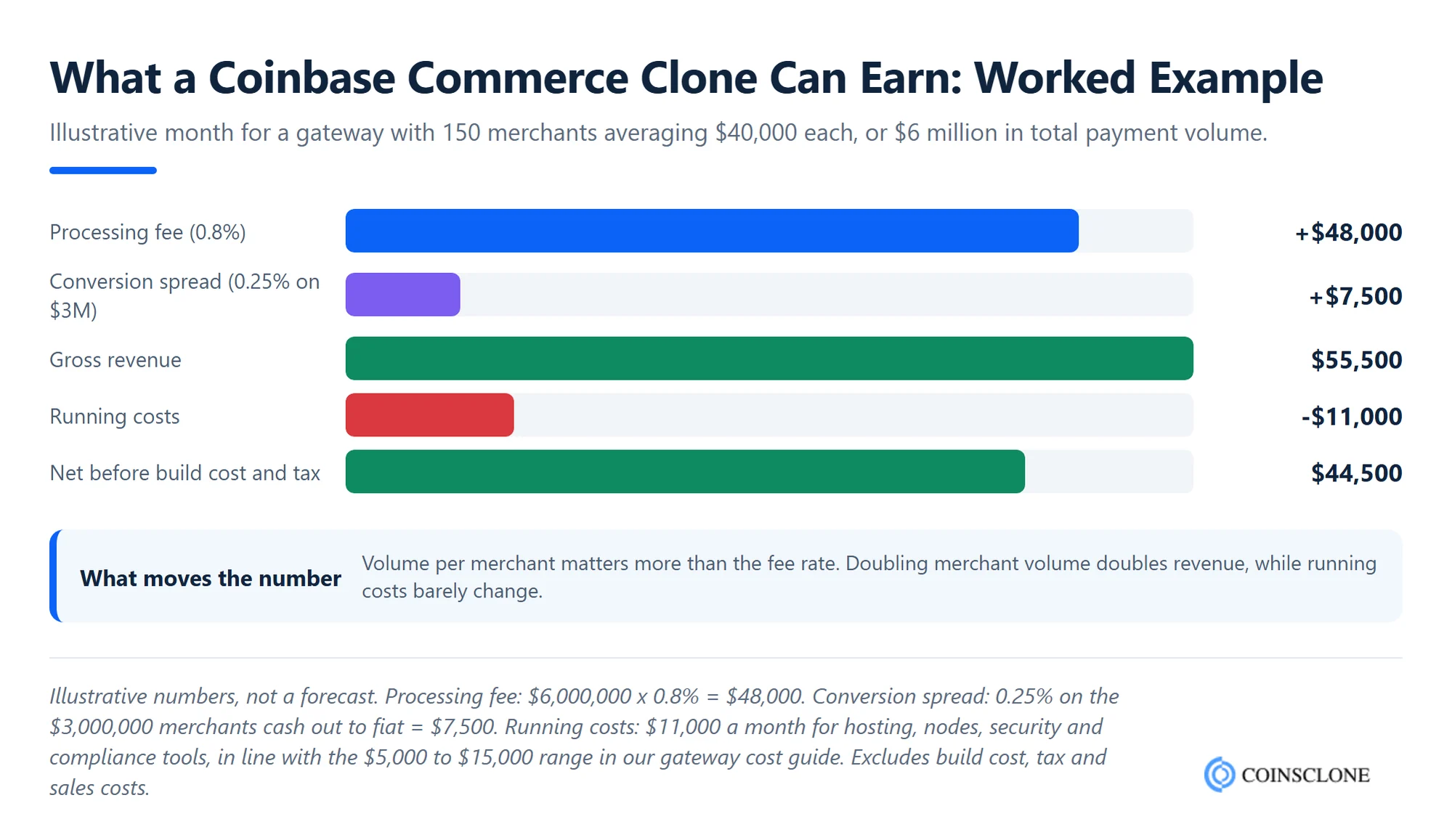
- Processing fee: A small percentage on each payment. Coinbase charged 1%, so many new gateways price between 0.5% and 1% to win merchants.
- Conversion spread: A small margin when you swap crypto to stablecoins or pay merchants out in local money.
- Payout fees: A flat fee for bank withdrawals or fast payouts.
- Subscription plans: Monthly plans that unlock lower fees, more users or advanced reports.
- Add-ons and plugins: Paid POS apps, accounting links or recurring billing.
- White label licensing: Let partners run your gateway under their own brand in other regions.
The worked example below shows how these add up for a small but busy gateway. The numbers are for illustration only, and real results depend on your market and pricing.
Compliance: What to Plan Before Launch
The rules for a crypto payment gateway depend on where you operate and on who holds the funds. A non-custodial gateway, where money goes straight to the merchant’s wallet, usually faces lighter rules than a custodial one that holds merchant balances. Still, plan for these points early:
- Licences: In the EU, a gateway that holds or transfers crypto for clients usually needs a MiCA licence. In the US, money transmitter rules apply state by state. Many other countries have their own crypto service provider regimes.
- KYB and KYC: Check who your merchants are and, for larger amounts, who their buyers are.
- AML screening: Screen wallet addresses against sanctions lists and known scam wallets.
- Travel Rule: If you move funds between providers, send sender and receiver details with each transfer. In the EU this applies to every transfer, and in the US it starts at $3,000.
- Tax records: Give merchants clean exports, since most tax offices treat crypto sales as taxable events.
Licence approval can take longer than the build itself. So start the legal work at the same time as development.
What You Get With Our Coinbase Commerce Clone
Coinbase Commerce Clone App (Android and iOS)
Launch a secure, easy-to-use crypto payment app on both Android and iOS. The app comes with multi-coin support, fast payment processing and a merchant dashboard, so businesses and buyers can pay and get paid on the go.
White Label Coinbase Commerce Clone Script
Get a ready-to-deploy, fully customizable white label Coinbase Commerce clone script. It is built for a fast launch and lets you brand the gateway as your own. It also includes payment tracking, API setup, wallet management and plugin support, so you can run a gateway that earns from day one.
How Much Does a Coinbase Commerce Clone Script Cost?
A Coinbase Commerce clone costs far less than a gateway built from scratch, because the core is already built and tested. Still, no two projects are the same, so the final price depends on your coins and chains, fiat payouts, custody model, apps and compliance tools.
Published 2026 agency cost guides put a white label crypto payment gateway at about $20,000 to $60,000 with core features, and $40,000 to $100,000 with custom work, more chains and fiat payouts. A fully custom gateway built from scratch usually costs $100,000 to $300,000 or more. On top of that, plan for running costs of about $5,000 to $15,000 a month for hosting, nodes, security and compliance tools.
Time follows the same pattern. Coinsclone launches a standard white label gateway in 6 to 9 weeks, or 10 to 14 weeks with fiat settlement. A security audit adds a few weeks to any path. For a full breakdown, read our guide on the cost to develop a crypto payment gateway.
Either way, a clone script costs far less than building a new payment gateway from scratch.
To get the best value, work with an experienced team that covers the whole project, from choosing the tech stack to launch and support. One such team is Coinsclone.
Why Choose Coinsclone for Your Coinbase Commerce Clone?
The biggest advantage of a clone script is how far you can shape it. You can adapt, extend or fine-tune the whole flow to match your business. That is why it pays to work with a skilled crypto payment gateway development company like Coinsclone. Our developers make sure every feature, flow and integration fits your plan.
Coinsclone has been building blockchain products since 2018. Our team has delivered 350+ platforms for 200+ clients across 20 industries, from payment gateways to wallets and exchanges. We build Coinbase Commerce clones as white label launches in 6 to 9 weeks, or 10 to 14 weeks with fiat settlement, and as fully custom gateways for larger projects. If you want to compare other models first, see our list of the top crypto payment gateway clone scripts.
Build a Crypto Payment Gateway like Coinbase Commerce
Cost-effective, White-Label Solution, Premium Features and Customizable. Live Demo Available.
Frequently Asked Questions
What is a Coinbase Commerce clone script?
A Coinbase Commerce clone script is ready-made, customizable software that copies the features of Coinbase Commerce, so a business can launch its own crypto payment gateway. It includes payment links, invoices, a checkout, merchant dashboards and an API, all under your own brand.
Is Coinbase Commerce shutting down?
Yes. Coinbase closed the Commerce portal on 31 March 2026. Merchants can no longer create charges or use the Commerce dashboard. Firms in the US and Singapore can move to Coinbase Business. Merchants in other countries need a different provider or their own gateway.
What replaced Coinbase Commerce?
Coinbase Business replaced it. It is a custodial account that accepts USDC on six EVM networks and USDT on Ethereum, settles in USDC and charges migrating merchants 1%. It is open only to firms with a legal entity in the US or Singapore for now.
How long does it take to build a payment gateway like Coinbase Commerce?
With a Coinbase Commerce clone script, a standard white label gateway takes about 6 to 9 weeks. With fiat settlement, it takes about 10 to 14 weeks. A fully custom build most often takes 4 to 9 months.
Which coins can buyers pay with?
That is your choice. Most gateways start with Bitcoin, Ethereum, USDT and USDC, then add chains such as Base, Polygon, Tron, Solana and BNB Chain. With an on-chain swap, buyers can pay with any token that has enough liquidity, while the merchant still receives a stablecoin.
How do stablecoins protect merchants from price swings?
The gateway swaps the buyer’s coin into a stablecoin, such as USDC, during the payment itself. So the merchant receives a fixed dollar amount, not a coin whose price can drop before they cash out.
Can merchants hold their own funds?
Yes, if you build a non-custodial gateway, as Coinbase Commerce was. Payments then go straight to the merchant’s own wallet. You can also offer a custodial option with hosted balances and bank payouts, which usually needs more licences.
Can I earn by building a platform like Coinbase Commerce?
Yes. You can charge a fee on each payment, earn a margin on conversions and payouts, sell monthly plans and paid add-ons, and license your gateway to partners.
Is the Coinbase Commerce clone script customizable?
Yes. You can change the design, coins, chains, fees, payout options and features to fit your business and market.
How safe is Coinsclone’s Coinbase Commerce clone?
It uses multi-sig and cold wallets, two-step login, locked-down APIs, DDoS shields, KYC and AML checks and planned audits. Together they guard against hacks and fraud.
See How Our MVP System Can Launch Your Payment Gateway Faster
Crypto Payment Gateway Development — done right.
- MVP System : Launch your Coinbase Commerce-like gateway 90% faster.
- Wallets & Integration : Pre-built modules for crypto payments, no coding needed.
- Brand & Customization : Your design, your supported coins, your checkout flow.
- Revenue Engine : Earn from transaction fees, subscriptions, and crypto payments.
See a free branded demo of your payment gateway in 48 hours — before you invest a cent.
Book a Free Demo to discover how our Coinbase Commerce Clone Script can take you from idea to live gateway in just 8-12 weeks.