
A Blur clone script is ready-made software for launching an NFT marketplace and aggregator that works like Blur. It comes with sweeps across markets, collection and trait bids, live floor charts, wallet login and an admin panel. This guide explains what the script includes, how it works, what it costs and how to run a Blur-style platform in 2026.
It also covers what most clone script pages leave out. Blur itself is changing fast. On 12 October 2026, Blur said it will retire its blur.io website on 12 November 2026, while its smart contracts stay live on Ethereum. So the real lesson from Blur is not only its speed or its 0% fee. It is how a trader-first marketplace can win volume, and why it also needs a way to earn. You will see both sides here.
In this guide:
- What a Blur clone script is, and Blur’s real status in October 2026
- The user, admin and security features a Blur-style platform needs
- How a Blur-style marketplace is built, using Blur’s own contract list
- How a Blur clone makes money, with worked numbers
- Cost, launch time and how Coinsclone builds it
Build a Pro-Level NFT Marketplace with Our Blur Clone Script
Your NFT Exchange — engineered for performance and growth.
- Advanced Trading Suite: Enable real-time bids, floor-price tracking, and NFT sweeping.
- Instant Aggregation: Pull listings from multiple NFT marketplaces seamlessly.
- Tailored Experience: Launch under your brand with full design and feature control.
- Speed to Market: Go live 10× faster with pre-built smart contracts and wallet systems.
See a free branded demo of your NFT marketplace in 48 hours — before you invest a cent.
Book a Free Call to see how our Blur Clone Script can turn your NFT business vision into a live platform in just 8–12 weeks.
What Is a Blur Clone Script?
A Blur clone script is pre-built software that copies the core working model of the Blur NFT marketplace. It includes real-time bidding, fast trades, bulk buying and listings pulled from other marketplaces into one screen. With it, you can launch an NFT trading platform with the same kind of speed, smart contract logic and pro tools as Blur.
In simple words, it is your ready-made Blur-like NFT marketplace. Unlike a basic NFT marketplace script, a Blur clone is built for active traders. It has fast APIs, wallet login, bid pools and an order book for NFTs. As a result, you skip the slow and costly job of building every part from scratch.
You can change the script to fit your plan, from the design and chain to the fees, royalties and reward rules. That matters even more now, because the Blur model needs one key change to last, as you will see below.
Blur in 2026: Status Check (October 2026)
Before you copy any platform, you should know where it stands today. Here is Blur’s status as of 16 October 2026:
- Website closing: Blur announced on X on 12 October 2026 that the blur.io website will stop running on 12 November 2026, as Unchained reported. Blur gave no reason.
- Contracts stay live: Blur said its marketplace protocol “will remain operational on-chain.” So existing listings and bids still work at the contract level, and other apps can in principle still connect to it.
- Blend lending ends: Blend stops matching new loans on 12 November 2026. Borrowers must repay by then or let their loans default. Blur promised a tool to withdraw assets later, with no date yet.
- Blast is closing too: Blast, the Ethereum layer 2 built by Blur’s founder, said on 2 October 2026 that it will shut down, because its costs exceed its revenue.
- BLUR token: It still controls the protocol’s fee switch. On 16 October 2026 it traded near $0.011, with a market cap of about $32 million, per CoinGecko. That is more than 99% below its $5.02 peak in February 2023.
Until then, the blur.io homepage still shows 0% marketplace fees, $7.4 billion in total volume and about 325,000 users since launch.
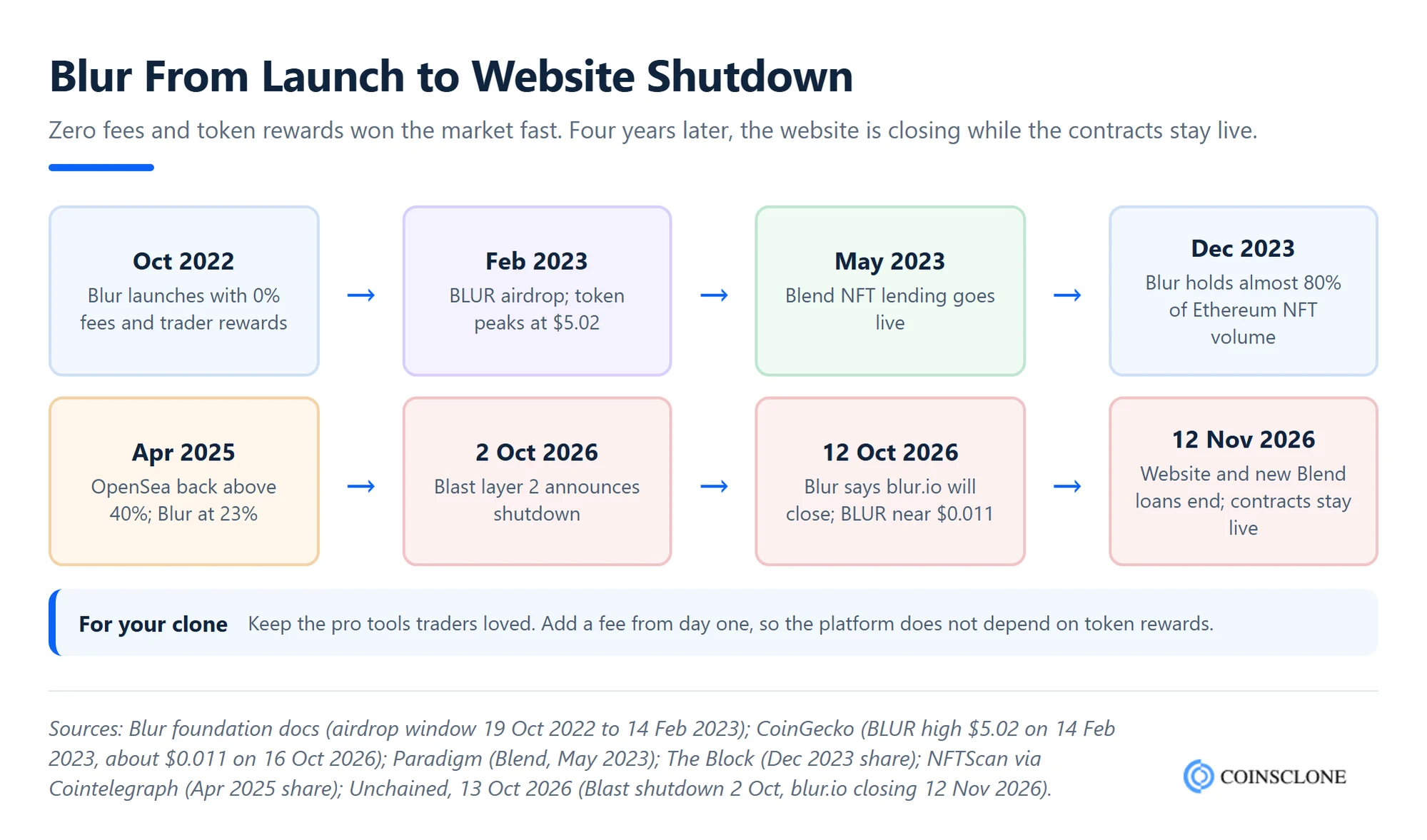
So what does this mean for a Blur clone script? In short, the model is still useful, but the business plan needs fixing. Traders still want fast sweeps, collection bids and low fees. What failed was a 0% fee paid for with token rewards that ran out. A smart Blur clone keeps the pro tools and adds a fair fee from day one.
How Does Blur Differentiate Itself From Other NFT Marketplaces?
Blur launched in October 2022 with backing from Paradigm. It came with a clean layout, 0% marketplace fees and token rewards for active traders. As a result, it grew very fast. By December 2023, it held almost 80% of Ethereum NFT volume, while OpenSea had about 17%.
Blur works on Ethereum and acts as an NFT aggregator. In other words, users can buy NFTs listed on other marketplaces from one screen, with instant liquidity. On top of that, Blur offered Blend, a peer-to-peer lending tool launched with Paradigm in May 2023. With Blend, a holder could borrow ETH against an NFT, or buy a high-value NFT now and pay over time.
Here is what set Blur apart:
- Zero fees: Blur charged 0% on every sale. Traders paid only gas and creator royalties.
- Royalty floor: On collections that do not enforce royalties on-chain, Blur applied a 0.5% minimum royalty that the seller could raise.
- Pro trading tools: Sweeps across markets, collection and trait bids, live depth charts and portfolio tracking.
- Token rewards: It gave BLUR tokens to active traders and bidders, which pulled in heavy volume.
However, the lead did not last. Once rewards slowed, traders drifted back. By April 2025, NFTScan data showed OpenSea with more than 40% of 30-day volume and Blur with 23%. For a full side-by-side, read our OpenSea vs Blur comparison.
So the ideal way to build a Blur-like NFT marketplace is with a Blur clone script. But first, it helps to know which parts of the model to keep.
What Still Works in the Blur Model, and What Did Not
Blur’s story is the best lesson a new NFT marketplace founder can get. It shows what traders love and what a business cannot live without.
What still works in 2026:
- Speed and bulk tools: Traders still want to sweep many NFTs in one go and see live floor prices.
- Collection and trait bids: One bid that any holder can accept gives sellers instant exits.
- Aggregation: Showing listings from many markets in one place gives buyers the best price.
- Low fees: Fees still drive where active traders list. OpenSea itself cut its fee to 1% in September 2025.
What did not work:
- Volume bought with tokens: Much of Blur’s volume came from traders farming rewards. When rewards slowed, volume left.
- No income: A 0% fee leaves the platform with no steady revenue to pay for staff, servers and audits.
- One chain: Blur stayed on Ethereum, while buyers spread to Solana, Base and other chains.
Keep in mind that the NFT market has also cooled. NFT sales fell 37% to $5.63 billion in 2025, according to CryptoSlam data. So a new platform today needs a clear niche and a fee that pays its way, rather than a race to zero.
What Makes Blur Clone Script the Best Solution Over Others?
A Blur clone script is the most practical way to build a trader-first NFT marketplace, mainly for startups. It is a smart choice over building from scratch, because it brings speed, lower cost and room to grow. Here is what makes it better than other build methods:
- Fast Launch: Go live quickly with a tested base, and skip long build cycles.
- Focus on Brand Growth: Spend less time on code and more on marketing and users.
- Lower Business Risk: Use tested contracts and screens instead of untested new code.
- Easy Feature Growth: Add your own features to stand out from rivals.
We have studied the Blur platform closely and built our clone script around it. Now let us look at its features in detail.
Essential Features In Our Blur Clone Script
Our Blur clone script copies the key features of the Blur NFT marketplace. On top of that, you can add any extra modules your business needs.
User (Buyer / Seller) Features
These features help NFT creators, collectors and traders:
- NFT Minting: Users can create and list their own digital assets.
- Auctions and Bidding: Join live auctions and place bids.
- Collection and Trait Bids: Place one bid on a whole collection, or on NFTs with a set trait.
- User Profile and Verification: Custom profiles with ID checks for trust.
- Advanced Search and Filters: Find NFTs by category, price, rarity and popularity.
- NFT Sweeping: Buy many NFTs from a collection in a single transaction.
- Royalty Sharing: Creators get paid on every resale, with no manual steps.
- Wallet Integration: Connect many crypto wallets for smooth trades.
- Personal Activity Dashboard: Track owned NFTs, bids, buys, sales and history.
Admin Features
These features help platform owners run the business:
- Analytics Dashboard: Track platform health, user activity and sales.
- Smart Contract Management: Deploy, upgrade and manage secure smart contracts.
- User and Profile Management: Approve, suspend or verify users and creators.
- Content and NFT Moderation: Review, approve or remove NFTs to keep quality high.
- Reports and Flags: Handle user reports, suspicious activity and disputes.
- Fee and Royalty Control: Set platform fees and creator royalty rates.
- Auction and Listing Control: Pause, extend or cancel auctions and listings.
- Wallet and Chain Settings: Choose supported wallets and blockchains from the admin panel.
Apart from these features, you can also add security tools, user-friendly extras and new revenue streams. For a wider checklist, see our guide to the must-have features of an NFT marketplace.
Security Features Of Our Blur Clone Software
A trading platform holds user funds and valuable NFTs, so security comes first. Here are the modern security features in our Blur clone script:
- Multi-Factor Authentication (MFA)
- Biometric Login Support
- Hardware Wallet Support
- Smart Contract Audits and Monitoring
- On-Chain Signature Checks
- End-to-End Data Encryption
- TLS 1.3 Secure Connections
- IP Whitelisting and Geo-Blocking
- Compliance and Audit Logs
- AI-Powered Fraud Detection
- Role-Based Access Control (RBAC)
On top of these, our Blur clone script comes with a set of extra modules.
Add-On Modules Included in Our Blur Clone Script
Our Blur clone script also comes with these add-on modules. They help you keep users active and give them more ways to trade.
- Cross-Chain NFT Bridge: Move NFTs across many blockchains.
- AI-Powered NFT Price Predictor: Use machine learning to forecast NFT price trends and demand.
- Fractional NFT Ownership: Let users buy, sell and trade shares of high-value NFTs.
- Social Trading and Copy Trading: Let users follow and copy top traders’ buying and bidding moves.
- Metaverse Integration: Connect NFTs to virtual worlds and virtual galleries.
- DAO Governance: Let the community vote on platform decisions with a governance token.
- NFT Lending: Let holders borrow against their NFTs, as Blur’s Blend did.
These modules help your platform stand out, especially now that Blur’s own lending product is closing.
How a Blur-Style Marketplace Is Built
Most clone script pages skip this part, yet it is the most useful one. Blur publishes its own contract list, and it shows exactly how the platform is put together. A Blur clone follows the same plan.
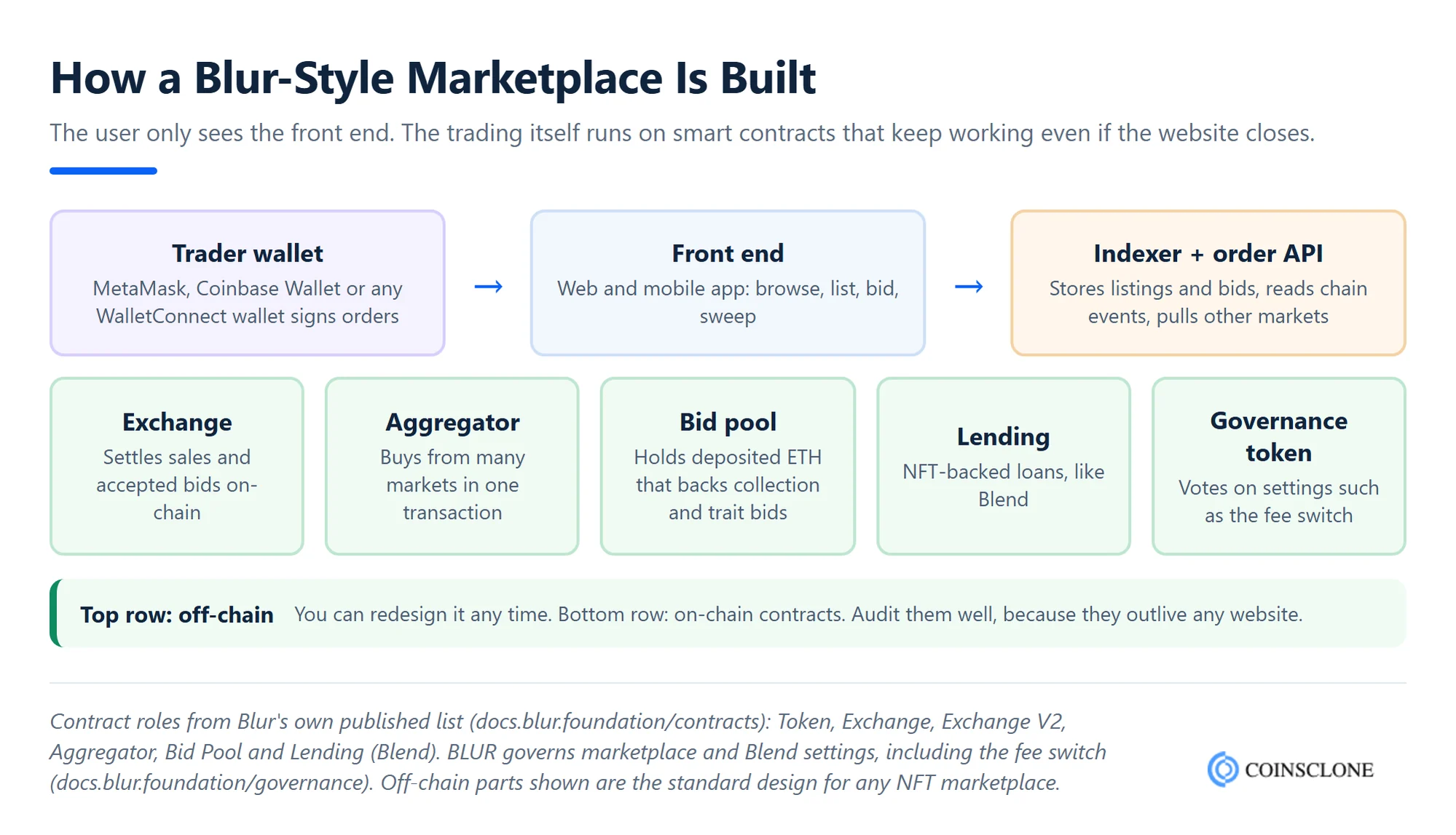
Here is what each part does:
- Front end: The website and apps where users browse, list, bid and sweep.
- Indexer and order API: A back end that reads chain events, stores listings and bids, and pulls listings from other marketplaces.
- Exchange contract: Settles sales and accepted bids on-chain. Blur runs two versions, its first Exchange and Exchange V2.
- Aggregator contract: Buys from several marketplaces in one transaction, which is how a sweep works.
- Bid pool contract: Holds the ETH that traders deposit to back their collection and trait bids.
- Lending contract: Runs NFT-backed loans, like Blend.
- Governance token: BLUR governs key settings of the marketplace and Blend, including the fee switch.
The big takeaway is clear. Blur’s contracts will keep working after its website closes, because they live on Ethereum. In the same way, your marketplace contracts should be audited and built to last, while your front end can change over time. If you want to go deeper on the aggregator side, read our guide to NFT aggregator platform development.
How Does Our Blur Clone Script Work?
From the User Side
First, the user connects a non-custodial wallet, such as MetaMask, Coinbase Wallet or any wallet that supports WalletConnect.
Next, the user picks an NFT collection to browse. The platform shows listings from your marketplace and from other marketplaces side by side, so the user sees the best price.
Then, the user can buy one NFT, sweep many at once or place a bid on a whole collection. The seller pays any creator royalty set by the collection or by your royalty rules.
Finally, the trade settles on-chain and the NFT lands in the user’s wallet. If you add the lending module, holders can also borrow against their NFTs.
From the Admin Side
The admin approves user profiles, reviews flagged NFTs and handles support issues.
The admin also tracks platform health, fee income, rewards and airdrops from one dashboard.
So the platform runs smoothly for both traders and owners. Next, let us see how it earns money.
How a Blur Clone Makes Money
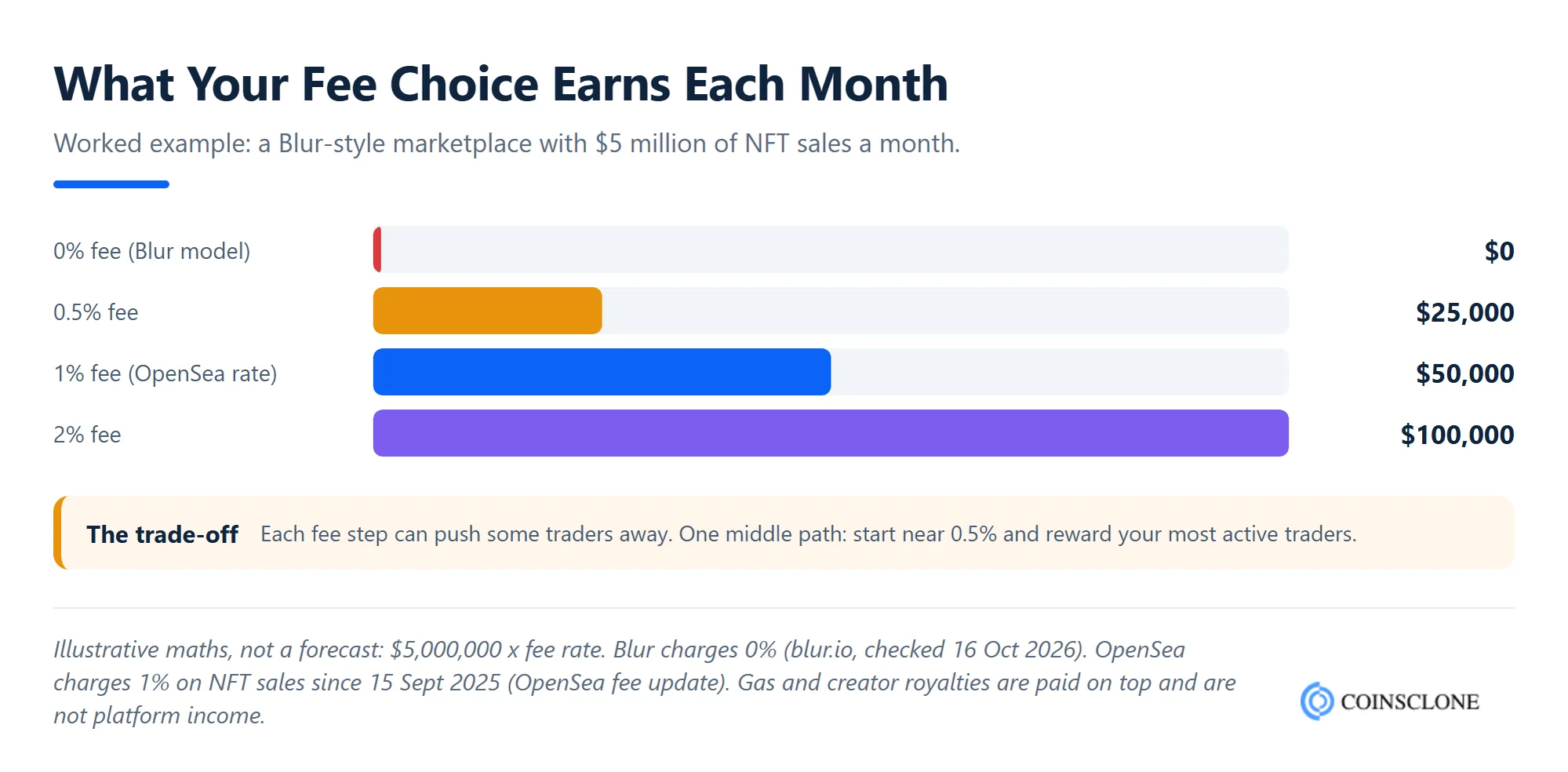
Blur proved that 0% fees attract traders. It also proved that 0% fees alone do not pay the bills. So the first choice for your clone is the fee you charge. Here is what different fee levels earn on the same trading volume.
Most Blur-style platforms earn in more than one way:
- Trading fees: A small fee on each sale, for example 0.5% to 2%. OpenSea now charges 1%.
- Launchpad fees: A share of primary mint sales for new collections.
- Premium tools: Paid plans for faster alerts, bulk tools or pro analytics.
- Lending fees: A share of loan interest from an NFT lending module.
- Listing and promotion fees: Paid spots for featured collections.
A useful middle path is to start with a low fee and reward your most active traders. Then you raise the fee only when your buyers and tools justify it. To compare more models, see how an OpenSea clone makes money.
Ready-To-Launch Deliverables Of Our Blur Clone
Blur Clone App
Our Blur Clone App is a ready-to-launch NFT marketplace for firms that want speed and steady uptime. We deliver a full mobile and web app with a modern design, smooth wallet login and fast NFT trading. The app is tuned for speed and safety, so pages load fast and trades stay secure.
- Pre-built NFT trading and minting
- Fast, clean user screens
- Secure wallet login and transactions
- Live market updates and alerts
White Label Blur Clone Script
Coinsclone’s White Label Blur Clone Script is a fully custom, brand-ready solution. It lets you launch your own NFT marketplace under your own name. We provide the full source code, design options and flexible feature settings. You can change themes, workflows and features without rebuilding the platform.
As a result, you cut build costs, launch sooner and run a strong NFT trading platform.
- Custom branding (logo, colours, screens)
- Works with many chains and wallets
- Built to scale for future upgrades
- Easy to connect third-party APIs and add-ons
NFTs Supported in Our Blur Clone Script
Blur is an NFT aggregator and marketplace where many types of NFTs are bought, sold and traded. Your Blur-like platform can support the same range, such as:
- Music albums
- Web3 collections
- Art and vintage art
- Gaming items
- Collectibles
- Virtual land
- Metaverse assets
- Digital artwork
While building your Blur-like NFT marketplace, you can add more categories based on your niche. If you plan to support more than Ethereum, check our guide to NFT standards for each chain.
Blur Clone Script Cost and Launch Time
Most clone script pages never give a number, so here are the 2026 market ranges. They come from our full guide to NFT marketplace development cost.
| Build route | Typical cost | Typical time | What you get |
| White label or clone script | $10,000 to $30,000 | 2 to 6 weeks | Tested code with your brand, chain and fee settings |
| Mid-tier custom platform | $40,000 to $80,000 | 3 to 5 months | Auctions, royalties, many wallets, search and filters |
| Large pro trading marketplace | $150,000 to $500,000+ | 8 to 12 months | Order book, aggregation, deep data tools |
A Blur clone usually starts in the first row and adds the pro tools from the third. Bid pools, sweeps across markets and an aggregator add to the cost. So does each extra chain. Also, budget $5,000 to $25,000 for an outside smart contract audit before launch.
Benefits of Using Coinsclone’s Blur Clone Script
Many factors make a Blur clone script a strong choice for your NFT business:
- Cost-Effective: The core is already built and tested, so it costs far less than a custom build.
- Customization: You can add features and plugins to fit your plan and your niche.
- Proven Demand: Blur showed how many active traders want fast, low-fee tools. Your platform can serve them as Blur’s own website closes.
- Saves Time: A white label build can go live in a few weeks instead of many months.
- Maintenance and Support: Your clone script provider keeps the software updated and fixes technical issues.
With a Blur clone app, you can launch your NFT marketplace and enter the market with less risk. To do it well, you need the right team. One such team is Coinsclone.
Why Prefer Coinsclone to Buy Blur Clone Script?
Coinsclone is a trusted NFT Marketplace Development company in the blockchain and crypto space. We have built crypto and blockchain products since 2018, and our team has delivered 350+ platforms for 200+ clients across 20 industries.
We also offer a wide range of NFT services, including white label platforms, staking platforms, NFT lending and NFT Aggregator platform development. Our team builds your Blur-style platform with your chains, fees and royalty rules, and we keep supporting you after launch. If you prefer a broader marketplace for all users, we also offer an OpenSea clone script.
So, if you want a fast, secure and future-ready NFT marketplace, now is a good time to start. Traders who relied on blur.io will soon look for new places to trade.
Build a Pro-Level NFT Marketplace with Our Blur Clone Script
Your NFT Exchange — engineered for performance and growth.
- Advanced Trading Suite: Enable real-time bids, floor-price tracking, and NFT sweeping.
- Instant Aggregation: Pull listings from multiple NFT marketplaces seamlessly.
- Tailored Experience: Launch under your brand with full design and feature control.
- Speed to Market: Go live 10× faster with pre-built smart contracts and wallet systems.
See a free branded demo of your NFT marketplace in 48 hours — before you invest a cent.
Book a Free Call to see how our Blur Clone Script can turn your NFT business vision into a live platform in just 8–12 weeks.
Frequently Asked Questions
What is a Blur clone script?
A Blur clone script is ready-made software that copies the core features of the Blur NFT marketplace. It includes real-time bidding, NFT listing, sweeps across markets, wallet login, smart contracts and fast trades. Businesses use it to launch a high-performance NFT trading platform without building every part from scratch.
Is Blur shutting down?
Partly. Blur said on 12 October 2026 that its blur.io website will stop running on 12 November 2026. Its marketplace contracts stay live on Ethereum, and the BLUR token keeps control of the fee switch. Blend stops matching new loans on the same day, so borrowers must repay before then.
Does Blur charge fees?
No. Blur charges a 0% marketplace fee on NFT sales. Traders pay gas and any creator royalty. On collections that do not enforce royalties, Blur applies a 0.5% minimum. Your Blur clone can copy this or charge its own fee.
How does Blur clone software work?
Blur clone software uses smart contracts, an indexer and an order API to let users list, buy and bid on NFTs in real time. It connects to wallets, reads data on and off the chain, pulls listings from other marketplaces and matches buyers with sellers through automated trades.
Is the Blur clone script legal to use?
Yes, a Blur clone script is legal when it is built with its own code and does not copy Blur’s name, logo or other trademarks. Clone scripts use standard blockchain tools and open-source tech. You still need to follow the rules for NFT trading in each country you serve.
What features should a Blur clone script include?
A standard Blur clone script should include:
- Real-time NFT bidding, with collection and trait bids
- NFT sweeping across marketplaces
- Wallet integration
- Smart contract deployment
- Royalty management
- Gas-saving tools such as batch trades
Can I customize a Blur clone script?
Yes, a Blur clone script can be fully customized. Developers can change the design, blockchain, smart contracts, fees, rewards and trading logic to fit your project.
Can I integrate my Blur clone with existing NFT platforms?
Yes. A Blur-style aggregator pulls listings from other NFT marketplaces through their APIs and contracts. So your users can buy NFTs listed elsewhere without leaving your platform.
Who should use Blur clone software?
Blur clone software suits startup founders, NFT marketplace builders, trading communities and Web3 businesses. It helps them launch a pro NFT trading platform without building every part from scratch.
How much does a Blur clone script cost?
In 2026, a white label NFT marketplace costs about $10,000 to $30,000. A Blur-style platform with sweeps, bid pools and aggregation costs more, and a large pro trading marketplace can reach $150,000 to $500,000 or more. Hosting, audits and upkeep add to the total.
What support and updates come with a Blur clone script?
Our support includes technical help, regular updates and patches, full documentation and help with custom changes. Our team makes sure the Blur clone script keeps working as your platform grows.