
A Curve Finance clone script is ready-made software for launching your own stablecoin exchange, built on the same low-slippage idea that made Curve famous. This guide explains what the script is, how Curve’s StableSwap pools and veCRV rewards work, and where Curve stands in October 2026.
You will also get the build steps, the tech stack, the legal and security points most guides skip, and the features you should expect in a finished product. By the end, you will know if a Curve-style DEX fits your plan and what it takes to launch one.
In this guide:
- Curve’s real 2026 numbers: about $1.24 billion locked and $73.9 billion traded in the last 12 months.
- A worked example of why StableSwap pools beat basic AMMs on stablecoin trades.
- How fees, veCRV voting and gauges turn liquidity into revenue.
- Why you cannot simply copy Curve’s code, and the safe ways to build instead.
- Build steps, tech stack, cost drivers and launch timelines.
See How Our MVP System Can Launch Your DeFi Platform Faster
Curve Finance Clone Script — DeFi Exchange Development Done Right.
- MVP System : Launch your Curve-like stablecoin DEX 90% faster.
- Pre-Built Wallets & Staking Engine :Pre-integrated stable swap & yield farming modules — no coding required.
- Brand & Customization : Your UI, your tokens, your liquidity markets.
- Revenue Engine : Earn from swap fees, liquidity provisions, and governance staking.
Get a free branded demo of your Curve-like DEX in just 48 hours — before you invest a cent.
Book a Free Call to discover how our Curve Finance Clone Script can take you from concept to live DeFi exchange in just 8–12 weeks.
What Is a Curve Finance Clone Script?
A Curve Finance clone script is pre-built software that lets you launch a decentralized exchange (DEX) with features and tools like Curve’s, shaped to your own business needs. Curve built its name on stablecoin swaps, liquidity pools, low fees and DeFi lending, which made it a leading automated market maker (AMM) for pegged assets. The clone script follows the same framework so you can run the same business model under your own brand.
The main gains of a clone script are customization, lower cost and faster launch. You also get room for add-ons, future upgrades and new chains. In short, it gives you a tested starting point instead of a blank page. Next, let us look at how Curve itself is doing, because that shapes what your clone should copy.
Is Curve Finance Still Worth Copying in 2026?
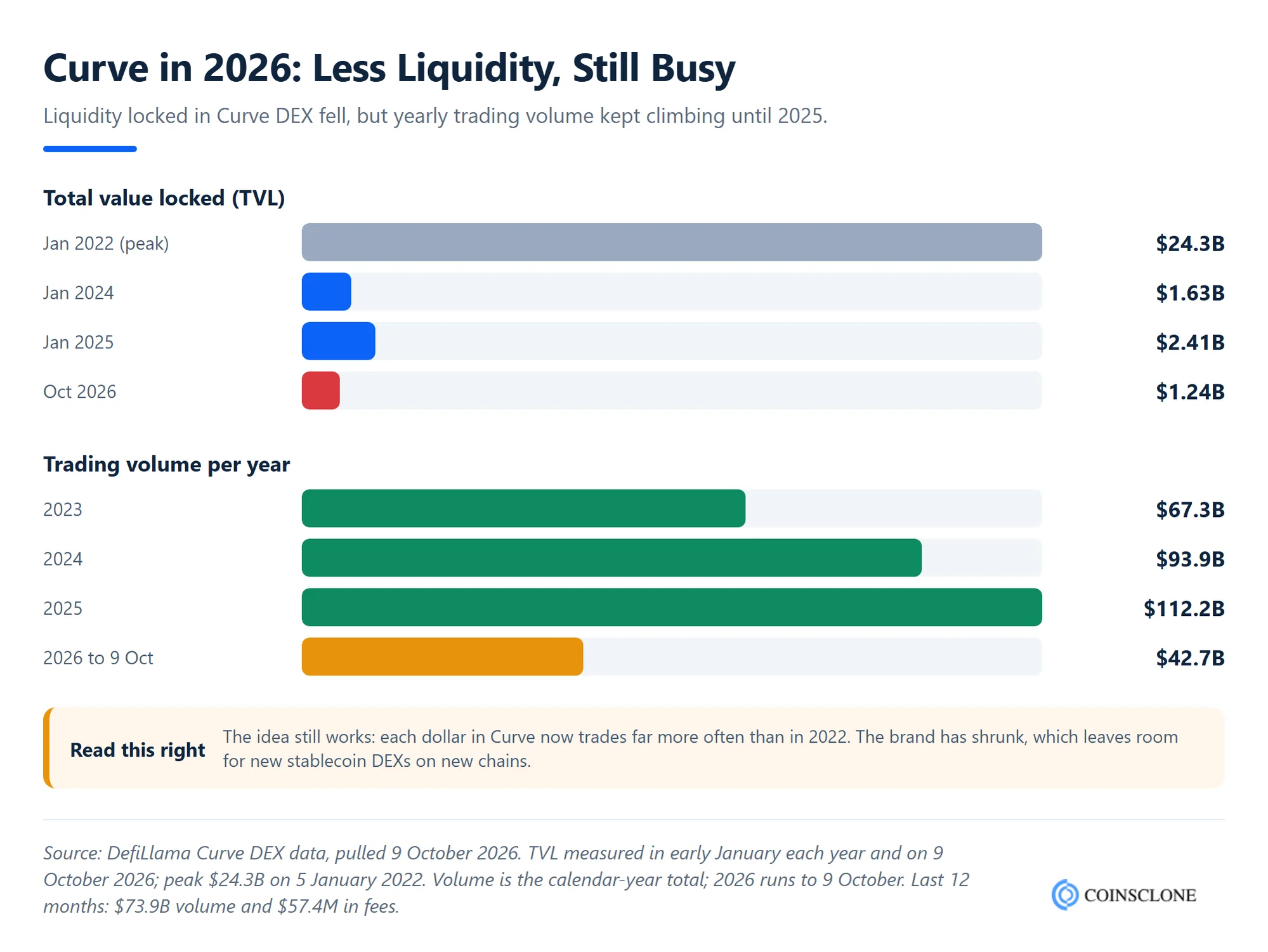
Yes, but copy the model, not the brand. Curve is still live and busy, yet it is much smaller than at its peak. According to DefiLlama’s Curve DEX data, Curve held about $1.24 billion in total value locked (TVL) on 9 October 2026. That is down from $24.3 billion in January 2022 and about $2.24 billion a year earlier.
Even so, trading did not collapse. Curve handled about $73.9 billion in swaps over the last 12 months and earned about $57.4 million in fees. Yearly volume grew from about $67 billion in 2023 to about $112 billion in 2025. In other words, each dollar in Curve now trades far more often than it did in 2022.
Here is what this means for your clone:
- Stablecoin swaps still need a home. Each new stablecoin, staked ETH token and tokenized bond fund needs a low-slippage market.
- Curve is mostly on Ethereum. About $1.18 billion of its TVL sits on Ethereum, while it is listed on 32 chains. Many newer chains have thin stable pools, which leaves room for a focused local DEX.
- The field is more crowded. Uniswap v4 and PancakeSwap Infinity now run stable pools too. So your DEX needs a clear niche, such as one chain, one asset group or one partner stablecoin.
- Curve now does more than swaps. It runs its own stablecoin, crvUSD, and a lending product called Llamalend, so a modern clone often bundles lending with swaps.
How Curve’s StableSwap Pools Work
Most AMMs, like the first Uniswap, use the constant product rule (x * y = k). It works for any pair, but it charges a large price impact on big trades, even between two coins that are both worth $1.
Curve’s answer is StableSwap, described in its StableSwap whitepaper. When a pool is close to balanced, the curve stays almost flat, so 1 USDC buys almost exactly 1 USDT. If the pool gets badly unbalanced, the curve bends like a normal AMM, so it can never be fully drained. An amplification setting (A) controls how flat the middle stays. A higher A means lower slippage, but less protection if one coin loses its peg.
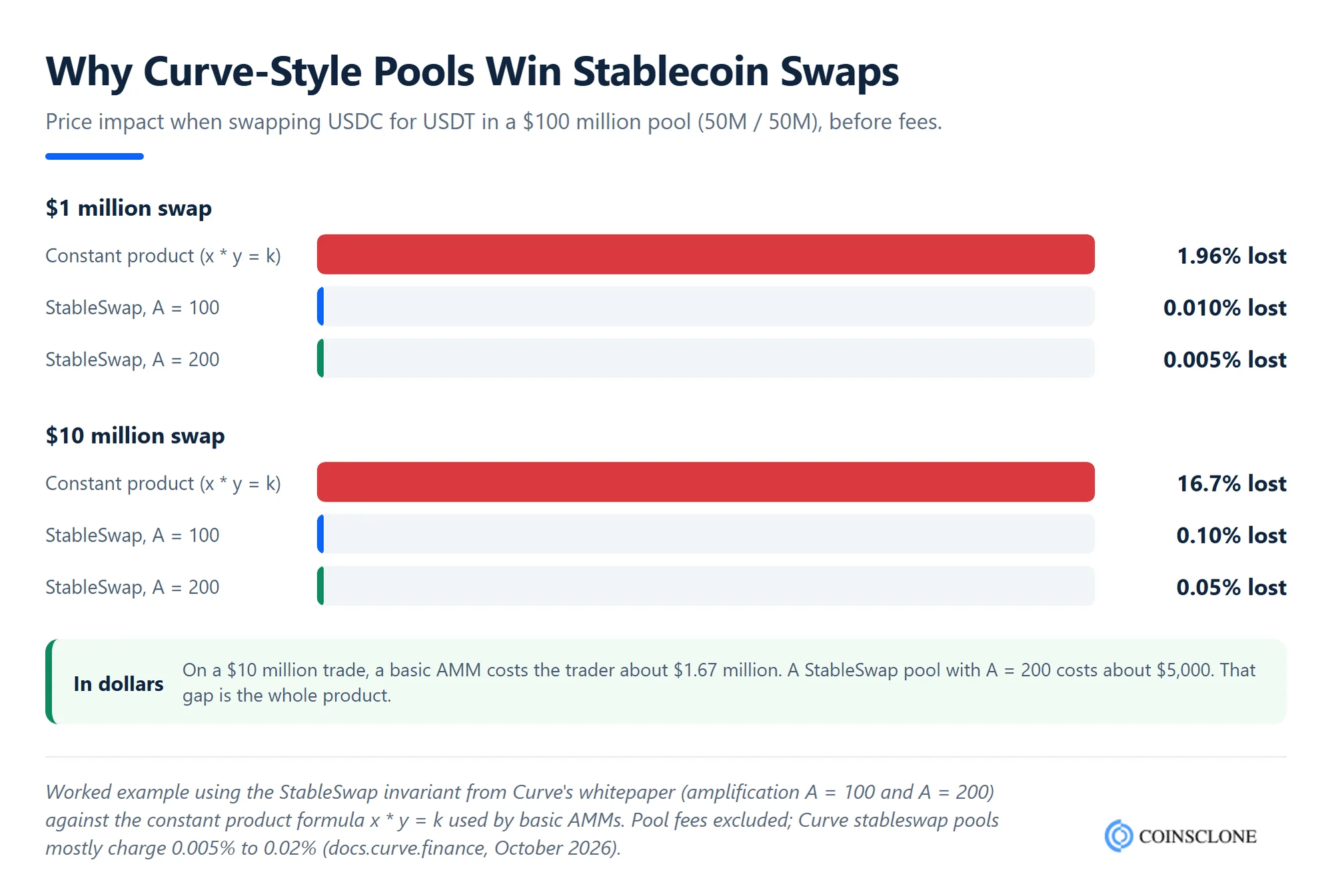
As the worked example shows, a $10 million swap in a $100 million pool costs a trader about 16.7% on a basic AMM. On a StableSwap pool with A set to 200, the same trade loses about 0.05%. That is why traders, trade routers and bots send stablecoin flow to Curve-style pools.
Curve now runs two main pool families, according to the Curve DEX docs:
| Pool type | Best for | Typical fee |
| Stableswap | Assets that should trade at about the same price, such as USDC and USDT, or ETH and stETH | Mostly 0.005% to 0.02% |
| Cryptoswap | Volatile pairs, such as ETH and a stablecoin | About 0.05% up to around 0.4% |
A good Curve Finance clone script should give you both, plus a factory that lets you or your users create new pools.
Why Should You Launch a DEX Like Curve Finance?
Launching a Curve-like DEX places your business in one of the steadiest, most used areas of DeFi. Traders and funds want steady prices and low risk of loss. That is exactly what a stablecoin AMM gives them.
- Stablecoin swaps bring steady trading and steady revenue.
- Low-slippage pools draw pro traders, trade routers and arbitrage bots.
- Stable pools carry less impermanent loss, which helps you keep liquidity providers.
- The Curve model is open and well understood, which builds user trust.
- New stablecoins and yield tokens keep adding demand for cheap stablecoin trades.
Why Prefer Curve Finance Clone Script Over Other Development Methods?
A Curve Finance clone script offers a faster, safer and lower-cost way to launch a DEX than building from scratch. Writing a StableSwap AMM yourself means hard math, long test cycles and more risk.
| Key Factors | Development From Scratch | Curve Finance Clone Script (Smarter & Easier Option) |
| Development Complexity | Requires heavy setup and manual pool math. | Comes with a ready-made StableSwap AMM, reducing complexity. |
| Time to Launch | Many months, plus audit time. | About 5 to 7 weeks for a white label DEX, or 10 to 14 weeks for a standard build. |
| Specialization | Generic DEX system without stablecoin tuning. | Purpose-built for low-slippage stablecoin swaps. |
| Technical Requirements | Needs skilled DeFi engineers for tuning and audits. | Tested smart contracts, ready for your independent audit. |
| Cost Efficiency | Higher cost due to long build cycles. | Lower cost because core features are already built. |
| Security Level | Security varies based on custom setup. | Audit-ready design with anti-flash-loan protection. |
| Best For | Teams building a general DEX. | Businesses that want a Curve-like stablecoin DEX with less effort. |
Essential Features of Our Curve Finance Clone Script
Our Curve DEX script has the core features you would expect from the Curve exchange. Here are the main ones.
User Features
A simple, open and efficient DeFi trading experience built for stable asset swaps.
- Stablecoin swap interface
- Low-slippage trading engine
- Add and remove funds in many tokens
- Yield farming and LP rewards
- Portfolio tracking dashboard
- Cross-chain pool access
Admin Features
Full platform control with tools that automate daily DEX operations.
- Liquidity pool setup, including the A setting and fees
- Fee adjustment dashboard
- Token listing and pool creation
- User and LP management
- Protocol revenue insights
- Smart contract governance controls
Security Features of Our Curve Finance Clone Software
The Curve Finance clone script uses multi-layer security to protect pools, user funds and key actions.
- End-to-end encryption
- Multi-signature wallet governance
- Time-locked admin functions
- Smart contract audit support
- Anti-flash-loan attack system
- DDoS and bot-attack defense
- Secure API management
- Compliance-ready protocol design
Add-On Modules Included in Our Curve Finance Clone Script
You can extend your DEX with modules that add revenue, scale and links to the wider DeFi world.
- Cross-chain bridge integration
- Governance token module
- DAO voting system
- Fiat on-ramp and off-ramp
- Hardware wallet support
- Advanced analytics dashboard
- Institutional liquidity tools
- Automated yield optimizer
These are the main features you can expect from the Curve Finance clone script. Its flexible base also lets you add new revenue modules later, so you can grow with partners over time. To get there, though, you need a clear plan for blockchain and crypto wallet support, which we cover below.
How the Curve Finance Clone Software Works?
The Curve Finance clone script follows the core flow of the original Curve DEX. Users start by connecting a wallet, such as MetaMask or Trust Wallet. Once connected, they can trade, add liquidity and vote (if enabled).
For each transaction, users pay a platform fee, taken from the tokens they trade. The script also supports a native token, which can be used for rewards, governance and other platform tasks.
- Connect: The user connects a wallet first. The Curve clone supports popular crypto wallets like MetaMask, Trust Wallet and more.
- Use: After connecting, the user can access all DEX features. Each feature has its own flow.
- Pay: For each trade, the user pays the pool fee set for that pool.
- Earn and vote: The DEX can launch its own token for LP rewards, fee sharing and governance.
Here is how the main services work in the Curve Finance clone software.
Swapping: Users swap stablecoins and other pegged assets at near 1:1 rates by paying a small pool fee.
Liquidity Pools: Users deposit assets into pools to earn a share of fees and token rewards. You can also let partners create their own pools through the pool factory.
Lending Services: Like Curve’s Llamalend, the platform can support DeFi lending, so users can lend or borrow assets directly. Curve’s own lending markets held about $74 million in October 2026, per DefiLlama.
You can expand your DEX further with features like custodial wallets and token listing. Always make sure new features match your platform’s security and speed standards.
How a Curve-Style DEX Makes Money: Fees, veCRV and Gauges
The swap fee is only half of Curve’s model. The other half is vote-escrow tokenomics, and it is the part most clone scripts skip.
Per the Curve fee docs, half of every stableswap and cryptoswap fee is an admin fee. The DAO collects it weekly, swaps it into crvUSD and pays it to veCRV holders. The other half stays in the pool for liquidity providers.
To get veCRV, users lock CRV for anywhere from one week to four years, according to the veCRV docs. veCRV holders vote on gauges, which decide how many new CRV tokens each pool earns every week. They can also boost their own CRV rewards by up to 2.5x.
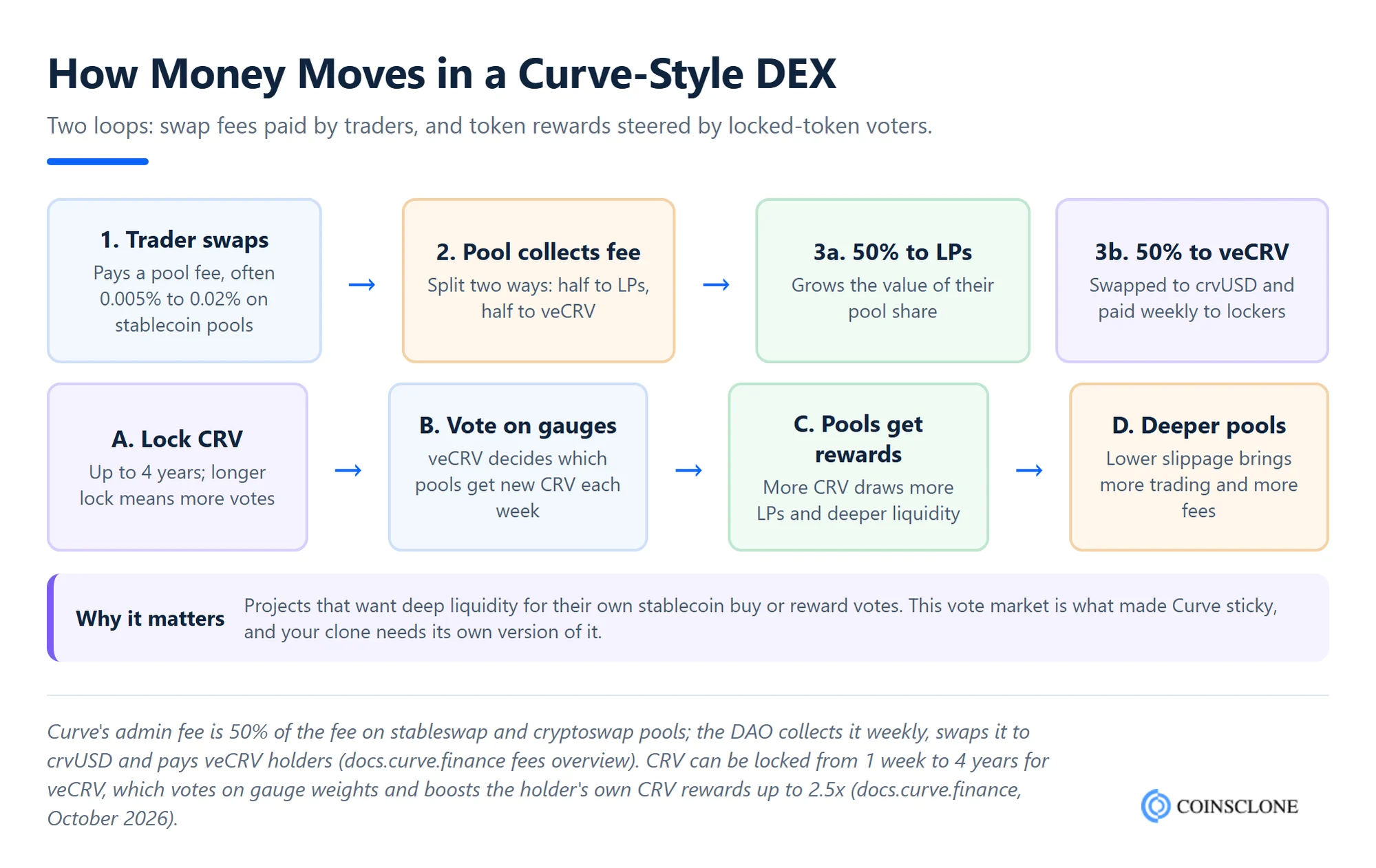
This created the “Curve Wars.” Stablecoin issuers want deep liquidity, so they buy the token, lock it, or pay voters to send rewards to their pools. For your clone, this means your own token design matters as much as your swap engine. Plan the lock period, the reward schedule and the vote rules before launch.
What We Deliver
When you choose our solution, you get a full package that helps you launch your decentralized exchange quickly and with confidence. We provide both the app and the white label Curve Finance clone, so you have everything needed to build and run a DEX like Curve Finance.
Curve Finance Clone App
A complete, production-ready Curve Finance app built for smooth stablecoin trading. Our Curve Finance clone app is built to perform during busy market hours, so trading stays simple at any time, from anywhere.
Delivered Capabilities
- Fully working Curve-like stable swap DEX
- Clean, trader-friendly UI and UX
- Multi-pool liquidity management
- High-precision price and slippage routing
- Real-time pool analytics
White Label Curve Finance Clone Script
A customizable, brand-ready white label Curve Finance clone built for quick launch. The script shortens your launch time, cuts build costs and gives you an enterprise-level base for scaling your exchange.
What You Receive
- Fully custom white-label DEX
- Custom branding, themes and UI
- Advanced stable swap AMM
- Modular design that grows with you
- Easy addition of new pools and token types
Business Perks of Using Coinsclone’s Curve Finance Clone Script
Coinsclone’s solution gives you a fast launch, strong performance and room for steady growth.
- Rapid deployment
- Lower build cost
- High-liquidity AMM design
- Multi-chain and cross-chain support
- Flexible pool setup
- Enterprise-grade security
- Steady trading volume potential
Revenue Opportunities With Curve Finance Clone Script
A stable-swap DEX earns steady income because stablecoin liquidity moves all the time. Curve’s own numbers show the scale: about $57.4 million in fees over the last 12 months, per DefiLlama. Here are the main revenue streams for a DEX like Curve Finance.
- Swap fees: A share of every trade, set per pool (the admin fee).
- Lending interest: Interest from borrowers if you add a lending market.
- Token listing fees: Charges for new projects that want a pool.
- Yield farming models: Partner-funded reward programs.
- Premium analytics: Paid dashboards for funds and traders.
- Sponsored pools: Stablecoin issuers paying for deep liquidity.
- Governance token economy: Value that builds as users lock your token.
To see how live pools pay LPs today, read our guide to the best DeFi liquidity pools.
Blockchains and Crypto Wallets Supported By Curve Clone Script
Here is the list of popular blockchains and crypto wallets supported by the Curve Finance clone software. The blockchain list follows where stable pools are active in 2026.
Blockchains
- Ethereum
- Arbitrum
- Base
- Optimism
- Polygon
- Avalanche
- BNB Chain
- Gnosis
- Sonic (formerly Fantom)
- Plasma
Crypto Wallets
- MetaMask
- WalletConnect
- Trust Wallet
- Rabby Wallet
- OKX Wallet
- Bitget Wallet
- Phantom Wallet
- Safe (multisig)
- Ledger
- Trezor
With this chain and wallet support, you can serve users where they already hold stablecoins. Still, wide support alone does not make a business. You also need a safe codebase and a clear legal setup, which come next.
Can You Fork Curve’s Code? The Licence Question
This is the question most clone-script pages leave out. Curve’s code is public on GitHub, but public does not mean free to reuse. The stableswap-ng licence says the code is published for information only and that no right to copy or share it is given. Curve’s crypto pool and crvUSD code use the same wording.
Curve also enforces this. In March 2026, it openly accused PancakeSwap of using StableSwap code without a licence, and invited PancakeSwap to talk about a licence instead.
So you have three safe paths:
- Build an original version of the StableSwap math from the published whitepaper, with your own code and tests.
- License Curve’s code directly, if you want the exact contracts.
- Use a provider’s own code, and ask in writing that its contracts are original work you are free to use.
Whichever path you choose, put code ownership and licence terms in your contract, including with us. Get legal advice for your own launch, since rules differ by country.
Security Risks to Plan For
Curve’s past gives you a good checklist. Stable pools hold large sums, so small bugs get found fast.
- Compiler bugs: In July 2023, a flaw in some older Vyper compiler versions broke reentrancy locks, and attackers drained several Curve pools. Pin and review your compiler version.
- Oracle mistakes: In March 2026, Curve’s own weekly report noted that an sDOLA lending market was exploited through a misconfigured oracle. Every new market needs its own oracle review.
- Depeg risk: If one coin loses its peg, a high A setting lets the pool fill up with the weak coin. Add depeg alerts and the ability to ramp A slowly.
- Admin key risk: Use multisig wallets and timelocks for every admin action.
- Audit scope: An audit of Curve does not cover your modified copy. Budget for your own independent smart contract audit before launch.
How to Build a DEX Like Curve Finance: Step by Step
Here is the path from idea to launch for a Curve-style DEX.
- Pick your niche. Choose the chain and asset group you will own, such as one new stablecoin chain, staked ETH tokens or tokenized treasuries.
- Design the pools. Set fees, A values and the coin mix for your first pools. Plan metapools if you want new stablecoins to pair with a base pool.
- Design the token. Decide supply, lock periods, gauge voting and how fees reach token lockers.
- Build the contracts. Write or adapt the pool factory, the StableSwap math, gauges and governance. Test rounding and tokens with different decimals.
- Build the front end. Add swap, deposit, withdraw, vote and analytics screens with wallet connection.
- Test hard. Run unit tests, fuzz tests and forked mainnet tests, then a public testnet.
- Audit. Get at least one independent audit and fix every finding before launch.
- Launch and seed liquidity. Partner with stablecoin issuers and market makers so the first pools are deep on day one.
- Get listed on aggregators. Most stablecoin flow arrives through DEX aggregators, so connect early.
Tech Stack for a Curve Finance Clone
| Layer | Common choices |
| Smart contracts | Vyper or Solidity, with a pool factory, StableSwap and Cryptoswap math, gauges and a vote-escrow token |
| Testing | Foundry or Titanoboa, fuzz testing, mainnet fork tests |
| Front end | React or Next.js, wagmi and viem, WalletConnect |
| Data and indexing | Subgraph or custom indexer, price and volume APIs |
| Infrastructure | Node providers, monitoring and alerting, multisig for admin keys |
What Drives the Cost of a Curve Finance Clone?
A Curve Finance clone costs much less than a scratch build, but the final price depends on scope. The biggest cost drivers are:
- Pool types: Stableswap only, or Stableswap plus Cryptoswap pools.
- Tokenomics: A plain swap DEX costs less than one with vote-escrow, gauges and fee sharing.
- Lending: Adding a Llamalend-style lending market adds contracts, oracles and audits.
- Chains: Each extra chain adds deployment, testing and monitoring.
- Audit: Published 2026 audit price guides put a simple token audit at roughly $5,000 to $15,000, with complex DeFi systems costing far more.
- Liquidity: Seed liquidity and launch rewards often cost more than the software itself.
For a fixed quote, share your pool list, chains and token plan with our team.
Looking for a Feature-rich Curve Finance Clone Script?
Cost-effective, White-Label Solution, Premium Features, Customizable. Live Demo Available.
Why Coinsclone For Curve Finance Clone Script?
Coinsclone is a leading Decentralized Exchange Development Company that has been building since 2018, with 350+ platforms delivered for 200+ clients across 20 industries. Our Uniswap clone script, PancakeSwap clone script and 1inch DEX clone scripts are in demand worldwide. The Curve clone script brings the same experience to stablecoin trading, and it pairs well with our stablecoin development services if you plan to launch your own coin too.
Our team combines deep technical skill with real market insight to help you build a modern DEX with the Curve clone. As a startup, you can reach your goals faster with our proven process and full support. Share your plan with us, and we will build your next DEX together with the Curve Finance clone script.
Frequently Asked Questions
1. How does a Curve Finance Clone Script differ from the original Curve Finance platform?
A Curve Finance clone script copies the features and flow of the Curve Finance platform, not its code. You can then add modules, security tools and extra functions that fit your business.
2. What security measures are included in a Curve Clone Script?
Along with basic blockchain security, the Curve Finance clone includes premium security features, such as:
- Code audit support
- Multi-signature wallet integration
- Data encryption
- Role-based access control
- Protection against cross-site scripting (XSS)
3. How long does it take to launch a platform using a Curve Finance Script?
A white label Curve-style DEX usually takes about 5 to 7 weeks to launch, and a standard custom build about 10 to 14 weeks. The real time depends on your custom features, add-on modules and audit schedule.
4. Can I integrate other DeFi protocols or tokens with a Curve Finance Clone Script?
Yes. The flexible base of the Curve clone lets you add new modules. You can add your own governance token, lending and borrowing, staking services and more, based on your business idea.
5. What kind of support is available for a Curve Finance clone Software?
Coinsclone’s team supports you from idea to launch of your Curve-like DEX. You can also choose post-launch support, which covers real-time monitoring, upgrades and regular maintenance.
6. How do decentralized exchanges like Curve make money?
They earn a share of every swap fee, plus income from lending interest, listing fees and partner reward programs. On Curve, half of each pool fee goes to veCRV holders and half stays with liquidity providers.
7. How much does it cost to create a decentralized exchange like Curve?
It depends on pool types, tokenomics, lending, the number of chains and audit scope. Seed liquidity and launch rewards are often the largest costs. Share your plan with our team for a fixed quote.
8. How do I make sure my Curve Finance clone follows the rules?
Start with the licence: use original code or a licensed copy. Then check local rules with a lawyer. In the EU, the MiCA regulation leaves out services run in a fully decentralised way, but a company that runs the front end or holds admin keys may still need to follow rules such as sanctions screening.
9. Can I add cross-chain support after launching the DEX?
Yes. You can deploy the pool factory on a new chain and add a bridge module later. Curve itself is listed on 32 chains, and it added new chains over time.
See How Our MVP System Can Launch Your DeFi Platform Faster
Curve Finance Clone Script — DeFi Exchange Development Done Right.
- MVP System : Launch your Curve-like stablecoin DEX 90% faster.
- Pre-Built Wallets & Staking Engine :Pre-integrated stable swap & yield farming modules — no coding required.
- Brand & Customization : Your UI, your tokens, your liquidity markets.
- Revenue Engine : Earn from swap fees, liquidity provisions, and governance staking.
Get a free branded demo of your Curve-like DEX in just 48 hours — before you invest a cent.
Book a Free Call to discover how our Curve Finance Clone Script can take you from concept to live DeFi exchange in just 8–12 weeks.