
An Exodus wallet clone script is a ready-made, self-custody crypto wallet with the same core features as Exodus: multi-chain storage, in-app swaps, staking and portfolio tracking. You put your own brand on it and launch in 3 to 5 weeks as a white label build, or 8 to 12 weeks as a custom build with Coinsclone.
This guide covers what you can and can’t copy, what Exodus itself has dropped in 2026, and the features, cost, timeline and revenue model of your own version. It also settles the two choices that change everything else: custodial or self-custody, and whether a clone script is the right route at all.
In this guide:
- Where Exodus stands in October 2026: no browser add-on, no WalletConnect, and NFTs gone from 1 December
- Market cost ranges: about $15,000 to $90,000 white label, $50,000 to $200,000 custom
- Coinsclone timelines: 3 to 5 weeks white label, 8 to 12 weeks custom
- Custodial vs self-custody, and what each means for licences
- The best Exodus wallet alternatives for users and for businesses
We sign an NDA before any tech talk. No obligation.
See How Our MVP System Can Launch Your Exodus-like Wallet Faster
Crypto Wallet Development — done right.
- MVP System: Launch your Exodus-style wallet 90% faster.
- Pre-Built Modules: Multi-asset support, portfolio tracking, and exchange integrations—no coding needed.
- Brand & Customization: Your design, your tokens, your blockchain.
- Revenue Engine: Earn from transaction fees, swaps, and staking rewards.
Get a free branded demo of your Exodus-like crypto wallet in 48 hours — before you invest a cent.
Book a Free Call to discover how our Exodus Wallet Clone Script can take you from concept to live wallet in just 8-12 weeks.
What Is an Exodus Wallet Clone Script?
It’s a ready-built wallet that does the core jobs of Exodus, which you then brand and grow as your own product. Wallet setup, key handling, multi-chain balances, send and receive, in-app swaps, a portfolio view, staking and dApp access all come working. You change the branding, choose your chains, add the modules you need, and launch.
What it isn’t: Exodus’s own app. Nobody can sell you the Exodus product, brand or design to relaunch. What you’re buying is a wallet built from scratch by us that works and feels much like it. We should be blunt about that, because a few vendors in this market are not, and you’ll want to know exactly what you own before you sign anything.
What You Can and Can’t Copy
This comes up on almost every call, so here it is plainly.
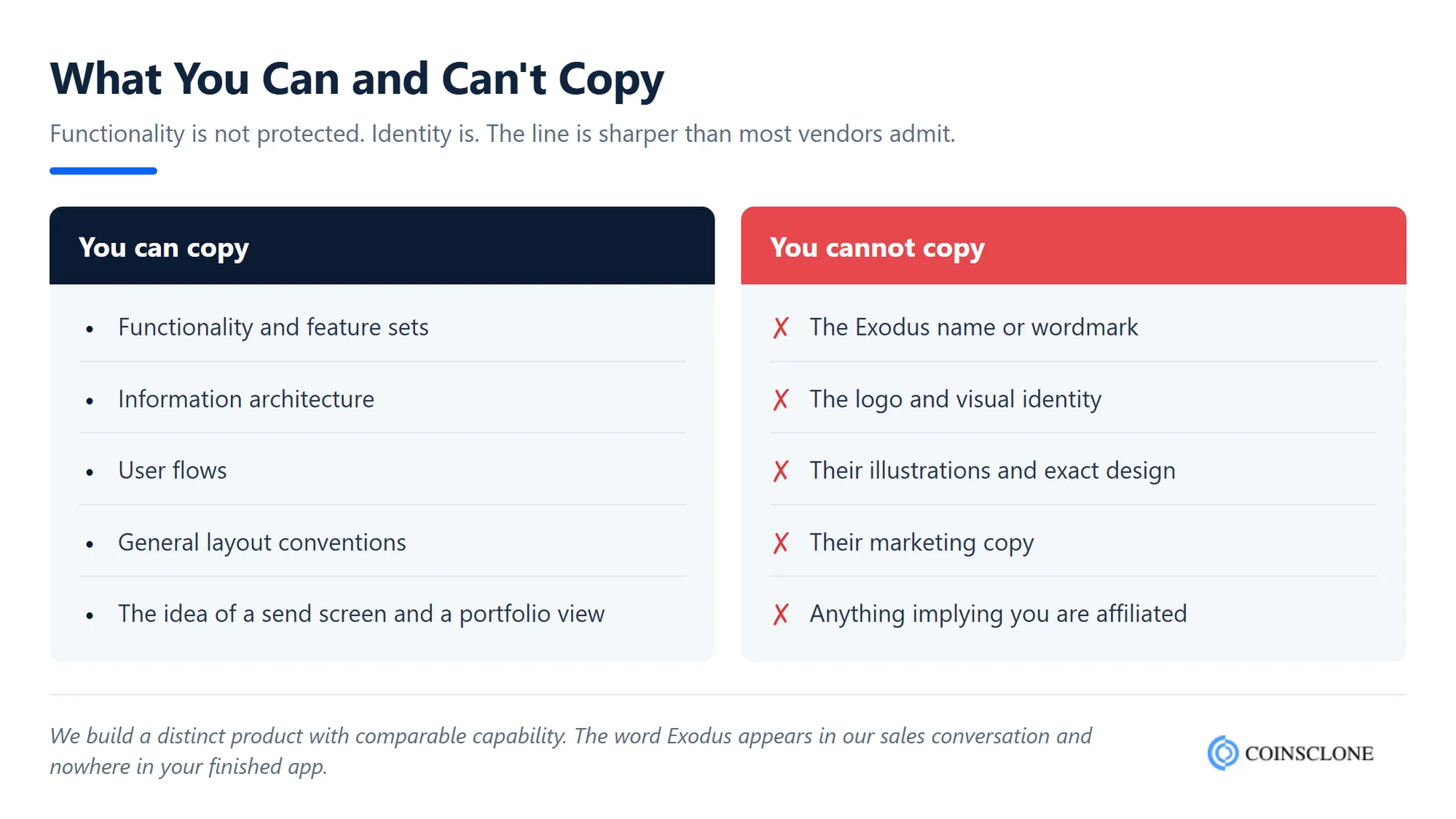
You can copy: features, feature sets, menu structure, user flows and common layout patterns. None of that is protected. Every major wallet has a send screen and a portfolio view for the same reason every car has a steering wheel.
You can’t copy: the Exodus name, logo or wordmark, their exact look and artwork, their sales copy, or anything that suggests you work with them. Using “Exodus” in your product name or domain breaks trademark law, and app stores pull apps over it.
We build you a distinct product that does the same jobs. Your brand, your design system, your name. The word “Exodus” appears in our sales conversation and nowhere in your finished app.
Is Exodus Open Source? Can You Fork It From GitHub?
Not as a full app. Exodus shares public copies of parts of its code on its GitHub account, such as the hydra code base and the headless wallet SDK. The finished Exodus apps, brand and design are not open source, so you can’t ship them as your own. If you plan to use any public package, check its licence first.
Be careful with anything sold as an “Exodus clone” IPA file or GitHub download. These are often fake-balance tools or phishing kits that steal the seed phrase of whoever installs them. The warning further down explains why.
Do You Actually Need a Clone Script?
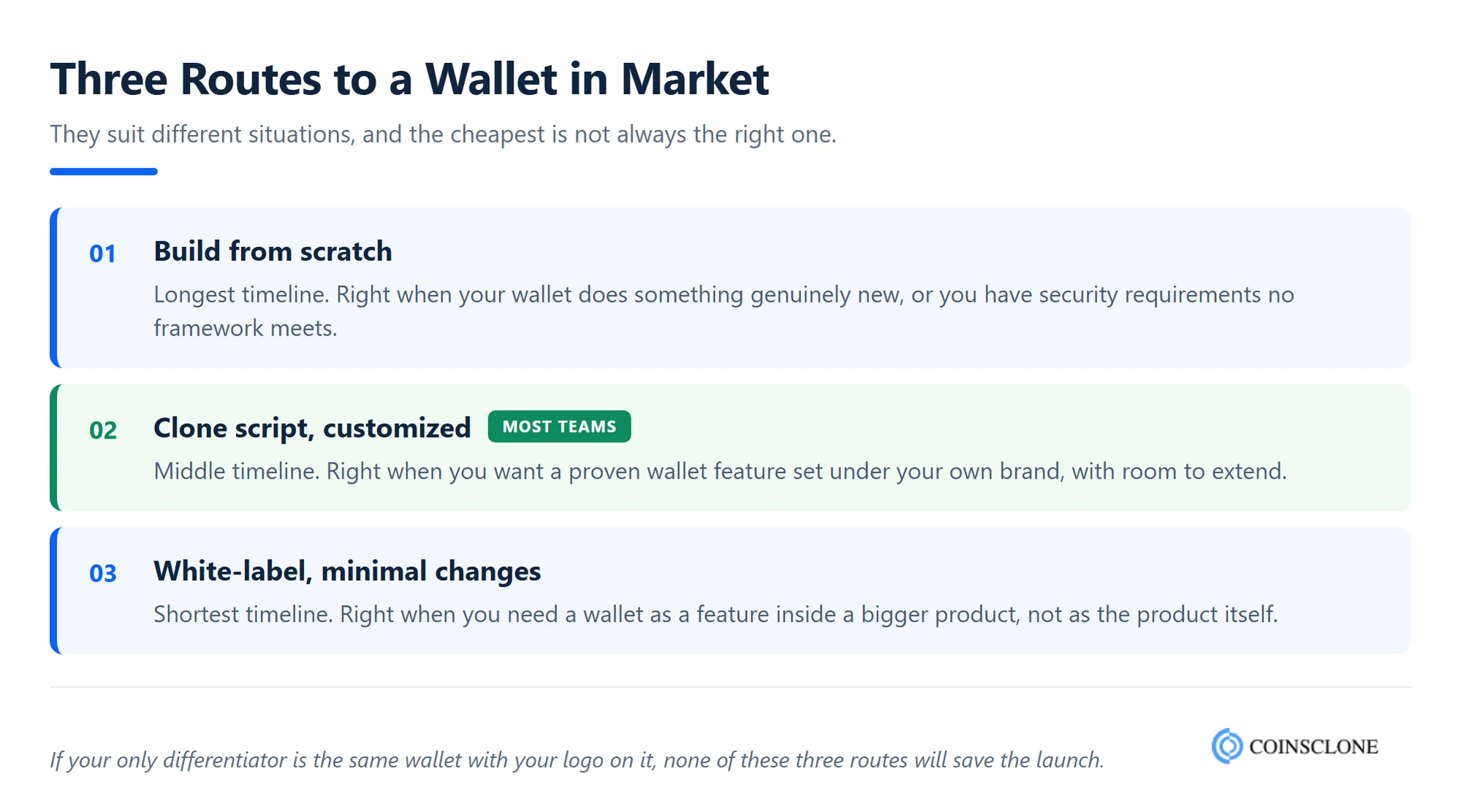
There are three routes to a wallet in market, and they suit different situations.
| Route | Typical timeline | Right for you when |
| Build from scratch | 4 to 7 months or longer | Your wallet does something genuinely new, or you have security needs no framework meets |
| Clone script, customized | 8 to 12 weeks with Coinsclone | You want a proven wallet feature set under your own brand, with room to extend |
| White-label, minimal changes | 3 to 5 weeks with Coinsclone | You need a wallet as a feature inside a bigger product, not as the product |
If you only need a wallet inside another app, an embedded wallet-as-a-service SDK may cost less than either build.
If your entire edge is “the same wallet but ours”, you’re going to struggle, and we’d rather tell you that now. Self-custody wallets are a crowded market with strong free rivals. The clients who do well on this route already have a way to reach users: a community, an exchange, a local user base, a game. The wallet serves that audience rather than competing for general users.
If that describes you, a clone script is the right call.
Exodus Wallet Status in October 2026: What It Has Dropped
Exodus is still running in October 2026, but it does less than most clone-script pages say. It trades on the NYSE as EXOD, has been in crypto for more than 11 years, and now leads with Exodus Pay, a payments app with a free Exodus Card. Swaps, staking and Trezor and Ledger pairing remain, and its site claims support for 1,000,000+ assets.
At the same time, Exodus has removed most of its Web3 features. Here is what changed, from its own support pages:
| Feature | Exodus status (October 2026) | In your Exodus wallet clone |
| Web3 Wallet browser extension | Support ended on 1 October 2026 | Can be built as a browser extension |
| WalletConnect and dApp browser | Removed from Exodus Mobile | Included |
| NFT Gallery and NFT support | Ends on 1 December 2026 | Optional module |
| Multiple portfolios on mobile | Not available for wallets created after 22 April 2026 | Included |
| Lightning Network | Ended on 18 August 2025 | Can be scoped |
| Monero (XMR) | Support ended | Can be scoped |
Why this matters to you. Exodus users who want dApps or NFTs now need another wallet. Users noticed overnight. In a September 2026 Reddit thread, one asked if the dApp browser had gone, and Exodus staff said yes. A wallet that keeps WalletConnect, a dApp browser and an NFT view serves exactly those users. For some buyers, that gap is the reason to build rather than tell users to install Exodus.
Custodial or Self-Custody Wallet: Which Should You Build?
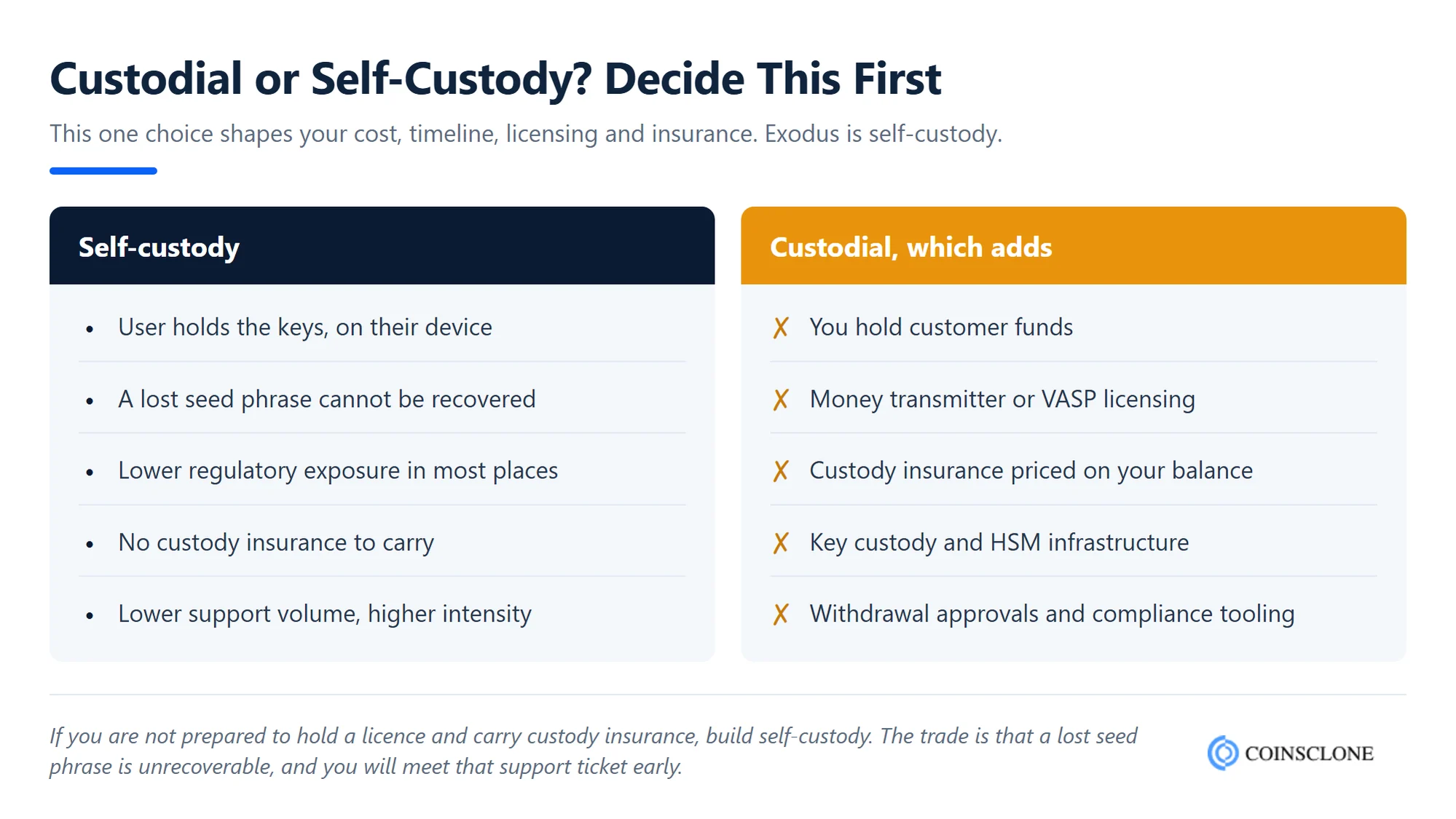
This choice shapes your cost, your timeline, your licence and your insurance, and most people who ask us about a wallet haven’t made it yet. Exodus is self-custody. If you clone the model without knowing what that means, you’ll get a nasty surprise later. Our guide to custodial vs non-custodial wallets goes deeper.
| Self-custody (like Exodus) | Custodial | |
| Who holds the keys | Your user, on their device | You, on your infrastructure |
| If a user loses their seed phrase | Their funds are gone and you cannot help | You can restore their account |
| Rules you face | Lighter in most countries. You’re shipping software, not holding money | You’re holding customer funds. Expect money transmitter or VASP licensing |
| Insurance | Not needed | Generally required, and priced on your balance |
| Support load | Lower volume, higher emotional intensity | Higher volume, more routine |
| Build effort | Lower | Much higher |
What we’ll tell you on the first call. If you’re not prepared to hold a licence and carry custody insurance, build self-custody. It’s cheaper, faster, and it keeps you out of a category of rules that has ended a lot of small companies. The trade-off is real, though. When a user loses their seed phrase, you will get an angry support ticket and there is nothing you or we can do about it. Build your onboarding and your backup flow with that in mind, because it will happen early.
There’s a middle route worth knowing about. Smart-account wallets with social recovery let users get back in through trusted contacts or a passkey, and you never hold keys. It costs more to build, and it’s where a lot of consumer wallets are heading. Ask us about it if seed phrases worry you.
Exodus Wallet Clone Script Features
| Layer | What’s included |
| Wallet core | Key generation, BIP-39 seed phrases, encrypted local storage, multi-account support, biometric unlock, auto-lock, multi-device sync |
| Assets | Multi-chain balances, send and receive, address book, transaction history, custom token import, real-time pricing |
| Swaps | In-app exchange through aggregator routing, quote display before you confirm, slippage controls, your fee margin set per pair |
| Portfolio | Holdings view, allocation breakdown, profit and loss, price alerts, historical charts, multiple portfolios under one seed phrase |
| Web3 | dApp browser, WalletConnect, contract decoding so users see what they’re approving, approval management and revocation |
| Staking | Delegation flows for the chains that support it, reward tracking, your commission set by you |
| NFTs | Collection view, metadata rendering, send and receive, marketplace links. An optional module, since Exodus is ending NFT support on 1 December 2026 |
| Hardware wallets | Ledger and Trezor pairing, scoped as a module |
| Fiat | On-ramp provider integration for card purchases, off-ramp where your licence permits |
| Admin | Operations dashboard, user analytics, transaction monitoring, risk flags, KYC and AML hooks, chain setup, feature toggles, release management |
We build for web, iOS and Android from one codebase, with platform-native key storage on each. iOS keys live in the Secure Enclave, Android keys in the hardware keystore. That’s not a marketing line. It’s the difference between a wallet that survives a stolen phone and one that doesn’t.
How Does an Exodus Wallet Clone Script Work?
An Exodus-style wallet is an app on the user’s phone or computer that holds the keys and signs each payment. Behind it, a set of services reads the chains and fetches prices and swap quotes. Your servers never touch the keys.
- Wallet app: creates the seed phrase, stores the keys in the device keystore, and signs every transaction on the device.
- Blockchain access: nodes and indexers read balances and history, and send signed payments out to each chain.
- Price and swap services: price feeds value the portfolio. A swap aggregator returns quotes, and your fee margin sits on top.
- Fiat partners: an on-ramp provider handles card purchases and the KYC checks that come with them.
- Admin backend: your team manages chains, tokens, fees, feature toggles and analytics, with no access to user funds.
So when a user taps “swap”, the app fetches a quote, the user approves it, the device signs, and a node broadcasts the transaction. The balance on screen always comes from the chain itself. That’s why a real wallet can never show money it doesn’t hold.
Security Features of an Exodus-Style Wallet
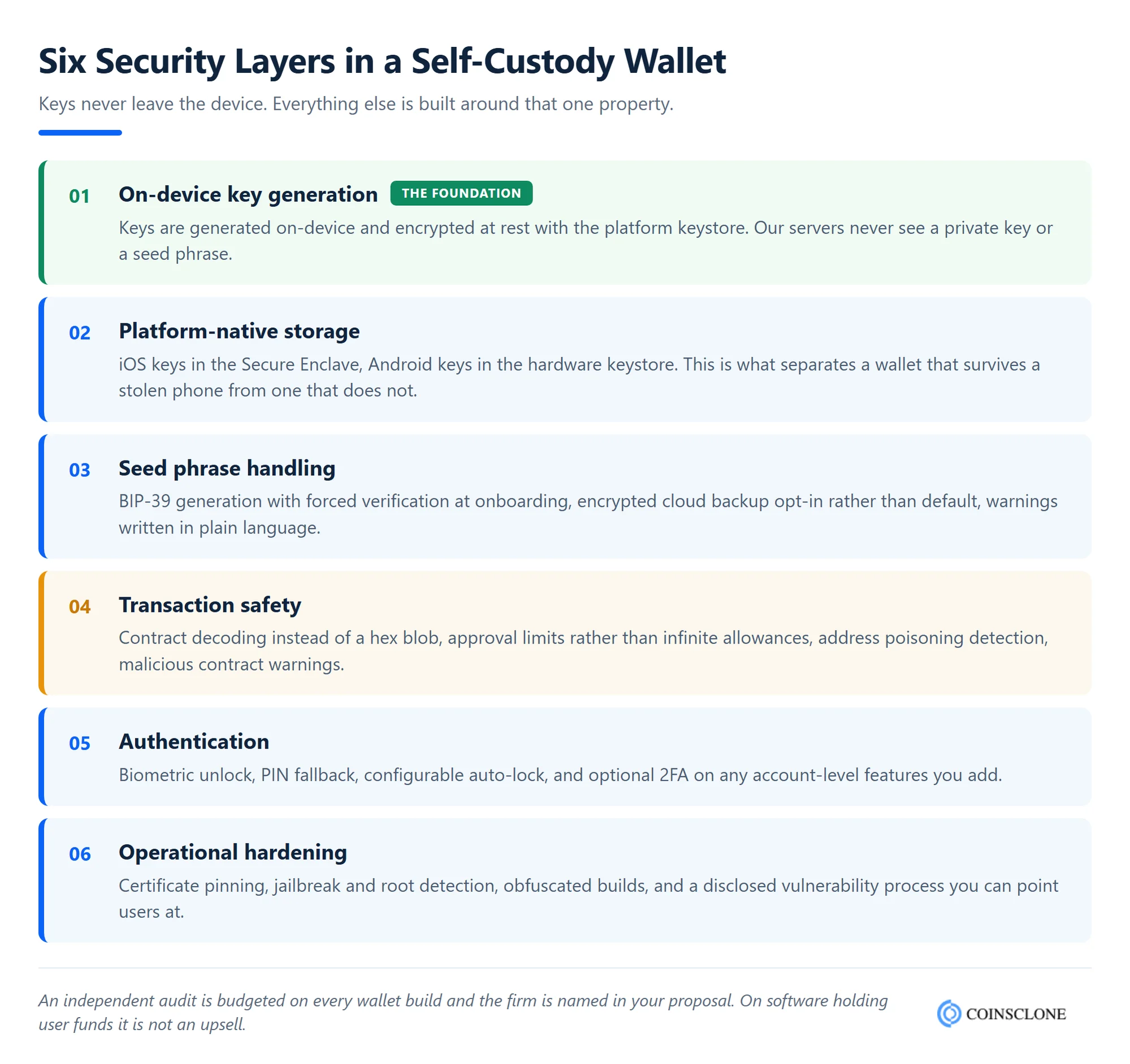
Keys never leave the device. We generate them on the device and encrypt them at rest with the platform keystore. Our servers never see a private key or a seed phrase, so a breach of our systems cannot drain your users.
Seed phrase handling. BIP-39 seed phrases with a forced check at sign-up, cloud backup that users opt into rather than get by default, and clear warnings in words any user will read.
Transaction safety. Users see in plain words what a contract will do before they sign, not a hex blob. Spend limits are capped by default, fake look-alike addresses get flagged, and known bad contracts trigger a warning.
Sign-in. Face or fingerprint unlock, a PIN backup, auto-lock you can set, and 2FA on any account features you add.
Outside audit. We budget for a third-party security audit on every wallet build, and we name the firm in your quote. Skipping it on a product that holds user funds is not a saving. It’s a deferred incident.
Operations. Certificate pinning, jailbreak and root checks, scrambled builds, and a public bug report process you can point users at.
Which Blockchains Does the Wallet Support?
Out of the box: Bitcoin, Ethereum, Solana, BNB Chain, Polygon, Base, Arbitrum, Optimism, Avalanche, Tron, TON and Litecoin, plus every ERC-20, BEP-20 and SPL token on those networks.
Adding a chain that isn’t on that list depends on how different its signing scheme is. EVM chains are close to free to add, because they share an address format and a signing scheme. Non-EVM chains such as Cosmos, Cardano or Sui need their own signing and address work, so they carry real effort and we scope them one by one.
One piece of advice we give everyone: launch with fewer chains than you think you need. Every chain you support is a chain you monitor, a set of RPC endpoints you pay for, and a class of support ticket you answer. Start with the five your users actually hold and add from there.
What Does an Exodus Wallet Clone Script Cost?
Across the market, an Exodus-style wallet costs about $15,000 to $90,000 as a white label build and $50,000 to $200,000 as a custom multi-chain wallet with swaps in 2026, based on published agency cost guides. Where you land depends on your custody model, your chain list and whether you ship it alone or inside an existing app. We give you a fixed quote after scoping. For a line-by-line breakdown, see our crypto wallet development cost guide.
What drives our side of the cost, in rough order of impact:
- Custody model. A custodial build costs far more than a self-custody one. It adds key storage on your side, HSM links, withdrawal sign-off flows and compliance tools. A self-custody build needs none of them.
- Non-EVM chains. Each one needs its own signing and address work. EVM chains beyond the first are close to free.
- Custom design versus reskinning. Applying your brand to our screens is fast. A bespoke design system drawn from scratch is a separate workstream.
- Scope beyond the wallet. Staking, smart-account recovery, a browser add-on and custom modules each add build time.
- Building into an existing app rather than shipping on its own, because we’re then working inside a codebase we didn’t write.
- Country. Local rules change what has to be built and what has to be documented.
Third-party costs that are not ours, and that you should budget for separately:
- Independent security audit. Priced by the audit firm on contract complexity. Published 2026 guides put a wallet audit at about $5,000 to $50,000 or more. We won’t launch a wallet without one, and we’ll name the firm in your proposal.
- App store developer accounts. Apple’s Developer Program is $99 per year. Google Play charges a one-time $25 sign-up fee.
- RPC and node services. A monthly running cost that scales with your chain count and your traffic.
- Fiat on-ramp providers. They take their own cut of each transaction, set by the provider.
- Licences and insurance, if you go custodial. On a custodial build these are usually the largest line items on the whole project, and they are not ours to quote.
Tell us your custody model and chain list, and you’ll have a scoped number, not a range.
How Long Does It Take to Build a Wallet Like Exodus?
Coinsclone delivers a white label Exodus-style wallet in 3 to 5 weeks and a custom wallet in 8 to 12 weeks. Custodial builds and extra modules take longer, and your quote fixes the date. What sits on the critical path is rarely the code.
| Scope | Typical timeline | What decides the timeline |
| White-label with branding | 3 to 5 weeks | How fast your brand assets and chain list arrive |
| Customized clone | 8 to 12 weeks | Design sign-off, then the security audit |
| Extended build | Set in your proposal | Custom module work |
| Custodial wallet | Set in your proposal | Custody systems and compliance review |
Two things slow projects down more than the build does, and neither is fully in our control. App store review, which is hard to predict for crypto apps in particular. And the security audit plus its fix round, which you should not compress.
We’ll give you a date and hold it. If something slips, we’ll tell you the week it slips, not the week before launch.
How to Build a Wallet Like Exodus: 7 Steps
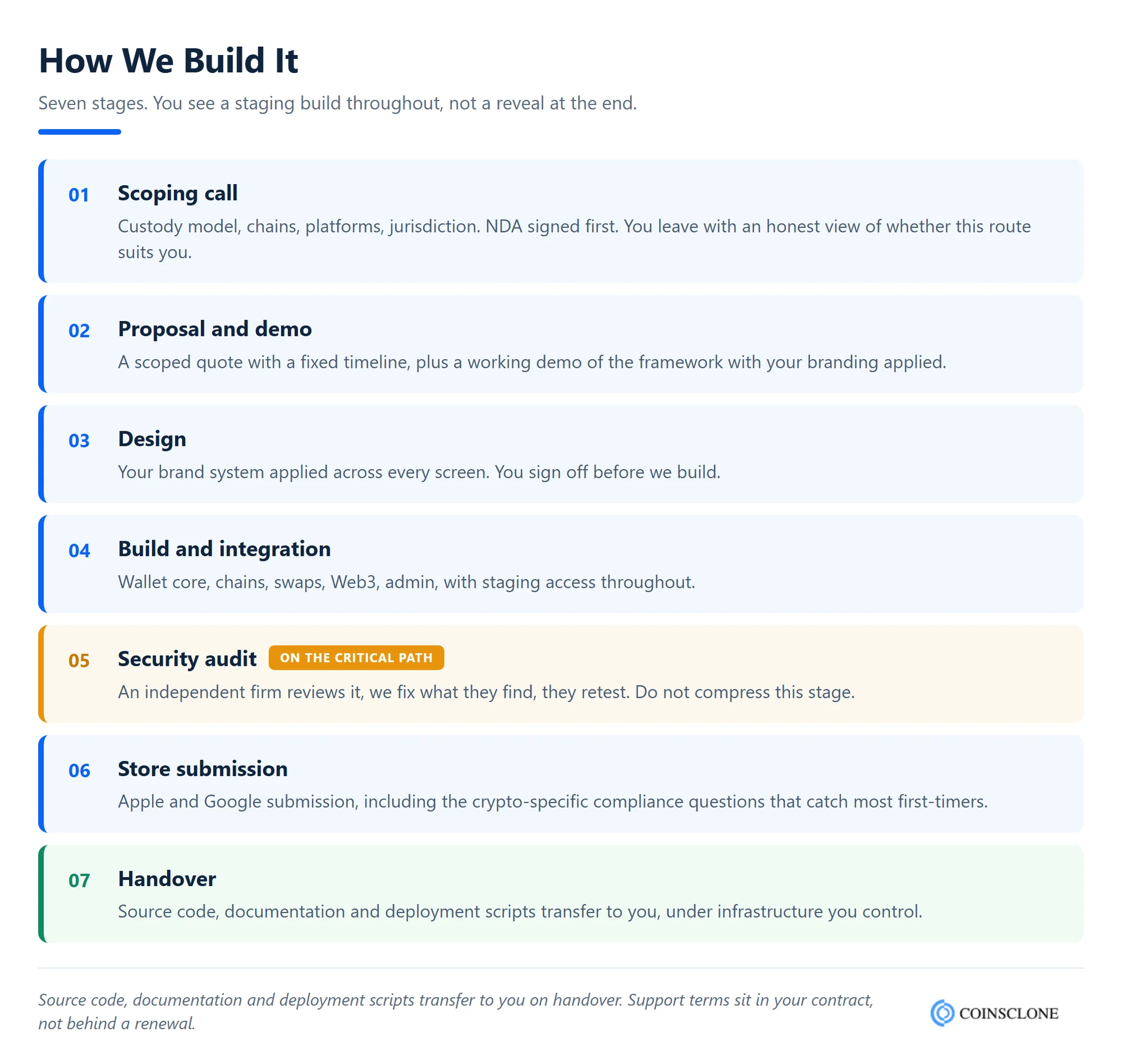
- Scoping call. Custody model, chains, platforms, country, and what you’re launching into. We sign an NDA before this. You leave with an honest view of whether this route suits you.
- Proposal and demo. A scoped quote with a fixed timeline, plus a working demo of the framework with your branding applied.
- Design. Your brand system applied across every screen. You sign off before we build.
- Build and integration. Wallet core, chains, swaps, Web3, admin. You get access to a staging build throughout, not a reveal at the end.
- Security audit. An independent firm reviews it. We fix what they find, and they retest.
- Store submission and launch. We handle the Apple and Google review, including the crypto questions that trip up most first-timers.
- Handover and support. The source code, docs and deploy scripts pass to you. Support terms are in your contract, not hidden behind a renewal.
To see how we scope this for your market, talk to our crypto wallet development company team.
How Does an Exodus-Style Wallet Make Money?
Be realistic about this. Wallet income is thin until you have scale, and anyone who says otherwise is closing a sale.
| Stream | How it works | What decides the take |
| Swap fees | Your margin on top of aggregator routing | Your margin per pair. This is the largest stream for most wallets |
| Fiat on-ramp share | Revenue share from your on-ramp provider | Set by the provider’s partner terms |
| Staking commission | A cut of the staking rewards you route | Your commission, and the network’s reward rate |
| Premium tier | Subscription for advanced features | Your price point, against steadily low conversion |
| NFT marketplace fees | Commission on in-wallet NFT trades | Your rate, and the market cycle, which dominates |
| Partner placements | Sponsored tokens or dApp listings | Deal-dependent, and it needs real user numbers first |
For a sense of where the market sits, Exodus publishes its own swap pricing and, as of October 2026, states that rates start as low as 0.5 percent. Check that figure, and any rival’s, on the day you set yours, because wallet swap rates change without notice.
Swap fees carry most wallets, and the arithmetic is unforgiving. At a 0.5 percent margin you need roughly $20 million in yearly swap volume to clear $100,000 in revenue. That’s possible with a real user base and impossible without one, which is why we keep coming back to reach. Have an audience before you have a wallet.
Exodus Wallet Alternatives in 2026
The best Exodus wallet alternative depends on what you miss. For dApps and WalletConnect, MetaMask or Trust Wallet fit. For Solana tokens, Phantom fits. For long-term storage, a hardware wallet such as Ledger or Trezor fits. And if you run a business with an audience, the real alternative is your own branded wallet.
Users asked this long before the 2026 cuts. One Reddit thread on Exodus alternatives asked for a hot wallet on the main chains with easy dApp access, no KYC, open code and quick swaps to stablecoins. Another, posted after Exodus dropped Monero, asked for one wallet with one seed phrase for Bitcoin, Litecoin, Solana USDC and Monero. No single public wallet ticks every box, which is the opening for a focused product.
| Alternative | Type | Good fit when | Build one like it |
| MetaMask | Self-custody, browser extension and mobile, EVM-first | You need dApps on EVM chains | MetaMask wallet clone script |
| Trust Wallet | Self-custody, multi-chain mobile and extension | You want many chains in one mobile app | Trust Wallet clone script |
| Phantom | Self-custody, Solana-first | You mostly hold Solana tokens | Phantom wallet clone script |
| Ledger or Trezor | Hardware wallet | You hold for the long term | Pairing scoped as a module |
| Your own branded wallet | Self-custody, your feature set | You have an audience and want swap and staking revenue | This page |
Warning: “Fake Balance” Wallet Apps Are Scam Tools
Some people reach this page searching for a “fake Exodus balance” or a “fake Exodus wallet”. Those apps and scripts are scam tools. They show a balance the wallet does not hold, and fraudsters use them to trick buyers, sellers and lenders in crypto deals. Using one to deceive someone is fraud. Some of these downloads also carry malware that steals the seed phrase of whoever installs them.
A legitimate Exodus wallet clone works the other way round. Every balance comes from the blockchain, and anyone can check it on a block explorer. We build real wallets for businesses, with a security audit behind each one. We don’t build, sell or support fake-balance tools, and we’d ask anyone looking for one to close this page.
If someone shows you a wallet screen as proof of funds, don’t trust the screen. Check the address on a block explorer yourself, or ask for a small on-chain transfer.
Why Build Your Exodus Wallet Clone With Coinsclone
We’ve been building blockchain products since 2018. Exchanges, wallets, payment gateways and token systems, from our office in Madurai. Over 350 platforms delivered for more than 200 clients across 20 industries.
You get the source code. The full code, docs and deploy scripts are yours at handover. No licence that expires, no dependency on us for your next release.
Every wallet gets an outside audit. We name the firm in your proposal, and we don’t launch without a clean retest. On software that holds user funds this isn’t optional, and we don’t treat it as an upsell.
We’ll tell you if this is a bad idea. If your only edge is the same wallet with your logo on it, we’ll say so on the first call. We’d rather lose a sale than build something nobody downloads.
Fixed timeline, fixed price. You get a date and a number in your proposal. If something slips, you hear about it the week it slips.
We handle the app store review. That includes the crypto questions that get most first-time apps rejected.
Frequently Asked Questions
What is an Exodus wallet clone script?
A ready-built multi-chain wallet with the same core features as Exodus, which you brand and adapt as your own product. It covers keys, multi-asset storage, in-app swaps, a portfolio view, staking and dApp access, with an NFT gallery as an add-on. You’re not buying Exodus’s app. You’re buying a wallet we built that does the same jobs.
Is it legal?
Building a wallet with similar features is legal. Features aren’t protected by copyright. What you cannot do is use the Exodus name, logo or visual identity, or imply any tie to them. We build you a distinct branded product. Beyond that, whether you need a licence depends on your custody model and your country, and that’s a question for your lawyer rather than for us.
How much does an Exodus wallet clone script cost?
Published 2026 agency guides put a white label wallet at about $15,000 to $90,000 and a custom multi-chain wallet with swaps at $50,000 to $200,000. Custody model and chain list move the number most, and we quote a fixed price after a scoping call. On top of that, budget for a security audit, app store accounts, RPC services and, if you go custodial, licences and insurance.
How long until launch?
Coinsclone delivers a white label wallet in 3 to 5 weeks and a custom wallet in 8 to 12 weeks, and your proposal fixes the date. What usually takes longest is design sign-off and then the security audit with its fix round, not the coding. App store review adds time that nobody can predict, especially for crypto apps.
Does Exodus still support WalletConnect and dApps?
No. Exodus has removed WalletConnect and its dApp browser from its mobile app. Support for its Web3 Wallet browser add-on also ended on 1 October 2026. Exodus now tells users who want dApps to import their secret key into another wallet. Your own wallet can keep WalletConnect and a dApp browser as standard features.
Which blockchains does it support?
Bitcoin, Ethereum, Solana, BNB Chain, Polygon, Base, Arbitrum, Optimism, Avalanche, Tron, TON and Litecoin as standard, plus their tokens. Extra EVM chains are quick to add. Non-EVM chains carry real effort because they need their own signing and address work, so we scope those one by one.
Can the wallet support Monero, which Exodus dropped?
It can be scoped, but treat it as its own project. Monero handles keys and balances in a different way from Bitcoin or EVM chains, so it needs its own work. Check your country’s rules and your fiat and swap partners first, because some regulated venues have delisted privacy coins.
Do I hold my users’ private keys?
Not if you build self-custody, which is what Exodus does and what we suggest for most clients. Keys are created on the user’s device and never reach your servers. That keeps you out of money transmitter territory in most countries. If you want to be able to restore accounts for users, you’ll need a custodial build. That brings licence and insurance costs you should price before you commit.
What fees does Exodus charge, and what can my wallet charge?
Exodus adds no fee of its own to send or receive, only the network fee. Its site says swap rates start as low as 0.5 percent (October 2026). Your wallet can set its own swap margin per pair, a staking commission and an on-ramp revenue share. Most wallets earn the bulk of their income from swaps.
Can I add my own token?
Yes. We can add your token with top placement, fee discounts for holders, staking, or any other in-wallet use you’ve planned. If you haven’t designed it yet, read our token development page first, because a token bolted onto a wallet without a function is usually worse than no token.
Do I own the code?
Yes. The source code, docs and deploy scripts pass to you at handover, on servers you control.
Can you white-label it under our brand entirely?
That’s the default. Your name, logo, colours, typography and copy throughout. Nothing in the finished app mentions Exodus or Coinsclone unless you ask us to credit the build.
Will it get approved on the App Store?
We handle the submission, and we build to the published rules rather than finding them at review. Apple and Google both have rules for crypto wallet apps on who holds the keys, in-app purchases and which regions can use them. No developer can promise an approval, and you should be wary of one who does.
See How Our MVP System Can Launch Your Exodus-like Wallet Faster
Crypto Wallet Development — done right.
- MVP System: Launch your Exodus-style wallet 90% faster.
- Pre-Built Modules: Multi-asset support, portfolio tracking, and exchange integrations—no coding needed.
- Brand & Customization: Your design, your tokens, your blockchain.
- Revenue Engine: Earn from transaction fees, swaps, and staking rewards.
Get a free branded demo of your Exodus-like crypto wallet in 48 hours — before you invest a cent.
Book a Free Call to discover how our Exodus Wallet Clone Script can take you from concept to live wallet in just 8–12 weeks.
Tell Us What You’re Building
A scoped quote, build notes and an honest timeline. NDA signed before the technical detail.