
An STO script is ready-made software that lets a firm sell security tokens to investors. It gives you the website, the investor and admin dashboards, the token contract and the rule checks a securities sale needs, so you can go live in weeks instead of building every part from scratch. Real money now sits in this model. Tokenized real-world assets on public chains reached $38.55 billion on 2 October 2026, per the rwa.xyz dashboard, not counting stablecoins.
This guide explains what an STO script includes, what it can and cannot do for you, and which securities rules it must enforce in the US and the EU in 2026. It also compares a script with a custom build, lists the cost drivers, and gives you a checklist to judge any provider.
In this guide:
- What is inside an STO script: the portals, the compliance engine and the token contract, and the licensed partners it plugs into.
- The rules it must enforce: Reg D, Reg S and Reg A+ in the US, plus the EU prospectus rules and the DLT Pilot Regime.
- Token standards: why most new security tokens use ERC-3643 and where ERC-1400 still fits.
- Time and cost: a script goes live in 2 to 4 weeks, while resale lock-ups run for months.
- How to choose a provider: eight questions to ask before you buy.
See How Our MVP System Can Launch Your STO Faster
STO Script Development — done right.
- MVP System: Launch your Security Token Offering 90% faster.
- Compliance Ready: Fully aligned with SEC and global security regulations.
- Smart Contracts: Pre-audited, customizable contracts for secure tokenized fundraising.
- Branding & Customization: Your platform, your design, your investor experience.
- Investor Dashboard: Real-time analytics, KYC/AML integration, and automated payouts.
See a free branded demo of your STO platform in 48 hours — before you invest a cent.
Book a Free Demo to discover how our STO Script can take you from idea to live, compliant fundraising in just 2–4 weeks.
What Is an STO Script?
An STO script (or STO software) is a pre-built, tested platform for running a security token offering. A security token offering, or STO, is a sale of tokens that count as securities, such as shares, bonds or fund units, issued on a blockchain. If you are new to the idea, our guide on what a security token is covers the basics.
A white-label STO script comes with your brand, and you can change any feature to fit your offer. It suits firms that want to turn equity, debt, real estate or fund shares into tokens without hiring a full blockchain team. A typical package includes:
- An STO website: the public page where investors learn about the offer and sign up.
- User and admin dashboards: to buy, approve and track each buyer.
- A security token contract: a token with transfer rules built in, so only approved wallets can hold it.
- A compliance engine: the rules for who may buy, how much and when they may sell.
- A wallet setup: investors link a wallet that the issuer approves, since only listed addresses can receive the token.
- Offer papers support: a template for the whitepaper or offering memo, which your lawyers finish.
What a Script Does, and What Licensed Partners Do
Many buyers expect a script to make them “compliant” on day one. It cannot do that alone. The software enforces the rules, but some roles in a securities sale must be filled by licensed firms. The chart below shows the split.
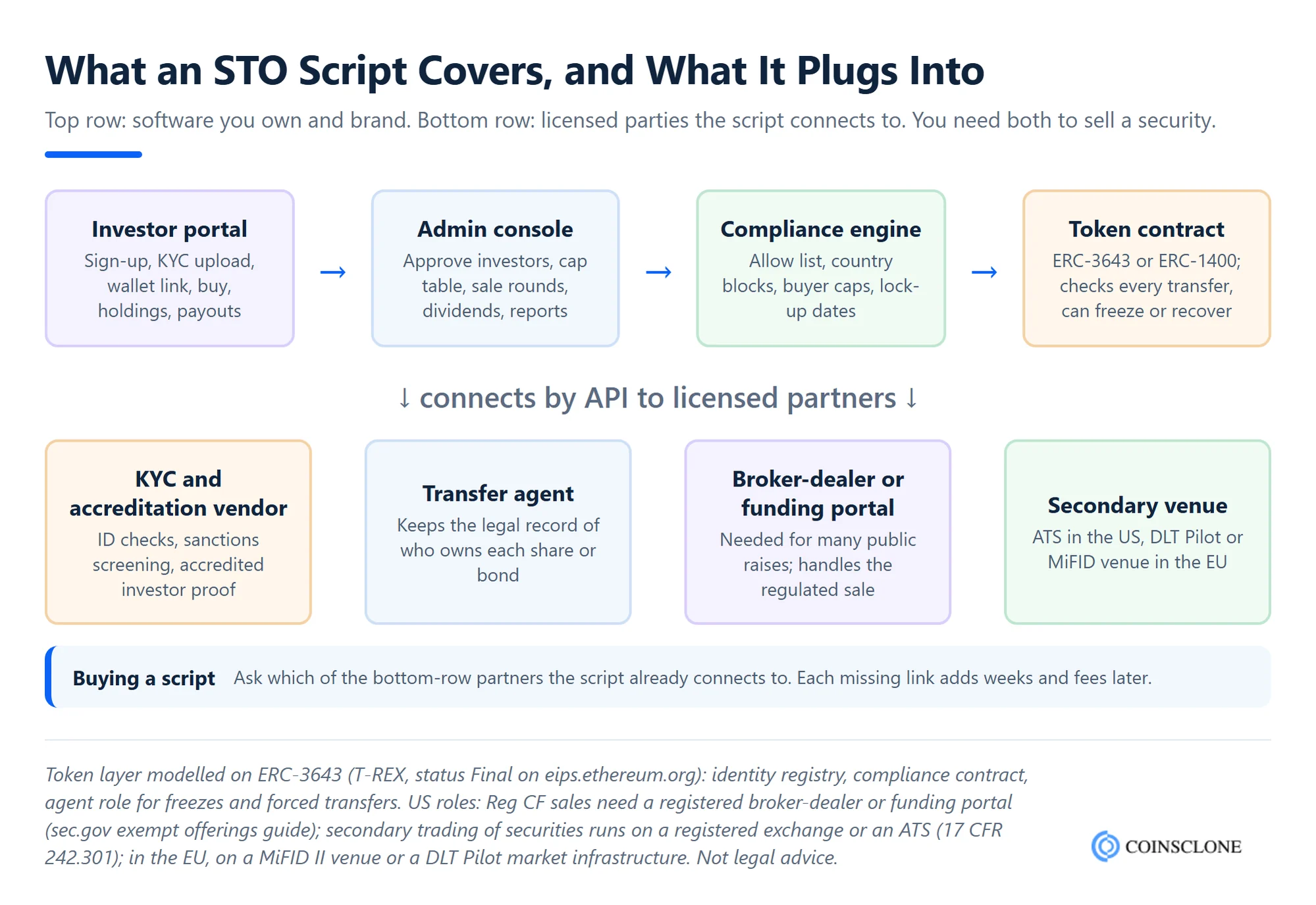
In short, the script is the engine, and the partners hold the licences. A good script connects to these partners out of the box, which saves you weeks of work later.
Benefits of STO Script Software
A ready-made script brings clear gains over a build from scratch. Here are the main ones.
Faster Launch
The core platform already exists and has been tested, so you only set it up and brand it. Our STO script goes from idea to a live platform in 2 to 4 weeks. A standard custom STO takes 8 to 12 weeks on our published timelines.
Lower Cost
You pay for set-up and changes, not for writing every module again. As a result, a script costs far less than a custom platform, and your budget can go to legal work and marketing instead.
Audited Security
The token contracts and the platform have been tested and audited before you get them. On top of that, two-factor login, KYC gates and role-based admin access come as standard.
Full Customization
You can change the design, add asset types, pick a blockchain and add modules such as dividend payouts. In this way, the Security Token Offering Platform launches exactly as you planned.
No In-House Blockchain Team Needed
The script is pre-designed, built and tested, so you do not need your own developers to launch. Your team decides on the offer and the rules, and the provider handles the code.
Increased Trust
Investors trust a platform that checks identity, shows clear records and follows the rules on every transfer. Later, you can add Security Token Exchange Development so holders get a licensed place to trade.
Beyond these benefits, many founders want to know exactly what features they get. Here they are.
Outstanding Features of STO Script
Features decide how investors feel about your platform. Clear tools build trust and help you raise more. These are the core features that come with our script.
Admin Dashboard
- Automated KYC verification
- Buyer approval and allow list control
- Token listing and sale round set-up
- Cap table and trade log
- Offer paper uploads
- Profit share and interest payouts
- Community management
- Detailed monitoring and reports
User Dashboard
- Real-time statistics on holdings
- Current token price and payment options
- KYC/AML submission
- User-friendly interface
- Investor reviews and updates
- Referral program
- Two-factor login, and much more
Compliance Engine
This is the part most scripts skip, and it is the part regulators care about most. A good STO script lets you set these rules without new code:
- Identity allow list: only wallets linked to a checked investor can hold the token.
- Buyer type checks: for example, only accredited buyers in a Reg D 506(c) sale.
- Country blocks: stop sales to people in places your offer does not cover.
- Holding caps: limit how much one investor can buy, or how many holders the token can have.
- Lock-up dates: block resale until the holding period ends.
- Freeze and recovery: let an authorised agent freeze a wallet or move tokens after a lost key or a court order.
In addition, you can add or adjust any feature in your STO dashboard.
Which Securities Rules an STO Script Must Enforce
A security token is still a security. The token format does not change the law, as the SEC’s staff note on tokenized securities of 28 January 2026 made clear. So your script must be set up for the legal route your lawyers choose. Here is how the main routes turn into script settings.
| Route | Who can buy | Raise limit | What the script must enforce |
| Reg D, Rule 506(b) (US) | Accredited investors, plus up to 35 non-accredited per 90 days | No cap | No public marketing pages; manual investor approval; resale lock-up |
| Reg D, Rule 506(c) (US) | Accredited investors only | No cap | Accredited checks before purchase; resale lock-up |
| Reg A, Tier 2 (“Reg A+”) (US) | Anyone, after SEC qualification | $75 million in 12 months | 10% investment limit for non-accredited buyers |
| Reg CF (US) | Anyone | $5 million in 12 months | Sale runs through a funding portal or broker-dealer |
| Reg S (outside the US) | Non-US buyers | No cap | Block US persons; one-year hold for most equity |
| EU public offer | Anyone in the target country | Prospectus needed above €12 million | Country rules and investor documents |
Limits from the SEC’s guide to exempt offerings and the Reg A and Reg S rules in 17 CFR 230.251 and 17 CFR 230.903, checked 16 October 2026. Not legal advice.
US Rules in Plain Terms
The SEC does not “approve” a token. Instead, the issuer either registers the offer or fits it into an exemption. For Reg D sales, you file a short Form D within 15 days after the first sale, and the SEC charges no fee for it. Reg A is the one route where the SEC must “qualify” the offer before you sell, which often takes months.
Checking accredited status used to mean collecting tax returns or bank statements. Since March 2025, SEC staff guidance has let 506(c) issuers rely on a high minimum purchase instead: $200,000 for a person or $1 million for a firm, plus a written promise from the buyer. Your script should support both methods.
Resale limits matter just as much. Tokens sold under Reg D are “restricted,” so buyers usually wait six months to a year before resale under Rule 144. Under Reg S, equity sold abroad by most issuers cannot flow back to US buyers for one year. The token contract, not a spreadsheet, should hold these dates.
Two more 2026 changes are worth knowing. In September, the SEC granted a five-year exemption that lets approved venues trade tokenized US stocks with set volume caps, as this law firm note explains. Meanwhile, the CLARITY Act, which would split crypto duties between the SEC and the CFTC, was still not law in October 2026. Security tokens stay with the SEC either way.
EU Rules in Plain Terms
In the EU, security tokens count as shares, bonds and the like. So MiFID II and the prospectus rules apply, not MiCA, which leaves these assets out in Article 2. Since 5 June 2026, the EU Listing Act lets a public offer of up to €12 million over 12 months skip the full prospectus, though each member state may set a lower bar of no less than €5 million. Offers only to qualified investors also skip it.
For trading after the sale, the EU DLT Pilot Regime, live since 23 March 2023, lets licensed venues trade and settle tokenized shares and bonds on a blockchain. Singapore, the UK, Switzerland and the UAE run their own regimes, so plan each market. Our list of the top countries to launch RWA tokenization compares them.
This section is a general guide, not legal advice. Always work with a securities lawyer in each country where you sell.
Token Standards Inside an STO Script: ERC-3643 vs ERC-1400
The token contract is where the rules live. Most STO scripts on Ethereum and other EVM chains use one of two standards.
| ERC-3643 (T-REX) | ERC-1400 | |
| Status | Final, accepted standard | Proposal, never accepted as an EIP |
| How it checks buyers | On-chain identity registry plus a compliance contract | Transfer checks and partitions set by the issuer |
| Lock-ups and caps | Built-in compliance modules | Custom code per project |
| Freeze and recovery | Built in through an agent role | Built in through controller operations |
| Best for | New issues, funds and real estate | Older projects and tranche-based bonds |
In practice, ERC-3643 is the default for new projects because its identity layer can be reused across many tokens. ERC-1400 still works well for teams that already run it. Our ERC-3643 token development and ERC-1400 token development teams build both.
Working Process of Security Token Offering Script
The working steps differ for the admin and the investor side.
For the Admin Dashboard Script
- First, we hand over the core parts of the script: a full STO website, a whitepaper template and a token backed by your asset.
- Next, your lawyers pick the legal route, such as Reg D, Reg S or Reg A+, and we set the compliance rules to match.
- After that, you file what the route needs, for example a Form D for Reg D or a Form 1-A that the SEC must qualify for Reg A+.
- As the admin, you review each investor’s KYC and approve suitable ones for your offer.
- Finally, you open the sale, issue tokens to approved wallets and pay out dividends or interest when they fall due.
For Investor Dashboard Script
- If the offer looks sound, the user signs up as an investor.
- Next, the investor submits KYC details and, where needed, proof of accredited status.
- The investor then links a wallet, which the admin adds to the allow list.
- After that, the investor pays in fiat or stablecoins and receives tokens in return.
- Finally, the investor holds the tokens, collects payouts and can resell once the lock-up ends.
This is how our STO software works. To Create STO Website with all these features, you can contact a reputed STO script provider like Coinsclone for a live demo.
STO Script vs Custom STO Development
A script is not the right answer for every raise. The table below compares the main routes.
| STO script (white label) | Custom STO build | |
| Time to launch | 2 to 4 weeks | 8 to 12 weeks for one asset; 8 to 14 months for a full platform |
| Control over design | High, within a tested core | Full |
| Best for | One raise in one market | Many assets, many countries, own trading venue |
| Risk | Low, the core is audited | Higher, every module is new code |
Keep in mind that build time is only part of the calendar. Resale lock-ups often run far longer than the build, as the chart below shows.
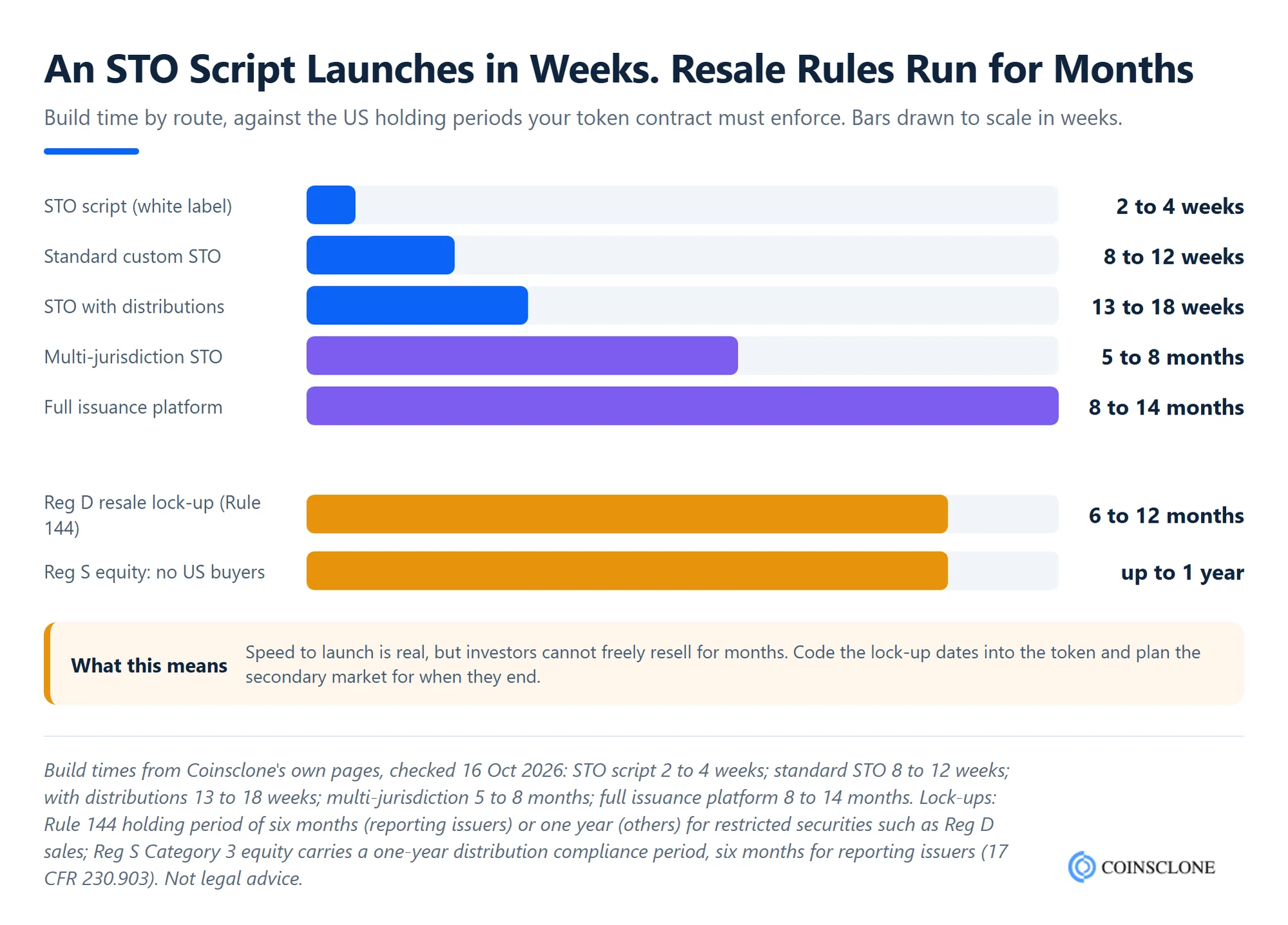
So the smart move is to launch fast with a script, then plan the secondary market for the day the lock-ups end.
What Does an STO Script Cost?
The cost of an STO script is not fixed. It depends on how much you change and which partners you connect. Published 2026 agency cost guides put a tokenization MVP at about $40,000 to $70,000 and a full production platform at $100,000 to $250,000, before legal fees. A white-label script usually lands below a custom MVP, because the audited core already exists. The main factors that set your price are:
- The UI/UX design you choose
- The blockchain for the token
- The number of tokens and asset types
- The countries you launch in, and their rules
- The KYC, payment and custody partners you plug in
- Extra modules, such as dividends or a trading board
Also budget for costs outside the software. These include legal work and offer papers, KYC checks per investor, smart contract audits after changes, a transfer agent, and broker or funding portal fees where your route needs one. For many raises, the legal work costs as much as the platform.
How to Choose an STO Script Provider
Many firms sell STO scripts, and their quality varies widely. Ask these questions before you buy:
- Who owns the source code? You should get full code rights, not a locked licence.
- Which token standard is used? Ask for ERC-3643 or a clear reason for something else.
- Are the contracts audited? Ask for the audit report and the firm that wrote it.
- Which KYC and accreditation tools are built in? Each new link takes time to add.
- Can it enforce lock-ups and country blocks on-chain? Rules in a back office alone are easy to bypass.
- Does it work with transfer agents and trading venues? You will need them later.
- Can you see a live demo? A real platform with your branding beats slides.
- What happens after launch? Check support hours, updates and the cost of new features.
Why Choose Coinsclone to Buy the Advanced STO Script Software?
Coinsclone is a reputed security token development company that has built blockchain products since 2018. We have delivered more than 350 platforms for 200+ clients across 20 industries. Our team gathers your needs, sets up the script for your legal route and delivers on time.
We also offer ICO scripts, crypto exchange scripts, NFT marketplace scripts and more. If you plan a token sale that is not a security, our ICO script is the better fit. With a well-built STO script from Coinsclone, you can launch your raise quickly and with the right rules in place from day one.
See How Our MVP System Can Launch Your STO Faster
STO Script Development — done right.
- MVP System: Launch your Security Token Offering 90% faster.
- Compliance Ready: Fully aligned with SEC and global security regulations.
- Smart Contracts: Pre-audited, customizable contracts for secure tokenized fundraising.
- Branding & Customization: Your platform, your design, your investor experience.
- Investor Dashboard: Real-time analytics, KYC/AML integration, and automated payouts.
See a free branded demo of your STO platform in 48 hours — before you invest a cent.
Book a Free Demo to discover how our STO Script can take you from idea to live, compliant fundraising in just 2–4 weeks.
Frequently Asked Questions
What is a security token offering (STO)?
An STO is a fundraise where a firm sells tokens that count as securities, such as shares, bonds or fund units. It works like a normal share or bond sale, but the asset is issued and recorded on a blockchain. The issuer must register the sale or use an exemption, such as Reg D, Reg A+ or Reg S in the US.
What is the difference between an STO and an ICO?
An ICO sells tokens that the issuer usually presents as utility tokens, often with little investor checking. An STO sells tokens that are openly treated as securities, so investors pass KYC, the sale follows securities law, and transfer rules are coded into the token. As a result, STOs take more legal work but face less risk of later enforcement.
What is an example of a security token offering?
BlackRock’s BUIDL fund is one of the best-known examples. Each token is a share in a fund that holds US Treasury bills and cash, issued with Securitize, and it was worth about $2.2 billion in October 2026. Franklin Templeton’s BENJI fund is another.
How much does an STO cost?
The software is often the smaller part. A white-label STO script costs less than a custom platform, for which published 2026 guides quote about $40,000 to $70,000 for an MVP and $100,000 to $250,000 for a full build. On top of that, budget for legal work, KYC checks, audits and a transfer agent.
Can I run a security token offering in Singapore?
Yes, but the same securities rules apply as for any other offer. Singapore’s regulator, MAS, says a token follows the same rules as the share or bond it stands for, in its guide on tokenised capital markets products. So an offer of tokenised shares or bonds needs a prospectus or an exemption. Running a trading market also needs MAS approval as an exchange or market operator.