
This guide explains what a Binance Web3 Wallet clone is and how to launch one in 2026. First, you will see what the real Binance wallet does today, since it has grown a lot since its 2023 launch. Then we walk through the features a clone copies, how its keyless MPC security works, and what happens when a user loses a phone.
By the end, you will know how long a build takes, what it costs, how the wallet earns money, and whether a white label or custom build fits your plan. We also cover the legal side, because who holds the key shares decides which rules apply to you.
In this guide:
- What the Binance Web3 Wallet (now Binance Wallet) offers in 2026, with its latest numbers
- How the 2-of-3 MPC key-share model works, including recovery and Emergency Export
- The user, admin and security features to build, plus a tech stack
- Build steps, timelines (3 to 5 weeks white label, 8 to 12 weeks custom) and cost ranges
- Swap fee benchmarks and other ways a wallet like Binance makes money
What Is a Binance Web3 Wallet Clone?
A Binance Web3 Wallet clone is ready-made, customizable software that copies the core features, security model and user flow of Binance’s self-custody wallet. You launch it under your own brand. It gives your users a keyless wallet with multi-chain support, built-in swaps, DeFi earning and one-tap access to dApps and decentralized exchanges (DEXs).
Like the original, the clone uses multi-party computation (MPC). Instead of one private key and a 12-word seed phrase, the wallet creates three key shares and stores them in three places: your server, the user’s device and the user’s own cloud backup. Any two shares can sign a payment, but no single share can. As a result, a thief who steals one share gets nothing useful, and users never have to write down a seed phrase.
In short, the clone gives you a proven product design without years of research. You then add your own features, chains and branding so the wallet stands out instead of looking like a copy.
See How Our MVP System Can Launch Your Web3 Wallet Faster
Binance Web3 Wallet Clone Development — done right.
- MVP System : Launch your Binance Web3-like wallet 90% faster.
- Multi-Chain Ready : Connect to Ethereum, BNB Chain, Polygon & more.
- DeFi & DApp Integration : Access swaps, staking & NFTs seamlessly.
- Brand & Customization : Your design, your domain, your users.
- Revenue Engine : Earn from swaps, staking, and transaction fees.
Get a free branded demo of your Binance Web3 Wallet Clone in just 48 hours — before you invest a cent.
Book a Free Demo to discover how our Binance Web3 Wallet Clone Script can take you from idea to live wallet in just 8-12 weeks.
What Is Binance Wallet Today?
Binance launched its Web3 Wallet inside the Binance app in November 2023. It has since been renamed Binance Wallet, and it is now one of the busiest self-custody wallets in crypto. Here is where it stands in October 2026:
- Users and reach: Binance’s own Binance Wallet page lists 30 million+ wallet users, 30+ supported networks and more than $20 billion in monthly volume.
- Platforms: The wallet runs in the Binance app, on the web, as a browser extension, through an API and as an AI agent.
- Binance Alpha: Alpha is the wallet’s hub for early-stage tokens, airdrops and token launch events. In June 2025, Alpha activity pushed the wallet to a record $12.5 billion in daily on-chain volume.
- More wallets per user: Since December 2025, one Binance account can run up to five keyless MPC wallets, each with its own name.
- Beyond swaps: The wallet now offers meme token trading, tokenized stocks, prediction markets and perpetual futures.
- Safety tools: A Security Center update in September 2026 added transaction previews, token approval warnings and filters for address-poisoning scams.
One limit matters for founders. Binance Wallet is not open to users in the United States, and every keyless wallet is tied to a verified Binance account. So there is room for brands that serve markets, users or chains that Binance does not.
Why Should You Launch a Crypto Wallet Like Binance Web3 Wallet?
A wallet like Binance’s works because it puts multi-chain support, easy dApp access and built-in DeFi tools in one simple app. The model has already proven itself with millions of users. That makes it a safe base for businesses that want steady user growth, quick onboarding and stable performance.
The keyless design is the biggest draw. Many new users give up at the seed phrase step. With MPC, a new user signs up, sets a recovery password and starts trading in a few minutes. Meanwhile, they still keep control of their funds.
The wallet also supports Web3 login, DEX access, token launches and multi-asset handling. So you can copy a user flow that already works instead of testing untried designs on your first users.
Why Prefer a Binance Web3 Wallet Clone Over Other Development Methods?
A Binance Web3 Wallet clone cuts build time, skips heavy research and gives you a ready-built Web3 base. This lets your brand launch faster and grow without building every part from scratch.
It also supports flexible changes through a white label crypto wallet framework. You can brand the wallet, add features and connect new blockchains at any stage.
Businesses choose this approach because it offers:
- Lower cost: You pay for setup and changes, not for building core wallet code again.
- Faster launch: A white label wallet goes live in weeks, not months.
- Room to grow: The modular design scales from a few thousand users to millions.
- Seedless sign-in: MPC key shares replace the seed phrase for everyday users.
- Easy dApp and DEX use: Swaps and dApp connections work from day one.
Essential Features of Our Binance Web3 Wallet Clone
Features are the base of every wallet that moves money safely. Our Binance Web3 Wallet clone comes with a wide range of them. Here are the main ones.
Key User Features
The Binance Web3 Wallet clone is built for a smooth user journey, with live market data and easy Web3 access.
Enhanced UI/UX
The interface is designed for simple, fast use. Users can swap tokens, check balances and track prices in a few taps. The home screen also shows news, airdrop details and new token launches, so users always know what is happening.
Multi-Chain Support
The clone supports major networks such as Ethereum, BNB Smart Chain, Solana, Bitcoin, Tron, Base, Arbitrum, Optimism and Polygon. You can add new chains as they gain users. As a result, people who use many blockchains can manage everything in one place.
dApp Integration
Users can open DeFi protocols, games, NFT platforms and social apps right from the wallet’s built-in browser. They can trade, stake, play or mint without copying addresses between apps. WalletConnect support also lets them link the wallet to outside dApps.
DEX Access
The wallet routes each swap through a DEX aggregator, which compares prices across many decentralized exchanges and picks the best route. Users get good prices without visiting each DEX on their own. Cross-chain swaps and bridges let them move tokens between networks too.
Taproot and Bitcoin Support
The clone supports Bitcoin’s Taproot (bc1p) addresses. Taproot, added to Bitcoin in 2021, makes many payments smaller and cheaper, and adds privacy. It is also the address type that Ordinals and BRC-20 tokens use, so users who hold these assets can store them safely.
Live Market
The wallet shows live prices, trading volume and price charts for each token. Users can spot trends and trade without leaving the app.
Earn Option
Users can earn passive income by staking tokens or joining DeFi yield products. The wallet shows the real-time APR (annual percentage rate) of each option, and you can add bonus tiers for loyal users.
Token Standard Support
The clone supports the main token standards: ERC-20 on Ethereum and other EVM chains, BEP-20 on BNB Smart Chain, SPL on Solana and TRC-20 on Tron. It can also show BRC-20 tokens on Bitcoin. Broad token support helps you attract users from many communities.
Token Discovery and Launch Hub
Binance Alpha shows how much demand there is for early token access. The clone can include a similar hub where users find new tokens, join airdrops and take part in launch events. This is one of the strongest tools for user growth and repeat visits.
Transaction History
Users can check every deposit, withdrawal, swap and balance change. This makes it easy to track past activity and prepare records for taxes.
Token Swapping
The built-in swap is the heart of a Web3 wallet. Users compare prices from many sources and swap in one step, with clear fees shown before they confirm.
Admin Features
The admin panel gives you full control, with secure tools to manage users and integrations.
Core Admin Tools:
- Unified dashboard: See users, volume and fees in one place.
- User permission controls: Set roles and access for your team.
- Web3 API and dApp setup: Add chains, dApps and swap routes.
- KYC/AML settings: Turn identity checks on for the markets and features that need them.
- Live analytics: Track signups, swaps and revenue as they happen.
- Threat alerts: Get warned about unusual activity and risky contracts.
- Wallet settings: Manage fees, limits and supported tokens.
These are the main user and admin crypto wallet features in our Binance wallet clone. If you want more, we can add them to fit your plans. Our crypto wallet team gives security the same care as every other feature.
Security Features of Our Binance Web3 Wallet Clone
In a wallet, one security gap can wipe out years of trust. That is why our Binance Web3 Wallet clone is built with several layers of protection.
MPC Technology: The private key is created and used as three separate shares, and a payment needs two of them. The full key never exists in one place. This removes the single weak point behind most wallet thefts, though good app and server security still matter.
Emergency Export: Users can export their private key on their own, without your help. This means they can reach their funds even if your service goes offline. Once they export, the cloud backup stops working and the keyless wallet closes, so users move the key into any standard wallet.
Biometric Login: Face ID, fingerprint and two-factor authentication (2FA) protect the app. Even a person holding the unlocked phone cannot sign without passing these checks.
SMS and Email Confirmation: For withdrawals and other risky actions, the wallet sends a one-time code to the user’s phone or email. This adds a second check before funds leave.
Transaction Preview and Approval Alerts: Before a user signs, the wallet shows what the payment will do and warns about risky token approvals. It also filters lookalike addresses used in address-poisoning scams, which mirrors Binance’s 2026 Security Center update.
With these layers in place, you can offer users safe payments from day one. For a deeper look at the key-share design, see our guide to MPC wallet development.
Add-On Modules Included in Our Binance Web3 Wallet Clone
Extra modules help you add features and open new ways to earn. You can switch them on at launch or later.
Available Add-ons:
- In-app crypto swap and cross-chain bridge
- NFT marketplace connector
- Inscription and BRC-20 marketplace
- Multi-chain expansion pack
- Hardware wallet support
- Referral and affiliate module
- Fiat on-ramp and off-ramp integration
- Token launch and airdrop hub
- Perpetuals or prediction market connector
- Cross-platform sync for app, web and browser extension
How Does Binance Web3 Wallet Clone Work?
The clone works like Binance’s own wallet. It uses a 2-of-3 MPC setup, so the key is born as three shares and any two can sign. Here is the flow:
- Sign-up: When a new user creates a wallet, the app and your server run a key-generation process. It creates three key shares and one public wallet address. The full private key is never formed.
- Share 1 (your server): The first share stays on your secure server, linked to the user’s account.
- Share 2 (the device): The second share is stored in the secure area of the user’s phone.
- Share 3 (the cloud backup): The third share is locked with the user’s recovery password and saved in their own iCloud or Google Drive.
- Everyday use: When the user sends or swaps tokens, the phone and your server each sign with their own share. The two parts join into one normal signature, and the blockchain sees a standard payment.
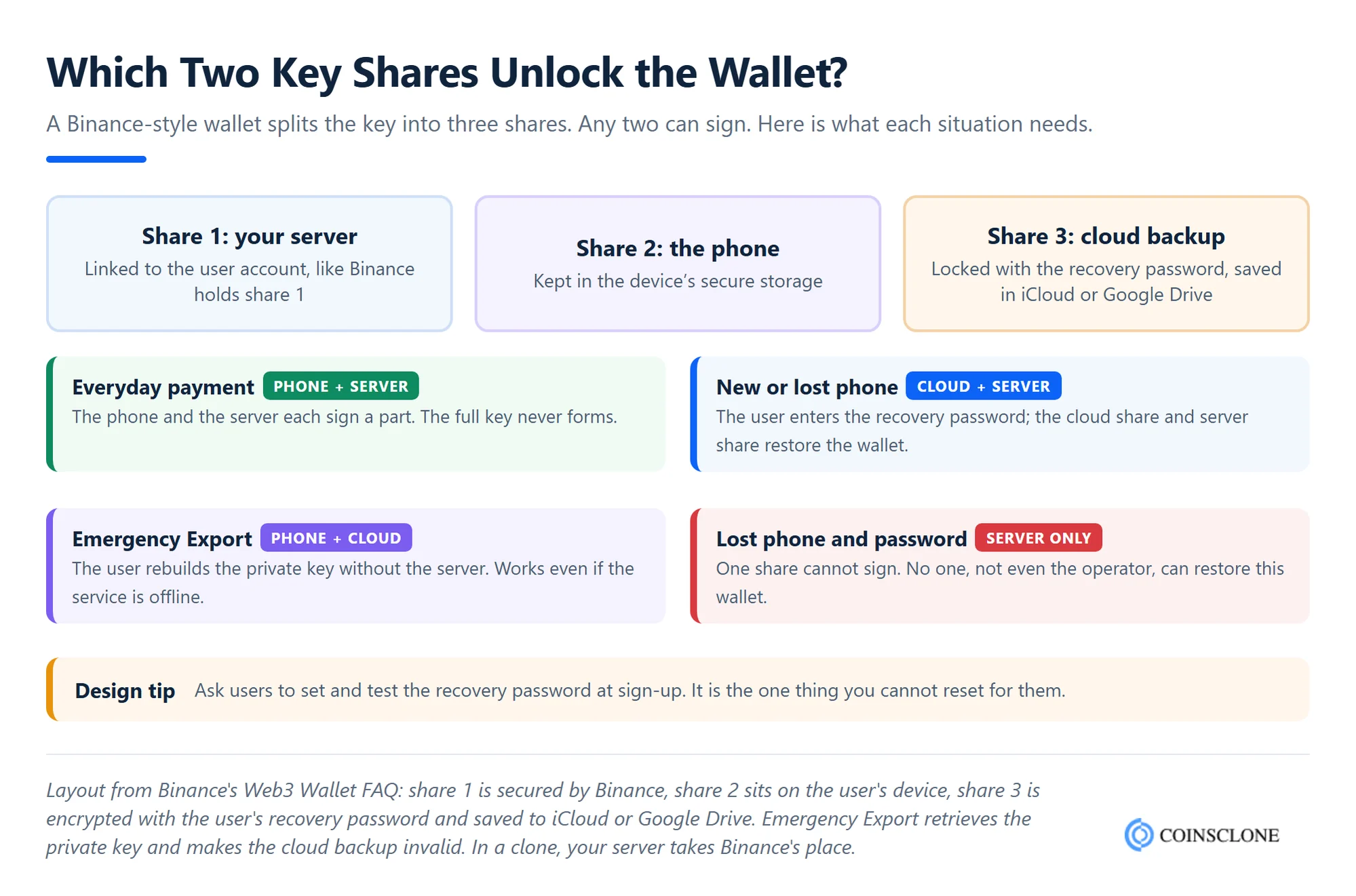
The real test of an MPC wallet is what happens when something goes wrong. If a user gets a new phone, the cloud share and your server share restore the wallet. With Emergency Export, the phone and cloud shares rebuild the private key, so users never depend on you. However, Binance’s own Web3 Wallet FAQ warns that if a user loses both the device and the recovery password, no one can restore the wallet. Your app should explain this clearly at sign-up.
Is a Binance Web3 Wallet Clone Custodial or Non-Custodial?
It is designed to be non-custodial. Your server holds only one of three shares, and one share cannot move funds. The user controls the other two shares and can export the full key at any time. In other words, you cannot spend user funds, and neither can a hacker who breaks into your server.
That said, the design has a link to your service that a classic seed phrase wallet does not. Binance ties each keyless wallet to a verified Binance account, and your clone will tie it to your user account. Users get easy sign-in and recovery, but they rely on your server for everyday signing until they choose to export.
This matters for the rules you follow. In the EU, MiCA (Regulation 2023/1114) treats holding or managing crypto for clients as a licensed service. Wallet software where users keep control usually falls outside that rule. Still, if your server could ever sign alone, or you also run an exchange, you may need a licence. So confirm your setup with a local lawyer before launch.
Tech Stack for a Binance Web3 Wallet Clone
A wallet like Binance’s needs a mobile app, a web app, a browser extension and a secure back end. Here is a common stack:
| Layer | Common choices |
| Mobile apps | React Native or Flutter, with Swift and Kotlin for secure storage |
| Web app and extension | React or Next.js, TypeScript, Chrome extension Manifest V3 |
| Back end | Node.js, Go or Rust services, PostgreSQL, Redis |
| MPC signing | Threshold signing for ECDSA chains and EdDSA chains such as Solana |
| Blockchain access | ethers.js, web3.js, Solana web3.js, TronWeb, your own or rented nodes |
| Swaps and data | DEX aggregator APIs, price feeds, token risk data |
| Security | Secure enclave on phones, HSMs on servers, 2FA, rate limits, audits |
| Hosting | AWS, Google Cloud or Azure, split across regions |
You do not need every part on day one. Many brands launch with the mobile app first, then add the web app and extension once users ask for them.
How to Build a Wallet Like Binance Web3 Wallet: Step by Step
A Binance Web3 Wallet clone follows a clear path from plan to launch. Here are the main steps:
- Pick your market and users: Decide who the wallet is for and which countries you will serve. This shapes chains, languages and rules.
- Choose the build route: A white label wallet is fastest. A custom build gives you full control of the design and MPC setup.
- Select chains and features: Start with the chains your users trade most. Then pick swaps, earn, dApps and add-ons.
- Set up MPC and recovery: Choose where shares live, how cloud backup works and how Emergency Export runs.
- Brand and design: Apply your logo, colors and user flows across app, web and extension.
- Test and audit: Run full testing on testnets, then a third-party security audit of the app, back end and signing code.
- Launch and grow: Publish to the App Store and Google Play, then add chains and features based on user data.
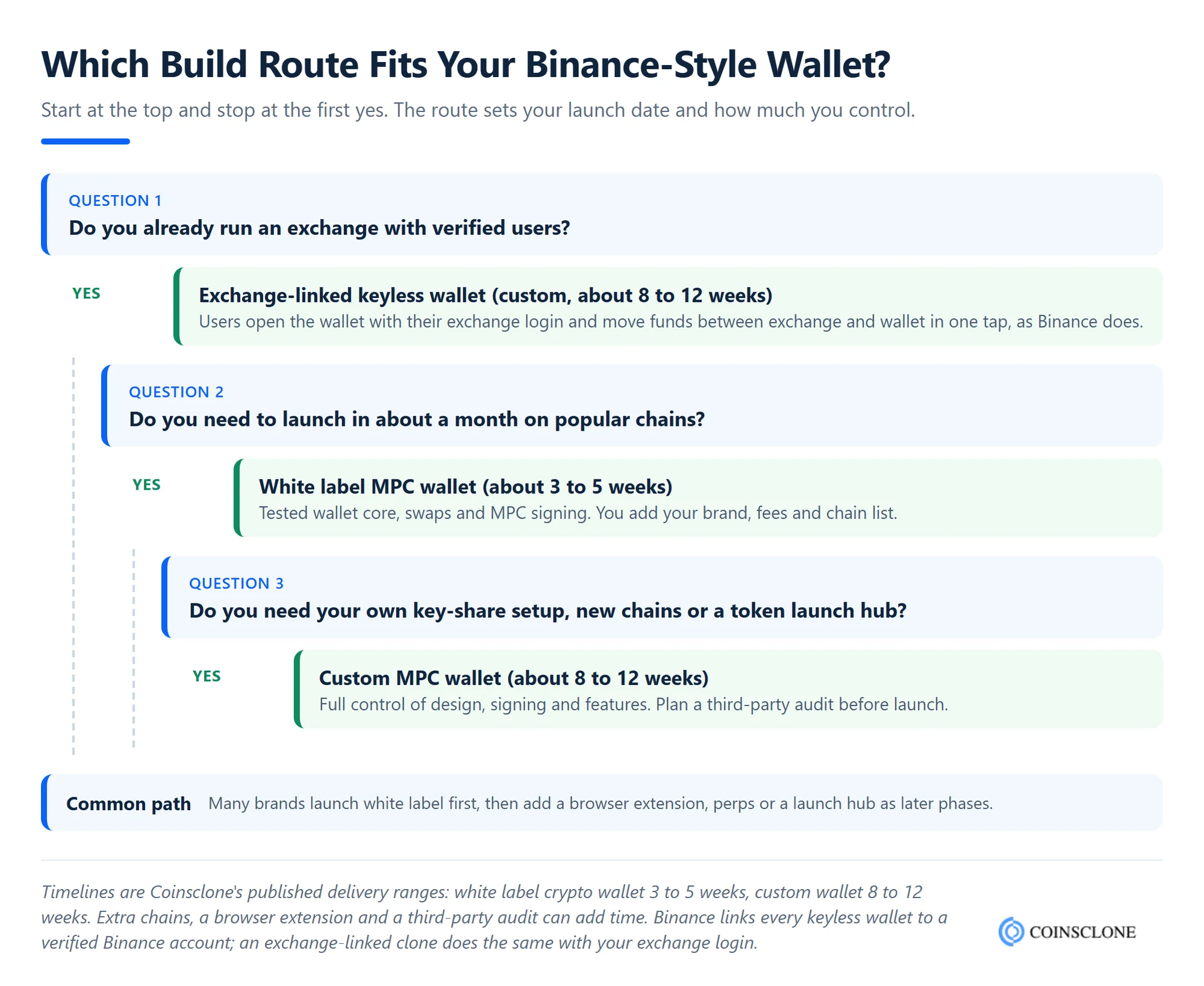
As for timing, a white label wallet usually goes live in 3 to 5 weeks. A custom wallet with your own MPC setup, design and features takes about 8 to 12 weeks. Extra chains, a browser extension or a token launch hub can add time, so plan these as later phases.
How Much Does a Binance Web3 Wallet Clone Cost?
The cost depends on the build route, the number of chains, the platforms you need and your security and audit scope. Published 2026 market estimates put a multi-chain wallet with swaps at about $50,000 to $200,000 when built from scratch. An advanced wallet with MPC keys, DeFi tools and gas features runs about $200,000 to $380,000.
A white label Binance Web3 Wallet clone costs far less than either, because the wallet core, MPC signing and swap engine are already built and tested. You mainly pay for branding, changes, chain setup and launch support. Running costs also matter: plan for nodes, data feeds, repeat audits and updates each year.
For a full breakdown, see our guide to crypto wallet development cost. For a quote that fits your plans, share your feature list with our team.
What We Deliver
Binance Web3 Wallet Clone App
A fully working Coinsclone Binance Web3 Wallet clone app comes with:
- Complete multi-chain support
- Fast, responsive design for Web3 use
- Built-in DEX and dApp access
- Live market dashboards
- Your brand across a secure, easy interface
The app is ready for real users and onboarding from launch day.
White Label Binance Web3 Wallet Clone Script
Coinsclone’s customizable white label Binance Web3 Wallet clone script comes with:
- Full branding freedom
- Modular design for future features
- Quick launch without long build delays
- A Web3 base that scales with your users
- Support for DeFi, NFTs, DEX trading and cross-chain tools
Our white label Binance Web3 Wallet lets you launch under your own brand, with full control over design, features and integrations.
Business Benefits of Acquiring Our Binance Web3 Wallet Clone
The Binance Web3 Wallet clone offers clear gains for both your business and your users. Here are the main business benefits.
- Easy to Launch
The wallet clone is already built and tested, so moving it to mainnet is simple. You can still change the features and design to suit your brand.
- Cost-Effective
Compared with a build from scratch, a Binance Web3 Wallet clone cuts the cost of research, coding and testing.
- Time-Saving
A white label version of the Binance wallet clone can go live in 3 to 5 weeks. A custom build with deeper changes takes about 8 to 12 weeks. So you reach users while the market is still hot.
- Global Reach
By offering features users already know from Binance, you make it easy for them to switch. Users who want new chains, better rewards or local support will choose your wallet over others.
These are the main business benefits of a Binance wallet clone. Next, let’s look at how the wallet earns money.
Revenue Opportunities With Binance Web3 Wallet Clone
The Binance Web3 Wallet clone opens several revenue streams from swaps, services and user activity.
Earning Models:
- Swap fees: A small fee on each in-app swap is the main income for most Web3 wallets.
- Bridge and network fees: A margin on cross-chain moves and gas top-ups.
- Premium plans: Paid tiers with lower fees, better rewards or pro tools.
- NFT marketplace fees: A cut of NFT sales made through the wallet.
- Referral rewards: Shared fees from partners and affiliate programs.
- dApp partnerships: Paid listings and revenue shares with dApps.
- Token launches and ads: Fees from projects that want to reach your users.
Swap fees deserve a closer look, since they bring in most of the money. Binance and Rabby keep their fees low to win volume, while MetaMask and Phantom charge close to 1%.
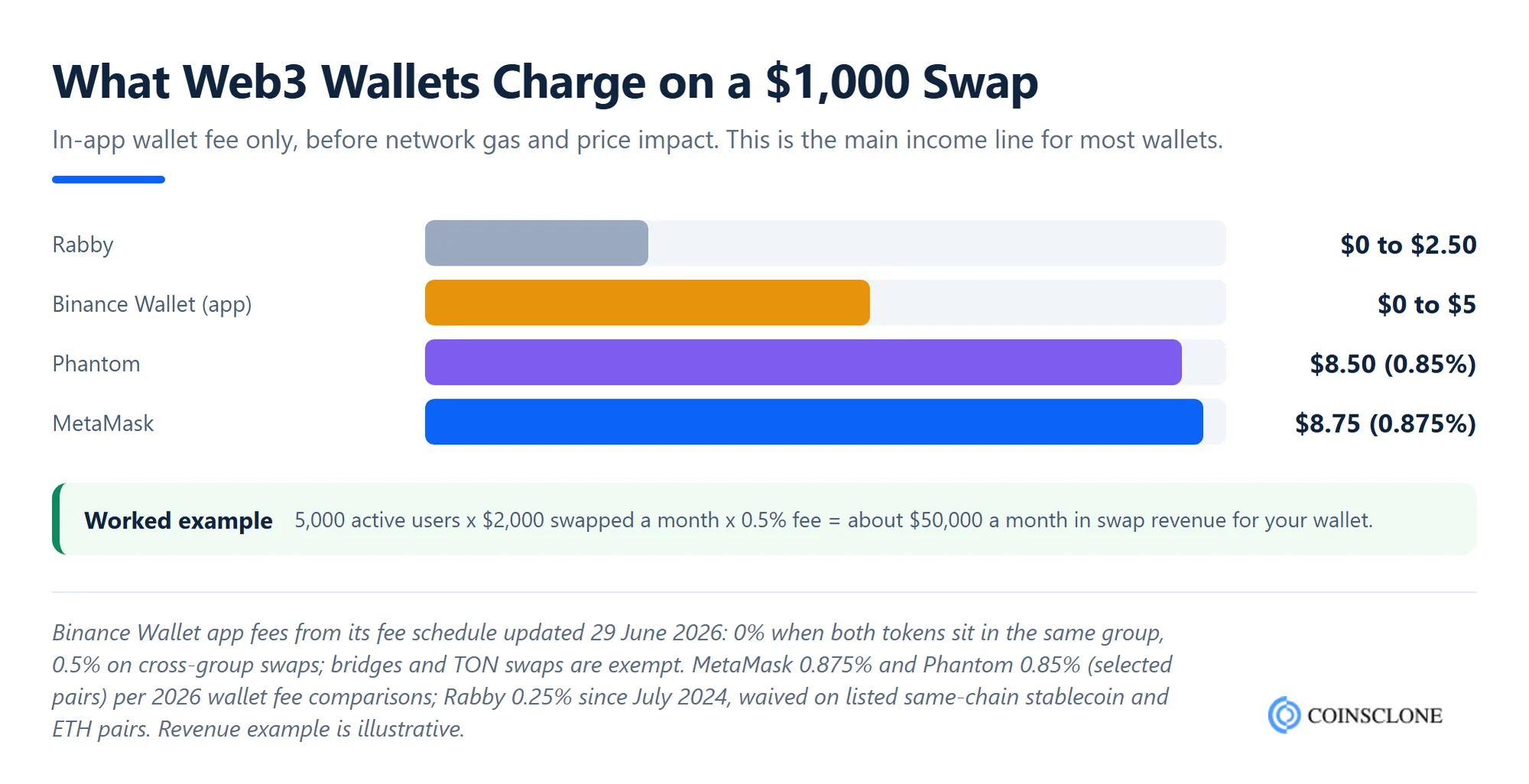
For example, if 5,000 active users each swap $2,000 a month and your fee is 0.5%, the wallet earns about $50,000 a month from swaps alone. Your own numbers will depend on your fee level, your users and your market.
Why Choose Coinsclone to Buy a Binance Web3 Wallet Clone?
With help from an experienced crypto wallet development company, you can launch a feature-rich wallet without the usual build hurdles. Coinsclone has built blockchain products since 2018, with 350+ platforms delivered and 200+ clients across 20 industries.
Our team builds MPC wallets, white label wallets and full exchange setups, so we can link your wallet to a trading platform if you need one. If you also want an exchange like Binance, our Binance clone script can run alongside your wallet. We change the product to fit your needs, then support you after launch with updates and new chains.
So, if you want to enter Web3 with a wallet users already understand, talk to our team. We will help you plan the features, timeline and launch of your Binance Web3 Wallet clone.
Start Your Crypto Wallet Business Using Our Binance Web3 Wallet Clone Script
Grab A Free Demo Now!
Frequently Asked Questions
1. How long does it take to develop a Web3 wallet with Binance Web3 Wallet Clone?
A white label Binance Web3 Wallet clone usually goes live in 3 to 5 weeks. A custom build with your own MPC setup, design and features takes about 8 to 12 weeks. Extra chains, a browser extension or advanced modules can add time.
2. What are the main features of Binance Web3 Wallet Clone?
The main features are keyless MPC security, multi-chain support, built-in swaps through a DEX aggregator, dApp access, staking and earn options, Taproot and BRC-20 support, and a token launch hub. You can add or change features to suit your plans.
3. How can our Binance Web3 Wallet Clone help your business?
It helps you enter the market quickly with a wallet design that millions of users already trust. The time and money you save on building can go into marketing, partnerships and growth.
4. Is Binance Web3 Wallet custodial or non-custodial?
Binance Wallet is a non-custodial wallet. It uses MPC to split the key into three shares held by Binance, the user’s device and the user’s cloud backup. Binance holds only one share, so it cannot move funds alone. A clone works the same way, with your server holding one share.
5. What happens if Binance goes down, or the wallet service goes offline?
Users can still reach their funds through Emergency Export. It uses the shares on the device and in the cloud backup to rebuild the private key, so the user does not need Binance or your server. After export, the keyless wallet closes and the user holds a normal private key that works in any compatible wallet.
6. How secure is a Binance Web3 Wallet clone script?
It is very secure when built well. MPC removes the single private key, while biometric login, 2FA, transaction previews and approval warnings add more layers. A third-party audit of the app, server and signing code before launch is a must.
7. Can I customize the Binance Web3 Wallet clone script for my brand?
Yes. You can change the name, logo, colors, user flows, chains, fees and features. A white label build keeps the tested core and lets you brand everything users see.
8. Does the clone support both Android and iOS?
Yes. The Binance Web3 Wallet clone comes as native apps for Android and iOS, and it can also include a web app and a browser extension so users can switch between devices.
See How Our MVP System Can Launch Your Web3 Wallet Faster
Binance Web3 Wallet Clone Development — done right.
- MVP System: Launch your Binance Web3-like wallet 90% faster.
- Multi-Chain Ready: Connect to Ethereum, BNB Chain, Polygon & more.
- DeFi & DApp Integration: Access swaps, staking & NFTs seamlessly.
- Brand & Customization: Your design, your domain, your users.
- Revenue Engine: Earn from swaps, staking, and transaction fees.
Get a free branded demo of your Binance Web3 Wallet Clone in just 48 hours — before you invest a cent.
Book a Free Demo to discover how our Binance Web3 Wallet Clone Script can take you from idea to live wallet in just 8-12 weeks.