
A DeFi integrated NFT marketplace is an NFT platform where people can do more than buy and sell. They can also borrow against their NFTs, stake them for rewards, buy shares of costly pieces and earn from liquidity pools, all in one place. This guide explains how that mix works, which features are worth adding and how to build one with white label software.
You will also get the facts most guides skip. NFT lending, the core DeFi feature, has shrunk hard. NFTfi closed on 31 August 2026, and Blur’s lending product, Blend, stops new loans on 12 November 2026. So the gap is real, but the old playbook needs fixing. By the end, you will know what to build, what to avoid and what it costs.
In this guide:
- What a DeFi integrated NFT marketplace is, with October 2026 market numbers
- The DeFi features that fit an NFT marketplace, and how an NFT-backed loan works
- The real status of Blur, Rarible, NFTX, NFTfi, OKX and Gondi today
- How to build one with white label software, with cost and launch time
- The risks to plan for, from price oracles to the rules
Merge DeFi with Your NFT Marketplace
DeFi Integrated NFT Marketplace — combining decentralized finance with digital collectibles.
- Liquidity Boost: Enable staking, lending, and borrowing directly within your NFT platform.
- Fractional Ownership: Let users own portions of high-value NFTs for wider participation.
- Seamless Integration: Pre-built white-label modules speed up deployment.
- Monetization Opportunities: Revenue from transaction fees, DeFi yields, and NFT trades.
See a free branded demo of your NFT marketplace in 48 hours — before you invest a cent.
Book a Free Demo to discover how our DeFi Integrated NFT Marketplace can help you launch a next-gen, profitable platform in just 8–12 weeks.
What Is a DeFi Integrated NFT Marketplace?
A DeFi integrated NFT marketplace joins two parts of crypto. The first is the NFT marketplace, where users mint, list, buy and sell unique tokens. The second is decentralized finance (DeFi), where smart contracts handle lending, staking and trading without a bank in the middle. Put together, this mix is often called NFTFi, short for NFT finance.
In a normal NFT marketplace, an NFT just sits in a wallet until the owner sells it. In a DeFi integrated one, that same NFT can work for its owner. For example, a holder can lock it as collateral and borrow ETH, or a buyer can own 1% of a rare piece instead of the whole thing. Chainlink’s NFTFi guide sums it up well: these tools aim to make NFTs, which are hard to sell quickly, far more liquid.
Here is how the two markets compare in size today:
- DeFi: Total value locked across DeFi was $90.1 billion on 15 October 2026, per DefiLlama.
- NFTs: NFT sales fell 37% to $5.63 billion in 2025, according to CryptoSlam data.
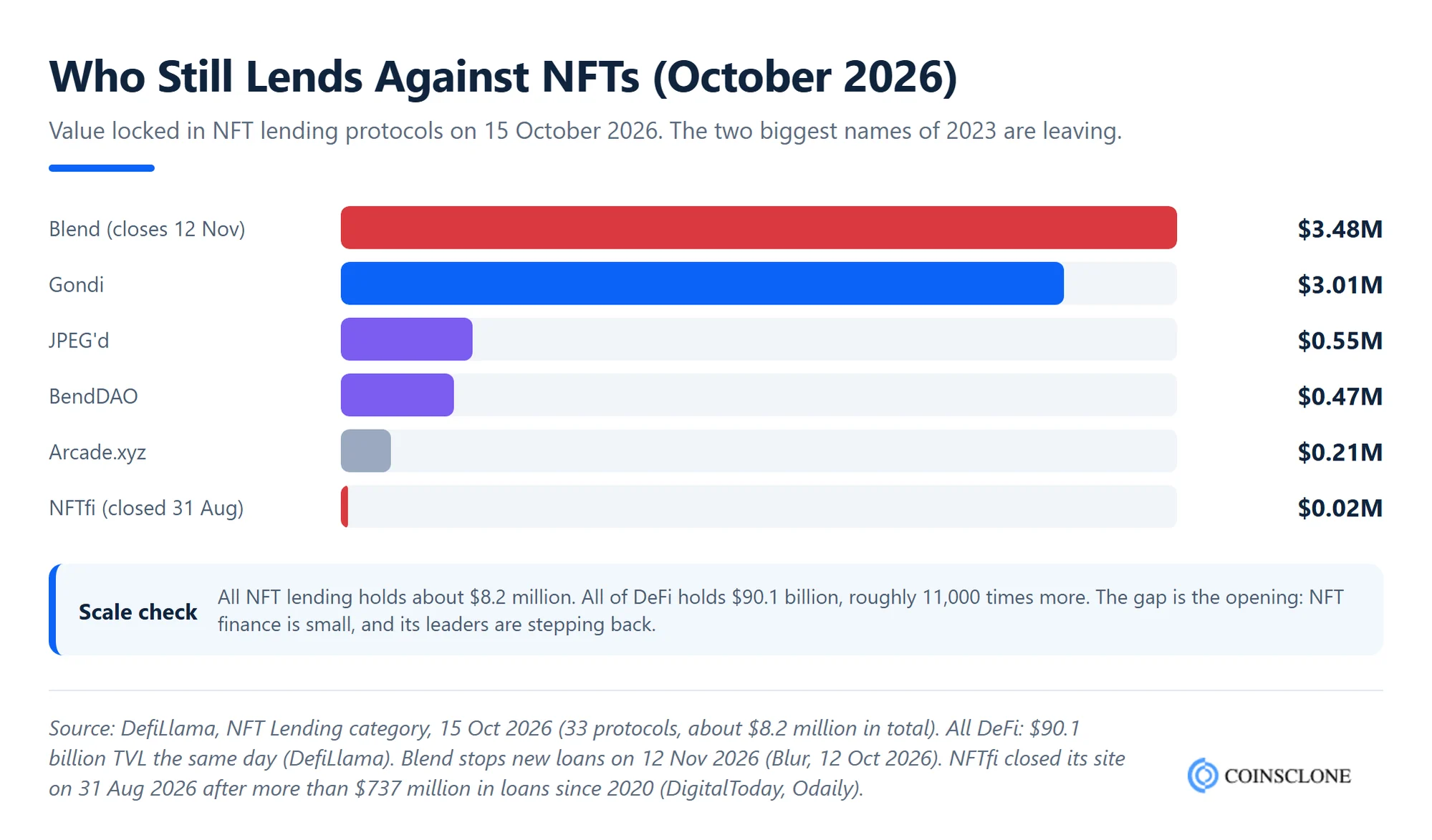
- NFT lending: All NFT lending apps held only about $8.2 million on 15 October 2026, per DefiLlama.
In short, DeFi is large and NFTs are still a multi-billion dollar market. Yet the bridge between them is tiny. That gap is both the risk and the opening for a new platform.
Would Implementing DeFi Into an NFT Marketplace Be Impactful?
Yes, if you build it for today’s market.
This may sound like an odd combo, yet it solves a real problem. Most NFTs are hard to sell fast, so their owners have value locked up that they cannot use. DeFi tools fix that. They let owners borrow, earn or sell a slice without giving up the whole NFT.
DeFi also brings openness. Every loan, swap and reward runs on smart contracts that anyone can check on the chain. As a result, there is less room for hidden fees or unclear terms. Crypto users want this kind of clear, on-chain record for their trades.
Security matters just as much. A good NFT marketplace already offers wallet login, anti-phishing checks and safe storage of NFTs. When you add DeFi, your contracts hold users’ NFTs and funds, so audits and safe design become even more important. We cover these risks in detail below.
However, the market has changed since the 2021 boom. Back then, any NFT platform with staking could draw a crowd. In 2026, users and lenders are fewer and more careful. NFT lending fell from about $1 billion a month in January 2024 to about $50 million a month by mid 2025, per DappRadar data. So the impact comes from a focused set of DeFi features with fair fees, not from adding every tool at once.
DeFi-Blended NFT Marketplaces and Their Status in 2026
The NFT community always welcomes new ideas. In that regard, several well-known NFT marketplaces have added DeFi tools to gain more attention. You can study them as business models. But first, check where each one stands today, because a lot has changed. Here is the status of each as of 16 October 2026.
Blur
Blur grew into the main rival to OpenSea, and for a while it beat it. It works as an NFT marketplace and an aggregator, so users can buy NFTs listed on other marketplaces with a single click. On top of that, Blur added DeFi tools such as Blend, a peer-to-peer lending product that let holders borrow ETH against their NFTs.
Now Blur is stepping back. On 12 October 2026, Blur said it will retire the blur.io website on 12 November 2026, as Unchained reported. Its smart contracts stay live on Ethereum. However, Blend stops matching new loans on the same day, so borrowers must repay before then. Even so, Blur’s trader-first tools are still worth copying. That is why an NFT Aggregator like Blur remains a strong, community-focused business idea, as long as it charges a fee that pays its way.
Rarible
Rarible was one of the first NFT marketplaces to let its users vote on how it runs. It gave its community a governance token, RARI, in 2020. Today Rarible is still active. It works across Ethereum, Solana, Robinhood Chain and MegaETH, and it rewards active users. Its main tools include NFT minting, wallet profiles and trades across chains. So creating a Rarible-like NFT Marketplace with DeFi features is still a proven way to attract communities.
NFTX
NFTX lets users turn NFTs into tokens that trade like normal crypto. Holders deposit NFTs from a collection into a vault and get ERC-20 “vTokens” back, each backed 1:1 by an NFT. They can then swap, stake or provide liquidity with those tokens to earn fees. In this way, NFTX works much like a DeFi Staking platform, where users lock assets to earn rewards. The NFTX site now runs version 4 of its protocol, and it held about $2 million on 15 October 2026, per DefiLlama.
NFTfi
NFTfi was the best-known NFT lending platform. Users could borrow against their NFTs or lend to others and earn interest, just like on a DeFi Lending & Borrowing Platform. Over six years it handled more than $737 million in loans, and no user lost an NFT to a contract hack.
However, NFTfi has now closed. It stopped new loans in June 2026, let borrowers repay until 31 August 2026 and then shut its website, DigitalToday reported. The reason was simple: a smaller NFT market could no longer cover its running costs. In September 2026 the team made its code open source on GitHub. The lesson for founders is clear. Lending alone could not carry the business, so plan more than one income stream.
OKX
OKEx renamed itself OKX in January 2022. Back in 2021, it paired its NFT marketplace with a DeFi Hub, so users could manage NFTs and DeFi assets from one dashboard. Today its NFT marketplace sits inside the OKX Wallet. According to OKX’s NFT FAQ, updated in August 2026, it supports more than a dozen networks. It also pulls in listings from OpenSea, Magic Eden and other marketplaces, and it charges no OKX service fee on buying or selling. Royalties, other platforms’ fees and gas still apply.
Gondi
Gondi is a newer example worth knowing. Gondi is an NFT marketplace and a lending market in one. Users can buy an NFT outright or with a loan, borrow against NFTs they own and swap NFTs peer to peer. On 15 October 2026 it was the second-largest NFT lender on DefiLlama’s list. Only Blend was larger, and Blend stops new loans in November. In other words, it is close to a working model of a DeFi integrated NFT marketplace.
What These Platforms Teach a New Founder
The platforms above offer staking, lending, swaps and fractional shares inside their NFT marketplaces. Users who want to stake, lend, borrow, use NFTs as collateral or swap them still look for these services. Yet only a few platforms now offer them, and two big lenders are leaving in 2026. As a result, there is room for new, well-built marketplaces.
Three lessons stand out:
- Fees must pay the bills: Blur grew on 0% fees and token rewards, and NFTfi on lending alone. Both models proved hard to sustain.
- Combine trading and finance: Gondi shows the stronger model. Users buy, sell and borrow in one place, so each feature feeds the others.
- Contracts outlive websites: Blur’s contracts stay live after its site closes. So build audited contracts that can last, and keep the front end easy to change.
You can build such a platform with the right tools, expert guidance and a capable team. To do that, you first need the right build method.
Also Read : Best NFT Marketplaces in Crypto Market
Why Should You Integrate DeFi in NFT Marketplace Development?
In a bunch of flowers, most people still pick the rose. Even though it has thorns, it gets the attention. Likewise, there are many business ideas in crypto, but this one stands out because it gives users more ways to use what they own. Here are the features that make it worth building, and what each one does for your users.
Global Outreach
Every startup that joins NFTs and DeFi wants to reach more crypto users. DeFi tools pull in two groups at once: NFT collectors and DeFi traders. As a result, a DeFi integrated NFT marketplace can grow a larger and more active user base than a plain NFT store.
NFT Collateralization and Lending
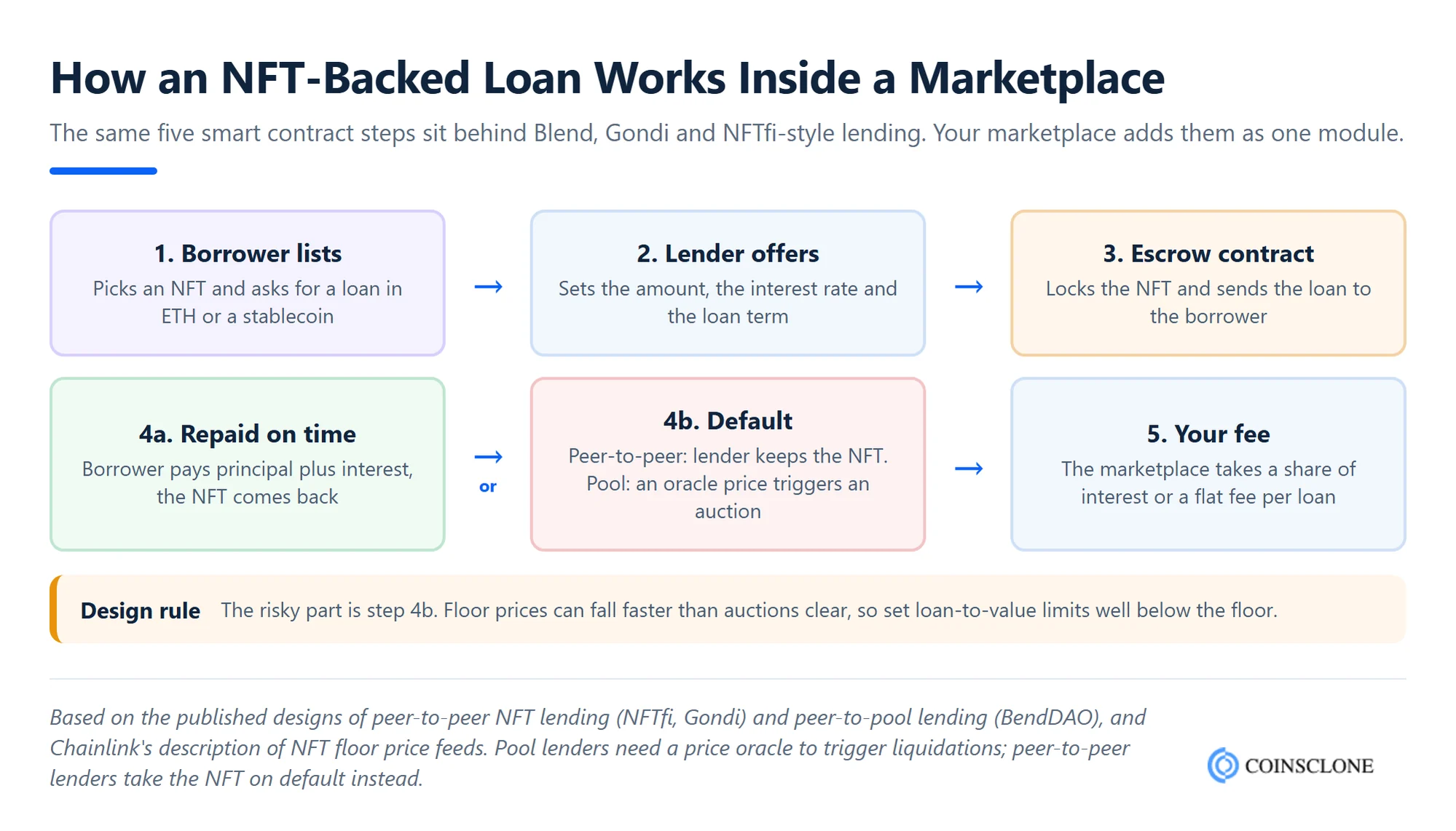
One of the main uses of DeFi in an NFT marketplace is lending. Users who own costly NFTs can lock them as collateral and borrow crypto without selling. The loan amount depends mostly on the collection’s floor price and trading history.
There are two common models:
- Peer-to-peer: A lender makes an offer on a specific NFT. If the borrower does not repay, the lender keeps the NFT. NFTfi and Gondi use this model.
- Peer-to-pool: Lenders put funds into a shared pool, and borrowers draw from it at a set rate. A price oracle tracks floor prices, and an auction sells the NFT if its value falls too far. BendDAO uses this model.
If you plan to make lending your main product, read our guide to NFT lending platform development.
NFT Staking and Rewards
Staking lets users lock their NFTs or your platform token for a set time and earn rewards in return. This keeps NFTs on your platform and rewards loyal users. However, rewards paid only in a new token tend to fade once the token price falls. So link rewards to real platform income, such as a share of trading fees. Our guide to NFT staking platform development explains the main reward models.
Increased Liquidity
Liquidity is DeFi’s biggest strength. When you add liquidity pools to an NFT marketplace, users can sell a floor NFT to a pool instantly instead of waiting for a buyer. NFTX and Sudoswap work this way. In turn, the people who fund the pools earn a share of trading fees. This makes your marketplace more useful for active traders.
Fractional Ownership
Some users cannot afford an entire NFT. Shared ownership solves this. The NFT is locked in a smart contract, which issues tokens that each stand for a share of it. Buyers can then own and trade a small part of a costly piece. To learn how this works in detail, see our guide to fractional NFTs. Many startups also build a full Fractional NFT Marketplace around this idea.
NFT Rentals
Rentals let an owner lend out an NFT for a fee, without selling it. This is useful for game items, event passes and memberships, where a user needs an NFT for a short time. Some designs never move the NFT out of the owner’s wallet. Instead, they give the renter usage rights for a set period, so no collateral is needed.
DeFi Insurance
Users want to protect what they own. In that regard, some platforms add cover for smart contract failures or loan defaults. Others turn insurance policies themselves into NFTs, so the terms are fixed in a smart contract and easy to transfer. This feature is still young, so treat it as an add-on rather than a core product.
Governance Tokens
A governance token lets your users vote on fees, new features and how to spend shared funds, as Rarible’s RARI does. This builds trust and loyalty. Still, keep real control rules in place until your community is large and active.
Apart from these, you can add more DeFi tools to fit your business plan. But each feature brings both value and risk, so let us look at how to build them and what can go wrong.
How to Develop a DeFi-Powered NFT Marketplace?
When it comes to building, you can choose any method that fits your budget and timeline. We suggest a White Label NFT Marketplace. You may now have this question:
Can I integrate decentralized finance (DeFi) features into my White Label NFT Marketplace?
Of course, you can. White label software is a ready-made base for an NFT marketplace with DeFi features. Its main benefit is that you can change almost everything. You can adjust the front end and back end, UI/UX design, trading options, DeFi modules and support system. So rather than building every part from scratch, you start from tested code.
With White Label NFT Marketplace Software, you need a smaller team, fewer resources and only basic knowledge of NFT marketplace building. You can add extra features and strong security rules to match your business needs. On top of this, you can add more revenue models that fit your marketing plan. Overall, white label software is an affordable and smart choice.
Steps to Build It
Here is how the build usually goes:
- Pick your niche and chain: Choose who you serve, such as gamers, art collectors or traders, and the chain they use, such as Ethereum, Solana or Polygon.
- Choose your DeFi modules: Start with one or two that fit your niche, such as lending for high-value art or staking for a game.
- Set up the core marketplace: Use white label code for minting, listing, auctions, wallets and the admin panel.
- Add the DeFi contracts: Plug in escrow, lending, staking, vault or pool contracts, plus a price oracle for any loan that can be liquidated.
- Audit and test: Have an outside firm audit every contract that holds user NFTs or funds, then test on a testnet.
- Launch and grow: Go live with clear fees, then add features once users ask for them.
Cost and Launch Time
Most guides never give a number, so here are the 2026 market ranges from our full guide to NFT marketplace development cost.
| Build route | Typical cost | Typical time | What you get |
| White label or clone script | $10,000 to $30,000 | 2 to 6 weeks | Tested marketplace with your brand, chain and fee settings |
| Mid-tier custom platform | $40,000 to $80,000 | 3 to 5 months | Auctions, royalties, many wallets, search and filters |
| Large pro platform | $150,000 to $500,000+ | 8 to 12 months | Order book, aggregation, deep data and finance tools |
Most builds start in the first row and add DeFi parts on top. Each module, such as lending, staking or fractional vaults, adds to the cost and the time. So does each extra chain. Also, budget $5,000 to $25,000 for an outside smart contract audit before launch, and more if you run lending pools.
We hope you now have a clear view of the build process. But you may still wonder what can go wrong when you mix NFTs and DeFi. The next part covers that.
Challenges in Merging Both NFTs and DeFi
Some challenges are technical, some are about the market and some are about the rules. If you plan for them early, you can build a strong white label NFT marketplace. Here are the main risks:
- Pricing is hard: Each NFT is unique, and many collections trade rarely. So a lending or fractional feature needs a reliable floor price feed, such as an oracle that filters out fake trades.
- Liquidation risk: When floor prices drop fast, loans can go underwater before auctions find buyers. BendDAO faced this in August 2022, when falling floors and failed auctions nearly emptied its ETH pool. Safe loan limits and longer auction windows help.
- Smart contract bugs: Your contracts hold real NFTs and funds. In June 2026, a flaw in Flooring Protocol’s token logic let an attacker drain pools, and Yuga Labs stepped in to rescue 68 NFTs worth about $570,000. Audits are not optional.
- Lost holder perks: An NFT locked in a vault or loan may miss airdrops, votes or event access. Tell users clearly before they lock anything.
- The rules: Lending, yield and fractional shares can count as financial services or securities. In the US, SEC Chair Paul Atkins said in a November 2025 speech that, in his view, digital collectibles are not securities. That is a speech, not a rule. In the EU, the MiCA regulation leaves out unique NFTs, but fractional shares can fall inside it. Get legal advice in each market you serve.
- Thin demand: NFT lending is a small market today. So start with one feature your users already want, and grow from there.
To handle these risks, you need three things in place before you add DeFi to your NFT marketplace:
- Advanced technical team: To take your NFT marketplace to the next stage, you need a team that can build secure contracts and features.
- Skilled developers: DeFi contracts must work smoothly with the marketplace. So you need developers who can fix errors, bugs and slow pages quickly.
- Expert guidance: An expert team shows you the likely outcomes, problems and challenges at the start. As a result, you can plan your roadmap with fewer surprises.
To cover all three, you first need the right NFT marketplace development company. Be clear on these points while you choose, so you save time and money. If you wonder which company has all of them, that is Coinsclone.
Unlock Various Revenue Streams with DeFi-Integrated NFTs!
High Liquidity. Scalable. Advanced Techs. Get A Free Consultation.
Unite With Coinsclone to Get an Enriched DeFi-Integrated NFT Marketplace Platform
Coinsclone is a leading NFT Marketplace Development Company with a skilled team. We have built crypto and blockchain products since 2018, and our team has delivered 350+ platforms for 200+ clients across 20 industries. We are known for our range of NFT marketplace clone scripts, and many startups have grown their crypto business with our software.
For this kind of platform, we start from our white label marketplace and add the DeFi parts you need, such as NFT lending, staking, fractional vaults or pools. Every contract is built to be audited, and you keep full control of your fees and branding.
If you want to launch your NFT marketplace with a touch of DeFi, contact our team. Apart from this, we also build DeFi apps, crypto exchanges, crypto tokens and crypto wallets. Our prices suit startups as well as larger firms. Get our free live demo and start your NFT marketplace journey with us.
We also offer these clone scripts for NFT marketplaces:
Merge DeFi with Your NFT Marketplace
DeFi Integrated NFT Marketplace — combining decentralized finance with digital collectibles.
- Liquidity Boost: Enable staking, lending, and borrowing directly within your NFT platform.
- Fractional Ownership: Let users own portions of high-value NFTs for wider participation.
- Seamless Integration: Pre-built white-label modules speed up deployment.
- Monetization Opportunities: Revenue from transaction fees, DeFi yields, and NFT trades.
See a free branded demo of your NFT marketplace in 48 hours — before you invest a cent.
Book a Free Demo to discover how our DeFi Integrated NFT Marketplace can help you launch a next-gen, profitable platform in just 8–12 weeks.
Frequently Asked Questions
What is a DeFi integrated NFT marketplace?
It is an NFT marketplace that also offers DeFi tools, such as NFT-backed loans, staking, liquidity pools and fractional ownership. Users can buy and sell NFTs and also borrow, earn or trade shares of them in the same place. This mix is often called NFTFi.
What is NFTFi?
NFTFi, or NFT finance, means using DeFi tools with NFTs. The main types are NFT lending, fractional ownership, NFT pools and indices, and rentals. They all aim to make NFTs easier to use and sell, since a single NFT can take a long time to find a buyer.
Can I integrate DeFi features into my white label NFT marketplace?
Yes. A white label NFT marketplace can add DeFi parts such as lending, staking, fractional vaults and pools. Each module is a set of smart contracts that connects to the marketplace. Plan an outside audit for every contract that holds user NFTs or funds.
How do NFT-backed loans work?
The borrower locks an NFT in an escrow contract and receives a loan in ETH or a stablecoin. If the borrower repays the loan plus interest on time, the NFT comes back. If not, the lender keeps the NFT in a peer-to-peer model, or the NFT is sold at auction in a pool model.
Is NFTfi still working?
No. NFTfi stopped new loans in June 2026 and closed its website on 31 August 2026, after more than $737 million in loans since 2020. Its code is now open source. Gondi and other lenders still offer NFT-backed loans.
Is Blur shutting down?
Partly. Blur said on 12 October 2026 that its blur.io website will stop running on 12 November 2026, while its smart contracts stay live on Ethereum. Blend, its lending product, stops matching new loans on the same day.
Are fractional NFTs securities?
They can be. Selling shares of one NFT with a promise of profit can look like a securities offer in the US. In the EU, MiCA leaves out unique NFTs but can cover fractional shares. Get legal advice for each market before you launch.
How much does a DeFi integrated NFT marketplace cost?
In 2026, a white label NFT marketplace costs about $10,000 to $30,000 and takes 2 to 6 weeks. Each DeFi module, such as lending or staking, adds to that. A smart contract audit adds $5,000 to $25,000, and a large custom platform can reach $150,000 to $500,000 or more.