
Fractional NFT marketplace development means building a platform where one costly NFT is locked in a smart contract and sold as many small shares. Buyers no longer need the full price of a rare artwork, a domain name or a piece of property. They can buy a slice, trade it, and get paid out if the whole asset is sold. This guide explains how such a marketplace works under the hood, what to build, what it costs and which rules apply in 2026.
The market has also changed a lot since the 2021 boom. Most of the first fractional platforms have closed, while new ones now focus on real assets and stricter rules. So you will also see which platforms still work, what went wrong for the others, and how to plan a platform that lasts.
In this guide:
- How a fractional NFT marketplace works, from the vault contract to the buyout
- Which of the early platforms are still live in October 2026, and what that teaches founders
- The features, token standards and tech stack a fractional platform needs
- A step-by-step build plan, with the security and legal checks most guides skip
- Real cost ranges and delivery times, plus how the platform makes money
Discover How Our Fractional NFT Marketplace Development Expands NFT Ownership
Fractional NFT Marketplace Development — designed for collectors and investors seeking shared ownership.
- Fractional Ownership: Allow multiple users to own shares of a single high-value NFT.
- Enhanced Liquidity: Increase trading activity and unlock new investment opportunities.
- Seamless Marketplace: Deploy a ready-made, white-label platform quickly.
- Monetization Potential: Earn from transaction fees, fractional sales, and premium listings.
See a free branded demo of your NFT platform in 48 hours — before you invest a cent.
Book a Free Demo to discover how our Fractional NFT Marketplace Development can help you launch a profitable, accessible NFT platform in just 8–12 weeks.
What Is Fractional NFT Marketplace Development?
Fractional NFT marketplace development is the work of building a platform where people buy, sell and trade parts of costly NFTs. The platform splits one NFT into many fungible tokens. Each token stands for a share of the original, so many people can own the same asset together. If you are new to the idea, our guide on fractional NFTs explains the basics, the Doge NFT story and the risks for buyers.
For a founder, the marketplace is more than a normal NFT store with smaller prices. It needs extra smart contracts to lock the NFT, issue shares, run a buyout and pay holders. It also needs a place where shares can trade every day, plus clear rules on who can buy. That is why fractional platforms take more planning than a standard marketplace.
Once you pick a build route, an NFT Marketplace Development Company does the tech work. Even so, you as the owner should know how the platform works. That way you can match its tools to your goals and judge the choices your team makes.
Fractional vs Normal NFT Marketplace
Here is how the two compare for a builder.
| Normal NFT marketplace | Fractional NFT marketplace | |
| What is sold | Whole NFTs, one owner each | Shares of one NFT, many owners |
| Core contracts | Listing, sale, auction, royalty | Those, plus vault, share token, buyout and payout contracts |
| Where trading happens | Fixed price sales and auctions | Order book or liquidity pool for shares, often running all day |
| Price per item | The full NFT price | Any amount, down to one share |
| Who decides a sale | The owner | Share holders, through a reserve price or a vote |
| Legal risk | Lower for unique art and collectibles | Higher, because shares can count as securities |
| Audit scope | Marketplace and royalty logic | Larger: vaults, buyouts and cash-outs hold pooled funds |
In short, a fractional platform adds a second market on top of the NFT itself. That extra layer is where most of the cost, the risk and the revenue sit.
How Does a Fractional NFT Marketplace Work?
A fractional NFT marketplace is simple to explain, though each step needs careful code. Here is the typical flow:
- NFT minting or deposit: The process starts with an NFT that stands for an asset such as art, music, a domain or a game item. The owner mints it on a blockchain or brings one they already hold.
- Fractionalization: The NFT is locked in a smart contract, often called a vault. The vault mints a fixed number of fungible tokens, usually ERC-20, and each token stands for a share of the NFT.
- Listing on the marketplace: The shares are listed on the platform. Investors can then buy, sell or trade them much like normal crypto tokens.
- Trading and ownership: Every trade is recorded on the blockchain. Each buyer becomes a part owner, and anyone can check who holds what.
- Revenue sharing: When the asset earns money, such as rent from a real asset, the smart contract pays it out to holders in line with their shares.
- Buyout: A buyer can offer to buy the whole NFT. If the offer beats the reserve price set by holders, an auction runs. The winner gets the NFT, and holders swap their shares for their part of the winning bid. If one wallet collects every share, it can also redeem the NFT directly.

The buyout step deserves extra care. It is the only way the NFT ever leaves the vault, and it moves pooled money. Newer designs make it fairer. For example, Doma’s domain share tokens set the buyout price as the highest of three numbers: a floor price the owner chose, the current value of all shares, and their average value over time. That last part stops someone from pushing the share price down for a few minutes and buying the asset cheap.
Now that you know the mechanics, let’s look at what has happened to the platforms that tried this model first.
Fractional NFT Marketplaces in 2026: Which Are Still Live?
Most guides on this topic still list the same early platforms as success stories. However, many of them have closed. Here is their status, checked on 16 October 2026.
| Platform | What it did | Status in October 2026 |
| Fractional.art / Tessera | Single-NFT vaults with ERC-20 shares | Renamed Tessera in 2022; shutdown announced in May 2023. Site offline |
| NFTfi | Loans backed by NFTs (often listed with fractional sites) | Stopped new loans on 11 June 2026 and ceased operations on 31 August 2026; contracts stay on-chain |
| Unic.ly | Pooled NFT shares (uTokens) | Domain parked and offered for sale |
| NFTfy | Fractional vaults on several chains | Website offline |
| LIQNFT | Fractional NFT shares | Original product gone; the domain now shows an unrelated exchange |
| Otis (WithOtis) | Shares in collectibles and NFTs | Bought by Public.com in 2022; offerings later wound down |
| Mintable | General NFT marketplace | Homepage shows a sunset notice for the platform |
| Propy | Real estate deals recorded as NFTs | Now sells AI-assisted title and escrow services |
| NFTX | Collection pools with ERC-20 floor tokens | Live, version 4 on Uniswap V4 |
| Doma | Fractional domain name tokens | Mainnet live since 25 November 2025 |
So what does this tell a founder? Several closures came because NFT trading shrank and fees no longer paid the bills. NFTfi said exactly that when it wound down. NFT sales fell 37% to $5.63 billion in 2025, according to CryptoSlam data. By contrast, the projects still live tie shares to something with lasting value. That can be a whole collection’s floor price or a real asset like a domain name.
The lesson is clear: pick an asset class with real demand, plan more than one income stream, and treat rules and security as part of the product. The rest of this guide is built around those three points.
Must-Have Features of a Fractional NFT Marketplace
A fractional platform needs the usual market tools plus a set of tools for shares. These are the ones to plan for.
For Asset Owners
- Vault creation: Owners pick an NFT, or a basket of NFTs, and lock it in a new vault through a simple form.
- Share settings: Owners choose the number of shares, the share name and symbol, the reserve price and any curator fee.
- Primary sale tools: A fixed price sale, an auction or a pool listing for the first batch of shares.
- Vault dashboard: Owners see holders, trading volume, fee income and buyout offers in one place.
For Investors
- Share trading: An order book or a liquidity pool, so investors can buy and sell shares at any time.
- Portfolio view: Holdings, share value, payouts and voting power across all vaults.
- Reserve price voting: Each holder can set the price they would accept, and the vault uses the weighted average.
- Buyout and cash-out: A clear screen to join an auction or swap shares for funds after a sale.
- Payouts: Income, such as rent from a property, shared out by the contract.
For the Platform Owner
- Admin panel: Fee settings, listing approval, dispute handling and user support.
- KYC and transfer rules: Identity checks and limits on who can hold shares, where the law requires them.
- Analytics: Volume, active vaults, fee income and user growth.
- Safety controls: A pause switch, access by role and alerts for odd trades.
Most of these build on the standard features of an NFT marketplace. The vault, voting and buyout parts are what make the platform fractional.
Token Standards and Tech Stack
Your choice of token standards shapes what the platform can do. Most fractional platforms on Ethereum and EVM chains use this mix:
- ERC-721 or ERC-1155 for the asset: The original NFT that goes into the vault. See our guide to NFT token standards for how these differ.
- ERC-20 for the shares: Fungible tokens that work with wallets, exchanges and DeFi tools out of the box.
- ERC-3525 for value slots: A Final standard for semi-fungible tokens, useful when shares need their own ID and value.
- ERC-3643 for regulated shares: A Final standard for permissioned tokens that only verified wallets can hold. It suits property, art and other real-asset shares.
- ERC-2981 for royalties: A Final standard so creators keep earning on resales of the whole NFT.
Beyond the tokens, a typical stack includes:
- Blockchain: Ethereum has the most buyers. Chains with lower fees, such as Polygon, Base, Avalanche or BNB Chain, cost less per trade. Solana suits teams that want fast, cheap trades with its own token tools.
- Smart contract tools: Solidity, audited libraries such as OpenZeppelin Contracts, and testing tools like Foundry or Hardhat.
- Liquidity: A built-in AMM pool or a link to a DEX such as Uniswap for share trading.
- Data layer: An indexer such as The Graph to read vault events, and IPFS for NFT metadata.
- Front end: A web app with wallet login through MetaMask, WalletConnect or embedded wallets.
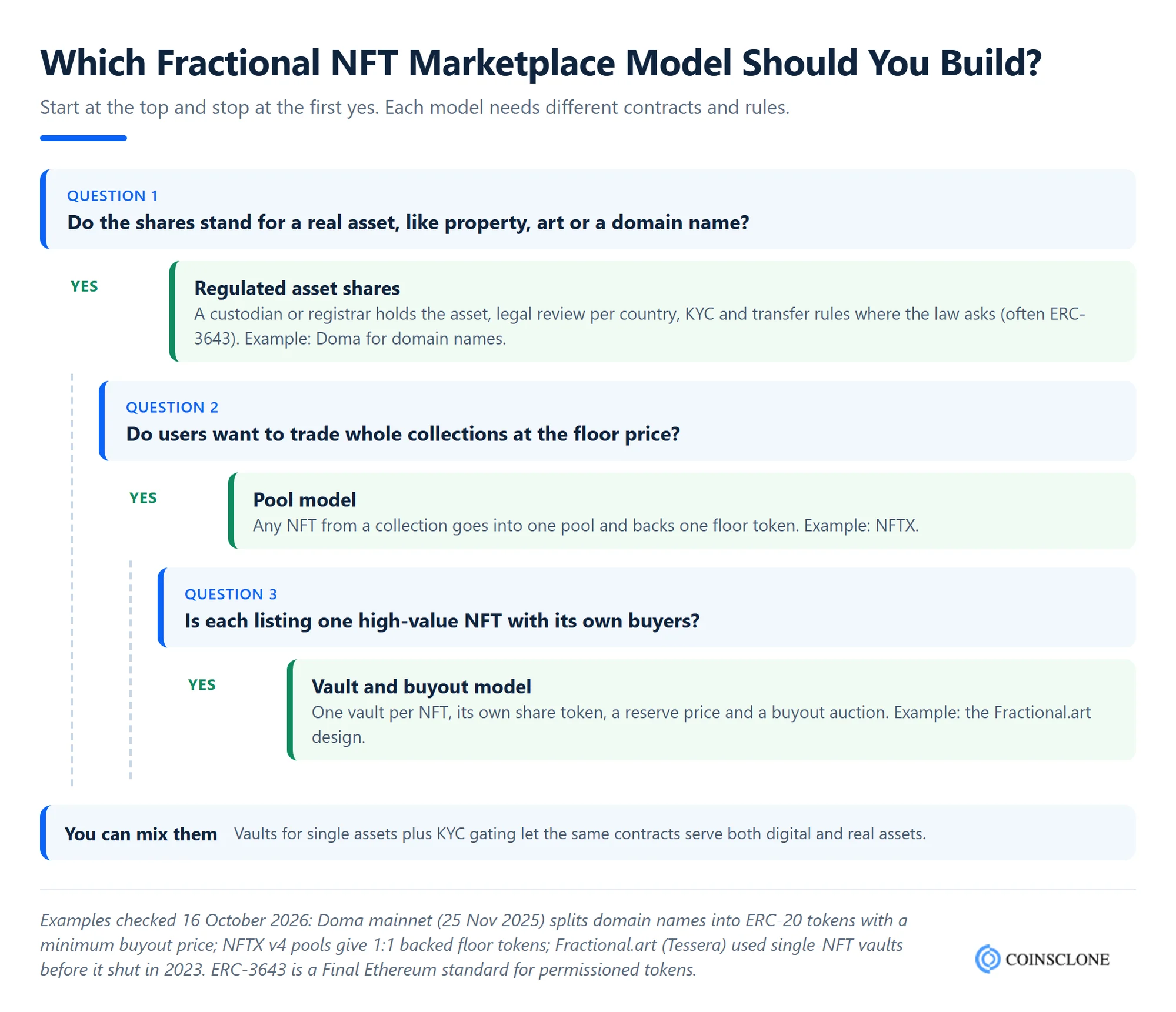
The model you choose matters as much as the chain. A vault model suits single high-value NFTs. A pool model suits whole collections. Meanwhile, shares in real assets need gated tokens, a custodian and legal review from the start.
How to Build a Fractional NFT Marketplace, Step by Step
Building a fractional NFT platform is not a risky or endless task. With the right team, a clear plan and good advice, you can launch with confidence. Here is the process.
Step 1. Be sure about the target: Define your purpose, your target users and the assets you will fractionalize. Art, gaming items, domains and property all need different features and rules.
Step 2. Choose the model: Decide between vaults, pools or regulated asset shares, using the decision tree above. This choice drives every later step.
Step 3. Check the rules early: Ask a lawyer whether your shares could count as securities in the countries you serve. The answer decides whether you need KYC, transfer limits or a licence.
Step 4. Pick the blockchain: Choose a chain that supports your token standards, keeps fees low for small share trades, and has wallets and DEXs your users already know.
Step 5. Design the front end: This phase is under your control. You choose the UI and UX design, the theme and the user dashboard. Keep the share, payout and buyout screens simple, because they handle money.
Step 6. Build the back end: Add user accounts, KYC links, the indexer, the admin panel and secure login for traders.
Step 7. Write the smart contracts: This is the core of the build. The contracts must handle vaults, share minting, revenue sharing, voting and buyouts without errors. Our NFT smart contract development guide covers this stage in more depth.
Step 8. Test and audit: Run full tests on a testnet, then get an outside security audit before any real funds go in. Fix every high-risk finding and test again.
Step 9. Launch and grow: Start with a few strong assets, add liquidity for their shares, and watch the data. Then add new asset types, chains and features over time.
These steps help you launch a safe platform that can grow. With the right guidance, you can be the next big player in shared digital ownership. Talk to the Coinsclone team to plan your platform and lead the next wave of shared ownership.
Security Risks to Plan For
Fractional platforms hold pooled assets and pooled money, so they draw attackers. Two real cases show where the danger lies.
- Buyout logic: In the public Code4rena audit of Fractional v2 (7 to 14 July 2022), reviewers found 20 high-risk and 12 medium-risk issues. Several sat in the buyout and cash-out code, including a way to force a buyout and a way to drain funds after a sale.
- Token logic in live pools: In June 2026, a flaw in Flooring Protocol’s token logic let an attacker drain pools, and Yuga Labs stepped in to rescue 68 NFTs worth about $570,000.
So plan for these safeguards from day one:
- Outside audits: At least one audit of the vault, share, buyout and payout contracts, and a new review after any big change.
- Time-weighted prices: Use average prices over time, not a single spot price, to set buyouts.
- Timelocks and limits: Delay admin changes, cap fees in code, and add a pause switch for emergencies.
- Bug bounty: Reward researchers who report flaws before attackers find them.
- Exit plan: Make sure holders can still redeem or cash out through the contracts if the website ever goes offline.
Rules and Compliance for Fractional NFT Platforms
Shares in an NFT can look like shares in a company. That is the legal risk every fractional platform has to manage.
In the US, SEC Chair Paul Atkins gave his Project Crypto speech on 12 November 2025. In his view, NFT art and collectibles are not stocks or bonds, while tokens that stand for stocks still are. That is a speech, not a rule. Shares sold with a promise of profit from someone else’s work can still count as securities.
In the EU, the MiCA regulation leaves out unique NFTs. However, its recital 11 says that parts of a unique NFT are not unique on their own. So fractional shares can fall under MiCA, with its white paper and licence rules.
What this means for your build:
- Get legal advice in each market before launch.
- Add KYC and transfer limits if your shares could be securities.
- Use a licensed custodian for real assets, and write clear terms on what a share does and does not give.
Benefits of a Fractional NFT Marketplace
Fractional NFTs are still a young market, and few platforms serve it well today. That leaves room for focused new players. Here is what a fractional platform offers:
- A larger user base: Shares lower the entry price, so far more people can take part than on a high-end NFT market.
- Better liquidity: Shares trade in small amounts at any time. This makes costly NFTs and real assets much easier to buy and sell.
- Clear ownership: Every share and trade sits on the blockchain. That openness builds trust in your platform.
- Live price discovery: Steady share trading gives a market price for assets that rarely sell as a whole.
- Shared income: Owners raise money without selling the whole asset, and holders earn from payouts and buyouts.
These benefits help both buyers and the owner of the platform. Here, a question may arise.
Can You Make Profits from a Fractional NFT Marketplace?
Yes, if you plan several income streams. Like a usual NFT marketplace, you can charge listing fees, bidding fees and trading fees. For comparison, OpenSea charges a 1% fee on NFT sales. On top of that, a fractional platform can earn from:
- Vault creation fees: A one-time fee to lock an asset and issue its shares.
- Share trading fees: A small cut of every share trade, or a share of pool fees.
- Curator fee share: Part of the yearly fee that vault owners earn.
- Buyout fees: A percentage of the winning bid when an asset is bought out.
- Extra services: Featured listings, asset checks, custody partners and ads.
Keep in mind that trading fees alone were not enough for several first-wave platforms. So add services that owners of real assets will pay for, such as custody, price checks and legal tools.
Fractional NFT Marketplace Cost and Build Time
There is no single price for a fractional NFT marketplace. Instead, the cost depends on your build route, your chain, your features and how much legal and security work you need. Published 2026 agency cost guides give these market ranges for NFT marketplaces:
| Build path | Typical market cost | What it covers |
| White label or clone script | $10,000 to $30,000 | Tested code with your brand, chain and fee settings |
| Custom MVP | $20,000 to $45,000 | Wallet login, minting and fixed price sales |
| Mid-tier platform | $40,000 to $80,000 | Auctions, royalties, several wallets, search and filters |
| Enterprise platform | $80,000 to $150,000+ | Many chains, KYC, mobile apps and a larger audit |
A fractional platform usually sits higher in each band than a normal NFT market. That is because it adds vault, share, voting, buyout and payout contracts. A smart contract audit alone often costs $5,000 to $25,000, and shares in real assets add legal review and KYC on top. For a full breakdown by part, see our guide to NFT marketplace development cost.
Time matters as much as money. Coinsclone’s published build times for NFT markets are 4 to 6 weeks for a white label build and 9 to 13 weeks for a standard build on a proven model. The share contracts and their audit add time to either route, so plan for them when you set a launch date. You can compare all the build routes in our guide on how to build an NFT marketplace.
A white label base is still the fastest way in. It gives you a tested marketplace, so your team can focus its time and budget on the fractional contracts and the audit. Once you know your budget, it helps to see where the market is heading next.
Future Trends in Fractional NFT Marketplaces
The fractional model is moving away from pure digital art. Here are the trends shaping it in 2026.
Real-world asset tokenization. The biggest growth is in shares of real assets such as bonds, funds, gold, property and art. Tokens backed by real assets, not counting stablecoins, reached $38.55 billion on 1 October 2026, per RWA.xyz. Fractional NFT platforms can serve this demand well, as long as they add custody and legal checks. Learn more in our guide to real-world asset tokenization.
New asset types. Domain names are one example. Doma’s mainnet lets owners split premium domains into tradable ERC-20 tokens, with a minimum buyout price to protect them. Expect more niche assets, such as music rights and gaming items, to follow the same path.
Deeper DeFi links. Shares that follow the ERC-20 standard can be used as collateral or added to liquidity pools. However, NFT lending has been hit hard, as NFTfi’s closure in August 2026 showed. So build these links with care and clear risk limits.
Clearer rules and safer design. US and EU regulators have now said more about when tokens count as securities. As a result, more platforms build in KYC, transfer rules and licensed custody from day one. This is slower at first, but it is what brings in larger investors. With these trends ahead, it is a good time to build your platform, and that is where Coinsclone comes in.
Why Choose Coinsclone to Build Your Fractional NFT Platform?
Our team is well versed in NFT development, from marketplaces to smart contracts. Coinsclone has been building blockchain products since 2018, and we have delivered 350+ platforms for 200+ clients across 20 industries.
For a fractional NFT platform, we help you plan the build and write the vault, share and buyout smart contracts. We also give you a tested white label base and 24/7 support after launch. We also help you plan for audits, KYC and custody, so your platform is ready for real users and real assets. If you have an idea for shared ownership of digital or real assets, our team can help you plan, build and launch it.
Maximize Your Investment Potential with Fractional NFT Marketplace Development!
Global Audience. Asset Ownership. New Investors. Increased Liquidity.
Frequently Asked Questions
What is a Fractional NFT Marketplace?
A fractional NFT marketplace is a platform that splits a single NFT into small shares. Many users can then buy, sell and trade parts of one digital asset, and get paid out if the whole asset is sold.
What are Fractional NFTs?
Fractional NFTs are NFTs whose ownership is split into many tokens. The NFT is locked in a smart contract, and each token stands for a set share of it, recorded on the blockchain.
What kind of NFTs are suitable for fractionalization?
Costly assets with steady demand suit shared ownership best. These include rare digital art, top NFT collections, premium domain names, game items and NFTs tied to real assets such as property or fine art. Real-asset shares usually need KYC and legal review.
How much does it cost and how long does it take to build a Fractional NFT Marketplace?
Published 2026 agency cost guides put a white label NFT market at about $10,000 to $30,000 and a custom MVP at $20,000 to $45,000. A mid-tier build costs $40,000 to $80,000, and a large one $80,000 to $150,000 or more. Fractional platforms sit higher in each range because of the extra contracts and audit. Coinsclone’s published build times are 4 to 6 weeks for a white label NFT market and 9 to 13 weeks for a standard build. The share and buyout parts add time to both.
Are fractional NFTs securities?
They can be. In the US, the SEC chair said in November 2025 that NFT art and collectibles are not stocks or bonds in his view. But shares sold as a way to make money can still count. In the EU, MiCA says fractional parts of an NFT are not unique, so they can fall under its rules. Get legal advice before you launch.
Discover How Our Fractional NFT Marketplace Development Expands NFT Ownership
Fractional NFT Marketplace Development — designed for collectors and investors seeking shared ownership.
- Fractional Ownership: Allow multiple users to own shares of a single high-value NFT.
- Enhanced Liquidity: Increase trading activity and unlock new investment opportunities.
- Seamless Marketplace: Deploy a ready-made, white-label platform quickly.
- Monetization Potential: Earn from transaction fees, fractional sales, and premium listings.
See a free branded demo of your NFT platform in 48 hours — before you invest a cent.
Book a Free Demo to discover how our Fractional NFT Marketplace Development can help you launch a profitable, accessible NFT platform in just 8–12 weeks.