

DeFi lending and borrowing platform development is how you build an app where people lend crypto to earn interest and borrow against their own crypto, with smart contracts in place of a bank. It is one of the largest parts of DeFi. On 2 October 2026, DefiLlama’s lending tracker listed 651 lending protocols holding about $55 billion, with roughly $31 billion out on loan.
This guide shows how these platforms work, the parts you need to build, how rates and liquidations are set, what it costs, and what went wrong for lending apps in 2026. You will also see live numbers from Aave, the largest lending protocol, so you can plan your own rules with real figures.
In this guide:
- How loans, collateral and liquidation work, with a worked example
- The nine parts of a lending platform and the tech stack behind them
- How a pool sets its rates, using Aave’s live USDC settings
- What hacked lending apps in 2026, and the fix for each cause
- Real 2026 cost ranges, build routes and timelines
See How Our MVP System Can Help You Build a DeFi Lending & Borrowing Platform Faster
DeFi Lending & Borrowing Development — trustless finance made easy.
- MVP System : Build your Compound-like lending protocol 90% faster.
- DeFi-Ready Modules : Collateralized lending, interest rate models, liquidation logic included.
- Brand & Customization : Your tokens, governance rules, UI, and preferred blockchain.
- Revenue Engine : Earn from lending interest, protocol fees, and staking rewards.
Get a free lending platform demo in just 48 hours — before you invest a cent.
Book a Free Demo to discover how our DeFi Lending & Borrowing Platform Development takes you from idea to live protocol in just 8–12 weeks.
What Is DeFi Lending and Borrowing Platform Development?
DeFi lending and borrowing platform development is the work of building a blockchain app that lets users lend crypto, borrow against collateral and earn interest through smart contracts. There is no bank or loan officer in the middle. The code holds the funds, checks the collateral, sets the rates and closes risky loans.
Most run on Ethereum, a layer 2 such as Base or Arbitrum, BNB Chain or Solana. The code runs the pools, loan limits, interest and payments in the open, while users keep their own wallets.
The market is large and still led by a few names. DefiLlama shows Aave V3 held $18.2 billion on 2 October 2026, with $12.7 billion out on loan. Morpho held $11.2 billion and SparkLend $5.7 billion. You can compare the leaders in our guide to the top DeFi lending platforms.
How DeFi Lending and Borrowing Platforms Work
The whole loan cycle runs through smart contracts, so it is fast and open to anyone. Here is the step-by-step flow for both sides.
Lending Process
- Deposit funds: Lenders deposit crypto, such as USDC or ETH, into a smart contract. Their funds join a shared pool.
- Earn interest: As users borrow from the pool, lenders earn interest based on how much of the pool is in use.
- Withdraw: Lenders get a receipt token that grows in value every block. They can withdraw their deposit plus interest at any time, as long as the pool has cash free.
Borrowing Process
- Lock collateral: Users lock assets worth more than the loan. This is called overcollateralization.
- Borrow: They borrow a supported asset up to a set limit, at a rate the contract sets.
- Repay: Users pay back the loan plus interest and get their assets back.
Health Factor and Liquidation: A Worked Example
Three settings decide how much a user can borrow and when the loan gets closed. Here they are with Aave V3’s live settings for ETH on Ethereum (read on-chain, 2 October 2026):
- Loan-to-value (LTV): 80.5%. A user who deposits $10,000 of ETH can borrow up to $8,050.
- Liquidation threshold: 83%. This is the line where the loan becomes unsafe.
- Liquidation bonus: 5%. A liquidator who repays part of the debt gets that much extra collateral as a reward.
Say the user borrows $6,000 of USDC. The health factor is $10,000 x 83% / $6,000 = 1.38. As long as it stays above 1, the loan is safe. If ETH falls about 28%, the collateral is worth about $7,230 and the health factor drops below 1. A liquidation bot can then repay part of the debt and take ETH at a 5% discount. The user keeps the borrowed USDC but loses that slice of collateral.
How Interest Rates Are Set
Rates follow utilization, the share of the pool that is lent out. When few people borrow, rates stay low. When the pool runs short of cash, rates jump to pull in new deposits and push borrowers to repay.
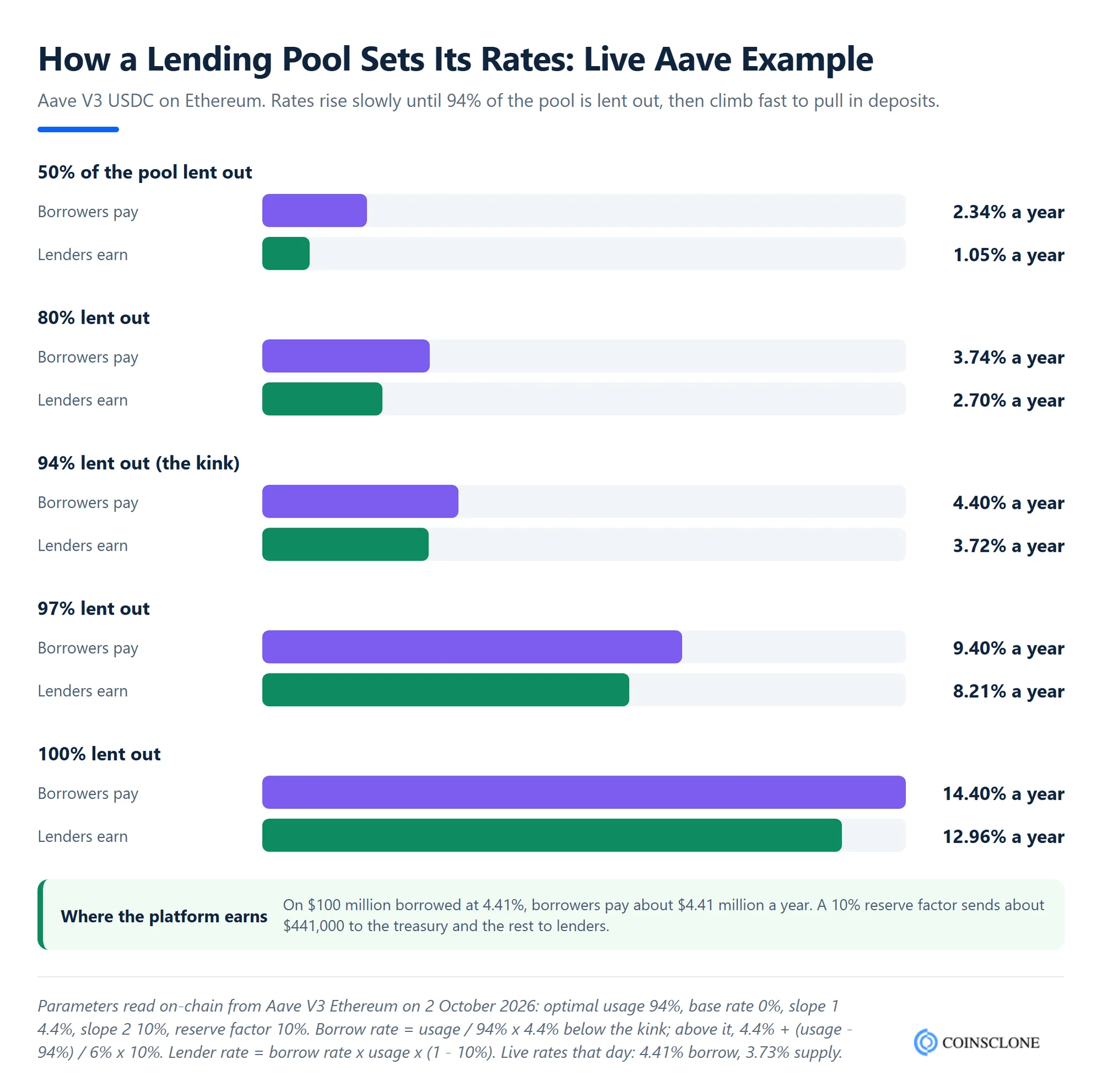
This curve is a design choice you make for each asset. The “kink” and the steep second slope protect lenders. They make sure there is almost always cash to withdraw. The test is real: after the April 2026 rsETH exploit, Aave’s USDC pool on Ethereum hit 99.87% use, and its risk team proposed steeper rates to bring cash back.
Types of DeFi Lending Platforms You Can Build
Before you write any code, pick the lending model. Each one serves a different user and needs a different risk setup.
- Pooled lending (Aave and Compound style): Everyone shares one pool per asset, and rates move with use. It is the most proven model and the safest first build. Our Aave clone script and Compound clone script follow this design.
- Isolated markets (Morpho and Euler style): Each market pairs one collateral with one loan asset, so a bad asset cannot drain the rest. Curators then build vaults that spread deposits across markets.
- Stablecoin minting (CDP): Users lock assets and mint a stablecoin, as on Sky (once MakerDAO) or Liquity. You need a stable, deep market for that coin.
- Fixed-rate loans: Borrowers lock a rate for a set term. Morpho added fixed-rate markets in July 2026, and Coinbase now uses them for fixed-rate USDC loans backed by bitcoin.
- Institutional credit: Lenders fund loans to vetted firms. Maple’s syrupUSDC paid 5.2% APY on 2 October 2026.
- NFT-backed loans: Users borrow against NFTs, with floor-price oracles and auctions for liquidation. See our NFT lending platform development service.
- Flash loans: Loans with no collateral that must be repaid in the same transaction. They are a feature inside a pool more than a platform of their own.
The Architecture of a DeFi Lending Platform
A lending platform is more than one smart contract. Five contracts hold the money and apply the rules. Four more parts, off chain, keep users informed and loans healthy.
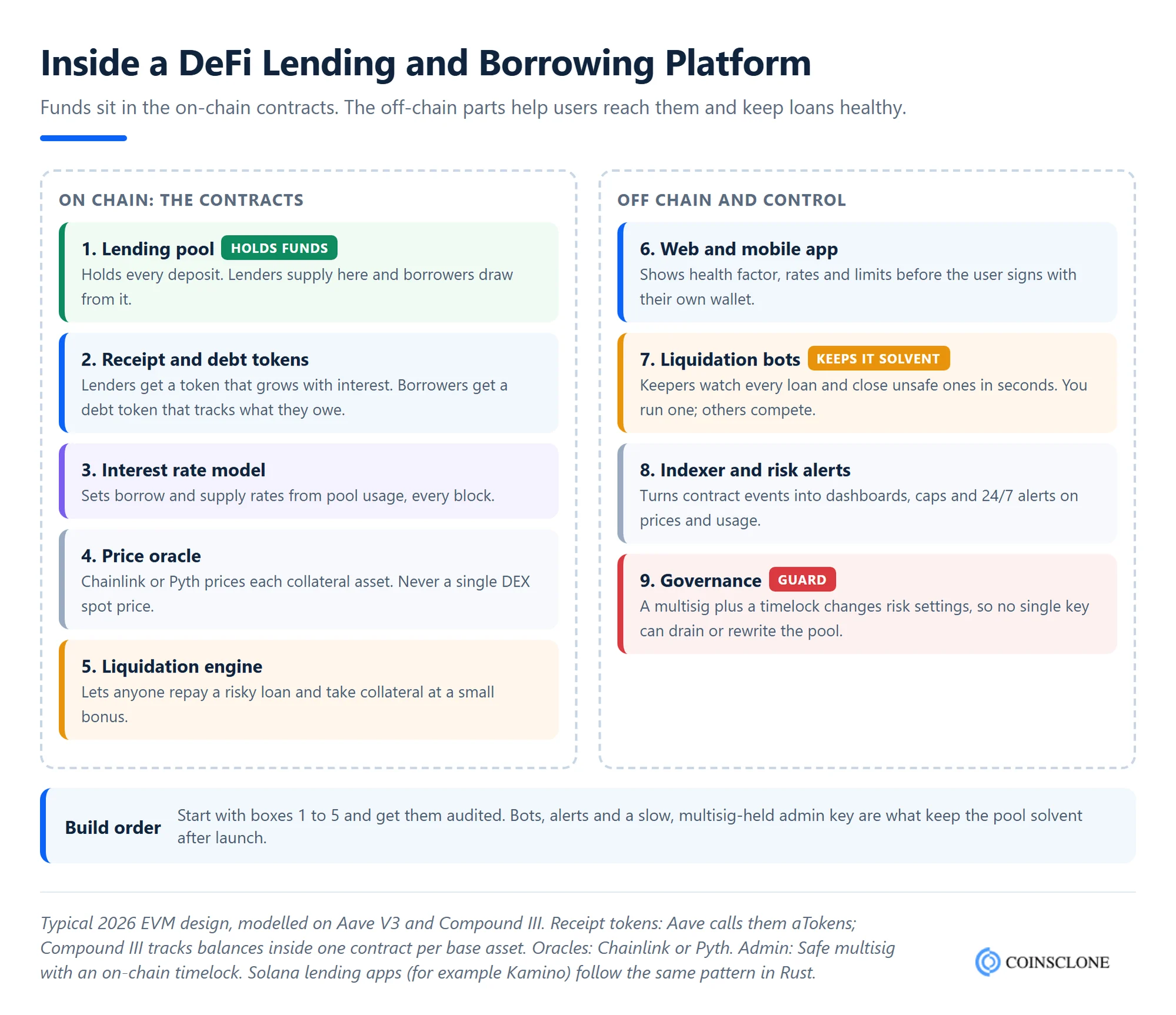
The two parts teams most often get wrong are the oracle and the liquidation bots. A cheap price feed lets an attacker inflate collateral for one block. Weak bots let bad debt build up in a fast market crash.
Core Features of a DeFi Lending and Borrowing Platform
DeFi lending and borrowing platforms share many features with any DeFi smart contract build. Here is what users, admins and security teams need.
User Features
- Smart contract automation: Code runs every step, from loans to paying interest. This cuts out middlemen and keeps costs low.
- Token support: Users can lend or borrow many assets, such as ETH, BTC wrappers and major stablecoins.
- Algorithmic interest rates: Rates move with supply and demand, so the price of money stays fair.
- Non-custodial wallets: Users keep control of their assets through their own wallets, such as MetaMask or a smart wallet.
- Health factor view: A clear gauge shows how close each loan is to liquidation, with alerts before it gets there.
- Cross-chain access: Some platforms run on several chains, so users can reach more assets and lower fees.
Admin Features
- Liquidity pools: Admins list assets, open pools and set supply and borrow caps for each.
- Governance: Token holders can vote on updates, new assets and fee changes.
- Live dashboards: Admins see cash in the pool, loan health, demand and revenue.
- Emergency pause: If something breaks, a guardian can pause one market or the whole platform to stop the damage.
- Risk settings: Admins tune LTV, liquidation thresholds, bonuses and rate curves as markets change.
Security Features
- Collateral rules: Users must lock more value than they borrow, which protects lenders.
- Smart contract audits: Outside firms check every contract for flaws before launch and after each upgrade.
- Bug bounty program: Ethical hackers get paid to find flaws before attackers do.
- Multisig and timelock: Admin changes need many signers and a wait, so no single key can change the rules at once.
- Non-custodial design: Users keep their own keys. The platform never holds them.
- Open records: Each deposit, loan and liquidation sits on a public chain that anyone can check.
Our Advanced Features to Power Your DeFi Lending and Borrowing Platform
Modern DeFi users expect more than basic lending. These features help you win users and grow your liquidity faster.
- Flash loans: Users borrow with no collateral, as long as they repay within the same transaction. Traders use them to trade price gaps, move loans and close risky loans. Aave charges a 0.05% flash loan fee by default, which becomes extra income for lenders and the treasury.
- Safety modules: A reserve fund or staked backstop covers lenders if a market ends up with bad debt after a crash.
- Cross-chain lending: Users supply on one chain and borrow on another, which opens up more assets and liquidity.
- Stablecoin loans: Users borrow coins pegged to the dollar, such as USDC or USDT, so what they owe stays easy to plan.
- NFT-backed loans: NFT holders can unlock cash from their collections without selling them.
- Fixed-rate options: Borrowers lock a rate for a set term, a feature large lenders now ask for.
- Referral and loyalty rewards: Rewards for lending, borrowing and staking help you win and keep users.
Tech Stack for DeFi Lending Platform Development
Most 2026 lending builds use a proven, open stack. The table shows a typical setup.
| Layer | Common choices in 2026 |
| Blockchain | Ethereum, Base, Arbitrum, BNB Chain, Solana |
| Smart contracts | Solidity with OpenZeppelin libraries (EVM); Rust with Anchor (Solana) |
| Build and test | Foundry or Hardhat, with fuzz and invariant tests |
| Price oracles | Chainlink, Pyth, RedStone |
| Front end | React or Next.js with viem and wagmi |
| Wallets | MetaMask, WalletConnect, embedded smart wallets |
| Data and alerts | The Graph or a custom indexer, plus on-chain monitoring |
| Admin control | Safe multisig with an on-chain timelock |
| Security checks | Slither, Echidna, outside audits, a public bug bounty |
Avoid tools that are no longer kept up. Truffle and Ganache, still listed by some guides, were retired at the end of 2023.
How to Keep a DeFi Lending Platform Safe
Lending apps hold large sums, so they draw constant attacks. The 2026 data shows exactly where the risk sits.
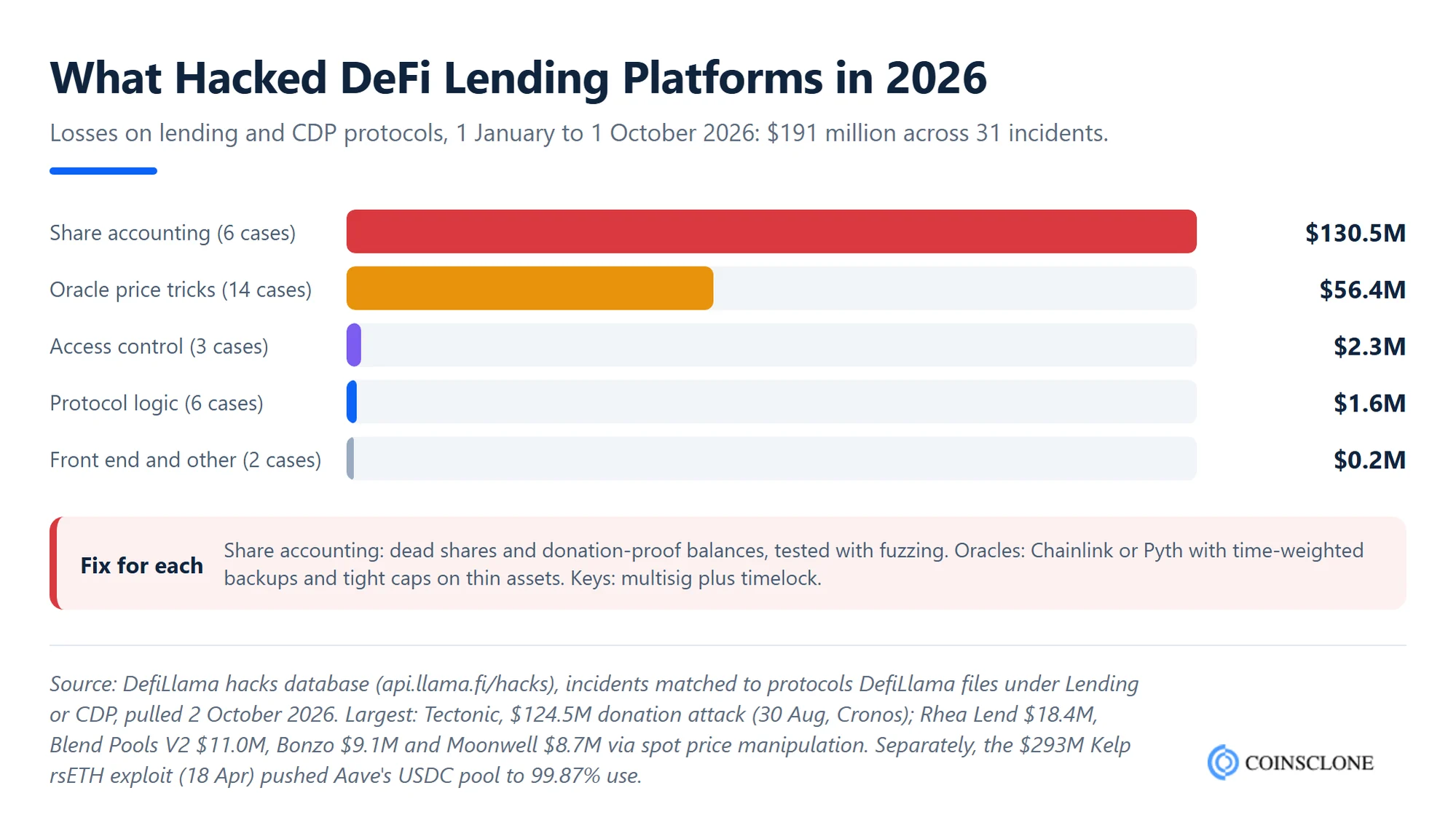
Two causes made up almost all of the $191 million lost on lending apps this year, based on DefiLlama’s hacks database:
- Share accounting bugs: An attacker “donates” tokens to a fresh or thin market to skew the share price, then borrows against the inflated value. This one flaw cost Tectonic about $124.5 million in August 2026.
- Oracle price tricks: In 14 cases, attackers moved a thin market price for one block and borrowed against the fake value. Using a single DEX spot price as the oracle is the classic mistake.
Collateral risk matters too. The April 2026 Kelp rsETH exploit ($293 million) was not a lending hack, but it hit every lending market that accepted rsETH as collateral. That is why careful teams cap new or wrapped assets, list them in isolated markets first and watch them around the clock.
Here is a practical security plan for launch:
- Use proven code paths: Start from audited lending logic and change as little as you can.
- Fix share math early: Use dead shares or virtual balances, and fuzz-test every deposit and borrow path.
- Pick strong oracles: Use Chainlink or Pyth with a time-weighted backup, and set supply caps for thin assets.
- Get two audits: Audit before launch and again after any change to the core contracts.
- Lock admin keys: Use a multisig, a timelock and a guardian that can only pause, not move funds.
- Watch everything: Run your own liquidation bot, price alerts and a public bug bounty from day one.
Our Three Ways to Build Your DeFi Lending Platform
Each DeFi business is unique, and so is the way we build your platform. We offer three routes to match your timeline, feature needs and budget.
Custom Development From Scratch
We build your DeFi lending and borrowing platform from the ground up, with your own lending model, risk pools, oracle setup and governance. This route suits teams with a new idea, such as fixed-rate loans, loans backed by real-world assets or cross-chain credit. It also fits teams that must meet strict rules. You get full control over features, full ownership of the code and room to grow.
White Label DeFi Lending and Borrowing Solution
Our White Label DeFi Lending and Borrowing Solution lets you enter the market fast. It comes with proven parts such as lending pools, backed loans, liquidations and staking. You can tailor the design, features, supported tokens and rewards. This route also cuts build effort and lowers security risk, since the core logic is already tested. Our Aave-style build takes about 8 to 12 weeks from idea to a live protocol.
Hire DeFi Developers
When you hire our dedicated developers for your DeFi platform, they help you with:
- Smart contract upgrades
- Better liquidity modules
- Security upgrades and audit fixes
- Scaling to more chains and assets
This lets you grow your DeFi lending and borrowing platform on your own terms, with expert support on call.
A Note on Forking Aave, Compound or Euler Code
Many teams plan to copy an open-source protocol. Check the licence first, because the newest versions are not free to reuse in production:
- Aave V4: The Aave V4 licence allows testing only. Any live use needs a commercial licence from Aave. It turns into MIT five years after V4 went live on Ethereum, or sooner if Aave governance sets an earlier date.
- Aave v3.7: A Business Source License that bars uses that pull users or funds away from Aave.
- Older Aave V3 core: Its licence switched to MIT on 27 January 2023, which is why so many V3 forks exist.
- Compound III: Its Business Source License changed to GPL 2.0 or later by 31 December 2025.
- Morpho Blue: GPL 2.0.
- Euler Vault Kit: Business Source License until 24 April 2029.
A white label build avoids this problem, since you get code you are allowed to run under your own brand.
Our Diverse DeFi Lending and Borrowing Services
At Coinsclone, we cover every part of a lending launch. Our services help you build and grow a DeFi lending and borrowing platform with less risk.
Smart Contract Design and Coding
We write safe, low-gas smart contracts for lending pools, rate models, collateral rules, liquidations and reward payouts. Every contract goes through outside audits and stress tests, so it works well even when the network is busy.
Tokenomics Design
We design token plans that attract and keep liquidity. This covers rewards, supply limits, token use in governance, incentives for lenders and a fair fee split. We test each model against market crash scenarios before launch.
Dashboards and Reports
Our dashboards give you a full view of collateral health, pool use, revenue, user growth, token supply and APY. This helps you make sound choices about rates, caps and growth.
DAO Governance Modules
We build voting systems so your community can propose and approve rule changes. Votes run on chain with a timelock, which keeps every change open and gives users time to react.
Non-Custodial Design
Users keep full control of their assets at all times. We back this with strong encryption, on-chain code and safe wallet links.
Cross-Chain Support and Bridges
We help you run your lending markets on many chains, such as Ethereum, Base, BNB Chain and Solana. This widens your reach and puts more liquidity to work.
Our Latest DeFi Lending and Borrowing App for Modern Businesses
Users want simple, safe and mobile-first ways to use DeFi. That is why we built a DeFi lending and borrowing app for businesses that want to move fast.
DeFi Lending and Borrowing App
Our app gives users a clean dashboard for their deposits and yield. Borrowing screens show the best options and check collateral on the spot. The app includes a non-custodial wallet, and users can fund their lending with stablecoins. With a few taps, users can lend, borrow, repay, track yield and manage collateral.
Whether you are a new startup or a business ready to grow, our app links your users to DeFi lending.
Benefits of Building a DeFi Lending and Borrowing Platform
A DeFi lending and borrowing platform offers clear gains for users, investors and founders.
- Decentralization: Peer-to-peer loans cut costs and give users control.
- Access: Anyone with a wallet can lend or borrow, even without a bank account.
- Transparency: Every loan and payment is on a public blockchain.
- Automation: Smart contracts run the process and reduce human error.
- Competitive returns: Lenders earn market rates that move with demand.
- Flexibility: Users can choose from many assets and loan types.
- Security: Non-custodial wallets and on-chain rules protect user funds.
- Market growth: Lending is one of the largest DeFi sectors, at about $55 billion in deposits.
- Customization: Features like cross-chain markets and governance tokens set your platform apart.
- Financial inclusion: Loans with no credit checks open finance to more people.
How DeFi Lending Platforms Make Money
A lending platform earns a share of the interest and fees that flow through it. Most of the money goes to lenders, so your take rate is a design choice you set in the contracts.
- Reserve factor: A cut of all interest paid by borrowers. Aave V3 sets 10% on USDC and 15% on ETH on Ethereum.
- Liquidation share: Part of each liquidation bonus can go to the treasury.
- Flash loan fees: A small fee, such as 0.05%, on each flash loan.
- Listing and integration deals: Fees or incentives from token teams that want a market.
- Token value: A governance token can capture fees through buybacks or staking.
For scale, Aave V3 users paid about $36.1 million in fees over the 30 days to 1 October 2026. Per DefiLlama, the protocol kept about $4.7 million of that.
Cost to Develop a DeFi Lending and Borrowing Platform
The cost depends on your lending model, the number of chains and assets, and how many audits you need. Published 2026 price guides from development firms give these market ranges:
| Build scope | What you get | Typical market cost |
| MVP | One chain, a few assets, pooled lending, basic admin | $80,000 to $120,000 |
| Mid-scale | More assets, governance, analytics, mobile app | $120,000 to $250,000 |
| Enterprise | Multi-chain, fixed-rate or institutional features | $250,000 to $450,000+ |
| Security audits | One or two outside audits of the core contracts | $40,000 to $120,000 |
A custom build with audits usually takes about 20 to 36 weeks. A white label route is faster and cheaper, since the core is already built and tested. Our Aave-style white label build takes about 8 to 12 weeks.
Also budget for running costs after launch. These include oracle feeds, servers for your bots and alerts, a bug bounty, and rewards to attract the first lenders. A lending pool with no deposits earns nothing, so liquidity planning is part of the cost.
Legal and Compliance Checks Before Launch
Rules for DeFi lending are still forming, so get legal advice for each market you serve.
- United States: The GENIUS Act, signed on 18 July 2025, sets rules for stablecoin issuers. It matters if you plan to issue your own stablecoin. The wider CLARITY market structure bill stalled after a 49 to 50 Senate vote on 15 September 2026.
- European Union: MiCA has no set rules yet for crypto loans, and fully decentralized services fall outside it. Front ends, token issuers and firms that control the platform may still need a license.
- Fiat access: If users can buy crypto with cards or bank transfers, your on-ramp partner will handle KYC and AML checks.
Our Structured Development Roadmap for Your DeFi Lending Business
At Coinsclone, we follow a clear process that takes your idea to a live, growing platform.
- Understand your needs: We study your business goals, target assets, lending model and revenue plan, then map a build plan.
- Design the platform and contracts: We design lending pools, collateral rules and rate curves on an upgrade-safe contract design.
- Build the app and integrations: We connect wallets, oracles and chains, and build clear screens for lenders and borrowers.
- Audit and test: Each part goes through audits, fuzz tests and crash drills to protect your users and your platform.
- Deploy: We launch your protocol on your chosen blockchain and help you bring in the first liquidity.
- Support after launch: We monitor, tune risk settings and add new features and governance tools as you grow.
Why Choose Coinsclone for DeFi Lending and Borrowing Platform Development?
Coinsclone is a leading DeFi development company that has built crypto and DeFi products since 2018. We have delivered 350+ platforms for 200+ clients across 20 industries. Our team builds secure, scalable lending platforms with audited contracts, strong oracles and clear risk controls.
If you want to launch fast, we can deliver an Aave-style white label lending platform in about 8 to 12 weeks. If you need a new lending model, we build it from scratch with you. Either way, you get a platform shaped around your users, your assets and your revenue plan.
Frequently Asked Questions
What is DeFi lending and borrowing platform development?
It is the work of building an app where users lend crypto to earn interest and borrow against crypto they lock up. Smart contracts manage the loans, rates, collateral and repayments on the blockchain, with no bank in between.
How does a DeFi lending platform work?
Lenders pool their assets in a smart contract. Borrowers lock collateral worth more than their loan and borrow from the pool. The contracts set the interest rate from pool use, track each loan’s health and let liquidators close loans that fall below the safe line.
How much does it cost to build a DeFi lending platform?
Published 2026 market ranges run from about $80,000 to $120,000 for an MVP, $120,000 to $250,000 for a mid-scale platform and $250,000 to $450,000 or more for an enterprise build. Outside audits add about $40,000 to $120,000. A white label platform costs less, since the core is already built.
How long does it take to build a DeFi lending platform?
A custom build with audits usually takes about 20 to 36 weeks. A white label, Aave-style platform from Coinsclone takes about 8 to 12 weeks from idea to launch.
Is a DeFi lending platform safe?
It can be, when it is built well. Loans backed by more than they are worth, strong price feeds, audited code, a multisig with a timelock and live alerts all cut risk. Still, lending apps lost about $191 million to hacks in the first nine months of 2026, mostly through share accounting bugs and oracle tricks. So audits and caps on risky assets are essential.
How are interest rates set on a DeFi lending platform?
Rates follow utilization, the share of the pool that is lent out. For example, Aave’s USDC pool on Ethereum charges borrowers about 4.4% a year when 94% of the pool is in use. Above that point, rates climb fast to bring in new deposits.
How do liquidations work in DeFi lending?
Each loan has a health factor: collateral value times the liquidation threshold, divided by the debt. When it falls below 1, anyone can repay part of the debt and take some collateral at a bonus, such as 5% on Aave’s ETH market. Bots do this in seconds, which keeps the pool solvent.
Can users borrow without collateral?
Yes, through flash loans. A flash loan needs no collateral, but it must be repaid within the same transaction or the whole action is reversed. Aave charges a 0.05% fee by default. Regular loans on most DeFi platforms still need collateral.
How do DeFi lending platforms make money?
They keep a share of the interest borrowers pay, known as the reserve factor, plus part of liquidation bonuses and flash loan fees. In the 30 days to 1 October 2026, Aave V3 users paid about $36.1 million in fees, and the protocol kept about $4.7 million.
What services does a DeFi lending platform development company provide?
Most firms offer smart contract design and coding, token and wallet setup, loan and liquidation logic, lending pools, cross-chain support, price feeds, app design, audits, launch and support after launch.
Can a DeFi platform support multiple cryptocurrencies and cross-chain assets?
Yes. A well-built DeFi lending platform can support many tokens and run on several chains. This lets businesses and users tap a wider base of assets for lending and borrowing.
What does “liquidity pool” mean in DeFi lending?
A liquidity pool is a shared pot of crypto supplied by lenders. Users borrow from it, and the smart contract pays interest to the lenders on its own.
What does “collateralization” mean, and why is it used?
It means users lock crypto, worth more than the loan, to back it. If the loan becomes unsafe, the platform sells part of the collateral to repay lenders. This protects lenders without credit checks.
See How Our MVP System Can Help You Build a DeFi Lending & Borrowing Platform Faster
DeFi Lending & Borrowing Development — trustless finance made easy.
- MVP System : Build your Compound-like lending protocol 90% faster.
- DeFi-Ready Modules : Collateralized lending, interest rate models, liquidation logic included.
- Brand & Customization : Your tokens, governance rules, UI, and preferred blockchain.
- Revenue Engine : Earn from lending interest, protocol fees, and staking rewards.
Get a free lending platform demo in just 48 hours — before you invest a cent.
Book a Free Demo to discover how our DeFi Lending & Borrowing Platform Development takes you from idea to live protocol in just 8–12 weeks.