
Decentralized exchange development is the process of building a crypto trading platform where users swap tokens from their own wallets through smart contracts, with no company holding their funds. A white label DEX takes about 5 to 7 weeks and costs about $10,000 to $50,000, while a custom DEX costs about $40,000 to $250,000 or more, based on published 2026 market ranges.
DEXs are now a major part of crypto trading. In the 30 days to 25 October 2026, DEX protocols handled about $217 billion of spot trades, according to DefiLlama’s DEX dashboard. Uniswap alone processed about $65 billion across its chains, and the busiest chain was Solana, not Ethereum. If you are planning a DEX for your DeFi business idea, this guide walks you through every decision.
In this guide:
- The six types of DEX you can build, and how a DEX sets prices
- Whether to build from scratch, fork, use Uniswap v4 hooks or start from a white label
- A 10-step build plan, the tech stack and the team you need
- Real 2026 costs, timelines and ways to attract liquidity after launch
- How a DEX makes money, and the rules that apply to it
See How Our MVP System Can Help You Build the Best Decentralized Exchange Faster
Decentralized Exchange Development — done right.
- MVP System : Launch your Uniswap or PancakeSwap-like DEX 90% faster.
- DeFi-Ready Modules : Built-in liquidity pools, staking, and wallet integration — no coding needed.
- Brand & Customization : Your tokens, your design, your liquidity ecosystem.
- Revenue Engine : Earn from swap fees, farming, and governance tokens.
See a free branded DEX demo in just 48 hours — before spending a cent!
Book a Free Demo to discover how our DEX Development System can take you from concept to a live decentralized exchange in 8–12 weeks.
What Is Decentralized Exchange Development?
Decentralized exchange development is the work of planning, coding, testing and launching a DEX. It covers the smart contracts that hold funds and run trades, the website and apps that traders use, and the data and security systems around them.
A decentralized exchange is a crypto trading platform that runs on smart contracts. Users connect a self-custody wallet, such as MetaMask or Phantom, and trade directly from it. The DEX never holds their funds, and trades settle on the blockchain.
Most DEXs use liquidity pools instead of a traditional order book. Liquidity providers add pairs of tokens to a pool. Traders swap against the pool at a price set by a formula. Some DEXs, especially for perpetual futures, use on-chain order books instead.
DEX vs CEX: The Key Differences
| Decentralized exchange (DEX) | Centralized exchange (CEX) | |
| Who holds funds | The user, in their own wallet | The exchange |
| Sign-up | Connect a wallet | Account and usually KYC |
| Trading | Smart contracts on a blockchain | The exchange’s own servers |
| Listing | Anyone can create a pool | The exchange decides |
| Main risks | Smart contract bugs, scam tokens | Hacks, insolvency, account freezes |
| Fiat on-ramp | Through partners | Usually built in |
Why Decentralized Exchange Development Is Worth It
- Growing volume: DEXs now handle hundreds of billions of dollars of trades every month.
- Self-custody demand: After failures such as FTX in 2022, many users prefer to keep control of their funds.
- Global reach from day one: A DEX can serve users anywhere a wallet works, subject to local rules.
- Built-in revenue: Every swap pays a fee, and a DEX can add launchpads, farms and perps.
- Composability: Aggregators and wallets can route trades into your pools, bringing volume from across the market.
Which Blockchain Is Best for a DEX?
The best blockchain for a DEX is the one your target traders already use. Solana leads on trades. Ethereum and its layer 2s have the deepest pools, and BNB Chain stays strong with retail traders. The chart below shows the 30-day split from September 2026:
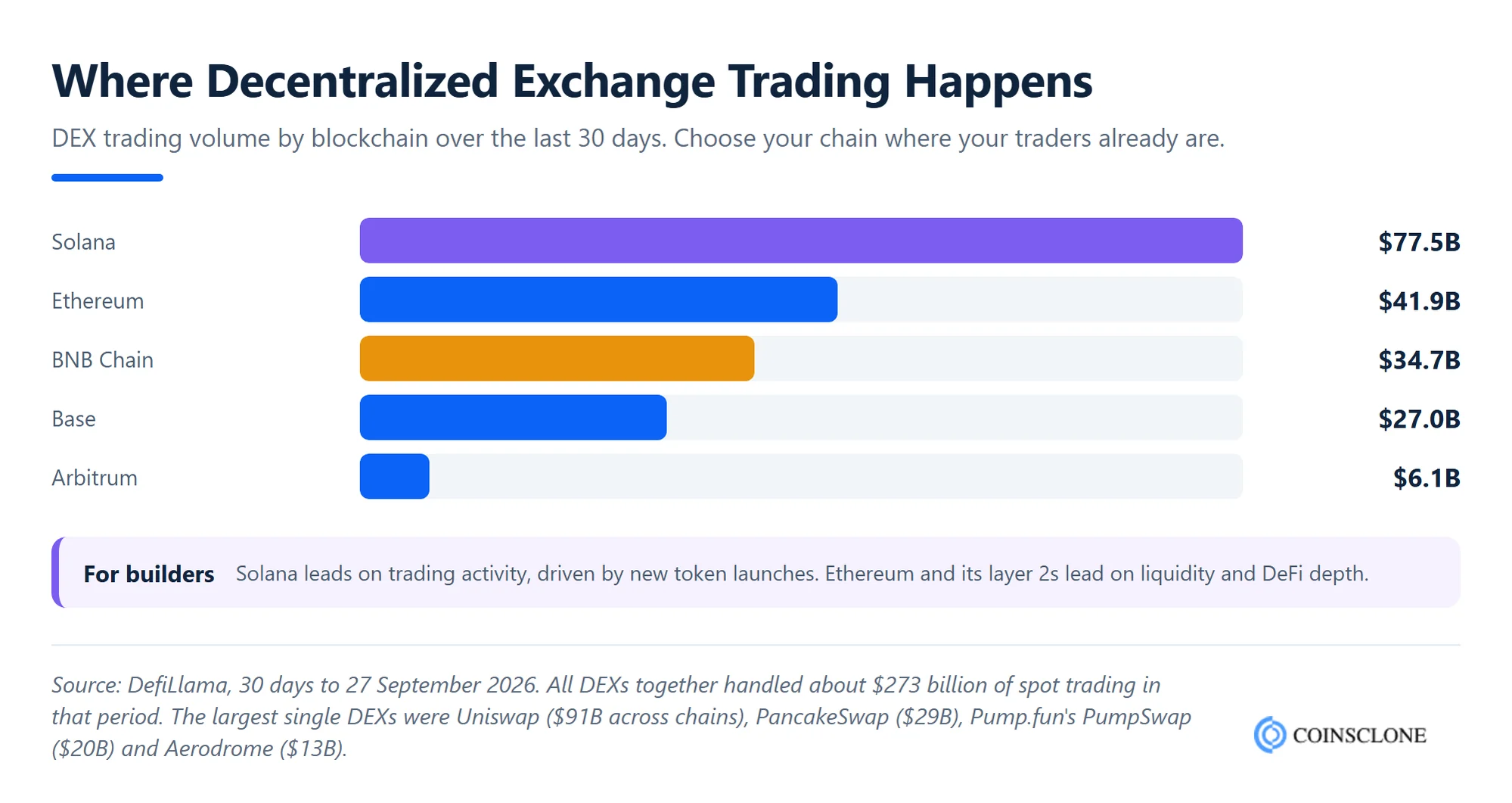
The picture moves fast. In the 30 days to 25 October 2026, DefiLlama shows about $63 billion of DEX trades on Solana and $38 billion on Ethereum. Base had $29 billion, BNB Chain $27 billion and Arbitrum $5 billion. Solana’s lead comes largely from new token launches. Many new DEXs now launch on two or three chains at once.
Types of Decentralized Exchanges You Can Build
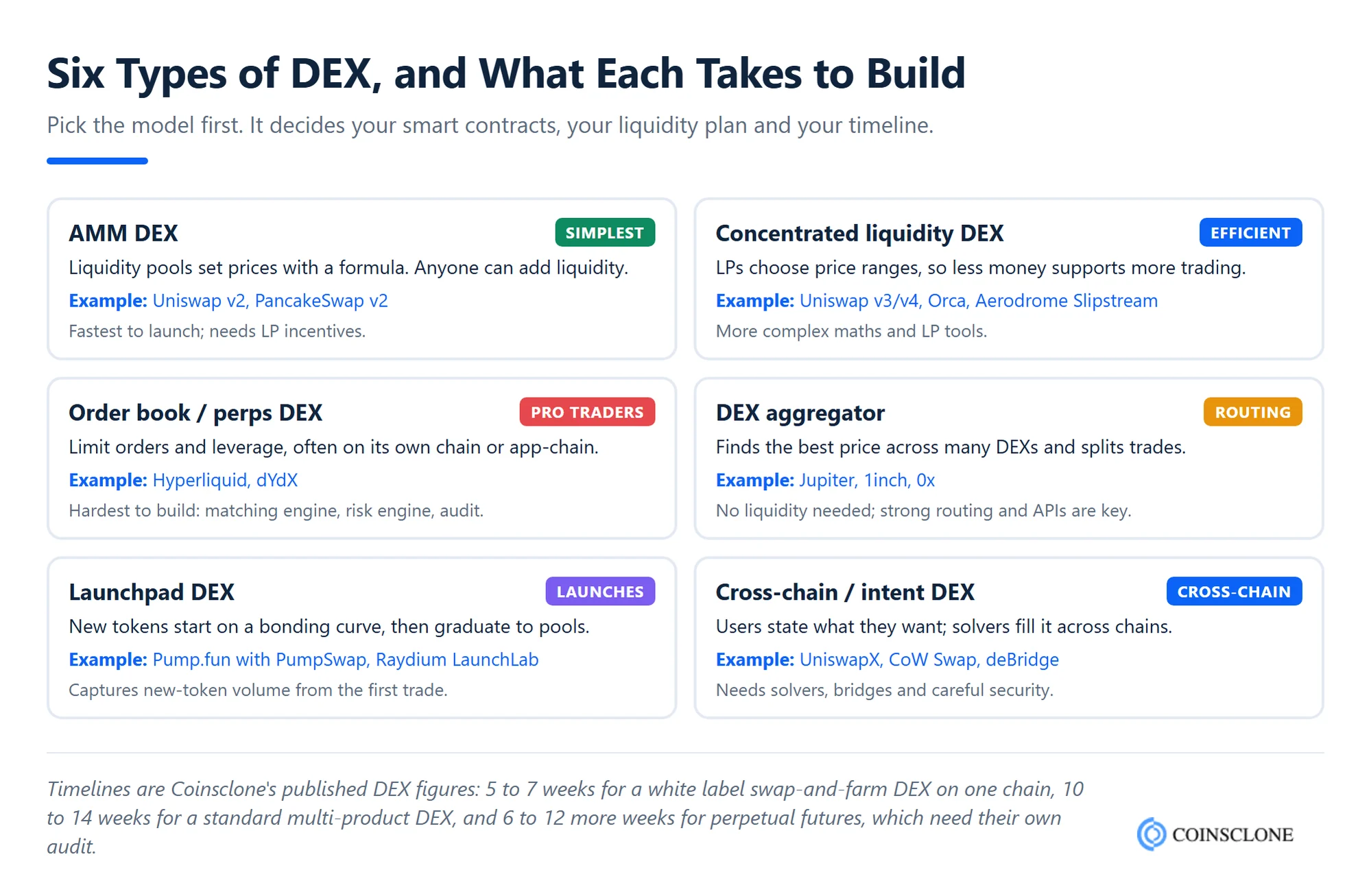
- AMM DEX: The simplest model. Pools set prices with a formula such as x × y = k. Ideal for a first DEX.
- Concentrated liquidity DEX: Liquidity providers pick price ranges, so each dollar in the pool works harder.
- Order book or perpetual DEX: Limit orders and leverage for pro traders. Hyperliquid showed how big this market can be, but it is the hardest type to build. See how to create a perpetual DEX like Hyperliquid.
- DEX aggregator: Routes trades across many DEXs for the best price. It needs no liquidity of its own. See DEX aggregator development.
- Launchpad DEX: New tokens start on a bonding curve, then move to pools, as on Pump.fun and Raydium LaunchLab. Plan for bots from day one; our guide on how to stop snipers on a token launch covers the main defences.
- Cross-chain or intent-based DEX: Users say what they want, and solvers fill the order across chains. See our guide to cross-chain DEXs.
Should a New DEX Use an AMM or an Order Book?
Use an AMM if you want any token to trade at any time with no market makers. Use an order book if traders need exact prices, such as for perps or for tokens sold at a fixed price.
A 2025 r/ethereum post asked exactly this for a real estate token. The owner wanted to sell tokens at a fixed price, let holders trade at their own prices, and buy everyone out at one price at the end. An AMM fails that test, because every trade moves the price and the pool locks up capital. An on-chain order book with limit orders suits that kind of real-world asset much better.
How Does a Decentralized Exchange Work?
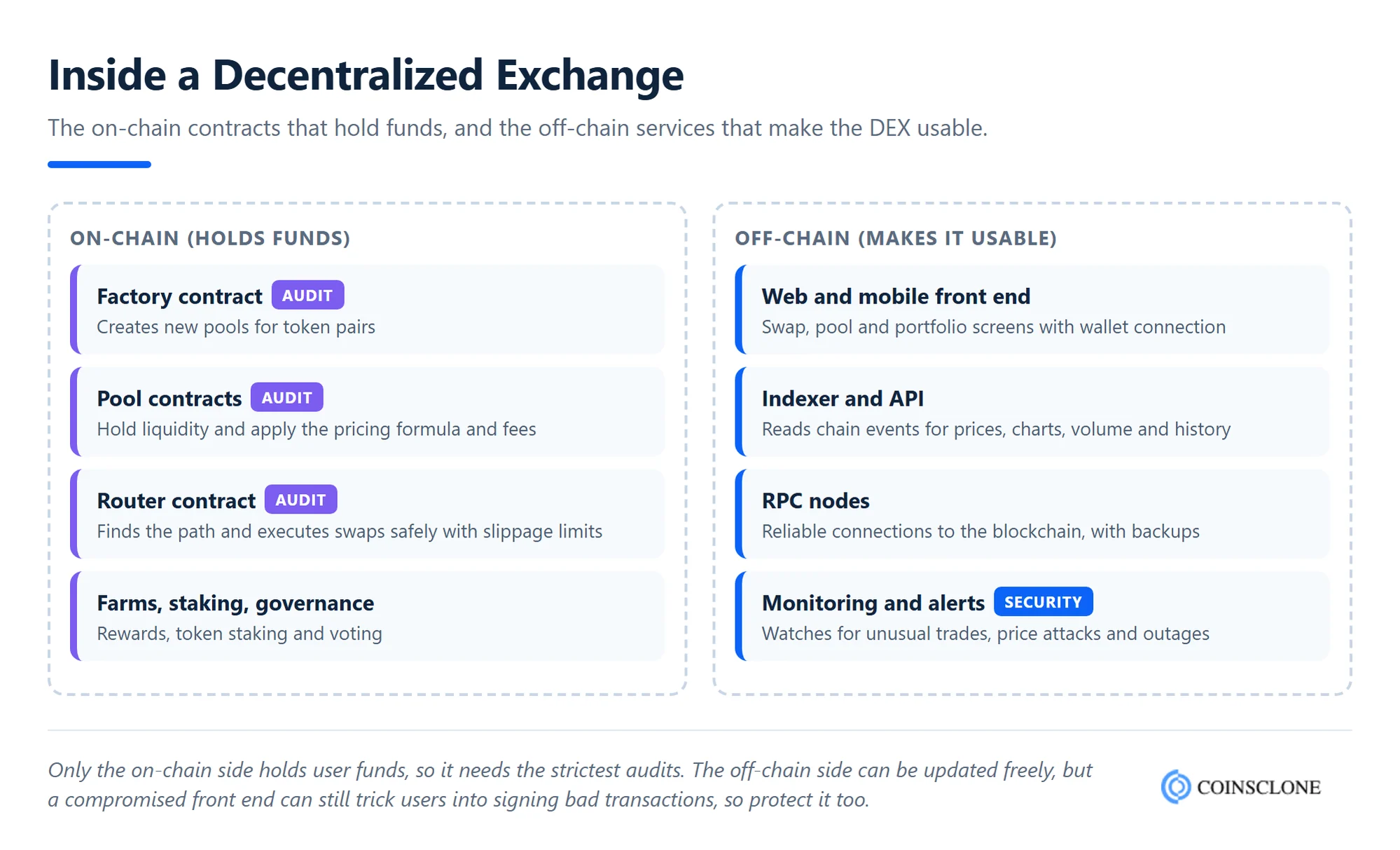
A DEX has two halves. The on-chain side is a set of smart contracts that hold funds: a factory that creates pools, the pools themselves, and a router that runs swaps with slippage limits. The off-chain side makes the DEX usable. It covers the website and apps, an indexer that turns chain data into prices and charts, solid RPC nodes, and alerts.
How an AMM Sets the Price
An AMM keeps the product of its two token balances fixed. Take a pool with 100 ETH and 400,000 USDC, so 1 ETH is worth 4,000 USDC:
| Trade | ETH received | Price impact |
| Spend 4,000 USDC | About 0.99 ETH | About 1% |
| Spend 40,000 USDC | About 9.09 ETH | About 9% |
The bigger the trade compared with the pool, the worse the price. That is why liquidity, not code, decides whether traders stay on a new DEX. These figures leave out the swap fee, which is often 0.3% on a standard pool.
Decentralized Exchange Software Development: Build, Fork or White Label?
The fastest route for most startups is a white label DEX or clone script. Building from scratch only makes sense when your edge is a new pool design or trading engine. In between sit two newer options: forking open code and building a hook on Uniswap v4.
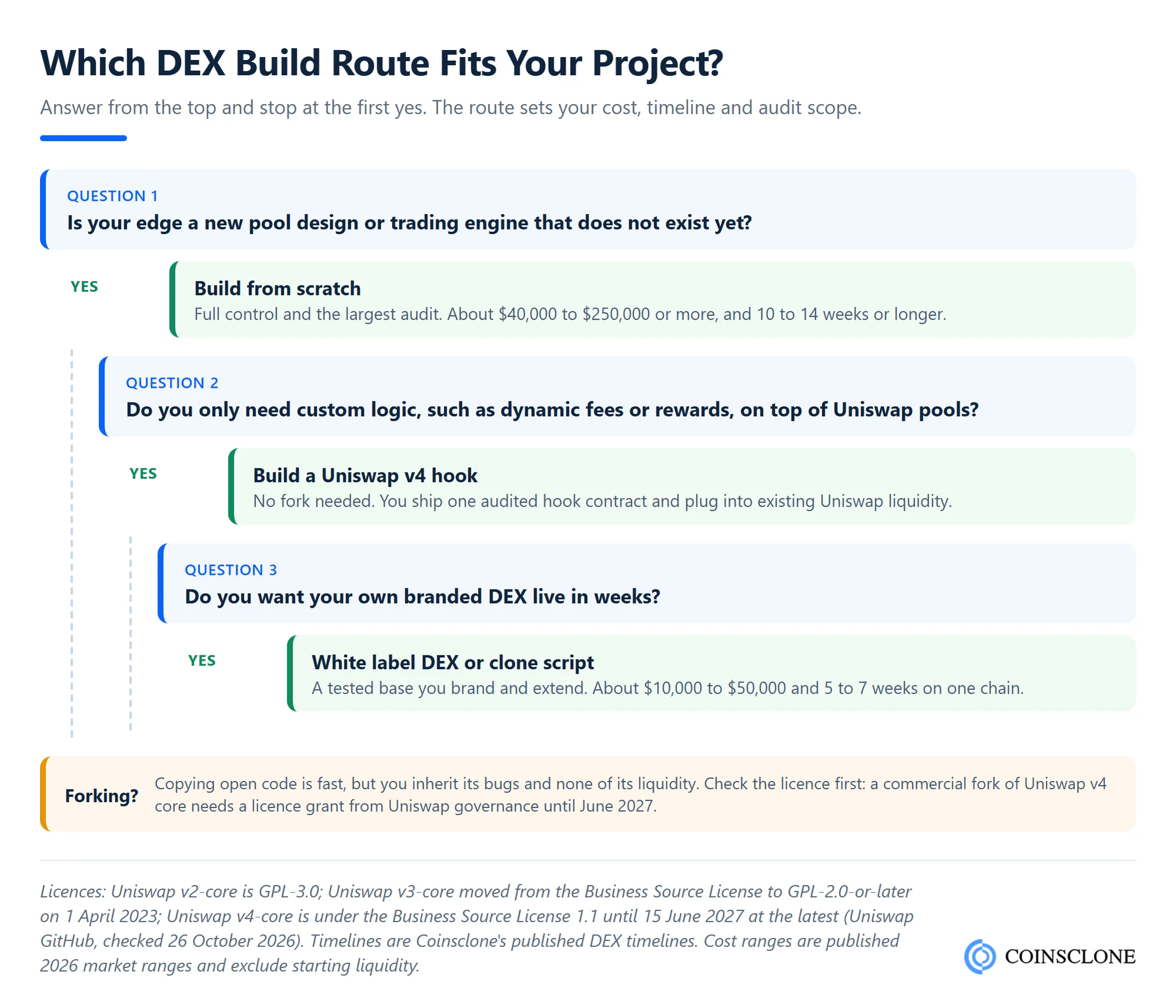
- From scratch: Full control, but the longest timeline and the largest audit scope.
- Fork open code: Fast, but you inherit its bugs and none of its liquidity. Check licences first. Uniswap v2 is GPL and v3 moved to GPL in April 2023, but Uniswap v4 core stays under a Business Source License until 15 June 2027 at the latest.
- White label or clone script: A tested base you can brand and extend. This is the fastest and lowest-risk route for most teams.
Can You Build a DEX on Uniswap v4 Hooks Instead of Forking?
Yes. Uniswap v4, live since January 2025, lets developers attach a “hook” contract to a pool. A hook can add dynamic fees, limit orders, rewards or custom checks without copying Uniswap’s code. You write and audit one contract and tap into Uniswap’s liquidity and routing. The trade-off is that your product lives inside Uniswap rather than as your own brand of exchange.
How to Build a Decentralized Exchange: Step by Step
These are the 10 steps we follow to create your own DEX. For a longer walkthrough, read our guide on how to create a decentralized exchange.
1. Market Analysis
Study your target users and rivals. Decide which chain, which tokens and which type of trader you will serve, and what you will do better than existing DEXs.
2. Choose the DEX Model
Pick the type from the list above. Most new projects start with an AMM or concentrated liquidity DEX and add features later.
3. Choose the Development Method
Decide between building from scratch, forking, a Uniswap v4 hook or a white label base. The decision tree above shows which one fits.
4. Choose the Blockchain
Match your chain to your users: Solana for fast, cheap trading and new tokens, Ethereum and its layer 2s for DeFi depth, BNB Chain for retail users, or several chains at once.
5. Design the UI and UX
Keep swaps to a few clicks. Show price impact, fees and slippage clearly, add charts and portfolio views, and support popular wallets.
6. Develop and Deploy Smart Contracts
Build the factory, pool and router contracts, plus farms, staking, referral and governance contracts if you need them. Use proven code libraries and keep admin powers small, behind a multisig or timelock.
7. Integrate Security
Add slippage limits, safe price feeds, a pause switch and live alerts. Protect the front end against DNS hijacks and malicious scripts.
8. Test and Audit
Test on a testnet, run automated tests and fuzzing, and get an independent audit. Consider a bug bounty after launch.
9. Launch and Bootstrap Liquidity
Seed your main pools, run liquidity rewards, and list your pools with aggregators such as Jupiter, 1inch or 0x so traders find you. The next section explains how.
10. Support and Upgrade
Monitor the DEX, respond to incidents, and add features such as new chains, limit orders or perps over time.
Launch Your Own Decentralized Exchange With A DEX Clone Script
Cost-effective | White-Label Solutions | Premium Features | Fully Customizable | Live Demo Available
How Do You Get Liquidity for a New DEX?
You get liquidity for a new DEX in three ways: seed the first pools yourself, pay rewards to outside providers, and plug into aggregators that send you trades. No single method is enough. Copying a DEX’s code is easy, but its liquidity does not come with it.
- Seed your own pools: Put treasury funds into the main pairs so early trades do not suffer large price impact. Our guide on how to create a liquidity pool for a token shows the steps.
- Use concentrated liquidity: It lets the same capital give tighter prices around the current rate.
- Get listed by aggregators: Jupiter on Solana and 1inch, 0x or CoW Swap on EVM chains route trades to whichever pool gives the best price.
- Work with market makers: For order book DEXs and perps, professional liquidity providers keep spreads tight from day one.
Which Rewards Really Bring Liquidity to a Small DEX?
A September 2026 r/CryptoCurrency thread asked this. The poster ran a small order book and had to add their own funds every day to keep it full. The pattern that works is to pay for depth, not just deposits:
- Maker rebates: Pay traders who post resting orders a small share of fees.
- Targeted rewards: Reward liquidity only on your core pairs and only close to the current price.
- Time-locked rewards: Pay more to providers who commit for weeks, so funds do not leave the day rewards drop.
- Market maker deals: Offer fee discounts or token loans in return for set spreads and uptime.
Broad token rewards on every pool tend to attract short-term “mercenary” capital that leaves when the rewards end.
Should a New DEX Start With External Market Makers?
Yes, for order book and perp DEXs, and it helps AMMs too. An August 2026 r/BlockchainStartups thread asked whether a new exchange should start with outside market makers and move to organic liquidity later. That is the common path. Still, a full order book is not proof of a healthy market. Watch real slippage on real user orders at different times of day, and cut paid support only as organic volume grows.
Key Features of a Decentralized Exchange
For users:
- Token swaps with best-price routing
- Liquidity pools and LP positions
- Farms and staking rewards
- Limit orders
- Wallet balances and trade history
- Multi-wallet support
- Charts and token information
- Cross-chain swaps
For the admin:
- Fee settings and fee split between LPs and the protocol
- Featured tokens and token warnings
- Farm and reward management
- Stats on volume, pools and users
- A pause switch and multisig controls
Tech Stack for DEX Software Development
- Smart contracts: Solidity with Foundry or Hardhat for EVM chains; Rust with Anchor for Solana.
- Front end: React or Next.js with wallet libraries such as wagmi, viem or the Solana wallet adapter.
- Indexing: Subgraphs or custom indexers for prices, volume and history.
- Hosting: Solid RPC providers with backups, and cloud hosting that blocks DDoS attacks.
- Testing: Unit tests, fuzz tests, code scans and outside audits.
What Team Do You Need to Build a DEX?
A typical DEX team has a product lead, one or two smart contract coders, a front-end coder and a back-end coder. Add a QA tester and a designer, plus an outside audit firm. A white label base shrinks this team, because the core contracts and screens already exist.
DEX Security: Lessons From Real Exploits
Even well-known DEXs have been hacked. KyberSwap lost about $48 million to an exploit of its Elastic pools in November 2023. Balancer lost about $128 million to a rounding bug in its v2 stable pools in November 2025. Its token holders then voted to wind it down in September 2026. Both bugs sat in complex pool maths.
To reduce risk:
- Keep the design as simple as your product allows.
- Audit every contract that holds funds, and re-audit after changes.
- Limit admin powers and put them behind a multisig and a timelock.
- Protect against price manipulation with safe oracle design.
- Offer MEV protection, such as private transaction routing, to stop sandwich attacks.
- Run a bug bounty so researchers report bugs instead of exploiting them.
How Much Does Decentralized Exchange Development Cost?
A white label or clone script DEX costs about $10,000 to $50,000, and a custom DEX costs about $40,000 to $250,000 or more, based on published 2026 market ranges. The price depends on the DEX type, the number of chains, the features and the audit scope.
| Cost item | Typical 2026 range |
| White label or clone script DEX | $10,000 to $50,000 |
| Custom DEX built from scratch | $40,000 to $250,000+ |
| Smart contract audit (mid-tier firm, DeFi protocol) | $15,000 to $70,000 |
| Starting liquidity and rewards | Set by you; often the largest single budget line |
| Hosting, RPC nodes and monitoring | A monthly running cost |
Perps, extra chains and cross-chain swaps push a build toward the top of the custom range. See the detailed cost to build a DEX like PancakeSwap for a worked example.
How Long Does It Take to Build a DEX?
A white label DEX on one chain takes about 5 to 7 weeks with Coinsclone, and a standard multi-product DEX about 10 to 14 weeks. Our published timelines are:
| DEX scope | Typical timeline |
| White label swap-and-farm DEX on one chain | 5 to 7 weeks |
| Standard multi-product DEX | 10 to 14 weeks |
| Adding perpetual futures | 6 to 12 more weeks, with its own audit |
How Does a Decentralized Exchange Make Money?
- Swap fees: A share of each trade’s fee, set through a protocol fee or “fee switch”.
- Launchpad fees: Fees on new token launches.
- Perps fees: Trading fees on leveraged products, often the largest earner.
- Front-end fees: A small fee on trades made through the DEX’s own app.
- Token value: Buybacks or staking rewards funded by protocol revenue.
The model you pick changes how much you keep. Over the 12 months to October 2026, Hyperliquid kept about $687 million of its $903 million in fees (DefiLlama data). Uniswap kept about $59 million of $933 million, because most AMM fees go to the people who supply the pools. Read more in how crypto exchanges make money.
Is It Legal to Launch a DEX?
Yes, in most countries, but the rules depend on how decentralized your DEX really is. Smart contracts alone face few rules. A company that runs the front end, charges fees or controls upgrades can still be regulated.
- European Union: MiCA says services run “in a fully decentralised manner” fall outside its scope (Recital 22). A team that keeps control over the DEX may still need a licence.
- United States: The SEC closed its investigation of Uniswap Labs in February 2025 without action. US teams that run a front end or charge fees still need to plan for sanctions and money transmission rules.
- Practical steps: Many teams block sanctioned regions on the front end, screen wallets, and keep admin keys in a multisig.
Get legal advice for each target market. Our guide to crypto licences explains which licence fits which business.
DEX Development Services: What You Get
A full DEX development service covers everything from the first idea to support after launch:
- Planning: Picking the DEX model, chain, fees and token.
- Smart contract development: Pools, router, farms, staking, launchpad and governance.
- Front end and apps: Web app, mobile apps, wallet connections and charts.
- Back end: Data feeds, APIs, stats and the admin panel.
- Security: Tests, audits, fixes and round-the-clock checks.
- Launch: Going live, with aggregator listings and a liquidity plan.
- Support: Upgrades, new chains and help when things break.
DEX Clone Script Development: Models You Can Launch
A clone script is the fastest way to launch a proven DEX model. Coinsclone offers:
| Clone script | Model | Chain |
| Uniswap clone script | AMM and concentrated liquidity | Ethereum and EVM chains |
| PancakeSwap clone script | AMM with farms, lottery and launchpad | BNB Chain and EVM chains |
| SushiSwap clone script | Multi-chain AMM | EVM chains |
| Raydium clone script | AMM, concentrated liquidity and launchpad | Solana |
| Hyperliquid clone script | Perpetual futures order book | App-chain |
| SunSwap clone script | AMM for TRX and TRC-20 tokens | TRON |
| Balancer clone script | Weighted multi-token pools (the original is winding down) | EVM chains |
| PantherSwap clone script | Yield farm DEX with anti-whale rules | BNB Chain |
| Poocoin clone script | Charting and swap platform | BNB Chain |
| DEX Screener clone script | Real-time DEX analytics | Multi-chain |
You can also start from our white label decentralized exchange or our ready-made decentralized exchange script and shape it around your own model.
Why Choose Coinsclone for Decentralized Exchange Development?
Coinsclone is a decentralized exchange development company that has built blockchain products since 2018. We have delivered more than 350 platforms for over 200 clients across 20 industries. We build AMM, concentrated liquidity, launchpad and perps DEXs on EVM chains, Solana and TRON. Every build comes with audited contracts, aggregator links and support after launch. Our DEX scripts are fully customisable, and you can see a live demo before you decide. For a wider view of the market, see our list of the best decentralized exchanges.
See How Our MVP System Can Help You Build the Best Decentralized Exchange Faster
Decentralized Exchange Development — done right.
- MVP System : Launch your Uniswap or PancakeSwap-like DEX 90% faster.
- DeFi-Ready Modules : Built-in liquidity pools, staking, and wallet integration — no coding needed.
- Brand & Customization : Your tokens, your design, your liquidity ecosystem.
- Revenue Engine : Earn from swap fees, farming, and governance tokens.
See a free branded DEX demo in just 48 hours — before spending a cent!
Book a Free Demo to discover how our DEX Development System can take you from concept to a live decentralized exchange in 8–12 weeks.
Frequently Asked Questions
What is decentralized exchange development?
It is the process of building a crypto trading platform that runs on smart contracts, where users trade from their own wallets without a company holding their funds.
How do I create a decentralized exchange?
Choose your DEX type and chain, then pick a build method: from scratch, fork, Uniswap v4 hook or white label. Next, build and audit the smart contracts and the front end, then launch and attract liquidity.
How long does it take to build a DEX?
With Coinsclone, a white label swap-and-farm DEX on one chain takes about 5 to 7 weeks, and a standard multi-product DEX about 10 to 14 weeks. Perpetual futures add 6 to 12 weeks.
How much does it cost to develop a DEX?
Published 2026 market ranges put a white label DEX at about $10,000 to $50,000 and a custom DEX at about $40,000 to $250,000 or more. The audit alone often costs $15,000 to $70,000, and you also need a budget for liquidity.
Is it legal to fork Uniswap for my DEX?
Forking Uniswap v2 or v3 is allowed under their GPL licences. Uniswap v4 core uses a Business Source License until 15 June 2027 at the latest. Until then, a commercial fork needs a licence grant from Uniswap governance. Building a v4 hook needs no fork at all.
What features should a new DEX offer?
A 2025 BitcoinTalk thread asked traders this, listing chains, fees, cross-chain swaps, liquidity rewards and limit orders. Start with fast swaps, clear price impact, multi-wallet support, farms and charts. Then add limit orders, cross-chain swaps and perps as volume grows.
Which blockchain is best for a DEX?
Solana had the most DEX trades in October 2026. Ethereum and its layer 2s such as Base have the deepest pools, and BNB Chain is a favourite of retail traders. Choose the chain your target users already use.
How does a DEX make money?
From a share of swap fees, launchpad fees, perps fees, front-end fees and, sometimes, token buybacks funded by revenue.
Is it legal to launch a DEX?
Rules vary by country. Non-custodial DEXs face fewer rules than exchanges that hold funds, but front ends, tokens and fees can still be regulated. Get legal advice for your target markets.
What is the difference between a DEX and a CEX?
A DEX lets users trade from their own wallets through smart contracts. A CEX holds users’ funds and matches trades on its own servers.