

This guide lists the 10 DeFi business ideas that earn real money in 2026, plus a few smaller ones worth a look. For each idea you will see what it is, how it makes money, a live example with its fees from DefiLlama, and what it takes to build. In short, it is a shortlist for founders who want to pick one model and start.
DeFi has changed a lot since the early days of token swaps. Total value locked fell over the past year, yet stablecoins, perp trading and prediction markets kept growing. So the best idea today is not always the one that was hot in 2021. We use fresh numbers so you can see where users pay fees right now.
In this guide:
- 10 proven models: from DEXs and lending to prediction markets and RWA tokenization, each with 30-day fee data.
- Where the money is: a chart of fees by business type, and how much each protocol keeps.
- How to choose: a simple decision tree based on your team, budget and licence needs.
- How to start: six steps, build times, and the rules and risks to plan for.
Top 10 DeFi Business Ideas to Start in 2026
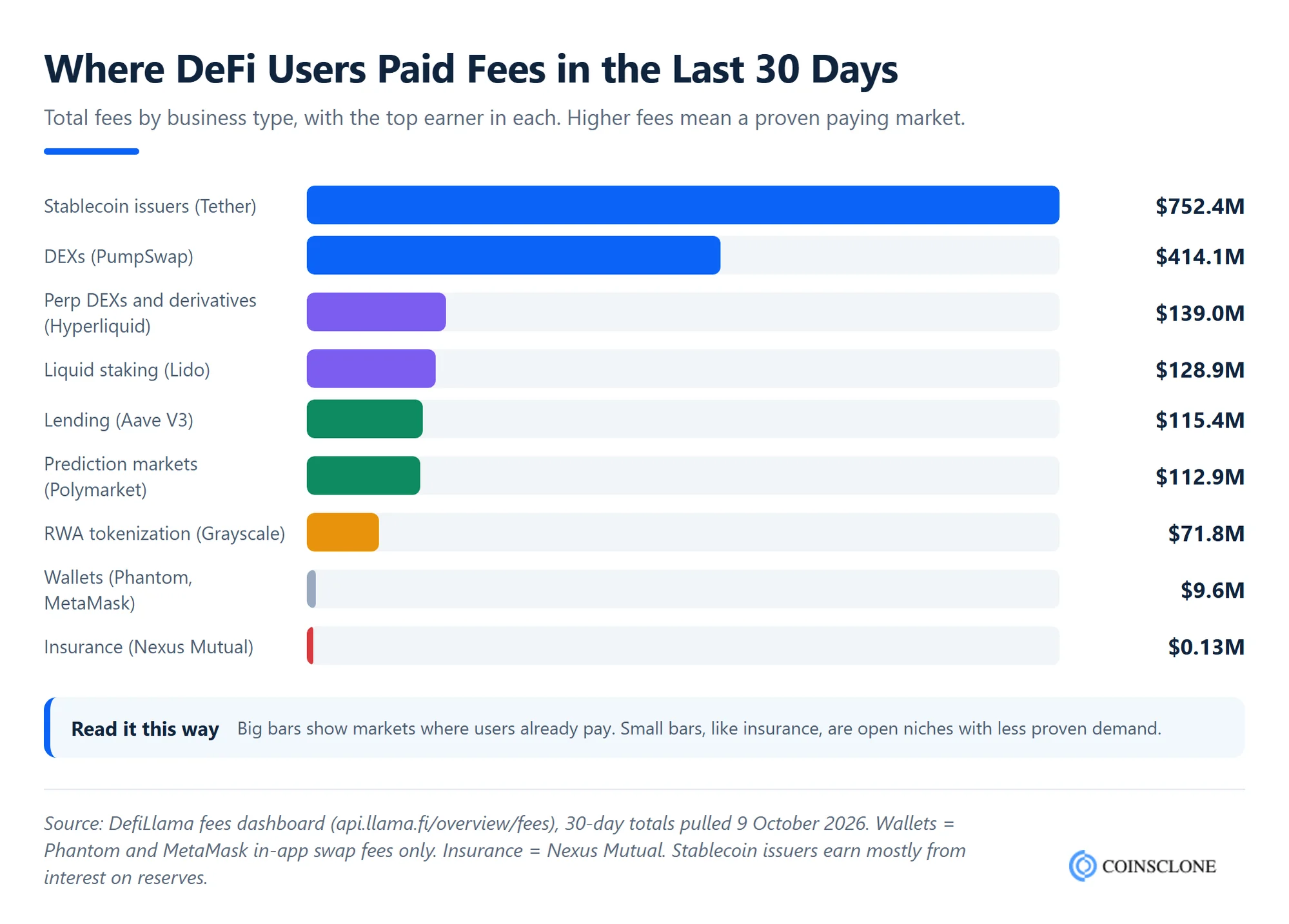
When it comes to picking from the top DeFi trends, the main focus will always be on how to make money with DeFi and how long the business can last. With that in mind, we chose the ten ideas below because each one has a live market where users pay real fees today. The chart shows where those fees went over the last 30 days.
1. Decentralized Exchange (DEX)
A decentralized exchange lets users swap tokens straight from their own wallets, with no middleman holding funds. Most DEXs use an Automated Market Maker (AMM), where users add tokens to pools and traders swap against them. A DEX is still one of the best DeFi business ideas, because every swap pays a small fee.
- How it earns: a swap fee on every trade (often 0.01% to 1% per pool), with a share kept by the protocol.
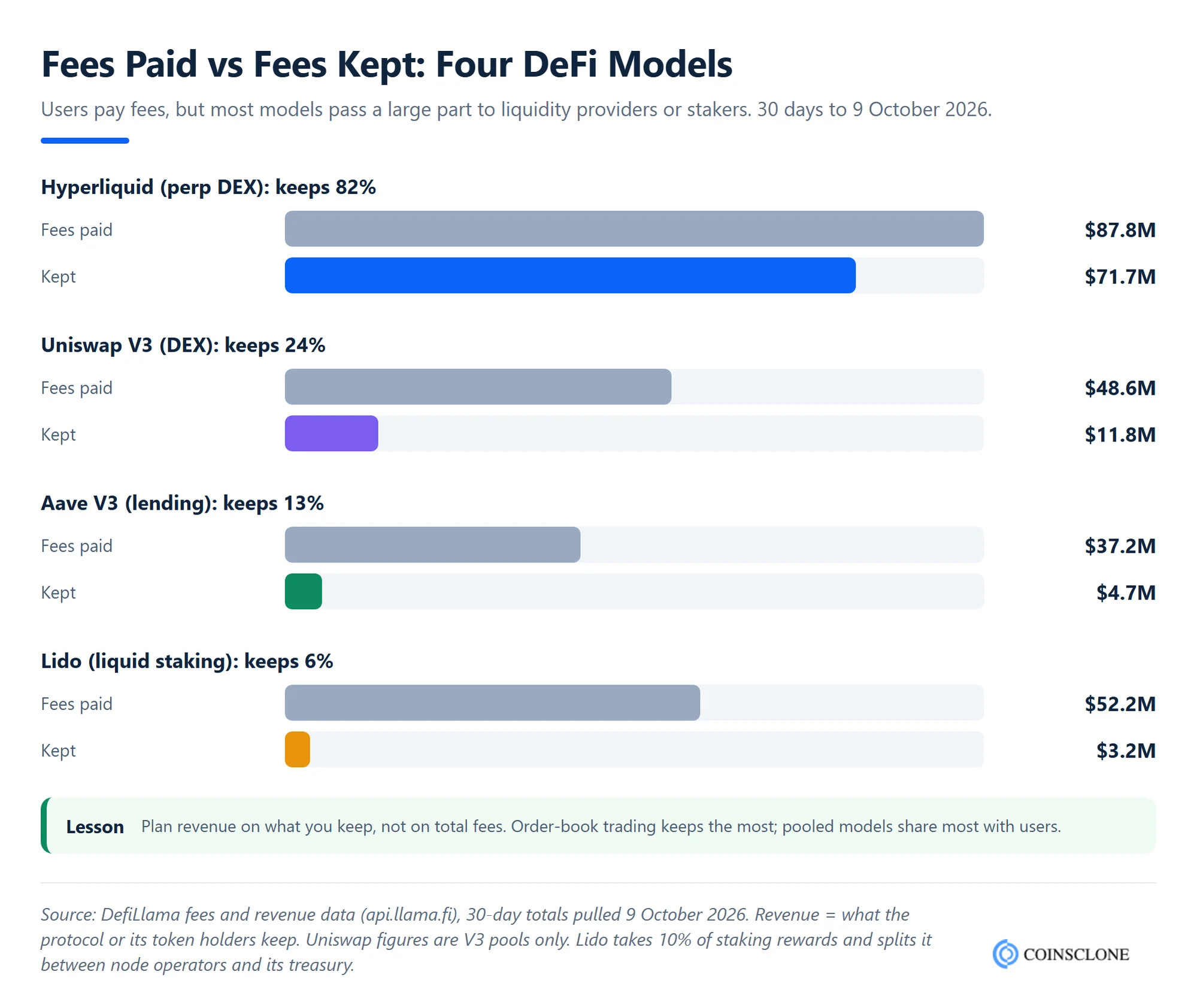
- Live example: Uniswap V3 pools earned $48.6 million in fees in 30 days. Uniswap kept $11.8 million of it, per DefiLlama fees data on 9 October 2026. All DEXs together earned $414 million in that time.
- What you need: liquidity on day one, a sharp niche (a chain, a token type or a region), and an audited AMM.
Building a DEX has become easier with white-label software. Coinsclone can build your DEX in 5 to 7 weeks with white-label code, or 10 to 14 weeks as a standard build.
2. DeFi Lending and Borrowing Platform
A DeFi lending platform lets users lend crypto to earn interest, or borrow against crypto they lock up. Here, a borrower gets funds from a shared pool, while the lender earns interest on it. Smart contracts set the rates and sell off a loan’s collateral if its value falls too far.
- How it earns: a cut of the interest that borrowers pay, plus fees when bad loans are closed out.
- Live example: Aave is the largest of the best DeFi lending platforms. Its lenders get aTokens, which earn interest, not AAVE tokens. Aave V3 borrowers paid $37.2 million in interest in 30 days. Aave kept $4.7 million, per DefiLlama.
- What you need: strong price oracles, careful risk settings for each asset, and an audit before launch.
For the full build path, see our guide to DeFi lending and borrowing platform development.
3. Perpetual Futures DEX
A perp DEX (short for perpetual futures DEX) lets traders bet on crypto prices going up or down, with borrowed funds and no end date. It is now one of the biggest earners in DeFi. Users keep their own funds, and the order book or pool runs on-chain.
- How it earns: trading fees on every order, plus funding and liquidation fees.
- Live example: Hyperliquid’s perp market charged $87.8 million in fees over 30 days and kept $71.7 million, per DefiLlama. That is a far higher share than most DeFi models keep.
- What you need: a fast trading engine, strong market makers, and a clear plan for rules, since trading with borrowed funds is regulated in many countries.
Our guide on how to create a perpetual DEX like Hyperliquid covers the design choices in detail.
4. DeFi Staking Platform
A DeFi staking platform lets users lock tokens to help secure a blockchain and earn rewards. Liquid staking goes one step further: users get a receipt token they can still trade or lend. Once the user base grows due to passive income, the owner can build a reputation that helps other products too.
- How it earns: a share of the staking rewards. Lido, for one, takes 10% of rewards and splits it between node operators and its treasury.
- Live example: liquid staking apps earned $128.9 million in fees over 30 days. Lido led with $52.2 million, of which it kept $3.2 million, per DefiLlama.
- What you need: trusted validators, a safe way to cash out, and clear lock-up terms.
5. Yield Farming and Vault Platform
Yield farming is the process of putting crypto to work across pools to earn rewards, often paid in governance tokens. A vault platform does this for users automatically. It moves funds to the best rates and compounds the rewards, so users do not have to.
- How it earns: a fee on profits (often 10% to 20%) and sometimes a small yearly fee.
- Live example: this market is smaller than it was in 2021. Yearn Finance earned about $0.7 million in fees over 30 days, per DefiLlama. However, newer “curator” vaults on lending markets are growing fast.
- What you need: strategies with real yield (not just token rewards), strict risk limits, and audited vault contracts.
See our guide to DeFi yield farming development for features and costs.
6. Stablecoin Payment Gateway
A DeFi payment gateway lets shops and apps accept crypto, mostly stablecoins such as USDT and USDC, and settle fast at low cost. It can also convert crypto to local money for the merchant. A payment gateway is a smart pick among DeFi startup ideas, because firms now use stablecoins for real trade.
- How it earns: a fee on each payment, plus fees on currency conversion and payouts. Gateway fees in 2026 run from 0% on self-hosted tools to about 2% on full-service ones.
- Live example: the stablecoin supply hit $311.6 billion on 9 October 2026. A year before, it was $302.6 billion, per DefiLlama stablecoin data. Tether alone earned $514.7 million in 30 days from the reserves behind its coin.
- What you need: a licence or a licensed partner for fiat payouts, KYC for merchants, and simple plugins for online shops.
Coinsclone can build your crypto payment gateway in 6 to 9 weeks, or 10 to 14 weeks with bank payouts.
7. DeFi Wallet
Any non-custodial wallet counts as a DeFi wallet, and the best-known one is MetaMask. Users hold their own keys and use the wallet to reach every DeFi app. Since every trader needs a wallet to enter DeFi, starting a business around one has a high scope for success.
- How it earns: a small fee on swaps, bridges and perp trades made inside the wallet.
- Live example: Phantom’s in-app swaps earned $7.0 million in fees over 30 days, and MetaMask’s swaps earned $2.7 million, per DefiLlama. Both also offer perp trading inside the app, and MetaMask has added prediction markets.
- What you need: strong key security, support for many chains, and a smooth mobile app.
Coinsclone can build your DeFi wallet in 3 to 5 weeks with white-label code, or 8 to 12 weeks as a custom build.
8. Prediction Market Platform
A prediction market lets users buy and sell shares on the outcome of real events, such as elections, sports or prices. Each share pays out if the event happens. This model has grown fast since 2024, and it is now among the top fee earners in crypto.
- How it earns: trading fees on each order, and sometimes fees for creating new markets.
- Live example: Polymarket’s US and global apps took about $104.5 million in fees in 30 days, per DefiLlama. In July 2025, Polymarket bought QCEX, a licensed US exchange, to serve US users.
- What you need: a trusted way to settle results (an oracle), deep pools of funds, and legal advice, since many countries treat these markets as betting or trading products.
See how we build a prediction market platform.
9. RWA Tokenization Platform
An RWA (real-world asset) tokenization platform turns assets such as bonds, funds, real estate or gold into tokens on a blockchain. Investors can then buy small parts, trade them at any time, and use them in DeFi apps. Banks and asset managers are now some of the biggest users.
- How it earns: fees to issue tokens, yearly management fees, and trading or redemption fees.
- Live example: RWA.xyz tracked about $38.55 billion of tokenized assets on 1 October 2026. DefiLlama’s RWA category earned $71.8 million in fees over 30 days.
- What you need: securities licences or a licensed partner, investor checks (KYC), and a token standard with built-in transfer rules.
Our guide to RWA tokenization platform development explains the legal and tech set-up.
10. DeFi Insurance Platform
A DeFi insurance platform sells cover against risks such as smart contract hacks, stablecoin de-pegs or exchange failures. Policies are written in smart contracts, and members share the risk in a pool. Claims are often voted on by members or settled by set rules.
- How it earns: cover fees (premiums) paid by users, and returns on the capital in the pool.
- Live example: this is still a small niche. Nexus Mutual, one of the best-known names, earned about $0.13 million in fees over 30 days, per DefiLlama. At the same time, DeFi lost $2.24 billion to hacks in 2026, so the need for cover is real.
- What you need: a strong risk model, enough capital to pay claims, and a fair, fast claims process.
Having discussed the main ideas, here are a few smaller ones before we compare them all.
Start your DeFi Business with Coinsclone
Cost-effective, White-Label Solution, Premium Features, Customizable. Live Demo Available.
More DeFi Startup Ideas Worth a Look
These ideas need less capital or serve other DeFi teams. They suit founders who want to start small or sell services first.
DeFi Token Launch
A DeFi token gives users a say in how a platform runs, rewards early users, or shares fees. Tokens are crypto assets built on a blockchain that already exists, using standards such as ERC-20 on Ethereum or SPL on Solana. Crypto fundraising is a major use of tokens. However, a token should support a real product, not replace one. Token sales are also regulated in many countries, so plan the legal side early. See our DeFi token development page for the options.
Smart Contract and dApp Studio
A smart contract is code stored on a blockchain that runs when set conditions are met. Since writing safe contracts is hard, many teams pay experts to build and review them. A studio that builds DeFi apps, audits code or monitors live contracts can earn steady service income from day one.
DEX Aggregator or Cross-Chain Bridge
A DEX aggregator searches many exchanges to find the best price for each swap. A bridge moves tokens between blockchains. Both earn a small fee on each trade or transfer. Bridges carry high risk, though: they are the most common target for large hacks, so security comes first.
DeFi Business Ideas Compared
This table sums up the ten main ideas. Fees are 30-day figures from DefiLlama on 9 October 2026. Build times are Coinsclone’s published ranges where one exists.
| Business idea | Main income | Live 30-day fees (example) | Licence needs | Build time |
| DEX | Swap fees | $414.1M (all DEXs) | Low to medium | 5-7 weeks white label, 10-14 standard |
| Lending platform | Interest spread | $37.2M (Aave V3) | Medium | Depends on scope |
| Perp DEX | Trading and funding fees | $87.8M (Hyperliquid) | High | Depends on scope |
| Staking platform | Share of rewards | $52.2M (Lido) | Low to medium | Depends on scope |
| Yield vaults | Performance fees | $0.7M (Yearn) | Low to medium | Depends on scope |
| Stablecoin payment gateway | Payment fees | $514.7M (Tether, issuer) | High | 6-9 weeks, 10-14 with settlement |
| DeFi wallet | In-app swap fees | $7.0M (Phantom) | Low | 3-5 weeks white label, 8-12 custom |
| Prediction market | Trading fees | $104.5M (Polymarket) | High | Depends on scope |
| RWA tokenization | Issuance and management fees | $71.8M (RWA category) | High | Depends on scope |
| DeFi insurance | Cover fees | $0.13M (Nexus Mutual) | Medium to high | Depends on scope |
Why Start a DeFi Business in 2026?
The DeFi market is big, but it has also changed shape. Total value locked was $91.6 billion on 9 October 2026, down from $167.2 billion a year earlier, mostly because token prices fell, per DefiLlama. Yet users still paid billions in fees, and money kept moving into stablecoins and tokenized assets.
Here is why it is still a good time to build:
- Users pay for real services: swaps, loans, trading and payments all charge fees every day, not just during a bull market.
- Clearer rules: the GENIUS Act gives US stablecoins a legal home, and the EU’s MiCA rules apply in full after the transition period ended on 1 July 2026.
- Big players are joining: banks, asset managers and fintech apps now use DeFi rails for payments, yield and tokenized funds.
- Faster launch: white-label software and audited open-source code cut build time from months to weeks.
Features like Automated Market Makers and smart contracts also keep running costs low, because code does the work a back office would do.
How DeFi Businesses Make Money
All DeFi firms earn from fees. The key question is how much of those fees the business keeps. In many models, most of the money goes to the users who fund the pools, so the app keeps only a slice.
The main DeFi business models are:
- Trading fees: DEXs, perp DEXs and prediction markets charge a fee on each trade.
- Interest share: lending apps keep part of what borrowers pay.
- Reward share: staking and vault platforms take a percentage of rewards or profits.
- Payment and conversion fees: gateways and wallets charge per payment or per swap.
- Reserve income: stablecoin issuers earn interest on the assets that back their coins.
- Service fees: studios charge for building, auditing and running smart contracts.
See How Our MVP System Can Help You Launch DeFi Business Ideas Faster
DeFi Business Ideas — built, tested, and launched with confidence.
- MVP System : Validate your DeFi business model 90% faster with ready-to-deploy modules.
- DeFi-Ready Modules : Lending, staking, prediction, and DAO features available.
- Brand & Customization : Full creative control over UI, tokens, and governance.
- Revenue Engine : Generate profits from fees, yield, and user rewards.
Get a free DeFi business idea demo in just 48 hours — before spending a cent!
Book a Free Demo to turn your DeFi business idea into a live platform fast.
How to Choose the Right DeFi Business Idea
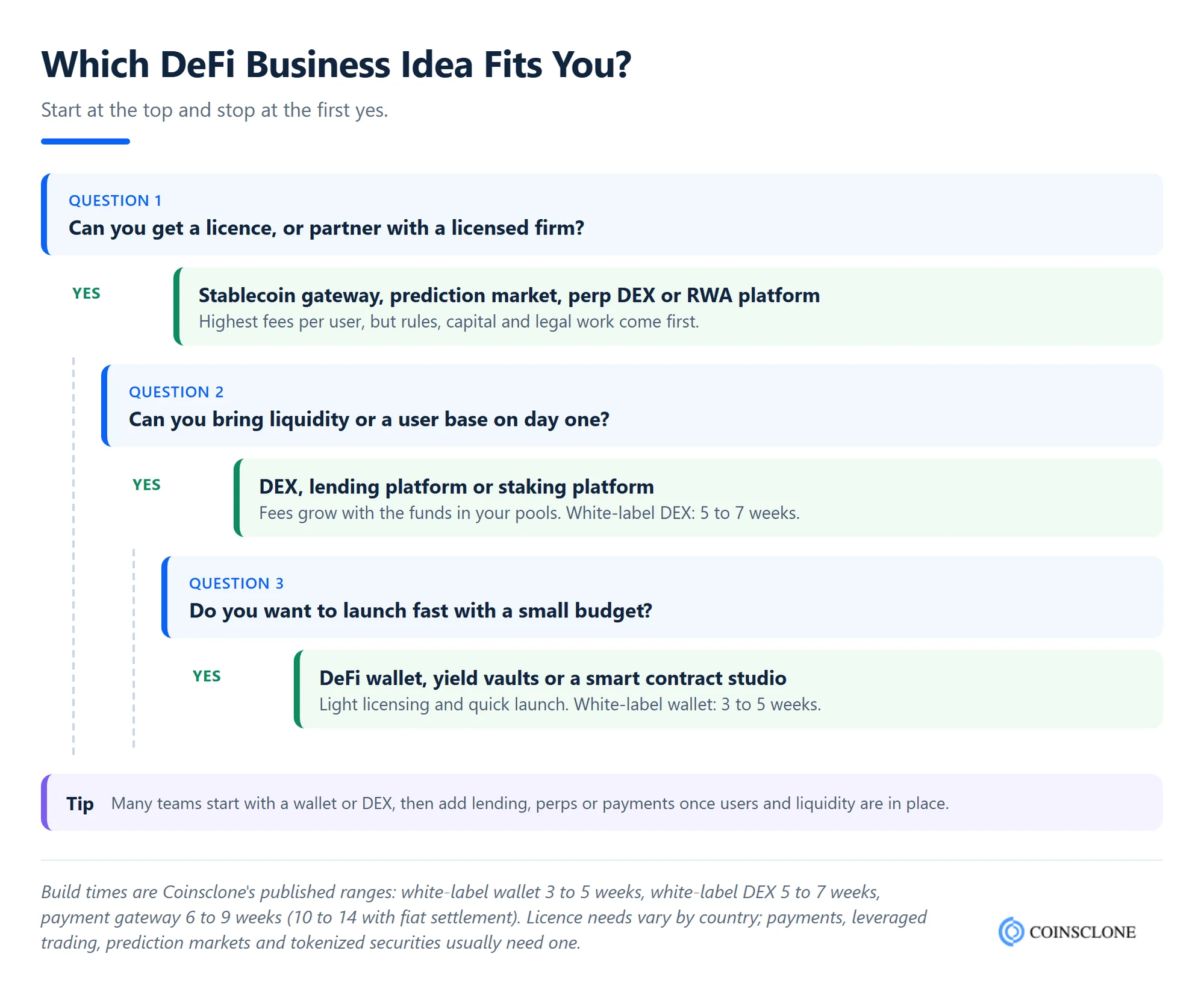
The best idea for you depends on three things: your budget, how much red tape you can handle, and whether you can bring users or funds on day one. A model with high fees often needs a licence and deep liquidity. In contrast, a model with low entry cost usually earns less per user.
Ask these questions before you commit:
- Who pays you, and why? Name the user and the exact fee they will pay.
- Where does liquidity come from? A DEX or lending pool with no funds has no users.
- Which licence do you need? Payments, perps, prediction markets and RWAs usually need one.
- What is your edge? A new chain, a region, a user group or a better user experience.
How to Start a DeFi Business in 6 Steps
Starting a DeFi business takes more than code. Follow these steps to go from idea to launch:
- Pick one model and one user group. Say, a stablecoin gateway for web shops in one country.
- Check the rules. Learn which licence your model needs in your target markets, and get legal advice early.
- Choose your chain. Ethereum has the most users and funds, while Solana, Base and BNB Chain offer lower fees.
- Build and audit. Use audited code where you can, then get a full audit and run a bug bounty before launch.
- Plan liquidity and users. Line up market makers, partners or rewards so the platform is useful on day one.
- Launch, measure and grow. Track fees, active users and retention, and add features only where users ask for them.
As a startup or founder, it helps to work with a DeFi Development Company like Coinsclone to turn any of these DeFi business ideas into a live product. Since 2018, Coinsclone has delivered 350+ platforms for 200+ clients across 20 industries, including DEXs, wallets, staking and payment platforms. We focus on each client’s needs, so check out our work and get in touch to start your DeFi business.
Risks and Rules to Plan For
DeFi can earn well, but it carries real risks. Plan for them from the start:
- Hacks: DeFi lost $2.24 billion across 285 hacks between 1 January and 1 October 2026, per the DefiLlama hacks list. Most losses came from stolen keys, admin rights and bridges, not clever code bugs.
- Market swings: fees and TVL fall when prices drop, so keep enough runway for a slow year.
- Liquidity risk: if users pull funds at once, pools can dry up and prices can slip.
- Rules in the US: the GENIUS Act, signed on 18 July 2025, sets rules for stablecoins. However, the wider market bill (the CLARITY Act) stalled after a 49 to 50 Senate vote on 15 September 2026.
- Rules in the EU: the MiCA regulation covers crypto service providers. Fully decentralized services sit outside it, but a company that runs the front end or issues the token often does not count as fully decentralized.
Frequently Asked Questions
What is a DeFi business?
A DeFi business offers financial services, such as trading, lending, payments or saving, through smart contracts on a blockchain instead of a bank. Users keep control of their own funds, and the business earns fees from each service it provides.
How do DeFi protocols make money?
DeFi protocols make money from fees. DEXs charge swap fees, lending apps keep part of the interest, staking apps take a share of rewards, and payment gateways charge per payment. Most fees often go to the users who fund the pools, and the app keeps a slice.
What is the best DeFi business idea for beginners?
A DeFi wallet or a white-label DEX is often the easiest start, because both need lighter licensing and launch in weeks. A stablecoin payment gateway is another good choice if you can team up with a licensed firm for bank payouts.
How much does it cost to start a DeFi business?
Cost depends on the model, the number of chains, custom features, audits, liquidity and legal work. A white-label product costs far less than a custom build. For a worked case, see our cost guide for a DEX like PancakeSwap.
How long does it take to launch a DeFi platform?
With white-label software, a wallet can launch in 3 to 5 weeks and a DEX in 5 to 7 weeks. Custom builds take longer: 8 to 12 weeks for a wallet and 10 to 14 weeks for a standard DEX, per Coinsclone’s published ranges.
Do I need blockchain knowledge to start a DeFi business?
No, but you need a team that has it. Many founders focus on users, partners and rules, and hire a development company to build, audit and maintain the smart contracts.
Is a DeFi business legal?
Yes, in most countries, but the rules depend on what you offer. You will usually need a licence for payments, stablecoins, margin trading, prediction markets or tokenized shares and bonds. Get legal advice for each market before you launch.
Also Read
How to create a DeFi App | Easy Steps to Build a DeFi Application
Cost Estimation to Launch DEX like Pancakeswap
See How Our MVP System Can Help You Launch DeFi Business Ideas Faster
DeFi Business Ideas — built, tested, and launched with confidence.
- MVP System : Validate your DeFi business model 90% faster with ready-to-deploy modules.
- DeFi-Ready Modules : Lending, staking, prediction, and DAO features available.
- Brand & Customization : Full creative control over UI, tokens, and governance.
- Revenue Engine : Generate profits from fees, yield, and user rewards.
Get a free DeFi business idea demo in just 48 hours — before spending a cent!
Book a Free Demo to turn your DeFi business idea into a live platform fast.