

This guide shows you how to create a decentralized exchange (DEX) in 2026, from the first idea to a live platform. We walk through each decision in the order you will face it: the type of DEX, the blockchain, how to build it, the smart contracts, liquidity, security and launch.
You will also see how a DEX swap is priced, real cost and time ranges, the legal points to check, and how a DEX makes money. By the end, you will know which build route fits your budget and what to prepare before you talk to a team.
In this guide:
- The 10 steps to create a decentralized exchange, with the key choice in each one
- How an AMM prices a trade, with a worked example in real numbers
- Where DEX trading happens today, using October 2026 DefiLlama data
- White label vs fork vs custom build, with timelines for each
- Costs, audit prices, legal basics and the main ways a DEX earns
Build Your Own Decentralized Exchange — The Smart Way
- MVP System : Launch your Uniswap-like DEX 90% faster — from idea to reality in weeks, not months.
- Pre-Built Liquidity & Wallets : Get integrated DeFi modules with zero coding required.
- Custom Branding : Your design, your tokens, your liquidity pools — fully white-labeled.
- Monetization Engine : Earn from swap fees, liquidity farming, and governance tokens.
Get a free branded DEX demo in just 48 hours — before spending a cent!
Book a Free Demo to discover how our DeFi-powered DEX Development System can help you go live in 8–12 weeks with your own decentralized exchange.
How to Create a Decentralized Exchange
To create a decentralized exchange, you research your market, choose a DEX model and a blockchain, then pick a build route: white label, fork or custom. Next, you build and audit the smart contracts, design the app, connect wallets and seed liquidity before launch. Here is what you are building first, and then each step in detail.
What Is a Decentralized Exchange?
Decentralized exchanges (DEXs) let users trade crypto assets directly, without a third party. They run on smart contracts, and users keep their funds in non-custodial wallets. A user connects a wallet such as MetaMask or Trust Wallet, then swaps tokens, adds liquidity or stakes. DEXs suit traders who care about privacy and security and want to keep control of their funds.
Most DEXs run on one or more blockchains and only swap tokens within those chains. For example, PancakeSwap is one of the leading DEXs, and it runs on BNB Chain, Ethereum, Base and other networks. Many DEXs also offer yield farming, liquidity pools and governance tokens. That is why the DeFi exchange clone script model is popular with DeFi founders.
The shift toward DEXs is real. In July 2026, DEX spot volume reached a record 24% of centralized exchange volume, up from 17% a year earlier, according to The Block.
How a DEX Swap Works
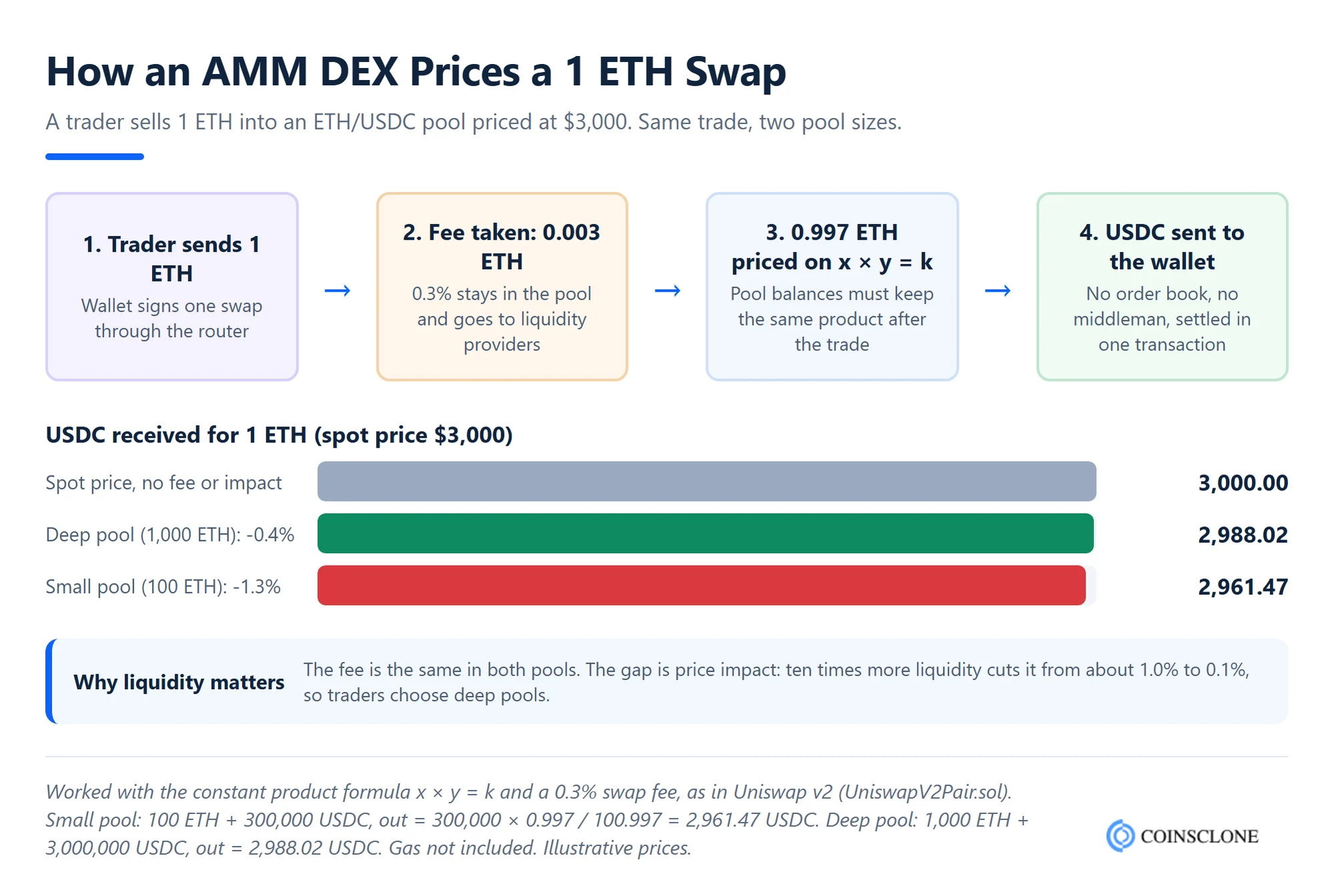
Most DEXs use an automated market maker (AMM). Instead of matching a buyer with a seller, the trader swaps against a pool that holds two tokens. The pool keeps the product of its two balances constant (x × y = k), so the price moves as one side grows and the other shrinks. Liquidity providers (LPs) fund the pool and earn the trading fee. Uniswap’s own docs explain this model step by step.
The example below shows why pool depth matters so much. The same 1 ETH trade gets a far better price in a deeper pool.
Now that you know what you are building, let’s go through the steps.
Step 1: Do Your Market Research
Start with market research before you build anything. Learn today’s trends, what users want and how the crypto space is changing. Then decide who your target users are: crypto fans, casual traders, memecoin hunters or institutions.
Next, study your competitors. Look at their strengths, features, fees and gaps. For example, a DEX built for one region’s stablecoins, or for one new token family, has a clearer pitch than just another Uniswap. This research helps you set your DEX apart.
Step 2: Choose Your DEX Model
Your trading model shapes everything else, so choose it early.
- AMM (automated market maker): Users swap against liquidity pools. It is the simplest model to launch and the most common. Uniswap, PancakeSwap and Aerodrome all work this way.
- Order book DEX: Buyers and sellers place limit orders, as on a centralized exchange. It suits active traders but needs a fast chain or an off-chain matching engine.
- Hybrid DEX: Orders are matched off-chain or on a fast app chain, while funds settle on-chain. Perpetual futures DEXs like Hyperliquid and dYdX work this way.
- DEX aggregator: It routes each trade across many DEXs to find the best price, so it needs little liquidity of its own.
Most first-time founders start with an AMM. You can add limit orders, perpetuals or aggregation later.
Step 3: Choose the Right Blockchain Network
Next, pick the chain your DEX runs on, such as Ethereum, BNB Chain, Base, Solana or Polygon. The network decides which tokens your DEX can support, how fast trades settle and what users pay in gas. It also decides your tech stack. EVM chains (Ethereum, BNB Chain, Base, Polygon, Arbitrum) use Solidity, and one codebase can deploy on all of them. Solana uses Rust, which means a separate build.
Look at where traders already are. The chart below shows 30-day DEX volume by chain.
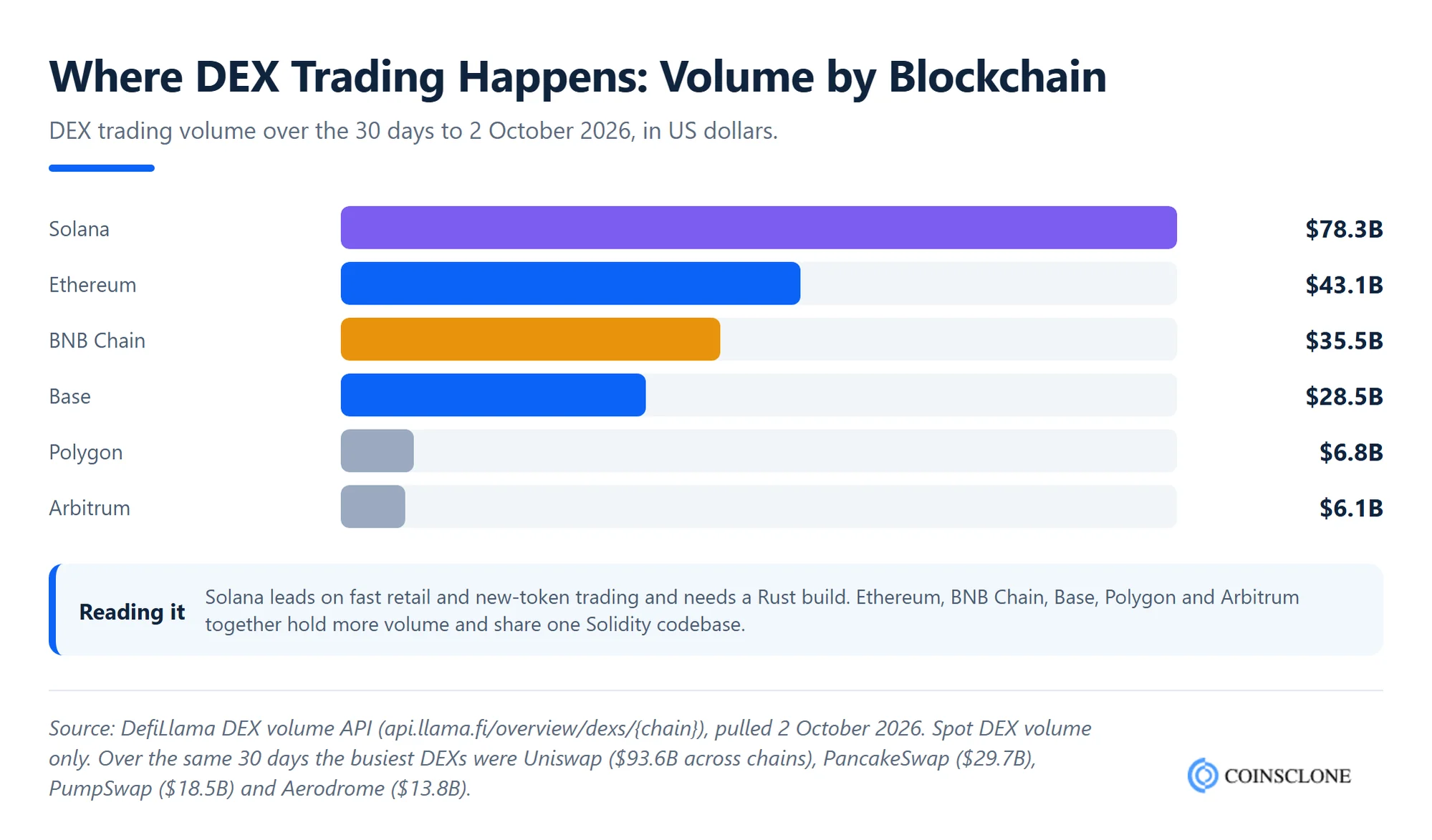
Many teams launch on one EVM chain, then add more chains once they have users.
Step 4: Pick Your Build Route
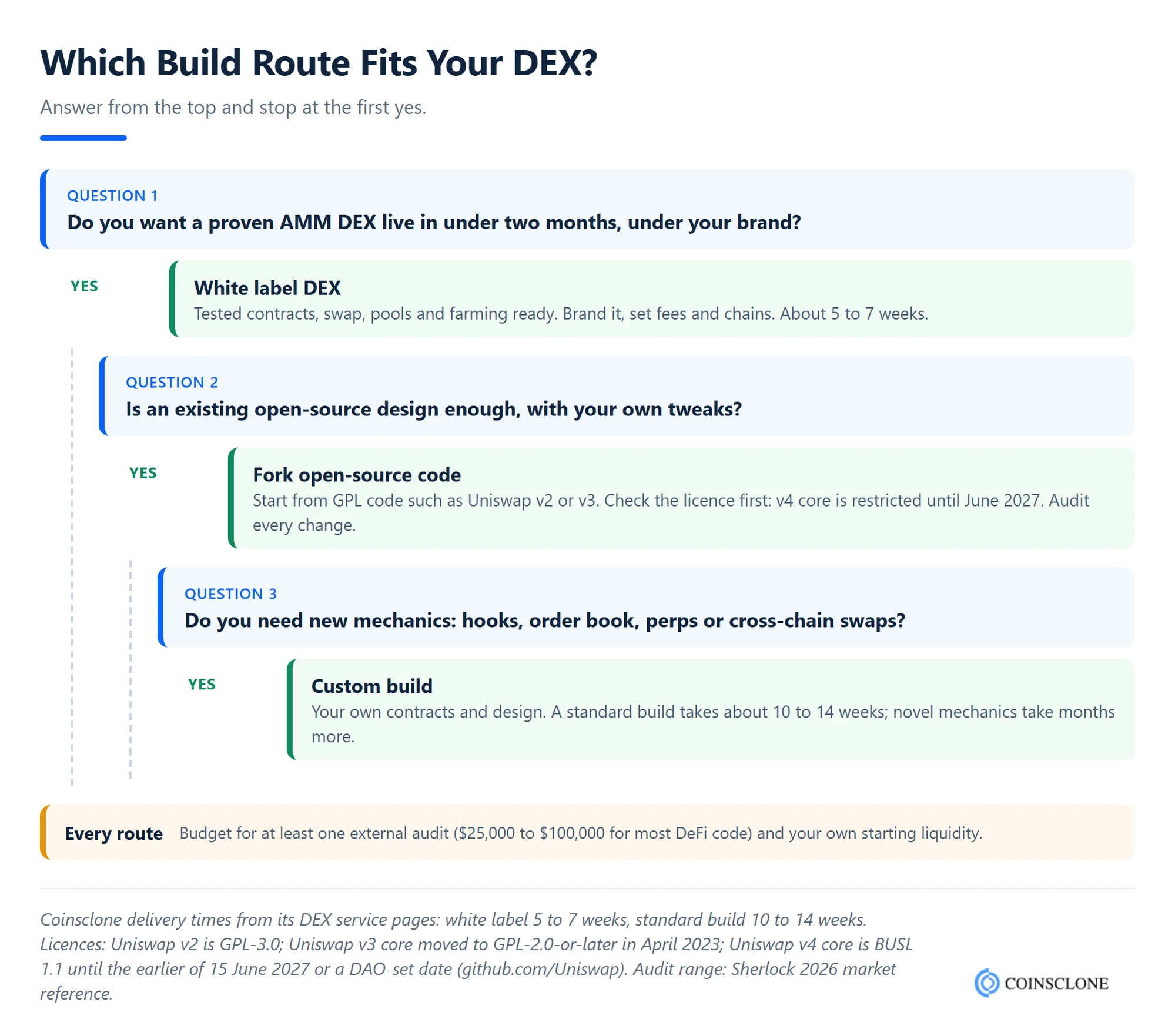
There are three ways to build a DEX. Each one trades off speed, cost and control.
- White label DEX: A ready-made, tested DEX that you brand and configure. It is the fastest and cheapest route.
- Fork of an open-source DEX: You start from public code such as Uniswap v2 or v3. Check the licence first. Uniswap v4 core runs under a Business Source License that limits commercial use until 15 June 2027 (or an earlier date the DAO sets). Code you fork is also only as safe as your changes to it.
- Custom build: You design your own contracts and mechanics, such as v4-style hooks, an order book or cross-chain swaps. It gives the most control but takes the most time and audit work.
This decision tree helps you choose.
Step 5: Develop the Smart Contracts
Smart contracts run the core of a DEX: swaps, liquidity pools, fees and staking. A typical AMM DEX has a few key contracts:
- Factory: Creates a new pool for each token pair.
- Pool (pair) contract: Holds the two tokens, runs the pricing formula and mints LP tokens to liquidity providers.
- Router: Finds the path for a trade, checks slippage limits and calls the pools.
- Fee and treasury logic: Splits each trading fee between LPs and your protocol.
- Staking or farming contracts: Reward users who lock LP tokens or your own token.
Many DEXs also use a price oracle, such as Chainlink, for features that need a fair market price. Plan these contracts with care, since a single bug can drain a pool. Keep admin powers small, put upgrades behind a timelock and add an emergency pause.
Step 6: Design a Simple Interface
The interface is what users see and trust. Design a clean flow that lets users connect a wallet, swap tokens, add liquidity and track their trades. Show the price impact, the fee and the minimum amount they will receive before they confirm.
Simple design builds trust and makes trading smooth. You will also need an indexer, such as a subgraph, so the app can show charts, pool stats and trade history quickly.
Step 7: Connect User Wallets
Add MetaMask, Trust Wallet, Coinbase Wallet and WalletConnect so users can trade from their own wallets. Without wallet connection, a DEX cannot work at all. This step is also what makes your DEX truly non-custodial, because users sign every trade and never hand over their funds.
On Solana, you will connect wallets such as Phantom and Solflare instead.
Step 8: Plan Your Liquidity Before Launch
A DEX with empty pools is a ghost town. Traders get poor prices, so they leave. As the worked example above shows, a deeper pool gives a much better price for the same trade. So plan liquidity before you launch:
- Seed your own pools: Add your project’s funds to the main pairs, such as your token with ETH or USDC.
- Reward early LPs: Offer a share of fees or token rewards to people who add liquidity in the first months.
- Work with market makers: For order book or hybrid DEXs, partner with pro market makers who quote both sides.
- Get listed on aggregators: Aggregators route trades to your pools once your prices are good.
Also explain impermanent loss to LPs. It is the value an LP can lose when token prices move apart, so clear docs build trust.
Step 9: Test and Audit the Platform
Before launch, test the whole platform for bugs, slow pages and security risks. Use a local test setup such as Hardhat or Foundry, then run the DEX on a public testnet like Sepolia. Test swaps, liquidity, wallet flows, admin tools and heavy load.
Next, get at least one third-party smart contract audit. A 2026 market review by audit firm Sherlock puts most DeFi audits at $25,000 to $100,000, with re-audits at $5,000 to $20,000 per pass. It is money well spent. In May 2025, the Cetus DEX on Sui lost about $223 million to a contract flaw. Launch a bug bounty as well, so researchers report issues to you instead of exploiting them.
Step 10: Launch and Maintain the Platform
Once testing and audits are done, deploy to mainnet and go live. Start with a few strong trading pairs rather than dozens of thin ones.
After launch, watch pool health, fees and contract events every day. Release updates to fix bugs and add features. Grow your community with clear docs, LP rewards and partnerships with token projects. With active upkeep, your DEX stays competitive in the DeFi market.
Building a DEX is one of the most exciting projects in crypto right now, and these steps give you a clear path to follow.
If you are a startup or new to the space, our Decentralized Exchange Script can save you a lot of time. Instead of building from scratch, this ready-made script lets you launch much faster. It is pre-built, secure and customizable, and it includes the features a fully working DEX needs. Let’s look at those features next.
Essential Features to Build a Decentralized Exchange
The features you offer decide how many users you attract and keep. Here are the features to plan for when you build a DEX.
- Token swapping: The core feature. Users swap one token for another in a few clicks, with clear price impact and slippage settings.
- Automated market maker: The pricing engine behind the pools, from the simple x × y = k model to concentrated liquidity.
- Liquidity pools: Users add token pairs and earn a share of the trading fees.
- Yield farming: Users stake LP tokens to earn extra rewards, which helps you attract liquidity.
- Crypto staking: Users lock your token to earn rewards or fee share.
- Multi-chain support: Users trade on more than one network from the same app.
- Wallet links: Connect MetaMask, Trust Wallet, WalletConnect and more in one click.
- Admin dashboard: Set fees, add pairs, manage rewards and watch platform stats.
- Many languages: Reach users in more countries.
- Security layers: Audited contracts, timelocks, an emergency pause, SSL and encrypted data between the app and your servers.
With these features, your users get a safe, smooth and easy trading app.
Now, let’s look at one of the most asked questions: the cost.
Cost to Create a Decentralized Exchange
The cost to create a decentralized exchange (DEX) depends on your build route, the number of chains, your features, the team’s hourly rate and how many audits you need. Published 2026 estimates from DEX development firms fall in these broad ranges:
| Build route | Typical market cost | Typical time |
| White label DEX | About $10,000 to $50,000 | 1 to 2 months |
| Custom single-chain AMM DEX | About $40,000 to $100,000+ | 3 to 5 months |
| Custom multi-chain or advanced DEX | $100,000 to $250,000+ | 6 to 12 months |
| Smart contract audit (each) | $25,000 to $100,000 | 2 to 8 weeks |
Two costs often get left out of the budget. First, the audit, which Sherlock’s 2026 market review prices separately from the build. Second, your starting liquidity, which is your own capital, not a fee, but you still need it on day one.
At Coinsclone, a white label DEX goes live in about 5 to 7 weeks, and a standard build with custom design and features takes about 10 to 14 weeks. That is why a DEX script is the most cost-effective way to start. Treat all of these figures as a rough guide, since the final cost depends on your exact requirements.
Next, let’s see whether you need a licence to run a DEX.
Is It Legal to Create a Decentralized Exchange?
In most countries, yes, you can build and run a DEX, but the rules depend on how decentralized it really is and who you serve. Here are the main points to check with a lawyer before launch:
- European Union: MiCA, the EU crypto law, does not cover services run in a fully decentralized way with no middleman (Recital 22). If your company controls the contracts, the front end or user funds, you may still need a licence.
- United States: The rules are still evolving. Teams that run the front end, charge interface fees or list tokens can face securities, money transmission and sanctions questions.
- Sanctions and screening: Many DEX front ends block sanctioned wallets and restricted countries, even when the contracts stay open to anyone.
- Your own token: If you launch a governance or reward token, its sale and marketing have their own rules in most markets.
In short, the less you control (open contracts, DAO votes, no custody), the lower your legal risk. Running a hosted front end still keeps some duties in place.
Why Should a Startup Create a Decentralized Exchange?
As a startup, there are good reasons to start a DEX business today. The main ones are a loyal crypto community, steady revenue and a strong place in a fast-growing DeFi market.
As noted above, DEXs let users swap digital assets without a middleman. They have become popular because users keep control of their funds, enjoy better privacy and often pay lower fees. Their share keeps growing: in July 2026, DEXs handled about a quarter as much spot volume as centralized exchanges.
If you create a DEX in 2026, you can offer users deep liquidity, fast trades, lower risk of exchange hacks and freezes, and access to new tokens early. You also benefit from the steady growth of crypto use worldwide.
On top of that, you can earn good revenue in several ways:
- Swap fees: A share of every trade. Uniswap v2 pools, for example, charge 0.3% per swap.
- Protocol fee share: A slice of LP fees for your treasury. In December 2025, Uniswap voters passed the UNIfication plan. It turned on a protocol fee, so 0.05% of the 0.3% fee on Ethereum v2 pools now goes to the protocol.
- Token launch tools: Fees from launchpad or IFO modules for new projects.
- Listings and ads: Paid placement for new tokens and partners.
- Premium features: Limit orders, analytics or MEV-protected trades.
Big DEXs like PancakeSwap and Uniswap mix many of these streams. A Uniswap clone script gives you that proven model, ready to brand.
Also Read : How to Create a DEX Like Uniswap for Crypto Entrepreneurs in 2026
However, to stand out in this busy market, you need a clear niche and strategies that keep your users active even when markets slow down.
You might ask: does building a DEX come with challenges? It does, so let’s look at them.
Challenges Involved in Creating a Decentralized Exchange
Building a DEX means working with many technical parts at once. You are building a blockchain platform that lets people swap crypto safely with no middleman, so small mistakes can be costly.
Even with modern tools, creating a decentralized exchange can be hard. The key challenges are:
- Smart contract security: Bugs, price manipulation and flash loan attacks can drain pools. Chainalysis counted over $3.4 billion in crypto stolen in 2025, and one contract bug can empty a pool in minutes.
- Liquidity: New DEXs struggle to attract enough liquidity, and rivals may lure LPs away with bigger rewards.
- MEV and front-running: Bots can trade ahead of your users and worsen their prices.
- Complex backend: Indexers, price feeds and multi-chain support add moving parts.
- Speed and gas: Busy networks and high gas fees slow trades and put users off.
- User experience: Wallets, gas and slippage confuse new users, so the interface must make them simple.
- Changing rules: Laws on DeFi and tokens keep changing across countries.
On top of that, your team needs deep blockchain and security skills, which are hard to hire.
You may ask: do I have to face all these obstacles to launch a DEX?
Not on your own. When you work with Coinsclone’s skilled crypto exchange team, you get a tested, audited base that handles most of these challenges for you, so you can focus on users and liquidity.
Create a Safe and Secure Decentralized Exchange
Cost-effective, White-Label Solution, Premium Features, Customizable. Live Demo Available.
Why Start a Decentralized Exchange with Coinsclone?
Coinsclone is a trusted Decentralized Exchange Development company. We build DEXs on BNB Chain, Ethereum, Polygon, Base and more. Since 2018, we have delivered 350+ platforms for 200+ clients across 20 industries, and our blockchain team has worked on many DEX projects.
We help you choose the right blockchain, DEX model and features for your business. You can start with our white label decentralized exchange in about 5 to 7 weeks, or choose a standard build with custom features in about 10 to 14 weeks.
Safety comes first. We use audited contracts and proven security practices to keep your decentralized exchange safe from attacks and breaches. That is why founders choose Coinsclone as their DeFi development partner.
Ready to build your DEX? Get in touch with our experts now!
Build Your Own Decentralized Exchange — The Smart Way
- MVP System : Launch your Uniswap-like DEX 90% faster — from idea to reality in weeks, not months.
- Pre-Built Liquidity & Wallets : Get integrated DeFi modules with zero coding required.
- Custom Branding : Your design, your tokens, your liquidity pools — fully white-labeled.
- Monetization Engine : Earn from swap fees, liquidity farming, and governance tokens.
Get a free branded DEX demo in just 48 hours — before spending a cent!
Book a Free Demo to discover how our DeFi-powered DEX Development System can help you go live in 8–12 weeks with your own decentralized exchange.
Frequently Asked Questions
Can I create my own decentralized exchange?
Yes. You can create your own DEX by forking open-source code, using a white label DEX script or building custom smart contracts. Most startups use a white label script to launch faster, then add custom features once they have users.
How long does it take to build a DEX?
A white label DEX can go live in about 5 to 7 weeks. A standard build with custom design and features takes about 10 to 14 weeks. A fully custom, multi-chain DEX with new mechanics can take 6 months or more, including audits.
How much does it cost to create a decentralized exchange?
Published 2026 market estimates put a white label DEX at about $10,000 to $50,000 and custom builds from about $40,000 to $250,000 or more. Add $25,000 to $100,000 for each smart contract audit, plus your own starting liquidity.
Which blockchain is best for a DEX?
It depends on your users. Solana led DEX volume over the 30 days to 2 October 2026 on DefiLlama, followed by Ethereum, BNB Chain and Base. EVM chains share one Solidity codebase, so many teams start there and add chains later.
How do smart contracts work in a decentralized exchange?
Smart contracts hold the pool funds, price each trade with a formula such as x × y = k, collect fees and send tokens straight to the user’s wallet. No company holds user funds, and anyone can check the code on-chain.
How can I attract liquidity to a new DEX?
Seed your main pools with your own funds, reward early liquidity providers with fees or tokens, partner with token projects and market makers, and get your pools listed on DEX aggregators. Deep pools give better prices, which brings more traders.
How do decentralized exchanges make money?
DEXs earn mainly from swap fees, a protocol share of LP fees, token launch tools, listing fees and premium trading features. Some also hold a treasury of their own token that grows with the platform.
Is it legal to start a decentralized exchange?
In most countries, yes, but rules vary. In the EU, MiCA does not cover services run in a fully decentralized way, while companies that control the front end, contracts or funds may need a licence. Always get legal advice for your target markets.