
PantherSwap was a swap exchange and yield farm on BNB Chain that launched in 2021, and as of October 2026 it is no longer active. A PantherSwap clone script is ready-made software that lets you launch the same swap and farm model under your own brand, with the weak parts fixed.
This guide explains PantherSwap’s real status, how its token rules and farms worked, and what still works in this model today. You will also see the features to expect, the security risks to plan for, and what a clone costs and takes to launch. By the end, you will know how to build a PantherSwap-style DEX that can last longer than the original did.
In this guide:
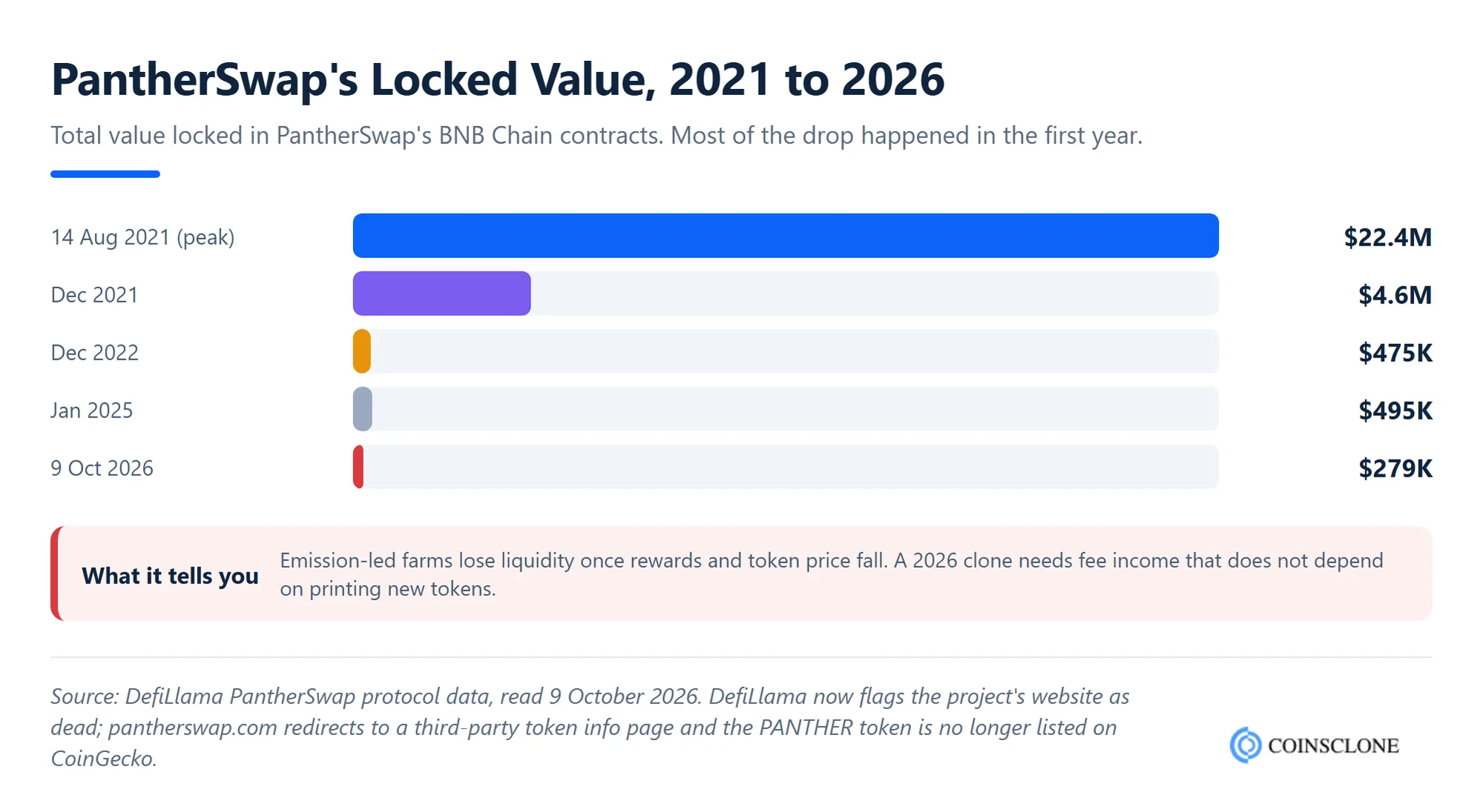
- PantherSwap’s real status: its site is gone and its locked value fell from $22.4 million to about $277,000.
- A worked example of the PANTHER transfer tax, deposit fee and referral rewards.
- Where BNB Chain trading happens now, and what that means for your clone.
- Features, security layers and add-ons a good clone script should include.
- Cost ranges, launch steps and Coinsclone’s published timelines.
See How Our MVP System Can Launch Your DEX Faster
PantherSwap Clone Script — DeFi Exchange Development Done Right.
- MVP System : Launch your PantherSwap-like DEX 90% faster.
- Liquidity & Farming : Pre-built yield farming & liquidity modules — no coding needed.
- Brand & Customization : Your UI, your tokens, your ecosystem.
- Revenue Engine : Earn from swaps, staking, yield pools, and token launches.
Get a free branded demo of your DEX in 48 hours — before you spend a single cent.
Book a Free Call to discover how our PantherSwap Clone Script can take you from idea to a live DEX in just 8–12 weeks.
What Is PantherSwap?
PantherSwap was a decentralized exchange (DEX) and yield farm on BNB Chain, which was then called Binance Smart Chain. It launched in 2021 and ran on its own reward token, PANTHER.
On PantherSwap, users could swap tokens, add liquidity, farm and stake for PANTHER rewards, join new token sales and play a lottery. It was built on PancakeSwap’s code, but its token had extra rules: a transfer tax, automatic liquidity and an anti-whale limit. At its peak in August 2021, users had $22.4 million locked in it. Today the platform is offline, as the status section below shows.
What Is a PantherSwap Clone Script?
A PantherSwap clone script is pre-built decentralized exchange software that copies the core features of PantherSwap. It combines an automated market maker (AMM) for token swaps with liquidity pools, yield farms, staking pools and a native reward token with its own rules.
You can shape this white-label DEX around your brand, your fee model, your token design and your governance rules. It comes with wallet support, tested smart contracts and room to add new chains later. As a result, you start from a working base instead of a blank page, which cuts both build time and cost.
But before you copy PantherSwap, it helps to know how the original did. That shapes which parts are worth keeping.
Is PantherSwap Still Running in 2026?
No. PantherSwap is no longer an active platform. No hack is on record; it simply faded out. Here is what we found on 26 October 2026:
- The website is gone. pantherswap.com now redirects to a third-party token price page, and the farms page returns an error.
- Data trackers mark it as dead. DefiLlama’s PantherSwap page flags the project’s site as dead. About $277,000 is still locked in its contracts, down from a peak of $22.4 million on 14 August 2021.
- The token is delisted. The PANTHER token no longer appears on CoinGecko.
- Development stopped. The last code update in the project’s public GitHub repositories was in November 2023.
Can You Still Buy the PANTHER Token?
Not in any useful way. CoinGecko no longer lists PANTHER, and CoinLore’s PANTHER page marks it inactive, with no price data since 10 August 2023. A few old pools may still hold some tokens on-chain, but they have so little liquidity that any trade would move the price sharply. For a clone builder, the lesson is simple: launch your own token and brand, and do not tie your project to PANTHER.
Why Did PantherSwap Fail?
PantherSwap faded because most of its rewards came from printing new PANTHER, not from trading fees. When new buyers slowed, the token price fell, farm yields dropped and liquidity left. It is a common pattern. In a June 2025 r/defi thread asking what is wrong with yield farming, the top reply warned that high-yield pools often pair a junk or highly inflationary token. Other replies said liquidity pools feel too complex for newcomers.
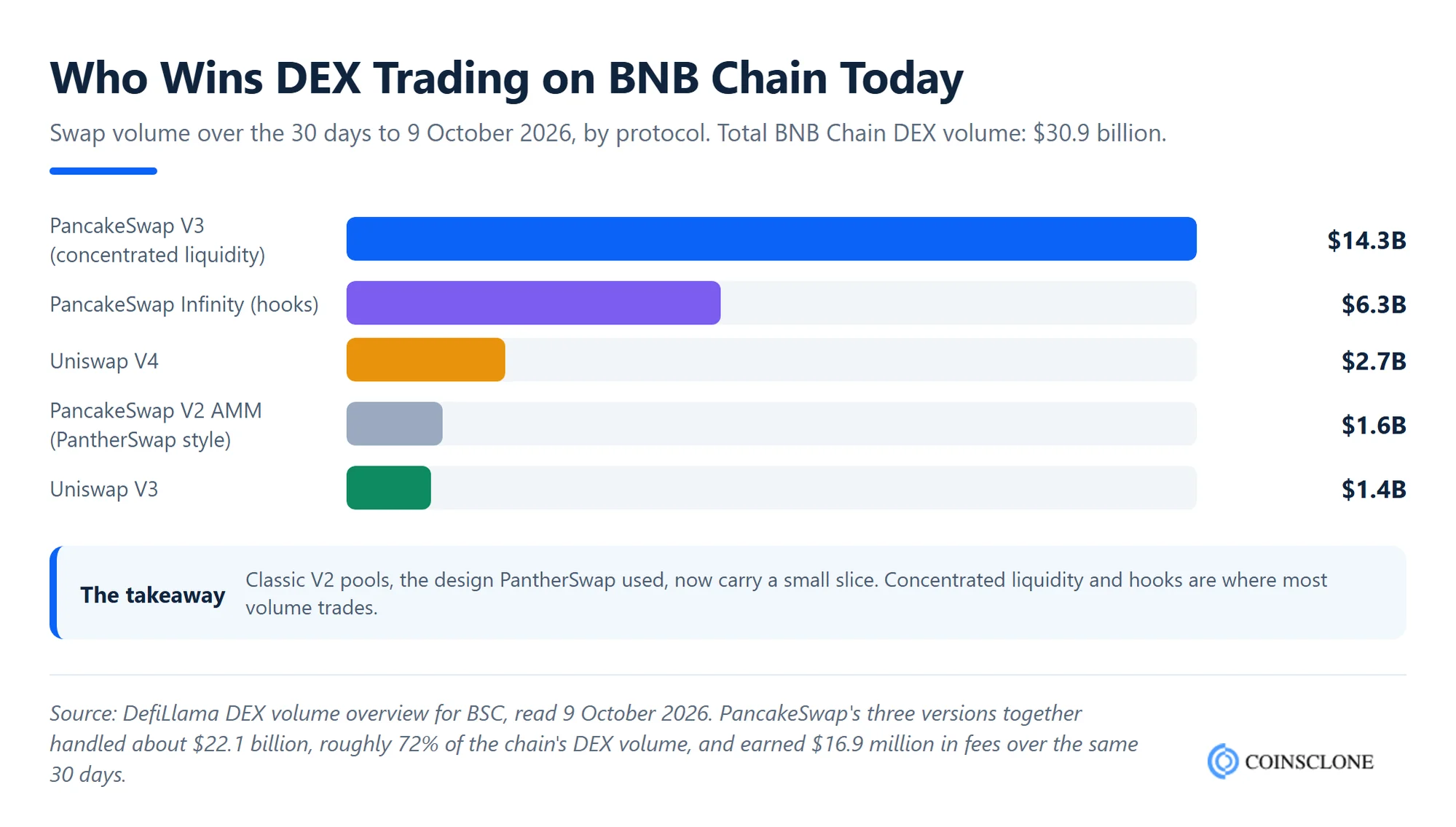
So why build a PantherSwap clone at all? Because the swap and farm model itself is still alive. BNB Chain handled about $27 billion of DEX trading in the 30 days to 26 October 2026, according to DefiLlama’s BSC DEX data. Your clone should keep the tools users liked, pay rewards from real fees and keep the screens simple.
How Did PantherSwap Work?
PantherSwap’s docs called it “the first automatic liquidity acquisition yield farm and AMM” on the chain. Its own SDK was a fork of PancakeSwap’s, and its farms also accepted PancakeSwap LP tokens.
Its main products were:
- AMM exchange: Swap tokens against pooled liquidity, with prices set by the pool’s reserves.
- Farms: Stake LP tokens to earn PANTHER rewards.
- Jungles: Stake one token to earn another project’s reward token.
- IPO (Initial Panther Offering): A launchpad where users committed LP tokens to buy new tokens.
- Lottery: Buy tickets with PANTHER for a share of a prize pool.
What made PantherSwap different was its token rules. According to the PantherSwap farm contracts and its archived docs:
- Transfer tax: Each PANTHER transfer paid a tax, set at 5% in the token contract (with a 10% cap). One fifth of the tax was burned and the rest added to liquidity. By early 2022 the docs listed a lower 2% tax, split evenly between burn and liquidity.
- Automatic liquidity: The pool share of the tax was paired with BNB and locked in the pool for good.
- Anti-whale rule: Any single transfer above 0.5% of the total supply was rejected.
- Harvest lockup: Farmers could only claim rewards after a set wait, up to 14 days, to stop bots from farming and dumping.
- Deposit fee sharing: Some pools charged a 4% deposit fee, and 3% of it went to PANTHER holders instead of a buyback.
- Referral program: An inviter earned 1% of a friend’s farm rewards.
- No migrator code, plus a timelock: Two safety steps that stopped the team from moving user funds or making changes without warning.
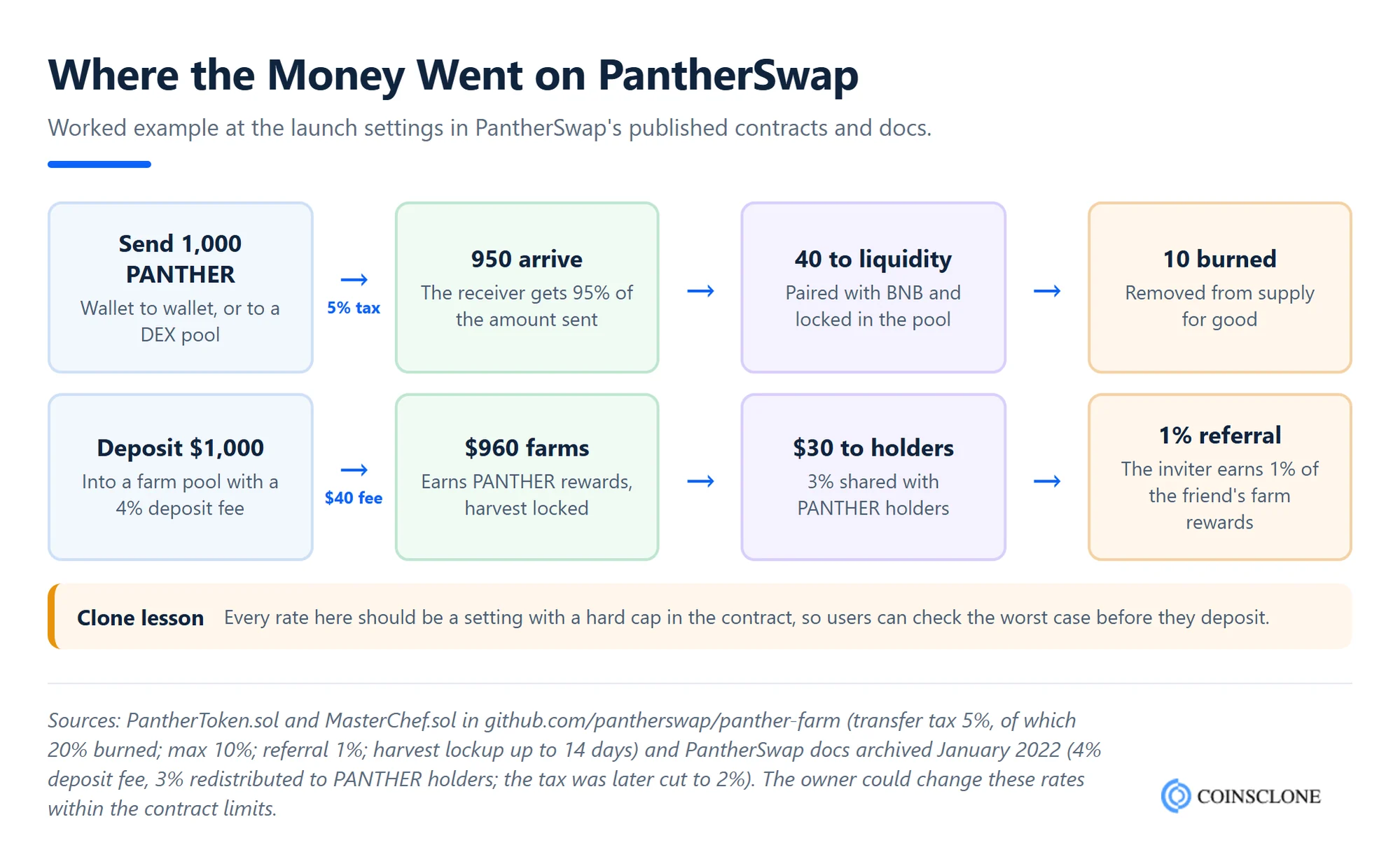
These rules were clever, but they all depended on new users buying PANTHER. When rewards and price fell, liquidity left fast. That is the key lesson for anyone building a clone today.
Is a PantherSwap-Style DEX Still Worth Launching in 2026?
Yes, if your rewards are backed by real fees. Launching a DEX like PantherSwap puts you in one of the busiest parts of DeFi. Users keep moving toward non-custodial trading, liquidity pools and staking for passive income. As a result, a well-run swap and farm platform still has real demand.
Users ask the same question from the other side. In a March 2025 r/defi thread, Yield Farming vs. RWAs: What’s Actually Worth It in 2025?, the poster said farming had been unreliable lately and that steadier real-world asset yields were drawing interest. For a platform owner, that sets the bar: your farms must show clearly where the yield comes from.
Here is why a PantherSwap-style platform is still worth building:
- Proven demand: Swaps on BNB Chain run at about $900 million a day, and farming still draws liquidity when rewards are backed by real fees.
- Many ways to earn: Charge swap fees, deposit fees, fees on farm profits and launchpad fees, and give your token real uses.
- Users come back: Farms, staking, lotteries and invite rewards give them reasons to return.
- No central control: Trading is non-custodial and transparent on-chain, which builds trust.
- Room to grow: Add cross-chain swaps, governance or new pool types as your user base grows.
Is PantherSwap Open Source? Can You Fork It?
Yes. PantherSwap’s code is public on GitHub, and most of it uses open licences. The swap core, periphery and front end use GPL-3.0, the farm contracts use WTFPL, and the SDK uses MIT.
So you can copy and change the code. Under GPL-3.0, if you share a changed version, you must release it under the same licence. These licences cover the code, not the PantherSwap name or logo, so launch under your own brand.
Before you fork the raw code, weigh three limits:
- Old code: Most contracts date from 2021, and the last update was in November 2023.
- Old audits: Any audit covered the original code only. Every change needs a new review.
- Old pool design: The code uses classic V2 pools, while most BNB Chain volume now runs through concentrated pools.
This is why most teams start from a maintained clone script instead of the 2021 repositories.
PantherSwap Clone Script vs Building From Scratch vs Forking
Building a DeFi exchange from scratch takes deep smart contract skill, several audits and a large budget. A PantherSwap clone script removes much of that work because it starts from a tested, ready-to-deploy codebase.
| Criteria | PantherSwap Clone Script | Build From Scratch | Open Source DEX Forks |
| Launch Time | 5-7 weeks white label, 10-14 weeks standard | 16-24+ weeks | Moderate |
| Cost Efficiency | Budget-friendly | Very high | Low to medium |
| Customization | Full UI and feature control | Fully customizable | Limited |
| Security | Pre-tested and audit-ready | Full audits required | Varies |
| Core DeFi Modules | AMM, farms, pools included | Must be built by hand | Basic only |
| Scalability | Multi-chain ready and upgradeable | Costly to scale | Limited |
| User Experience | Proven PantherSwap-like UX | Designed from scratch | Varies, less polished |
What Works in the PantherSwap Model in 2026
The 2021 yield farm boom left a clear record of what lasts and what does not. Here is what to keep, change and add.
Keep:
- Simple swaps, pools and farms. Users still want one place to swap, add liquidity and stake.
- Harvest lockups and anti-whale limits. They slow down bots that farm and dump rewards.
- Time delays and no code to move user funds. Users now expect both as a minimum.
Change:
- Back rewards with fees, not just new tokens. PancakeSwap earned about $12 million in fees over the 30 days to 26 October 2026, per DefiLlama. Rewards paid from real income last longer than rewards paid from token printing.
- Use lighter transfer taxes, or none. Taxed tokens break some wallets, bridges and aggregators, and they put off larger traders.
- Move beyond classic V2 pools. On BNB Chain, PancakeSwap’s V3 and Infinity pools now carry far more volume than its V2 pools. Concentrated pools let LPs earn more fees with less money.
Add:
- A launchpad with clear rules, like PantherSwap’s IPO, for new tokens that want liquidity on day one.
- Aggregator listing, so trades routed by DEX aggregators reach your pools.
- Multi-chain pools on chains where your users already hold funds.
For a deeper look at the fee side, see how PancakeSwap makes money.
Why Do Taxed Tokens Fail to Sell on a DEX?
A taxed token often fails to sell because the pool receives fewer tokens than the router expected, so the trade reverts. A developer asked exactly this on the OpenZeppelin forum in October 2025. Buys worked with a 3% tax, but sells showed a warning that the swap might fail.
The usual fix is to use the router’s fee-on-transfer swap functions and set slippage above the tax. Even then, some aggregators cannot route these tokens, as the Velora help centre explains. If you keep a tax in your clone, keep it small, and test sells through your own router and the main aggregators before launch.
PantherSwap Clone vs PancakeSwap Clone: Which Should You Choose?
Choose a PantherSwap clone for a lean swap and farm DEX with custom token rules. Choose a PancakeSwap clone if you want a larger exchange with many products and concentrated pools from day one.
| Factor | PantherSwap Clone | PancakeSwap Clone |
| Core products | Swaps, farms, staking, launchpad, lottery | Swaps, V2 and V3-style pools, farms, staking, lottery and more |
| Token model | Reward token with transfer tax, auto-liquidity and anti-whale rules | Reward token with no transfer tax and burns funded by fees |
| Best for | A community DEX or token launch on one chain | A multi-product DEX that aims for wide volume |
| Build effort | Lower | Higher |
Many teams start with the PantherSwap model and add V3-style pools and new chains later.
Features of a PantherSwap Clone Script
Our PantherSwap clone software includes every feature needed to run a full DEX with yield farming.
User Features
- Token swaps: AMM-based trading for instant decentralized swaps.
- Liquidity pools: Add, remove and earn from multi-token pools.
- LP tokens: Users get LP tokens that show their share of a pool.
- Live prices: Prices update in real time from pool balances.
- Low fees: Swaps tuned for BNB Chain’s low gas costs.
- Slippage control: Users set the price move they accept before a trade.
- Pool moves: Shift funds smoothly when pools change.
- Farming pools: Stake LP tokens to earn reward tokens.
- Staking: Stake the native token with flexible reward options.
Admin Features
- Native token setup: Create your token with custom supply and fee rules.
- Anti-whale controls: Cap large transfers to protect the market.
- Auto-liquidity: Send part of each fee or tax into locked liquidity.
- Burn rules: Manage supply with transparent burns.
- DAO voting: Let token holders vote on key changes.
- Admin dashboard: Manage pools, fees and settings in one place.
- Reward rates: Adjust token payouts for farms and staking pools.
- Pool management: Create, edit or close pools.
- Fee settings: Set trading, deposit and withdrawal fees, each with a hard cap in the contract.
PantherSwap Clone Script Security Features
Security is the backbone of any DeFi platform. Our PantherSwap clone app includes these safety layers:
- Anti-whale mechanism
- Harvest lockup and timelock
- Rug-pull protection design
- Smart contract audits (automated and manual)
- Multi-sig admin controls
- Front-running bot protection
- Liquidity locking
- DDoS and spam attack prevention
- Ongoing vulnerability monitoring
In short, these layers keep traders, pool funders and stakers safe.
Security Risks to Plan For
Yield farm forks on BNB Chain have a rough record. DefiLlama’s hacks database lists 272 incidents on the chain with about $3.1 billion lost. Two 2021 cases show the main risks:
- Uranium Finance (April 2021, $57.2 million): A forked AMM with a small math error in a changed constant. Every edit to forked code needs a fresh audit.
- PancakeBunny (May 2021, $45 million): A flash loan pushed a pool price off, and the reward contract minted tokens at the wrong price. Reward logic must never trust a single spot price.
To protect your clone, plan for these steps:
- Audit every change. Do not rely on the original project’s audits once you edit the code.
- Use time-weighted or oracle prices for any reward that depends on a price.
- Cap admin powers in code. Fee and tax settings should have hard limits and run through a timelock.
- Lock or vest team tokens and liquidity so users can check them on-chain. A token vesting smart contract releases team tokens on a fixed schedule.
- Run a bug bounty after launch and keep monitoring contracts.
Our DeFi smart contract development team builds these controls into the base contracts.
PantherSwap Clone Script Add-On Modules
Expand your platform with specialized add-ons for the PantherSwap clone script.
- Cross-chain token bridge
- Referral reward system
- IDO or token launchpad module
- NFT staking integration
- Multi-chain AMM integration
- Advanced analytics dashboard
- Multi-wallet login
- Governance voting portal
- Fiat-to-crypto on-ramp (optional)
How Does a PantherSwap Clone Script Work?
The ready-to-launch PantherSwap clone script follows the same logic and steps as the original. Here is a simple breakdown of how your PantherSwap-like DEX works:
- Connect: Users connect a crypto wallet (MetaMask, Trust Wallet, WalletConnect and others) in one click. No email or password is needed because the platform is non-custodial.
- Browse: Users see token pairs, farms, liquidity pools and live APR.
- Approve: Before a first trade, users approve the token. This standard DeFi step lets the smart contract use those tokens for swaps or liquidity.
- Swap: Users swap tokens instantly. The AMM sets the price from the pool’s reserves.
- Add liquidity: To earn fees, users add tokens to a pool and receive LP tokens for their share.
- Farm: Users stake LP tokens in farms. The contract works out rewards from emission rates, pool weight and time staked.
- Stake: Users can also stake the native token for extra rewards or voting power.
- Withdraw: Rewards and liquidity go straight back to the user’s wallet, with no middleman.
- Manage: As the owner, you set trading fees, farm rewards, token rules and anti-whale limits from the admin panel.
The smart contracts run every step on-chain, so each transaction is open to check and free from central control.
How to Launch a DEX Like PantherSwap: Step by Step
Here is the path most PantherSwap-style projects follow, from idea to launch.
- Pick your niche and chain. Decide who you serve: a token community, a chain with thin DEX liquidity, or a launchpad audience. BNB Chain is the natural home for this model, but any EVM chain works.
- Design the tokenomics. Set supply, emissions, fees and any tax. Model what happens when the token price falls by half, not just when it rises.
- Choose the pool design. Classic V2 pools are simple; concentrated liquidity pools earn LPs more fees. Many teams start with V2 and add V3-style pools later.
- Customize the script. Add your brand, features, fee caps and admin roles.
- Audit and test. Run unit tests, a public testnet and at least one independent audit.
- Seed liquidity. Fund the first pools and lock that liquidity so users can see it. Our guide on how to create a liquidity pool for a token covers pairing, pricing and locking.
- Launch and list. Go live, then get your pools listed on DEX trackers and aggregators. Plan launch guards first, because bots often buy the first blocks; see how to stop snipers on a token launch.
- Grow carefully. Add farms, a launchpad and new chains as volume grows.
With a white-label PantherSwap clone, Coinsclone’s stated launch time is 5 to 7 weeks. A standard build with more custom work takes 10 to 14 weeks.
How Much Does a PantherSwap Clone Script Cost?
A PantherSwap clone script usually costs about $10,000 to $50,000 as a white-label build, and about $40,000 to $250,000 or more as a custom build, based on published 2026 market ranges for DEX builds. Where you land in that range depends on these cost drivers:
- White label or custom build: A white-label base costs far less than custom smart contracts.
- Pool design: V2 pools are cheaper to build than concentrated liquidity or hook-based pools.
- Number of modules: Each extra product (launchpad, lottery, NFT staking, bridge) adds build and audit time.
- Audits: Every contract you change needs its own review.
- Chains: Each added chain means more deployment, testing and liquidity.
- Mobile apps: Native Android and iOS apps add design and build work.
Also set aside money for the first liquidity in your pools, since the build price does not include it. For a detailed breakdown on a similar model, read our guide on the cost to build a DEX like PancakeSwap.
PantherSwap Clone App and White Label Options
PantherSwap Clone App
A full PantherSwap clone app for Android and iOS that lets users swap, stake, farm and manage their wallets. It offers live price tracking, a portfolio view and smooth DeFi actions. The app is simple and fast, so users can reach your DEX safely from their phones.
White Label PantherSwap Clone
Our white label PantherSwap clone lets users trade, stake and farm tokens on a secure, scalable platform. It comes with a custom interface, smart contracts, AMM logic and built-in farming and staking modules. Users get flexible token rules, voting and reward payouts, while the platform runs smoothly on more than one chain. This option helps startups and enterprises launch a trusted, easy-to-use DEX quickly.
Why Choose Coinsclone’s PantherSwap Clone Script?
Choosing Coinsclone gives you an edge in the DeFi market. Our PantherSwap clone script gives you a fast launch, room to grow and a smooth user experience.
- Launch in 5 to 7 weeks with the white-label version
- A white-label base you can fully change
- DeFi design that grows with you
- Audit-ready smart contracts
- Many ways to earn
- Strong, layered security
- A skilled blockchain team
- 24/7 technical support
Our PantherSwap clone app helps founders launch strong DEX platforms that draw traders and pool funders from around the world.
Launch a PantherSwap-Like DEX with Coinsclone
Coinsclone is a trusted Decentralized Exchange Development Company that has been building blockchain products since 2018. We have delivered 350+ platforms for 200+ clients across 20 industries. We guide startups and large firms through each stage of a DEX build, from token design to the tech stack and contracts.
We build AMM DEXs, DeFi yield farming platforms, liquidity mining tools and more. If you want the same swap and farm model on a larger, multi-product base, our PancakeSwap clone script is the closest match. From smart contracts to farms, staking and pools, our team handles the whole build for a safe launch that can grow. Coinsclone is a strong partner for launching your PantherSwap-like DeFi exchange with confidence.
Frequently Asked Questions
1. What is a PantherSwap Clone Script?
A PantherSwap clone script is a pre-built DEX and yield farm that works like PantherSwap did on BNB Chain. It includes AMM swaps, liquidity pools, farms, staking and reward features, with smart contracts you can customize.
2. Is PantherSwap still working in 2026?
No. As of 26 October 2026, PantherSwap’s website redirects to a third-party price page, DefiLlama marks the project as dead, and its contracts hold only about $277,000. The swap and farm model it used still works on BNB Chain.
3. How does a PantherSwap Clone work?
A PantherSwap clone uses AMM smart contracts to handle swaps, pools, staking and reward payouts. Liquidity providers earn trading fees, and farmers earn native tokens from reward pools.
4. How much does a PantherSwap clone script cost?
A white-label PantherSwap clone usually costs about $10,000 to $50,000, and a custom build about $40,000 to $250,000 or more, based on published 2026 DEX cost ranges. Audits, extra modules, chains and mobile apps move the price.
5. Which blockchain does the PantherSwap Clone support?
Most PantherSwap clones run on BNB Chain (formerly Binance Smart Chain), because the original platform was built there. The script can also run on other EVM chains such as Polygon, Arbitrum or Base.
6. What features are included in a PantherSwap Clone Software?
Common features include AMM swaps, pools, farms, staking, harvest lockup, invite rewards, reward rate controls, trading fees and anti-rug guards.
7. Can I customize my PantherSwap Clone App?
Yes. You can change the UI, farm rewards, tokenomics, pool structures, fee models and security layers. You can also add new tools such as stats dashboards or support for more chains.
8. Is a PantherSwap Clone safe to use?
Safety depends on the quality of the smart contracts. A safe setup has outside audits, time delays on changes, anti-whale rules, hard caps on fees and guards against flash loan price tricks.
9. How does farming work in a PantherSwap Clone?
Users stake LP (liquidity provider) tokens in farms. Smart contracts work out rewards from emission rates, pool weight and time staked, then pay out native tokens.
See How Our MVP System Can Launch Your DEX Faster
PantherSwap Clone Script — DeFi Exchange Development Done Right.
- MVP System : Launch your PantherSwap-like DEX 90% faster.
- Liquidity & Farming : Pre-built yield farming & liquidity modules — no coding needed.
- Brand & Customization : Your UI, your tokens, your ecosystem.
- Revenue Engine : Earn from swaps, staking, yield pools, and token launches.
Get a free branded demo of your DEX in 48 hours — before you spend a single cent.
Book a Free Call to discover how our PantherSwap Clone Script can take you from idea to a live DEX in just 8–12 weeks.