
Everyone who wants to raise funds with a token sale asks the same thing first: what is the cost to launch an ICO? Many founders do not know, because most guides give one wide range and stop there. This guide breaks the budget into the real line items you will pay for in 2026: the sale platform, the smart contract audit, KYC checks, legal work, marketing and the costs that keep running after the sale.
You will get sourced numbers, not guesses. We show what each item costs, which rules add cost in the EU and the US, how long each kind of build takes, and where you can save without cutting corners. By the end, you will be able to write a first budget for your own token sale.
In this guide:
- A line-by-line cost table for an ICO in 2026, with sources
- The factors that push the cost up or down, including audit prices by contract type
- The legal costs of MiCA in the EU and the new SEC proposal in the US
- The hidden and ongoing costs most budgets forget, from exchange listings to KYC per buyer
- How an ICO script or white label platform cuts the cost and the time to launch
See How Our ICO Launch System Saves You 80% in Costs
ICO Development — done right.
- Smart Launch System : Launch your ICO faster and cheaper — no coding required.
- Token Creation & Dashboard : Pre-built modules for ERC20, BEP20 & custom tokens.
- Investor Portal : Manage investors, KYC, and funds seamlessly.
- Marketing & Compliance : Built-in tools to meet legal and promotional standards.
Get a free cost breakdown and demo of your ICO platform in 48 hours — before you invest a cent.
Book a Free Demo to discover how our ICO Development Services can help you launch a fully compliant ICO in just 2–4 weeks — at a fraction of the usual cost.
What Is the Cost to Launch an ICO in 2026?
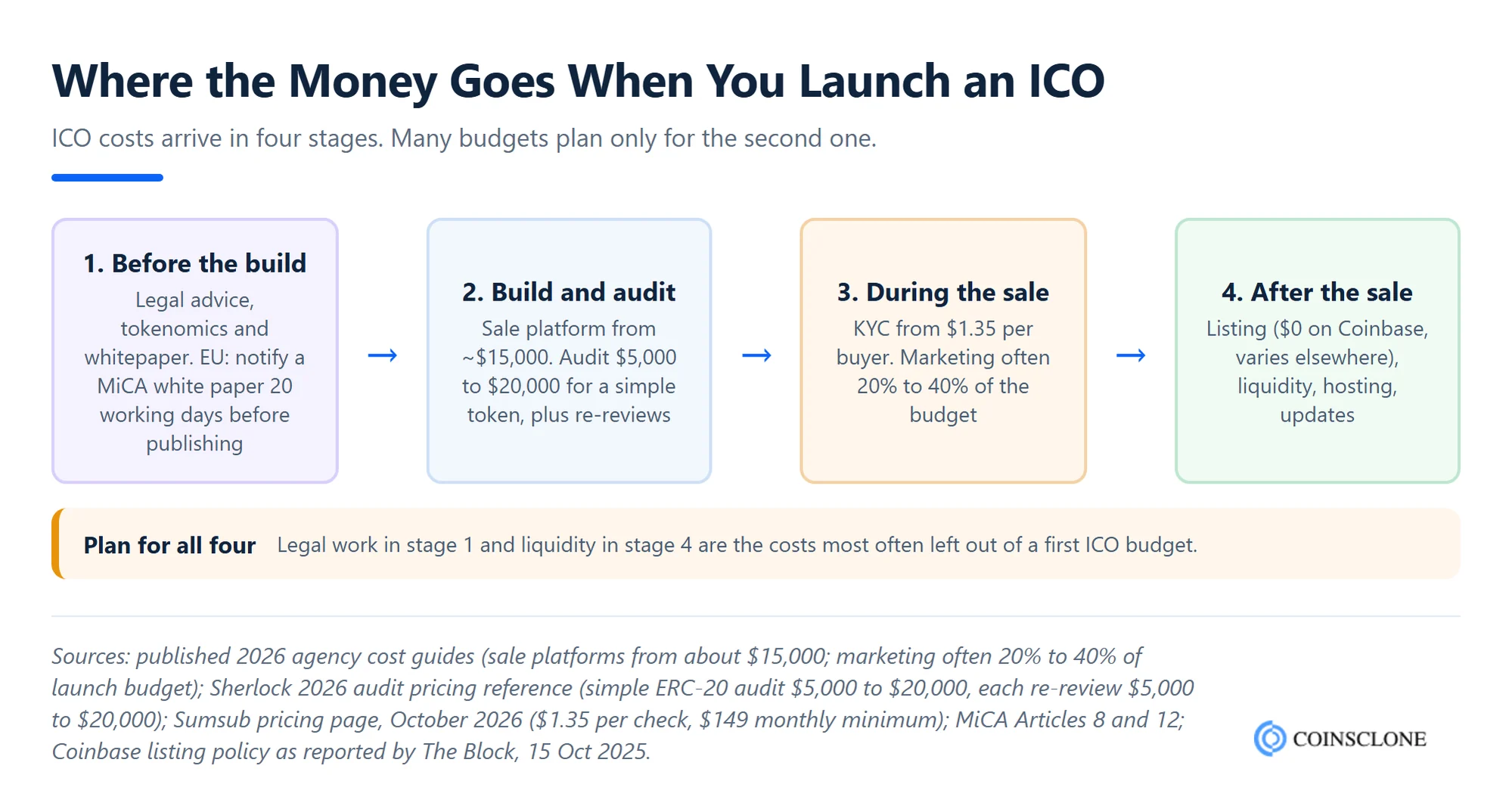
The cost to launch an ICO usually starts at about $20,000 for a small, simple sale and can pass $500,000 for a large, multi-chain one. Those are the ranges in published agency cost guides updated in 2026. The sale platform alone starts at about $15,000 for a basic build, and a premium multi-chain platform can pass $200,000.
However, the platform is only one part of the bill. A real budget also covers the audit, legal advice, KYC checks for every buyer, marketing and the work after the sale. Here is how those items add up:
| Cost item | Typical 2026 cost | What drives it |
| Sale platform (white label or script) | From about $15,000 | Changes to design, rounds, chains and payments |
| Custom sale platform | $50,000 to $200,000+ | New sale rules, many chains, security tokens |
| Smart contract audit | $5,000 to $20,000 for a simple token | Lines of code, chain, how urgent it is |
| Audit re-review after fixes | $5,000 to $20,000 per pass | Number of issues found and fixed |
| KYC checks | From $1.35 per buyer, $149 monthly minimum | Number of buyers and the checks you need |
| Legal advice and filings | Quote from counsel | Where you sell, to whom and under which rule |
| Marketing and community | Often 20% to 40% of the launch budget | Size of the raise and the channels you use |
| Exchange listing and liquidity | $0 on some exchanges, varies on others | Exchange, market maker, size of the trading pool |
Sources for the table: published 2026 agency cost guides for platform, total and marketing ranges; Sherlock’s 2026 audit pricing reference for audits and re-reviews; Sumsub’s published pricing for KYC.
So a lean white label sale can stay near the low end. In contrast, a custom sale with tiered rounds, two chains and buyers in the EU and the US will sit far higher. If you plan to build the sale yourself, our guide to ICO token sale platform development explains what goes into the platform.
Factors that Affect the Cost to Launch an ICO
The cost to launch an ICO is not a fixed price. Several factors move it up or down, and knowing them early helps you plan.
The Idea of the Project
Your ICO idea sets the scope of everything else. A simple token with one public round needs far less work than a token with staking, voting and many sale rounds. As a result, the more your idea asks of the platform, the higher the cost to launch an ICO. Choose a scope you can fund, and add extras in a later phase.
Complexity and Timeline
These two go hand in hand. If one changes, the other changes too. Complexity covers the sale rules, the tokenomics, the total supply, vesting and the number of chains.
A complex project takes longer, and time is money. Here are Coinsclone’s published build times for each kind of sale:
| Scope | Time to launch | What it includes |
| White label ICO platform | 2 to 4 weeks | Ready sale platform, rebranded and set up |
| Standard token sale | 5 to 8 weeks | Sale contract, KYC gating, vesting and audit |
| Sale with tiered rounds | 9 to 13 weeks | Several rounds, custom pricing, dashboard and audit |
| Compliance-heavy sale | 4 to 6 months | Transfer limits, investor checks and many countries |
| Full token programme | 6 to 10 months | Sale plus governance, treasury, staking and listing support |
Thus, the complexity and timeline of your project play a big role in the cost to launch an ICO.
ICO Development Team
The team you need depends on the project. A complex project needs a larger team of blockchain developers, smart contract engineers, designers and testers. Hiring them in-house adds salaries, tools and months of hiring time. On the other hand, a development company brings a ready team, which is why most startups outsource the build.
Smart Contracts and Security Audit
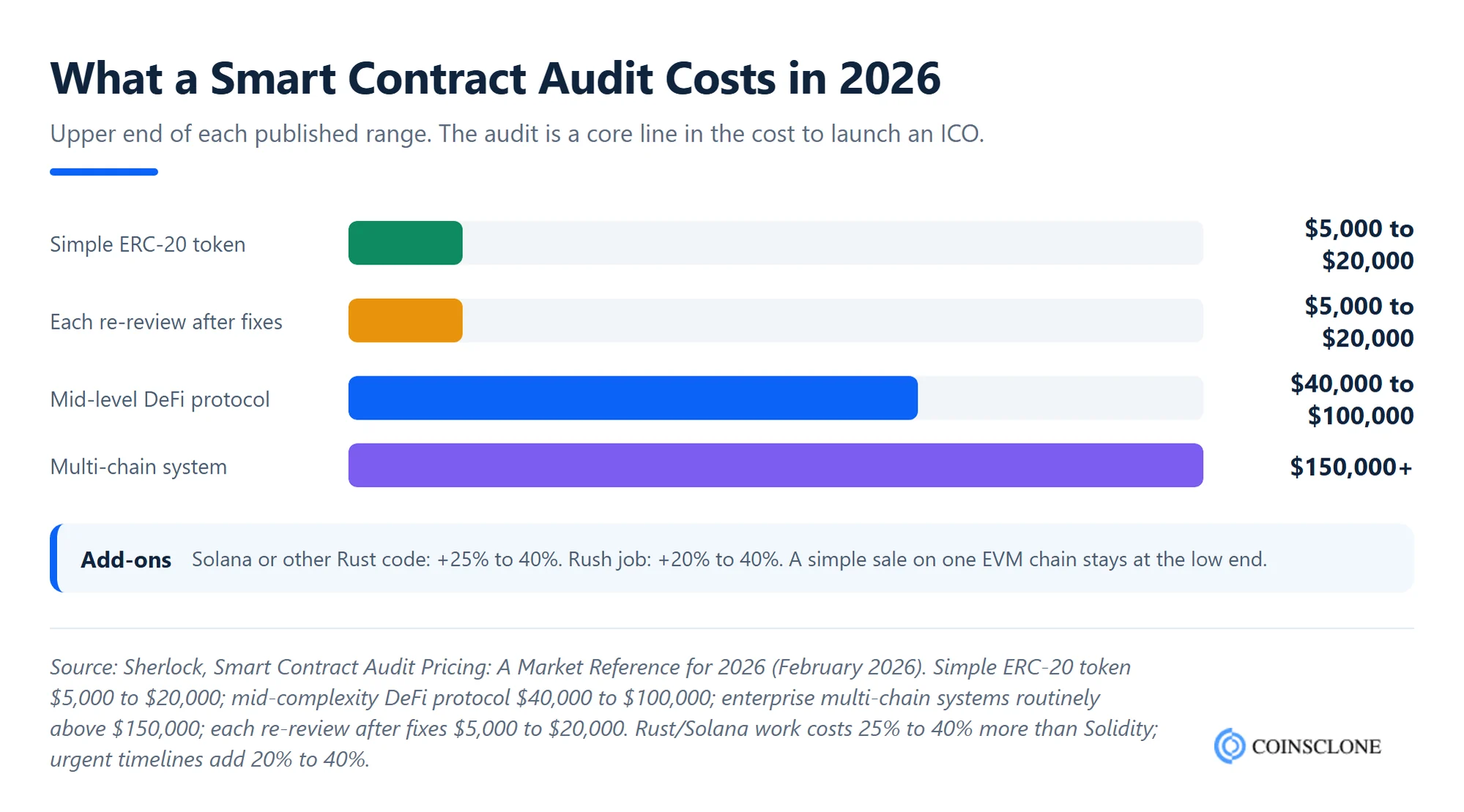
The smart contracts hold the money, so the audit is a cost you should never skip. Sherlock’s 2026 market reference gives a clear picture of what audits cost:
- Simple ERC-20 token: $5,000 to $20,000
- Mid-sized DeFi app: $40,000 to $100,000
- Large multi-chain system: often more than $150,000
- Each re-review after fixes: another $5,000 to $20,000
The chain matters too. The same guide says audits of Rust code on Solana cost 25% to 40% more than the same work in Solidity, and a rush job adds 20% to 40%. So if you change a ready-made sale contract, budget for a new audit of the changes. Our smart contract development services page explains what an audit covers and how long it takes.
Whitepaper
A whitepaper is the paper that explains your project, your token, your team, your tokenomics and the terms of your sale. Buyers read it closely, so you should write it with care. In the EU, it is also a legal paper for most public sales, which adds legal review and a set file format to the cost. Our guide on how to write an ICO whitepaper walks through each section.
ICO Advisory and Legal Work
Advisers guide you through the rules you must follow for a clean launch. This part is not optional. Wherever you sell, you need legal advice on who can buy, which countries to block and how your token is classed. Legal fees vary so much by country and sale size that no honest guide can give one figure, so get a written quote from counsel early.
Technical Architecture
The blockchain you choose, the number of chains, wallet support, payment options and the hosting setup all affect the cost. A sale on one EVM chain such as Ethereum, BNB Chain or Base is cheaper to build and audit than one that spans EVM chains and Solana. In addition, custom design, branding and extra languages for the website add to the launch cost.
To keep the cost down, work with a skilled ICO development company like Coinsclone that has the core platform built and tested.
Legal and Compliance Costs in 2026: EU and US
Rules changed a lot in the past two years, and they now drive a large share of the budget. This is general information, not legal advice.
European Union: MiCA
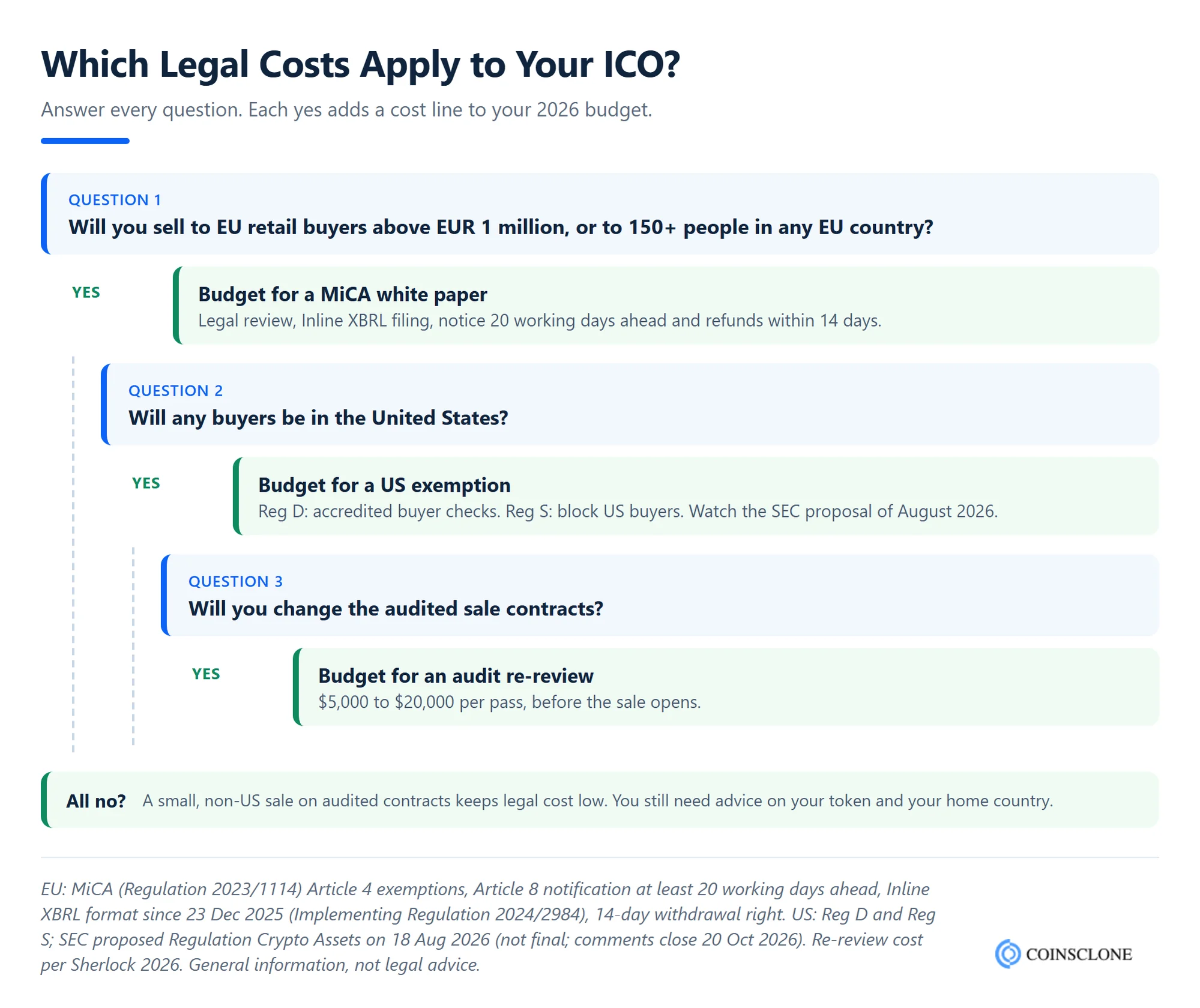
In the EU, the MiCA regulation covers most public token sales. Unless an exemption applies, you must write a white paper in a set format. You then send it to the regulator in your home country at least 20 working days before you publish it, and you are liable for what it says. Since 23 December 2025, the paper must also be filed in XHTML with Inline XBRL tags, so a PDF alone is no longer enough.
Small sales are exempt. You do not need a MiCA white paper if you raise no more than EUR 1 million over 12 months, sell to fewer than 150 people in each EU country, or sell only to qualified investors. Retail buyers who buy straight from you also get a 14-day right to withdraw, so your platform must handle refunds in that window.
United States: The SEC Proposal
On 18 August 2026, the SEC proposed “Regulation Crypto Assets”. According to the SEC’s press release, it would allow a startup exemption of up to $5 million and a fundraising exemption of up to $75 million in each 12-month period, under set conditions. It is still a proposal, and comments close on 20 October 2026. Until a final rule arrives, most US sales use existing routes such as Reg D (accredited buyers only) or Reg S (buyers outside the US).
Each route adds its own cost: accredited checks for Reg D, country blocks for Reg S, and filings and records for both.
For the full legal path from company setup to sale day, see our step-by-step guide on how to start an ICO.
Hidden and Ongoing Costs of an ICO
Many budgets stop at launch day. However, several costs arrive during and after the sale.
- KYC per buyer: you pay for each identity check. At Sumsub’s Basic rate of $1.35, checking 2,000 buyers costs $2,700, with a $149 monthly minimum.
- Exchange listing: costs vary a lot by exchange. Coinbase says it charges no listing or application fees, as The Block reported in October 2025. Binance also says it charges no listing fee, although some founders have publicly disputed this. Smaller exchanges often do charge, so ask for terms in writing.
- Liquidity: a token needs buyers and sellers. Plan funds for a DEX trading pool or a market maker, which is often a bigger cost than the listing itself.
- Audit re-reviews: every change to the sale contracts after the audit needs another review, at $5,000 to $20,000 per pass.
- Hosting, support and upgrades: servers, monitoring, bug fixes and security updates after launch.
- MiCA updates: if a big fact changes, EU rules require you to update the white paper and notify the change at least 7 working days before you publish it.
- Marketing after the sale: community, content and updates keep holders with you through the token release and listing.
Is an ICO Still Worth the Cost in 2026?
Token sales are back, but buyers are far more careful than in 2017. CryptoRank data reported by PANews counted 533 public token sales in 2025, and only 63 of them, about 12%, traded above their sale price by year end.
The pace has also cooled in 2026. CryptoRank figures reported by Grafa show public sales raised about $390 million in Q1 2026 and only $58 million in Q2 by mid-June, the weakest quarter in five years.
So what does this mean for your budget? Buyers now expect KYC, fair allocation, clear vesting and audited contracts. Spending on those basics is what makes a sale credible. In contrast, cutting the audit or the legal work to save money is the fastest way to lose buyers’ trust.
Challenges Associated with Launching an ICO
Thinking about the challenges early leads to a smoother launch and fewer surprise costs.
Seeking Investors’ Attention
Convincing buyers to fund a new token is the main challenge most startups face. Attracting a large investor is even harder. To do it, you need a detailed whitepaper that explains each part of the project, a clear use for the token and an honest roadmap. Also, show buyers why your project has real value; only then will they fund it.
ICO Platform Security
Every online product faces attacks, and a token sale holds real money. Even a small flaw can wipe out the funds you raise and your reputation with them. A good ICO team builds in the key safeguards:
- Two-factor authentication
- SSL encryption
- Audited smart contracts with clear sale terms
- Raised funds held in a multisig wallet
- Security checks before and after the ICO launch
With expert help, you also get wallet screening and alerts for odd activity.
Building a Reputation in the Market
Many new token projects enter the market, but only a few earn real trust. Buyers now filter out weak and scam projects and pick only the credible ones. As a new startup, you build that trust with a real product, a public team and steady updates. Thus, come up with a genuine idea that solves a real problem.
Rules in each country are a challenge too, as the legal section above shows. To avoid costly mistakes, work with an experienced team from the start.
How to Launch an ICO Cost-Effectively?
With an ICO development company, you can build your token sale website in two ways: from scratch, or with a ready-made script. Building from scratch is a long and complex process. You gather the idea, design the website and write every part of the code from the start, so it takes more time, more people and more money. To skip that, you can choose the budget-friendly option: an ICO script.
An ICO Script is pre-built software that holds all the basic parts you need to launch an ICO. It comes as a full package. You get an ICO website with the key features, a token on a major chain such as Ethereum, BNB Chain or TRON (as an ERC-20, BEP-20 or TRC-20 token), a self-held wallet for buyers and help with your whitepaper. This makes it a low-cost option compared with building an ICO website from scratch.
You can still customize the features and design to match your needs. Because the core software is already built and tested, you need far less technical work to launch. A white label ICO platform can go live in 2 to 4 weeks with a script. That is why many startups that choose crypto crowdfunding start with an ICO script. Here are the key features that come built into our ICO script.
For Admin Dashboard
- Whitelisting
- Investor management
- Custom funding plan
- Admin permission management
- Customized smart contract
- Pending transactions handling
- Concierge plan
- Reporting and analytics
For Investor Dashboard
- Real-time statistics
- KYC/AML solutions
- User-friendly interface
- One-touch information
- Multi-language support
- Community management
- Two-factor authentication
- Investor review
Adopting an ICO script is a smart choice for those who want to save time and money. Another practical option is white label ICO software, which also cuts the overall cost of launching an ICO.
Opting for White Label ICO Software is an efficient way to reduce the cost of an ICO. These ready-to-use platforms help you start your sale quickly while still leaving room to customize.
With this software, you can shape the platform around your brand, from the design and interface to the core features. It keeps your costs low and your ICO running smoothly, without giving up speed, safety or ease of use. The market offers many script providers, so compare them on audits, code ownership and support before you choose.
More Ways to Cut the Cost
- Launch with core features first: add staking, governance or extra chains in a later phase.
- Start on one chain: each extra chain adds build, audit and support cost.
- Keep audited contracts as they are: every change needs a re-review, so change only what you must.
- Check exemptions early: a smaller EU sale under EUR 1 million can avoid the cost of a full MiCA white paper.
- Start legal work in week one: legal delays keep the whole team waiting, and waiting costs money.
Why Should You Choose Coinsclone for Launching an ICO?
By now, you have a clear idea of the cost to launch an ICO and the best way to build one. Coinsclone is a leading Crypto Launchpad Development Company that excels in ICO scripts and white label ICO platforms. Since 2018, we have delivered 350+ platforms for 200+ clients across 20 industries. Our ICO script is tested across many builds, and startups around the world have used our ICO software to raise funds and grow their business.
We focus on our clients’ goals, so you can add or customize any feature or design to match your plans. Our support team stays with you after delivery and fixes issues quickly. Why wait? Get a ready ICO script from Coinsclone and launch your token sale at a cost that fits your budget.
Frequently Asked Questions
How much does it cost to launch an ICO?
Published agency cost guides updated in 2026 put a small, simple ICO at about $20,000 to $50,000 and a large, multi-chain one above $500,000. The platform starts at about $15,000. On top of that, plan for an audit ($5,000 to $20,000 for a simple token, per Sherlock), KYC from $1.35 per buyer, legal advice, marketing and listing costs.
Is it possible to launch a successful ICO with a lower budget?
Yes. You can launch a successful ICO on a modest budget if you use a white label platform or an ICO script, start on one chain, keep the audited contracts as they are and launch with core features first. Expert guidance helps you avoid costly mistakes. Coinsclone offers a ready ICO script that you can shape to fit your budget.
How much time does it take to launch an ICO?
A white label ICO platform can be ready in 2 to 4 weeks. A standard token sale takes 5 to 8 weeks, a sale with tiered rounds takes 9 to 13 weeks, and a compliance-heavy sale takes 4 to 6 months. Legal work often sets the real pace.
After the launch of the ICO, are there ongoing costs?
Yes. Ongoing costs include hosting, support, security updates, a new audit review after any contract change, KYC for new buyers, marketing, exchange listings and liquidity. In the EU, you must also update and re-notify your white paper if a big fact changes.
How much does it cost to register an ICO?
There is no single ICO registration fee. In the EU, most public sales send a MiCA white paper to the home regulator, which does not need to approve it, and small sales under EUR 1 million or 150 buyers per country are exempt. In the US, sales use exemptions such as Reg D or Reg S. The real cost is the legal work, which varies by country.
Who pays legal fees in an ICO setup?
The company that runs the ICO pays the legal fees. They change with each country and region, and with the type of buyers you accept. An ICO script lowers the build cost, but it does not replace legal advice, so get a quote from counsel early.
Which country is best for an ICO?
There is no single best country. EU companies get one rulebook across all member states under MiCA. Other hubs such as Switzerland, Singapore, Dubai and the UK have their own rules. Choose your base with your lawyers before you set up the sale, because it decides who can buy and what you must file.
What are the advantages of launching an ICO?
An ICO lets you raise funds from a global audience, build a community around your project early and give your token liquidity once it lists. It can also be faster than traditional fundraising. However, you must follow the rules where you sell.
See How Our ICO Launch System Saves You 80% in Costs
ICO Development — done right.
- Smart Launch System : Launch your ICO faster and cheaper — no coding required.
- Token Creation & Dashboard : Pre-built modules for ERC20, BEP20 & custom tokens.
- Investor Portal : Manage investors, KYC, and funds seamlessly.
- Marketing & Compliance : Built-in tools to meet legal and promotional standards.
Get a free cost breakdown and demo of your ICO platform in 48 hours — before you invest a cent.
Book a Free Demo to discover how our ICO Development Services can help you launch a fully compliant ICO in just 2–4 weeks — at a fraction of the usual cost.