
The cost to create a crypto token runs from under one cent to $50,000 or more, depending on how you build it. The token itself is almost free: on 27 September 2026, it cost a few cents on Base, BNB Chain or Polygon, about $2.40 on Solana and about $31 on Ethereum, while a basic custom token built by a team costs about $5,000 to $15,000.
Launching a token that people trust and trade is a different matter. Custom contract features, a security audit, starting liquidity, legal advice and marketing can take the budget into the tens of thousands of dollars. In this guide, we break down both parts with real 2026 numbers: what each blockchain charges, what each step costs, what a full launch costs, and where you can safely save.
In this guide:
- Network fees: Under $0.05 on BNB Chain and most layer 2s, about $2.40 on Solana and about $31 on Ethereum (September 2026).
- Build cost: About $5,000 to $15,000 for a basic custom token, and $15,000 to $50,000+ with vesting, staking or governance.
- Audit cost: About $5,000 to $15,000 for a simple token, and $15,000 to $70,000 for complex contracts.
- Step-by-step costs: What each launch step costs, from tokenomics to listing, with three example budgets.
- Biggest costs: For most projects, liquidity, the audit and marketing cost far more than the token itself.
How Much Does It Cost to Create a Crypto Token?
Here is the short answer, based on published 2026 market ranges:
| What you are building | Typical cost | Typical time |
| Meme token on Pump.fun | Network fee only (under $0.01) | Minutes |
| Standard token from audited templates (no custom logic) | Network fee plus a few hundred to a few thousand dollars for setup | Days |
| Basic custom token by a development team | About $5,000 to $15,000 | 1 to 3 weeks |
| Token with vesting, staking, tax or governance logic | About $15,000 to $50,000+ | Several weeks |
| Security audit (simple to mid-complexity) | About $5,000 to $70,000 | 1 to 4 weeks |
Sources: published 2026 agency cost guides and published audit-firm price ranges. Prices vary with team location and scope.
The rest of your budget depends on your launch plan: how much liquidity you add, whether you list on exchanges, and how much you spend on legal work and marketing.
See How Affordable It Is To Launch Your Own Crypto Token
Crypto Token Development — simplified.
- Transparent Pricing: Know exactly how much it costs to create your token.
- Multi-Chain Support: Ethereum, BNB Smart Chain, Tron, Solana & more.
- Smart Contract Security: Audited, optimized, and gas-efficient.
- Branding & Utility: Custom logo, name, and tokenomics that fit your project.
Get a detailed cost breakdown — before you spend a cent
Book a Free Consultation to discover how much it costs to create your crypto token and launch in just 2–4 days
How Much Does It Cost to Create a Token on Each Blockchain?
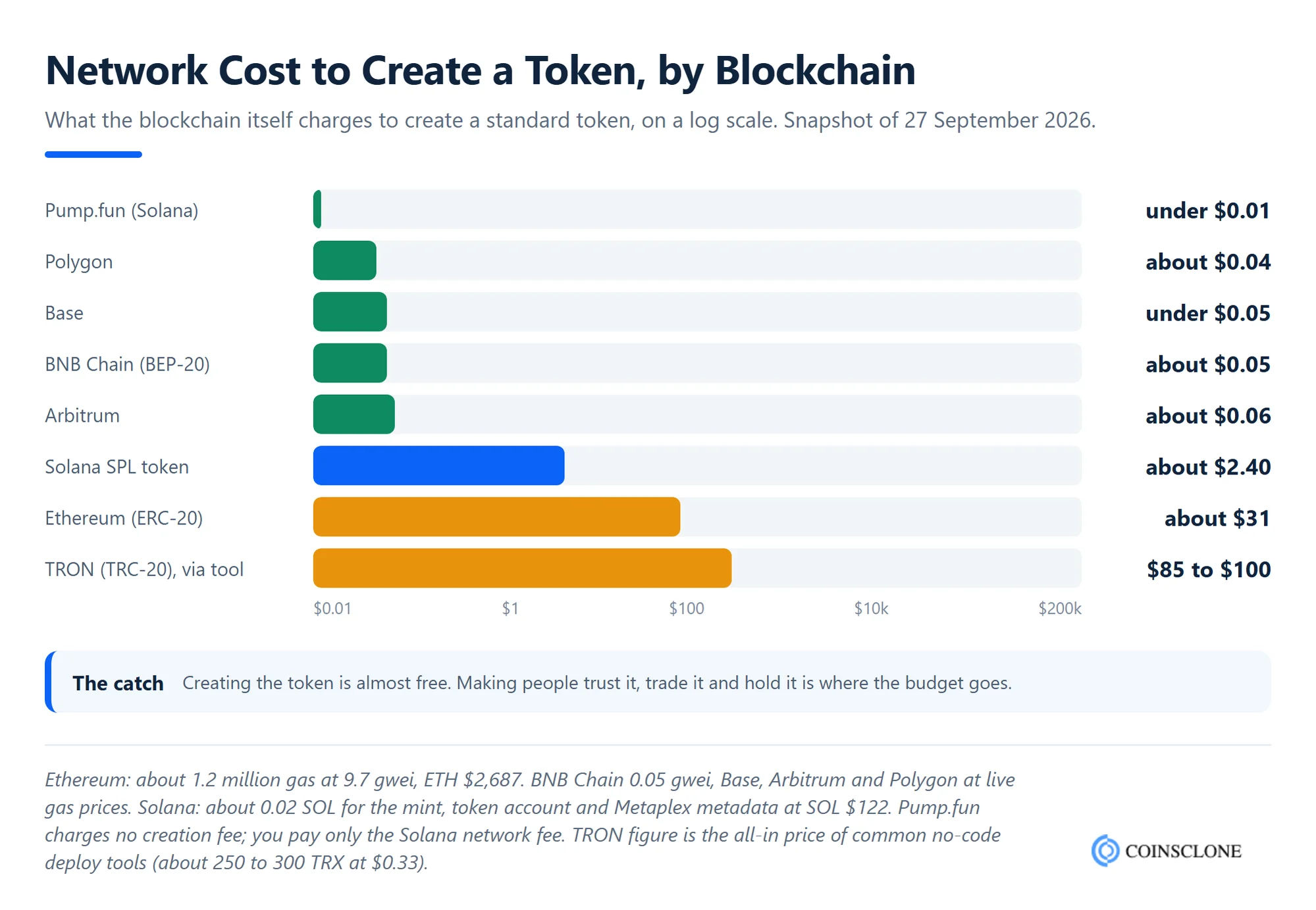
Every blockchain charges a network fee (gas) to create a token. On most networks, it is tiny:
Cost to Create a Token on Ethereum (ERC-20)
Deploying a standard ERC-20 contract uses about 1.2 million gas. At 9.7 gwei and ETH at $2,687 on 27 September 2026, that was about $31. When the network is busy, it can cost $100 or more. See our step-by-step guide to create an ERC20 token.
Cost to Create a Token on BNB Chain (BEP-20)
The same contract costs about $0.05 on BNB Chain. It is popular for community and meme tokens because both creating and trading are cheap. Read more about the cost to create a BEP20 token.
Layer 2s: Base, Arbitrum and Polygon
These networks run the same Ethereum code for a few cents. Base in particular has become a major home for new tokens.
Robinhood Chain
Robinhood Chain is a newer Ethereum layer 2 that pays gas in ETH, so an ERC-20 deploy costs cents there too. Launchpads made it very cheap: on 2 September 2026, almost 25,000 new tokens went live on it in a single day, most for a launch fee of about $1. For network settings, liquidity and sniper risks, see our guide on how to create a token on Robinhood Chain.
Cost to Create a Token on Solana (SPL)
Creating an SPL token needs a mint account, a token account and a metadata account. The unavoidable on-chain cost is about 0.02 SOL, or about $2.40 at a SOL price of $122. No-code tools often charge 0.1 to 0.5 SOL on top as their service fee. Learn more about Solana token development.
Cost to Create a Token on Pump.fun
On Pump.fun, creating a token is free. You only pay the Solana network fee. The token starts on a bonding curve and “graduates” to Pump.fun’s own DEX, PumpSwap, after about 85 SOL of buying, roughly $50,000 in market value at September 2026 prices. Since PumpSwap launched in March 2025, that move costs just 0.015 SOL, taken from the pool itself, replacing the old 6 SOL fee. For the full step-by-step process, see our guide on how to create a meme coin. To run your own launchpad like this, see our Pump.fun clone script.
TRON (TRC-20)
Deploying a contract on TRON burns TRX for “energy”. Popular no-code tools charge about 250 to 300 TRX all-in, roughly $85 to $100. You can reduce this by staking TRX for energy. See our TRC20 token development services.
How to Create a Crypto Token and What Each Step Costs
Creating a crypto token takes eight steps, and most of the money goes into four of them: the build, the audit, liquidity and marketing. Here is what each step costs in 2026:
| Step | What you do | Typical cost |
| 1. Pick a launch model and chain | Launchpad meme token, custom utility token or regulated asset token | Free, but it sets every cost below |
| 2. Design the tokenomics | Supply, allocation, vesting and owner powers | Your time, or part of a development package |
| 3. Build the smart contract | Use a launchpad template or audited code, or write custom logic | $0 on a launchpad; about $5,000 to $15,000 basic; $15,000 to $50,000+ complex |
| 4. Test on a testnet | Deploy and test with free test tokens | Free apart from developer time |
| 5. Audit the code | Independent review of any custom logic | About $5,000 to $15,000 simple; $15,000 to $70,000 complex |
| 6. Deploy on mainnet | Publish and verify the contract | Under a cent to about $31 (September 2026) |
| 7. Add and lock liquidity | Pair your token with ETH, SOL or USDC in a DEX pool | Your own capital, plus a small pool fee (0.15 SOL on Raydium) |
| 8. List and market | Data sites, exchanges, community and content | Free to apply on CoinGecko and CoinMarketCap; marketing is open-ended |
For team and investor tokens, the vesting contract is often the first custom feature you pay for. Our guide to token vesting smart contracts shows how to set cliffs and linear unlocks. For step 7, see how to create a liquidity pool for your token, including how much to add. For the full walkthrough with code, read our guide on how to create a crypto token.
Crypto Token Development Cost: What a Full Launch Costs
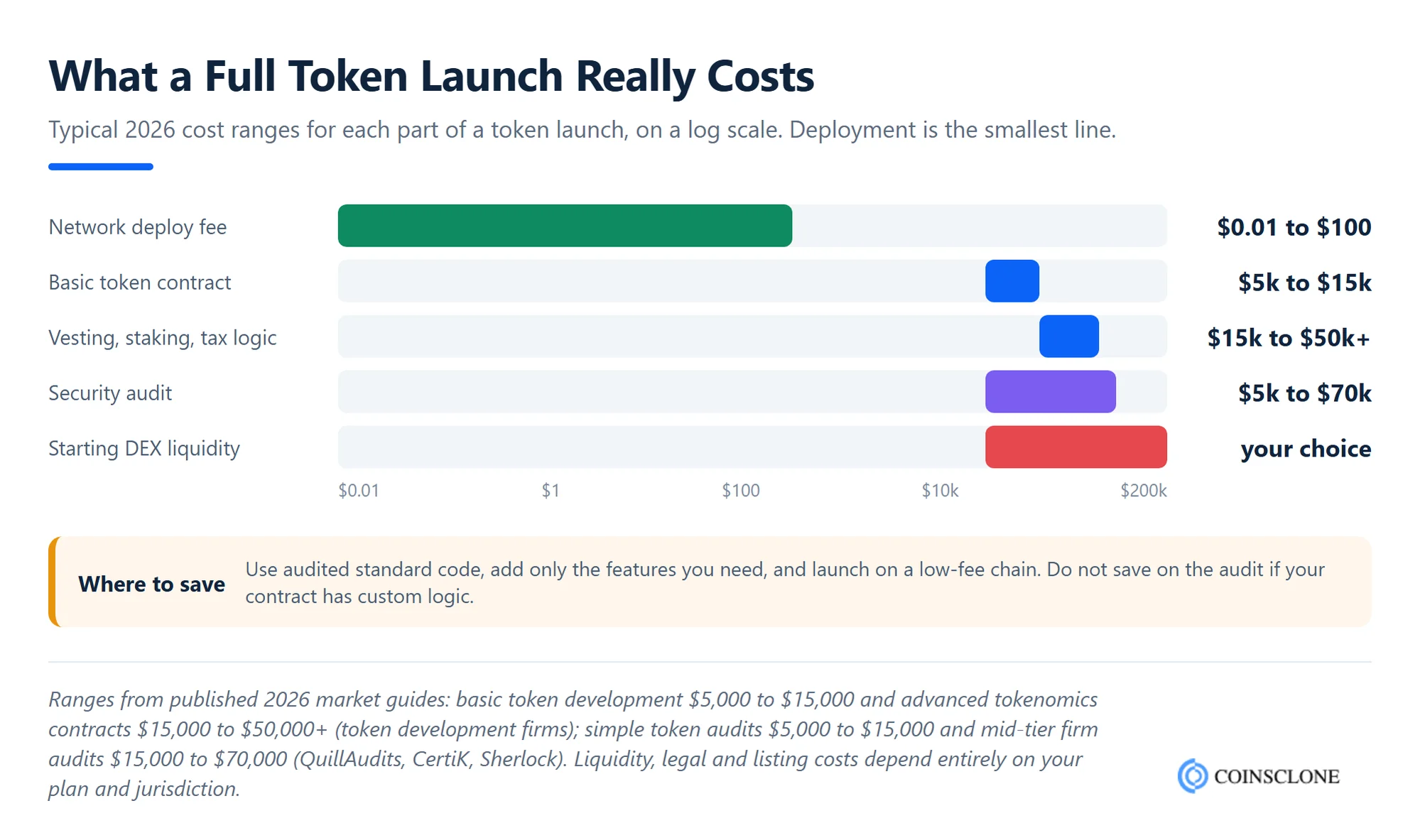
The network fee is the smallest line in any serious token budget. Here is how the other costs compare:
Smart Contract Development
A plain token built from audited open-source code, such as OpenZeppelin’s ERC-20, needs very little custom work. Costs rise when you add features such as vesting schedules for the team, staking rewards, transfer taxes, anti-bot rules or governance. Each feature is more code to build, test and audit.
Security Audit
If your token has any custom logic, get an independent audit. Published 2026 ranges put a simple token audit at about $5,000 to $15,000, and mid-tier audit firms at $15,000 to $70,000 for more complex contracts. A plain, unmodified template carries little risk, but a single bug in custom code can destroy a project.
Starting Liquidity
To let people trade your token on a DEX, you must add liquidity: your token plus a paired asset, such as ETH, SOL or USDC. There is no fixed price. Thin liquidity means big price swings on every trade, so many projects budget tens of thousands of dollars or more. You can also lock the liquidity to show buyers you will not pull it.
Exchange Listings
Listing on data sites such as CoinGecko and CoinMarketCap is free to apply for, but you must meet their criteria. Centralized exchange listings are negotiated privately. Some exchanges ask for fees, token allocations or market-making commitments, so treat any quote with care. Our guide on how to list a token lists each platform’s official fees and requirements.
Legal and Compliance
Rules depend on where you and your buyers are. A token sold to raise money can count as a security in some countries, and the EU’s MiCA rules require a white paper for many token offers. A legal review is usually worth it before any public sale.
Tokenomics, White Paper and Marketing
Clear tokenomics and a white paper build trust. Community building and marketing are often the largest ongoing cost after launch.
Ongoing Costs After Launch
The spending does not stop at launch day. Plan a monthly budget for:
- Community and support: Moderators, content and replies to holders.
- Monitoring: Alerts on large transfers, pool changes and admin actions.
- Owner key security: A multisig wallet for any admin powers, with clear signers. If you give up control instead, renouncing ownership costs only a network fee.
- Upgrades and new audits: Any change to the contract needs fresh testing and, often, a fresh audit.
- Listing upkeep: Keeping data sites and exchange pages accurate.
Crypto Token Cost by Token Type
The type of token you build changes the cost more than the chain does. Here is how the main types compare:
| Token type | Typical build cost | What drives the cost |
| Meme token on a launchpad | Network fee only | Marketing and community |
| Basic utility token | About $5,000 to $15,000 | Standard code, light testing, a simple audit |
| Governance, DeFi or staking token | About $15,000 to $50,000+ | Staking, voting and vesting logic, a deeper audit |
| Security or real-world asset token | Usually at or above the top of the complex range | Identity checks, transfer rules and securities law |
| Stablecoin | Usually the most expensive | Reserves, licences and frequent audits |
For regulated tokens, a standard such as ERC-3643 builds the identity checks into the token. See our ERC-3643 token development page for how it works, or our guide to DeFi token development for staking and governance tokens.
Example Token Budgets: Meme, Utility and Regulated Tokens
Every project is different, but these three examples show how the same token can cost very different amounts to launch:
| Cost item | Community meme token (Solana) | Utility token with vesting (Base) | Regulated asset token (Ethereum) |
| Network fee to create | Under $0.01 on Pump.fun | Under $0.05 | About $31 at 9.7 gwei |
| Contract development | None (launchpad template) | Vesting and staking contracts | Permissioned token (for example ERC-3643) with identity checks |
| Security audit | Not needed for the template | Needed for vesting and staking code | Needed, often more than one |
| Starting liquidity | Built by the bonding curve | Your DEX pool, often locked | Usually none; sold to verified investors |
| Legal work | Minimal, but check local rules | Advice on how the token is sold | Essential: securities rules apply |
| Biggest cost | Marketing and community | Audit and liquidity | Legal work and compliance |
The lesson: pick the launch model first, then budget. A meme token and a regulated asset token are both “tokens”, but their costs differ by orders of magnitude.
Factors That Affect the Cost of Creating a Crypto Token

Consulting Services
Expert advice on tokenomics, legal structure and technology helps you avoid costly mistakes. A token development company usually includes this in its package.
Development Method
- No-code token generator: The cheapest route for a simple token. Check who controls the contract and whether it hides fees or owner powers.
- Freelancer: Can work for small projects. Check their past contracts and insist on tests.
- Development company: Best for tokens with custom features, audits and launch support. You get developers, testers and support after launch.
Blockchain and Token Standard
Your chain decides the fee, the wallets and the DEXs your token can use. ERC-20 on Ethereum and its layer 2s, BEP-20 on BNB Chain, SPL on Solana and TRC-20 on TRON are the most common. See our guide to ERC token standards for the Ethereum options.
Token Features
Every feature adds work. Common ones include:
- Fixed or capped supply: Simple and trusted.
- Mintable: New tokens can be created later. Buyers will ask who controls this.
- Burnable: Tokens can be destroyed to reduce supply.
- Pausable: Transfers can be stopped in an emergency.
- Transfer tax: A fee on each transfer, which many scanners treat as a warning sign.
- Anti-whale limits: Caps on how much one wallet can buy or hold.
- Vesting: Team and investor tokens unlock over time.
- Staking: Holders earn rewards for locking tokens.
- Governance: Voting power for holders.
Testing and Quality Assurance
Thorough testing on a test network catches bugs before they cost real money. Custom logic needs more tests.
Security Audit
Required for any token with custom code. The price depends on how many lines and how much logic the auditor must review.
Legal and Regulatory Compliance
Legal costs depend on your country, your buyers and whether you run a public sale.
Liquidity and Listings
The amount you add to DEX pools, and any exchange listings, can be larger than all other costs combined.
Marketing
Community, content, partnerships and events keep a token alive after launch.
How to Reduce the Cost of Creating a Crypto Token
- Choose a low-fee chain: Base, BNB Chain, Polygon or Solana cost cents to use. See our list of the top blockchain platforms.
- Start from audited code: Standard OpenZeppelin or Solana Token Program code is safer and cheaper than writing from scratch.
- Add only the features you need: Every extra feature adds development and audit cost.
- Keep owner powers minimal: Fewer admin functions mean less to audit and more trust from buyers.
- Test on a testnet first: Deploying to a test network is free.
- Work with an experienced team: Paying once for good work costs less than fixing a broken launch.
Is It Cheaper to Create a Token or a Coin?
A token is far cheaper. A token runs on an existing blockchain, so you only write a smart contract. A coin needs its own blockchain, with nodes, validators and security, which takes a much larger team and budget. See our altcoin development service if you need your own chain.
Why Choose Coinsclone for Crypto Token Development?
Coinsclone is a crypto token development company that has built blockchain products since 2018, delivering more than 350 platforms for over 200 clients across 20 industries. We build tokens on Ethereum, BNB Chain, Solana, TRON and other chains, from simple tokens to complex tokenomics with vesting, staking and governance. We start from audited code, keep owner powers transparent, and help with testing, audits and launch planning, so your budget goes where it matters.
Read our full guide on how to create a crypto token, or contact our team for a quote on your exact scope.
See How Affordable It Is To Launch Your Own Crypto Token
Crypto Token Development — simplified.
- Transparent Pricing: Know exactly how much it costs to create your token.
- Multi-Chain Support: Ethereum, BNB Smart Chain, Tron, Solana & more.
- Smart Contract Security: Audited, optimized, and gas-efficient.
- Branding & Utility: Custom logo, name, and tokenomics that fit your project.
Get a detailed cost breakdown — before you spend a cent
Book a Free Consultation to discover how much it costs to create your crypto token and launch in just 2–4 days
Frequently Asked Questions
How much liquidity should I add when I launch a token?
There is no fixed amount. The more liquidity you add, the smaller the price swing on each trade, which makes buyers more comfortable. A useful rule is to put about 100 times your largest normal buy on the paired side of the pool, which keeps that buy near 1% slippage. Then lock the pool for a set period to show you will not pull it. Our guide on how to create a liquidity pool for your token works through the numbers.
How much does it cost to create a crypto token?
The network fee is tiny: a few cents on Base, BNB Chain or Polygon, about $2.40 on Solana and about $31 on Ethereum in September 2026. A professionally built token with custom features typically costs $5,000 to $50,000+, plus an audit and starting liquidity.
How much does it cost to create a token on Solana?
The on-chain cost is about 0.02 SOL (about $2.40) for the mint, token account and metadata. No-code tools add a service fee, often 0.1 to 0.5 SOL. Custom Solana programs cost more to build and audit.
How much does it cost to launch a token on Pump.fun?
Creating a token on Pump.fun is free apart from a tiny Solana network fee. When a token graduates to PumpSwap, a flat 0.015 SOL fee comes out of the pool itself, so the creator pays nothing extra. That has been the rule since March 2025, when it replaced the old 6 SOL fee.
How much does it cost to make a meme coin?
The token costs almost nothing: under a cent on Pump.fun, or a few cents on Base or BNB Chain. The real costs are marketing, community and, on your own DEX pool, the liquidity you add. Our guide on how to create a meme coin covers each route.
Why do token creator sites quote 0.1 to 0.5 SOL to launch a Solana token?
The gap is the tool’s own service fee. The unavoidable on-chain cost of a Solana token is about 0.02 SOL, and no-code creators add 0.1 to 0.5 SOL on top. Some sites also ask for broad wallet access. Only sign the single transaction you expect, and use a fresh wallet with just the SOL you need.
How long does it take to create a crypto token?
A launchpad token takes minutes. A basic custom token takes about 1 to 3 weeks, and a token with vesting, staking or governance takes several weeks. Add 1 to 4 weeks for an audit, plus time to set up liquidity and listings.
Is a $5,000 audit worth it for a simple ERC-20 token?
It depends on how much custom code you wrote. An unchanged OpenZeppelin ERC-20 has well-known code, so a full paid audit adds little. Once you add taxes, vesting, minting rules or anti-bot logic, a $5,000 to $15,000 audit is cheap next to the cost of one exploited bug. Many teams also run free automated scanners first, so the auditor spends paid time on the real logic.
Is creating a crypto token really as easy as people say?
Deploying a basic token is easy and can take an afternoon. The hard part is the work around it: sound tokenomics, code with no weak spots, enough liquidity, and the right legal setup for how you sell it. That is where most of the time and money goes.
Do I need to pay gas fees to create a token?
Yes. Every blockchain charges a network fee to create the token contract or mint account. The amount depends on the chain and how busy it is.
How much does a token audit cost?
Published 2026 ranges put a simple token audit at about $5,000 to $15,000. Complex tokenomics and DeFi contracts can cost $15,000 to $70,000 or more.
Can I create a crypto token for free?
You can practise for free on a test network. On a live network, you always pay a small network fee, and Pump.fun lets you create a token for only that fee.
Is it cheaper to create a token or a coin?
A token is much cheaper, because it runs on an existing blockchain. A coin needs its own blockchain and network of nodes.
What is the biggest cost of a token launch?
For most projects, it is not the token itself but the starting liquidity, the audit and marketing. Plan these before you deploy.