
This guide explains ICO token sale platform development: what the platform is, what it must do in 2026 and how to build one that buyers trust. An ICO token sale platform is the website, dashboard and smart contracts that sell your new tokens to the public, check who is buying, hold the funds safely and pay out tokens when the sale ends.
You will see how a sale runs from whitelist to token claim, how the platform shares out tokens when demand beats supply, and when your own platform beats a launchpad. We also cover the features to include, the build routes and the weeks each one takes.
In this guide:
- What an ICO token sale platform includes, part by part
- Your own token sale platform vs a launchpad, and when each one fits
- How a sale runs, including soft caps, refunds and token claims
- Three ways to share out tokens when a sale is oversubscribed, with worked numbers
- The features, build steps, time and costs to plan for
See How Our MVP System Can Launch Your ICO Token Sale Faster
ICO Token Sale Platform Development — done right.
- MVP System:Launch your fundraising platform 90% faster.
- Smart Contracts:Secure, audited, and customizable for smooth token sales.
- Token Creation:Mint,manage,and distribute tokens with complete control.
- Branding & Customization:Your project, your interface, your investor experience.
- Investor Dashboard:Integrated wallets, analytics, and automated KYC for compliance.
See a free branded demo of your ICO token sale platform in 48 hours — before you invest a cent.
Book a Free Demo to discover how our ICO Token Sale Platform Development can take you from concept to live fundraising in just 2–4 weeks.
What Is ICO Token Sale Platform Development?
ICO token sale platform development is the work of building a secure, easy-to-use system that a blockchain project uses to sell its native tokens to the public. Startups that create new tokens list them on the platform to raise funds for their crypto project. As a result, the platform is often the first thing buyers, crypto investors and traders judge a project by.
A good platform does three jobs. First, it makes buying simple: connect a wallet, pass KYC, pay, done. Second, it keeps the money safe and the rules fair, with caps, refunds and audited contracts. Third, it gives the team a clear view of the raise in real time. Many token creators skip this thinking and buy the cheapest sale page they can find. Expert ICO consulting services can help startups plan the tech and business side before the build starts.
What a Token Sale Platform Is Made Of
Every ICO token sale platform has the same core parts, whether you buy a script or build from scratch:
- Sale website: The public page with the whitepaper, roadmap, tokenomics, team and a countdown to the sale.
- Investor dashboard: Where buyers connect a wallet, pass KYC, choose a payment coin, buy tokens and later claim them.
- Admin panel: Where your team sets rounds, prices and caps, approves KYC, tracks funds and handles support.
- KYC and AML checks: An identity provider that checks each buyer and blocks sanctioned people and banned countries.
- Sale smart contract: The code that takes payments, enforces caps and allocations, and handles refunds.
- Vesting and claim contracts: The code that releases tokens on a schedule after the token generation event (TGE).
- Multisig treasury: A wallet that needs several signatures to move raised funds, so no single person can run off with them.
Is Creating an ICO Token Sale Platform Beneficial?
Yes, for most serious projects. The ICO token sale platform plays a vital role in the success of the crypto project. So, as a startup, you need to focus on a top-notch platform.
Raise Funds for Your Project
The main aim of an ICO token sale platform is to raise enough funds for the crypto project. A clean, secure user dashboard also makes your project easier to promote, because every buyer can see how the sale works.
Get the Attention of Users
The first impression counts. This even applies to your ICO platform. Clear features, easy navigation and a simple dashboard help you win more investors. On the other hand, a clunky sale page with an unaudited contract is often where buyers drop out.
Earn More Than the Sale Itself
The platform is not only meant for one sale. You can run bounty programmes and referral rewards to grow your community. Even after the ICO ends, you can reuse the ICO token sale platform for later rounds, staking or token claims.
Have Your Own Brand Recognition
When you create your own ICO token sale platform, you build your own brand. You do not need a third party to sell your tokens, so you skip their fees and their rules. In addition, you keep full control of the sale terms, the buyer data and the treasury.
To gain these benefits, you need the right mix of features and a clear plan. But first, it helps to know when your own platform is the better choice than a launchpad.
Own ICO Token Sale Platform vs a Launchpad
You can sell tokens in three main ways: on your own platform, on a crypto launchpad, or on a curated sale venue run by a large exchange. Each one trades control for reach.
| Your own token sale platform | Launchpad (IDO or IEO) | Curated sale venue (for example Coinbase token sales) | |
| Who runs the sale | You | The launchpad | The exchange |
| Fees | Build cost and running costs, no cut of the raise | Listing fee and/or a share of the raise, set by each launchpad | The issuer pays a percentage of the USDC raised |
| Your rules | You set rounds, prices, caps and vesting | You follow the launchpad’s model | You follow the venue’s model, including a six-month issuer lockup at Coinbase |
| Buyer reach | Only the buyers you bring | The launchpad’s community | A large, KYC-checked user base |
| Buyer data | Yours | Mostly the launchpad’s | The venue’s |
| Best for | Projects with a community, private rounds, repeat sales | Smaller raises that need a ready audience | Large raises with strong demand that pass a strict review |
In practice, many teams use both. They run seed and private rounds on their own platform, then add a public round on a launchpad or a curated venue. Coinbase, for instance, launched its token sales in November 2025 with no fees for buyers and a percentage of the USDC raised charged to the issuer. If you want to run the launchpad side yourself, see our crypto launchpad development company page.
How To Create an ICO Token Sale Platform?
You have three routes: an ICO script, a white label platform or a custom build. Most startups pick a trusted token development company instead of hiring a team from zero. A good partner brings a team that has run sales before, plus advice, support and upkeep after launch.
If you need to launch fast, pick an ICO script with features you can change. You can then edit the dashboard, features and plugins, and add extra modules as you grow.
| Build route | What you get | Typical time | Best for |
| ICO script | Ready-made sale website, dashboard and contracts that you rebrand and adjust | Days to a few weeks, plus an audit | Small raises and tight budgets |
| White label ICO platform | A tested platform with your brand, your chains and your sale rules | 2 to 4 weeks (Coinsclone) | Most startups that want speed with control |
| Custom build | Every part designed for your token model, rounds and rules | 6 to 9 weeks for a sale platform with KYC; 3 to 4 months for multi-round (Coinsclone) | Larger raises, unusual pricing, strict compliance |
Whichever route you choose, the build follows the same steps:
- Plan the sale: Fix the tokenomics, the rounds, prices, soft cap and hard cap, and the vesting for each group. Your whitepaper should set all of this out.
- Pick the chain and token standard: Ethereum, BNB Chain, Base, Arbitrum, Polygon, Solana or TRON (TRC-20). Use ERC-3643 if the token is a regulated security that may only be held by checked investors.
- Write the contracts: Token, sale, vesting and claim contracts, with caps, refunds, pause controls and multisig withdrawals.
- Build the dashboards: The investor dashboard, the admin panel and the sale website.
- Connect KYC and payments: Add ID checks, country blocks, wallet links, stablecoin payments and card on-ramps.
- Test and audit: Run the full sale on a testnet, fix the findings of an independent audit, then re-check the fixes.
- Launch and support: Open the whitelist, run the rounds, then handle the TGE, claims, listing and buyer support.
Once the platform is built, it helps to know exactly how a sale runs on it.
How Does an ICO Token Sale Platform Work?
The working process of an ICO token sale platform is not hard to follow. With proper guidance, you can run your ICO project on it from start to finish.
- Publish the project: First, you need a strong ICO website with the project’s whitepaper, roadmap and token details.
- Build demand: Next, market your ICO tokens and open a whitelist, so buyers can sign up and pass KYC early.
- Run the presale: Then sell tokens to a small group of early buyers, often at a lower price and with longer vesting. Our guide on how to start an ICO explains where these rounds fit.
- Open the public sale: After the presale, open the main token sale event to all checked buyers until the hard cap or the end date.
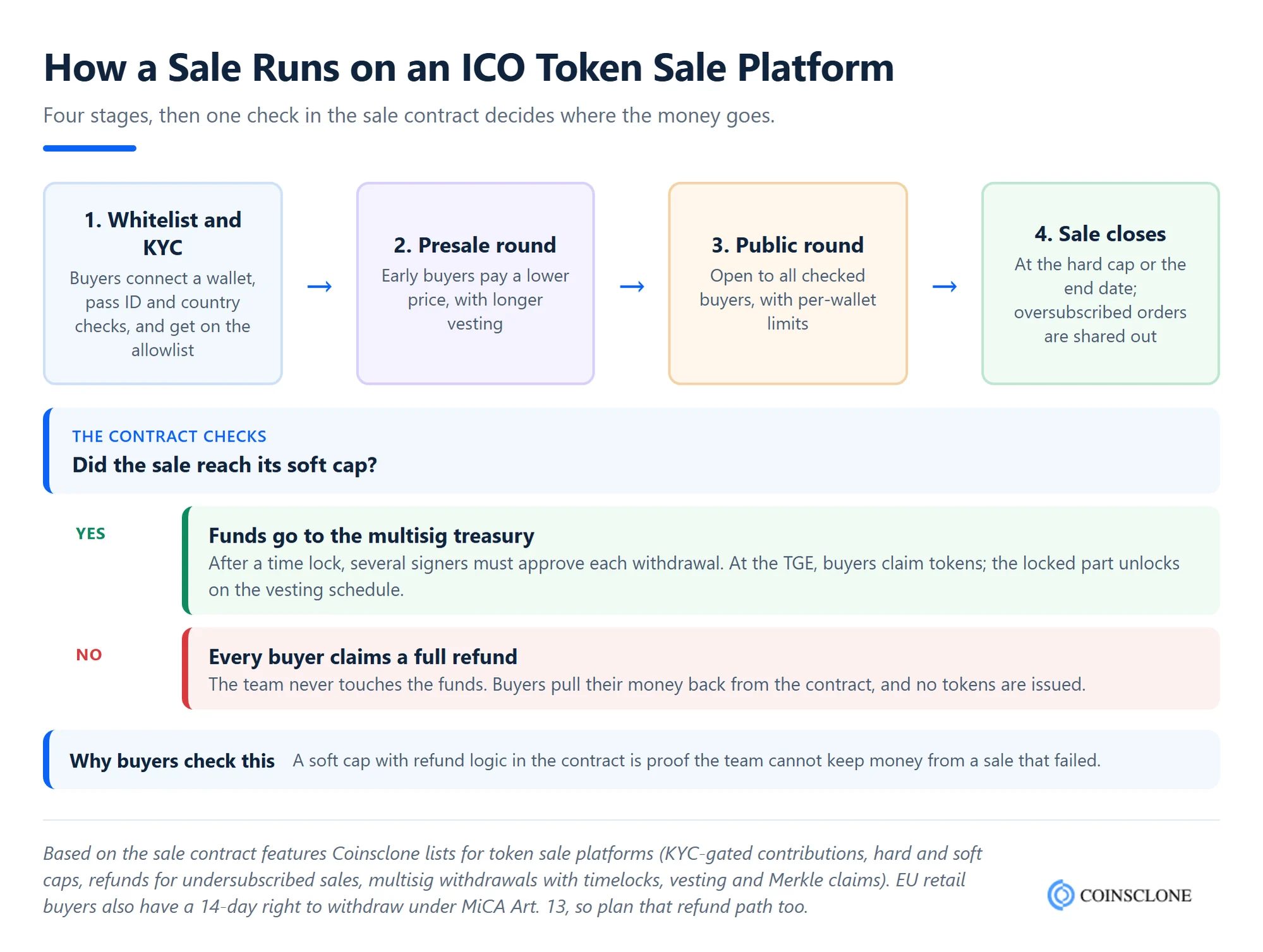
- Settle the sale: If the soft cap is met, funds move to the multisig treasury. If not, every buyer can claim a refund from the contract.
- Deliver tokens: At the TGE, buyers claim their tokens. Any locked part unlocks on the vesting schedule.
The diagram below shows the full lifecycle, including the soft cap check that decides between a payout and refunds.
How the Platform Shares Out Tokens When Demand Beats Supply
Popular sales often get more bids than there are tokens. For example, Coinbase’s first token sale, for Monad, drew $269 million in bids from 85,820 buyers for $187.5 million of tokens between 17 and 22 November 2025, per The Block. So your sale contract needs a clear rule for who gets what. There are three common ones:
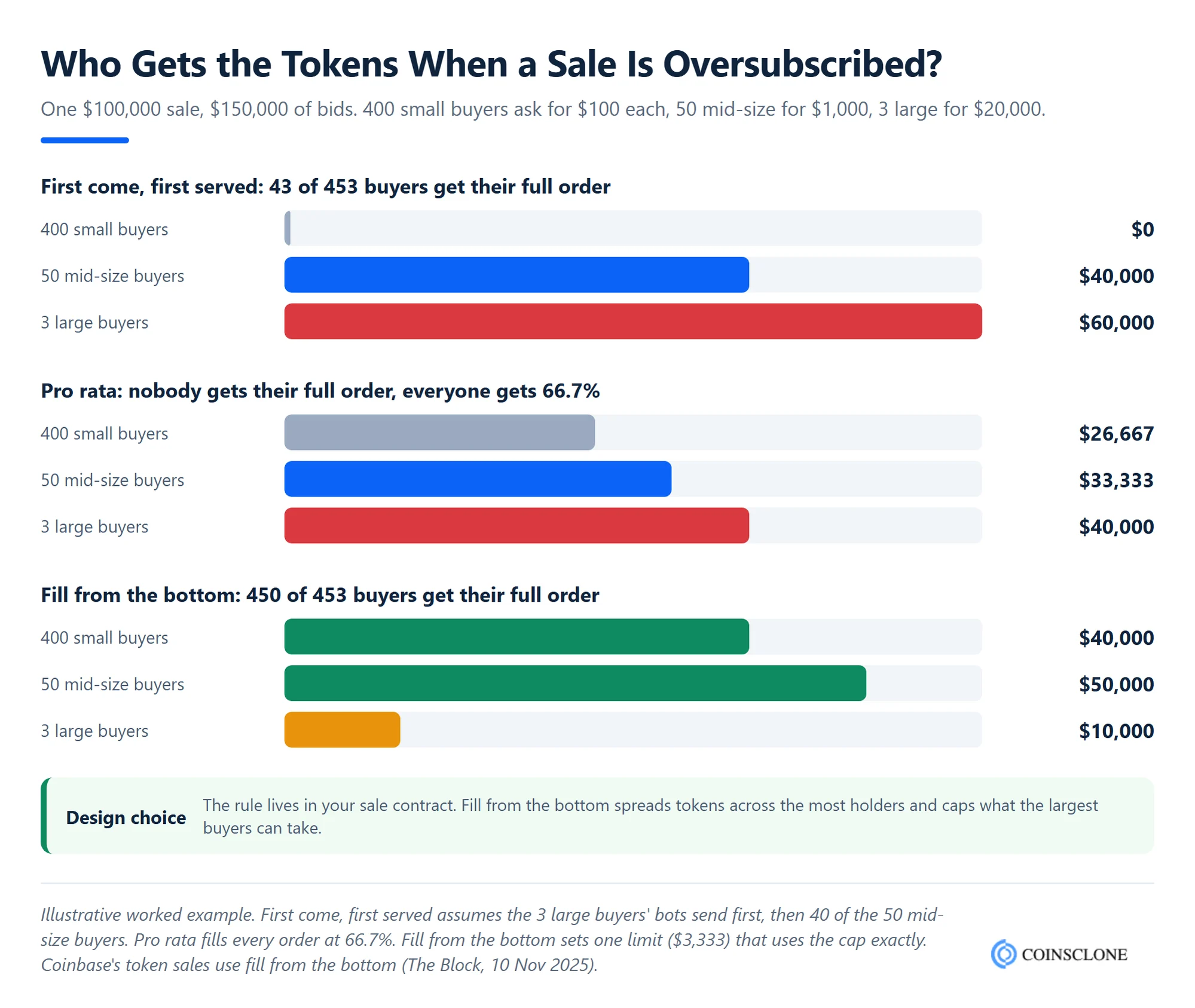
- First come, first served: Orders fill in the order they arrive until the hard cap. It is simple, but bots and large buyers with fast scripts often take most of the sale.
- Pro rata: Everyone gets the same share of their order. If bids are 1.5 times the cap, each buyer gets two thirds of what they asked for.
- Fill from the bottom: The contract fills the smallest orders in full first, then raises a single limit until the cap is used. Coinbase uses this method, so most small buyers get their full order.
The worked example below runs the same oversubscribed sale through all three rules. The difference in who ends up holding the tokens is large.
Features Needed in an ICO Token Sale Platform
The features play a major role in winning the trust of crypto buyers. Here is what a 2026 platform needs, grouped by who uses it.
Investor Features
- Wallet choice: MetaMask, WalletConnect, Coinbase Wallet, Phantom and other common wallets.
- Multi-currency payments: USDT, USDC, ETH, BNB, SOL and card payments through an on-ramp. Each missing payment option is a reason for a buyer to leave.
- Smart account support: Wallets based on ERC-4337 and Ethereum’s EIP-7702 upgrade (live since May 2025) let buyers skip gas tokens or pay gas in stablecoins.
- Token sale dashboard: Shows the buyer’s orders, tokens owed, vesting dates and claim buttons.
- Easy buying flow: A short, clear set of steps that works well on phones.
- Multi-language support: Lets you reach buyers in their own language.
- Two-factor authentication: Protects buyer accounts on the platform.
Admin Features
- Round and price controls: Set rounds, prices, caps and dates. Advanced platforms also support tiered, rising or Dutch auction pricing.
- KYC/AML management: Review checks, set country blocks and keep records for audits.
- Real-time analytics: Track funds raised, buyers, payment coins and traffic sources.
- Referral programme: Reward buyers who bring new buyers, with clear limits.
- Support desk: A ticket system or chat, because buyers will have questions about payments and claims.
Security and Contract Features
- Caps and refunds in the contract: Soft cap, hard cap, per-wallet limits and automatic refunds if the soft cap is missed.
- KYC-gated contributions: The contract only accepts funds from wallets that passed KYC, often through a signed allowlist or a Merkle proof.
- Multisig treasury with a time lock: Raised funds need several signatures and a waiting period to move.
- Vesting and Merkle claims: Tokens unlock on a schedule, and buyers claim them in one cheap transaction.
- Pause switch: Lets the team stop the sale if something goes wrong, with the switch itself under multisig.
If you want to add any other features, you can build them in as you grow. Your main focus should be on choosing a partner that has run real sales, which brings us to time and cost.
How Long Does It Take and What Does It Cost?
Build time depends on scope. Coinsclone publishes these times on its ICO token development page:
- Token and sale contract with a claim page: 3 to 5 weeks, including the audit.
- Sale platform with KYC: 6 to 9 weeks, with buyer onboarding, eligibility checks, dashboards and vesting.
- Multi-round platform: 3 to 4 months, with private and public rounds and several payment coins.
- Full launch programme: 4 to 6 months, adding liquidity, listing prep and post-sale work.
Cost depends on the same scope, plus two items that teams often forget. First, the audit. Sherlock’s 2026 audit pricing reference puts a simple token contract at $5,000 to $20,000, and each re-review after fixes adds another $5,000 to $20,000. Second, KYC fees per buyer. Sumsub’s published pricing is $1.35 per ID check, or $1.85 with AML screening, plus a monthly minimum. For 5,000 buyers at $1.85, that is about $9,250. For a full breakdown, read our guide on the cost to launch an ICO.
Security Checklist for Your Token Sale Platform
Token sales hold large sums in public contracts, so they draw attackers. Before you open the sale, check these points:
- Independent audit done: And every finding fixed and re-checked, not just noted.
- Keys under your control: Deployer and admin keys moved to your own multisig, not left with the developer.
- Limits tested: Caps, per-wallet limits, refunds and the pause switch all tested on a testnet with real flows.
- Official links locked down: Scammers copy sale pages and buy search ads for fake ones. So publish one official link, pin it on every channel and warn buyers never to send funds to an address in a direct message.
- Front end protected: Domain and DNS locked, the website checked for injected scripts, and the contract address shown so buyers can check it.
Rules Your Platform Must Support in 2026
Token sale rules tightened, and your platform must turn them into features. In the EU, MiCA (Regulation 2023/1114) requires a published white paper for most public token offers. It exempts offers to fewer than 150 people per member state, offers under EUR 1 million over 12 months, and offers only to qualified investors. Retail buyers also get a 14-day right to withdraw. Your platform therefore needs country checks, buyer caps and a refund path.
In the US, the SEC proposed “Regulation Crypto Assets” on 18 August 2026. It would allow a startup exemption of up to $5 million over four years and a fundraising exemption of up to $75 million per 12 months. It is still a proposal, with comments open until 20 October 2026, so most teams still block US buyers or limit them to accredited investors. Your lawyers set the rules; the platform enforces them through KYC, geo-blocking and investor checks.
Are Token Sales Still Worth Running in 2026?
Yes, but buyers are pickier. CryptoRank data reported by PANews counted 533 public token sales in 2025, and only 63 of them, about 12%, traded above their sale price by year end. The pace also cooled in 2026. CryptoRank figures reported by Grafa show public sales raised about $390 million in Q1 2026 and only $58 million in Q2 up to 10 June.
In short, demand is still there for good projects. However, buyers now judge the product, the unlock plan and the platform itself. A fair allocation rule, audited contracts and a smooth claim day are part of the pitch.
Conclusion
An ICO token sale platform is more than a sale page. It is the system that checks buyers, takes payments, applies your caps and allocation rules, protects the treasury and delivers tokens on time. Get those parts right and your project earns trust before the first token trades.
Coinsclone is a renowned ICO Development Company that has built crypto platforms since 2018, with 350+ platforms delivered for 200+ clients across 20 industries. We build ICO token sale platforms with KYC-gated sales, audited contracts, vesting and claim portals, and hand over the code and keys to you. Book a live demo of our ready-made platform and start your token sale with us.
Frequently Asked Questions
What is an ICO token sale platform?
It is the website, dashboard and smart contracts that a crypto project uses to sell its new tokens to the public. It checks buyers through KYC, takes payments in crypto or by card, enforces the sale’s caps and rules, keeps raised funds in a multisig treasury and pays out tokens at the TGE.
How long does it take to develop an ICO token sale platform?
It depends on scope. A white label ICO platform can go live in 2 to 4 weeks. A custom sale platform with KYC takes 6 to 9 weeks, and a multi-round platform takes 3 to 4 months. The audit and the fixes after it are usually part of that time.
What are the key features of an ICO token sale platform?
For buyers: wallet links, payment in many coins, KYC checks and a dashboard to buy and claim tokens. For your team: an admin panel with round and price controls, live data on the raise, and support tools. In the contracts: soft and hard caps, refunds, vesting and a treasury that needs several signatures.
How much does an ICO token sale platform cost?
It varies with the build route and scope. Beyond the build itself, plan for a smart contract audit ($5,000 to $20,000 for a simple token contract, per Sherlock), KYC fees of about $1.35 to $1.85 per buyer, legal advice and marketing. Our guide on the cost to launch an ICO has a full breakdown.
Should I build my own token sale platform or use a launchpad?
Use your own platform if you have a community, plan several rounds or want full control of rules, data and funds. Use a launchpad or curated venue if you need a ready audience and accept its fees and rules. Many projects run private rounds on their own platform and a public round on a launchpad.
What happens if a token sale does not reach its soft cap?
A well-built sale contract lets every buyer claim a full refund of what they paid. The team never gets access to the funds, which is why buyers look for a soft cap and refund logic in the contract before they invest.
Are ICOs still a thing?
Yes. Public token sales came back in 2025, led by curated venues such as Coinbase’s token sales. However, only about 12% of 2025’s public sales traded above their sale price by year end, so a strong product, fair unlocks and audited contracts matter more than ever.
See How Our MVP System Can Launch Your ICO Token Sale Faster
ICO Token Sale Platform Development — done right.
- MVP System:Launch your fundraising platform 90% faster.
- Smart Contracts:Secure, audited, and customizable for smooth token sales.
- Token Creation:Mint,manage,and distribute tokens with complete control.
- Branding & Customization:Your project, your interface, your investor experience.
- Investor Dashboard:Integrated wallets, analytics, and automated KYC for compliance.
See a free branded demo of your ICO token sale platform in 48 hours — before you invest a cent.
Book a Free Demo to discover how our ICO Token Sale Platform Development can take you from concept to live fundraising in just 2–4 weeks.