
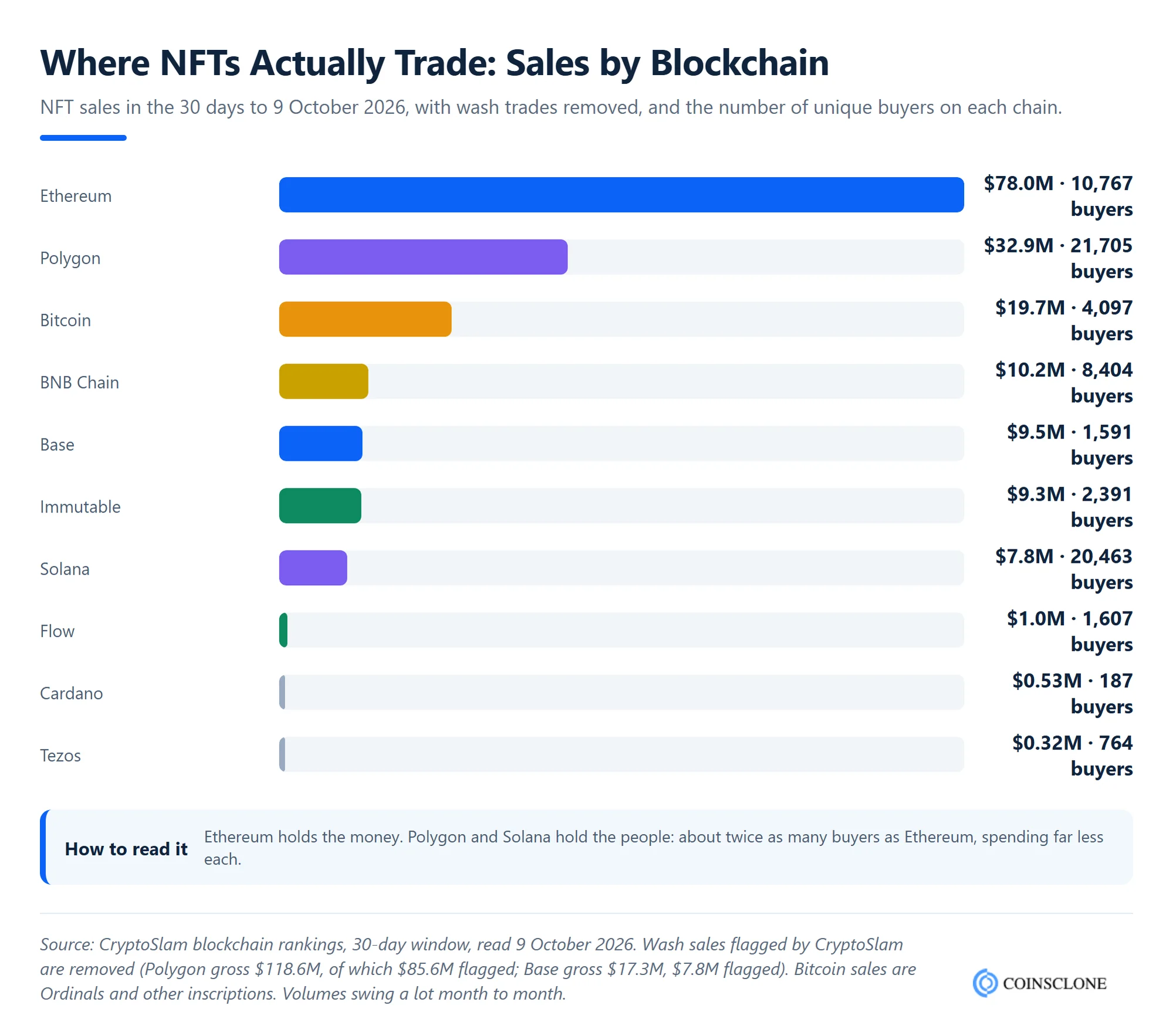
The top blockchains for an NFT marketplace in 2026 are Ethereum, Polygon, Base, Solana and BNB Chain. Immutable, Flow, Tezos, WAX and Cardano round out the top 10. Ethereum leads on money, with $78.0 million in NFT sales in the 30 days to 9 October 2026. Polygon and Solana lead on buyers, with more than 20,000 each, per CryptoSlam.
This guide ranks each chain on where NFTs really sell today, what a mint and a trade cost, and what kind of market it suits. For each one you get its sales and buyers, its token standard, its main markets and its weak spots. The NFT market has changed a lot since 2021. Some big markets have closed, and Ethereum fees have dropped to cents. Newer chains such as Base and Immutable now outsell older names. So the second half helps you choose, with a decision path, the cost to build, and when one chain is enough.
In this guide:
- The 10 best blockchains for NFT marketplaces in 2026, compared side by side with real sales and buyer numbers
- What it costs to mint one NFT on each chain, checked on 26 October 2026
- Why Ethereum still holds the most money while Polygon and Solana hold the most buyers
- What changed in 2025 and 2026: closures, upgrades and a hack you should know about
- A four-question test to pick the right chain
- When a single chain is enough and when multi-chain pays off
Choose the Best Blockchains for NFT Marketplace to Power Your Platform
NFT Marketplace Development — optimized for speed and scalability.
- Top Blockchain Options : Ethereum, BSC, Polygon, and Flow.
- High Performance : Ensure fast transactions, low fees, and seamless trading.
- Full Customization : Build your platform with your brand, tokenomics, and UI.
- Future-Proof : Scalable and secure infrastructure to support growing users.
See a free branded demo of your NFT marketplace in 48 hours — before you invest a cent.
Book a Free Demo to discover how selecting the right Blockchains for NFT Marketplace can launch your platform in just 8–12 weeks.
Top 10 Blockchains for NFT Marketplace in 2026
We picked these blockchains on four things: real NFT sales and buyers today, the cost of each trade, the tools and wallets you can use, and how well the other markets on the chain are doing. Here is the list at a glance.
| # | Blockchain | NFT sales, 30 days | Unique buyers | NFT standard | Main markets | Best for |
| 1 | Ethereum | $78.0M | 10,767 | ERC-721, ERC-1155 | OpenSea, Blur | High-value art and collections |
| 2 | Polygon | $32.9M | 21,705 | ERC-721, ERC-1155 | OpenSea | Brands, loyalty and games |
| 3 | Base | $9.5M | 1,591 | ERC-721, ERC-1155 | OpenSea | Cheap mints for Coinbase users |
| 4 | Solana | $7.8M | 20,463 | Metaplex, compressed NFTs | Magic Eden, Tensor | Mass-market mints and trading |
| 5 | BNB Chain | $10.2M | 8,404 | BEP-721, BEP-1155 | Few large venues left | Low-fee niche projects |
| 6 | Immutable | $9.3M | 2,391 | ERC-721 on zkEVM | Immutable Play | Web3 games |
| 7 | Flow | $1.0M | 1,607 | Cadence NFT standard | NBA Top Shot, OpenSea | Sports and fan collectibles |
| 8 | Tezos | $0.32M | 764 | FA2 | Objkt | Digital art on a budget |
| 9 | WAX | $0.33M | Not reported | AtomicAssets | AtomicHub | Packs and digital collectibles |
| 10 | Cardano | $0.53M | 187 | Native tokens (CIP-25, CIP-68) | Few left after JPG Store closed | Existing Cardano communities |
Sales and buyers: CryptoSlam blockchain rankings, 30 days to 9 October 2026, wash trades removed. WAX buyer counts are not reported by CryptoSlam.
Looking for places to buy and sell NFTs rather than chains to build on? See our NFT marketplace list, which compares the top platforms by fees and chains.
1. Ethereum (ETH)
Ethereum is by far the most popular blockchain for NFTs and among the most trusted. It has logged about $82.6 billion in NFT sales since launch (wash trades included), far more than any other chain, per CryptoSlam. Most builders use ERC-721, the token standard for NFTs on Ethereum, and ERC-1155 for editions and game items. So many builders, audit firms and wallets already work here.
OpenSea, one of the largest NFT markets, started on Ethereum. Pro traders use Blur here too. Top collections such as CryptoPunks, Bored Ape Yacht Club and Art Blocks also live here.
The big change is cost. The old story of high gas fees no longer holds most days. On 9 October 2026, the Etherscan gas tracker showed gas at about 0.12 gwei, and an NFT sale cost about $0.19 in gas. Still, fees jump when demand spikes. So many teams mint on a cheaper layer 2 and keep Ethereum for big sales.
Also Read : How to launch NFT Marketplace similar to Cryptopunks
2. Polygon (POL)
Polygon, first called the MATIC network, was built to fix Ethereum’s speed and cost problems. Its token changed from MATIC to POL in September 2024. Polygon runs the same code as Ethereum, so an Ethereum NFT market can move here with little work.
In October 2025, the Rio upgrade raised Polygon PoS to about 5,000 transactions per second, with trades final in a few seconds. OpenSea lists Polygon, and big brands use it for loyalty and game NFTs.
Polygon had 21,705 NFT buyers in the last 30 days, the most of any chain. That said, CryptoSlam flagged $85.6 million of its $118.6 million in gross sales as wash trades, so look at buyer counts, not headline volume.
Also Read : How to Develop NFT Marketplace on Polygon Blockchain?
3. Base
Base is a layer 2 network built by Coinbase on the OP Stack, and it went live in August 2023. It runs Ethereum code at a fraction of the cost. It also gives you a direct path to Coinbase’s huge user base and wallet.
In the last 30 days, Base had $9.5 million in NFT sales after removing wash trades. OpenSea supports Base, and many new creator and social NFT apps launch there first. For a new marketplace, Base is a good way to get Ethereum-style tools with low fees from day one. You can read more in the Base docs.
4. Solana (SOL)
Solana pairs Proof of History with Proof of Stake, which makes it one of the fastest chains around. Its fee is very low: a base fee of 5,000 lamports (0.000005 SOL) per signature, per the Solana fee docs. Solana also offers compressed NFTs through Metaplex, so you can mint millions of items for very little.
Solana had 20,463 NFT buyers in the last 30 days, close to Polygon and about twice Ethereum. Buyers spend less per item, though: total sales were $7.8 million. Magic Eden and Tensor are the main markets. In March 2026, Magic Eden closed its Bitcoin and EVM markets to focus on Solana only.
Thanks to its speed and low cost, Solana suits markets for mass-market mints, music and in-game items. See how the top Solana-based NFT marketplaces work, and borrow what fits your plan.
5. BNB Chain (BNB)
Binance launched Binance Chain in 2019 and Binance Smart Chain in 2020, and both were renamed BNB Chain in 2022. The chain runs Ethereum-style code. A small group of validators makes the blocks, a model called Proof of Staked Authority. As a result, it is fast and cheap.
In January 2026, the Fermi hard fork cut block times to 0.45 seconds. BNB Chain had $10.2 million in NFT sales and 8,404 buyers in the last 30 days.
However, the NFT side of the chain has thinned out. OpenSea dropped BNB Chain support in 2023, and Binance closed its own NFT marketplace in July 2026. So BNB Chain makes sense if your users live in its DeFi and gaming apps, but you will need to bring your own traffic.
6. Immutable (IMX)
Immutable is a blockchain built for web3 games. In early 2026, it merged its older Immutable X network into Immutable zkEVM, which runs Ethereum code. Games get gaming wallets, a shared order book, and royalty rules that pay creators on approved markets.
Immutable had $9.3 million in NFT sales in the last 30 days, ahead of Solana. If your marketplace sells game items that players trade often, Immutable is worth a close look.
7. Flow
Flow is a blockchain made by Dapper Labs for fan and gaming products. It uses its own smart contract language, Cadence, and since its 2024 Crescendo upgrade it also runs Ethereum-style contracts through Flow EVM. NBA Top Shot, a popular sports NFT marketplace, runs on Flow, and users can sign up without a crypto wallet. OpenSea now lists Flow too.
Flow has recorded about $1.79 billion in NFT sales since launch, though recent activity is lower, at $1.0 million in the last 30 days. One thing to know: on 27 December 2025, an attacker used a Cadence bug to copy tokens worth about $3.9 million. Validators halted the chain within hours, and it resumed on 29 December, per Flow’s post-mortem. User balances were not touched.
Also Read : Create NBA Top Shot like Sports NFT Marketplace Easily
8. Tezos (XTZ)
Tezos is a blockchain with a strong digital art scene. It runs on Proof of Stake, so it uses little energy, and its fees are low. Tezos also has on-chain governance, which lets holders vote on protocol upgrades, so the chain can change without splitting.
Objkt, the top NFT marketplace on Tezos, is well known for its art collections. Tezos sales are small, at $0.32 million in the last 30 days, but 764 buyers is a loyal base for an art-focused marketplace. Its NFTs use the FA2 token standard.
9. Worldwide Asset Exchange (WAX)
Worldwide Asset Exchange is a blockchain based on a Delegated Proof of Stake (DPoS) model. It was designed for digital collectibles, packs and game items, so users can trade fast without paying gas on each action.
The top NFT platform on WAX is AtomicHub, where collectibles can be traded with ease. AtomicHub now also lists NFTs from other chains such as Polygon, and it reports more than 63 million sales. WAX had $0.33 million in NFT sales in the last 30 days.
10. Cardano (ADA)
Cardano launched in 2017 and runs on Proof of Stake, which uses very little energy. NFTs are native tokens on Cardano, so you can mint them without writing a smart contract. Their data follows the CIP-25 and CIP-68 standards.
But the NFT scene on Cardano has shrunk. JPG Store, once the largest Cardano NFT marketplace, closed on 23 May 2026 after it said running it was no longer viable. Cardano saw $0.53 million in NFT sales and 187 buyers in the last 30 days. So build here only if you already have fans on Cardano.
For those who are wondering: What is the best blockchain for an NFT marketplace? Ethereum is still the best overall, thanks to its buyer money, security and tools. For low fees on the same tools, pair it with Base or Polygon.
However, your needs might not always match Ethereum, which is why the next sections help you choose.
Other Blockchains for NFTs: Bitcoin, Arbitrum, Avalanche and TON
A few more chains are worth knowing, even if they are not in our top 10:
- Bitcoin: Ordinals NFTs made $19.7 million in sales in the last 30 days, third of all chains. Bitcoin has no smart contracts like Ethereum’s, so marketplaces here are harder to build.
- Arbitrum and Avalanche: both run Ethereum code with low fees, and OpenSea lists both. See how to create an NFT marketplace on Avalanche.
- TON: NFTs on TON follow the TEP-62 standard, and Getgems is the main marketplace. Telegram lets users move collectible gifts to the TON blockchain, which brings in a large chat audience.
How Much Does It Cost to Mint an NFT on Each Blockchain?
Minting one NFT costs less than one US cent on most of these chains. On Ethereum it costs about 2 cents, based on live gas prices on 26 October 2026. Solana is the odd one out. A standard Solana NFT costs more to mint than one on Ethereum. That is because most of the cost is a deposit for the accounts that hold it. Here is what one mint costs on each chain:
| Blockchain | What you pay to mint one NFT | About in US$ |
| Ethereum | 0.06 gwei gas price x about 150,000 gas, paid in ETH | $0.02 |
| Base | 0.006 gwei x 150,000 gas, plus a small data fee to Ethereum | Under $0.01 |
| Polygon | About 70 to 110 gwei x 150,000 gas, paid in POL | Under $0.01 |
| BNB Chain | 0.05 gwei x 150,000 gas, paid in BNB | $0.006 |
| Immutable zkEVM | 10 gwei minimum tip (11 gwei on the day) x 150,000 gas, paid in IMX | Under $0.001, and free for players on Immutable Passport |
| Solana | About 0.003 SOL for a Metaplex Core NFT, or 0.022 SOL for an older Token Metadata NFT, deposits included | $0.30 (Core) or $2.22 (Token Metadata) |
| Solana, compressed | 0.00009 SOL mint fee plus 0.000005 SOL network fee, after a one-time tree setup | About $0.01 |
| Flow | 0.0001 FLOW base fee plus a small execution fee, and storage at 1 FLOW per 100 MB | Under $0.001 |
| Tezos | 0.25 tez burned per kB stored, plus a small baker fee | About $0.01 to $0.03 |
| WAX | No gas per action; you buy RAM to store the NFT, at about 0.45 WAX per kB | Under $0.001 |
| Cardano | 0.155 ADA plus 44 lovelace per byte (about 0.19 ADA in all), plus about 1.3 ADA that must stay with the NFT | $0.04 fee, plus about $0.27 held |
Gas prices read from each chain’s public RPC on 26 October 2026, and token prices from CoinGecko the same day (ETH $2,314, POL $0.088, BNB $737.50, SOL $100.73, ADA $0.20). EVM rows assume about 150,000 gas, a typical single ERC-721 mint in our sample of live mints. Solana costs come from the Metaplex Core docs and the Metaplex fee list. Flow costs come from its fee docs, and Immutable from its chain config. The Tezos, WAX and Cardano rows use each chain’s live settings. The Tezos row assumes a mint that stores a few hundred bytes.
So gas is no longer a good reason to pick a chain. On every Ethereum-style chain in this list, a mint costs a few cents or less. Many platforms also offer lazy minting, where the buyer pays the gas at the first sale. On Solana, large drops use Core or compressed NFTs to keep the deposit small. If you plan to let creators mint on your platform, our guide to NFT minting platform development covers how each option works.
Which Blockchain Is Cheapest to Mint NFTs and Still Has Buyers?
Base and Polygon are the cheapest chains with real buyers, at well under one cent per mint. Polygon had 21,705 NFT buyers in the 30 days to 9 October 2026, the most of any chain. A collector asked on Reddit in November 2025 where to mint “dirt cheap”. The top reply said the same: Polygon and Base cost a fraction of a penny. But it also warned that many serious buyers still collect on Ethereum. Since an Ethereum mint now costs about 2 cents, the better test is where your buyers already hold wallets.
Is Ethereum Too Expensive for an NFT Marketplace in 2026?
No, not on most days. On 26 October 2026, one NFT mint on Ethereum cost about $0.02 in gas. On 9 October, an NFT sale cost about $0.19, per Etherscan. On Reddit, teams that plan their own NFT market still name Ethereum fees as their main worry. But that view dates from 2021 and 2022. The real risk now is spikes. During a hot mint, gas can jump many times over for a few hours. So build on Ethereum if your buyers want it, and add Base or Polygon for low-price items and free mints.
Why Your Choice of Blockchain Matters for an NFT Marketplace
Users tend to trust your NFT marketplace based on the blockchain you choose. Each blockchain has its ups and downs, but the top ones give you a large user base, tested tools and markets that work. For example, Ethereum brings the most money per buyer. Solana brings many buyers who each spend a little.
Hence, the choice of blockchain becomes the X-factor while creating your NFT marketplace. Creator fees, network size, wallet support and security all depend on it, and these shape how your business grows over time. In addition, the past two years show that the chain’s health matters too: when big markets close, the buyers on that chain can drift away fast. New to how listings, sales and royalties work? Start with our guide to what an NFT marketplace is and how it works.
How to Choose the Right Blockchain for Your NFT Marketplace
Before you pick a chain, answer these questions:
- Where are your buyers? Go where your users hold wallets and money. Ethereum has the most money, and Polygon and Solana have the most buyers.
- What does each action cost? Test the cost to mint, list and sell, not just the gas price. A $1 fee kills a $5 sale but does not matter on a $5,000 one.
- Which token standard fits? ERC-721 suits one-of-one art. ERC-1155 suits editions and game items. Solana compressed NFTs suit very large drops. Our guide to NFT token standards covers each one.
- Can you pay creators fairly? Royalties are not enforced on most chains by default. Immutable and some contract designs enforce them on approved marketplaces.
- How strong is the ecosystem? Look for live wallets, audit firms and data tools, and check whether other markets on the chain are growing or closing.
- What is the security record? Read how the chain handled past outages or hacks, and how fast it recovered.
Which Blockchain Is Best for NFT Art, Games or Brands?
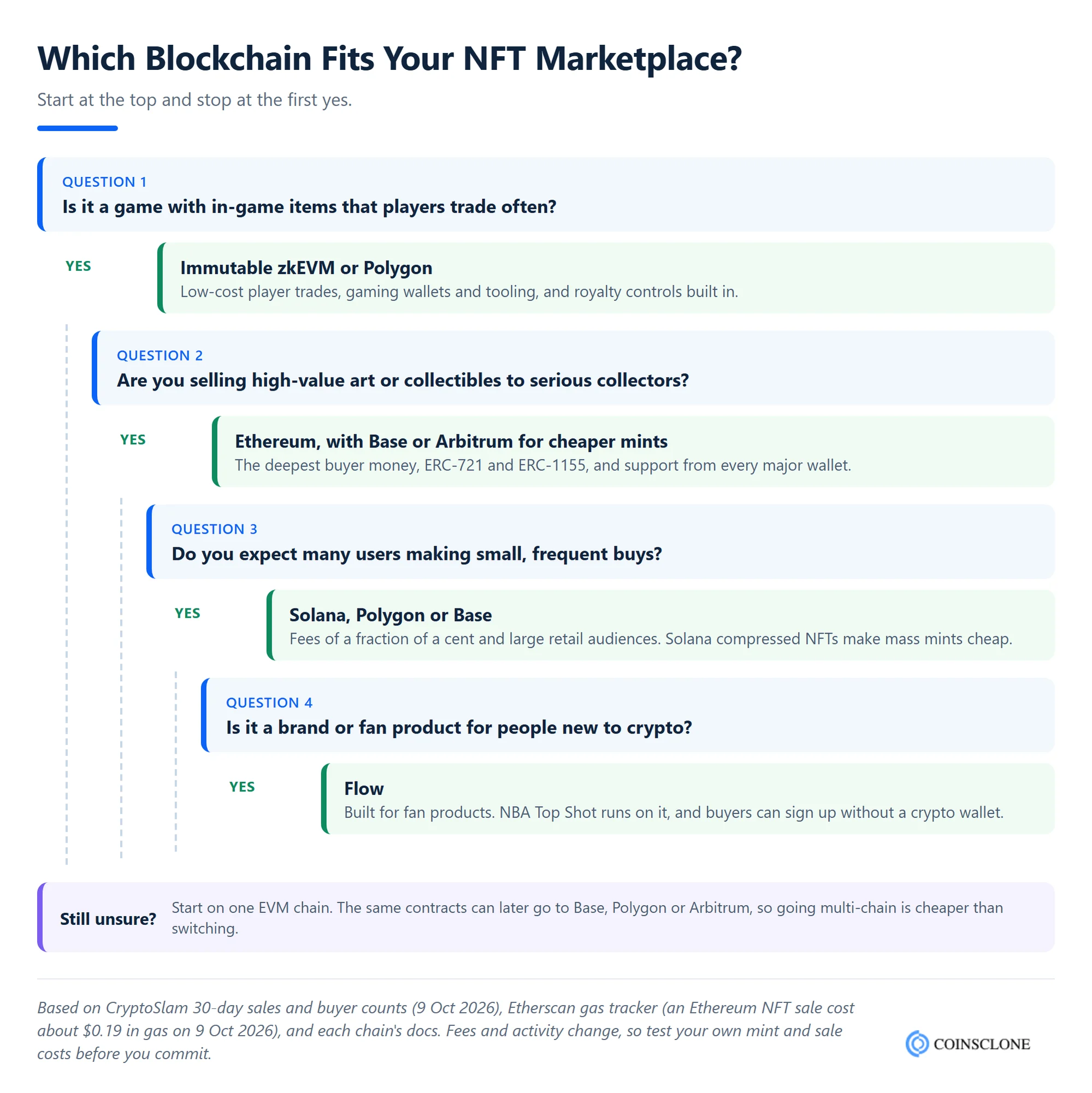
The best chain depends on what you sell. Here is the short answer for the most common types of NFT marketplace:
- Art and top collections: Ethereum, where most of the money is. Tezos with Objkt suits art on a small budget.
- Games and in-game items: Immutable, since it pays gas for players and shares one order book across games. Polygon is the main EVM option.
- Brands and loyalty: Polygon or Base, for low fees and easy wallets. Base also reaches Coinbase users.
- Mass mints, music and low-price drops: Solana with compressed NFTs, or Base.
- Sports and fan collectibles: Flow, home of NBA Top Shot, where fans can sign up without a crypto wallet.
- Telegram audiences: TON, where Getgems is the main market.
Single Chain or Multi-Chain?
Most new marketplaces should start on one chain and add more later. A single chain keeps your contracts, audits and support simple, and it lets you build one strong community first.
Going multi-chain makes sense once you have traction. Base, Polygon and Arbitrum run the same code as Ethereum. So you can reuse most of your code on each. For example, OpenSea now works on more than 25 chains, as its list of supported blockchains. Adding a non-EVM chain such as Solana or Flow takes more work, because it needs new contracts and new wallets. Read more on cross-chain NFT marketplace development and the cost to build an NFT marketplace. A few large game studios go one step further and run their own chain. If that is your plan, see which rollup service is best for your project.
How Much Does It Cost to Build an NFT Marketplace on These Blockchains?
An NFT marketplace costs about $10,000 to $30,000 to launch with white label software, and $20,000 to $45,000 for a custom MVP. A mid-tier platform with auctions and royalties costs about $40,000 to $80,000, and an enterprise build costs $80,000 to $150,000 or more. These ranges come from published 2026 agency cost guides. Our NFT marketplace development cost guide breaks them down.
The chain you pick changes the bill less than the number of chains you support:
- One EVM chain: Base, Polygon, BNB Chain and Immutable all run the same Solidity code and wallet tools as Ethereum. This is the cheapest path.
- A second EVM chain: Adding one later costs far less than the first, since most of the code carries over.
- Solana, Flow, Tezos or TON: Each uses its own contract language and NFT standard. So it needs its own contracts, wallets and audit, which can nearly double the work.
Time follows the same pattern. A white label launch takes about 2 to 6 weeks, while a custom MVP takes about 2 to 3 months.
NFT Marketplace Development on the Right Blockchain
To cut the guesswork, you can ask the team at an NFT Marketplace development company like us. Since 2018, Coinsclone has delivered 350+ platforms for 200+ clients across 20 industries. Our team can share what we have learned on each chain to take your NFT market to the next level. We also write and test the minting, sale and royalty contracts for each chain through our NFT smart contract development service.
We also have clone scripts for top NFT markets, such as our OpenSea clone script. Our white label NFT marketplace software helps you go live fast. Picking a chain on your own can be risky unless you have blockchain experience, so a short talk with our team can save you months.
Build a Future-Proof NFT Marketplace with the Right Blockchain!
Right Solutions. Unique Features. Secured Platform. Get A Free Consultation!
Final Thoughts: Which Blockchain Should You Pick?
To conclude, launching your NFT marketplace on a top blockchain is a great way to start a business. The right chain gives you buyers, low fees and tools that work, while the wrong one can leave you with an empty market. Decision-making is a skill you need to master from the start, and it cannot be taken for granted. To go deeper, read our guide on how to build an NFT marketplace and our list of the best NFT marketplaces.
Remember, the value of the sentence “most suited to me” is always higher than the words “most preferred by many” in terms of business.
Other Related blogs
Cross-Chain NFT Marketplace Development
Cost to Create Multichain NFT Marketplace
Top 10 Blockchain Platforms for Crypto Token Creation
Frequently Asked Questions
What’s the best blockchain for an NFT?
Ethereum is the best blockchain for most NFTs in 2026. It had $78.0 million in NFT sales in the 30 days to 9 October 2026, more than twice any other chain, per CryptoSlam. For low fees, Base and Polygon run the same contracts, and Solana is a strong pick for large, low-price drops.
Which blockchain is most commonly used for NFTs?
Ethereum is the most common blockchain for NFTs. Many more live on networks linked to it, such as Base, Arbitrum and Polygon. Others live on Solana, Bitcoin, BNB Chain, Flow, Tezos, WAX and TON. Each NFT stays on the chain where it was minted unless it is bridged.
Is Solana or Ethereum better for NFTs?
Ethereum is better for costly NFTs, and Solana is better for lots of cheap ones. In the 30 days to 9 October 2026, Ethereum had $78.0 million in NFT sales from 10,767 buyers. Solana had $7.8 million from 20,463 buyers, per CryptoSlam. A compressed Solana NFT costs about one cent to mint, which suits drops of thousands or millions of items.
Can you build an NFT marketplace on Bitcoin?
Yes, but it is harder than on Ethereum. Bitcoin NFTs, called Ordinals, made $19.7 million in sales in the 30 days to 9 October 2026, third of all chains. But Bitcoin has no smart contracts like Ethereum’s. So a marketplace needs its own indexer and special signed trades to swap items safely. Magic Eden closed its Bitcoin NFT market in March 2026, which shows how hard it is to make one pay.
What services offer tools for building blockchain-based marketplaces?
Three kinds of services do. Firms such as Coinsclone build the full market, often from white label NFT marketplace software. Chain toolkits give you the core parts. Metaplex on Solana is one. The Immutable SDK and OpenSea’s free Seaport code are two more. Finally, node, data and storage providers run the servers your platform reads from.
What blockchain does OpenSea use?
OpenSea started on Ethereum and now supports more than 25 blockchains. The list covers Ethereum, Base, Solana, Flow and Ronin, among others. OpenSea dropped BNB Chain in 2023.
Can you build an NFT marketplace on the TON blockchain?
Yes. TON supports NFTs through its TEP-62 standard, and Getgems runs a TON NFT marketplace. Its tie to Telegram is the main draw, since Telegram users can move gifts to the chain as NFTs. However, TON uses its own contract language, so EVM code cannot be reused.
How do I choose a blockchain for my NFT marketplace?
Start with your buyers and what they will pay per trade. Then check the token standards, royalty options, wallets and the health of other markets on the chain. In short, games suit Immutable, art suits Ethereum, big cheap drops suit Solana or Base, and fan apps suit Flow.
Choose the Best Blockchains for NFT Marketplace to Power Your Platform
NFT Marketplace Development — optimized for speed and scalability.
- Top Blockchain Options : Ethereum, BSC, Polygon, and Flow.
- High Performance : Ensure fast transactions, low fees, and seamless trading.
- Full Customization : Build your platform with your brand, tokenomics, and UI.
- Future-Proof : Scalable and secure infrastructure to support growing users.
See a free branded demo of your NFT marketplace in 48 hours — before you invest a cent.
Book a Free Demo to discover how selecting the right Blockchains for NFT Marketplace can launch your platform in just 8–12 weeks.