
Polygon NFT marketplace development means building a site where people mint, buy and sell NFTs on the Polygon blockchain. A white label build costs about $10,000 to $30,000 and can go live in 4 to 6 weeks, while a custom build costs about $20,000 to $150,000 or more. The chain is a good fit because each trade costs about half a cent in gas and settles in seconds. It also runs the same smart contract code and wallets as Ethereum, so your team can use tools it knows.
This guide shows where the chain stands in 2026, what each NFT action costs today and who still trades on it. You will also see the build steps, the core features, the tech stack and a real budget and time plan. By the end, you will know if Polygon fits your plan and how to start.
In this guide:
- Real 2026 costs: On 26 Oct 2026, one NFT sale cost about half a cent in gas on Polygon.
- Where the demand is: Tokenized trading cards on Courtyard drove about 92% of the chain’s real NFT sales in mid-October 2026.
- Who is live: OpenSea, Courtyard, Element and OKX serve the chain today, while Magic Eden, tofuNFT and NFTrade have left.
- The build path: Eight steps from niche to launch, with the Amoy testnet and a smart contract audit.
- Time and budget: 4 to 6 weeks for a white label launch, 9 to 13 weeks for a standard build.
Launch a Scalable Polygon NFT Marketplace in Weeks
Polygon NFT Marketplace Development — build fast, low-cost NFT platforms on Polygon.
- Lightning-Fast Transactions: Process NFT trades instantly with minimal gas fees.
- EVM Compatibility: Seamlessly integrate Ethereum-based dApps and assets.
- Cross-Chain Ready: Expand reach across multiple blockchain networks easily.
- Robust Smart Contracts: Ensure secure minting, trading, and ownership transfers.
See a free branded demo of your NFT marketplace in 48 hours — before you invest a cent.
Book a Free Demo to discover how Polygon NFT Marketplace Development can help you launch in just 8–12 weeks.
Polygon NFT Marketplace Development
Polygon NFT marketplace development is the process of building an NFT platform on a chain known for fast trades and low gas fees. It covers wallet links, smart contracts, NFT minting, listings, auctions and the admin tools that run the business.
How Does a Polygon NFT Marketplace Work?
A Polygon NFT marketplace works through smart contracts that swap the NFT and the payment in one trade. Creators use the platform to mint NFTs, and sellers list them by signing a free message. Buyers then pay in POL or in stablecoins such as USDC. The contract moves the NFT to the buyer and splits the payment between the seller, the creator and your platform, all in one step. Your back end only shows the listings; the chain keeps the record of who owns what.
So why this chain? It makes NFT trading cheaper and easier to scale than Ethereum, while it stays linked to Ethereum’s users. That is why brands, game studios and card platforms pick it for products where users make many small trades.
If you plan to build your own NFT site but are unsure about the chain, you have found the right guide. First, let’s see where Polygon stands in 2026.
Why Build an NFT Marketplace on Polygon in 2026?
Polygon began in 2017 as the Matic Network, founded by Jaynti Kanani, Sandeep Nailwal and Anurag Arjun, with Mihailo Bjelic joining soon after. It took the Polygon name in 2021, which is why many people still search for a “Matic NFT marketplace”. Its main network, now called Polygon Chain (often still called Polygon PoS), is a Proof of Stake sidechain for Ethereum that runs the same code, as the official docs describe it. It runs next to Ethereum and saves a record of its state there at set times.
The network has changed a lot in the last two years:
- MATIC became POL: In September 2024, POL took over from MATIC as the token for gas and staking. The team says about 99% of MATIC has since moved to POL. On 26 Oct 2026, POL traded at about $0.09, according to CoinGecko.
- Faster blocks: The Rio upgrade went live on 8 Oct 2025. It raised the limit to about 5,000 trades per second and made trades final almost at once, so they no longer risk being reversed.
- zkEVM shut down: The team closed its separate zkEVM chain on 1 July 2026 to focus on the main chain and its Agglayer network. So new NFT sites should build on Polygon Chain.
- A payments focus: In 2026, the team has put most of its work into stablecoin payments. That brings more users and wallets that hold USDC on the chain, which helps any NFT site that prices items in dollars.
- A smaller DeFi base: Polygon held about $735 million in DeFi on 25 Oct 2026, per DefiLlama, well below the big chains. That matters less for NFTs, but it means fewer large wallets sit on the chain by default.
Why choose Polygon over other blockchain networks?
The chain gives you cheap fees, fast trades and full Ethereum support in one place. On 26 Oct 2026, it still made a new block about every 1.5 seconds, based on public network data. Your Solidity contracts, ERC-721 and ERC-1155 NFTs and wallets such as MetaMask all work here with no changes. As a result, many startups and big brands have launched their NFT products on it.
Polygon vs Ethereum vs Solana for NFT Marketplaces
| Feature | Polygon | Ethereum | Solana |
| Gas fee for one NFT sale (October 2026) | About $0.005 | About $0.02 to $0.61, as gas swings day to day | Under one cent |
| Block time | About 1.5 seconds | 12 seconds | About 0.4 seconds |
| Smart contract language | Solidity (EVM) | Solidity (EVM) | Rust |
| NFT standards | ERC-721, ERC-1155 | ERC-721, ERC-1155 | Metaplex standards |
| Energy use | Low (Proof of Stake) | Low (Proof of Stake) | Low (Proof of Stake) |
| Strongest NFT niche today | Tokenized collectibles, games | Blue-chip art and PFPs | PFPs, memes, games |
With its mix of low costs, speed and Ethereum tools, Polygon is still a top choice for NFT platforms. The trade-off is that its NFT market now leans on a few large apps, as the next sections show. To weigh more chains, see our list of the top blockchains to launch an NFT marketplace.
How Much Does It Cost to Mint and Sell NFTs on Polygon?
Minting or selling one NFT on Polygon costs less than one US cent in gas. On 26 Oct 2026, the gas price moved between about 120 and 280 gwei during the day, paid in POL, with POL at about $0.09. Even at the high end, one mint cost about $0.004, one sale about $0.005, and deploying a new collection contract about $0.07. These are estimates based on the usual gas each action needs.
The chart below shows the same actions on 2 Oct 2026, when Ethereum cost about 18 times more. Ethereum gas swings a lot from day to day, so the gap can be much smaller or much larger. Polygon fees stay low and steady, which makes your costs easy to plan.
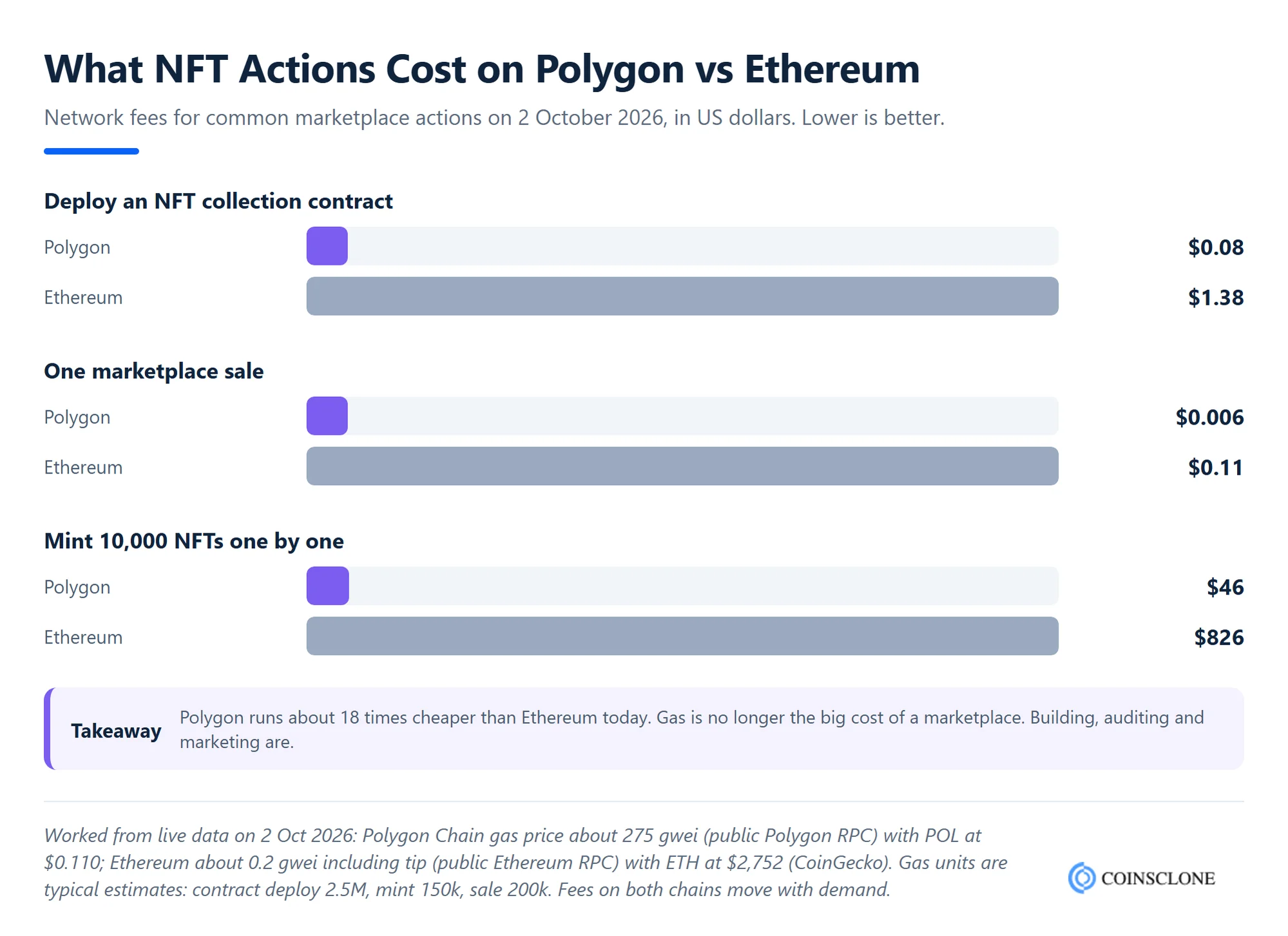
This matters most for products with many small trades. A game that mints 10,000 items one by one paid about $46 in gas here on 2 Oct, and about $37 at 26 Oct prices. You can also offer lazy minting, where the NFT is created only when it first sells, so creators pay nothing up front.
The bigger lesson: gas is no longer the main cost of running an NFT site. Your budget goes on the build, the audit and the marketing.
How Big Is the Polygon NFT Market in 2026?
Polygon was the second largest NFT chain by real sales in mid-October 2026, with about $8.4 million in a week. Before you build, it helps to know who is buying. The chain’s NFT market has changed shape since the 2021 to 2022 boom. Back then, art and profile picture sets led the way. Today, the biggest driver is real-world asset (RWA) collectibles: real items such as graded trading cards, stored in a vault and traded as NFTs.
The clearest case is Courtyard. In April 2025, Polygon briefly passed Ethereum in weekly NFT sales, with $22.1 million against $21.8 million, and Courtyard made up about $20 million of that, according to CryptoSlam data. In the week to 17 Oct 2026, Polygon was second among all chains, with $8.38 million in real sales. Courtyard alone made $7.68 million of it, about 92%, per CryptoSlam data. The chart below shows the same pattern in early September.
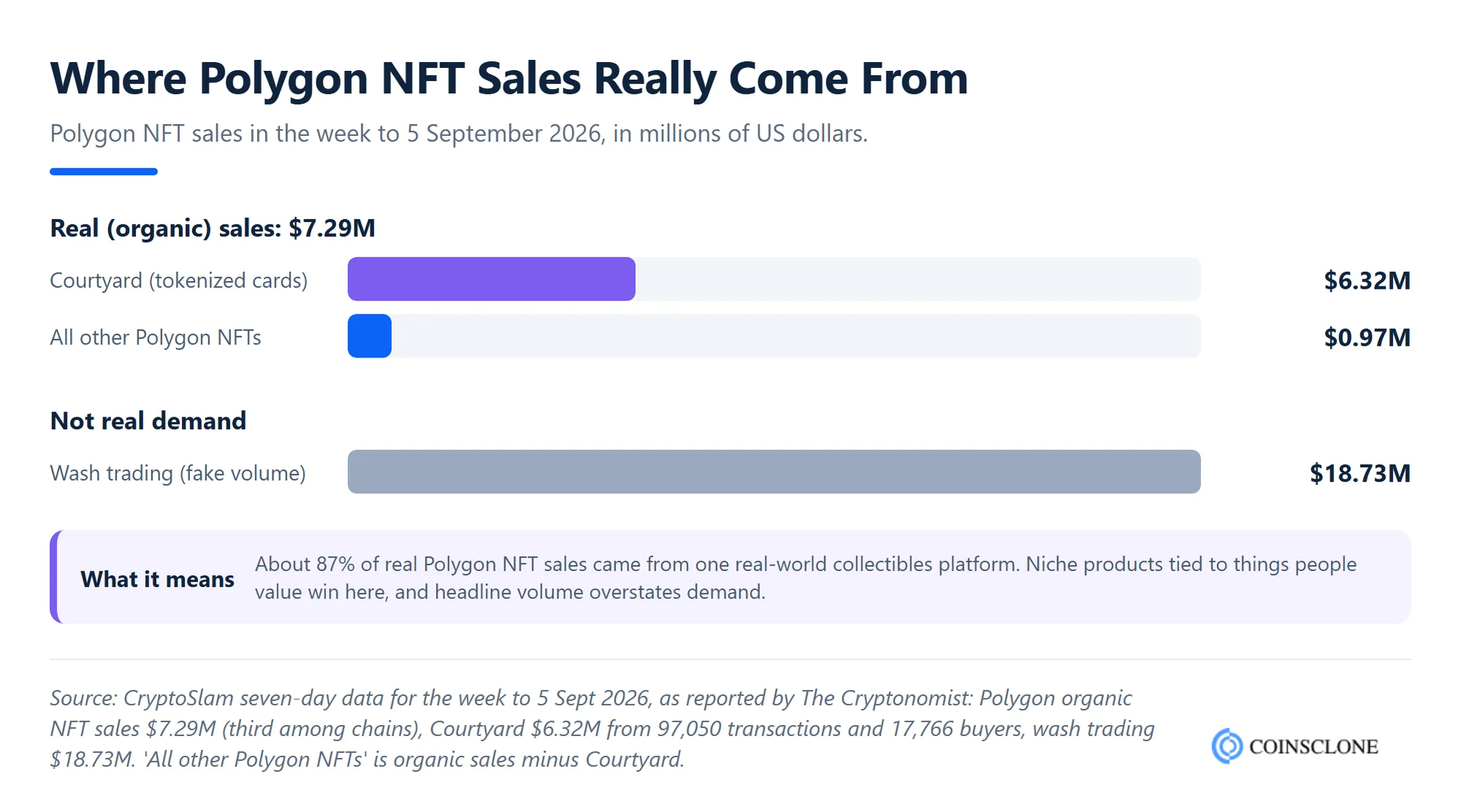
CryptoSlam also counted $18.72 million of wash trading on the chain in the October week. These are fake trades made to pump up volume, so be careful with headline numbers when you size your market. For a new site, the lesson is clear: real demand here comes from products tied to things people already value, such as cards, tickets, game items and brand rewards. A niche like that is a stronger plan than one more art site for all. If tokenized assets are your focus, see our guide to real world asset tokenization.
6 Best Polygon NFT Marketplaces in 2026
The best Polygon NFT marketplace for most buyers is OpenSea, while Courtyard leads for graded cards. The list of NFT sites on this chain has changed a lot since 2022, so this one covers only sites that are live in October 2026.
- OpenSea: OpenSea is the largest NFT site across many chains and still lists Polygon sets next to Ethereum, Base and others. Its fee is 1% per sale. For a Polygon project, it gives access to the biggest NFT buyer base.
- Courtyard: Courtyard is a site for tokenized, graded cards such as Pokémon and sports cards. Each card sits in an insured vault, and its NFT can be traded on the chain or swapped for the real card. It has been the top NFT set by weekly sales for much of 2026, with $7.68 million in the week to 17 Oct.
- Element: Element is a cross-chain NFT site with a full Polygon section, with rankings, floor prices and volume tracking.
- OKX NFT: OKX runs a cross-chain NFT site inside its Web3 wallet that supports Polygon, along with Ethereum, Solana, Bitcoin and more.
- Hodl My Moon: Hodl My Moon is a social NFT site built only for this chain. Users can mint, buy and sell NFTs and meet other collectors.
- PlayDapp: PlayDapp is a gaming and NFT site for in-game items. It moved its market from an Avalanche subnet to the Polygon mainnet in April 2025 for lower fees and better scale.
Which Polygon NFT Marketplaces Have Closed?
Several names you may see in older guides are no longer options. Magic Eden ended its Bitcoin and EVM markets, Polygon and Ethereum included, on 9 March 2026 to focus on Solana. tofuNFT has closed and now shows a farewell page. NFTrade has shut down, Refinable’s site is an “under construction” page, and the Tixhive and MBD Boulevard sites no longer run. This shake-out shows that an NFT site needs real users and a clear niche to last.
What Happens to NFTs When a Polygon Marketplace Closes?
The NFTs stay in their owners’ wallets on Polygon, because the chain, not the site, records who owns them. What users lose is the shop window: the place to list, find and trade them. Reddit is a clear case. It ended its Collectible Avatars program, built on Polygon, in late 2025 and retired its in-app wallet on 1 Jan 2026. On Reddit, owners still ask what the point of the avatars is now. The answer is that they can export their wallet and trade the avatars on other NFT sites.
For a builder, there are three lessons. First, store images and metadata on IPFS or Arweave and keep them pinned, so the art does not vanish. Next, let users hold NFTs in wallets they control or can export. Finally, use standard ERC-721 or ERC-1155 contracts, so other sites can list the same NFTs.
Also Read: The 10 Best NFT Marketplaces to Trade NFTs in 2026
If you want to build a site that joins this list, you need to know the build process. Next, let’s look at the steps.
How to Build an NFT Marketplace on Polygon in 8 Steps
To build an NFT marketplace on Polygon, you pick a niche, write and audit Solidity contracts, test them on the Amoy testnet and then launch on the mainnet. It may look like a big task, but with the right help it is simple to launch. Here is the step-by-step path we follow.
Step 1: Build a Clear Roadmap
Before any code, study the market and your rivals. Look at what the live sites do well, where users complain, and which features they lack. Then set clear goals for your first year, such as users, sales and revenue.
Step 2: Focus on Your Niche
Once the research is done, choose your niche. You can build a site for all kinds of NFTs or focus on one area, such as game items, event tickets, music, brand rewards or tokenized cards. Be clear about your target users and the kind of NFTs they want. On this chain in 2026, a focused niche tends to beat a site for everyone.
Step 3: Choose a Build Partner
This is a key stage. Pick an NFT marketplace development company that has shipped NFT platforms before. A good partner helps with each step, from the roadmap to the launch plan. Their team should know how to shape the site around your goals and your users.
Step 4: Design the UI/UX
A confusing design drives buyers away. So keep wallet sign-in simple, show each fee before a trade and make minting just a few clicks. Also plan for phone users from day one, since many collectors browse and buy on their phones.
Step 5: Build the Smart Contracts
Smart contracts run the core of each NFT site. On this chain, you write them in Solidity, using ERC-721 for one-of-one NFTs and ERC-1155 for editions and game items. The market contract then handles listings, offers, auctions, royalties (through the ERC-2981 standard) and your platform fee. At its core, it needs a few functions: create a listing, cancel it, buy it, and make or accept an offer. Most teams write and test these with Hardhat or Foundry and start from audited OpenZeppelin code. Then they post the final code on Polygonscan so anyone can read it. To learn more, read our guide to NFT smart contract development.
Step 6: Set Up the Tech Stack and Wallets
Each NFT site has a front end that users see and a back end that stores data and keeps listings in sync with the chain. The diagram below shows how the parts fit together.
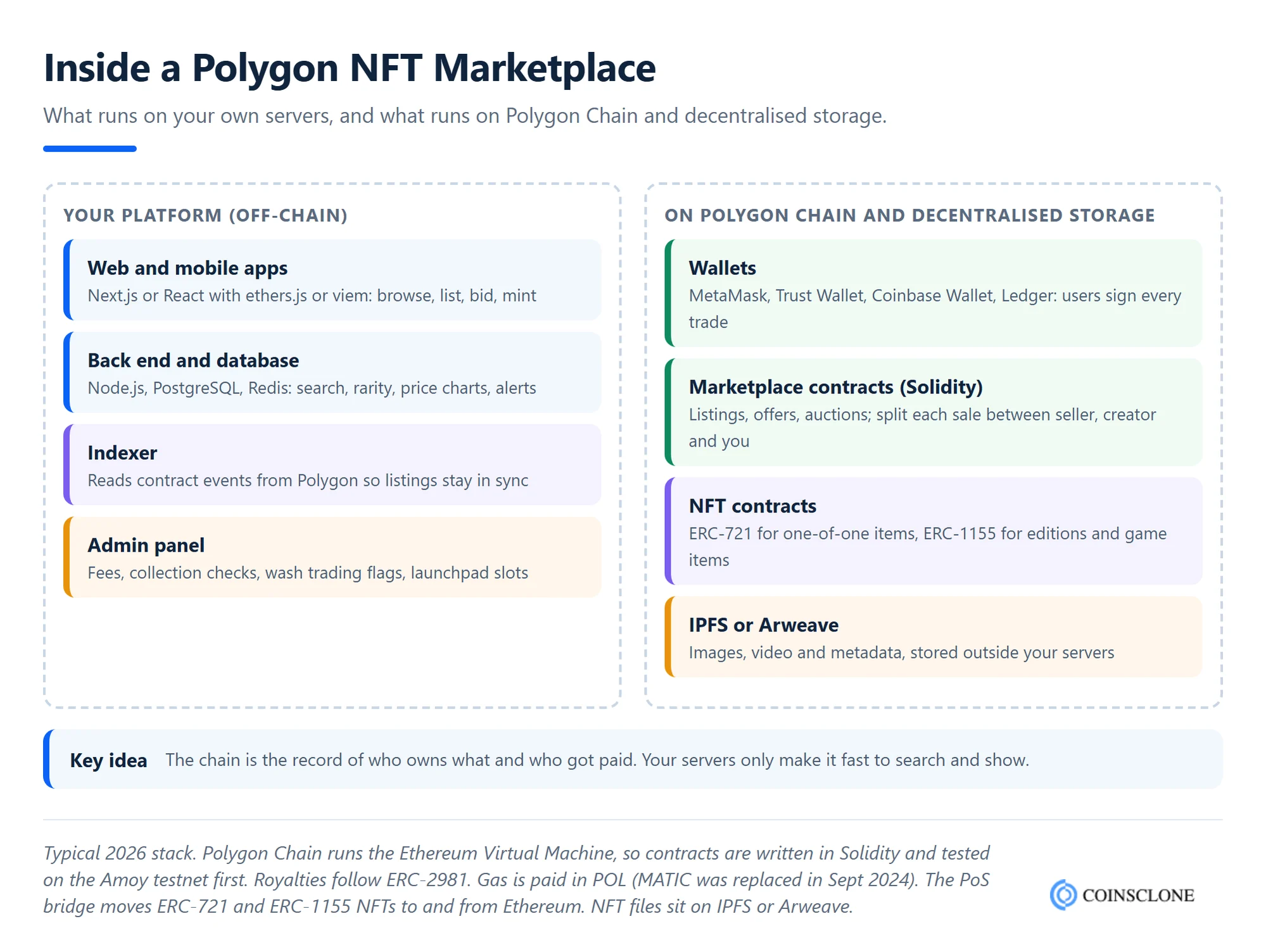
A common stack in 2026 is Next.js or React with ethers.js or viem on the front end, and Node.js with PostgreSQL on the back end. For a full list of tools, see our NFT marketplace tech stack guide. NFT images and metadata go on IPFS or Arweave. For wallets, support MetaMask, Trust Wallet, Coinbase Wallet, Ledger and WalletConnect. Adding email login with a built-in wallet also helps new users who have never used crypto.
Step 7: Test on Amoy and Audit
Once the build is done, test each feature on Amoy, the chain’s free test network. Amoy works like the main network but uses test POL, so you can run full trades at no cost. Check for bugs, security gaps and heavy traffic. Then have an outside firm audit the smart contracts, since a single contract bug can put user funds at risk.
Step 8: Launch, Market and Maintain
Next, deploy the contracts to the mainnet and launch. After that, the work shifts to growth: partner drops with known creators, low fees for early sellers, deals with creators who have big followings, and events on X and Discord. Keep fixing bugs, watching for fraud and adding the features users ask for.
These steps show that building an NFT platform on Polygon is very doable with the right team. Now let’s see why it pays off.
Benefits of Building an NFT Marketplace on Polygon
Knowing the gains of building on this chain can help you move ahead with confidence.
- Low fees: A sale costs well under one cent, so you can offer cheap or free minting and still earn from each trade.
- Fast, final trades: Blocks arrive about every 1.5 seconds, and since the Rio upgrade, confirmed trades are final almost at once.
- Works like Ethereum: The same Solidity code, NFT standards and wallets that work on Ethereum work here too.
- NFT bridging: Users can move ERC-721 and ERC-1155 NFTs between the two chains through the official PoS bridge.
- Room to grow: With room for about 5,000 trades per second, the network can handle busy drops and big games.
- Stablecoin users: The chain’s push into payments brings more USDC holders, which makes NFTs priced in dollars easy to buy.
- Proven at scale: Big real-world products, such as Courtyard’s cards, already run here.
What Are the Risks of Building on Polygon?
The main risks are a narrow buyer base, fewer outside venues and fake volume, not the network itself. No chain is perfect, so plan for these points too:
- A narrow market: One platform, Courtyard, makes up most of the chain’s real NFT sales. You will need your own plan to bring in creators and buyers.
- Fewer outside venues: Magic Eden and several small sites have left, so fewer sites list Polygon NFTs for you.
- Wash trading: Headline volume includes a lot of fake trades, so judge demand by real buyers, not by total volume.
- Old contract approvals: Users give your market contract an “approve for all” right over their NFTs. In September 2026, attackers found a bug in an old trade contract that Magic Eden had stopped using in 2024. It let them move NFTs from wallets that never took back that right. A whitehat rescued about 23,155 NFTs worth about $5.7 million. So build a pause switch into your contracts, and show users how to revoke rights if you ever retire one.
The good news is that a narrow market also means less rivalry in most niches. A site with a clear purpose, such as a game, a ticket brand or a card line, can stand out fast.
Polygon NFT Marketplace Features
The features you add decide how many users you win and keep. In simple terms, they are the pillars of your NFT site.
For users:
- Wallet login: One-click sign-in with MetaMask, Trust Wallet, Coinbase Wallet or WalletConnect, plus email login for newcomers.
- Minting: Upload a file, set a royalty and mint as ERC-721 or ERC-1155, with lazy minting as an option.
- Listing and buying: Fixed price sales, timed auctions and offers, paid in POL or stablecoins such as USDC.
- Bulk offers and sweeps: Bid on any item in a set, or buy several items in one go.
- Search and filters: Filter by price, traits, rarity and recent sales.
- Wallet view and alerts: Track what users own, its floor price and new bids.
For the admin:
- Fee settings: Set the platform fee per set or per sale type.
- Project checks: Verify real projects and hide fakes and copies.
- Wash trading flags: Spot trades between linked wallets so your volume stays honest.
- Launchpad tools: Run allowlists, mint phases and drop pages.
- Reports: Volume, users, fees earned and risk alerts.
Polygon-specific features worth adding:
- Gasless listing: Sellers sign a free message to list, and gas is paid only when a sale happens.
- Card payments: Let buyers pay by card and get the NFT in a wallet made for them, through a crypto on-ramp.
- Redeem flow: For NFTs backed by real items, let owners burn the NFT to claim the real item, as Courtyard does.
For a deeper list, see our guide to the must-have features of an NFT marketplace.
White Label or Custom: Which Polygon NFT Marketplace Should You Build?
Choose white label to launch fast on tested code, and a custom build if your model needs its own rules, such as a redeem flow or game logic. Both run the same way on Polygon. The difference is how much of the code is shaped around you.
- White label: A ready marketplace with your brand, fees and chain settings. It is the fastest and cheapest path, and it suits art, cards and fan drops. Coinsclone’s white label NFT marketplace software works this way.
- Custom on a proven base: You start from tested contracts but change the design, the features and the flow. This suits brands, ticket sites and loyalty programs.
- Fully custom: Every contract and screen is built for you. This suits card vaults with a redeem flow, games with their own item trades, or sites that span many chains.
- No-code NFT tools: Some tools let you mint and sell with no code. They work for a test run, but you give up control of fees, design and data, so they rarely suit a business.
How Much Does It Cost to Develop a Polygon NFT Marketplace?
There is no single price, because each NFT site has its own features and scope. Still, published 2026 agency cost guides give a useful range:
| Build route | Typical cost (market range) | What you get |
| White label or clone script | $10,000 to $30,000 | Tested code with your brand, fees and Polygon settings |
| Custom MVP | $20,000 to $45,000 | Wallet login, minting and fixed price sales |
| Mid-tier platform | $40,000 to $80,000 | Auctions, royalties, many wallets, search and filters |
| Enterprise platform | $80,000 to $150,000 or more | Launchpad, RWA redeem flow, KYC, mobile apps and a larger audit |
As for time, a white label site can go live in 4 to 6 weeks, and a standard custom build takes 9 to 13 weeks. Larger builds with a launchpad or phone apps take four months or more. What pushes cost up? Mostly custom smart contracts, the security audit, phone apps, a launchpad and links to vaults or payment firms. Running costs stay low here, since network fees are fractions of a cent. For a full breakdown, see our guide to NFT marketplace development cost.
It also helps to keep the wider market in view. NFT sales reached $5.63 billion in 2025, down 37% from 2024, and the average sale fell to $96, according to CryptoSlam data. In other words, buyers now want cheap, fast trades and real use, which is just where Polygon is strong.
How Does a Polygon NFT Marketplace Make Money?
A Polygon NFT marketplace makes money mainly from a small fee on each sale, plus launch and listing fees. Most NFT sites earn from several streams at once:
- Trading fees: A small cut of each sale, often 0.5% to 2.5%.
- Launchpad and minting fees: A share of first sales from new drops.
- Featured listings: Paid spots on the home page and in search.
- Badge fees: Charged to projects that want a verified badge.
- Pack and redeem fees: For card platforms, margins on packs and fees for shipping real items.
Since gas is so cheap here, you can keep fees low and still earn well on volume. For example, 5,000 sales a month at $40 each with a 2% fee would bring in $4,000 a month. Launchpad fees and featured spots then add to that base.
Where Can I Get Polygon NFT Marketplace Development Services?
You can get Polygon NFT marketplace development services from Coinsclone. We have been building blockchain products since 2018 and have delivered 350+ platforms for 200+ clients across 20 industries. Our team covers each step, from the roadmap and design to smart contracts, tests on Amoy, audits and launch. If you are still weighing your options, talk to our experts and ask for a free live demo.
With the demo, you can see how your Polygon NFT site could look and work. We also build NFT sites on other chains, such as an NFT marketplace on Avalanche, and offer clone scripts to launch faster. Need a token for rewards or fees too? Our Polygon token development team can build it with the marketplace. Coinsclone builds Polygon NFT marketplaces through its NFT marketplace development service, from white label launches to fully custom platforms.
Launch Your NFT Marketplace on Polygon Blockchain with Ease!
Faster Transactions. Highly Scalable. Low Cost Network. Get A Free Consultation.
Other Related Articles:
Frequently Asked Questions
What is Polygon NFT marketplace development?
It is the process of building an NFT platform on the Polygon blockchain. Users can mint, buy, sell and trade digital assets on it with low fees and fast trades. It includes smart contracts, wallet links, minting, listings, auctions and an admin panel.
Is Polygon good for NFTs?
Yes. On 26 Oct 2026, an NFT sale on Polygon cost about half a cent in gas, and blocks arrived about every 1.5 seconds. It also runs the same smart contract code as Ethereum. The main drawback is that its NFT market leans heavily on a few large apps such as Courtyard.
How much does it cost to mint an NFT on Polygon?
Minting one NFT cost about $0.004 or less on 26 Oct 2026, based on a peak gas price of about 280 gwei and POL at about $0.09. Deploying a new set’s contract cost about $0.07. With lazy minting, creators pay nothing until the first sale.
Can you mint NFTs on Polygon for free?
Yes, through lazy minting or gasless minting. With lazy minting, the creator signs the NFT details for free, and the NFT is only minted when someone buys it, so the buyer’s purchase covers the gas. With gasless minting, the marketplace pays the tiny gas fee for the user. It is a common question on Reddit’s NFT forum, and on Polygon the cost to the platform is a fraction of a cent per mint.
Do sellers pay gas to list an NFT on a Polygon marketplace?
No, not on most modern marketplaces. Listing and making offers only need a signed message, which costs nothing. Gas is paid when a trade settles on the chain, such as a sale, or when a seller cancels a listing on-chain. OpenSea users asked when they pay gas in October 2026. The answer is the same on Polygon. The difference is that each paid step costs about half a cent.
Is a Matic NFT marketplace the same as a Polygon NFT marketplace?
Yes. Matic was Polygon’s old name, and MATIC was its old token. Since September 2024, POL has taken over as the gas and staking token, and about 99% of MATIC has been swapped. Buyers now pay gas in POL, which they can get on an exchange or a Polygon DEX. Many NFT sites also price items in stablecoins such as USDC.
Will NFTs from my Polygon marketplace show on OpenSea?
Yes, if you use the standard ERC-721 or ERC-1155 contracts. OpenSea and other sites that support Polygon read NFTs straight from the chain, so items minted on your site can also be listed there. This adds reach for your creators. You can still keep your own fees and features for trades on your own site.
Why did Magic Eden leave Polygon?
Magic Eden ended its Bitcoin and EVM markets, Polygon and Ethereum included, on 9 March 2026 to focus on Solana, which made up most of its volume. It was a business choice by Magic Eden, not a problem with the network. OpenSea, Element and OKX still support Polygon NFTs.
How long does it take to develop a Polygon NFT marketplace?
A white label site takes about 4 to 6 weeks. A standard build takes 9 to 13 weeks. A custom build with a launchpad, phone apps or a redeem flow for real items takes four months or more.
What features does a Polygon NFT marketplace need?
The core set is wallet login, minting, fixed price and auction sales, offers, search and filters, royalties, a wallet view and an admin panel for fees and project checks. Bulk offers, gasless listing and card payments help you compete in 2026.
Is Polygon NFT marketplace development secure?
Yes, when it is built with audited smart contracts, safe wallet links and a strong back end. The chain is secured by Proof of Stake validators and saves its state on Ethereum. For your site, the bigger risk is contract bugs, so use audited code like OpenZeppelin and get an outside audit before launch. Also add a pause switch, since old contracts that users still trust can be attacked years later.
Can I customize my Polygon NFT marketplace platform?
Yes. You can fully shape the branding, NFT types, payment options, fee rules and extra features such as launchpads, redeem flows or support for more chains, based on your business needs.
Launch a Scalable Polygon NFT Marketplace in Weeks
Polygon NFT Marketplace Development — build fast, low-cost NFT platforms on Polygon.
- Lightning-Fast Transactions: Process NFT trades instantly with minimal gas fees.
- EVM Compatibility: Seamlessly integrate Ethereum-based dApps and assets.
- Cross-Chain Ready: Expand reach across multiple blockchain networks easily.
- Robust Smart Contracts: Ensure secure minting, trading, and ownership transfers.
See a free branded demo of your NFT marketplace in 48 hours — before you invest a cent.
Book a Free Demo to discover how Polygon NFT Marketplace Development can help you launch in just 8–12 weeks.