
NFT marketplace development on Avalanche means building a site where people mint, buy and sell NFTs on this network. You can use its fast C-Chain or a custom L1 chain of your own. The chain gives you final trades in about a second, fees well under one cent and full support for Ethereum tools. That mix makes it a strong base for games, brands and creator sites that need cheap, quick trades.
This guide explains how the chain works today, why it suits NFT trading and what each action really costs in 2026. You will also see which NFT sites on it are still live and how to choose between the C-Chain and your own L1. Then we cover the features to build, the build steps, and the budget and time to plan for. By the end, you will know if Avalanche fits your plan and how to start.
In this guide:
- Real 2026 costs: On 2 October 2026, one NFT sale cost about $0.011 in gas on Avalanche, against about $0.08 on Ethereum.
- The live market: Joepegs, Salvor and OpenSea serve the chain today, while NFTrade and Kalao have closed.
- C-Chain or own L1: A simple decision tree, plus what your own L1 costs to run after the Etna upgrade.
- The build path: Eight steps from niche to launch, with the testnet, audit and tech stack explained.
- Time and budget: 4 to 6 weeks for a white label launch, 9 to 13 weeks for a standard build.
Launch Your NFT Marketplace on the Avalanche Blockchain
NFT Marketplace on Avalanche — designed for creators and collectors seeking fast, low-fee transactions.
- High-Speed Deployment: Build your marketplace leveraging Avalanche’s high throughput.
- Multi-Wallet Support: Integrates MetaMask, Trust Wallet, and other popular wallets.
- Scalable & Eco-Friendly: Handle transactions with energy-efficient PoS consensus.
- Monetization Opportunities: Earn from NFT listings, trading fees, and exclusive drops.
See a free branded demo of your NFT marketplace in 48 hours — before you invest a cent.
Book a Free Demo to discover how our NFT Marketplace on Avalanche solution can help you launch a secure, scalable platform in just 8–12 weeks.
NFT Marketplace Development on Avalanche
An NFT marketplace on Avalanche is a web or phone app linked to smart contracts on the chain. Creators use it to mint NFTs, sellers list them, and buyers pay in AVAX or tokens such as USDC. The contracts move the NFT to the buyer and split the payment between the seller, the creator and your platform, all in one step.
Most teams build on the C-Chain, the network’s main smart contract chain. It runs the Ethereum Virtual Machine (EVM). So the same Solidity code, ERC-721 and ERC-1155 token types and wallets that work on Ethereum work here too. Large projects, such as big games, can also run their own L1. That is a chain of their own with its own rules, which can still talk to the C-Chain.
So who is this for? It fits founders who want low fees and fast trades without leaving the Ethereum tool set. Common uses include game items, event tickets, fan rewards, art and tokenized assets. In short, if your users will make many small trades, this chain keeps each one cheap and quick.
Avalanche Blockchain: Overview
Avalanche went live in September 2020. It was built by Ava Labs, a team founded by Cornell professor Emin Gün Sirer, based on research first shared as a paper on IPFS. AVAX is its native token. On 2 October 2026, AVAX traded at about $11.07, with a market value near $4.9 billion, according to CoinGecko.
Avalanche is often called an Ethereum rival, but it is also a close partner. Its main network has three chains, each with its own job:
- X-Chain: Creates and trades assets.
- P-Chain: Tracks validators and the Avalanche L1s they run.
- C-Chain: Runs smart contracts and is where almost all NFT activity happens.
The network has also changed a lot in the last two years. The Etna upgrade (16 December 2024) turned “subnets” into L1s and cut the cost of running one, as the Avalanche team explains. The Octane upgrade (8 April 2025) made C-Chain fees more dynamic and lower. Then the Granite upgrade (19 November 2025) let validators shorten block times, per the builder blog. Today the C-Chain makes a new block about every 1.2 seconds, based on public network data on 2 October 2026.
Through the network, people can stake AVAX, use DeFi apps or build their own NFT marketplace to earn revenue. So why pick this chain over others for NFTs? Let’s look at the gains.
Why Build an NFT Marketplace on Avalanche?
The two chains do not work the same way under the hood. Both now use Proof of Stake (Ethereum switched from Proof of Work in September 2022). But Avalanche has its own way for nodes to agree, and it locks in each block in about a second. Here are the main gains for an NFT market on this chain.
Fast, Final Trades
Avalanche confirms a trade in about one to two seconds, and once a block is accepted it is final. There is no waiting period for the trade to “settle”. As a result, buyers see their NFT in their wallet almost at once, even when a hot drop brings heavy traffic to your marketplace.
Low Cost
Fees on Avalanche are tiny. On 2 October 2026, the C-Chain gas price was about 5 nAVAX (billionths of an AVAX). That makes one NFT sale cost about one cent, and minting an NFT under one cent. Ethereum is also cheap in 2026, but Avalanche still costs about seven times less, as the chart below shows. For startups, this means you can offer free or near-free minting to creators.
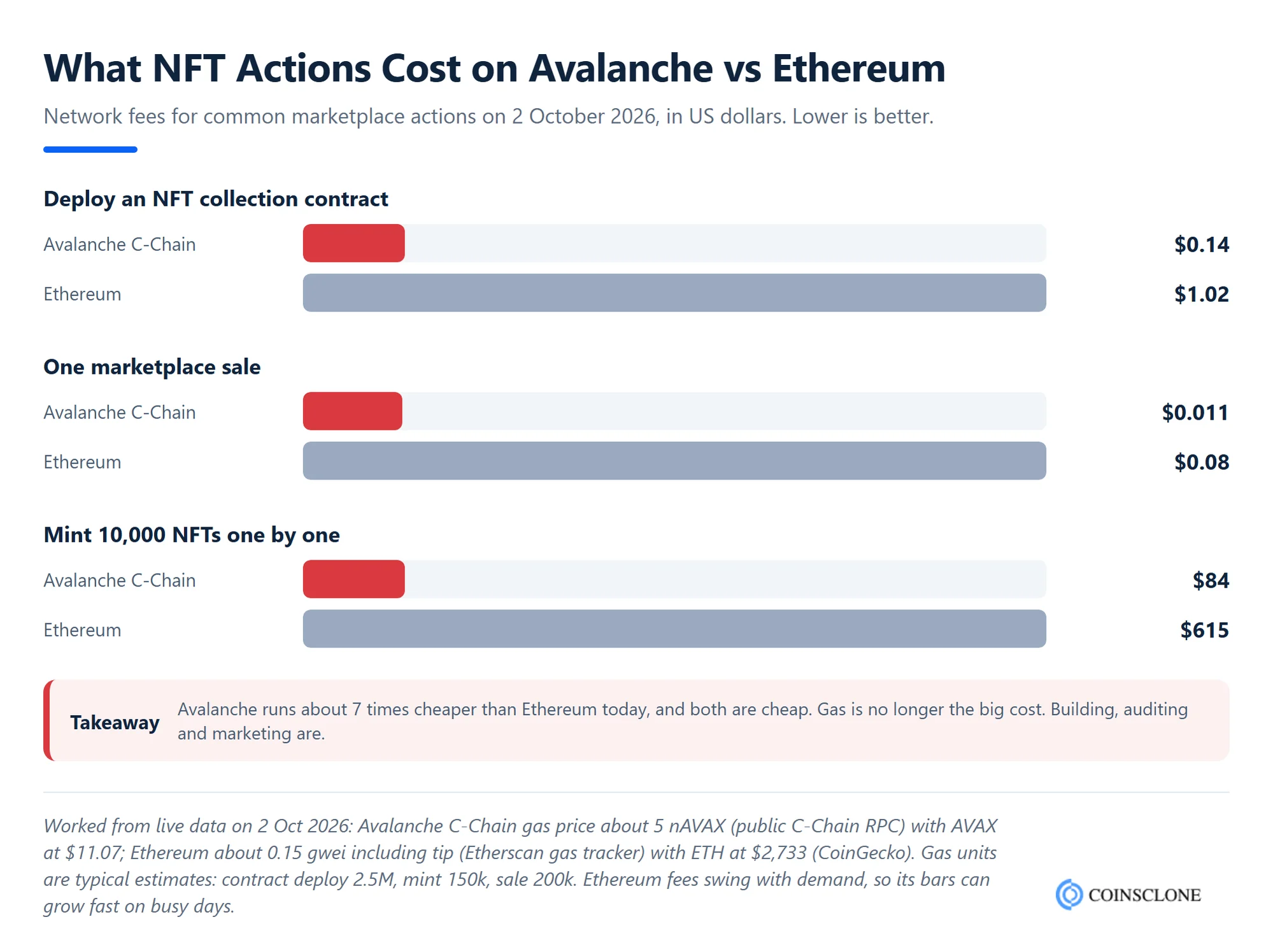
The bigger lesson: gas is no longer the main cost for any marketplace. Your budget goes on the build, the audit and the marketing.
Also Read: Tips to Reduce the Cost of NFT Marketplace Development
Security
To agree on each block, the network asks small random groups of nodes again and again until all of them agree. Each node that checks blocks on the main network must stake at least 2,000 AVAX. To change results, an attacker would need a large share of all staked AVAX. That would cost a great deal and put their own stake at risk. On top of that, NFT contracts on the C-Chain can use the same checked code, such as OpenZeppelin, that guards Ethereum projects.
Interoperability
Though it is a rival, Avalanche is built to work with Ethereum. Since the C-Chain runs the EVM, you can deploy the same contracts with few or no changes. Tokens can also move between the two chains through the bridge in the Core wallet. Inside the network, Interchain Messaging (ICM) links the C-Chain with each L1, so assets can move between them.
Flexibility
This is the major plus for startups and large brands. With an L1, you can launch your own chain with your own gas token, fee rules and nodes. You can even make it private, so only approved users can trade. Since Etna, each L1 node pays a fee of about 1.3 AVAX a month instead of staking 2,000 AVAX up front. So a custom chain is now within reach of mid-size projects, not only big firms.
Decentralization
The core value of blockchain is that no single party controls it. Avalanche backs this with a large, open set of nodes. On your site, users keep their NFTs in their own wallets, and trades follow code that anyone can check. That builds trust from day one.
Energy Efficient
Proof of Stake uses far less energy than Proof of Work mining. So an NFT site on this chain suits brands that care about their climate footprint, a common question from big partners.
Things to Weigh Before You Choose Avalanche
No chain is perfect, so plan for these points too:
- Smaller NFT market: Most NFT trading still happens on Ethereum, Solana and a few other chains. You will need your own plan to bring in creators and buyers.
- Fewer venues, less shared traffic: Several NFT sites on the chain have closed since 2023, so fewer outside sites list its NFTs.
- A lower AVAX price: AVAX sits far below its 2021 peak of about $145. That keeps fees cheap, but it also means less hype-driven money than in past cycles.
The good news is that a smaller market also means less competition. A marketplace with a clear niche, such as a game, a sports brand or a ticketing platform, can stand out fast.
Unlock all these gains by starting your NFT market on Avalanche.
Best Avalanche NFT Marketplaces in 2026
Now you might be thinking about launching your own site after seeing these gains. First, let’s see who leads today. The NFT scene on the chain has changed a lot since 2022, so this list only covers sites that are live in October 2026.
Joepegs
Joepegs is an NFT market built by the team behind the Trader Joe exchange (now LFJ). It launched in 2022 and offers a launchpad for new drops, collection pages and auctions. Joepegs is known for its curated art and gaming collections, and its launchpad has hosted many local projects.
Salvor
Salvor started as an art market and has grown into one of the busiest NFT hubs on the chain. Beyond trading, it offers peer-to-peer NFT loans, where holders borrow AVAX against their NFTs. Salvor shares platform revenue with holders who stake its ART token and its Salvors NFTs, and it rewards active traders with points. It has also won a $1 million grant from Avalanche Rush, a fund run by the chain’s foundation.
OpenSea
OpenSea added Avalanche in October 2022 and still lists its NFTs next to many other chains. It gives these collections access to the largest NFT audience in the market. Its marketplace fee is 1% per sale, low for a site of its size.
Closed or Quiet Platforms
Several names you may see in older guides are no longer good options. NFTrade has shut down, and its site now shows a thank-you notice. Kalao’s web address is now a parked domain. YetiSwap is still online, but its dashboard shows no trading volume. This shake-out is a reminder that a marketplace needs real users and a niche to last.
Here is how the live platforms compare:
| Marketplace | Launched on Avalanche | Best known for |
| Joepegs | 2022 | Launchpad, curated art and gaming collections |
| Salvor | 2022 | Trading plus NFT-backed loans and revenue sharing |
| OpenSea | October 2022 | Multi-chain reach and the largest buyer base |
For a wider view across all chains, see our list of the best NFT marketplaces in 2026.
C-Chain or Your Own Avalanche L1?
Before you write any code, decide where your marketplace will live. This is the biggest tech choice in the whole build, and it shapes your costs and features.
Build on the C-Chain if you want to tap into the chain’s users, wallets and tokens from day one. Most NFT sites start here because it is cheap, simple and shares liquidity with every other app on the chain.
Launch your own L1 if your project needs its own rules. For example, a game with millions of in-game items may want its own gas token and no fee spikes from other apps. Gunzilla Games did exactly this: its shooter Off The Grid runs on the GUNZ L1, where players mint items they win as NFTs and trade them, as the network’s team reports. An L1 can also limit trading to approved users, which suits regulated assets.
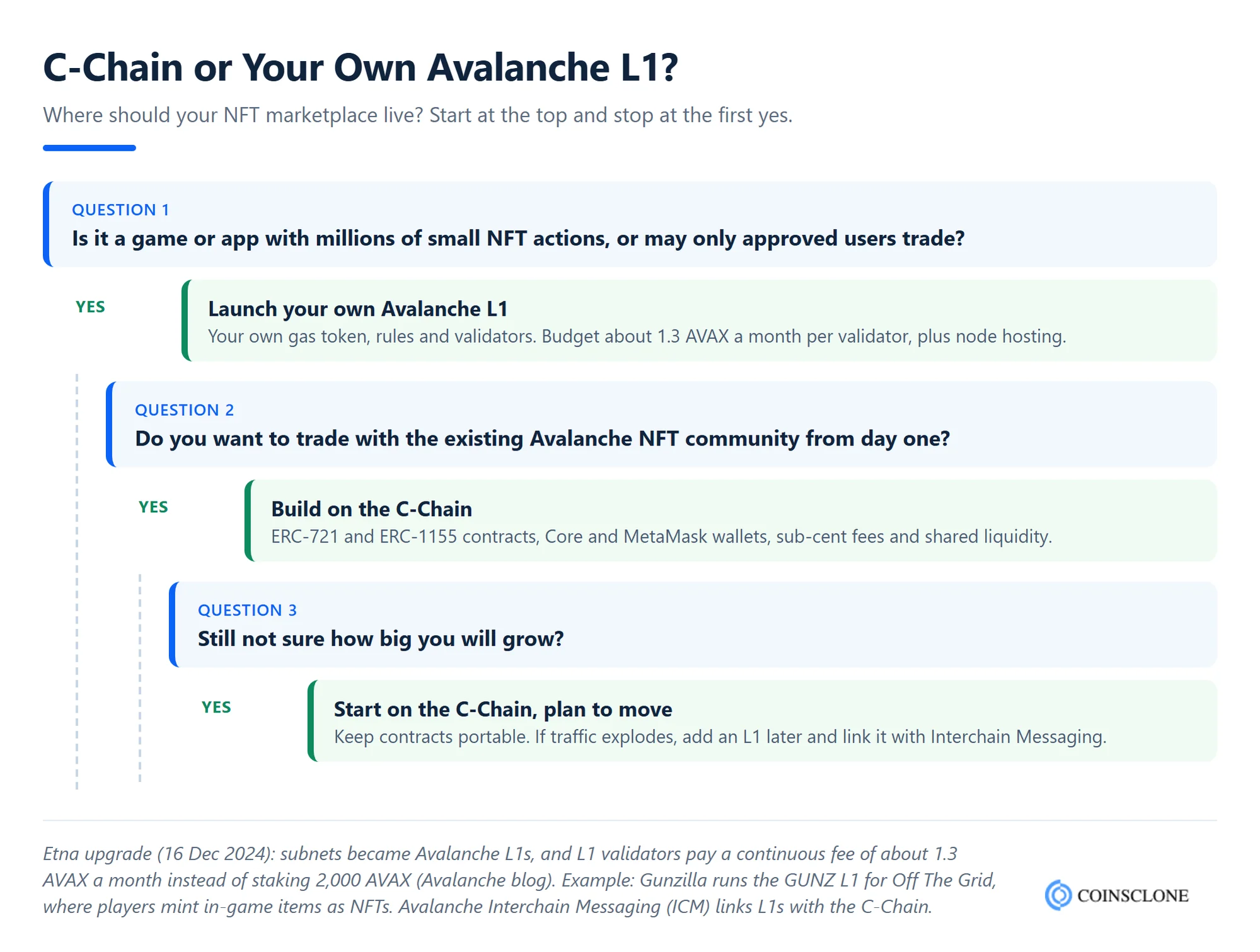
If you are not sure, start on the C-Chain and keep your contracts portable. You can add an L1 later and connect it with Interchain Messaging, so early users and NFTs come with you. Many teams also want reach beyond this one chain. In that case, read our guide to cross-chain NFT marketplace development.
Key Features of an Avalanche NFT Marketplace
The features you add decide how many users you win and keep. Here is what every NFT market on the chain should ship with.
For users:
- Wallet login: One-click sign-in with Core, MetaMask, Trust Wallet or WalletConnect, plus email login for new users.
- Minting: Upload art, set a royalty and mint as ERC-721 (one-of-one) or ERC-1155 (editions and game items).
- Listing and buying: Fixed price sales, timed auctions and offers, paid in AVAX or stablecoins like USDC.
- Collection offers and sweeps: Bid on any item in a collection, or buy several cheap items in one go.
- Search and filters: Filter by price, traits, rarity and recent sales.
- Portfolio and alerts: Track what users own, its floor price and new bids.
For the admin:
- Fee settings: Set the platform fee per collection or per sale type.
- Collection checks: Verify real projects and hide fakes and copies.
- Launchpad tools: Run allowlists, mint phases and drop pages.
- Reports: Volume, users, fees earned and risk alerts.
Avalanche-specific features worth adding:
- Gasless listing: Sellers sign a free message to list; gas is paid only when a sale happens.
- Royalties by standard: Support ERC-2981 so creator royalties show up on every sale.
- L1 support: Let game studios plug in their own Avalanche L1 collections later.
Steps to Develop an NFT Marketplace on Avalanche
Launch an NFT Marketplace on the AVAX blockchain. Sounds pretty useful, right?
After seeing the benefits, you may be ready to plan your own build. To make this simple, we have summed up each step below. These are also the steps we at Coinsclone follow for every build on this chain.
1. Define Your Niche and Find the Right Partner
The first and most important step is to define your audience. Who will mint, who will buy, and why will they choose you over OpenSea or Joepegs? A clear niche, such as gaming items, music, tickets or a brand’s fan rewards, makes every later choice easier. Then pick a build partner who has shipped NFT sites before. Coinsclone is a trusted NFT build partner that covers each step, from plan to launch.
2. Choose Your Features
Next, shape your NFT marketplace around your niche. This is the stage where you pick the features and trading types you want. Think buying and selling, auctions, offers, filters and launchpad tools. On Avalanche, you can build a fully custom product or start from a tested white label base and change it to fit.
3. Design the UI/UX
A confusing design drives users away fast. Your platform should feel easy for first-time buyers and fast for pro traders. So keep wallet sign-in simple, show fees before each trade and make the mint flow just a few clicks. It is wise to work with experienced designers who know how NFT buyers shop.
4. Build the Smart Contracts
Smart contracts run the core of every NFT marketplace. They handle the creation, ownership and transfer of each NFT. On the C-Chain, you write them in Solidity, using ERC-721 or ERC-1155 for the NFTs. The marketplace contract then handles listings, offers, auctions, royalties and your platform fee. To learn more, read our guide to NFT smart contract development.
5. Integrate Wallets
The AVAX network supports a wide range of wallets. Core is the official Avalanche wallet, and MetaMask, Trust Wallet and Ledger all work with the C-Chain. A secure wallet link lets users view their NFTs, sign trades and keep full control of their assets. Adding email login with a built-in wallet also helps new users who have never used crypto.
6. Set Up the Tech Stack
Every marketplace has a front end and a back end. The front end is what users see and click. The back end stores data, runs search and keeps your listings in sync with the chain. The diagram below shows how the parts fit.
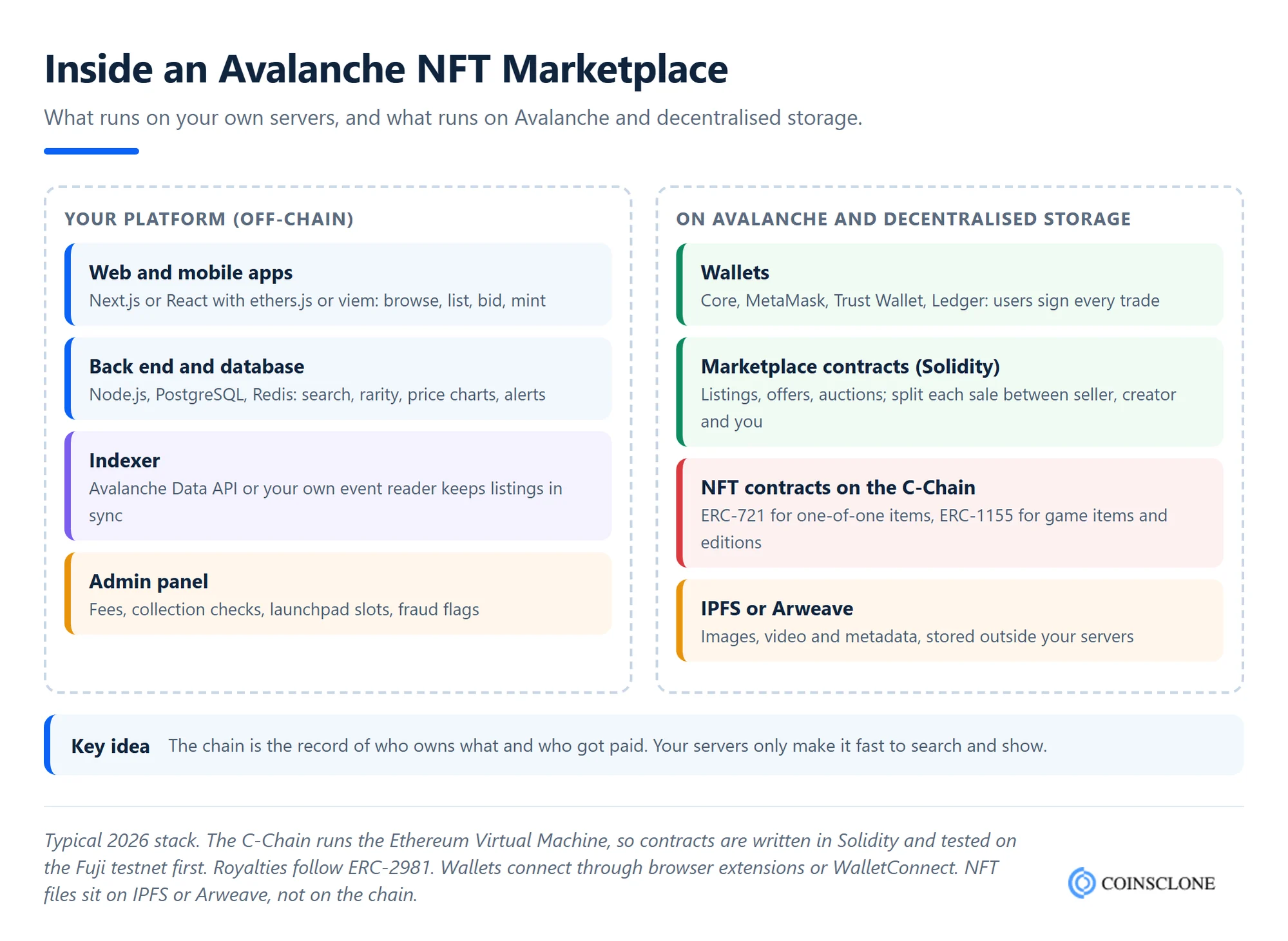
A common stack in 2026 is Next.js or React with ethers.js or viem on the front end, and Node.js with PostgreSQL on the back end. NFT images and metadata go on IPFS or Arweave, so they do not rely on your servers.
7. Test on Fuji and Audit
After the build, our testing team checks every feature on Fuji, Avalanche’s free test network. Fuji works just like the main network but uses test AVAX, so you can run full trades at no cost. The team tests for bugs, security gaps and heavy traffic. Then an outside firm audits the smart contracts, since a single contract bug can put user funds at risk.
8. Deploy and Launch
Once testing is done, we deploy the contracts to the Avalanche mainnet and launch your platform. After launch, startups can begin marketing to attract users. Good first moves include partner drops with known creators, low or zero fees for early sellers, and community events on X and Discord. Then keep improving the product based on what users ask for.
These are the steps to create an NFT marketplace on the AVAX blockchain. Some of them are technical and take time. So it is wise to work with an experienced team. Coinsclone builds Avalanche NFT marketplaces on the C-Chain or on your own L1 through its NFT marketplace development service.
How Much Does It Cost to Build an NFT Marketplace on Avalanche?
There is no single price, because each marketplace has its own features and scope. Still, published 2026 agency cost guides give a useful range:
| Build route | Typical cost (market range) | Typical time |
| White label marketplace | $10,000 to $30,000 | 4 to 6 weeks |
| Standard marketplace on a proven model | $20,000 to $80,000 | 9 to 13 weeks |
| Custom build with launchpad or own L1 | $80,000 to $150,000 or more | 4 months or more |
The times shown are Coinsclone’s own published build times. What pushes cost up? Mostly custom smart contracts, the security audit, mobile apps, a launchpad and running your own L1. Running costs stay low on Avalanche: network fees are cents, and an L1 validator fee is about 1.3 AVAX a month plus hosting. For a full breakdown, see our guide on how to build an NFT marketplace.
It also helps to keep the market in view. NFT sales reached $5.63 billion in 2025, down 37% from 2024, and the average sale fell to $96, according to CryptoSlam data. In other words, buyers want cheap, fast trades in a clear niche, which is exactly where Avalanche is strong.
How an Avalanche NFT Marketplace Makes Money
Most marketplaces earn from several streams at once:
- Trading fees: A small cut of each sale, often 0.5% to 2.5%.
- Launchpad and minting fees: A share of primary sales from new drops.
- Featured listings: Paid spots on the home page and in search.
- Verification and listing fees: Charged to projects that want a verified badge.
- Token perks: Fee discounts or revenue sharing for holders of your own token, as Salvor does.
Here, low gas means you can keep fees small and still earn well on volume. For example, 1,000 sales a month at an average of 10 AVAX with a 2% fee would bring in 200 AVAX, about $2,214 at today’s price. Launchpad fees and featured spots then add to that base.
Conclusion
Avalanche gives NFT sites fast, final trades, fees of about a cent and full support for Ethereum tools. Its L1s add something few chains offer: a custom chain for your game or brand at a running cost of about 1.3 AVAX a month per validator. The market is smaller than on Ethereum or Solana, so success depends on a clear niche and a strong launch plan.
If you plan to launch an NFT market on this chain with standout features, Coinsclone can help. Coinsclone is a leading NFT Marketplace Development Company that has been building blockchain products since 2018. We have delivered 350+ platforms for 200+ clients across 20 industries. Our teams cover each step, from plan and design to smart contracts, tests and launch. We shape each product around your goals.
To make it easy, we offer a free demo. Just book a time with our experts and see how your own NFT site could look and work.
Frequently Asked Questions
Is Avalanche good for NFTs?
Yes. Avalanche confirms trades in about a second, and an NFT sale costs about one cent in gas. It also runs the same smart contract code as Ethereum, so creators and developers can use familiar tools. The main drawback is a smaller NFT market than Ethereum or Solana.
Why choose Avalanche over Ethereum for an NFT marketplace?
Avalanche is faster to final settlement and, on 2 October 2026, about seven times cheaper per trade. It also lets you launch your own Avalanche L1 with custom rules. Ethereum has a larger buyer base, so many teams build on Avalanche and plan cross-chain support later.
How much does it cost to mint an NFT on Avalanche?
Minting one NFT on the C-Chain cost under one cent on 2 October 2026, based on a gas price of about 5 nAVAX and AVAX at $11.07. Deploying a new collection contract cost about $0.14. Fees rise a little when the network is busy.
Which wallets support Avalanche NFTs?
Core is the official Avalanche wallet and supports NFTs on the C-Chain. MetaMask, Trust Wallet, Coin98 and Ledger hardware wallets also work. Your site can link all of them through browser add-ons and WalletConnect.
How secure are Avalanche NFTs?
Avalanche NFTs are as secure as the network and the smart contracts behind them. The network is secured by validators who each stake at least 2,000 AVAX. For your marketplace, the bigger risk is contract bugs, so use audited libraries like OpenZeppelin and get an outside audit before launch.
What core features should an Avalanche NFT marketplace include?
It should include wallet login, minting, fixed price and auction sales, offers, search and filters, royalties, a user portfolio and an admin panel for fees and collection checks. Collection offers, sweeps and a launchpad help you compete in 2026.
How long does it take to build an NFT marketplace on Avalanche?
A white label marketplace takes about 4 to 6 weeks. A standard build takes 9 to 13 weeks. A custom build with a launchpad or its own Avalanche L1 takes four months or more.
How can I market my Avalanche NFT marketplace?
Start with a clear niche and sign a few known creators or projects for launch drops. Offer low fees to early sellers, run rewards for active traders, and build a community on X and Discord. Teaming up with games and brands on the chain can also bring in ready-made users.
Launch Your NFT Marketplace on the Avalanche Blockchain
NFT Marketplace on Avalanche — designed for creators and collectors seeking fast, low-fee transactions.
- High-Speed Deployment: Build your marketplace leveraging Avalanche’s high throughput.
- Multi-Wallet Support: Integrates MetaMask, Trust Wallet, and other popular wallets.
- Scalable & Eco-Friendly: Handle transactions with energy-efficient PoS consensus.
- Monetization Opportunities: Earn from NFT listings, trading fees, and exclusive drops.
See a free branded demo of your NFT marketplace in 48 hours — before you invest a cent.
Book a Free Demo to discover how our NFT Marketplace on Avalanche solution can help you launch a secure, scalable platform in just 8–12 weeks.