
An NFT marketplace is a platform where people mint, list, buy and sell non-fungible tokens, with the sale settled by a smart contract rather than by the platform holding the asset. The token stays in the seller’s wallet until the moment of purchase, and the marketplace only ever has permission to move it. That single fact explains most of what follows.
Understand What an NFT Marketplace Is and How It Works Today
What is an NFT Marketplace — discover features and working process clearly.
- Easy Asset Listing: Creators mint and list NFTs with fixed or auction pricing.
- Seamless Wallet Integration: Buyers connect wallets to browse, bid, and purchase.
- Robust Admin Controls: Manage users, content, fees, and blockchain interactions.
- Essential Features: Includes search filters, royalties, security, and notifications.
See a free branded demo of your NFT marketplace in 48 hours — before you invest a cent.
Book a Free Demo to discover how What is NFT Marketplace can help you launch in just 8–12 weeks.
What Is an NFT Marketplace?
An NFT marketplace is an online platform for trading non-fungible tokens, which are blockchain records that prove ownership of a specific digital or tokenised item. It combines an ordinary web storefront with smart contracts that handle escrow, transfer and payment in a single transaction.
- It is a marketplace in the classified-advert sense: it lists what other people own rather than holding inventory.
- The purchase and the transfer happen atomically, so neither buyer nor seller can take the other side’s value and walk away.
- Marketplaces run on blockchains such as Ethereum, Solana, Polygon, Base and Bitcoin through Ordinals.
What an NFT Marketplace Is Made Of
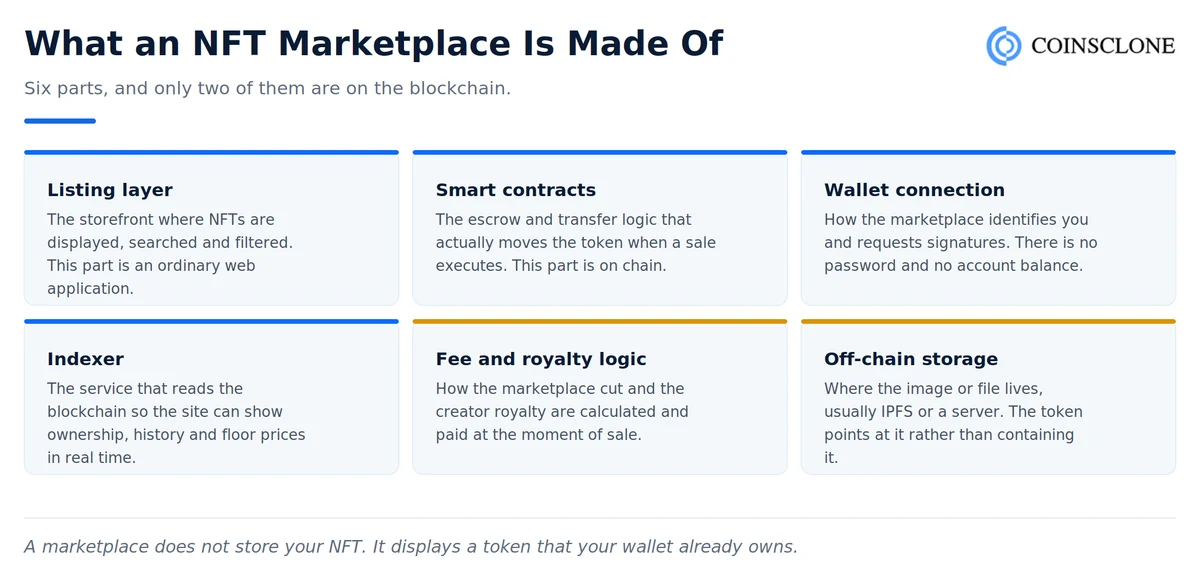
An NFT marketplace has six working parts, and only two of them live on the blockchain. Understanding which is which answers most technical questions about how these platforms behave.
- Listing layer and indexer: an ordinary web application plus a service that reads chain data so the site can show ownership and prices.
- Smart contracts: the escrow and transfer logic that actually executes a sale, and the only part that moves assets.
- Wallet connection and fee logic: how you are identified, and how the platform cut and creator royalty are deducted at settlement.
- Off-chain storage: the image or file itself, usually on IPFS or a server, with the token holding a pointer to it.
How Does an NFT Marketplace Work?
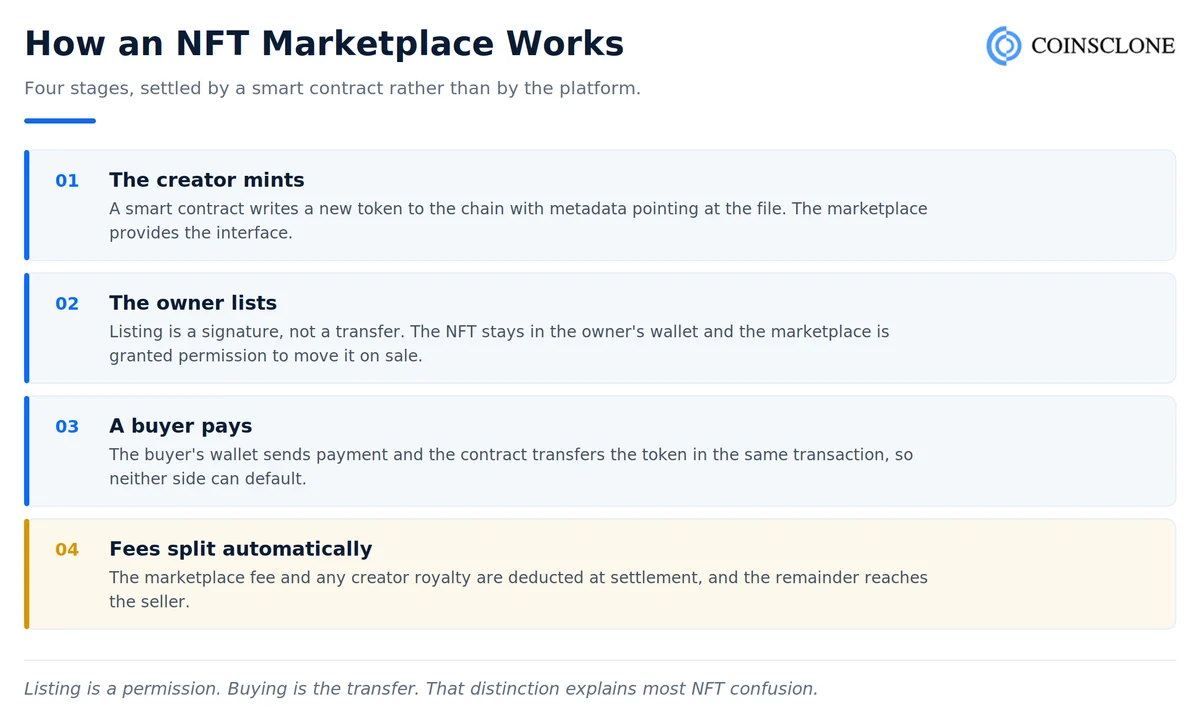
An NFT marketplace works in four stages: a creator mints a token, the owner lists it by signing a permission, a buyer pays and the contract transfers the token in the same transaction, and fees split automatically at settlement. The platform never takes custody in a standard marketplace flow.
- Minting writes a new token to the chain with metadata pointing at the file.
- Listing is a signature granting the marketplace contract permission to transfer, not a transfer itself.
- Buying executes payment and transfer together, which is what removes counterparty risk.
- Settlement deducts the marketplace fee and any creator royalty, then sends the remainder to the seller.
How Do NFT Marketplaces Operate Day to Day?
Operationally, a marketplace runs a storefront, an indexer that keeps pace with the chain, a moderation function, and a fee and payout system. The hard engineering problem is not the trading, it is keeping displayed data in sync with on-chain reality.
- Indexing lag is why a sold item can briefly still appear listed.
- Moderation handles stolen art, impersonated collections and prohibited content, none of which the blockchain prevents.
- Analytics on floor price, volume and holder distribution are now a core part of the product, not an extra.
Types of NFT Marketplace
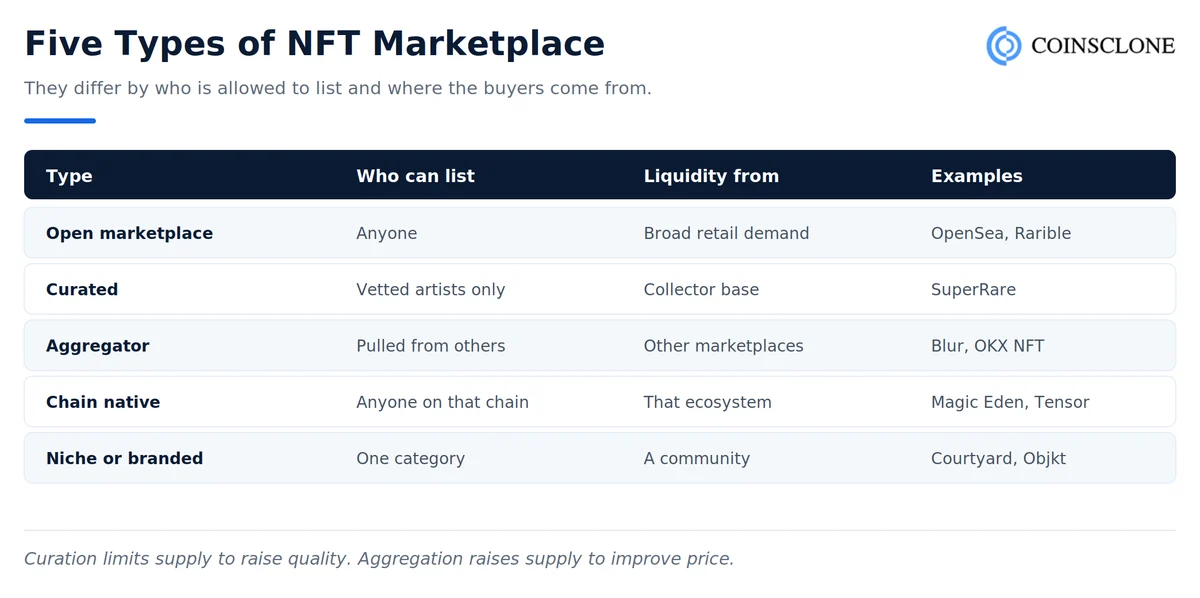
NFT marketplaces divide into five types by who is allowed to list and where the buyers come from: open, curated, aggregator, chain native and niche. The type determines both the quality of supply and the depth of demand.
- Open marketplaces let anyone mint and list, which maximises supply and minimises curation.
- Curated marketplaces vet the artist before listing, trading volume for quality.
- Aggregators pull listings from other venues so buyers see the true floor across the market.
- Chain native marketplaces serve one ecosystem deeply, and niche marketplaces serve one category or community.
How Crypto Wallets Interface With NFT Marketplaces
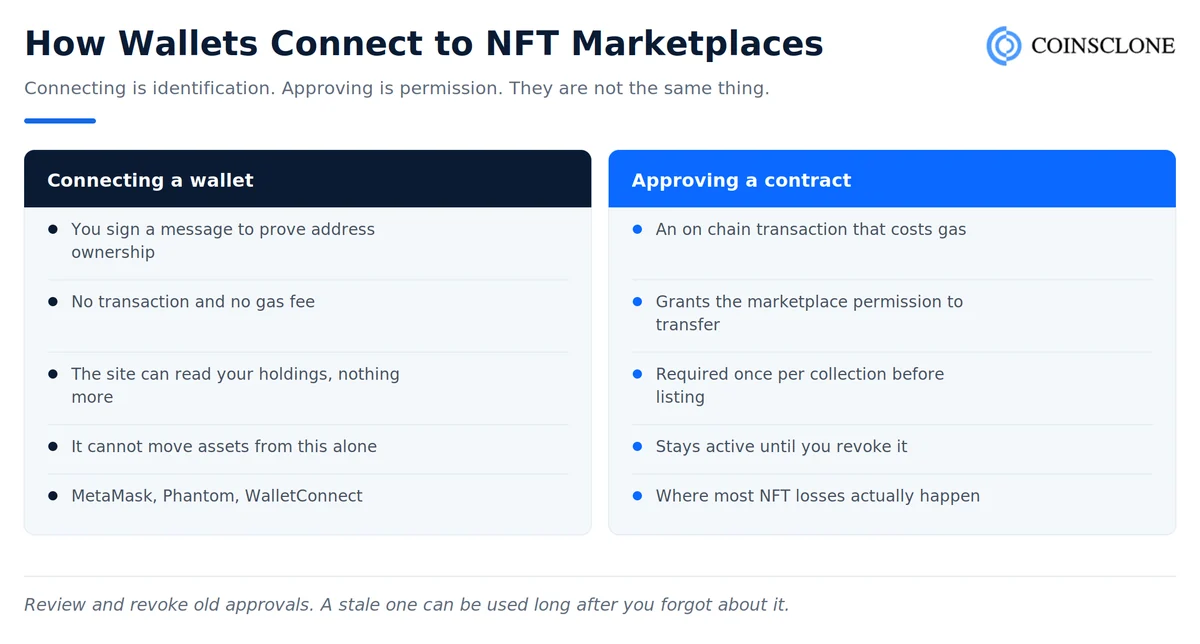
A wallet connects to a marketplace by signing a message that proves you control an address, which costs nothing and grants no ability to move assets. Approving a contract is a separate, on-chain action that does grant that ability, and the distinction is where most NFT losses originate.
- Connecting is off-chain, free, and read-only. The site can see what your address holds and nothing more.
- Approving is an on-chain transaction that lets the marketplace contract transfer tokens from that collection when a sale executes.
- Approvals persist until revoked, so old ones from platforms you no longer use are worth reviewing periodically.
- MetaMask and WalletConnect cover most EVM marketplaces, while Phantom and Backpack cover Solana.
How Do NFT Marketplaces Ensure Authenticity and Ownership?
Ownership is proven by the blockchain rather than by the marketplace, because the token’s transfer history is public and cannot be edited. Authenticity is a different problem, and marketplaces solve it with verification badges, contract-level checks and moderation.
- The chain proves who holds a token and every address it has passed through, which no platform can alter.
- It does not prove that the artwork was made by the person who minted it, which is why verified collection badges exist.
- Always open a collection from inside the marketplace and check the contract address, because copied collections are the most common scam.
How Do NFT Marketplaces Handle Secondary Sales and Royalties?
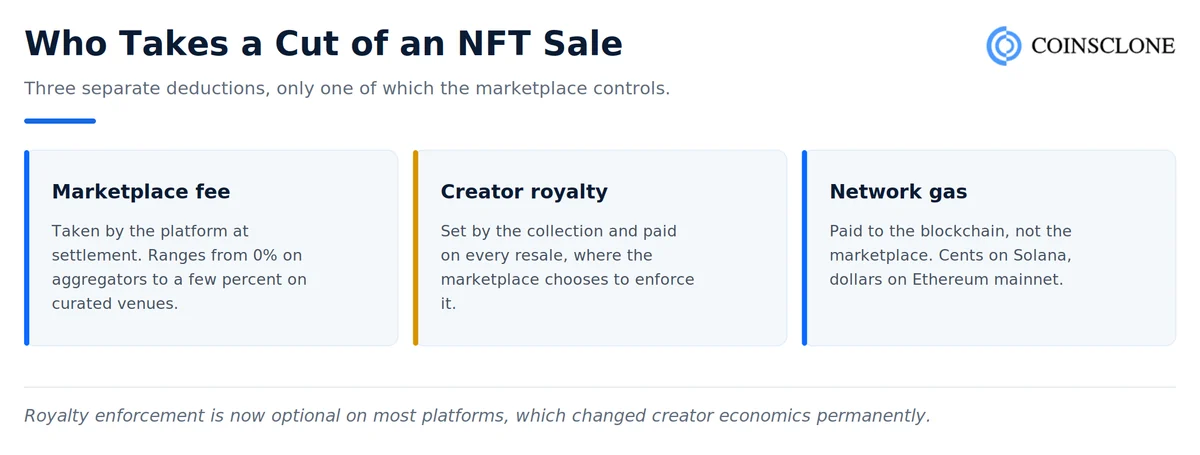
Secondary sales run through the same contract flow as a first sale, with the marketplace fee and any creator royalty deducted at settlement. The significant change in recent years is that royalty enforcement became optional on most major platforms.
- A creator royalty is set at the collection level and is only paid where the marketplace chooses to enforce it.
- Some platforms cap royalties, some make them buyer-optional, and curated art venues generally still enforce them fully.
- For creators this means the venue you list on now materially affects long-term income, not just first-sale reach.
What NFT Marketplaces Are Not
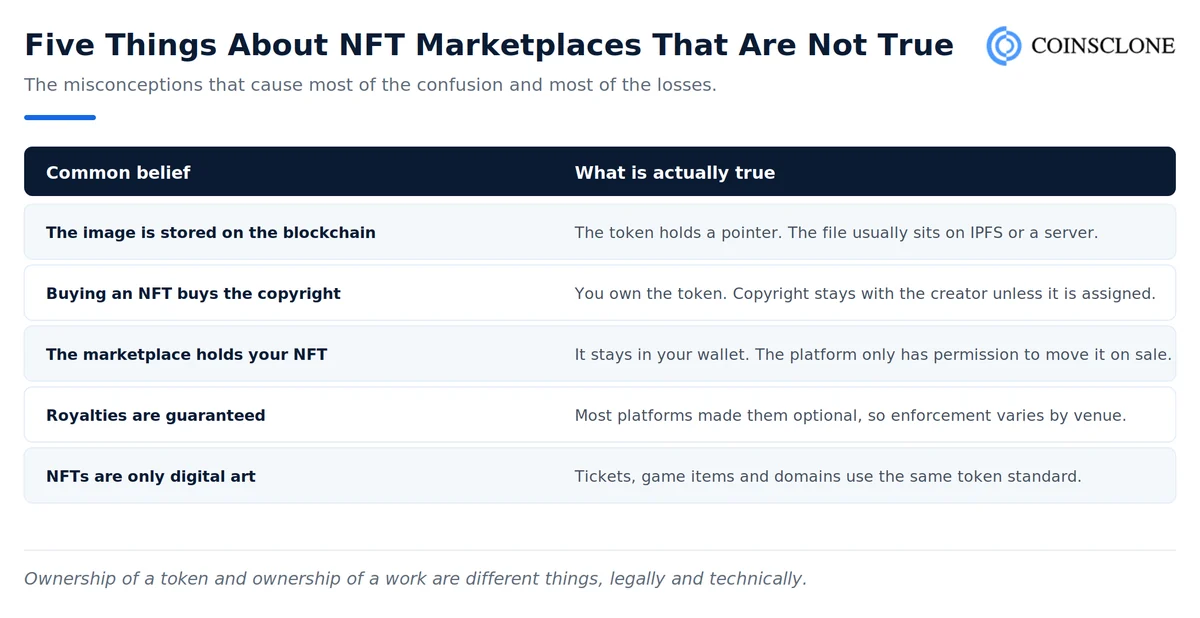
Several widely held beliefs about these platforms are simply wrong, and they cause both confusion and real losses. The most important is that the marketplace does not hold your NFT.
- The image is not on the blockchain. The token holds a pointer, and the file usually lives on IPFS or a server.
- Buying an NFT does not buy the copyright. You own the token, and the rights stay with the creator unless assigned.
- The marketplace does not custody your asset. It holds permission to transfer, which is why revoking approvals matters.
- Royalties are not guaranteed. Enforcement varies by platform.
- NFTs are not only art. Tickets, game items, domain names and tokenised physical goods use the same standard.
Key Features of an NFT Marketplace
The features that actually determine whether a marketplace works are wallet integration, minting tools, listing formats, search and filtering, royalty logic, and a reliable indexer. Everything else is a preference.
- Wallet integration across the wallets your target chain actually uses.
- Minting with configurable metadata, editions and royalty settings.
- Listing formats covering fixed price, timed auction and collection-wide offers.
- Search, filters and rarity data, which is how buyers navigate large collections.
- Indexing and analytics for floor price, volume and holder history.
- Moderation and verification to handle stolen work and impersonated collections.
NFT Marketplaces for Beginners
For a first purchase, use a large marketplace on the chain your target collection lives on, verify the contract before buying, and start with an amount you would be comfortable losing. The technical risk is low and the human risk is high.
- OpenSea covers the widest range of chains and collections, and Magic Eden covers Solana and Bitcoin Ordinals.
- Never mint or buy from a link sent to you. Navigate to the collection from inside the marketplace.
- Budget for gas on top of the price, and check whether the chain you are on makes that a rounding error or a real cost.
Building an NFT Marketplace
A marketplace build is a smart contract layer, an indexer, a wallet integration layer, a storefront and an admin console. The contracts are the smallest part of the work and the indexer is usually the largest.
- Contracts: minting, listing, escrow, transfer and royalty logic, audited before launch.
- Indexer: the service that keeps displayed state in sync with chain state, which determines whether the product feels reliable.
- Storefront and admin: browsing, search, rarity, moderation tools, fee configuration and reporting.
- Chain choice: decided by where your target collections and buyers already are, not by technical preference.
Frequently Asked Questions
What is an NFT marketplace in simple terms?
A website where people list non-fungible tokens for sale and buyers purchase them, with the swap of payment for token executed by a smart contract rather than by the site itself.
How does an NFT marketplace make money?
Mainly a percentage fee on each sale, and sometimes listing fees, launchpad allocations or premium tooling. Aggregators often charge nothing and monetise elsewhere.
Do I need a crypto wallet to use an NFT marketplace?
Yes. The wallet is your identity and your account, and it holds the assets. There is no password-based account holding a balance on your behalf.
Is the NFT stored in the marketplace?
No. The token stays in your wallet and the media file usually sits on IPFS or a server. The marketplace displays both.
What is the difference between an NFT marketplace and a crypto exchange?
An exchange trades fungible assets where one unit equals another. A marketplace trades unique items, so each listing has its own price and there is no single order book price.
Can anyone create an NFT marketplace?
Technically yes, and the contracts are well understood. The difficult parts are liquidity, verification and moderation, which is what separates a working marketplace from an empty one.
Understand What an NFT Marketplace Is and How It Works Today
What is an NFT Marketplace — discover features and working process clearly.
- Easy Asset Listing: Creators mint and list NFTs with fixed or auction pricing.
- Seamless Wallet Integration: Buyers connect wallets to browse, bid, and purchase.
- Robust Admin Controls: Manage users, content, fees, and blockchain interactions.
- Essential Features: Includes search filters, royalties, security, and notifications.
See a free branded demo of your NFT marketplace in 48 hours — before you invest a cent.
Book a Free Demo to discover how What is NFT Marketplace can help you launch in just 8–12 weeks.
Build Your NFT Marketplace with Coinsclone
Coinsclone builds NFT marketplaces for founders targeting a specific chain, asset class or community rather than another general platform. Our work covers audited smart contracts, the indexing layer that keeps displayed data accurate, wallet integration, minting and listing flows, royalty logic, and the moderation and admin tooling a live marketplace needs.
We start from a live demo rather than a specification document. Talk to our team about the chain and community you are targeting, and we will map the fastest route to launch.