
The best OpenSea alternatives in October 2026 are Magic Eden and Tensor for Solana, and Element and LooksRare for Ethereum trading. For Bitcoin Ordinals, use OKX NFT. For art, pick SuperRare or Objkt, and for real trading cards, Courtyard. Blur, long the top pick, closes its website on 12 November 2026, so it is no longer on our list.
This guide lists the 10 best OpenSea alternatives that are still live. For each one, you get the chain it runs on, what it charges and who it suits best. We checked each fee on the platform’s own help pages or docs, so you can compare them with OpenSea’s 1% sale fee. That check matters more than ever. Since 2024, Binance NFT, Kraken NFT, Nifty Gateway, Foundation and Mintable have all closed, and Magic Eden left each chain but Solana. Many lists online still send you to these dead sites.
In this guide:
- The 10 best OpenSea alternatives, with a side by side table of fees and chains
- What Blur’s shutdown means for you, and where Ethereum traders can go next
- What a $1,000 sale costs you on each platform
- Which well-known NFT sites have shut down, and when
- A simple way to pick the right one, and how to switch without risk
Explore Top OpenSea Alternatives for Your NFT Marketplace Launch
OpenSea Alternatives — Discover the Best Platforms and Clone Solutions.
- Diverse Marketplaces: Platforms with lower fees and a unique niche focus.
- Multi-Chain Support: Trade NFTs across various blockchains seamlessly.
- Ready Clone Scripts: Launch customized marketplaces quickly and affordably.
- Expert Support: End-to-end assistance for deployment and customization.
See a free branded demo of your NFT marketplace in 48 hours — before you invest a cent.
Book a Free Demo to discover how OpenSea Alternatives can help you launch in just 8–12 weeks.
10 Best OpenSea Alternatives in 2026
Looking for OpenSea alternatives doesn’t mean that OpenSea isn’t a good place to trade. It is still the biggest one by all-time sales, and it now trades tokens as well as NFTs. But its competitors can be cheaper, faster or a better fit for your chain or your art. So here is the list of the top 10 NFT marketplace alternatives to OpenSea:
- Magic Eden: the largest NFT marketplace on Solana
- Tensor: a pro trading site for Solana NFTs
- OKX NFT: a multi-chain market inside OKX Wallet that still lists Bitcoin Ordinals
- Rarible: a market on many chains that now also sells graded cards
- SuperRare: a hand-picked home for one-of-a-kind art
- LooksRare: an Ethereum marketplace that shares its fees with stakers
- Element: a low-fee marketplace across many EVM chains
- Objkt: the main art marketplace on Tezos
- Courtyard: a market for real trading cards held as NFTs
- SolSea: an open Solana marketplace with built-in licences
OpenSea Alternatives Compared
The table below sets all 10 side by side. “Fee” is the platform’s own cut when an NFT sells again. Creator royalties and network gas come on top.
| Platform | Main chains | Platform fee on a resale | Royalties | Best for |
| OpenSea (for reference) | Ethereum, Base, Solana and 20+ more | 1% (0.5% on token swaps) | Enforced on newer contracts | The widest choice of NFTs |
| Magic Eden | Solana | 2% | Buyer chooses | Solana collections |
| Tensor | Solana | 2% taker, 0% maker | Paid by buyer | Active Solana traders |
| OKX NFT | Bitcoin, Ethereum, Solana, Base, Polygon and more | 0.5% on BRC-20; NFT fee shown at checkout | Set by the creator | Bitcoin Ordinals and OKX Wallet users |
| Rarible | Ethereum, Base, Polygon, Solana and more | 2% (1.5% on Solana) | Set by the creator | Many chains and trading cards |
| SuperRare | Ethereum | 3% buyer fee, 15% on first sales | 10% to the artist | Curated 1/1 art |
| LooksRare | Ethereum | 0.5% | Buyer chooses | Earning from fees |
| Element | Ethereum, BNB, Base, Arbitrum and more | 0.5% on Ethereum, 2% on most others | Set by the creator | Trading on many EVM chains |
| Objkt | Tezos | 5% | Set by the artist | Low-cost art |
| Courtyard | Polygon | 0% | Not applicable | Real trading cards |
| SolSea | Solana | 2%, or 0% if you stake AART | Set by the creator | Licensed Solana NFTs |
1. Magic Eden
Magic Eden is the largest NFT marketplace on Solana. For a while it also ran Bitcoin Ordinals and EVM markets. But on 27 February 2026 it said it would close them and focus on Solana, which brought in more than 85% of its volume. Trading of non-Solana assets ended on 9 March 2026, and its multi-chain wallet went offline on 1 April.
So, if your NFTs are on Solana, Magic Eden is still the default place to trade. Listing is free, and Magic Eden takes 2% on each sale. Where royalties are not required, buyers can choose to pay full, half or none.
- Chain: Solana only
- Fee: 0% to list, 2% per sale
- Best for: Solana buyers and new project launches
Related: Build a Solana NFT Marketplace like Magic Eden
2. Tensor
Tensor is a Solana NFT marketplace made for active traders. It offers live charts, fast bulk buys and AMM pools that let you place bids at many price points at once. In short, it is the pro trading desk of Solana NFTs.
Its fee model rewards people who list. Per Tensor’s fee docs, the buyer pays a 2% taker fee, and the seller with a resting listing pays 0%. The buyer always pays royalties, and they are forced on sets that use pNFTs, a newer Solana NFT type. For more Solana options, see our list of the best Solana NFT marketplaces.
- Chain: Solana
- Fee: 2% taker, 0% maker
- Best for: Solana traders who want pro tools
3. OKX NFT
OKX NFT is the NFT market built into OKX Wallet, the self-custody wallet from the OKX exchange group. From one page, you can trade on Bitcoin, Ethereum, Solana, Base, Polygon, Arbitrum, BNB Chain, Linea, X Layer and more. Since Magic Eden dropped Bitcoin in March 2026, it is one of the few large sites that still lists Bitcoin Ordinals and BRC-20 tokens.
Until recently, it charged no trading fee. That changed on 22 September 2026, when OKX added trading fees to its NFT market. BRC-20 trades now cost 0.5%, paid by the person who fills an order, with a minimum of 546 satoshis. On other chains, the fee and who pays it are shown on the trade page, so check the total before you confirm.
- Chains: Bitcoin, Ethereum, Solana, Base, Polygon and many more
- Fee: 0.5% on BRC-20 (taker pays); NFT fees shown at checkout
- Best for: Ordinals holders and people who already use OKX Wallet
4. Rarible
Rarible is one of the oldest NFT markets that work across many chains. It offers a wide range of NFTs like music, digital art, game items and photos, where users can trade, create and hold their NFTs. Its “community market” builder also lets a brand or project spin up its own branded store.
In 2026, the Web3 firm IMPOSSIBLE bought the Rarible brand. The new Rarible keeps the NFT market and adds graded trading cards held as tokens, such as Pokémon and sports cards. On fees, Rarible’s FAQ now lists a 2% seller fee on Ethereum, Base and Polygon, and 1.5% on Solana. The old 0.5% to 7.5% sliding scale you may see in other guides is gone.
- Chains: Ethereum, Base, Polygon, Solana and many more
- Fee: 2% (1.5% on Solana)
- Best for: creators who want many chains, and card collectors
Also Read : A Complete Comparison between ~ OpenSea Vs Rarible
5. SuperRare
SuperRare is the best alternative to OpenSea when it comes to NFT art. It focuses on one-of-a-kind art, and artists must apply and be accepted before they can list. Built on Ethereum, it is home to many well-known digital artists.
Its fees are higher, but they flow to artists. SuperRare takes 15% of the first sale, and buyers pay a 3% fee on each purchase. The artist then earns 10% each time the work sells again. Compared with the 25% to 50% cut a physical gallery often takes, many artists see that as fair.
- Chain: Ethereum
- Fee: 15% on first sales, 3% buyer fee on all sales
- Best for: top art buyers and well-known artists
Related: Launch a Curated Art Marketplace like SuperRare
6. LooksRare
LooksRare was built with the motto “By NFT people, For NFT people” and is still well known for putting its community first. It is an Ethereum market that pays its fees out to users. LooksRare’s docs state a fixed 0.5% fee on each public sale, and all of it goes to people who stake its LOOKS token.
LooksRare also offers a “Collection Offer” feature, where you can bid on any item in a whole set. With its multi-cancel tool, you can also cancel many listings at once. Volume is far lower than in 2022, so check how many buyers a collection has before you list.
- Chain: Ethereum
- Fee: 0.5% per sale (cut from 2% in April 2023)
- Best for: traders who also want to earn from staking
Related : Create an NFT Marketplace Like LooksRare Easily!
7. Element
Element is an NFT market that covers more EVM chains than most. You can trade on Ethereum, BNB Chain, Base, Arbitrum, Polygon, Linea and many other chains from one place. It also pulls in listings from other markets, which helps on chains with thin trading.
Its fees depend on the chain. Element’s fee table shows 0.5% on Ethereum, 2% on most other chains and 1% on Bitcoin. With Blur’s site closing, that makes Element, along with LooksRare, one of the cheapest places to trade Ethereum NFTs.
- Chains: Ethereum, BNB Chain, Base, Arbitrum, Polygon and more
- Fee: 0.5% on Ethereum, 2% on most others
- Best for: Ethereum flippers and traders on smaller EVM chains
8. Objkt
Objkt is the largest NFT art marketplace on Tezos. Tezos has very low network fees, so artists can mint and sell work for a fraction of the cost of Ethereum. That has made Objkt a home for generative art, photos and new artists testing the market.
According to Objkt’s fee page, the site takes a 5% fee on each sale, paid by the seller. Sales that go through other Tezos contracts, such as Teia, carry no extra Objkt fee.
- Chain: Tezos
- Fee: 5% per sale, paid by the seller
- Best for: artists who want low minting costs
9. Courtyard
Courtyard is a marketplace for real trading cards held as NFTs. You send in a graded card, such as a Pokémon or sports card, and it is stored in an insured vault in the US. Then a matching NFT on Polygon lets you trade it in seconds, or ship the real card home at any time.
It is now one of the busiest NFT markets. DefiLlama shows about $47 million in fees over the past 12 months (as of 26 October 2026), mostly from card pack sales. On the market itself, Courtyard charges 0% to list and sell when you pay from a crypto wallet, while card payments carry a small fee.
- Chain: Polygon
- Fee: 0% marketplace fee; card payments cost extra, and shipping is billed when you take a card home
- Best for: collectors of real, graded cards
10. SolSea
SolSea is an open Solana marketplace best known for letting creators choose and embed licences in their NFTs. Creators can upload, mint and list work without approval, and add unlockable content for buyers. It works with common Solana wallets such as Phantom and Solflare.
SolSea charges a 2% fee per sale. If you stake AART tokens on its fee reduction page, that fee falls step by step and reaches 0% at 100,000 AART. SolSea is smaller than Magic Eden or Tensor, so it suits creators who care about licences more than fast resale.
- Chain: Solana
- Fee: 2%, down to 0% with AART staking
- Best for: creators who want clear usage rights
Related: How to start a NFT Marketplace like Solsea
The above listed are the platforms one can look at when weighing the best options. Each one shares the basics with OpenSea, but each stands out for its chain, its fees or its audience.
Is Blur Still an OpenSea Alternative?
No. Blur said on 12 October 2026 that it will close its blur.io website on 12 November 2026, so it has left our list. For a time it was the top OpenSea rival on Ethereum, thanks to its 0% trading fee and pro tools.
The smart contracts behind Blur stay live onchain, and BLUR holders keep control of the fee switch. But the website, with its listings, bids and charts, goes away. Blend, Blur’s NFT lending tool, also stops matching new loans on 12 November. The reason is plain: per CoinDesk, Blur’s monthly volume fell from about $1.43 billion in March 2023 to under $7 million by March 2026. Its sister chain, Blast, announced its own shutdown on 2 October, with withdrawals open until 26 October.
If you used Blur, act before 12 November:
- Withdraw your ETH: move any ETH left in Blur’s bid pool back to your wallet.
- Cancel open listings and bids: this stops old prices from being filled later.
- Settle Blend loans: repay them, or the NFT you put up can be lost to default.
- Revoke approvals: remove Blur’s right to move your NFTs once you are done.
Then pick a new home. On Ethereum, Element and LooksRare take 0.5%, and OpenSea takes 1%. Blur’s model still holds lessons for builders, such as pulling in listings from many markets. You can study it in our guide to a Blur-style NFT marketplace clone script, or read our NFT aggregator marketplace guide.
Why Look for an OpenSea Alternative in 2026?
OpenSea is still the largest NFT site by all-time volume. Yet there are good reasons to look elsewhere. Here are the main ones:
- Fees: OpenSea raised its NFT sale fee to 1% in September 2025, and it takes 10% of primary drop mints. Courtyard, LooksRare and Element can be cheaper.
- Chain focus: OpenSea only added Solana NFT trading at the end of August 2026. Solana traders still find more depth on Magic Eden and Tensor.
- Artist income: if you are an artist, SuperRare and Objkt protect your income from later sales better than open markets.
- Niche focus: curated art, real trading cards, Bitcoin Ordinals and licensed content each have a home built for them.
- The token question: OpenSea’s SEA token, first set for March 2026, was delayed and still has no new date as of October 2026. Some traders prefer sites whose rewards are live today.
The market is also much smaller than in 2021. NFT sales fell to about $5.63 billion in 2025, down 37% from 2024, per CryptoSlam data. In a thin market, fees and the number of active buyers matter more than brand names.
Which OpenSea Alternative Has the Lowest Fees?
Courtyard has the lowest fee: 0% to list and sell when you pay from a crypto wallet. On Ethereum, Element and LooksRare charge 0.5%, half of OpenSea’s 1%. On Solana, Tensor charges sellers 0% on resting listings, but the buyer pays 2%.
Fees look small as a share of the price, but they add up on each trade. Here is the platform’s cut when an NFT sells again for $1,000. Royalties and gas are left out, since they depend on the NFT and the chain.
| Platform | Platform fee on a $1,000 resale |
| Courtyard | $0 (wallet payment) |
| Tensor | $0 to a resting seller; the buyer pays $20 |
| Element (Ethereum) or LooksRare | $5 |
| OpenSea | $10 |
| Rarible | $20 ($15 on Solana) |
| Magic Eden or SolSea | $20 (SolSea is $0 with 100,000 AART staked) |
| SuperRare | $30, paid by the buyer |
| Objkt | $50 |
So the cheapest option depends on your chain. On Ethereum, Element and LooksRare cost the least now that Blur is closing. On Solana, most sites sit near $20, although Tensor charges the buyer rather than you.
Is There an OpenSea Alternative With No Gas Fee?
No marketplace removes network fees completely, but you can get close. On Ethereum sites, a listing is often just a free signature. You only pay gas once per collection, for the approval that lets the site move your NFTs. When someone buys at your listed price, the buyer pays the gas.
To cut gas further, trade on a cheaper chain. Fees on Solana, Polygon, Base and Tezos are usually well under one cent per trade. That is why low-cost art lives on Objkt and Courtyard runs on Polygon.
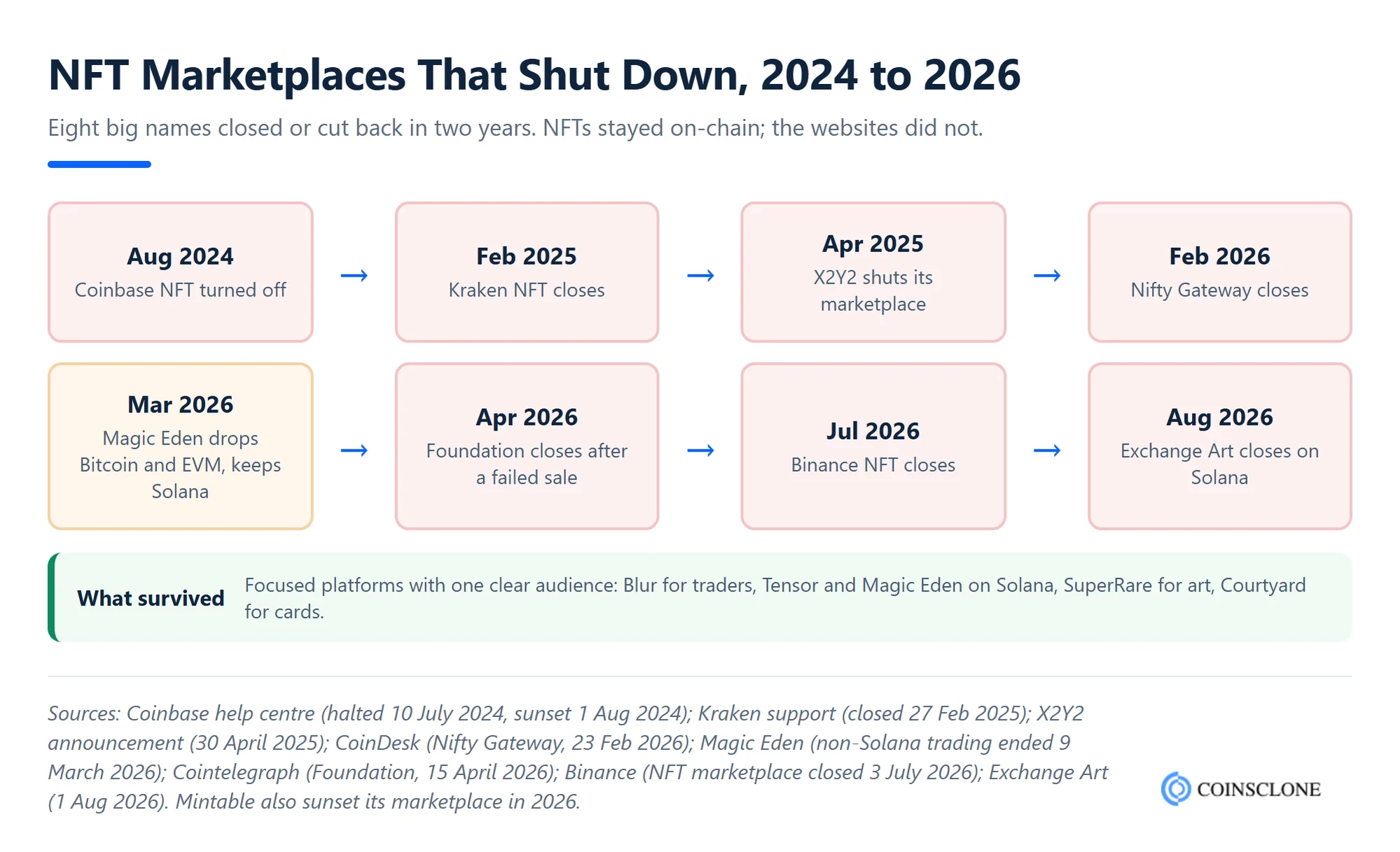
Which OpenSea Alternatives Have Shut Down?
Many lists of OpenSea alternatives, our own first version too, named sites that no longer exist. The NFT slump since 2022 has closed one big name after the next. Here are the ones you are most likely to see in old guides:
- Blur: the blur.io website closes on 12 November 2026, as covered above. Its contracts stay onchain.
- Binance NFT: closed on 3 July 2026. Users had to move NFTs to Binance Wallet or another wallet before the deadline.
- Nifty Gateway: Gemini’s drop site froze trading on 24 Jan 2026 and shut down on 23 Feb 2026.
- Foundation: the invite-only art market closed for good in April 2026 after a planned sale to Blackdove fell apart.
- Kraken NFT: closed on 27 February 2025, three months after it stopped new trades.
- Mintable: the gasless minting pioneer, live since 2018, sunset its marketplace in 2026.
What Happens to Your NFTs When a Marketplace Closes?
Your NFTs stay in your wallet, because they live on the blockchain, not on the website. When a market closes, you can list them on any live platform that supports the chain. The real risk is NFTs held inside an exchange account, as on Binance NFT or Kraken NFT. Those had to be withdrawn before the deadline. Funds left in a site’s own tools, such as Blur’s bid pool or Blend loans, also need action before the site goes dark.
These closures hold lessons for builders. The ideas behind them can still work for a focused team, such as hand-picked art or a market tied to an exchange. You can study them in our guides to a Foundation-style NFT Marketplace and Binance NFT Marketplace clone.
Which NFT Marketplace is the Best OpenSea Alternative?
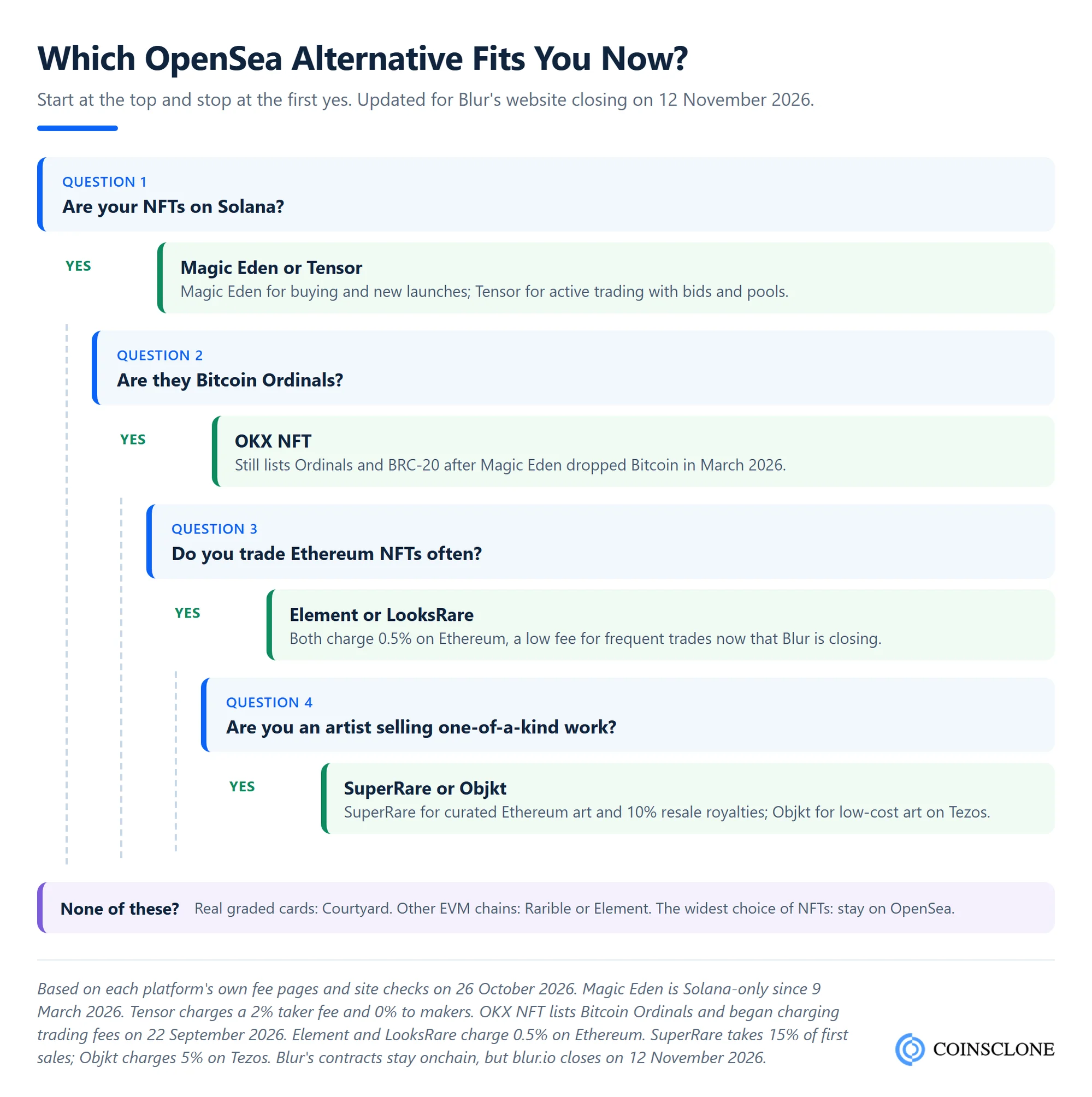
Magic Eden for Solana, Element for Ethereum trading and SuperRare for art.
Out of all the best OpenSea alternatives, these three stand out, because each one is the strongest live pick in its own group. However, the right choice depends on what you want to do.
Start with your chain, since an NFT can only trade where its chain is supported. Then think about your goal. Traders care about fees and speed. Artists care about royalties and the right audience. Buyers of rare items care about trust and the price they can sell for later. The decision tree below walks through these choices.
For a wider view that also covers OpenSea itself, see our ranking of the best NFT marketplaces in 2026. No matter which special features these platforms have, picking one that fits your needs is the best plan.
How to Switch From OpenSea Safely
You do not need to leave OpenSea to use an alternative. Since your NFTs sit in your own wallet, you can list the same item on several sites at once. Here is how to do it safely:
- Connect the same wallet: sign in to the new site with the wallet that holds your NFTs. There is nothing to transfer.
- Check the chain: make sure the site supports the chain your NFT lives on. A Polygon NFT will not show up on a Solana-only site.
- Watch your prices: if you list on two sites, keep the prices in line. A sale on one site cancels the other listing, but an old low price can still get filled first.
- Review your approvals: each site asks for the right to move your NFTs. Use a tool such as Revoke.cash to remove approvals for sites you no longer use, especially closed ones like X2Y2 and, after 12 November, Blur.
- Use the official link: fake marketplace sites copy real ones to steal NFTs. Type the address yourself or use a saved bookmark.
Which Wallet Do You Need for Each Alternative?
The wallet depends on the chain, not the site. Any Ethereum wallet, such as MetaMask or Rabby, works on the Ethereum sites in this list. For Magic Eden, Tensor and SolSea, use a Solana wallet such as Phantom or Solflare. Objkt needs a Tezos wallet such as Temple or Kukai. OKX NFT is built for OKX Wallet, and Courtyard lets you pay by card if you do not want to set up a wallet.
After seeing how many new markets keep appearing, many founders want to build their own NFT marketplace. No worries. There are many NFT build teams to guide you on this journey.
People say Coinsclone is one of the best, with advanced Web3 clone script solutions, free demos, and expert help for founders who want to build new NFT and Web3 platforms.
Creating a whole NFT marketplace that fits your needs might sound hard. But don’t sweat about it. In the next section, we will discuss the best ways to create your own NFT marketplace like OpenSea.
Best Way to Build Your Own OpenSea Alternative
The best way to create an NFT marketplace like OpenSea is to use white label software or a clone script. A clone script copies the proven flows of a live market, such as OpenSea, Magic Eden or Tensor. White label software is a ready-made, tested base you brand and adjust to your needs. Both let you launch within weeks at a lower cost than a build from scratch.
The lesson from 2026 is to go niche. Blur’s closing shows that a 0% fee alone cannot hold traders. The marketplaces still growing, like Courtyard, Tensor and SuperRare, each serve one clear audience. So pick your chain, your audience and your fee model first, and then choose the build route. A white label market can go live in about 4 to 6 weeks, while a standard build with your own changes takes about 9 to 13 weeks. For a full walkthrough, read our guide on how to create an NFT marketplace like OpenSea.
To start, talk to a skilled NFT build team. With the right team, the hard parts like smart contracts, royalties, wallets and support for many chains are already solved.
Create OpenSea-like NFT Marketplace with Coinsclone
Coinsclone is a leading NFT Marketplace development company with a skilled blockchain team. We have been building blockchain products since 2018, and we have delivered 350+ platforms for 200+ clients across 20 industries. With our ready-made OpenSea clone script or white label software, you can launch a site with OpenSea’s core features. Then you add your own chains, fees and royalty rules.
We shape each build to fit your needs, whether you want a Solana trading site, a hand-picked art market or a store for real cards. All you have to do now is book a call with us while you wait for your coffee. Our team will get in touch with you in no time.
Frequently Asked Questions
Is there an alternative to the OpenSea platform?
Yes, there are many. The strongest live picks in 2026 are Magic Eden or Tensor for Solana, and Element or LooksRare for Ethereum trading. For art, try SuperRare or Objkt. OKX NFT covers Bitcoin Ordinals, Rarible covers many chains, and Courtyard sells real trading cards. Each has its own fees and audience.
What is the best alternative to OpenSea?
It depends on your chain. On Solana, Magic Eden is the main choice, and Tensor suits active traders. On Ethereum, Element and LooksRare charge 0.5%, half of OpenSea’s fee, now that Blur is closing. For curated art, SuperRare is the leader.
Is Blur shutting down?
Yes. Blur will close its blur.io website on 12 November 2026, and Blend will stop matching new loans that day. Its contracts stay onchain, but most users will lose the tools they used to trade. Withdraw your ETH, cancel open bids and settle any loans before then.
Is OpenSea still the best NFT marketplace?
OpenSea is still the largest NFT marketplace by all-time sales and has the widest range of NFTs and chains. Its 1% sale fee is low, and its app now trades tokens too. But it is not the cheapest. Courtyard charges 0%, Element and LooksRare charge 0.5% on Ethereum, and Magic Eden and Tensor have more Solana depth.
Which is better: OpenSea or Rarible?
It depends on your needs. OpenSea has far more buyers and a lower 1% seller fee. Rarible charges 2% on most EVM chains but offers a builder for branded stores and, since 2026, graded trading cards. If you want the most buyers, choose OpenSea.
Is Magic Eden better than OpenSea?
For Solana NFTs, often yes. Magic Eden has focused only on Solana since March 2026 and has deeper Solana trading, though it charges 2% against OpenSea’s 1%. For any other chain, OpenSea is the better choice, since Magic Eden no longer supports it.
Which NFT platform is best for beginners?
OpenSea is still the easiest place for beginners, thanks to its simple layout and wide choice. Courtyard is also easy, since you can pay by card and buy real trading cards you can ship home. Beginners should avoid pro tools like Tensor until they know how bids and floors work.
Which OpenSea alternative has the lowest fees?
Courtyard charges a 0% marketplace fee when you pay from a wallet. Element and LooksRare charge 0.5% on Ethereum, and Tensor charges sellers 0% on resting listings. Remember that creator royalties and network gas are added on top, so check the full cost at checkout.
Where should I list my first NFT drop: OpenSea, Magic Eden or Rarible?
Choose by chain first. If you mint on Solana, Magic Eden is the natural home. If you mint on an EVM chain, OpenSea has the most buyers, and Rarible works too. In most cases, a normal mint shows up on every major marketplace for that chain, so you are not locked to one site.
Which NFT marketplace gets the most views for a new collection?
OpenSea still has the widest audience, so it is the safest place to be seen. Yet views on any marketplace mostly follow your own community. Collections that sell usually bring buyers from X, Discord or a mailing list. So treat the marketplace as the checkout, not the place where fans find you.
Can I list my NFTs on more than one marketplace?
Yes. Your NFTs stay in your wallet, so you can list the same item on OpenSea, Element, Magic Eden or any site that supports its chain. When it sells on one site, the other listings can no longer be filled. Keep your prices in line to avoid a sale at an old price.
Do OpenSea alternatives make buyers pay royalties?
Some do. SuperRare pays artists a fixed 10% each time a work sells again. Tensor forces royalties on pNFTs, a type of Solana NFT. Magic Eden and LooksRare let buyers choose. On OpenSea, royalties are enforced on newer contracts that support it.
How much does it cost to build an OpenSea alternative?
A white label NFT marketplace costs about $10,000 to $30,000, based on published 2026 market ranges. A custom MVP costs about $20,000 to $45,000, and a mid-tier build with auctions and royalties about $40,000 to $80,000. A custom enterprise platform starts at about $80,000 to $150,000 or more. Our NFT marketplace development cost guide breaks down each tier.
Other Related Articles,
How to Create NFT Marketplace like OpenSea?
An Exclusive Comparison for Startups – OpenSea Vs Blur
Explore Top OpenSea Alternatives for Your NFT Marketplace Launch
OpenSea Alternatives — Discover the Best Platforms and Clone Solutions.
- Diverse Marketplaces: Platforms with lower fees and a unique niche focus.
- Multi-Chain Support: Trade NFTs across various blockchains seamlessly.
- Ready Clone Scripts: Launch customized marketplaces quickly and affordably.
- Expert Support: End-to-end assistance for deployment and customization.
See a free branded demo of your NFT marketplace in 48 hours — before you invest a cent.
Book a Free Demo to discover how OpenSea Alternatives can help you launch in just 8–12 weeks.