
To create an NFT marketplace like OpenSea, pick a niche and a chain, build or license audited trading contracts, add wallets and minting tools, then test and launch with your first creators lined up. A white label OpenSea clone script costs about $10,000 to $30,000 and can go live in 4 to 6 weeks, while a custom build costs about $20,000 to $150,000 or more.
This guide walks you through each of those steps, from the first plan to launch day. You will see how the platform works under the hood, the four ways to build your own version, and what each route costs in time and money. Along the way, we explain how OpenSea earns money today, so you can set fees that work for your own site.
The NFT market is smaller and more focused than it was in 2021. Sales reached $5.63 billion in 2025, down 37% from 2024, and OpenSea itself now trades tokens as well as NFTs. So the right plan is not a straight copy of the 2021 site. Instead, it takes the proven parts and adds a sharper niche. By the end, you will know which parts to copy, which to change, and the fastest way to launch.
In this guide:
- The eight steps to create an NFT marketplace like OpenSea, with the current tools to use
- How OpenSea looks in 2026: its 1% fee, 20+ chains, token trading and what changed since 2021
- How this kind of platform fits together, from smart contracts to search
- Four build routes compared, with Coinsclone’s delivery weeks and market cost ranges
- How to stand out against the market leader, why most new markets fail, and the safety and legal checks to finish before launch
Launch Your Own NFT Marketplace Like OpenSea
Create an NFT Marketplace like OpenSea — designed for collectors, creators, and entrepreneurs.
- Fast Deployment : Build your marketplace quickly using ready-made clone scripts.
- Multi-Blockchain & Wallet Support : Integrates Ethereum, BSC, and major crypto wallets.
- Marketplace Features : Minting, auctions, direct sales, and seamless NFT listing.
- Monetization : Earn from trading fees, NFT listings, and premium collections.
See a free branded demo of your NFT marketplace in 48 hours — before you invest a cent.
Book a Free Demo to discover how our Create NFT Marketplace like OpenSea solution can turn your NFT idea into a live, profitable platform in just 8–12 weeks.
How to Create an NFT Marketplace Like OpenSea
To create an NFT marketplace like OpenSea, you need eight things in order: a clear niche, the right blockchains, a simple design, smart contracts, wallet support, minting tools, testing and a launch plan. Each step builds on the one before it, so skipping one tends to cost you time later. Here is the full process, whether you build from scratch or start with a ready-made OpenSea clone script.
Step 1: Pick Your Niche and Business Model
OpenSea is an open, “sell anything” market where almost any NFT on its chains can be listed. Copying that broad model head-on is hard, because buyers go there out of habit. So first decide who your platform serves, such as game items, music, tickets, graded cards or tokenized real-world assets.
Then choose your model:
- Open market: Anyone can mint and list, like OpenSea. You grow faster, but you need strong spam and fraud filters.
- Curated market: Only approved creators can list. Growth is slower, but quality and prices tend to be higher.
- Hybrid: Open listings plus a curated “featured drops” area, which is how the Drops page works on OpenSea.
Step 2: Choose the Blockchains
OpenSea started on Ethereum and now supports more than 20 chains, such as Base, Polygon and Solana. You do not need that many on day one. Start where your target users hold their NFTs and wallets today.
- Ethereum: The top NFT sets and the deepest buyer pool, but higher gas fees.
- Base and Polygon: Cheap, fast and able to run the same tools as Ethereum.
- Solana: Very low fees and fast trading, with its own wallets and token standards.
Picking EVM chains first has a big plus. The same smart contracts and tools work across all of them, so adding a chain later is quick.
Step 3: Design a Simple, Clear Layout
Good design is what made OpenSea feel easy for first-time buyers. Your design team should map each screen before any code is written: the home page, collection pages, item pages, the profile, the listing flow and checkout.
Keep the parts users know from OpenSea, like the item grid, price chart and “Make offer” button. Then add the touches that suit your niche. For instance, a ticket site needs event dates and seat maps, while a gaming one needs item stats.
Step 4: Build and Audit the Smart Contracts
The smart contracts run each trade, so they are the heart of the platform. OpenSea settles its sales through Seaport, a free, open-source trading engine under the MIT licence. Seaport sits at the same address on Ethereum, Base, Polygon and other EVM chains.
You can use Seaport as it is, extend it, or write your own exchange contract. Either way, your contracts must handle:
- Listings and offers: Fixed prices, offers on a single item and offers on a whole set.
- Auctions: Timed English auctions and Dutch auctions where the price drops.
- Fees and royalties: Your fee and the creator’s cut, split in the same step as the sale.
- Token standards: ERC-721 for single items and ERC-1155 for multi-copy items and game items.
Each contract that holds or moves user funds needs an outside security audit before launch. If your team has not shipped trading contracts before, our NFT smart contract development services cover the build and the audit prep.
Step 5: Add Wallets and Payments
OpenSea never holds users’ NFTs. Instead, users connect a self-held wallet, sign listings and approve trades. So your site should support the wallets your buyers use, such as MetaMask, Coinbase Wallet, Phantom for Solana and any wallet through WalletConnect.
Card payments matter too. OpenSea lets buyers pay by credit or debit card through MoonPay. Adding an on-ramp like this brings in buyers who do not yet own crypto.
Step 6: Add Minting and Creator Tools
Creators need a simple way to make NFTs without writing code. OpenSea does this through its Studio and Drops tools. Your platform should let creators upload files, add names and traits, set a royalty and publish a set of items.
Lazy minting is a smart extra. With lazy minting, the NFT is only written to the blockchain when someone buys it, so the buyer pays the gas instead of the creator. As a result, more creators list their work, because listing costs them nothing.
Step 7: Build the Back End and Test Everything
Next, your team builds the off-chain parts: the indexer, database, search, user pages and admin panel. Then the whole platform goes through testing.
Run your contracts on public testnets first. Today that means Sepolia for Ethereum and Polygon Amoy for Polygon, since the older Goerli and Mumbai testnets are gone. Test each flow, such as listing, buying, bidding, cancelling, royalty payouts and failed payments. Then load-test the site so it stays fast during a busy drop.
Step 8: Seed Your First Listings, Then Launch
A market is only as good as its buyers and sellers. An empty site on launch day loses visitors fast, so fill it before you open the doors. Line up a group of creators and a few dozen live listings ahead of time, ideally with a first drop that brings their fans with them. After that, list your site on NFT aggregators so their users can see and buy your items.
Finally, plan your growth with care. Low launch fees, creator rewards and a strong social presence all help. The most successful NFT sites all grew around a loyal group of early users.
What Is OpenSea in 2026?
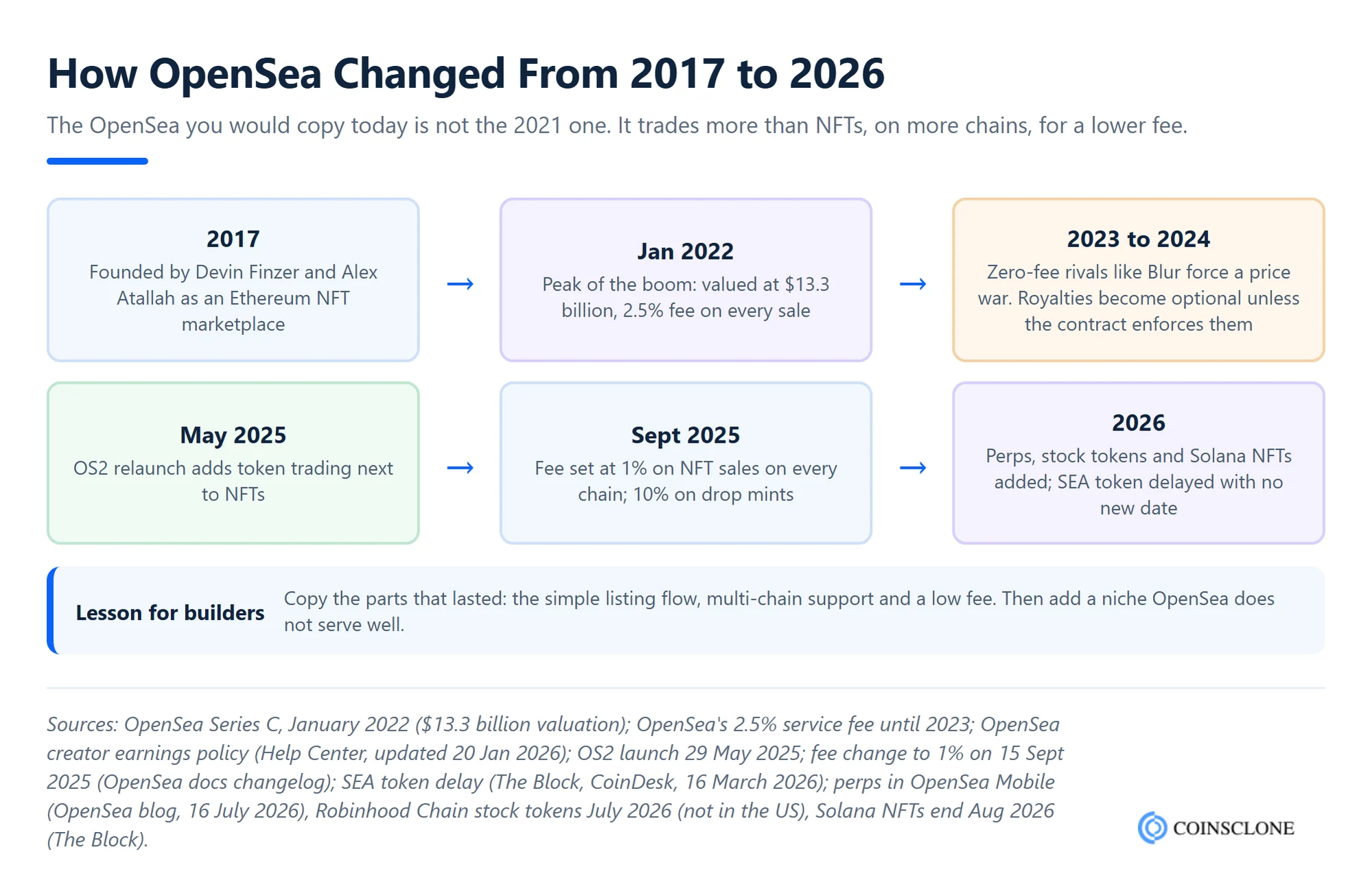
OpenSea is one of the oldest and largest NFT markets. Devin Finzer and Alex Atallah founded it in 2017, and in January 2022, at the peak of the NFT boom, investors valued it at $13.3 billion. Today it is a trading platform on many chains, where users buy and sell NFTs, art, game items and, more and more, crypto tokens.
The platform has changed a lot in the last two years. Here is what OpenSea looks like now:
- OS2 relaunch: In May 2025 the site was rebuilt as OS2, with token trading next to NFTs.
- 1% fee: It charges a 1% fee on NFT sales, 10% on first-sale drop mints and nothing on private listings. The fee rose to 1% in September 2025.
- Creator earnings: Royalties are a choice for buyers on most NFTs. Creators can make them binding with ERC721-C or ERC1155-C contracts, up to a 10% cap.
- More chains: It covers more than 20 chains, and added Solana NFT trading at the end of August 2026.
- Beyond NFTs: In mid-2026 it brought perpetual futures, built on Hyperliquid, to its mobile app. In July 2026 it also added stock tokens on Robinhood Chain, though stock tokens are not offered in the US.
- SEA token: The firm planned to launch its SEA token in early 2026, but it delayed the launch in March 2026 with no new date.
Also Read: A Complete Guide on NFT Marketplace for Startups
Is It Worth Creating an NFT Marketplace Like OpenSea in 2026?
Yes, if you build for a clear niche rather than a general copy. The NFT market is no longer in its 2021 boom, but it still moves real money. NFT sales across all chains reached $5.63 billion in 2025, according to CryptoSlam data. On top of that, OpenSea alone kept about $373,000 in fees in the 30 days to 26 October 2026 and about $5 million over the past 12 months, per DefiLlama.
Here is why this kind of platform is still a sound business in 2026:
- Proven model: OpenSea has tested its layout, listing flow and fee model for years. You start from what works.
- Many income streams: Trading fees, drop fees, featured listings and premium tools all add up.
- Room for niches: OpenSea serves everyone, so niche markets like games, music, tickets and real-world assets are left open for focused sites.
- Weaker rivals gone: Many NFT sites have closed, such as Nifty Gateway, Foundation and Binance NFT. Their users still want a home.
- Cheaper to build: Free code like Seaport and ready clone scripts cut the cost and time to launch.
The strongest reason, though, is its brand and simple approach. For many people, OpenSea is the first name that comes to mind for NFTs. By copying its easy user flow and adding a clear focus, you can win the users it does not serve well.
How an NFT Marketplace Like OpenSea Works
A market like this has two halves. The on-chain half moves NFTs and money. The off-chain half makes the site fast to browse and search. Here is how a sale flows through both:
- Listing: A seller signs a listing in their wallet. This signature is free, because nothing is sent to the blockchain yet. Only the first listing from each NFT set needs a one-time approval that costs gas.
- Storage: Your back end saves the signed order in its order book and shows it on the site.
- Buying: A buyer clicks “Buy now”. Their wallet sends the signed order to the exchange contract, such as Seaport.
- Settlement: In one step, the contract moves the NFT to the buyer and splits the money between the seller, the creator and you.
- Indexing: Your indexer reads the new event from the chain and updates prices, owners and recent sales on the site.
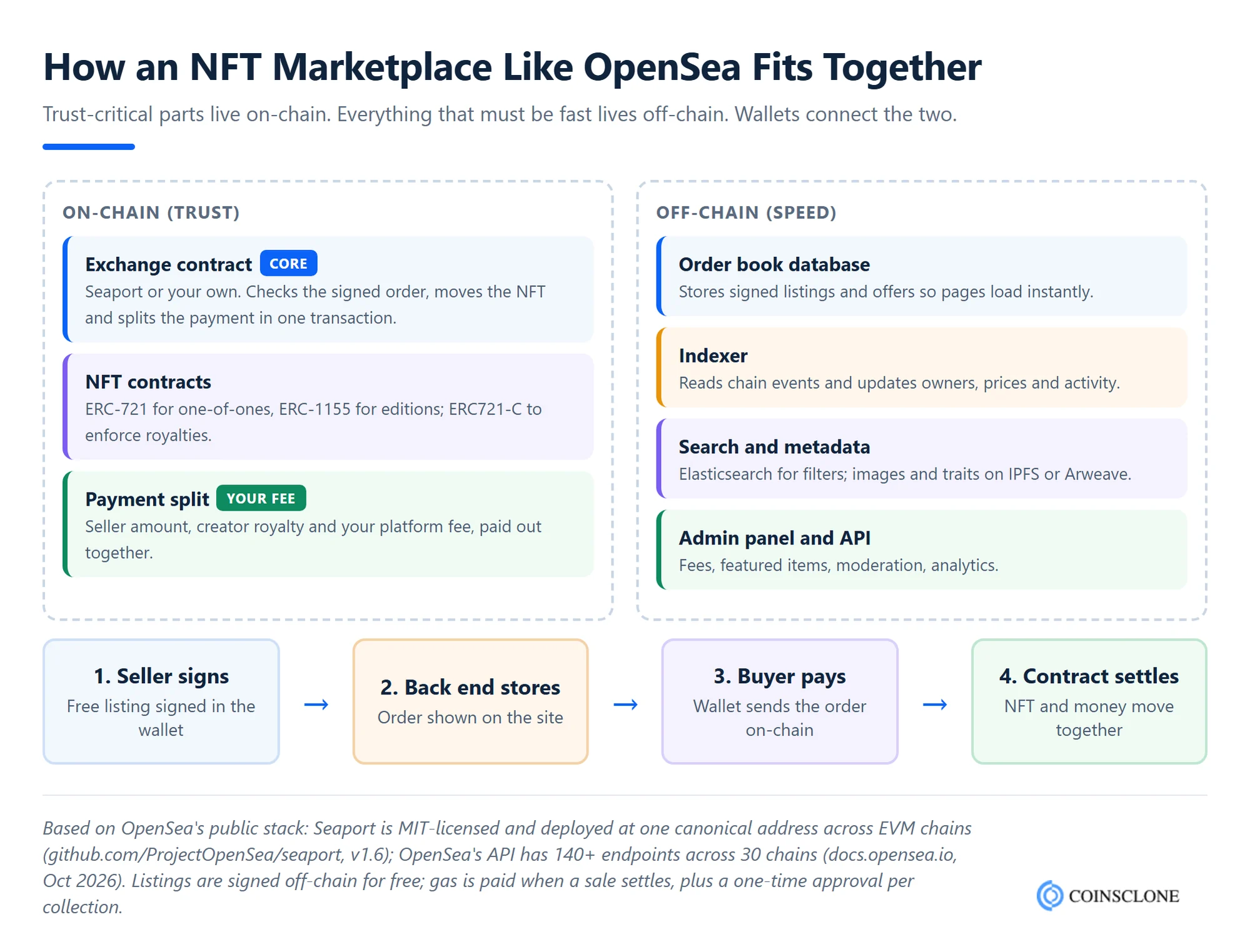
This split is why OpenSea feels fast. Search, filters and user pages run off-chain in normal databases. Only the parts that need trust, like who owns what and who gets paid, live on the blockchain.
The Tech Stack Behind It
A common stack for this kind of site in 2026 looks like this:
| Layer | Common choices |
| Smart contracts | Solidity with Hardhat or Foundry; Seaport for trading; Rust for Solana programs |
| Front end | React or Next.js, with ethers.js or viem for blockchain calls |
| Back end | Node.js, PostgreSQL, Redis and Elasticsearch for search |
| Indexing | Your own indexer or The Graph to read chain events |
| File storage | IPFS or Arweave for NFT images and metadata |
| Wallets | MetaMask, Coinbase Wallet, Phantom, WalletConnect |
One note on tools: the older web3.js library was archived in March 2025, so new builds should use ethers.js or viem instead. Also, Seaport runs only on EVM chains. On Solana, your team writes its own trading program in Rust and uses Metaplex standards for NFT data. For a layer-by-layer guide, see our post on the NFT marketplace tech stack.
Four Ways to Build an NFT Marketplace Like OpenSea
There are four ways to build a platform like this. Each one trades cost, speed and control in a different way. Let’s look at each.
1. Build an NFT Marketplace From Scratch
Building from scratch means your team designs and codes each part. This route gives you full control, but it needs deep pockets and a strong team. It suits large firms with special needs, such as a new trading model or a custom chain. Expect 6 to 11 months of work for a multi-chain platform, plus regular check-ins with your team.
A from-scratch build usually needs this core team:
- Smart contract developers: One or two Solidity (or Rust, for Solana) coders for the trading, minting and royalty contracts.
- Back-end developers: Two coders for the indexer, order book, search and admin panel.
- Front-end developer: One or two coders for the web app and wallet flows.
- UI/UX designer: One person to map every screen before coding starts.
- QA tester and DevOps: Testing on testnets, load tests and server setup.
- Product lead: One person who owns the plan, the timeline and the launch.
On top of that, you hire an outside firm for the security audit, since your own team should not audit its own code.
2. White Label OpenSea Clone Script
A white label OpenSea clone script is ready-made software that you rebrand and shape as your own. It comes with the core features, so you skip months of building. This approach speeds up your launch and still lets you change the design and features to fit your business.
Ideal for startups, a white label OpenSea clone script offers a fast, low-cost and adaptable way to launch.
For newcomers with a modest budget, this is most often the best choice. Our guide to white label NFT marketplace software explains what comes in the box. For more options, see our list of the best NFT marketplace clone scripts.
3. Build on Seaport
Since Seaport is open source, your team can use it as the trading engine and build its own site, indexer and tools around it. This saves time on the hardest and riskiest code. Still, you need to build the rest, so it sits between a clone script and a full custom build.
Note that only the contracts and tools are open. OpenSea’s website, indexer and order book are its own closed code. So the free “OpenSea clone” projects on GitHub are mostly demos: they skip audits, admin tools and search, and many still point at retired testnets and libraries.
4. Use the OpenSea API
OpenSea offers a developer API for tokens, NFTs and swaps across about 30 chains, plus a TypeScript SDK and a CLI. With it, you can show its listings inside your own branded store. This is quick, but you depend on its API key, rules and limits, and you do not own the order book. So it works best for a brand store or a game’s item shop, not a full rival market.
| Route | Best for | Time to launch | Control |
| White label clone script | Startups that want a fast, low-cost launch | 4 to 6 weeks (7 to 10 with creator minting) | High: your brand, fees and features |
| Custom build on a standard base | Proven models with your own changes | 9 to 13 weeks | High |
| Build on Seaport | Teams that want a trusted trading engine | Several months | Full off-chain, shared contracts |
| From scratch, multi-chain | Large firms with unique needs | 6 to 11 months | Full |
| OpenSea API storefront | Brands and games selling their own items | A few weeks | Low: OpenSea sets the rules |
Times for the white label, standard and multi-chain rows are Coinsclone’s published ranges for NFT marketplace builds.
Features of an OpenSea Clone Script
You may be surprised by how many features a site like this needs once you see them all. OpenSea keeps adding tools to stay a full-service NFT platform. Here are the key features, grouped by who uses them.
For Buyers and Collectors
- Storefront: A visual showcase where NFTs are shown for sale with full details, traits and past prices.
- Search and filters: Smart search with filters for price, chain, traits and rarity, so users find items fast.
- Quick sorting: Users can sort NFTs from lowest to highest price, newest listings or recent sales.
- Offers and bids: Buyers can make offers on one item, a set of traits or a whole set.
- Card checkout: Buyers without crypto can pay by card through an on-ramp partner.
- Multi-wallet support: Connect more than one crypto wallet for smooth trading on each chain.
For Creators
- Minting: New creators can mint NFTs in a few clicks, with lazy minting to avoid upfront gas fees.
- Drops: Timed launches with allowlists, mint limits and a countdown page.
- Royalty settings: Creators set their royalty and can choose contracts that enforce it.
- Collection pages: Custom banners, text and links for each set.
For You, the Platform Owner
- Admin panel: Manage users, NFT sets, fees, featured items and reports.
- Fee controls: Set your fee by chain, NFT set or listing type.
- Safety tools: Flag stolen or fake items, block copies of known sets and screen wallets.
- Stats: Track volume, active users, top sets and fee income.
- Social tools: Profiles, follows and live feeds keep users coming back.
- Many languages: Language options help users trade in their own tongue.
These features come built into a good clone script, and each one can be changed to suit your business. Of course, the features you add will shape your total cost.
How an NFT Marketplace Like OpenSea Makes Money
OpenSea keeps its income model simple: a 1% fee on NFT sales and 10% on first-sale drop mints. Your site can use the same base and add more streams on top:
- Trading fees: A small cut of each sale. Fees in 2026 run from 1% on OpenSea to 2% on Magic Eden and Rarible, so 0.5% to 2% is a fair range.
- Drop and launchpad fees: A share of first-sale mints. OpenSea takes 10% of drop mints.
- Featured listings: Creators pay to appear on the home page or in search.
- Paid tools: Paid stats, bulk listing or pro trading tools for active traders.
- Gas-free minting: Charge a small fee to mint on behalf of creators who do not want to pay gas.
As a worked example, a site with $2 million in monthly NFT sales and a 1% fee earns $20,000 a month before costs. For a deeper look, read our guide on how an OpenSea clone makes money.
Cost to Create an NFT Marketplace Like OpenSea
There is no fixed price to create an NFT marketplace like OpenSea, because the cost depends on the build route, the number of chains and the features you add. As a guide, here are the usual market ranges from published 2026 agency cost guides:
| Build type | Usual cost range | What you get |
| White label or clone script | $10,000 to $30,000 | Core marketplace, your brand, one or two chains |
| MVP with custom features | $20,000 to $45,000 | Core features plus a few custom changes |
| Mid-tier marketplace | $40,000 to $80,000 | Several chains, drops, card payments, mobile-ready design |
| Enterprise platform | $80,000 to $150,000+ | Many chains, KYC, mobile apps, a larger audit |
| Large open marketplace like OpenSea | $150,000 to $500,000+ | Many chains, token trading, custom indexer, full audits |
These ranges are market estimates, not fixed quotes. The main cost drivers are the number of chains, custom smart contracts, security audits, design work and your team’s location. Running costs matter too, such as servers, indexing, IPFS storage and support staff.
So, keeping cost in mind, a white label OpenSea clone script is the best way for most startups to launch. For a full breakdown, see our guide on NFT marketplace development cost.
How to Stand Out Against OpenSea
Copying OpenSea feature for feature will not pull users away from it. Instead, give a clear group of users something it does not. Here are proven ways to do that:
- Own a niche: Build the best place for one type of asset, such as game items, music, tickets or tokenized cards.
- Price smart: Charge a lower fee than OpenSea’s 1% at launch, or share fees with active traders.
- Protect creators: Make royalties binding by default, which many artists now look for.
- Make buying easy: Offer card checkout, email sign-in and gas-free buying for newcomers.
- Add real use: Link NFTs to perks, such as event access, game rewards or real goods.
Why Do Most NFT Marketplaces Fail After Launch?
Most NFT marketplaces fail because they open with no buyers, no sellers and no reason for either to leave OpenSea. The code is rarely the problem. The common mistakes are these:
- An empty order book: Visitors who find nothing to buy do not come back. Seed listings and line up buyers before launch.
- Too many chains too soon: Each new chain splits your small pool of buyers. Start on one or two chains and add more once trading picks up.
- A fee war you cannot win: The big markets already charge 1% or less, so a lower fee alone will not pull traders over. Win on a niche, tools or perks instead.
- Weak data tools: If the indexer misses sales or images fail to load on drop day, users lose trust fast.
- Unaudited contracts: One exploit can drain user funds and end a young market overnight.
- Counting royalties as income: Royalties go to creators, not to you. Plan your budget on your own fees only.
Security, Royalties and Legal Checks
Trust is the whole game for an NFT market. A single bug or hack can end a young platform. So finish these checks before you go live:
- Smart contract audits: Have each contract that moves funds checked by an outside security firm, and fix all issues.
- Wallet safety: Show clear signing messages, warn users about risky approvals and flag known scam links.
- Royalty rules: Decide early whether royalties are a choice or a must. Standards like EIP-2981 signal royalties, while ERC721-C contracts can enforce them.
- Copyright takedowns: Set up a process to remove stolen art and fake NFT sets fast.
- Your own brand: Copying OpenSea’s features and flow is fine, but never use its name, logo or design assets. Our guide on whether clone scripts are legal to use explains where the line sits.
- Sanctions and KYC: Screen wallets against sanctions lists, and add KYC if you take card payments or hold user funds.
- Local rules: In the EU, MiCA does not cover unique NFTs, but large series or split-up NFTs may fall under it. Check the rules in each market you serve.
How Does Coinsclone Help You Create an NFT Marketplace Like OpenSea?
Coinsclone is a reputed NFT marketplace development company that has helped firms launch crypto and blockchain platforms since 2018. We have delivered 350+ platforms for 200+ clients across 20 industries. Our team of blockchain coders, UI/UX designers and testers builds safe, feature-rich NFT platforms with modern tools.
Coinsclone builds markets like this with its ready-made OpenSea clone script, which you can shape for your niche, chains and fees. A white label build can go live in 4 to 6 weeks, or 7 to 10 weeks with creator minting tools.
So, what are you waiting for? Start your journey into digital ownership with Coinsclone. If you are unsure which route fits your plan, contact us. Our team will walk you through a free live demo.
Upscale Your Branding by launching OpenSea-like NFT Marketplace!
Feature-Rich. Highly Profitable. Global Audience. Get A Free Consulation!
Also Read: Top OpenSea Alternatives to Look Out For!
Frequently Asked Questions
How long does it take to build an NFT marketplace like OpenSea?
It depends on the build route. A white label OpenSea clone script can launch in 4 to 6 weeks, or 7 to 10 weeks with creator minting tools. A standard custom build takes about 9 to 13 weeks. A full multi-chain platform built from scratch can take 6 to 11 months.
How much does it cost to build an NFT marketplace like OpenSea?
Published 2026 agency cost guides put a white label or clone script build at about $10,000 to $30,000. A custom MVP costs about $20,000 to $45,000, a mid-tier marketplace about $40,000 to $80,000, and an enterprise platform $80,000 to $150,000 or more. A large, multi-chain platform on the scale of OpenSea can cost $150,000 to $500,000 or more.
How does an NFT marketplace like OpenSea make money?
OpenSea earns mainly from a 1% fee on NFT sales and a 10% fee on first-sale drop mints. Your site can add featured listings, launchpad fees, paid tools and paid minting on top of trading fees.
Which blockchain is best for an NFT marketplace like OpenSea?
Ethereum and its layer-2 networks, such as Base and Polygon, have the most buyers and the best wallet support. Solana suits fast, low-cost trading. The best choice is the chain where your target users hold their NFTs today. Many NFT sites start on one or two chains and add more later.
Do I need a smart contract audit before launch?
Yes. Any contract that holds or moves user funds or NFTs should be audited by an outside security firm before launch. An audit costs far less than a hack, and it builds trust with users and partners.
Should I choose white label, clone script or a custom build?
Choose a white label or clone script if you want to launch fast on a modest budget with proven features. Choose a custom build if you need a new trading model, special chains or features no script offers. Many startups launch with a clone script, then add custom features as they grow.
What is lazy minting, and should my marketplace support it?
Lazy minting writes an NFT to the blockchain only when it is first sold, so the buyer pays the gas instead of the creator. It lowers the cost for creators to list, which helps a new market grow its supply. Most sites like OpenSea should support it.
Is there an OpenSea clone on GitHub?
Yes, but only in part. OpenSea publishes its Seaport trading contracts and its developer tools on GitHub as open source. Its website, indexer and order book are not public. Free “OpenSea clone” repos on GitHub are mostly tutorials. They are useful for learning, but they lack audits, admin tools and search, so they are not ready for real money.
Is it legal to create an NFT marketplace like OpenSea?
Yes. Features, common layouts and a fee-based business model are generally free to copy, so you can build a site that works like OpenSea. What you cannot use is its name, logo, brand assets or closed code. You also need to follow the rules where you operate, such as KYC for card payments and sanctions screening.
Should an NFT project own its own marketplace?
It depends on the size of your community. A project with a loyal base of holders can earn fees and control the buying flow with its own store. A small or new project usually does better listing on a large market first, where the buyers already are. A branded store built on a white label script or the OpenSea API is a middle path.
Can I build an NFT marketplace from scratch on my own?
You can, but it is slow. A solo coder needs strong skills in smart contracts, front end, back end and servers, and must still pay for an outside audit. Most founders hire a team or start with a clone script, then add custom features once they have users.
Launch Your Own NFT Marketplace Like OpenSea
Create an NFT Marketplace like OpenSea — designed for collectors, creators, and entrepreneurs.
- Fast Deployment : Build your marketplace quickly using ready-made clone scripts.
- Multi-Blockchain & Wallet Support : Integrates Ethereum, BSC, and major crypto wallets.
- Marketplace Features : Minting, auctions, direct sales, and seamless NFT listing.
- Monetization : Earn from trading fees, NFT listings, and premium collections.
See a free branded demo of your NFT marketplace in 48 hours — before you invest a cent.
Book a Free Demo to discover how our Create NFT Marketplace like OpenSea solution can turn your NFT idea into a live, profitable platform in just 8–12 weeks.