
A SolSea clone script is ready-made software for launching an NFT marketplace like SolSea on the Solana blockchain. It comes with minting, copyright licences for each NFT, listings, bids, wallet login, fee settings and an admin panel, so you can go live under your own brand in weeks rather than months. This guide explains what the script includes, how it works and what it costs to launch in 2026.
You will also get the facts most SolSea clone pages skip. SolSea is still online, but it is a much smaller platform than it was in 2021, and the Solana NFT market now runs mostly through Magic Eden and Tensor. So we show what is still worth copying, what to leave behind and how to build a marketplace that earns.
In this guide:
- What a SolSea clone script is and what SolSea looks like in October 2026
- The features, security tools and add-ons to include, with the copyright licence flow explained
- How the platform works for users, step by step
- How a SolSea-style marketplace makes money, with a worked fee example
- Launch time and 2026 cost ranges for a white label or custom build
Launch Your Own Powerful Solsea Clone Script NFT Marketplace
Solsea Clone Script — build a full‑featured NFT marketplace on Solana.
- Solana Blockchain Powered: Enable ultra‑fast, low‑fee trades on the Solana network.
- Wallet & Mint Integration: Support Phantom, Solflare, and seamless NFT creations.
- 3D View & Rarity Index: Showcase collectibles with 3D rendering and rarity metrics.
- Revenue‑Ready Tools: Set minting, listing, bidding fees, and generate revenue early.
See a free branded demo of your NFT marketplace in 48 hours — before you invest a cent.
Book a Free Demo to discover how Solsea Clone Script can help you launch in just 8–12 weeks.
What Is a SolSea Clone Script?
A SolSea clone script is ready-to-use code that helps you build an NFT marketplace like SolSea on the Solana blockchain. It has tools to mint NFTs, set royalties, run collections and handle fast, cheap trades. In short, it gives your team a tested base, so you can build, customise and launch an NFT marketplace without starting from scratch.
SolSea itself went live in August 2021, built by the ALL.ART team. Its big idea was to let creators embed a copyright licence in an NFT when they mint it, as Solana Compass notes. Buyers could trade art, GIFs, videos, game items and other collectibles by connecting a Solana wallet. A SolSea clone gives you the same core: low fees, quick trades, creator licences and a clean trading screen.
SolSea in 2026: Status Check (October 2026)
Before you copy any platform, check how it is doing today. Here is what we found when we checked SolSea and its market on 16 October 2026:
- The site is live, in beta: solsea.io still loads with featured listings priced in SOL and USDC. It labels itself “beta” and promotes a separate AI agent product with a waitlist.
- Fees: SolSea says its trading fee starts at 2% and drops to 0% for users who stake its AART token.
- Help docs are offline: The docs.solsea.io and howto.solsea.io help sites no longer resolve, so new users have no official guides.
- The team has moved on: The ALL.ART website now leads with AI agents. It names a tie-up with 3AS Protocol on 16 May 2025, plus a real-world asset launchpad marked “coming soon”.
- The AART token has collapsed: AART traded near $0.000019 on 16 October 2026, with a market cap of about $96,000, per CoinGecko. That is more than 99.9% below its $0.0444 peak on 28 December 2021.
In other words, SolSea has not shut down, but it is a much reduced platform. Meanwhile, the Solana NFT market has moved to two big players:
| Marketplace | Status in October 2026 | Trading fee | Best known for |
| SolSea | Live in beta, help docs offline | 2%, down to 0% for AART stakers | Copyright licences, unlockable content, creator tokens |
| Magic Eden | Live; Solana only since March 2026 | 2% per sale on Solana | Largest Solana brand and launchpad |
| Tensor | Live; run by the Tensor Foundation since November 2025 | 2% taker, 0% maker | Pro trading: bids, sweeps and live charts |
Magic Eden closed its Bitcoin and EVM markets on 9 March 2026 to focus on Solana, as Crypto Briefing reported. Its CEO said about 80% of costs went to products that brought in only about 20% of revenue. Tensor changed hands too: the Tensor Foundation bought the marketplace from Tensor Labs on 21 November 2025.
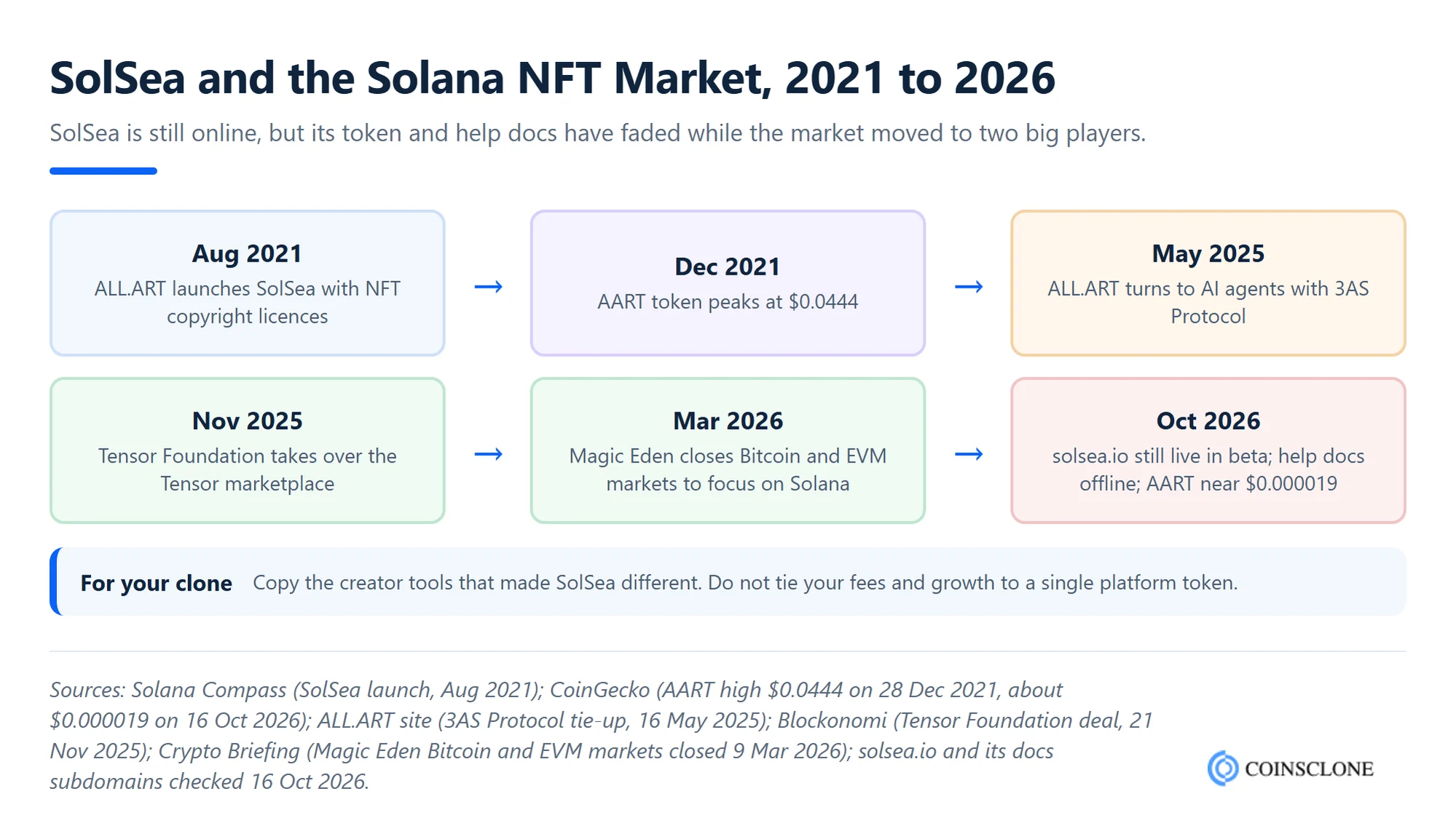
What this means for you: the SolSea brand is not the prize. The prize is its creator-first model on a cheap, fast chain. A SolSea clone still works in 2026 when you serve a clear niche, such as licensed art, music, brand drops or a regional creator scene, and when your fees do not depend on one token.
Why Launch an NFT Marketplace Similar to SolSea?
SolSea won early users because it gave creators something other markets did not: clear rights. A buyer could see what they were allowed to do with the art before paying. On top of that, Solana kept every trade cheap and quick. Those two strengths still matter today.
Here is why the model is still worth building on:
- Solana is still busy: Solana had 20,463 NFT buyers and $7.8 million in NFT sales in the 30 days to 9 October 2026, per CryptoSlam data. That is close to Polygon on buyers and about twice Ethereum, though each buyer spends less.
- Trades cost almost nothing: Solana’s base fee is 5,000 lamports, or 0.000005 SOL, per signature, as Solana’s fee docs show. So users can trade small items without gas eating the price.
- Creators want clear rights: Brands, studios and musicians need to know what a buyer may do with their work. A licence attached at mint answers that.
- The big players left room: Magic Eden and Tensor serve traders across all of Solana. A focused market for one community, art style or brand can still win loyal users.
Keep in mind that the wider NFT market has cooled. NFT sales fell 37% to $5.63 billion in 2025, according to CryptoSlam data. So a new platform needs a clear niche and a fee that pays its way.
Also Read: Popular NFT Marketplaces on Solana Blockchain
As a startup, you can tap this demand by launching your own NFT marketplace on Solana. The quickest way to do that is with a white label SolSea clone script.
Why Choose This Clone Script?
This clone script is built for firms that want a strong NFT marketplace without being locked to one chain. It comes with support for more chains, strong security and an easy interface, so both new and large firms can enter the NFT space quickly. You can also shape the design, features and fee rules to fit your plan. As a result, the script cuts build time and cost while giving you a platform that can grow as NFT trends and user needs change.
Exclusive Features of SolSea Clone Script
Our SolSea clone script includes everything you need to launch a full NFT marketplace like SolSea. It offers a clean interface, easy wallet login and smooth NFT trading, so the flow stays simple for creators and collectors alike. Here are the top features and security features of our SolSea clone script.
Top Features of Our SolSea Clone Script
Our SolSea clone software comes with proven features. The features you choose will shape what makes your NFT marketplace stand out, so pick the ones your users care about most. Here is the list of features we enable in the script:
- Digital collectibles gallery
- NFT minting
- Pick a copyright licence at mint
- Unlockable content for owners only
- NFT 3D view support
- Public and private listing
- Rarity index
- Dark mode
- Trading chart of Solana NFT collections
- Buy and bid on NFTs
- Advanced user dashboard
- NFT activity tracking
- Filter and search collections
- Multiple crypto wallet support
- Highly secured admin panel
- Admin profit management and more
You can also add other trending NFT trading features later, based on your business needs.
Security Features of SolSea Clone Script
The script you get from Coinsclone comes with strong security tools to protect your NFT trading platform from fraud and attacks. Here is the list of security modules in the SolSea clone script:
- SSL encryption for all traffic
- Solana’s own chain safety
- Multi-step login (2FA)
- Role-based access control
- End-to-end encryption
- API security
- Smart contract audit before launch, and more
With this protection in place, your SolSea-like marketplace stays strong and ready for real users. Next, let’s look at the add-ons that extend your SolSea clone script.
Upgrade Your SolSea Clone with These Add-Ons
- More Chains: Lets the platform run on more than one blockchain.
- Lazy Minting: Mints NFTs only at the time of purchase to cut upfront costs.
- NFT Launchpad: Runs exclusive drops and curated NFT collections.
- Royalty Tools: Pay creators their cut on every resale, with no manual work.
- Creator Token Markets: Lets a collection trade in its own Solana (SPL) token, as SolSea’s creator economies do.
- Analytics Dashboard: Tracks sales, user habits and how the platform performs.
- KYC and AML Checks: Adds ID checks for brands and regions that need them.
How Copyright Licences Work in a SolSea-Style Marketplace
The copyright licence is the feature that set SolSea apart, so it deserves a closer look. In most NFT markets, the buyer owns the token but has no clear idea what they may do with the art. SolSea fixed that with its NFT-PRO format, which Solana Compass describes as Metaplex-compatible with an embedded licence agreement.
In a SolSea clone, the flow works like this:
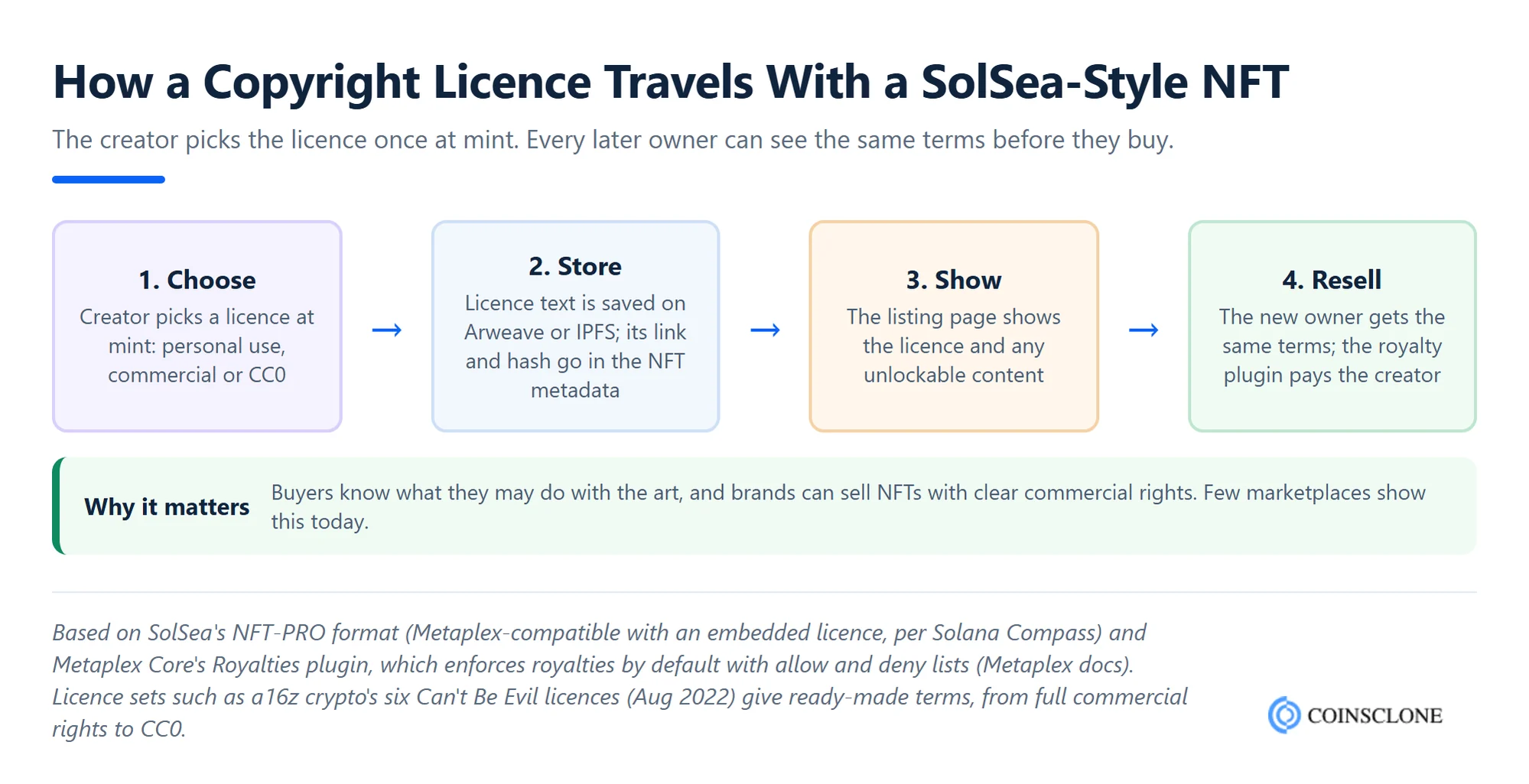
- Choose: At mint, the creator picks a licence, such as personal use only, full commercial rights or CC0 (no rights reserved).
- Store: The licence text is saved on Arweave or IPFS. Its link and hash go into the NFT’s metadata, so nobody can quietly change it later.
- Show: The listing page shows the licence next to the price, along with any unlockable content for the owner.
- Resell: When the NFT changes hands, the new owner gets the same terms, and the royalty rule pays the creator.
You do not need to write every licence from scratch. For example, a16z crypto published six free Can’t Be Evil NFT licences in 2022, which range from full commercial rights to CC0. Your platform can offer a short list like this and still let brands upload their own terms. Even so, have a lawyer review the licence text for each country you serve.
Solana NFT Standards Your SolSea Clone Should Support
Solana has three main ways to mint NFTs, and each one changes your users’ costs. Your clone should support all three, so creators can pick the right one for each drop:
- Token Metadata (legacy): The older standard used by most 2021 and 2022 collections. A mint costs about 0.022 SOL.
- Metaplex Core: The newer standard, which Metaplex recommends for new projects. A mint costs about 0.003 SOL, and its Royalties plugin enforces creator royalties by default. Creators can also allow or block certain markets.
- Compressed NFTs (Bubblegum): NFTs stored in a Merkle tree. A tree for about 1 million NFTs costs about 8.5 SOL, which suits game items, tickets and fan rewards.
For the full picture, read our guide to NFT token standards.
How Does Our SolSea Clone Script Work?
The SolSea clone script follows the same user flow as SolSea. Here is the full step-by-step flow for your users:
- Registration: First, the user signs up and creates an account with a few basic details.
- Connect Crypto Wallet: Next, the user connects a Solana wallet such as Phantom, Solflare or Backpack, since the platform runs on Solana.
- Upload Collectibles: Creators upload their digital file in the required format to mint their own NFT.
- Pick a Licence and Royalty: The creator picks a licence for the art and sets their cut of each resale.
- Verification and Listing: Once the admin verifies the NFT, it goes live on the platform. The creator adds a title and description.
- Buy and Sell NFTs: Collectors can then buy, bid on and resell NFTs whenever they wish. Prices show in SOL, and you can also accept USDC.
- NFT Sent to the Buyer’s Wallet: The NFT moves straight to the buyer’s wallet in seconds.
This is how the SolSea clone software works in real time. Since the script is fully customisable, you can also change the flow to suit your own ideas. To see how it performs, you can check out the free trial version.
Business Benefits of SolSea Clone Script
- Fast Trades: NFT trades on Solana confirm in seconds.
- Quick Launch: You can launch a feature-rich NFT marketplace on Solana like SolSea within a few weeks.
- Admin Console: One screen lets you run the whole marketplace with ease.
- Flexible Fee Management: As the owner, you set the fees for trading, minting, bidding and other actions.
- Proven Revenue Models: It comes with tested revenue modules, so the platform can start earning from day one.
- Full Control of the Design: You can change the theme, core features, back end, user flow, look and plug-ins to match your brand.
- No Coding Needed on Your Side: You do not need technical skills, because the Coinsclone team builds, launches and supports the platform for you.
- Strong Blockchain Base: The script runs on Solana, one of the busiest chains for NFT buyers, with room to add other chains later.
- Clear Path to Returns: Trading, minting and promotion fees give you several steady income streams.
- Wide Wallet Support: It accepts SOL and USDC, and supports popular Solana wallets such as Phantom, Solflare, Backpack and Trust Wallet.
Now, let’s see how the platform makes money.
How Does the SolSea Clone Script Make Money?
A SolSea clone script comes with several built-in ways to earn. The system applies the right fee automatically when users trade, mint or promote their NFTs.
Here are the main ways a SolSea clone script earns:
- Transaction Fees: A small share of every NFT sale, often around 2%, which is what Magic Eden charges on Solana.
- Minting Fees: Creators pay a fee to mint new NFTs on the platform.
- Listing Fees: Optional charges to list NFTs or collections.
- Featured Promotion Fees: Artists pay to show their NFTs in top spots on the home page.
- Paid Plans: Users pay for pro charts, alerts or bulk listing tools.
- Service Charges: Extra fees for services like collection verification or launchpad support.
One SolSea lesson is worth a closer look. SolSea lets users cut the fee from 2% to 0% by staking its token. That pulls users in, but it also eats your income, as this example shows:
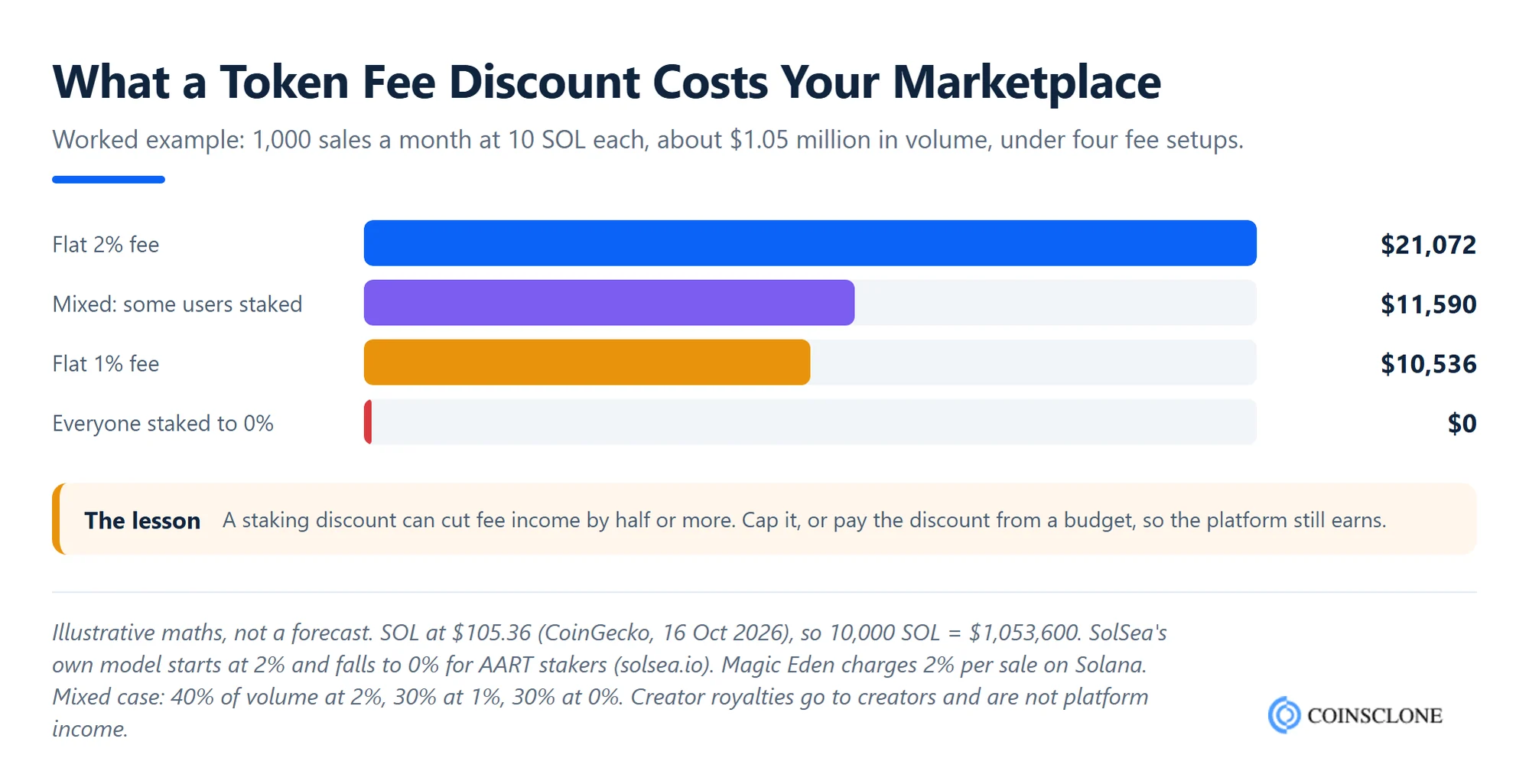
At 2%, 1,000 sales of 10 SOL a month bring in about $21,000 at 16 October 2026 prices. If many users stake their way to a lower fee, the same volume can bring in about half that, and with everyone at 0%, it brings in nothing. So if you add a token discount, cap it or fund it from a set budget. To compare more models, read our guide to the NFT marketplace revenue model.
Craft Your Own NFT Marketplace Like Solsea with us!
Simplified Solution. Highly Secured. Easy Customizations. Get A Free Consultation.
Supported Blockchains for Our SolSea Clone
Coinsclone builds SolSea-like NFT marketplace software that can go beyond Solana. With more chains, you can reach more creators and buyers, keep fees low on each one and grow in new NFT groups.
Supported blockchains include:
- Solana
- Ethereum
- Polygon
- BNB Chain
Each extra chain adds reach, but it also adds cost. Ethereum, Polygon and BNB Chain share the same contract code, so adding one after another is fairly quick. Adding them next to Solana, however, means new contracts, new wallets and more upkeep. Even Magic Eden dropped its Bitcoin and EVM markets in 2026 to cut that load. So start on Solana, prove demand, then add the next chain your users ask for. Read more about cross-chain NFT marketplace development.
How Much Does a SolSea Clone Script Cost, and How Long Does It Take?
Cost and time depend mostly on scope. A white label marketplace on one chain is the fastest route, while a launchpad or several chains add months. Here are the build times Coinsclone lists for NFT marketplaces:
| Scope | Timeline | What it includes |
| White label marketplace | 4 to 6 weeks | Your brand, standard listings, licences, one chain |
| Standard marketplace | 9 to 13 weeks | Custom listings, auctions, royalties, indexing, audit |
| Marketplace with launchpad | 4 to 7 months | Primary drops, creator checks, curation tools |
| Multi-chain marketplace | 6 to 11 months | Several chains, cross-chain listings, full tooling |
On budget, 2026 market guides put a white label NFT marketplace at about $10,000 to $30,000 and a custom MVP at about $20,000 to $45,000. A smart contract audit adds about $5,000 to $25,000, and native mobile apps add about $15,000 to $60,000. These are market ranges, not a quote. For a full breakdown, see our guide to NFT marketplace development cost.
Clone script or custom build? A clone script suits most startups, because the core is already tested and you pay only for changes. A custom build makes sense when you need your own on-chain programs, an unusual auction type or deep links to a game or brand app. Many teams start with the script and add custom modules once users ask for them.
How to Launch an NFT Marketplace Like SolSea
Here is a simple path from idea to launch:
- Pick your niche: Choose who you serve, such as digital artists, musicians, a game or a brand, and what licences they need.
- Set your fee model: Decide your trading fee, mint fee and any promotion fees. If you plan a token discount, set a cap.
- Choose your NFT standards: Support Metaplex Core for new mints, legacy Token Metadata for older sets, and compressed NFTs for large drops.
- Customise the script: Add your brand, licence list, wallets, payment options and admin rules.
- Audit and test: Have the smart contracts audited, then run a test launch on Solana devnet with real users.
- Launch and grow: Go live with a first drop from known creators, then add a launchpad or a new chain as demand grows.
Why Choose Coinsclone for SolSea Clone Script?
Coinsclone has built blockchain products since 2018. In that time, we have built 350+ platforms for 200+ clients across 20 industries. These include white label NFT marketplaces with clean, simple designs. Our SolSea clone script is tested, fully customisable and built with current frameworks, so it can be shaped to your exact needs.
Our team builds your SolSea-style platform with your chains, fees, licences and royalty rules, then supports you after launch. To compare ready-made options, see our NFT marketplace clone script range. If you want a trader-first Solana platform instead, we also offer a Magic Eden clone script. Our support team is available 24/7, so Coinsclone is a strong partner for starting your NFT marketplace business.
Frequently Asked Questions
What is a SolSea clone script?
A SolSea clone script is pre-built software for launching an NFT marketplace with the same features as SolSea. It includes NFT minting, copyright licences, listing, bids, rarity tools, creator checks and fast, low-cost trades on Solana.
How is the SolSea clone script different from building from scratch?
A clone script saves time and money compared with building an NFT marketplace from scratch, because the core features are already built and tested. You pay mainly for branding and the changes you need, not for the whole platform.
Can I customise the SolSea clone script?
Yes. You can change the design, workflow, features, fee rules, licence options and supported tokens to fit your own marketplace idea.
What blockchain does the SolSea clone use?
The SolSea clone runs on Solana by default, like SolSea itself. It supports Solana wallets such as Phantom, Solflare and Backpack, and it can mint with Metaplex Core, legacy Token Metadata or compressed NFTs.
Which blockchain networks does a SolSea clone script support?
Besides Solana, our SolSea clone script can support Ethereum, Polygon and BNB Chain. Most teams start on one chain and add others once they see demand, because each new chain adds build and upkeep costs.
Is the SolSea clone app safe for users and transactions?
Yes, when it is built well. Our script uses SSL, two-step login, admin roles and API security. We also advise an outside smart contract audit before launch. Users also keep their NFTs in their own wallets, so the platform never holds their keys.
How long does it take to launch a marketplace with SolSea clone software?
A white label SolSea clone can go live in about 4 to 6 weeks. A standard marketplace with custom listings, auctions and an audit takes about 9 to 13 weeks, and adding a launchpad or several chains takes longer.
How much does it cost to create a SolSea clone script?
The cost depends on features, chains and custom needs. In 2026, market guides put a white label NFT marketplace at about $10,000 to $30,000 and a custom MVP at about $20,000 to $45,000. A smart contract audit adds about $5,000 to $25,000, and mobile apps add more.
Launch Your Own Powerful Solsea Clone Script NFT Marketplace
Solsea Clone Script — build a full‑featured NFT marketplace on Solana.
- Solana Blockchain Powered: Enable ultra‑fast, low‑fee trades on the Solana network.
- Wallet & Mint Integration: Support Phantom, Solflare, and seamless NFT creations.
- 3D View & Rarity Index: Showcase collectibles with 3D rendering and rarity metrics.
- Revenue‑Ready Tools: Set minting, listing, bidding fees, and generate revenue early.
See a free branded demo of your NFT marketplace in 48 hours — before you invest a cent.
Book a Free Demo to discover how Solsea Clone Script can help you launch in just 8–12 weeks.