
PancakeSwap makes money mainly from trading fees. Every swap pays a small fee, and most of it goes to the people who supply the pools, called liquidity providers (LPs). The protocol keeps a share, and it uses most of that share to buy back and burn its CAKE token. Smaller amounts come from perpetual futures, prediction markets, the lottery and token launches.
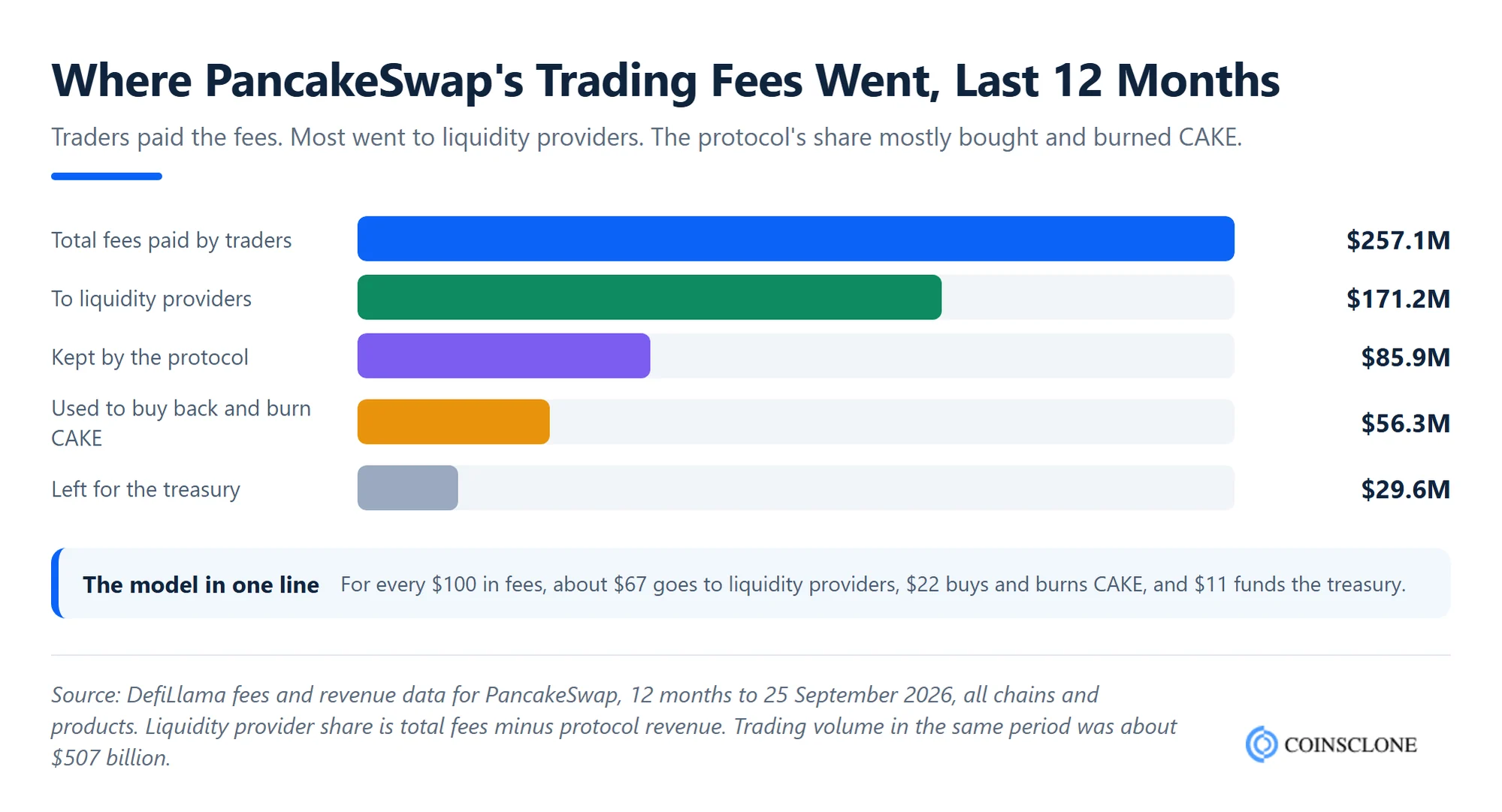
The numbers are large. In the 12 months to 25 September 2026, traders paid about $257 million in fees on PancakeSwap, according to DefiLlama. PancakeSwap kept about $86 million, and about $56 million of that went to buying and burning CAKE. This guide explains each revenue stream, what changed with CAKE Tokenomics 3.0, and what founders can copy when they build a DEX of their own.
See How Our MVP System Can Help You Understand How PancakeSwap Makes Money
How PancakeSwap Makes Money — the DeFi revenue model explained.
- MVP System : Learn real revenue mechanics used by top DEXs.
- DeFi-Ready Modules : Swap fees, farming rewards, burns, staking.
- Brand & Customization : Apply proven models to your own platform.
- Revenue Engine : Earn through trading fees and native token economics.
Get a free DeFi revenue demo in just 48 hours — before launching your own DEX.
Book a Free Demo to uncover PancakeSwap’s revenue model and replicate it within 8–12 weeks.
What Is PancakeSwap?
PancakeSwap is one of the best decentralized exchanges in crypto and the leading DEX on BNB Chain. Users swap tokens straight from their own wallets, supply liquidity to earn fees, farm rewards and play prediction and lottery games. It launched on BNB Chain in 2020 and now runs on 11 chains, including Ethereum, Base, Arbitrum and Solana.
CAKE is PancakeSwap’s native token. It is used for rewards and voting, and PancakeSwap often buys it back and burns it with part of its income. In December 2023 the community capped CAKE’s total supply at 450 million.
PancakeSwap is growing beyond swaps. Its newest version, called Infinity, lets builders add custom features to pools, much like Uniswap v4. Its June 2026 roadmap also names a multi-chain aggregator and PCSX, a trading rail for real-world assets.
How Does PancakeSwap Make Money?
Although PancakeSwap is a DEX, it earns money in a few ways. Here are the main revenue streams, in order of size.
1. Swap Fees
Swap fees are PancakeSwap’s biggest source of income. Every time a trader swaps tokens, they pay a fee that depends on the pool.
- V2 pools: a fixed 0.25% fee. Of that, 0.17% goes to LPs, 0.0225% to the treasury, and 0.0575% to buying back and burning CAKE.
- V3 and Infinity pools: fee tiers range from 0.01% for stablecoin pairs to 1% or more for volatile tokens. Most of each fee goes to LPs, and PancakeSwap’s share pays for CAKE burns and the treasury. On its Solana pools, for example, 84% goes to LPs, 8% is burned and 8% goes to the treasury.
With about $29 billion in trading volume every month, even these small percentages add up to millions of dollars.
2. Perpetual Futures Fees
PancakeSwap offers perpetual futures, so traders can go long or short with leverage. Traders pay fees to open and close trades, which adds to its income. Perpetuals also attract active traders who trade far more often than casual swappers.
3. Prediction Market Fees
In PancakeSwap Prediction, users bet on whether the price of BNB or other assets will go up or down over a short round, often five minutes. PancakeSwap keeps 3% of each round’s total bets, and the rest is paid to the winners.
Also Read: Kalshi Clone Script, a next-generation prediction market platform
4. Lottery
Users buy lottery tickets with CAKE for a chance to win a prize pool. A share of the CAKE from each round is burned, and the lottery keeps users engaged between trades.
5. Token Launches
PancakeSwap also runs token sales for new projects, long known as IFOs. Projects gain funding and users, and PancakeSwap gains new tokens to trade, more liquidity and more fee-paying volume.
6. The Aggregator
PancakeSwap’s aggregator finds the best price across its own pools and outside venues on several chains, then routes the trade. When the best route runs through PancakeSwap’s own pools, the swap fee stays in its ecosystem.
How Do Liquidity Pools on PancakeSwap Generate Income?
LPs deposit two tokens into a pool, such as BNB and USDT. Traders swap against that pool and pay a fee, and LPs earn their share of every fee in proportion to their part of the pool. In the last 12 months, LPs earned about two-thirds of all fees paid on PancakeSwap.
On V3 and Infinity pools, LPs choose a price range. If the price stays in their range, they earn more fees per dollar. If it moves outside, they stop earning until they adjust their range. LPs also face impermanent loss when the two tokens’ prices move apart.
How Does Yield Farming Work on PancakeSwap?
Yield farming adds a second layer of rewards. After providing liquidity, LPs can stake their position in a farm to earn CAKE on top of their trading fees. Syrup Pools let users stake tokens to earn rewards from partner projects.
Farm rewards come from new CAKE emissions, which is why PancakeSwap balances them with regular burns. Under Tokenomics 3.0, emissions were cut sharply to keep CAKE’s supply falling.
What Changed With CAKE Tokenomics 3.0?
PancakeSwap reshaped how it shares value in 2025:
- veCAKE retired: on 23 April 2025, veCAKE and gauge voting were switched off, and boosts on farms and pools were phased out.
- Revenue sharing ended: the 5% of trading fees that went to veCAKE holders stopped on 7 May 2025 and was redirected to CAKE burns.
- Lower emissions: daily CAKE emissions fell by about 44%.
- Deflation target: the goal is for CAKE’s supply to shrink by at least 4% a year, with burns larger than new emissions.
For builders, the lesson is clear: PancakeSwap chose a simple model. Its income buys back and burns the token, instead of paying stakers.
What Founders Can Learn From PancakeSwap’s Revenue Model
- Fees must fund liquidity first: about two-thirds of fees go to LPs, because without them there is nothing to trade.
- Tie the token to real usage: buying back and burning CAKE with revenue links the token’s value to trading activity.
- Add products that keep users active: prediction, lottery and perpetuals bring users back between swaps.
- Go multi-chain when the base is strong: PancakeSwap grew on BNB Chain first, then expanded to other chains.
- Own the routing: an aggregator sends trades to your own pools whenever they offer the best price.
How to Build a DEX Like PancakeSwap
You can launch a DEX like PancakeSwap in two ways.
Build from scratch. Your team designs the AMM, farms, staking, token contracts, interface and security from zero. It gives full freedom, but it takes the longest and needs a large budget and a full audit.
Use a PancakeSwap clone script. The swap, liquidity, farm and staking modules are already built and tested, and the revenue model can be set up from the start. Coinsclone’s published timelines are 5 to 7 weeks for a white label swap-and-farm DEX on one chain and 10 to 14 weeks for a standard multi-product DEX. Perpetual futures add six to twelve weeks and need their own audit.
For a full budget breakdown, read our guide to the cost to build a DEX like PancakeSwap.
Wrapping Up
PancakeSwap shows that a DEX can be a large business that earns real money. Its model is simple: charge small fees on huge volume, pay most of it to LPs, and use its own share to burn its token. Products like prediction, lottery and perpetuals add extra income and keep users active.
Coinsclone is a leading DEX development company that has delivered more than 350 blockchain platforms for over 200 clients. Besides PancakeSwap, we build DEXs like Uniswap, SushiSwap and QuickSwap, and aggregators like ParaSwap. We shape the revenue model around your business, so your DEX can earn from day one.
See How Our MVP System Can Help You Understand How PancakeSwap Makes Money
How PancakeSwap Makes Money — the DeFi revenue model explained.
- MVP System : Learn real revenue mechanics used by top DEXs.
- DeFi-Ready Modules : Swap fees, farming rewards, burns, staking.
- Brand & Customization : Apply proven models to your own platform.
- Revenue Engine : Earn through trading fees and native token economics.
Get a free DeFi revenue demo in just 48 hours — before launching your own DEX.
Book a Free Demo to uncover PancakeSwap’s revenue model and replicate it within 8–12 weeks.
Frequently Asked Questions
How does PancakeSwap make money?
Mainly from trading fees on every swap. Most fees go to LPs. PancakeSwap’s share pays for CAKE buybacks, burns and the treasury. PancakeSwap also earns from perpetual futures, prediction markets, the lottery and token launches.
How much does PancakeSwap earn?
In the year to 25 September 2026, PancakeSwap took in about $257 million in fees and kept about $86 million for itself, based on DefiLlama data. About $56 million of that was used to buy back and burn CAKE.
How much does PancakeSwap charge per swap?
V2 pools charge 0.25% per swap. V3 and Infinity pools use fee tiers, from 0.01% for stablecoin pairs up to 1% or more for volatile pairs.
What is PancakeSwap and how does it work?
PancakeSwap is a decentralized exchange that runs on BNB Chain and 10 other chains. Users connect a wallet and swap tokens against liquidity pools funded by other users, who earn a share of the trading fees.
What rewards can I earn from PancakeSwap’s Syrup Pools?
Syrup Pools let you stake tokens to earn rewards, often in the tokens of partner projects. Rewards change by pool, so check the pool’s current rate before you stake.
What is CAKE Tokenomics 3.0?
It is PancakeSwap’s 2025 token update. It retired veCAKE and gauge voting, ended revenue sharing, cut CAKE emissions by about 44%, and set a goal of at least 4% yearly deflation through buybacks and burns.