
An FTX clone script is ready-made software for launching a crypto exchange with the trading tools FTX made famous: spot markets, futures, perpetual contracts, options and leveraged tokens, all from one account. This guide explains what the script includes, how it works, what it costs and how long it takes to launch in 2026.
It also tells you the full story. FTX itself collapsed in November 2022 and never came back. So you will see what still works in the FTX model, what broke, and the controls your own exchange needs so it earns trust that FTX lost.
In this guide:
- What an FTX clone script is, with its admin, user and security features
- FTX’s real status in October 2026: the bankruptcy, the court rulings and the creditor payouts
- What failed at FTX, and the controls that stop the same thing on your exchange
- Cost ranges, launch times and the licences a derivatives exchange needs
- A six-step plan to go live with an FTX-style exchange
Launch Your Crypto Exchange Faster with Our FTX Clone Script!
Build your exchange like FTX — faster, smarter, and ready to scale.
- MVP Ready: Go live 90% faster with a proven exchange framework.
- Built-in Wallets & Liquidity: No code. Instant integration.
- Fully Customizable: Your brand, your tokens, your UI.
- Revenue Engine: Earn from trades, listings, and staking.
Get a free branded demo in 48 hours — before you invest a cent.
Book a Free Demo and see how our FTX Clone Script takes you from idea to live exchange in just 8 – 12 weeks.
What Is an FTX Clone Script?
An FTX clone script is a ready-made crypto exchange package that copies the core trading features of FTX. It lets startups launch an exchange quickly, without building everything from scratch. The script usually includes spot trading, derivatives trading, a fast matching engine, secure wallets, liquidity tools and advanced trading screens.
As a result, an FTX clone script cuts build time, cost and technical risk while still giving you a pro-grade exchange. It suits startups, fintech firms and business owners who want to enter crypto trading, especially the futures and perpetuals market where most trading now happens.
One point matters from the start. A good FTX clone copies the trading product, not the company’s money handling. Your version should ship with the custody, audit and reserve controls that FTX never had.
FTX in 2026: What Happened and Where It Stands
Before you copy a platform, you should know its real status. As of October 2026, FTX is not an operating exchange. Here is the short timeline:
- 2019 to 2021, the rise: Sam Bankman-Fried and Gary Wang launched FTX in 2019. It grew fast on futures, leveraged tokens and options. Leaked financials showed revenue of $1.02 billion in 2021, up from $89 million in 2020, as CNBC reported.
- November 2022, the fall: Reports showed that Alameda Research, Bankman-Fried’s trading firm, held a large part of its assets in FTX’s own FTT token. Customers rushed to withdraw, FTX could not pay them, and it filed for Chapter 11 bankruptcy on 11 November 2022.
- 2023 to 2024, the trial: A New York jury convicted Bankman-Fried of fraud in November 2023. In March 2024 he was sentenced to 25 years in prison.
- June 2026, the appeal: A US appeals court upheld the conviction and sentence on 12 June 2026. It ruled that customers were defrauded as soon as their money was moved to Alameda, even if he planned to pay it back.
- 2025 to 2026, the payouts: The FTX Recovery Trust began repaying creditors in 2025. Its fifth round, about $900 million from 31 July 2026, took total payouts to nearly $10 billion, The Block reported.
There is no relaunch. On 16 October 2026, ftx.com simply redirects to the trust’s claims portal.
So why does anyone still search for an FTX clone script? Because the product was strong. FTX built some of the most liked trading tools in crypto. The failure came from how the company handled customer money, and that part you can design out.
What Still Works in the FTX Model
FTX’s trading product is worth studying because derivatives now lead the crypto market. In August 2026, derivatives made up 79.3% of all trading on centralized exchanges, $3.40 trillion out of $4.29 trillion, according to the CoinDesk Data exchange review for August 2026. On-chain futures exchanges added another $549 billion that month.
These are the FTX ideas that still pull in traders:
- One account for everything: Spot, futures, perpetuals and options share one wallet and one margin balance, so traders do not move funds between apps.
- Cross margin: Profits on one position support margin on another, which traders find more capital-efficient.
- Leveraged tokens: Tokens that give 2x or 3x exposure without a margin account. They are simple for newer traders.
- Wide product range: Volatility contracts, index futures and new listings kept active traders on the platform.
- Pro tools: Fast APIs, sub-accounts and advanced order types won over trading firms and bots.
- Sensible leverage limits: FTX itself cut its maximum leverage from 101x to 20x in July 2021, noting that few users needed more. Regulated venues go lower still: Coinbase’s US perpetual-style futures, launched in July 2025, allow up to 10x.
If you plan a futures-first platform, our guide to crypto derivatives exchange development goes deeper into perps, options and risk engines.
What FTX Got Wrong, and the Controls That Fix It
FTX did not fail because its trading engine broke. It failed because customer money was not kept apart, its own token propped up its balance sheet and nobody outside the inner circle could check the books. When John J. Ray III took over as CEO in November 2022, he told the court he had never seen “such a complete failure of corporate controls.”
Each of those failures has a clear fix you can build into your exchange from day one:
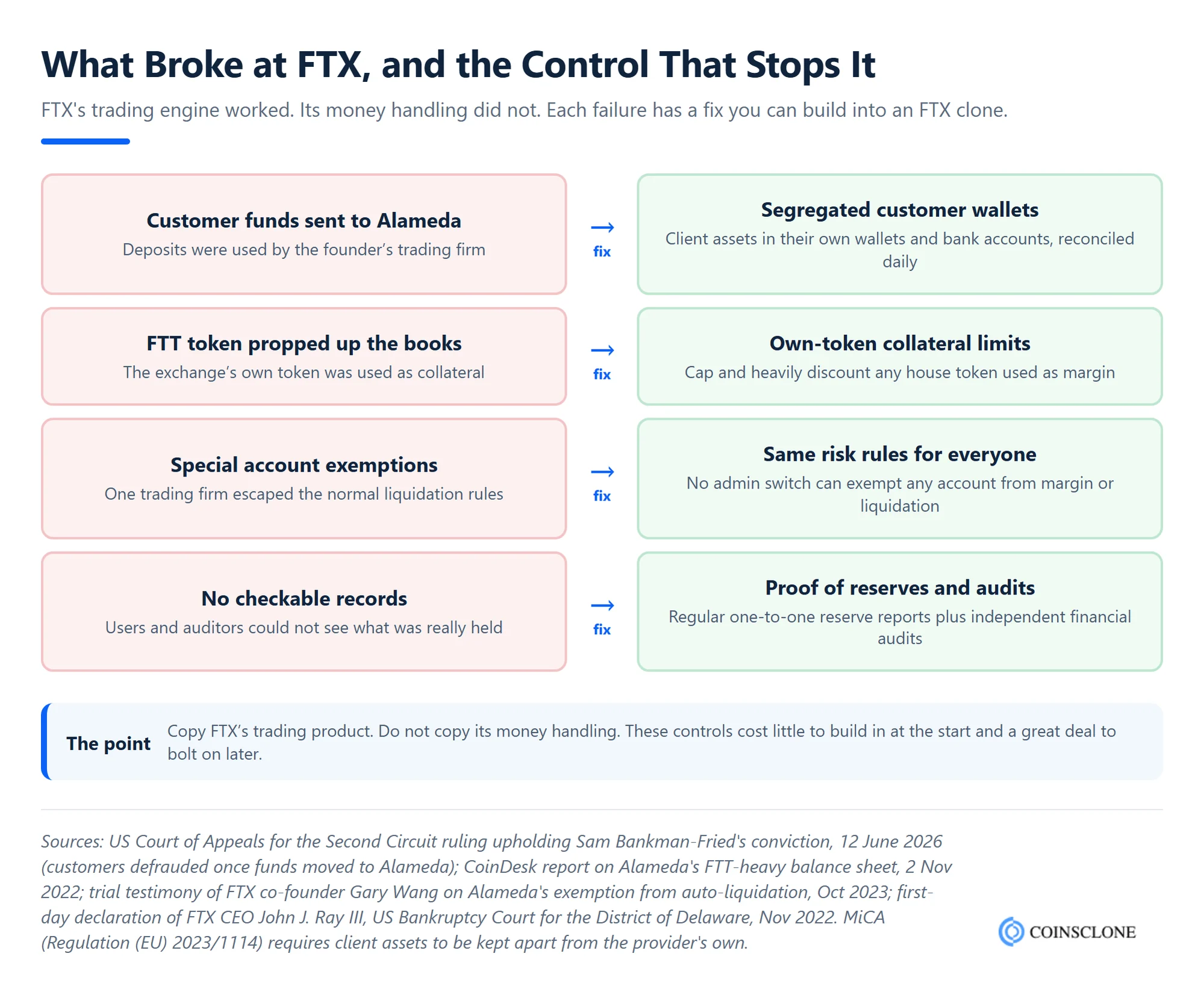
- Separate user funds: Keep client assets in their own wallets and bank accounts, apart from company money, and check them against the books every day.
- Proof of reserves: Publish regular reports that prove you hold every customer balance one to one. Large exchanges such as Binance, OKX and Kraken now do this.
- Limits on your own token: If you launch an exchange token, cap how much of it counts as collateral and apply a large haircut.
- No special accounts: No user, trading firm or insider gets exemptions from margin or liquidation rules. The admin panel should make this impossible, not just forbidden.
- Split admin roles: Cold wallet payouts need two or more sign-offs, and each admin action lands in a log no one can edit.
- Outside audits: Use independent auditors for both your accounts and your smart contracts and wallets.
These controls are not only good practice. In the EU, MiCA requires crypto-asset service providers to keep client assets apart from their own, so a clone built this way is ready for licence reviews too.
Advantages of Developing a Crypto Exchange Using an FTX Clone Script
1. Proven Market Architecture
You get a ready-made base modelled on one of the best trading products crypto has seen. This lowers design risk and lets the platform scale smoothly from day one.
2. Pro-Grade Performance from the Start
The clone script comes with a tuned matching engine that handles high volume, low delay and real-time order execution. Pro traders want just that.
3. Faster Compliance Setup
The script supports quick onboarding of KYC, AML and reporting workflows. This helps you launch in several markets without long engineering cycles.
4. Modular Product Growth
You can extend your exchange into derivatives, margin trading, staking or launchpads without disrupting your live platform, thanks to the modular design.
5. Lower Operating Load
Pre-built systems for liquidity, wallets, admin work and trading make day-to-day running lighter. So your team can focus on growth, partners and users instead of tech upkeep.
Attractive Features of Our FTX Clone Script
When you start a crypto exchange, the trading tools you offer decide how unique your platform feels. Features also drive your revenue and your user count. So it pays to switch on strong technical features before your exchange goes live.
Our clone script is built with top trading features and a clean, clear UI/UX design. Here are the main features you get with our FTX clone script.
Admin Features
- One Derivatives Panel: Run futures, perps, options and leveraged token markets from one dashboard.
- Custom Risk Engine Controls: Set margin rules, liquidation levels, insurance fund rules and risk limits.
- Advanced KYC/AML Tools: Automate compliance checks with risk scoring and document checks.
- Asset, Market and Index Management: Create and manage assets, indexes, market pairs and synthetic products.
- Liquidity Controls: Connect liquidity providers, set spreads and run your own market-making rules.
- Fee and Commission Manager: Set trading fees, listing fees and premium account tiers.
- Compliance and Audit Dashboard: Track system logs, transaction trails and admin activity for regulators.
- CMS and Promotion Tools: Manage banners, alerts, offers and site-wide updates easily.
- Institutional Account Controls: Approve VIP accounts, set custom trading limits and assign account managers.
- Reserve and Reconciliation Reports: Match customer balances against wallet and bank holdings and export proof-of-reserves data.
User Features
- Perpetual and Futures Trading: Trade futures and perpetual contracts with live funding rates and advanced order types.
- Spot Trading Module: Buy and sell crypto with live market depth and instant execution.
- Leveraged Tokens: Get 2x or 3x exposure without a margin account, much like FTX’s best-known product.
- Options Trading Screen: Trade crypto options with Greeks, volatility data and strategy tools.
- Cross and Isolated Margin: Choose isolated or cross margin for flexible risk control.
- Advanced Charting Suite: Real-time charts with indicators, overlays, order views and drawing tools.
- Multi-Asset Wallet: Secure balances for spot, margin, futures, leveraged tokens and staking.
- Portfolio Tracking: Watch open positions, profit and loss, margin levels and total risk.
- Trading APIs: Connect trading bots through secure REST and WebSocket APIs built for low delay.
These are the main features you get from our white label FTX clone software as one complete package. Next, let us look at security.
Security Features of Our FTX Clone Script
When you plan to create a crypto exchange, security comes first. Security features are the pillars of any trading platform, and FTX showed that a weak spot in money handling can sink even the biggest brand. With that in mind, Coinsclone built its FTX clone software with layered security tools.
Here are the security features you get with our white label FTX clone software:
- HTTPS and two-factor login
- Jail login and anti-phishing codes
- Data encryption at rest and in transit
- Hot, warm and cold wallet tiers with multi-signature or MPC signing
- Separate user wallets, checked against the books every day
- Saved withdrawal addresses and two-person sign-off for admin payouts
- SQL injection prevention
- Anti DoS and anti DDoS protection
- Cross-Site Request Forgery (CSRF) protection
- Server-Side Request Forgery (SSRF) protection
Apart from these modules, you can add extra controls to suit your market. For a full checklist, read our guide on how to build a non-hackable crypto exchange.
Add-on Modules for Our FTX Clone Script
Our FTX clone script becomes even more powerful with add-on modules that go beyond a standard exchange. These modules help you deepen your order books, meet the rules, automate trading and keep users active. Whether you target retail traders or institutions, add only the modules you need and build your own trading ecosystem.
- Automated Market Maker (AMM) Module
- Liquidity Aggregation Module
- Futures and Options Module
- Margin Trading Module
- Automated KYC/AML Module
- Referral and Rewards Module
- Staking and Yield Module
- Multi-Wallet Integration Module
- Launchpad/IEO Module
- OTC Trading Desk Module
How Does Our FTX Clone Script Work?
1. User Onboarding and KYC
Users sign up, pass the built-in KYC/AML checks and turn on two-factor login to use the platform.
2. Wallet Setup and Deposits
Each user gets a multi-currency wallet where they can deposit crypto or fiat (based on your payment rails). Deposits land in separate user wallets, never in company accounts.
3. Pick a Market and Place an Order
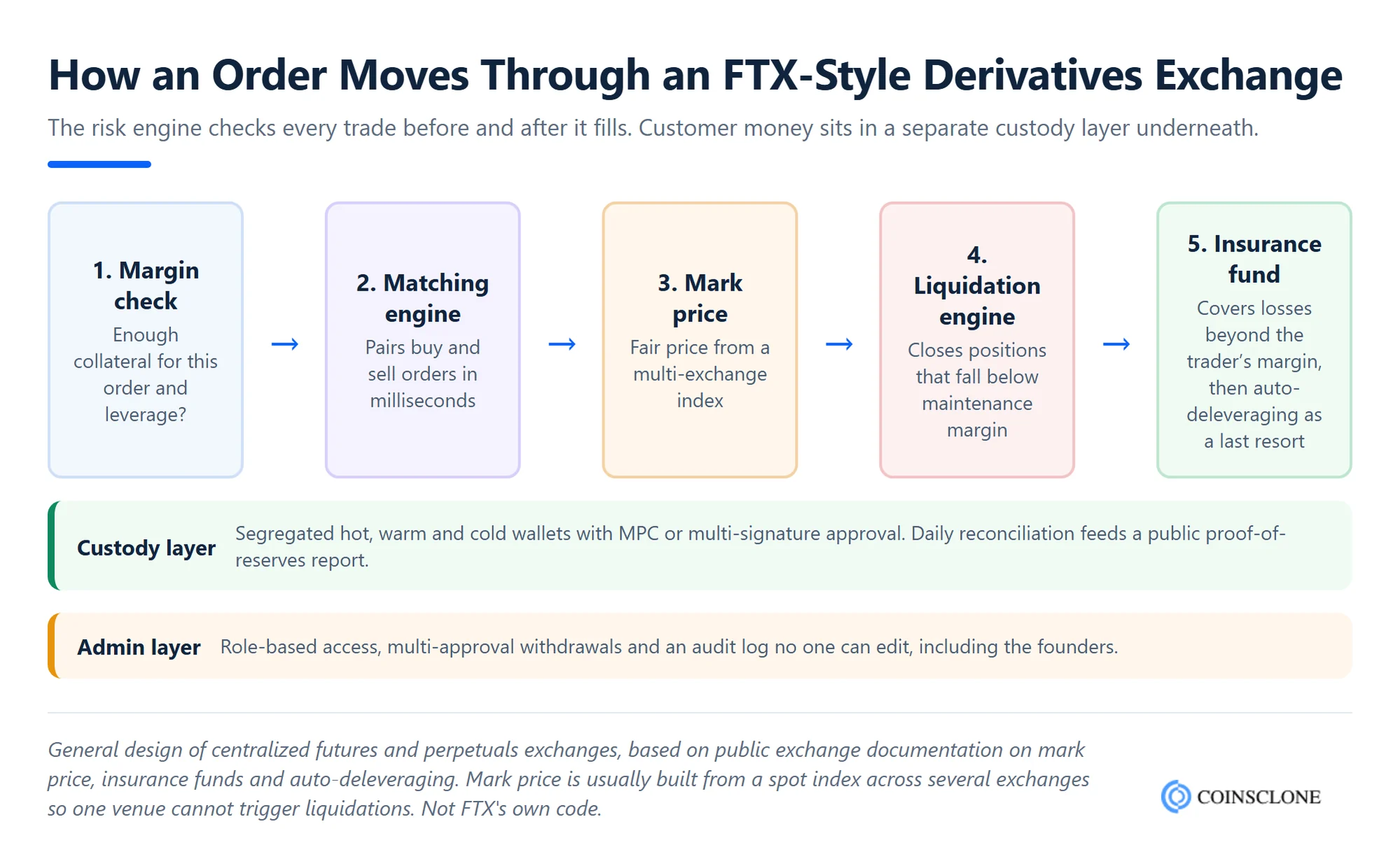
Users pick spot, futures or other markets and place buy or sell orders. The system supports market, limit, stop and advanced order types. Before an order goes through, the risk engine checks that the user has enough margin.
4. Matching Engine Executes Trades
Our fast matching engine processes orders in milliseconds, so trades stay smooth and accurate even during busy markets.
5. Risk Checks and Payouts
Completed trades settle at once and update the user’s portfolio. For derivatives, the risk engine tracks each position against a fair mark price and closes it if margin runs too low. Users can then withdraw funds safely through verified channels.
How an FTX-Style Exchange Makes Money
FTX earned most of its $1.02 billion of 2021 revenue from trading fees, as CNBC’s report on its leaked financials showed. Your FTX clone can earn from the same sources:
- Trading fees: A maker and taker fee on every spot and futures trade, usually lower for big traders.
- Liquidation fees: A small fee when the engine closes a position that ran out of margin, often paid into the insurance fund.
- Leveraged token fees: A small daily management fee on leveraged token balances.
- Listing fees: Fees from projects that want their token on your exchange.
- Withdrawal fees: A fixed fee per withdrawal to cover network costs.
- Premium and VIP plans: Lower fees, higher limits and faster support for a subscription.
- OTC and staking: Spread on large private trades and a share of staking rewards.
In short, volume is everything. So plan your fees, your market makers and your referral rewards together, since deep order books bring the traders who pay the fees.
What You Get With Our FTX Clone Solution
FTX Clone App (Android and iOS)
We deliver a fully branded, high-performance mobile trading app for both Android and iOS. The app comes with real-time market data, advanced charts, multi-asset wallets, instant order execution and a smooth experience for both beginners and pro traders. With strong security and a modern UI, your exchange can offer a world-class mobile trading experience from day one.
White Label FTX Clone Script
Our white label FTX clone script is a complete exchange package built to scale, stay secure and adapt. It includes a powerful matching engine, modular trading features, an admin back end, liquidity connections, compliance tools and a front end styled to your brand. This ready-to-launch stack lets you build a professional, FTX-style exchange faster and at a lower cost.
Business Benefits of Coinsclone’s FTX Clone Script
Here are the main benefits you get with our FTX clone script:
- Fast launch: You can deploy an exchange like FTX within weeks, not months.
- Fully customizable: You can change features, design and workflows to fit your needs.
- Clear dashboards: A strong admin panel and an easy user dashboard come ready.
- Smooth trading: Users get fast, secure crypto transactions.
- Lower cost: It costs far less than building a crypto exchange from scratch.
- No deep tech skills needed: Our team handles the build, so you focus on the business.
- Revenue ready: Fee, listing and premium plan modules let you earn from launch.
- Trust built in: Reserve reports, audit logs and segregated wallets show users their money is safe.
Licences and Compliance for an Exchange Like FTX
FTX’s story proves that rules can cost more than code. Futures and perpetuals also face stricter rules than spot trading in most large markets. Here is the picture as of October 2026:
- United States: The CFTC oversees crypto derivatives. A trading venue needs a Designated Contract Market licence, and brokers need Futures Commission Merchant status.
- European Union: MiCA covers spot crypto and custody. Futures, perps and options count as financial instruments under MiFID II, so they need an investment firm or trading venue licence. Our guide to launching a MiCA-compliant crypto exchange in the EU covers the spot side.
- United Kingdom: The FCA’s ban on selling crypto derivatives to retail clients, in force since January 2021, still applies, so a UK venue can only serve professional clients.
- Dubai: VARA sets rules for margin and derivatives trading in its Exchange Services Rulebook.
In every market, you will also need KYC, anti-money laundering checks, sanctions screening and Travel Rule data sharing. Our script ships with these tools, so your licence work does not stall.
How Much Does an FTX Clone Script Cost?
There is no fixed price for an FTX clone. The cost depends on how much you reuse, which products you offer and where you launch. Published 2026 agency cost guides put the ranges at about:
| Build path | Typical cost (USD) | Time to launch |
| White label spot exchange | $15,000 to $60,000 | 4 to 6 weeks |
| FTX clone with futures and perps | $15,000 to $60,000 | 8 to 12 weeks |
| FTX clone with fiat rails and mobile apps | $15,000 to $60,000 or more | 9 to 13 weeks or more |
| Custom MVP exchange | $100,000 to $200,000 | 6 to 9 months |
| Full custom derivatives exchange | $250,000 to $500,000 or more | 9 to 14 months |
The launch times for the white label and clone paths are Coinsclone’s own delivery times. The final price depends on these factors:
- The trading and security features you switch on
- The derivatives products you add, since options cost more than perps
- Custom design and exchange architecture changes
- The number of payment rails and blockchains
- Licences, legal advice and audits
- Liquidity, hosting and ongoing support
Keep in mind that software is only part of the budget. Licence fees, KYC checks, market makers and the insurance fund add to it in the first year. Our full breakdown of crypto exchange development cost covers each of these.
How to Launch a Crypto Exchange Like FTX in 6 Steps
Here is the path most of our clients follow, from idea to a live exchange:
- Pick your market and products: Choose your launch country, your users (retail, pro or both) and whether you start with spot, futures or both.
- Start the licence work early: Talk to a lawyer and file for the licence your market needs. For derivatives, this often takes longer than the build.
- Customize the script: Set your brand, fees, trading pairs, leverage limits and the modules you need.
- Plan your liquidity: A derivatives exchange lives on order book depth. Connect crypto liquidity providers, add market-making bots and fund your insurance pool.
- Test, audit and prove reserves: Run load tests, security tests and a full trial with real accounts. Then publish your first proof-of-reserves report before launch.
- Launch and grow: Go live, watch the numbers and add new markets, products and apps as volume grows.
Why Choose Coinsclone to Create a Crypto Exchange Using an FTX Clone Script?
Coinsclone is a trusted web3 clone script provider that has built crypto platforms since 2018. We have delivered 350+ platforms for 200+ clients across 20 industries. Our FTX clone scripts combine advanced trading features, high-speed performance and a clean, easy UI/UX. Our white label FTX clone software is fully customizable, so you can adapt features, branding and workflows to your needs at a fair cost.
At Coinsclone, we follow a clear cryptocurrency exchange development process to build solid platforms that scale. Every project begins with a detailed talk about your requirements, target users and business goals. Only then do we move into the build, so the FTX clone we create fits your plan. A white label exchange goes live in 4 to 6 weeks, and an exchange with futures and perps usually takes 8 to 12 weeks. After launch, our team stays on for support, updates and technical guidance.
If you want a ready base from a different exchange model, you can also compare our Binance clone script and Bybit clone script.
Launch Your Crypto Exchange Faster with Our FTX Clone Script!
Build your exchange like FTX — faster, smarter, and ready to scale.
- MVP Ready: Go live 90% faster with a proven exchange framework.
- Built-in Wallets & Liquidity: No code. Instant integration.
- Fully Customizable: Your brand, your tokens, your UI.
- Revenue Engine: Earn from trades, listings, and staking.
Get a free branded demo in 48 hours — before you invest a cent.
Book a Free Demo and see how our FTX Clone Script takes you from idea to live exchange in just 8 – 12 weeks.
Frequently Asked Questions
What is an FTX clone script?
An FTX clone script is a ready-made software package that copies the core features of the FTX exchange, including the trading engine, order books, wallets and derivatives modules. Developers use it to create an exchange like FTX without rebuilding the whole system.
How does an FTX clone script work?
It provides ready-made back-end logic, APIs, UI templates and exchange functions. Developers install the script, set up the trading modules, connect blockchain networks and customize the features and design. This cuts build time and keeps the platform consistent.
What features are included in a typical FTX clone script?
Most FTX clone scripts include spot trading, futures and perps, margin trading, leveraged tokens, market-making tools, wallets for many coins, KYC/AML checks, secure login, admin controls, liquidity tools and a fast matching engine.
Is an FTX clone script safe to use for building an exchange?
Yes, when the script uses strong security standards. This means AES-256 encryption, two-factor login, DDoS shields, hot and cold wallets, separate user funds, reserve reports and regular code audits. Safety also depends on proper server setup and honest money handling.
Can I customize an FTX clone script?
Yes. You can change features, add new trading products, redesign the UI/UX, add payment systems, adjust fees, connect outside liquidity and support more blockchains. The script is the base, and customization builds on top of it.
What is the cost of developing an exchange using an FTX clone script?
Published 2026 agency cost guides put a white label or clone-based exchange at about $15,000 to $60,000. A custom derivatives exchange can cost $250,000 to $500,000 or more. Licences, liquidity, audits and the insurance fund add to the first-year budget.
How long does it take to launch an exchange using an FTX clone script?
With Coinsclone, a white label spot exchange goes live in 4 to 6 weeks. An FTX-style exchange with futures and perps usually takes 8 to 12 weeks. Custom modules, new designs or extra products such as options add time for building and testing.
What happened to FTX?
FTX collapsed in November 2022 after it emerged that customer money had been moved to Alameda Research, its founder’s trading firm. Customers rushed to withdraw, FTX could not pay, and it filed for bankruptcy on 11 November 2022. Founder Sam Bankman-Fried was convicted of fraud in 2023 and sentenced to 25 years, and an appeals court upheld that in June 2026.
Is FTX still operating?
No. FTX has not run an exchange since November 2022, and no relaunch is planned. The estate now operates as the FTX Recovery Trust, and ftx.com redirects to its claims portal.
What happened to FTX customers?
Most FTX customers are being repaid through the bankruptcy plan. By its fifth payout round in July 2026, the FTX Recovery Trust had paid out nearly $10 billion. Retail customers have generally received about 118% to 142% of their claim value, though claims were priced at November 2022 rates, well below today’s crypto prices.