
Are clone scripts legal? Yes, in most cases. A clone script copies the idea, features and business model of a known platform, and the law leaves those free for anyone to use. What the law does protect is the original’s source code, artwork, text and brand. So the real question is not “clone or no clone” but what exactly your script copies, and whether you hold the right licences to run the business.
This guide explains where that line sits, with the actual laws, court cases and code licences behind it. You will see how copyright, trademark and patents apply to a clone. You will also see how code licences such as GPL and BUSL control forks of real DeFi code, and why an exchange needs money licences that no script can give you. We also cover a checklist for choosing a provider. This is general information, not legal advice; speak to a lawyer in your country before you launch.
In this guide:
- Why copying a platform’s idea is legal, with the US and EU laws that say so
- The four things a clone must never copy: code, design assets, brand and patented methods
- What the GPL, MIT and BUSL licences let you do with Uniswap, PancakeSwap and Aave code
- Why a legal script still needs a licensed business to run it in the EU, US and India
- An eight-point checklist, with three legal checks, to use before you buy a clone script
Are Clone Scripts Legal?
Clone scripts are legal when they copy how a platform works, not the platform itself. Copyright law in most countries protects the way an idea is written down, not the idea. In the US, Section 102(b) of the Copyright Act says copyright never covers “any idea, procedure, process, system, method of operation”. The EU says the same for software in Article 1(2) of the Software Directive: the ideas and principles behind a program, including its interfaces, are not protected.
Courts have applied this rule to software that copies another program’s features. In SAS Institute v World Programming (2 May 2012), the EU’s top court held that a program’s functions, its programming language and its data file formats are not protected by copyright. A rival could rebuild the same behaviour, as long as it did not copy the source code.
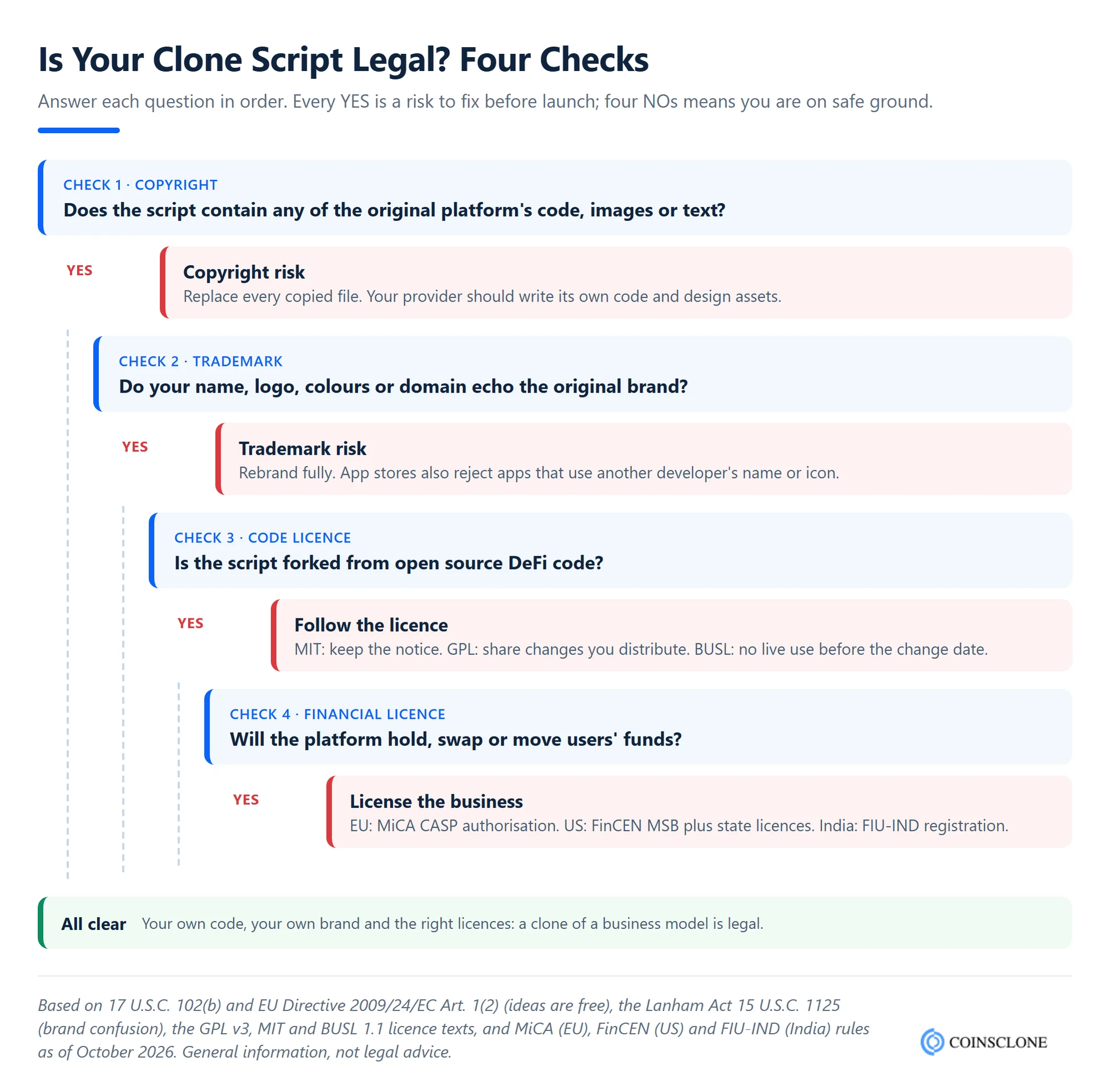
So an order book exchange, a P2P trading site with escrow or a token swap pool is a model, and anyone can build one. A clone script crosses the line only when it copies protected parts:
- Source code: the original’s actual files, copied or lightly edited
- Design assets: logos, icons, images, written text and distinctive page layouts
- Brand: the name, logo, colours or domain in a way that could confuse users
- Patented methods: a process covered by a live patent in your market
A good clone script avoids all four. Expert developers write their own code for a known business model, then you launch it under your own brand. That is why good providers can sell clone scripts in the open. Most of the doubt around them comes from the word “clone” itself.
What is a Clone Script?
Clone scripts are ready-made software that rebuilds the business model and features of a popular platform. They are not a copy of the original’s files. The provider writes its own code that works in a similar way, then customises it for each client. Since the core is already built and tested, changing the features and the look is quick.
Sometimes called an MVP (minimum viable product), a customisable script offers a lot of value for less effort. For example, if a small startup wants an exchange like Binance with core features in a short time, the best way is to go to a clone script provider. A white label crypto exchange from Coinsclone takes 4 to 6 weeks, 7 to 10 weeks with fiat rails and 9 to 13 weeks with mobile apps. Building the same platform from scratch usually takes many months.
Understanding What a Clone Script Is With an Example
If a dress you want is sold out, you look for one that is close to it. You pick the same cut and feel, but maybe a new colour or label. Many industries work the same way, and clone scripts apply that habit to software.
The LocalBitcoins clone script is a good example. “LocalBitcoins clone” is a marketing term for software that runs an ads-based P2P crypto exchange. A LocalBitcoins clone script and the original site use the same core model: buyers and sellers post ads, trade directly and lock coins in escrow until payment clears. They also share the same revenue streams, such as trade fees. What they do not share is a single line of the original’s code or its brand.
That example also says something about the market today. LocalBitcoins itself closed its trading service on 16 February 2023, citing the crypto winter. The P2P model did not die with it. Large exchanges run their own P2P desks today, and new P2P exchanges still launch on clone scripts. The model is free to use; only the old name and code belong to someone else.
There are many other clone scripts in the crypto market that help startups launch quickly. To guide you, we have compiled a list of top clone scripts that can help you kickstart your crypto startup.
What the Law Protects and What It Leaves Free
Three areas of law decide whether a clone is safe: copyright, trademark and patents. Each protects something different, so a script can pass one test and fail another.
Copyright: Code, Graphics and Text
Copyright protects the original’s source code, images, icons, written text and creative screen designs. It applies the moment the work is created, with no registration needed, in the more than 180 countries of the Berne Convention. So copying the original’s front end files, its help pages or its illustrations is infringement, even if you change a few things.
Some founders point to Google v Oracle (5 April 2021). There, the US Supreme Court held that Google’s copying of about 11,500 lines of Java interface code was fair use. However, that ruling turned on its own facts under the US fair use test. It is not a licence to copy a rival’s code. The safe path is simple: your script should contain no files from the original platform.
Trademark: Name, Logo and Look
Trademark law protects brand signs: names, logos, slogans and, in some cases, colours and overall look. Under the US Lanham Act, using a mark in a way that is likely to confuse buyers about who runs a service is unlawful. The USPTO trademark basics page explains how this works.
This is where many real disputes start, even when the code is original. In October 2023, the Trader Joe’s food store chain sued a DeFi exchange called Trader Joe over its brand. It said the near-identical name, back story and red-cap logo traded on its fame. In legal terms, it claimed trademark infringement and dilution. The lesson for clone buyers is plain: “Binance clone” is a fine way to describe your software to a developer, but it can never be your product’s name.
App stores enforce this too. Apple’s App Review Guidelines (rule 4.1, Copycats) reject apps that copy another app with minor changes to its name or UI. They also bar using another developer’s icon, brand or product name without approval. Google Play has a matching rule against apps that pose as others.
Patents: The Rare Case
Patents can protect a process, which means you could infringe one even with your own code. In practice, this is rare for crypto clone scripts, since order books, escrow and AMM pools are old and widely known methods. Rules also differ by region. The US grants some software patents, while the European Patent Convention excludes computer programs “as such”. If your platform adds a truly new method, ask a patent lawyer to run a search in your target markets.
Forking Open Source DeFi Code: GPL, MIT and BUSL
DeFi adds a twist. Many leading protocols publish their smart contracts on GitHub, so a clone can start from the real code. That is legal only if you follow the licence attached to it. The licence file in the repository is the first thing to read.
Three licence types cover most DeFi code:
- MIT: very open. You can copy, change and sell the code if you keep the copyright notice. See the MIT licence text.
- GPL (v2 or v3): open, but “copyleft”. You can use the code commercially, but if you share your changed version, you must share its source under the same licence. See the GPL v3.
- BUSL 1.1 (Business Source License): source available, not open source. You may read, copy and test the code, but production use is barred until a set “change date”. After that date the code turns into an open licence. See the BUSL 1.1 terms.
Here is how that plays out for code that clone buyers ask about most, checked in each project’s GitHub licence file on 16 October 2026:
| Codebase | Licence | What it means for a clone |
| Uniswap v2 core | GPL-3.0 | Free to fork for a live product, under GPL terms |
| PancakeSwap core | GPL-3.0 | A Uniswap v2 fork; same GPL terms apply |
| Uniswap v3 core | BUSL 1.1 until 1 April 2023, now GPL-2.0 or later | Free to fork since the change date passed |
| Aave v3 core | BUSL 1.1 until 27 January 2023, now MIT | Free to fork with the MIT notice |
| Uniswap v4 core | BUSL 1.1, change date 15 June 2027 at the latest | No production use without a grant until then; MIT after |
| Aave v3.7 | BUSL 1.1, change date 6 March 2027 at the latest | Use grant bars pulling users or funds from Aave, and bars teams that ran a rival Aave fork in the past four years |
PancakeSwap is the best-known proof that this works. It launched in 2020 on BNB Chain (then Binance Smart Chain) as a fork of Uniswap v2 code, which the GPL allowed, and it grew into one of the largest DEXs in its own right. A BUSL licence, by contrast, means a live fork before the change date breaks the licence, even if every other part of your launch is clean.
Remember that the licence covers only the code. Names like “Uniswap”, “Aave” and “PancakeSwap” are still brands, so a fork needs its own name, logo and site. A Uniswap clone script or PancakeSwap clone script should follow this rule: the same AMM model, a checked code licence and your own brand.
Is Running the Cloned Business Legal?
A legal script is only half the picture. The code can pass every IP test, yet the business you run on it still needs licences. Crypto rules apply to what you do with users’ money, not to where your code came from.
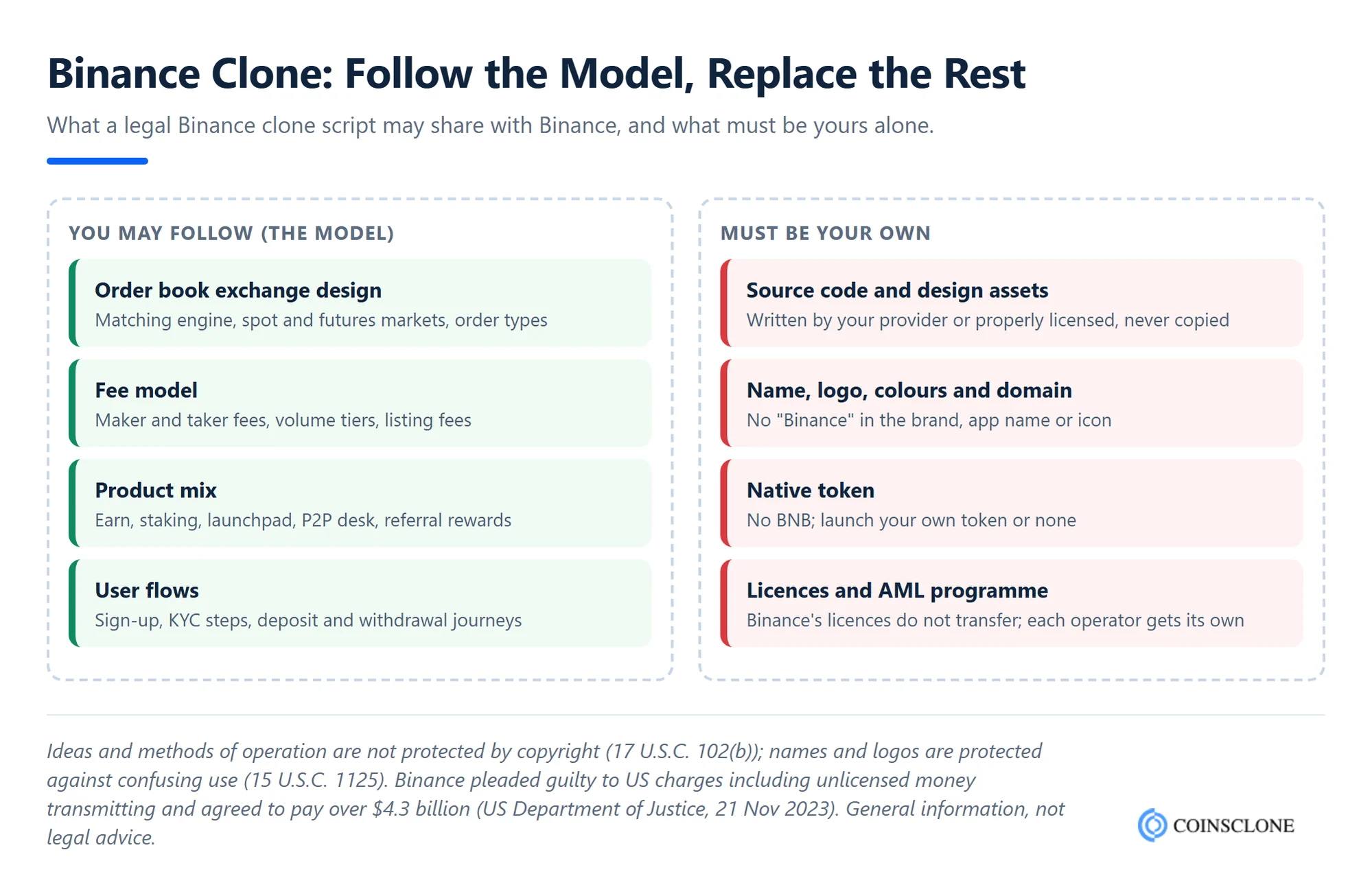
Binance shows how much this matters. In November 2023, Binance pleaded guilty to US charges, including running an unlicensed money transmitting business, and agreed to pay over $4.3 billion. A Binance clone copies the exchange model, but no script can copy Binance’s licences. Each operator must earn its own.
Here is what that means in the main markets as of October 2026:
- European Union: MiCA’s transition period ended on 1 July 2026, so only firms authorised as a crypto-asset service provider (CASP) can serve EU users. A trading platform needs at least EUR 150,000 in capital under MiCA. ESMA’s MiCA page lists the rules.
- United States: register with FinCEN as a money services business, then get state money transmitter licences. New York adds its BitLicense. FinCEN’s guidance says firms that only provide self-custody wallet software are not money transmitters.
- India: exchanges must register with FIU-IND and follow its anti-money laundering rules.
So plan the licence path at the same time as the build, not after it. For the EU route in detail, see our guide on how to launch a MiCA-compliant white label crypto exchange.
Why is Clone Script Available at an Affordable Cost? Does Quality Get Reduced?
Many founders think a low-cost script must be lower in quality. That is a common view, but it helps to look at it from the provider’s side. A provider builds the core once, then reuses it for many clients. Each client pays for the custom work on top of a tested base, rather than for the whole build from zero.
So the cost drops because the work is shared, not because corners are cut. Once the base is ready, the team adds the client’s brand, features and integrations. That needs skilled developers, but far fewer hours than a new build. That is the main reason a white label launch costs less than a custom build, and why most startups begin with a script.
For the provider, ten clients on one tested base is better business than one client on a fresh build. It grows the portfolio and keeps the code improving, since fixes found for one client reach the rest. That is how clone script providers can offer solid products at lower prices.
Moving on, let’s look at the benefits of a clone script.
Benefits of Buying a Clone Script
A clone script has many plus points for founders. Here are the main ones.
Scalability
A good script is built to grow. It can handle more users, pairs and features as the business expands, through regular upgrades.
Customization
You can add the features and functions you want with ease. That leaves you more time to focus on growth, partners and compliance.
Faster Brand Recognition
A script lets your brand reach the market quickly. For a new brand, revenue depends on how fast it can launch and win users, and speed is key to long-term success.
Time Saved
A script is already built, so launch takes weeks instead of months. A white label wallet from Coinsclone takes 3 to 5 weeks, and a white label P2P exchange takes 4 to 8 weeks.
Cost
Many founders choose clone scripts for their lower cost. Compared with a build from scratch, you pay for customisation rather than for the whole platform, and you can spend the savings on marketing and licences.
Security
Security builds trust in any online business. A mature script comes with proven safety tools, such as two-factor login, cold wallet storage and admin roles. You can add more if needed.
Tested Code
A script has been tested across many past launches, so most common errors are already fixed. Still, no software is perfect. Ask for a fresh smart contract audit and a penetration test before you go live.
All these benefits come to the full only if you choose the right clone script provider.
How to Pick the Best Clone Script Provider?
Some checks help you pick the right development company. If you are about to start your first business, run through them before you sign. The last three are the legal checks most buyers forget.
Tech Stack
Check the code and tools the company uses before you buy. Make sure the script uses current technology, since that shapes speed, security and upkeep.
Track Record
A long track record counts in any trade. The company you choose should have years of work behind it, building clone scripts for real clients.
Portfolio
Look at the company’s past work to see the projects it has built. You can also check client reviews to see where it stands in the industry.
Development Process
Every company should list its usual steps, from gathering needs to launching the script. The steps, timeline and handover should be clear in writing.
Ask for a Demo
A demo is an essential part of buying a clone script, and the company should provide one without hesitation. The demo lets you test the script and decide with confidence.
Code Ownership and Licence
Ask what you actually get: full source code ownership, or a licence to use it. Ask for a written IP warranty that the provider wrote the code or holds the right to sell it. If the seller does not have the right to distribute the code, you can end up in trouble too.
Open Source Audit
Ask for a list of the open source parts in the script and their licences. This shows whether any GPL code creates sharing duties, and whether any BUSL code bars live use before its change date.
Brand and Compliance Support
Check that the provider replaces every trace of the original’s name, logo and text with your brand. Also ask whether it builds in KYC, AML monitoring and reporting, since your licence will depend on them.
Once a company meets all these checks, you can buy the clone script with confidence.
Why Does the Binance Clone Script Have a Huge Demand in the Crypto Industry?
Binance is still the world’s largest crypto exchange by trading volume. It handled about $13.8 billion in 24-hour volume on CoinGecko on 9 October 2026. Founded in 2017, it covers spot, futures, earn products and a launchpad in one place. So many startups ask, “Can Binance be cloned?”
The answer is the Binance clone script, a ready-made, customisable exchange that follows the Binance model. It brings over the trading engine design, fee tiers and product mix, then runs under your own brand. Since this is a quick route to a full-featured exchange, demand for the software stays high.
It is also a clear case of where the legal line sits. You may match how Binance works. You may not use its name, logo, BNB token, colour scheme or any of its code, and you cannot rely on its licences.
Why Choose Coinsclone for Purchasing Clone Scripts?
Coinsclone is a leading Web3 clone script provider that has been building since 2018. We have delivered 350+ platforms for 200+ clients across 20 industries, including exchanges like Binance, P2P platforms like LocalBitcoins and DEXs like Uniswap. Every script is delivered under your brand and tested before launch. Tell us which platform you want to follow, and we will walk you through the build, the timeline and the checks in this guide.
Frequently Asked Questions
Is it legal to clone a website or app if the code and images are my own?
Usually, yes. Copyright protects the original’s code, images and text, not its features or idea. If every file and image is your own, copyright is unlikely to be a problem. However, a name, logo or look that could confuse users can still break trademark law, so use your own brand.
Can I start a business using a clone script?
Yes. Many crypto exchanges, wallets and DEXs started on clone scripts. The script must be your own build or rightly licensed. The business must also hold the licences your market needs, such as a MiCA CASP licence in the EU or FIU-IND sign-up in India.
Is cloning the functionality of an application legal?
In most countries, yes. US copyright law leaves out any “method of operation”. The EU’s top court also ruled in 2012 that a program’s functions are not covered by copyright. A patent on a specific method is the main exception, and those are rare for standard crypto features.
What are the legal risks of copying an app?
There are three main risks. Copying code, art or text can bring a copyright claim. A name or logo that looks like the original’s can bring a trademark claim. And the App Store or Google Play can remove the app under their copycat rules. Copyright and trademark cases are usually civil claims for damages and an order to stop.
Does buying a clone script give me the rights to the code?
Not always. Some providers sell full source code ownership, while others sell a licence to use the code. Read the contract, ask for an IP warranty, and check the licences of any open source parts. If the seller had no right to distribute the code, the buyer can be exposed too.