
Crypto derivatives exchange development means building a trading platform where people trade futures, perpetual contracts and options on crypto prices, without holding the coins. It is a bigger job than a spot exchange. You need a fast matching engine, a margin and risk engine, fair price feeds and a safe way to close losing trades before they hurt the platform.
This guide explains how a derivatives exchange works, what it takes to build one in 2026 and what it costs. It also covers the licences you need in the US, EU, UK and Dubai, and the ways the platform earns money. Coinsclone has built crypto trading platforms since 2018, so we also show how our team builds yours.
In this guide:
- What a crypto derivatives exchange is and how it differs from a spot exchange
- Why derivatives now make up about 79% of all trading on centralized exchanges
- How margin, liquidation, the insurance fund and auto-deleveraging protect the platform, with worked numbers
- Which licence path fits your market, and the cost drivers behind a build
- The features, revenue streams, tech stack and step-by-step build process
What Is Crypto Derivatives Exchange Development?
Crypto derivatives exchange development is the work of designing and building a platform where users trade contracts based on crypto prices. A trader who buys a Bitcoin futures contract does not own Bitcoin. Instead, the trader holds a contract whose value moves with the price of Bitcoin. That is why traders can go long or short, and why they can use leverage.
Most derivatives exchanges offer perpetual futures, fixed-date futures, options and margin contracts. Each one needs extra parts that a spot exchange does not have:
- Leverage and margin: Users put up a small deposit to open a much larger trade.
- Funding rates: Small payments between long and short traders keep perp prices close to the spot price.
- Liquidation: The system closes a losing trade before the loss goes past the deposit.
- Price index: A blended price from many exchanges, so one bad trade cannot set off a wave of forced closes.
Who buys this kind of build? Crypto exchange owners who want to add futures, fintech startups, trading firms and brokers. Each wants full control over speed, safety and rules.
Spot Exchange vs Derivatives Exchange
On a spot exchange, a user buys 1 ETH and owns 1 ETH. On a derivatives exchange, the same user can open a 10x long ETH contract with a tenth of the money, and the system must watch that trade every second. So the hard part of a derivatives build is not the order book. It is the risk engine that sits behind it.
Launch Your Crypto Derivatives Exchange — the Smart Way
Building a derivatives exchange doesn’t have to take forever.
- MVP System : Go live 90% faster with our ready-to-scale framework.
- Futures, Perps & Options : Pre-integrated trading modules — no coding required.
- Custom Branding : Your UI, your tokens, your leverage limits.
- Revenue Engine : Earn from funding rates, trading fees & liquidations.
Get a free branded demo of your derivatives exchange in just 48 hours — before you spend a cent.
Book a Free Demo to see how our Crypto Derivatives Exchange Software can take you from idea to live platform in 8-12 weeks.
Why Crypto Derivatives Exchanges Matter in 2026
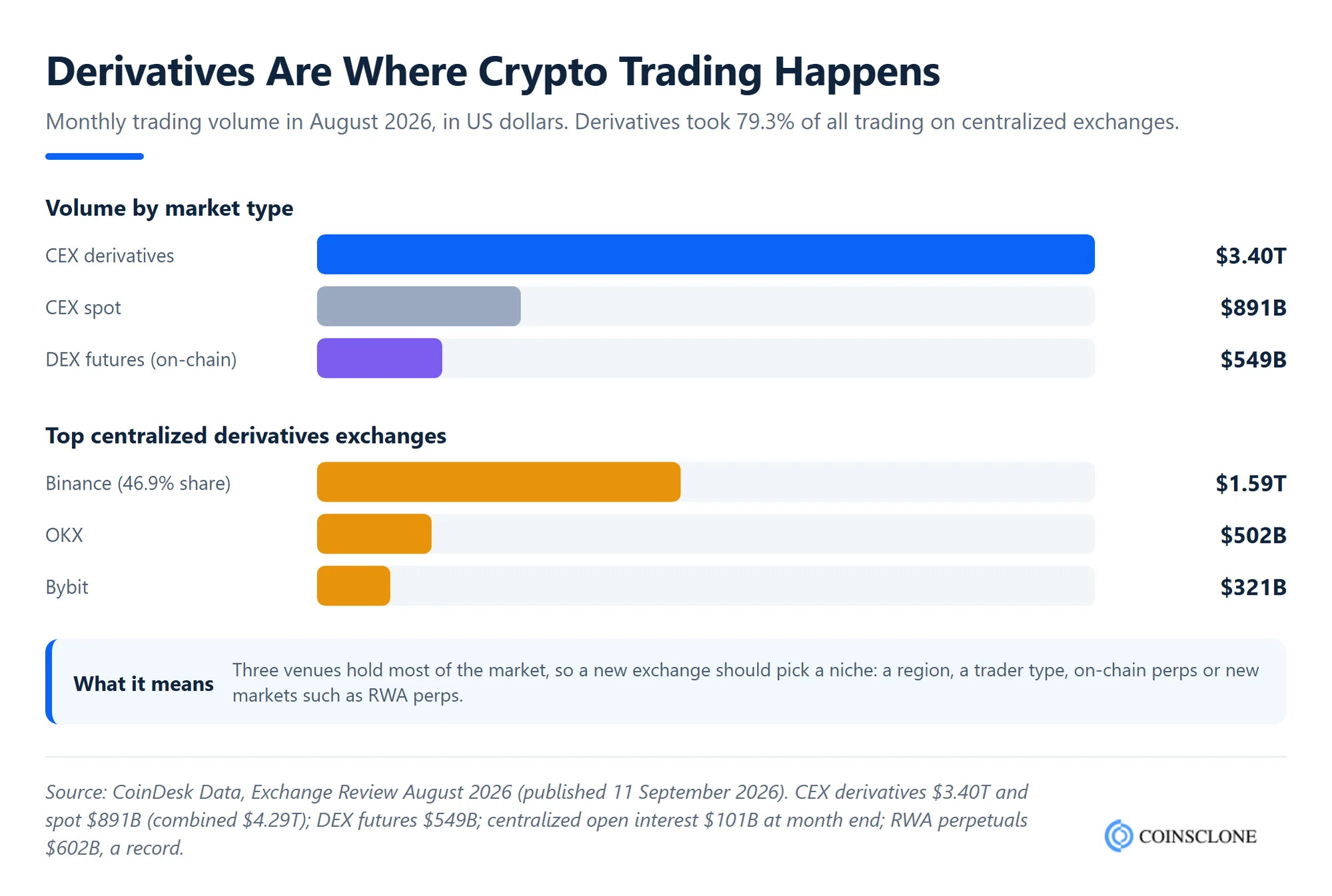
Derivatives are now where most crypto trading happens. In August 2026, centralized exchanges handled $4.29 trillion in trades. Derivatives made up $3.40 trillion of that, or 79.3%, while spot trading was $891 billion, according to the CoinDesk Data exchange review for August 2026.
The same report shows how concentrated the market is. Binance alone traded $1.59 trillion in derivatives that month, a 46.9% share. OKX and Bybit followed with $502 billion and $321 billion. Open interest, the value of all open contracts, ended the month at $101 billion.
Two trends stand out for new players:
- Decentralized perps are growing: DEX futures volume reached $549 billion in August 2026. On-chain order books like Hyperliquid now compete with the big exchanges. If that model fits you, read our guide on how to create a perpetual DEX like Hyperliquid.
- New markets beyond crypto: Perps on real-world assets, such as stock and gold indexes, hit a record $602 billion in August 2026. A modern engine should list these too, not only BTC and ETH.
In short, demand is large, but the leaders are strong. A new exchange wins by serving a region, a niche of traders or a product the big names do not offer.
Our Crypto Derivatives Exchange Development Methods
At Coinsclone, we offer three ways to build, so you can match the route to your budget, launch date and plans.
1. Developing from Scratch
Choose this route if you want full control, unique trading features and room to scale. We design and build every part: the matching engine, order book, risk engine, admin panel and APIs. As a result, the platform fits your business logic exactly.
Key Advantages:
- Full control: Every part and rule follows your design.
- Your own logic and UI: No shared look with other platforms.
- Room to grow: Built for high trade counts and big funds.
- Safety and rules built in: KYC and AML checks are part of the core, not added later.
2. Derivative Exchange Script
For a faster, cheaper launch, our crypto derivative exchange script is the best fit. It is a ready product that already has the core features of top futures sites like Binance Futures, Bybit and BitMEX. You then brand it and adjust the rules. If you want a full Bybit-style platform, see our Bybit clone script.
Key Advantages:
- Full source code: One-time license with complete code access.
- Tested parts: Core trading, margin and wallet code is already proven.
- Easy upgrades: We deploy it and help you add features later.
- Lower cost: You pay for setup and changes, not to build every part again.
3. Hire Derivatives Exchange Developers
If you already have a plan or your own team but need trading and blockchain experts, you can hire crypto exchange developers on flexible terms. Our team knows trading engine logic, smart contracts and how futures markets work.
Key Advantages:
- Flexible terms: Hire by the hour, week or month.
- Futures skills: Hands-on work with futures, options and perps.
- Direct contact: You talk to the developers and track progress yourself.
- Faster delivery: Your team keeps control while our experts fill the gaps.
How Does Our Crypto Derivatives Exchange Work?
Our crypto derivatives exchange runs on a fast trading engine, live risk checks and a safe wallet system. Here is the full flow in five steps:
- Users deposit funds into a margin wallet. Traders deposit crypto or stablecoins, and the ledger updates their balance at once. Users then pick isolated or cross margin before they open a trade.
- Traders place orders through the app or APIs. Users send market, limit or advanced orders. The system checks that they have enough margin and sends the order to the matching engine within milliseconds.
- The matching engine fills orders. The sub-5ms engine pairs buy and sell orders in real time. Once a trade fills, open trades, balances and trade history update right away.
- The risk engine manages margin, PnL and liquidations. It keeps checking margin, tracks risk, applies funding and closes trades when a trader’s equity falls below the safe level.
- Trades settle and funds become free to withdraw. Closed trades settle on their own, PnL is booked, and users can withdraw with multi-step checks and MPC wallets.
How Margin, Liquidation and the Insurance Fund Protect Your Exchange
This is the part that makes or breaks a derivatives platform. If forced closes run late, losing traders owe more than they put in, and the exchange pays the gap. So it is worth seeing the numbers.
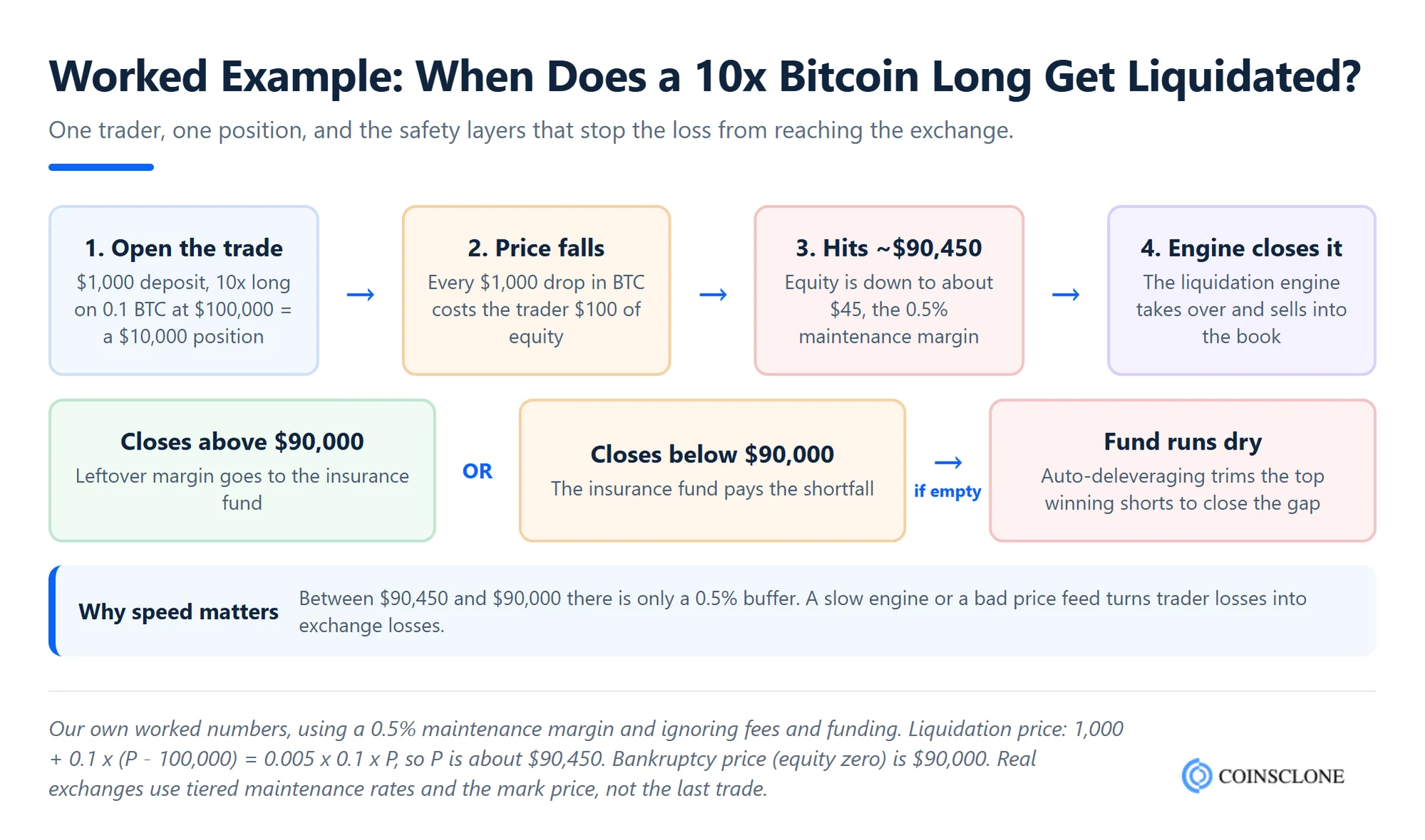
Here is how each safety layer works:
- Initial margin: The deposit needed to open a trade. At 10x leverage, a $10,000 position needs $1,000.
- Maintenance margin: The minimum equity needed to keep the trade open. On major pairs it is often under 1% of the position for small trades, and it rises in tiers as positions grow.
- Mark price: The risk engine uses a fair price built from many exchanges, not the last trade on your own book. This stops one large order from setting off false closes.
- Liquidation engine: When equity falls below the safe level, the engine takes over the trade and closes it in the market.
- Insurance fund: If a trade closes at a worse price than its bankruptcy price, the fund covers the loss. When forced closes get a better price, the extra flows back into the fund.
- Auto-deleveraging (ADL): If the fund runs dry in a crash, the system trims the top winning trades on the other side to cover the gap. Good sites show each user their ADL rank.
Regulators now ask for these layers by name. For example, Dubai’s rules call for an insurance fund at any licensed futures venue. That is why we build the risk engine, insurance fund and ADL as one tested unit.
Features of Our Crypto Derivatives Exchange Platform
Here are the features you get with our crypto derivatives exchange development service.
Admin Features
Admin tools help owners watch risk, manage order book depth, control users and keep the exchange stable in real time.
- Risk Dashboard: Track margin levels, close-out risk and open exposure at once.
- Trade Watch: Spot odd trading or market abuse.
- Depth Panel: Manage order book depth, funding rates and spreads.
- Fee Settings: Set and change trading, funding and maker-taker fees.
- User Accounts: Control KYC, roles, bans and user logs.
- Compliance Reports: Run AML checks and make audit-ready reports.
- Settlement and PnL Controls: Oversee how contracts settle and fix profit or loss errors.
- API Access Control: Limit and watch API keys, rate limits and coder access.
- Dispute and Support Console: Settle user disputes with full trade logs.
User Features
User tools let traders place futures trades fast, with full control over margin, leverage, risk and live data.
- Perp Trading: Trade BTC and ETH perp pairs with live market data.
- Isolated and Cross Margin: Choose how margin is shared across trades.
- Leverage Picker: Set leverage for each trade in one click.
- Pro Order Types: Market, limit, stop-limit, TP/SL and trigger orders.
- Live PnL and Metrics: Track open and closed PnL, funding fees and margin use.
- Trading Dashboard: One screen with charts, order book and positions.
- Multi-Device Trading: Trade from web, mobile and desktop.
- On-Chart Trading Tools: Change orders right from the chart.
- Insurance Fund View: See fund levels and forced-close stats.
Security Features
Our safety features protect user funds and trading from attacks, price tricks, account takeovers and outages.
- MPC and Hardware Wallets: Keep funds safe with split keys that no one person holds.
- Biometric and 2FA Login: Block access from stolen devices or passwords.
- Price Feed Guard: Block fake price feeds and unfair forced closes.
- DDoS Protection: Block high-volume attacks that aim to take the exchange offline.
- Account Watch: Flag odd patterns and freeze suspect accounts.
- Order Rate Limits: Stop bot floods, spam orders and system abuse.
Together, these features give you a safe, complete crypto derivatives exchange.
Core Components of Our Crypto Derivatives Exchange
Matching Engine (sub-5ms latency)
The matching engine is the heart of a futures exchange. It pairs buy and sell orders with very low delay. A sub-5ms engine gives fast fills, less slippage and high throughput, even in busy markets. So it shapes how traders feel, how deep your book gets and how much they trade.
- Risk Engine: A futures exchange needs its own risk engine to measure exposure and manage margin in real time. It checks open trades, price moves and funding all the time, so the exchange stays solvent.
- Maintenance Margin: The least money a trader needs to keep a trade open. If equity falls below it, the system starts a forced close to protect the exchange.
- Initial Margin: The deposit needed to open a trade with leverage. The risk engine sets it by trade size, price swings and market mood, so leverage stays safe.
- Liquidation Engine: It closes risky trades when margin runs short. It keeps the exchange solvent, protects other traders and feeds the insurance fund.
Funding Rate Engine
Perps use funding payments to keep their price close to the spot market. The funding engine works out these payments between longs and shorts, often every eight hours. When perps trade above spot, longs pay shorts, and the reverse is also true. A well-built engine keeps prices fair and stops abuse.
Price Index and Oracle Feeds
Price oracles pull live prices from several trusted exchanges and blend them into one index price. The exchange uses this index for forced closes, funding and PnL. A strong oracle design blocks price tricks and keeps settlement right.
Wallet and Ledger Engine
The wallet and ledger engine track user balances, history, margin and which funds belong to whom. They handle deposits, withdrawals and transfers, and update balances in real time. A safe ledger stops errors and keeps the books clear.
Advanced Trading UI and APIs
A strong trading screen gives users charts, order books, open trades and stats. Big funds, on the other hand, use FIX and WebSocket APIs to run bots and fast trading. Our UI and APIs are built for speed, ease of use and every device.
Major Types of Crypto Derivatives Trading We Support
Futures Contracts: Futures let traders buy or sell an asset at a set price on a set future date. Traders use them to hedge and to bet on price moves, long or short, without owning the coin. Our system supports futures markets with flexible leverage and settlement rules.
Perpetual Contracts: Perps work like futures but never expire, which makes them the most traded crypto contract. A funding rate keeps their price in line with spot. We build fast perp engines with live PnL, funding logic and strong risk controls.
Swaps: Swaps let two parties trade cash flows or price exposure over an agreed period. They suit advanced hedging. Our system supports custom swap terms for big funds and everyday traders.
Forwards: Forwards are private, custom deals between two parties to buy or sell an asset at a future date and price. Unlike futures, they do not trade on public markets, so they carry counterparty risk, but they are very flexible. We support forward contract setup, settlement tracking and auto risk checks for OTC desks.
Options Contracts: Options give traders the right, but not the duty, to buy or sell an asset at a set price before a set date. They suit hedging and strategies such as straddles, spreads and collars. Our system supports both European and American-style options, with pricing engines and price-swing models.
USD-Margined vs Coin-Margined Futures
Every futures market needs a margin currency. USD-margined (linear) contracts use a stablecoin like USDT or USDC for margin and profit, so PnL is easy to read. Coin-margined (inverse) contracts use the coin itself, such as BTC, which suits miners and long-term holders who want to hedge without selling. We support both, and you can launch with one and add the other later.
Which Products Should You Launch First?
Most new exchanges launch with USDT-margined perps on 5 to 20 busy pairs, since that is where most trading sits. Next, they add fixed-date futures for hedgers, and then options once they have market makers in place. Options need deeper order books and a pricing engine, so they rarely make sense on day one.
Licences and Rules for a Crypto Derivatives Exchange
Building the software is legal almost everywhere. Running a public futures exchange, though, needs a licence in most large markets, and the rules differ a lot from spot trading. Here is the picture as of October 2026:
- United States: The CFTC oversees crypto derivatives. A venue needs a Designated Contract Market (DCM) licence, brokers need Futures Commission Merchant (FCM) status, and clearing needs a Derivatives Clearing Organization (DCO). Coinbase Derivatives brought perpetual-style futures to US traders in July 2025 under these rules.
- European Union: MiCA covers spot crypto, not futures. Perps, futures and options count as financial products under MiFID II, so you need an investment firm or trading venue licence. On 30 September 2026, the Hyperliquid Policy Center asked the EU to keep it that way, as The Block reported.
- United Kingdom: The FCA’s ban on selling crypto derivatives to retail clients, in place since January 2021, still stands. The FCA lifted its ban on crypto ETNs but said the derivatives ban stays. So a UK venue can only serve pro clients.
- Dubai: VARA sets rules for exchange-traded derivatives and margin trading in its Exchange Services Rulebook, in the version in force since 31 March 2026. Firms need clear approval, checks that each client is a good fit, a separate derivatives account for each client and an insurance fund. Like any VARA exchange, they must also settle trades within 24 hours.
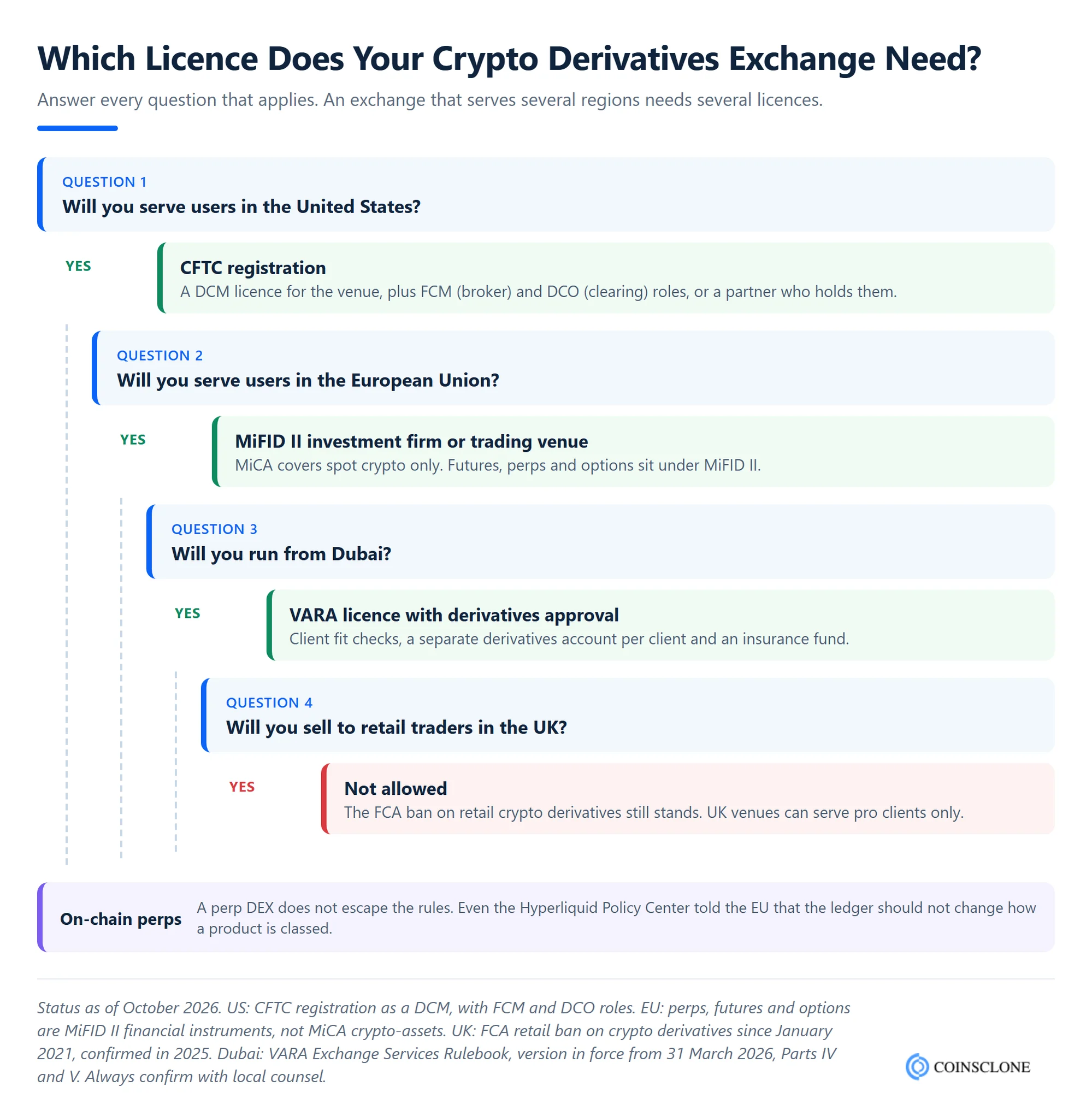
So we build licence-ready controls in from the start: KYC tiers, country blocks, leverage caps per user group, fit checks, split margin accounts and audit-ready reports. Your legal team then picks the market, and the software is ready for it. Always confirm the details with a local lawyer before launch.
How Much Does It Cost to Build a Crypto Derivatives Exchange?
The cost depends on the build route, the products you offer and the markets you plan to serve. Published vendor quotes in 2026 start near $10,000 for a basic script setup and pass $100,000 for enterprise custom builds. A full custom platform with options, mobile apps and audits sits at the top of that range or above it.
These are the drivers that move the price most:
| Cost driver | Why it adds cost |
| Build route | A script reuses tested modules; a custom build designs every part from scratch |
| Products | Perps are the base; options add a pricing engine and price-swing models |
| Risk engine | Cross margin, portfolio margin and ADL need more logic and much more testing |
| Liquidity | Market maker deals or market making software are needed from day one |
| Mobile apps | Native iOS and Android apps add design, build and store review time |
| Compliance | KYC, AML, travel rule, country blocks and reports for regulators |
| Security audits | Pen tests and, for on-chain parts, smart contract audits |
Running costs matter too. Budget for cloud hosting, price feeds, KYC checks per user, market making, the insurance fund and your licence.
At Coinsclone, a derivatives exchange built on our script usually goes live in 8 to 12 weeks. A full custom build takes longer, depending on the products and markets you choose.
Business Benefits of Our Crypto Derivatives Exchange Development Services
As a crypto startup or exchange owner, you gain clear gains from our crypto derivatives exchange development service:
- Faster launch: Our ready parts cut months from the build.
- Full control: You can customize every rule, screen and fee, and scale as you grow.
- Lower cost: You pay for setup and changes instead of building everything from zero.
- Steady revenue: You earn trading, funding and liquidation fees on every active market.
- Bigger audience: Futures draw pro traders, funds and big-volume users who seldom stay on spot-only sites.
- More trading: Derivatives make up about 79% of trading on big exchanges, so adding them grows your share.
- Room for new products: The same engine can later list RWA perps, options or new pairs.
To get these benefits, work with a trusted crypto exchange development company like Coinsclone.
Revenue Streams of Our Crypto Derivatives Exchange Software
Our crypto derivatives exchange software gives owners many steady income sources. Each one fits a type of trader, from fast bot traders and leverage users to market makers and big funds, so income holds up in any market. Here are the main ways your exchange earns:
- Trading Fees: Earn maker-taker fees on every filled trade. High volume in perp and futures markets makes this the steadiest income.
- Funding Fees (Perpetual Contracts): On most large exchanges, funding passes between traders with no cut. Our engine lets you add an optional platform fee on funding, if your model and licence allow it.
- Liquidation Fees: When a trade falls below the safe margin level, the engine closes it and charges a fee. Part goes to the insurance fund, and the rest is your income.
- Cash In and Out Fees: Charge set fees for crypto payouts and, if you choose, for fiat on and off ramps. Small fees add up over many users.
- Loan Interest: If you lend margin, you earn interest on the funds traders borrow. Our margin trading exchange module covers this.
- Market Making as a Service: Built-in market making tools let you earn from spreads, depth deals or fees from funds that use your systems.
- API Fees: Charge pro traders, bot funds and HFT firms for premium APIs, higher rate limits or private endpoints.
- Listing Fees: Earn from projects or partners who want their tokens, perpetual pairs or custom contracts listed.
Our Crypto Derivatives Exchange Development Process
At Coinsclone, we follow a clear, proven process to build a fast, safe crypto derivatives exchange. Each step keeps the system ready to scale, within the rules and easy to use.
1. Needs and Planning
First, we learn your business model, target market and must-have features. Then we write a project roadmap that covers the trading design, licence needs and revenue model.
2. UI/UX Design
Next, our designers create a clean, easy trading screen. From the dashboard to the order book and portfolio view, every screen is built for quick use and live data.
3. Core Development
In this phase, we build the core parts: the trading engine, risk engine, market maker links and margin trading. Our team focuses on low delay, high throughput and speed fit for big funds.
4. Smart Contract and Blockchain Integration
We add secure smart contracts for deposits, withdrawals and any on-chain settlement. Depending on your plan, we connect the platform to major blockchains or your own network.
5. Security Setup
We add many layers of safety, such as DDoS shields, data encryption, 2FA, anti-phishing tools and cold wallets. Our security team then runs pen tests on the whole system.
6. Testing and QA
Every part goes through unit, link-up and load tests. We also replay crash-day market conditions to check that liquidations, the insurance fund and ADL hold up under stress.
7. Deployment and Launch
Once the platform passes every check, we deploy it to your chosen hosting, on-premise or cloud. Our team runs the go-live and watches performance after launch.
8. Post-Launch Support and Maintenance
After launch, we provide ongoing support, feature updates and version upgrades, so you keep pace with the fast-moving derivatives market.
Blockchain Networks Supported in Our Crypto Derivatives Exchange
Our crypto derivatives exchange software supports many blockchains. This gives you full freedom over which coins you list, how users deposit and which chains you settle on. Here are the main ones we support:
- Bitcoin (BTC)
- Ethereum (ETH)
- BNB Chain (BNB)
- Polygon (POL)
- Solana (SOL)
- Avalanche (AVAX)
- Tron (TRX, with TRC-20 stablecoins)
- Custom L1 and L2 blockchains
Why Coinsclone Is the Best Crypto Derivatives Exchange Development Company
As a crypto exchange development company building since 2018, Coinsclone brings real trading know-how to every futures project. We have delivered 350+ platforms for 200+ clients across 20 industries. We build safe futures exchanges that meet your goals today and grow with you.
Key Reasons to Choose Us:
- Proven Track Record: 350+ platforms shipped since 2018.
- End-to-End Service: From design to launch, we handle every step.
- Fast Engine: A low-delay trading engine built for high volume.
- Bank-Grade Safety: Layers of encryption, KYC and AML tools, and fraud checks.
- Flexible Options: Build from scratch, white label, or use our ready script.
- Licence-Ready Controls: KYC tiers, country blocks, leverage caps and audit reports built in.
- Dedicated Support: 24/7 technical help and post-launch care.
Launch your crypto derivatives exchange with Coinsclone, where new ideas meet proven delivery.
Tech Stack We Use in Our Crypto Derivatives Exchange Development
At Coinsclone, we use a modern tech stack to build safe, fast crypto derivatives exchanges that scale.
- Front-End: React.js, Angular, Vue.js, HTML5, CSS3, WebSocket
- Back-End: Node.js, Express.js, Go, Python, microservices
- Database: PostgreSQL, MongoDB, Redis, Cassandra
- Blockchain: Ethereum, BNB Chain, Polygon, Solana, Avalanche
- Smart Contracts: Solidity, Rust
- Security: AES-256 encryption, 2FA, DDoS protection, SSL, anti-phishing
- Infrastructure: AWS, Google Cloud, Kubernetes, Docker, CI/CD
- Integrations: Liquidity APIs, FIX protocol, market data feeds
Frequently Asked Questions
What is crypto derivatives exchange development?
Crypto derivatives exchange development is the process of building a platform where users trade contracts like futures and options based on crypto prices. Instead of owning the coins, traders bet on price moves using leverage, expiry dates and margin.
What does a crypto derivatives exchange development company do?
Such a company builds the trading engine, contract system, margin and forced-close logic, wallets, admin tools and safety layers. It also links live price feeds, risk tools and KYC and AML checks for licensed trading.
What are the main types of crypto derivatives?
The main types are futures, perpetual contracts, options, swaps and forwards. Perps are by far the most traded, because they never expire and track the spot price through funding payments.
How is a crypto derivatives exchange different from a spot exchange?
A spot exchange lets users buy and sell real coins. A crypto derivatives exchange lets users trade contracts based on crypto prices without owning the coins. As a result, these exchanges need leverage, margin, forced closes and a strong risk engine.
How much does it cost to build a crypto derivatives exchange?
Published vendor quotes in 2026 start near $10,000 for a basic script and pass $100,000 for a custom enterprise build. The final cost depends on the build route and the products, since options cost more than perps. Mobile apps, KYC tools, market makers and audits add to it.
How long does crypto derivatives exchange development take?
With Coinsclone’s script, a crypto derivatives exchange usually goes live in 8 to 12 weeks. The timeline grows with features such as options, mobile apps, extra markets, price oracles and compliance controls. Custom risk engines and security audits can add more time.
What licences are required to operate a crypto derivatives exchange?
It depends on where your users are. In the US, the CFTC requires a DCM licence for the venue, plus FCM and DCO roles. In the EU, crypto derivatives fall under MiFID II, not MiCA. In the UK, retail crypto derivatives are banned. In Dubai, VARA approval under its Exchange Services Rulebook is needed.
Which derivative products should a new exchange launch first?
Most new exchanges start with USDT-margined perps on a small set of busy pairs. They add fixed-date futures next and options last, once market makers can supply the deeper books that options need.
How does a crypto derivatives exchange manage trading risk?
It uses margin rules, a fair mark price from many exchanges, an auto close-out engine, an insurance fund and ADL. Together, these stop one trader’s losses from becoming the exchange’s losses.
Is it legal to build a crypto derivatives exchange?
Building the software is legal in most places. But running a public futures exchange most often needs a licence, plus strong KYC, AML and reports. Some markets, like the UK, also ban crypto derivatives for retail users.
What security features does a crypto derivatives exchange need?
A safe crypto derivatives exchange needs live risk checks, auto close-outs, encrypted wallets, 2FA login, payout approvals, audit logs and DDoS shields. These features protect user funds and lower trading risk across the system.
Launch Your Crypto Derivatives Exchange — the Smart Way
Building a derivatives exchange doesn’t have to take forever.
- MVP System : Go live 90% faster with our ready-to-scale framework.
- Futures, Perps & Options : Pre-integrated trading modules — no coding required.
- Custom Branding : Your UI, your tokens, your leverage limits.
- Revenue Engine : Earn from funding rates, trading fees & liquidations.
Get a free branded demo of your derivatives exchange in just 48 hours — before you spend a cent.
Book a Free Demo to see how our Crypto Derivatives Exchange Software can take you from idea to live platform in 8-12 weeks.