
ERC223 token development is the work of building an Ethereum token on the ERC-223 standard, a format that stops tokens from getting lost when someone sends them to the wrong kind of contract. In technical terms, ERC223 tokens look a lot like ERC-20 tokens. The big difference is what happens on the receiving side: a contract has to say “yes, I can handle this” before the tokens arrive.
This guide explains how ERC-223 works, where it stands in 2026, and how it compares with ERC-20. It also covers the trade-offs, the features worth building, the costs and the steps we follow, so you can decide whether ERC-223 suits your project before you spend a dollar.
In this guide:
- Status check: ERC-223 has been a Final standard since September 2023, but very few projects use it compared with ERC-20.
- How it works: the tokenReceived handler, and why it stops tokens from getting stuck.
- ERC223 vs ERC20: a side-by-side table and a simple decision tree.
- Build plan: features, security checks, tech stack, steps and typical market costs.
Build Smarter Tokens with Our ERC223 Development Expertise
ERC-712 Token Development — done right.
- Advanced Token Standard : Create efficient, secure ERC223 tokens compatible with existing ERC20 ecosystems.
- Seamless Transfers : Prevent token loss with the improved transfer mechanism of ERC223.
- Smart Contract Integration : Built for DeFi, exchanges, and tokenized assets with full EVM compatibility.
- Custom Branding & Utility : Your design, your utility model, your ecosystem.
See a free token demo in 48 hours — before you invest a cent.
Book a Free Consultation to discover how our ERC223 Token Development Company can help you launch your next-gen token in just 2–4 weeks.
What Is ERC223 Token Development?
ERC223 token development is the process of creating tokens that follow the ERC-223 token standard, proposed by the developer Dexaran in May 2017. The standard was built to fix one well-known flaw in ERC-20. When a user sends ERC-20 tokens straight to a smart contract with the plain transfer function, the contract is never told about it. The deposit is not credited, and in most cases the tokens are stuck forever.
ERC-223 changes this. Every time tokens go to a contract, the token calls a function named tokenReceived on that contract. If the contract does not have that function (or a fallback that handles it), the whole transfer is undone and the tokens stay with the sender. Transfers to normal wallet addresses work just like ERC-20.
An ERC223 token development company designs the token and writes and tests the smart contracts. It also sets clear transfer rules and checks how the token works with the wallets, exchanges and dApps you plan to use. That last step matters more for ERC-223 than for most standards, as you will see below.
ERC-223 Status in 2026: Final, but Lightly Adopted
Here is the plain picture as of 16 October 2026.
- Official status: ERC-223 is marked Final on eips.ethereum.org. It was proposed on 3 May 2017 and moved to Final on 6 September 2023, after six years in draft. Since then the text has only had small typo fixes.
- Adoption: very low next to ERC-20. Blockchair data shows 185,745 new ERC-20 tokens were created on Ethereum between 1 January and 3 September 2025 alone. No one tracks a like-for-like count for ERC-223, and the official ethereum.org ERC-223 page lists “limited adoption” as its first drawback.
- Big tokens: the large stablecoins such as USDT and USDC, and the main DeFi tokens, are ERC-20 contracts.
- Tooling: OpenZeppelin Contracts, the code base most token teams start from, ships ERC-20 and ERC-1363 code in v5.7.0 (29 July 2026), but no ERC-223 code.
- Live projects: the best-known project built around the standard is Dex223, a DEX led by Dexaran that says it supports both ERC-20 and ERC-223 tokens.
- Converter: a companion proposal, ERC-7417, describes a contract that converts ERC-20 tokens to ERC-223 and back. It is still in Review, not Final.
What this means for you: ERC-223 is a real, approved standard, so you are not building on a draft. However, it is a niche one. Most exchanges, wallets and DeFi apps are built around ERC-20, so an ERC223 token needs more integration work and testing to reach the same audience.
How ERC223 Works
ERC-223 keeps the parts of ERC-20 that users know: name, symbol, decimals, total supply and balances. The changes sit in how tokens move.
- Two transfer functions: transfer(to, value) and transfer(to, value, data). The second one lets you attach data to a payment, for example an order ID or a function call for the receiving contract.
- The tokenReceived handler: a contract that wants to accept the token must have tokenReceived(address from, uint256 value, bytes data) and return the value 0x8943ec02. Older guides call this handler tokenFallback; the Final standard uses tokenReceived.
- Automatic revert: if the receiving contract has no handler, the transfer fails and nothing is lost.
- One-call deposits: paying into a contract takes one transfer. ERC-20 needs two calls (approve, then transferFrom).
- No required approvals: approve and transferFrom are not part of ERC-223. You can add them if outside tools need them.
- Transfer event with data: the event carries the extra data field, so explorers and indexers that only watch the ERC-20 event may need extra support to list your transfers.
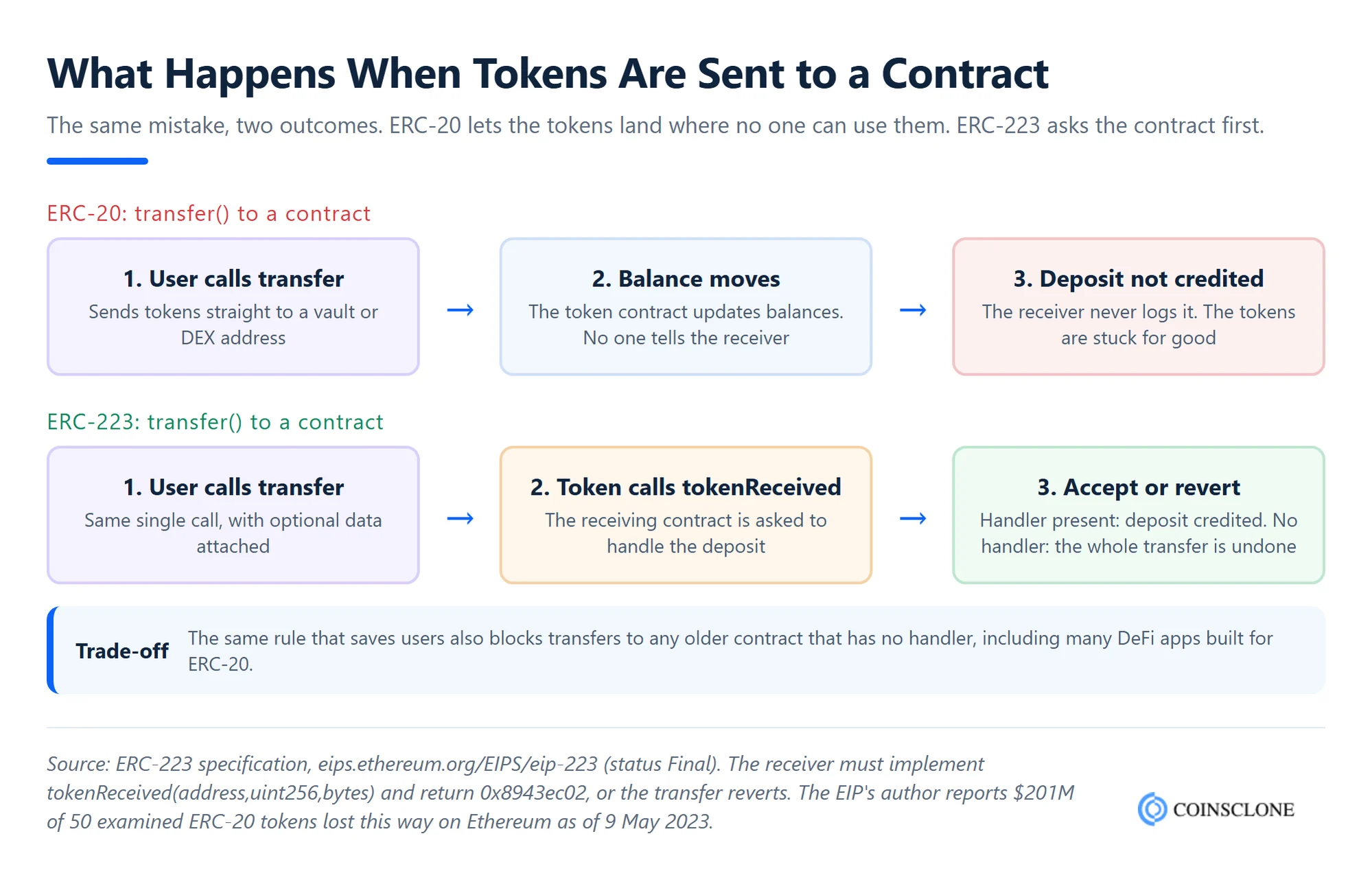
The problem this solves is real. The ERC-223 text reports that, as of 9 May 2023, about $201 million worth of 50 checked ERC-20 tokens had been lost on Ethereum by being sent to contracts that could not handle them. That figure comes from the standard’s author, so treat it as a careful estimate rather than an audited total.
ERC223 vs ERC20: Key Differences
Both standards create fungible tokens on Ethereum and other EVM chains. The table below shows where they differ.
| Point | ERC-20 | ERC-223 |
| Status on eips.ethereum.org | Final (2015) | Final (moved to Final 6 Sept 2023) |
| Sending to a contract | Tokens can land without being credited | Contract must accept via tokenReceived, or the transfer reverts |
| Depositing into a dApp | Two calls: approve, then transferFrom | One call: transfer |
| Gas for a deposit | transferFrom alone is about 75,000 gas, plus an approve call | About 54,000 gas in one transaction |
| Data with a transfer | Not supported | Optional data field |
| approve and transferFrom | Required | Optional |
| Wallet, exchange and DeFi support | Near universal | Limited; check each partner |
| Library support | OpenZeppelin, every major toolkit | Reference code from the author |
Gas figures are the estimates given in the ERC-223 standard. They vary with your contract code.
Is ERC223 backward compatible with ERC20? Only partly. The two-argument transfer and the balance functions match, so a wallet can show balances and send tokens to normal addresses. But the three-argument transfer is not part of ERC-20, and any ERC-20-style contract without a tokenReceived handler will reject ERC223 deposits. The ethereum.org page lists “not backward compatible with ERC-20” as a limit.
Should You Build on ERC223?
ERC-223 is not the only fix for lost deposits. ERC-1363 (also Final) keeps the ERC-20 functions as they are and adds transferAndCall, which calls the receiver. You get much the same safety and current tools still work. Use the tree below to pick a path.
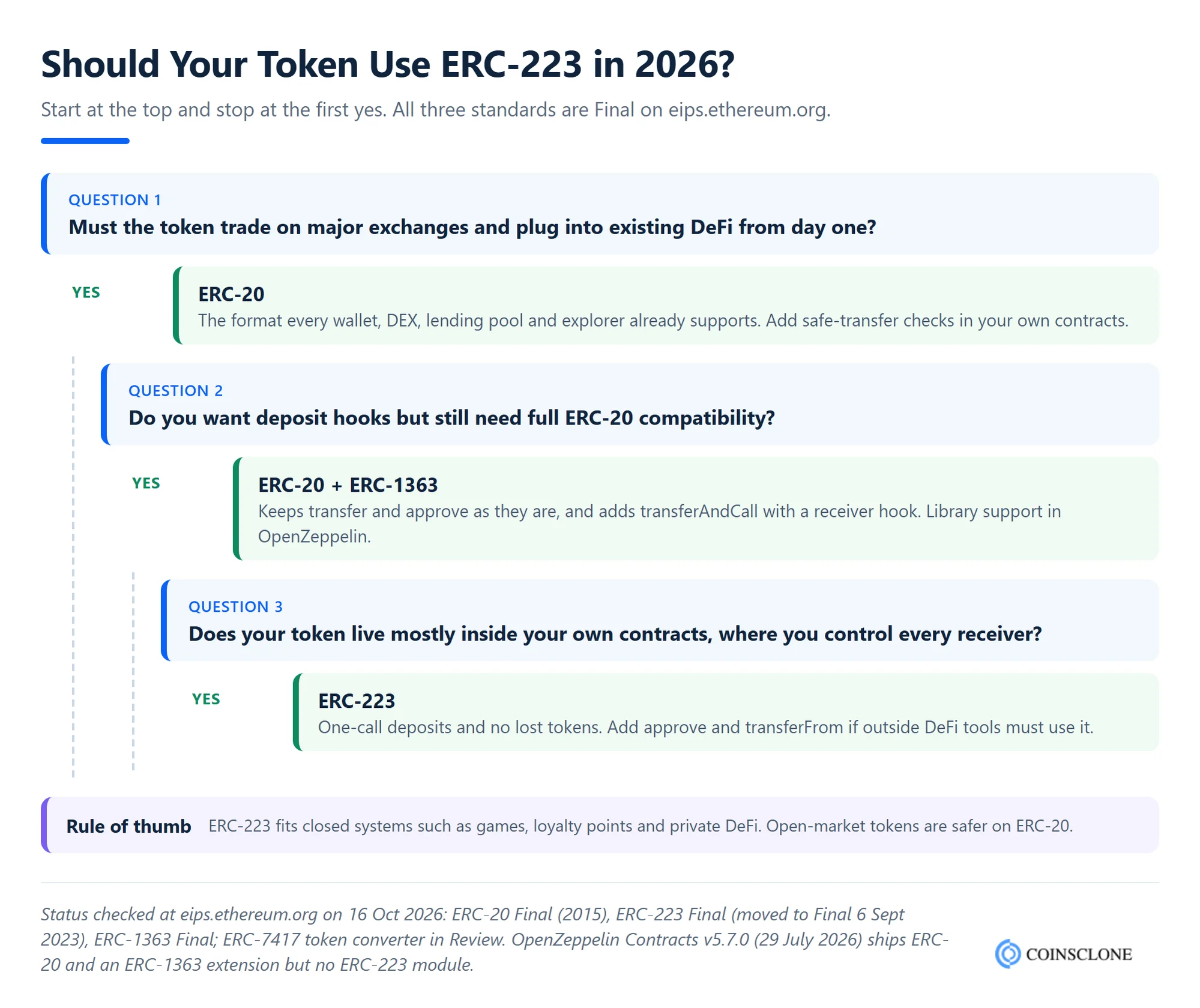
If you are unsure, a short call with our team can map your use case to the right standard. Read our guide to ERC token standards for the wider picture.
Types of ERC223 Tokens We Develop
Ethereum tokens serve many money, voting and platform needs. Here are the common types businesses build, and how ERC-223 fits each.
- Utility Tokens: These give access to services, features or apps on a network. ERC-223 suits them well when the token is spent mostly inside your own contracts.
- Governance Tokens: These let holders vote on upgrades, spending and rules. A DAO contract can receive votes or deposits in one call.
- Payment Tokens: These move value on a blockchain. The optional data field lets each payment carry an order or invoice reference.
- Asset-Backed Tokens: These stand for real things like land, gold or a song’s rights. Many people can own a share, and every transfer is on record. Regulated assets often need permission rules too, so many teams pair them with standards such as ERC-3643.
- Stablecoins: A stablecoin is tied to a normal currency like the US dollar, or to an asset like gold. Firms use these to pay and keep books. Note that the major stablecoins today are ERC-20.
- Deflationary Tokens: These cut supply over time through a burn rule, to reward long-term holding.
- DeFi Tokens: These power staking rewards, lending and liquidity inside DeFi networks. One-call deposits make staking simple for users.
- Reward and Incentive Tokens: These pay users for staying, inviting friends and taking part, and keep them coming back.
- Crowdfunding Tokens (ICO / IDO / IEO): These help projects raise funds on-chain with set supply, allocation and distribution rules.
Our Token Development Approaches
At Coinsclone, we follow different approaches to create an ERC223 token, depending on your business goals and how your team works.
Development from Scratch
In this method, your token is designed and built from the ground up. In the design phase, we set the business rules, token model, safety rules and links to other apps before we write any code. This model suits businesses that need custom behavior and long-term growth.
Hire Token Developers
Alternatively, businesses can hire our token developers to build secure tokens on the ERC223 standard. This approach gives you more control over timing and technical ownership. Your in-house team directs the work, while our developers bring their token experience to the build.
Core Features of ERC223 Token Development
The features below shape how an ERC223 token behaves on a live network. Here are the key ones we build into our ERC223 tokens.
- Recipient Checks: Each transfer to a contract calls tokenReceived first. If the contract cannot handle the token, the transfer reverts and the sender keeps the funds.
- One-Call Deposits: Users pay into staking pools, vaults or games with one transfer and no extra approval step.
- Transfer Data: Each transfer can carry data, such as an order ID or an instruction for the receiving contract.
- Smart Contract Automation: Transfers, reward payouts and rule checks run in the contract in real time. This cuts manual work and human error.
- ERC-20-Style Interface: Name, symbol, decimals, balances and the basic transfer match ERC-20, so wallets can show balances with little extra work.
- Optional Approve and TransferFrom: We can add these functions when your token must work with DEXs or lending pools built for ERC-20.
- Custom Tokenomics: Supply, minting, burning and distribution are set to match your model.
- Staking and Rewards: Built-in staking and reward logic makes incentive programs easier to run.
Security Features of ERC223 Token Development
Security matters at every layer of a token. Our ERC223 builds cover the risks that come with the standard itself, plus the launch controls many projects ask for.
Standard-level protections:
- Re-entrancy Guards: The tokenReceived call runs code in a second contract. We update balances before that call, as the standard advises, and add re-entrancy guards where needed.
- Token Filters in Receivers: Inside tokenReceived, the caller is the token contract. Receiver contracts check that address so they only accept the tokens they expect.
- Contract Detection Limits: The reference code checks code size to tell contracts from wallets. That check can fail while a contract is still being deployed, so we test that edge case.
- Replay Checks: The standard warns that its ether-like model means replay issues must be considered, so signed actions get nonces and chain IDs.
Optional launch controls:
- Anti-Whale Protection: Caps the size of trades by large holders so they cannot push the price around.
- Anti-Bot / Anti-Sniper: Stops bots from grabbing tokens at launch or in the first trades.
- Liquidity Lock: Locks liquidity for a set period to prevent a sudden pull of funds.
- Blacklist / Whitelist: Controls which addresses can send or receive the token.
- Front-Running Protection: Makes it harder to jump ahead of buyers and skew the price at launch.
- Max Slippage Control: Limits how far the price can move on a single buy or sell, to protect users.
- Auto-Liquidity Addition: Adds part of each trade to liquidity pools to support a stable market.
- Price Impact Limiter: Limits sharp price swings caused by large trades.
Every token we ship goes through a security review and testing before mainnet. For tokens that will hold a lot of value, we also advise an outside audit.
Challenges and Limits of ERC223
A fair guide has to cover the downsides too. These are the main ones to plan for.
- Limited Exchange and Wallet Support: Most centralized exchanges and wallets are built and tested around ERC-20. Before you commit, confirm with each exchange or wallet partner that it can handle your token.
- DeFi Compatibility: Many DEXs and lending pools pull tokens with approve and transferFrom, and their contracts have no tokenReceived handler. A pure ERC223 token cannot be deposited into them.
- Explorer and Indexer Gaps: The Transfer event carries an extra data field. Tools that only track the ERC-20 event may show your transfers late or not at all.
- Fewer Ready-Made Libraries: OpenZeppelin Contracts has no ERC-223 code, so teams start from the author’s sample code and must test it well.
- New Attack Surface: The receiver call adds a code path that plain ERC-20 does not have, which is why re-entrancy checks and audits matter.
The usual fix is a hybrid design: ERC-223 transfers for your own contracts, plus approve and transferFrom so outside DeFi tools still work. We help you pick the right mix in the planning stage.
Use Cases of ERC223 Token Development
Businesses use ERC223 tokens in many settings. ERC-223 works best where your own contracts receive most transfers. Here is how it applies.
- Crowdfunding: An ERC223 token can take funds in an ICO, IDO or IEO, so buyers do not lose tokens by sending them to the wrong contract.
- Staking and Yield Farming: Users stake tokens in one transfer and receive rewards from your own staking contracts.
- Loyalty and Rewards Systems: Brands send rewards to buyers on their own and track them with no lost transfers.
- In-Game Assets and Upgrades: In games, an ERC223 token can serve as the in-game currency for items and upgrades, and game contracts can safely receive it.
- Voting and DAO Governance: A DAO contract can accept tokens for voting or deposits in one call, with each vote tied to the transfer.
- Smart Contract Payments: Payments to contracts only go through when the contract can receive them, and the data field can carry the invoice reference.
- Asset-Backed Utility Tokens: ERC223 tokens can give secure access to assets through smart contracts.
- Access and Subscription Models: Tokens can control access to tools, networks or content through access contracts.
- Private DeFi Platforms: In a closed DeFi system where you write every contract, ERC-223 gives contract-to-contract transfers without the risk of lost tokens.
- Education and Research Platforms: ERC223 tokens can unlock courses, research data, online books and live classes.
Benefits of Creating an ERC223 Token
At Coinsclone, we focus on giving our clients real value. Here is what an ERC223 token offers when it fits your use case.
- Prevents Accidental Token Loss: Tokens sent to a contract that cannot handle them bounce back instead of getting locked forever.
- Safer Smart Contract Interactions: Contracts know when tokens arrive and how many, so each deposit is counted right.
- Lower Gas for Deposits: One transfer replaces the approve and transferFrom pair. The standard estimates about 54,000 gas for a deposit, against about 75,000 gas for ERC-20’s transferFrom step alone.
- Payments With Context: The data field lets you attach references or instructions to each transfer.
- Familiar Interface: Balances, names and basic transfers work the way ERC-20 users expect.
- Better User Experience: Fewer failed or lost transfers mean fewer support tickets and more trust in your token.
Profit-Making Opportunities of Creating an ERC223 Token
Through ERC223 token development, you can earn from several channels. Let us look at the main ones.
- Fundraising: Teams can raise funds through ICOs and IDOs for their ERC223 token.
- Power a dApp With a Native Token: Users spend or stake your token to perform actions in your dApp.
- Governance and Voting Rights: Token holders take part in decisions, which keeps users engaged for longer.
- Earn Transaction Fees: Your contracts can charge small fees on token-driven actions.
- Grow Your User Base: Token rewards attract, retain and engage users, which grows your community.
- Long-Term Earnings With Real Utility: Tokens with a clear purpose hold value better than tokens built for speculation alone.
Industries We Assist With ERC223 Token Development
At Coinsclone, we cover a range of sectors with our industry experience in ERC223 token development.
- FinTech and Digital Payments: Our ERC223 tokens allow secure, programmable payments with fewer failed transfers.
- Supply Chain and Logistics: We support clear tracking of goods, proof of ownership and contract-based transfers across many parties.
- Art and Collectibles: Tokens prove who owns a piece and where it came from, and let people share or trade it safely.
- Real Estate: We make it easy to split a building into tokens, so many people can own a share, with smart contracts for clear sales.
- Gaming: We help games run their economy with tokens for assets, rewards and ownership.
- Metaverse and Virtual Worlds: ERC223 tokens manage virtual currency, access rights and trade in virtual worlds.
- Ed-Tech: Users access courses, certificates and learning platforms through token-based access.
- Sports and Fitness: Clubs and fitness centres can build membership programs on tokens.
- Healthcare: We help healthcare teams build token-based apps that control who can access data.
- Agriculture: ERC223 tokens help track goods and ownership records, and bring more clarity to farm supply chains.
- Entertainment and Media: Tokens manage content access, royalty payouts and creator funding.
Tech Stack for ERC223 Token Development
Here are the tools we typically use to build and ship an ERC223 token.
- Language: Solidity 0.8.x, starting from the sample code linked in the ERC-223 standard.
- Frameworks: Foundry or Hardhat for building, unit tests and fuzz tests; Remix for quick checks.
- Libraries: OpenZeppelin Contracts for access control, re-entrancy guards and any ERC-20 functions you add.
- Networks: Ethereum or an EVM chain such as BNB Chain, Polygon, Arbitrum or Base. We test first on a public test chain like Sepolia.
- Verification: Source code verified on the chain’s block explorer so users can read the contract.
- Front end: ethers.js or viem for wallet connections and transfers with data.
Our ERC223 Token Development Process
Here are the key steps we follow to develop an ERC223 token.
1. Ideation
We first study your needs and how people will use the token. We also check which exchanges, wallets and DeFi apps you need, since this decides whether you need pure ERC-223 or a hybrid design.
2. Design and Tokenomics
We plan how many tokens will exist, how they will be shared out and how they will be used over time. We build security and long-term health into every phase.
3. Smart Contract Development
We build ERC223 smart contracts with the tokenReceived checks, any extra ERC-20 functions, and the receiver contracts your platform needs.
4. Security Review
We add access control and transfer checks, then review the code for re-entrancy, receiver filtering and other risks. For tokens that will hold a lot of value, we advise an outside audit as well.
5. Testing
We test the token on a testnet against the wallets, dApps and smart contracts you plan to use, including transfers that should fail.
6. Launch and Post-Launch Support
After testing, we deploy the ERC223 token on mainnet, verify the code and stay with you for ongoing technical support.
ERC223 Token Development Cost
Cost depends on how much you build around the token. A basic ERC223 contract is a small piece of work. Receiver contracts, staking, vesting, a hybrid ERC-20 layer and exchange testing take more time.
Published 2026 agency cost guides put a standard ERC-20 or BEP-20 token at about $5,000 to $15,000 to build, and a feature-rich token with staking or vesting at about $20,000 to $80,000. Published 2026 audit price guides put a simple token audit at roughly $5,000 to $15,000, with complex DeFi systems far higher. An ERC223 token usually lands in the same ranges, with extra testing for wallet and DeFi compatibility. For a full breakdown, read our guide to the cost to create a crypto token.
If your token must reach the widest market, our ERC20 token development service may fit better, and we can add deposit hooks through ERC-1363.
Why Choose Coinsclone for ERC223 Token Development?
Coinsclone is a leading crypto token development company. We have been building since 2018 and have delivered 350+ platforms for 200+ clients across 20 industries. Our team guides you through each phase and works closely with your own staff. We keep up with the latest threats, so safe code is how we always work.
Whether you want to create an ERC223 token or launch a wider token project, a free consultation awaits. As an Ethereum token development company, we also build ERC20, ERC721, ERC1400, ERC827 and ERC865 tokens with the same care.
Launch your own token and secure your place in the crypto market.
Frequently Asked Questions
1. What is ERC223 token development?
ERC223 token development is the creation of Ethereum tokens using the ERC-223 standard. The token calls tokenReceived on any receiving contract, and the transfer reverts if the contract cannot handle it. This stops tokens from getting stuck in contracts.
2. How is ERC223 different from ERC20 tokens?
ERC223 tokens reject transfers to contracts that have no tokenReceived handler, and they let users deposit into a contract with one transfer. ERC-20 tokens sent to a contract with the plain transfer function are not credited and can be locked forever. ERC-20 is far more widely supported.
3. Why is ERC223 considered safer than ERC20?
ERC223 is safer for contract deposits because the receiving contract must accept the tokens. If it cannot, the transaction fails and the sender keeps the tokens. It does not remove other risks, so the contract still needs testing and a security review.
4. Where are ERC223 tokens commonly used?
ERC223 tokens fit closed systems where your own contracts receive most transfers, such as games, loyalty programs, staking pools, DAOs and private DeFi platforms. Open-market tokens that need wide exchange and DeFi support usually use ERC-20.
5. Is ERC223 compatible with Ethereum wallets?
Partly. Wallets can usually show ERC223 balances and send the token to normal addresses, because those functions match ERC-20. Sending to contracts, reading transfer data and listing the token on exchanges need support from each wallet or platform, so test with every partner before launch.
6. Can ERC223 tokens interact with DeFi applications?
Yes, if the DeFi contracts include a tokenReceived handler. Most DEXs and lending pools are built for ERC-20’s approve and transferFrom. So many teams add those two functions to their ERC223 token to keep it working in DeFi.
7. How long does ERC223 token development take?
The core contract can be written in days. Planning, receiver contracts, tests with wallets and dApps, and a code review often take a few weeks in all. Timelines grow with features like staking, vesting or a hybrid ERC-20 layer.
8. Why work with an ERC223 token development company?
An expert team makes sure the transfer rules, receiver contracts and safety checks are done right. It also tests the token with the wallets, exchanges and dApps you need, which is where most ERC-223 projects run into trouble.
9. Are ERC223 tokens safe to use?
The standard itself is Final and its design prevents one common type of token loss. Safety still depends on the code, so guards, well-built receiver contracts and tests all matter. Users should also check that the token’s contract is verified and reviewed.
10. What tools are used to develop ERC223 tokens?
Teams most often write ERC223 tokens in Solidity using the sample code from the standard, then build and test with Foundry or Hardhat. Remix is handy for quick checks, and OpenZeppelin Contracts supplies access control and re-entrancy guards.
Build Smarter Tokens with Our ERC223 Development Expertise
ERC-712 Token Development — done right.
- Advanced Token Standard : Create efficient, secure ERC223 tokens compatible with existing ERC20 ecosystems.
- Seamless Transfers : Prevent token loss with the improved transfer mechanism of ERC223.
- Smart Contract Integration : Built for DeFi, exchanges, and tokenized assets with full EVM compatibility.
- Custom Branding & Utility : Your design, your utility model, your ecosystem.
See a free token demo in 48 hours — before you invest a cent.
Book a Free Consultation to discover how our ERC223 Token Development Company can help you launch your next-gen token in just 2–4 weeks.