
ERC712 token development is the work of adding EIP-712 typed data signing to a token or a Web3 app. ERC712 is not a new kind of token. It is the Ethereum rule for how wallets sign clear, structured messages, so users can read what they approve before they sign. This guide explains what ERC712 really is, how a signature is built and checked, and where it powers real products in 2026.
You will also see the risks that come with signed approvals, the build steps, the related standards and what a launch costs. By the end, you will know whether your token or dApp needs ERC712 and how to add it safely.
In this guide:
- What ERC712 (EIP-712) is, and why it is a signing standard rather than a token standard
- How the domain separator, type hash and nonce keep each signature safe
- Where ERC712 runs today: ERC-2612 permits, Uniswap’s Permit2, OpenSea’s Seaport and DAO votes
- The phishing risks, with 2025 loss data, and how to design around them
- The build process, related standards and real cost ranges
See How Our MVP System Can Launch Your ERC-712 Project Faster
ERC-712 Token Development — done right.
- MVP System : Build and deploy custom ERC-712 tokens 90% faster.
- Smart Contract Integration : Secure and scalable token architecture for real-world use cases.
- Brand & Customization : Your token name, your features, your ecosystem.
- Revenue Engine : Enable trading, royalties, and interoperability across DeFi and NFT platforms.
See a free branded demo of your ERC-712 token project in 48 hours — before you invest a cent.
Book a Free Demo to discover how our ERC-712 Token Development Company can take you from concept to live deployment in just 2–4 weeks.
What Is ERC712 (EIP-712)?
ERC712 is the common name for EIP-712, the Ethereum standard for “typed structured data hashing and signing.” It was created on 12 September 2017 by Remco Bloemen, Leonid Logvinov and Jacob Evans, and its status is Final. It is filed as an Interface standard, not as an ERC token rule.
In plain words, EIP-712 lets an app ask a wallet to sign a message made of named fields, such as owner, spender, amount and deadline. The wallet shows those fields to the user in readable form. Before EIP-712, users were often asked to sign a long string of hex that told them nothing. That is called blind signing, and it made phishing easy.
So why do people say “ERC712”? The idea was first shared by the 0x team as “ERC-712” and used in 0x Protocol v2. The name stuck in search, even though the official title is EIP-712.
ERC712 token development, then, means building a token or dApp whose smart contracts accept EIP-712 signatures. The token itself still follows ERC-20, ERC-721 or ERC-1155. EIP-712 adds a safe way to approve actions off-chain, such as a gasless approval, a marketplace listing or a governance vote.
How ERC712 Signing Works
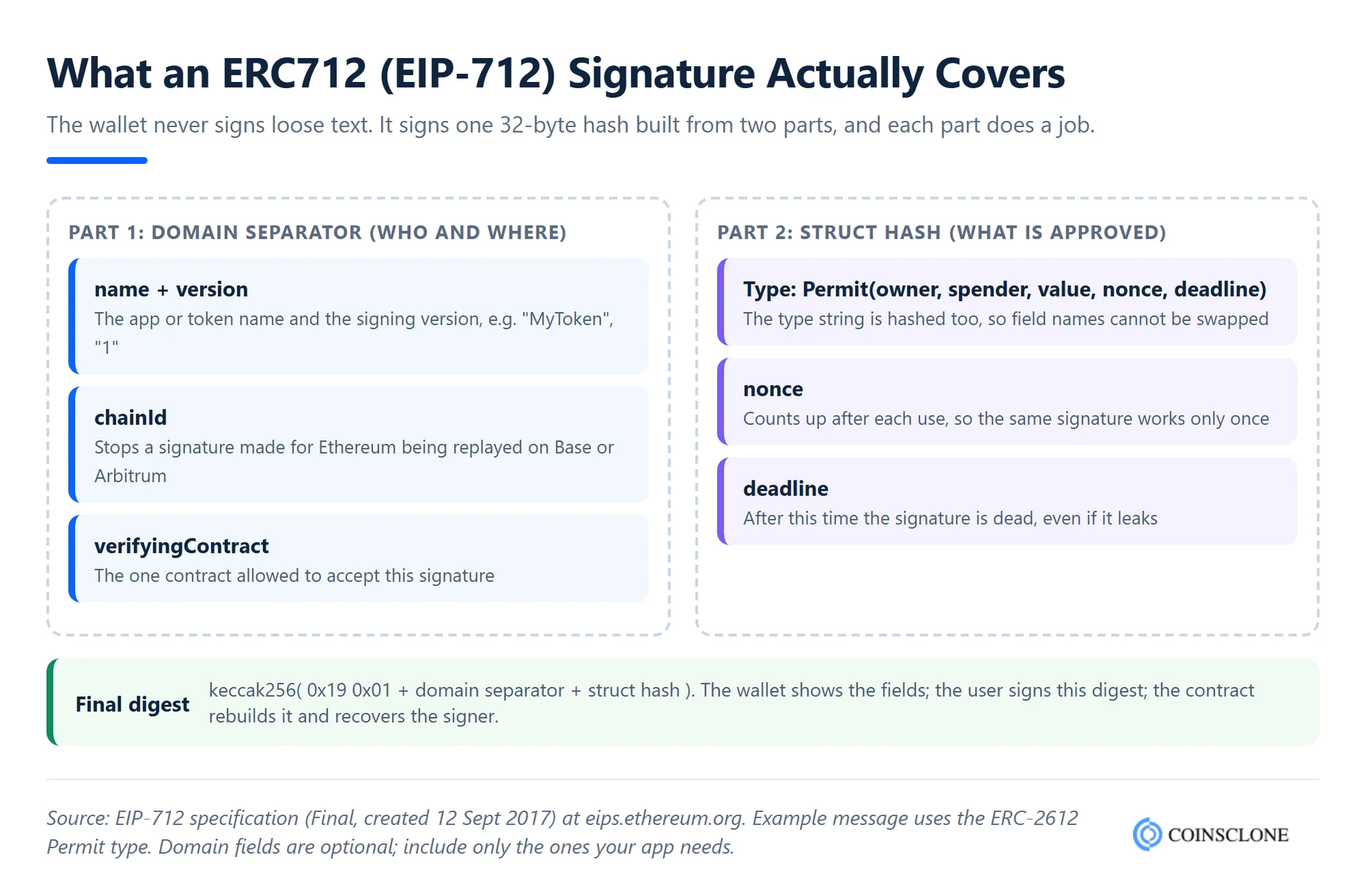
Every EIP-712 signature covers one 32-byte hash. That hash is built from two parts, and each part has a clear job.
- Domain separator: This says who the signature is for and where it can be used. It can hold the app name, a version, the chain ID, the contract address and an optional salt. Because the chain ID and contract are inside, a signature made for one app on Ethereum cannot be used again on a second app or chain.
- Struct hash: This says what the user is approving. The app defines a type, for example `Permit(address owner,address spender,uint256 value,uint256 nonce,uint256 deadline)`. The type string is hashed along with the values, so no one can swap field names or meanings.
- Final digest: The wallet joins the prefix `0x19 0x01`, the domain separator and the struct hash, then hashes them with keccak256. The user signs that digest with their private key.
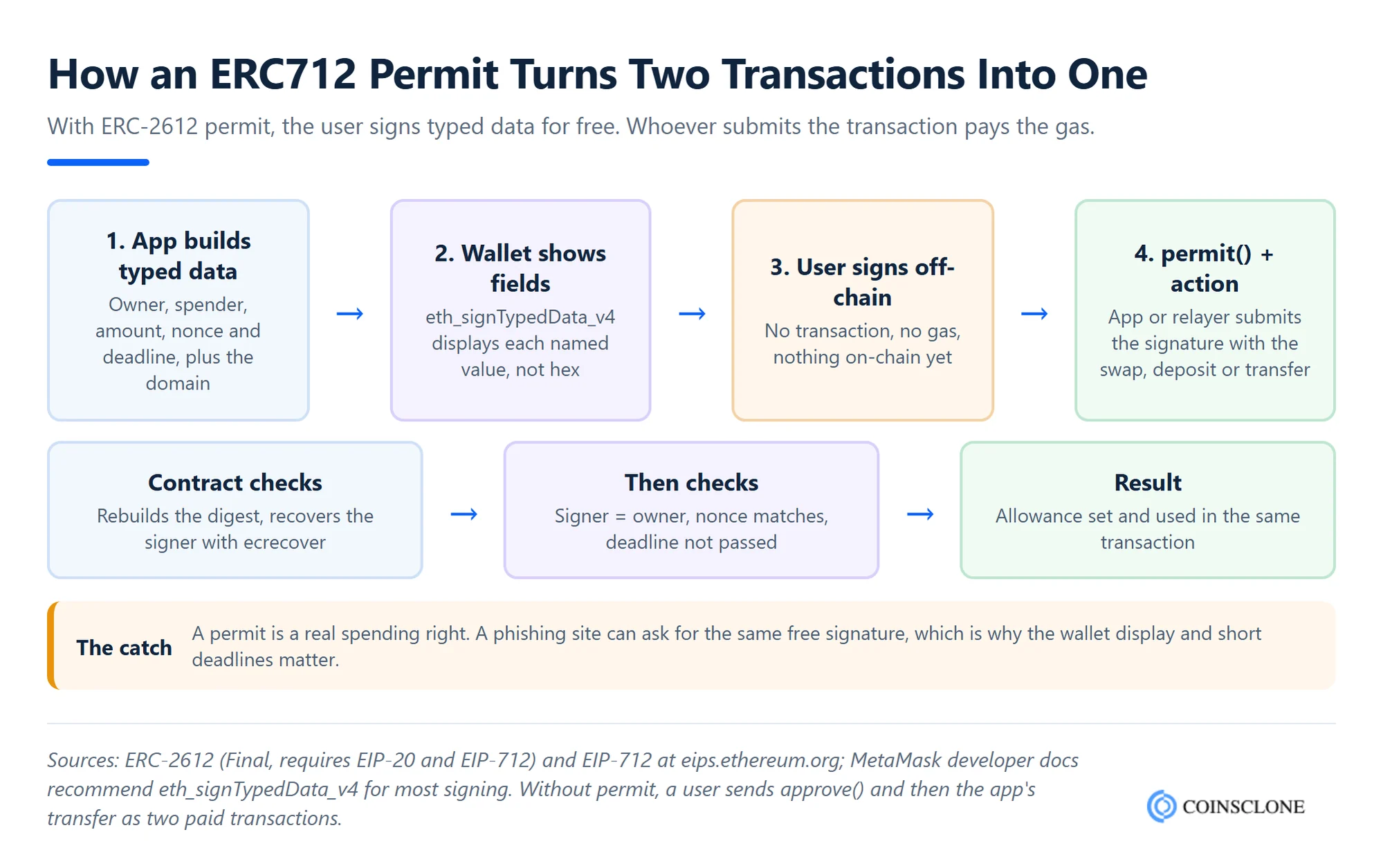
On-chain, the contract rebuilds the same digest from the values it receives. Next, it uses `ecrecover` to find the address that signed it. If that address matches the owner, and the nonce and deadline are valid, the action goes through.
On the wallet side, apps call `eth_signTypedData_v4`. MetaMask’s developer docs suggest this method for most signing, and they mark the old `eth_sign` method as deprecated.
ERC712 vs eth_sign vs personal_sign
Ethereum wallets have three common ways to sign a message. EIP-712 is the only one built for structured data that a contract will act on.
| Method | What the user sees | Safe for on-chain actions? | Best use |
| `eth_sign` | A raw hash in hex | No, deprecated in MetaMask | Legacy apps only |
| `personal_sign` (EIP-191) | Plain text | Limited, no typed fields | Sign-in messages, simple proofs |
| `eth_signTypedData_v4` (EIP-712) | Named fields with values | Yes, with domain, nonce and deadline | Permits, orders, votes, meta-transactions |
In short, `personal_sign` is fine for “sign in with your wallet.” When a signature moves money or changes rights, EIP-712 is the right tool.
Where ERC712 Is Used in 2026
EIP-712 is now one of the most used signing standards in Ethereum. Here are the places you meet it most often.
- ERC-20 permits: ERC-2612 (Final, created April 2020) adds a `permit` function to ERC-20 tokens. Users sign an EIP-712 message instead of sending a paid `approve` transaction.
- Uniswap Permit2: Permit2 brings signed approvals to any ERC-20 token, even old ones without `permit`. It offers single-use signed transfers and allowances that end on a set date.
- NFT marketplace orders: OpenSea’s Seaport protocol has sellers sign orders as typed EIP-712 data. Its documentation adds bulk listings, where one signature covers many orders.
- DAO voting: Voting systems let holders sign votes off-chain or hand their voting power to others by signature, so voters do not pay gas for each ballot.
- Meta-transactions and gasless apps: A relayer submits the user’s signed request and pays the gas.
- Smart contract wallets: Multisig and smart account wallets check signatures through ERC-1271 (Final), which works with EIP-712 messages.
Each of these uses the same core idea: the user agrees to something specific off-chain, and the contract proves it on-chain.
Our Token Development Approaches
Coinsclone offers two simple ways to launch an ERC712-ready token or dApp. Choose Development from Scratch for a custom, ready-to-use product, or Hire Our Developers to add expert talent to your team.
Development from Scratch
We build your token and its signing logic from the ground up. That covers the token standard, the EIP-712 domain, typed data schemas, permits and the front-end signing flow. You get a ready-to-use product that matches your business goals and has been tested across major wallets.
Hire Token Developers
Hire our skilled developers as a full team or one at a time. They can add EIP-712 permits, signed orders or gasless flows to a token or dApp you already run.
Both paths put your project on a solid footing. Next, let’s look at the features a good build includes.
Core Features of ERC712 Token Development
EIP-712 changes how users approve actions, not what the token is. A strong build pairs a standard token with these signing features.
- Typed Data Schemas: Clear structs for each action, such as Permit, Order or Vote, with field names users can understand.
- Domain Separator Setup: A domain with name, version, chain ID and contract address, so signatures cannot be replayed on other apps or chains.
- Nonces and Deadlines: Each signature works once and expires on time. This limits the damage if a signature leaks.
- ERC-2612 Permit Support: Gasless approvals for ERC-20 tokens, so users can approve and act in one transaction.
- Smart Wallet Support: Checks through ERC-1271, so multisig and smart account users can sign too.
- Domain Discovery: The `eip712Domain()` function from ERC-5267 (Final), so wallets and apps can read your domain and build the right message.
- Enhanced Human-Readable Security: Wallets show clear, readable fields instead of hex codes, which cuts the risk of phishing and mistakes.
Most teams build on OpenZeppelin Contracts, whose `EIP712` contract handles the domain separator and final digest. Your team still writes the struct hashes and the checks around them.
Use Cases of ERC712 Token Development
The real value of EIP-712 is that it ends blind signing. By turning complex code into readable messages, it lets users know what they authorize. That makes high-stakes actions safer and faster.
- Crowdfunding: Backers sign gasless pledges and token approvals, which lowers the barrier for small contributors.
- Equity Tokenization: Holders sign clear ballots for votes and payouts, which makes company voting simple.
- Revenue-Sharing Models: Holders give verified consent to profit splits and can claim their share with a signed request.
- Token Swaps and DeFi Deposits: Users approve and swap in one step with a permit, instead of two paid transactions.
- NFT Listings: Creators list or sell items with one signature and pay gas only when a sale happens.
These use cases do more than modernize your operations. They also bring clear gains for your firm.
Benefits of Creating an ERC712 Token
Adding EIP-712 to your token gives your project an edge. It joins strong safety with a smooth user flow.
- Higher Conversion Rates: Users see clear, readable messages instead of confusing code when they sign. They feel confident and finish the action.
- Lower User Costs: With permits and relayers, users can approve actions without paying gas upfront. The platform or the next transaction covers the fee, which makes it easier for new users to start.
- Less Fraud and Phishing Risk: Users can see what they are signing before they approve. That helps them spot hidden or unclear details.
- Better Compliance and Record Keeping: Each signature is tied to one app and one network. This prevents misuse and leaves clear records for audits and reviews.
Because of these gains, EIP-712 is now a default choice for fields that need both safety and clear terms.
Industries We Assist with ERC-712 Token Development
EIP-712 suits any field that values clear consent and lower costs. We help businesses add it to build trust and make user actions simpler.
- Finance & Banking: Readable transaction approvals let users check transfer details in plain text before signing.
- Venture Capital & Private Equity: Backers sign fund pledges and resale trades without paying gas first.
- Entertainment & Media: Creators claim royalties and sign license terms without gas, so their work is easier to manage and sell.
- Crowdfunding Platforms: Backers make gas-free pledges that are only processed on-chain once funding goals are met.
- Technology & Startups: Companies sponsor gas fees, which gives new users a smooth “Web2-style” start.
To help these industries succeed, any EIP-712 build also has to deal with one hard problem: signatures can be abused.
ERC712 Security Risks and How to Avoid Them
EIP-712 makes signing readable. It does not make every signature safe. A signed permit is a real spending right, and it costs the user nothing to give away. That is why attackers love it.
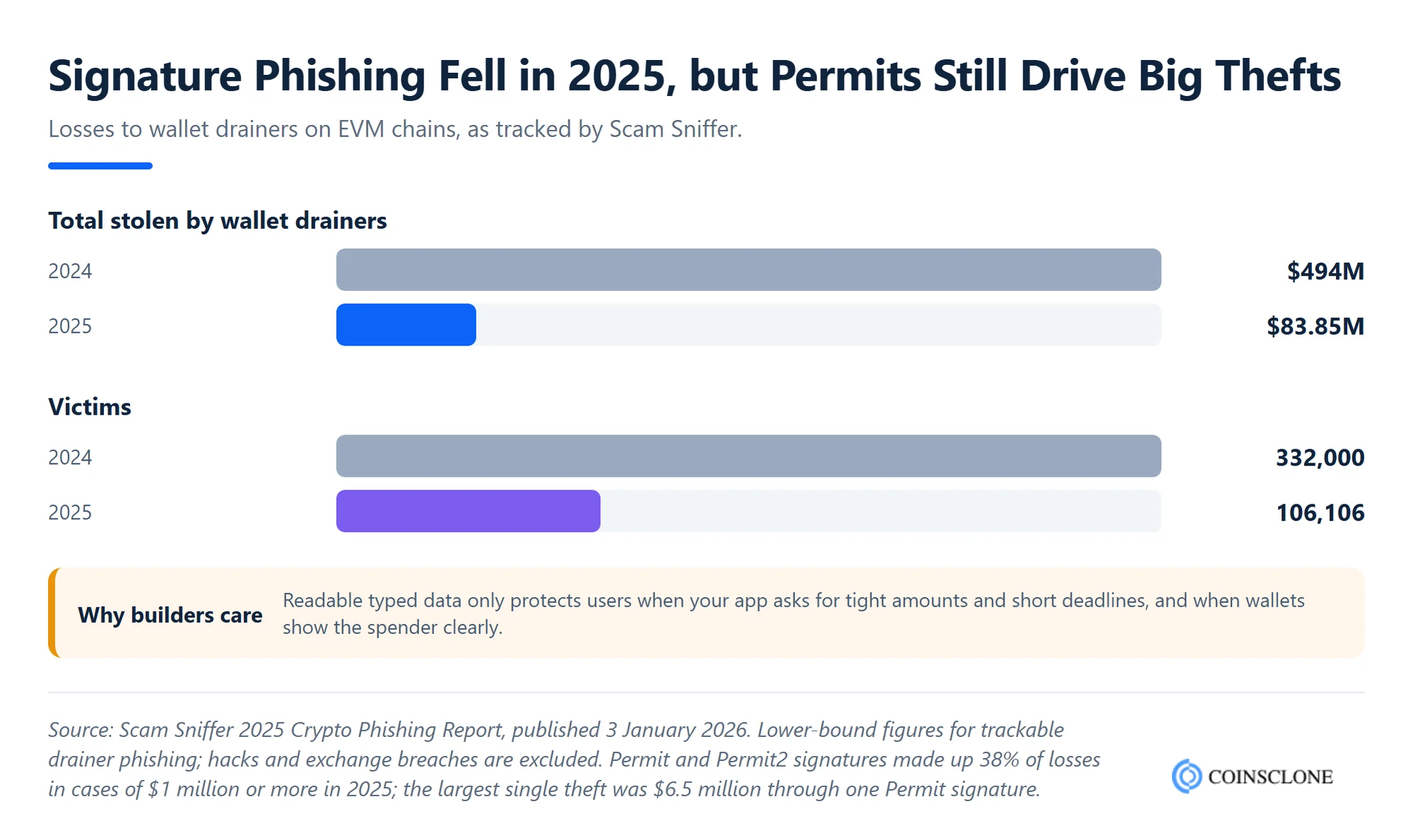
The numbers show the risk. The Scam Sniffer 2025 Crypto Phishing Report, published 3 January 2026, found that wallet drainers stole $83.85 million from 106,106 victims in 2025. That was down 83% from $494 million in 2024. Still, Permit and Permit2 signatures made up 38% of losses in cases of $1 million or more, and the largest single theft, $6.5 million in September 2025, came from one Permit signature.
Readable data also only helps when the screen shows the truth. In February 2025, attackers took about $1.5 billion from the exchange Bybit, a theft the FBI attributed to North Korea. Bybit said the signing screen was masked to show the right address while the contract logic underneath had changed. In other words, the signers approved something they could not truly see.
Here is how a good build reduces these risks:
- Ask for the least: Request exact amounts, not unlimited approvals, and set short deadlines.
- Use nonces every time: The spec does not add replay protection by itself. Your contract must track a nonce per user.
- Lock the domain: Always include the chain ID and contract address, and keep the name and version in sync between the contract and the front end. A mismatch is a common cause of failed signatures.
- Name fields clearly: Wallets can only show what you define. Use field names that a non-technical user understands.
- Check smart wallets correctly: Use ERC-1271 checks for contract wallets instead of assuming every signer is a plain address.
- Audit the signing logic: Have the signature checks, permit code and relayer paths reviewed before launch.
ERC712 and Related Standards
EIP-712 sits at the center of a small family of standards. Knowing their real status helps you pick the right ones.
| Standard | What it does | Status (eips.ethereum.org, Oct 2026) |
| EIP-712 | Typed structured data hashing and signing | Final |
| ERC-2612 | Permit: gasless approvals for ERC-20 tokens | Final |
| ERC-1271 | Signature checks for smart contract wallets | Final |
| ERC-5267 | Lets apps read a contract’s EIP-712 domain | Final |
| ERC-4494 | Permit for ERC-721 NFTs | Stagnant |
| ERC-7964 | EIP-712 signatures valid across chains | Draft |
Treat Stagnant and Draft proposals as ideas, not adopted standards. For a wider view of token rules, see our guide to ERC token standards.
Our ERC712 Token Development Process
Building an ERC712-ready token takes a clear process, so that each off-chain signature turns into a safe on-chain action.
- Requirement and Use Case Review: We find where EIP-712 signing is needed and how users will interact with the token or platform.
- Typed Data Design: We create clear data formats so users can see what they approve.
- Smart Contract Build: We write contracts that check EIP-712 signatures, nonces and deadlines on-chain.
- Wallet and User Testing: We test the signing flow across supported wallets so messages display correctly.
- Security Checks and Deployment: We review the signature logic, then deploy the contracts and connect them to your app.
ERC712 Token Development Cost
Cost depends on how much sits around the token itself. Adding EIP-712 permits to a standard token is a small part of the work. A full signing system with relayers, signed orders or gasless onboarding takes more time and testing.
Published 2026 agency cost guides put a standard ERC-20 or BEP-20 token at about $5,000 to $15,000 to build, and a feature-rich token with staking or vesting at about $20,000 to $80,000. Published 2026 audit price guides put a simple token audit at roughly $5,000 to $15,000, with complex DeFi systems far higher. For a full breakdown, read our guide to the cost to create a crypto token.
If you need help, Coinsclone builds ERC712-ready tokens and signing flows as part of its Ethereum smart contract development work.
Why Choose Coinsclone for ERC712 Token Development?
If you plan to add ERC712 signing to a token, Coinsclone, a trusted crypto token development company, turns hard business needs into sound tokens. With our skill in ERC-20, ERC-721 and ERC-1155 standards, your project stands out for its security and clean user experience.
We have been building since 2018 and have delivered 350+ platforms for 200+ clients across 20 industries. As a leading Ethereum token development company, we handle the full build at a fair cost and test it well. Partner with Coinsclone to launch a token whose signing flow your users can trust.
Frequently Asked Questions
1. What is ERC-712 token development?
ERC-712 token development means building Ethereum smart contracts that accept EIP-712 typed data signatures. Instead of signing unreadable hashes, users sign clear messages that show details like the amount, the contract and the purpose. This improves security and cuts signing mistakes.
2. What does an ERC712 token development company do?
An ERC712 token development company builds smart contracts and front ends that use EIP-712 signatures. This includes the domain setup, typed data schemas, permits, nonce and deadline checks, wallet testing with tools like MetaMask, and a security review of the signing logic.
3. Why is ERC-712 important for blockchain applications?
ERC-712 is important because it:
- Prevents blind signing
- Makes what you sign clear in wallets
- Reduces phishing and signature misuse when apps ask for tight amounts and deadlines
- Supports gasless, off-chain approvals
You will find it in DeFi permits, NFT marketplaces, DAO voting and gasless transfers.
4. How is ERC-712 different from ERC-20 or ERC-721?
ERC-20 and ERC-721 define token behavior, while ERC-712 defines how data is signed. ERC-712 works with token standards to allow secure message signing without an immediate on-chain transaction. This makes it a good fit for permits, relayers and gas-free flows.
5. Where is ERC-712 commonly used?
ERC-712 is widely used in:
- DeFi protocols (ERC-2612 permits and Uniswap’s Permit2)
- NFT marketplaces (signed listings and bulk orders)
- DAO governance voting
- Meta-transactions and gasless flows
Any app that relies on off-chain signatures benefits from ERC-712.
6. Is EIP-712 Ethereum-only, and does it work on Layer 2s?
EIP-712 started on Ethereum, but it works on any EVM chain, including BNB Chain, Polygon and Layer 2 networks such as Arbitrum and Base. The chain ID in the domain keeps a signature tied to one network. A draft proposal, ERC-7964, explores signatures that work across chains, but it is not yet adopted.
See How Our MVP System Can Launch Your ERC-712 Project Faster
ERC-712 Token Development — done right.
- MVP System : Build and deploy custom ERC-712 tokens 90% faster.
- Smart Contract Integration : Secure and scalable token architecture for real-world use cases.
- Brand & Customization : Your token name, your features, your ecosystem.
- Revenue Engine : Enable trading, royalties, and interoperability across DeFi and NFT platforms.
See a free branded demo of your ERC-712 token project in 48 hours — before you invest a cent.
Book a Free Demo to discover how our ERC-712 Token Development Company can take you from concept to live deployment in just 2–4 weeks.