
ERC20 and TRC20 are the two token standards behind most of the world’s USDT, and plenty of other tokens too. They look alike in a wallet and they share the same basic functions, yet they run on separate blockchains with their own fees, speeds and trade-offs. This ERC20 vs TRC20 guide lays out every difference that matters, using real network data from October 2026.
You will see what each standard is, how the fee models work in practice, how to tell which network your USDT is on, and what happens if you pick the wrong one. If you plan to launch a token of your own, the last part helps you choose the right standard for your business.
In this guide:
- A side-by-side table of ERC20 and TRC20 on fees, speed, security and addresses.
- Real October 2026 costs to send USDT on each network, worked out from on-chain data.
- How to check if your USDT is ERC20 or TRC20 before you send it.
- What to do if funds go to the wrong network.
- A simple decision tree for choosing a standard for your own token.
ERC20 vs TRC20: Which Token Standard Fits Your Project Best?
Crypto Token Development — done right.
- ERC20 (Ethereum):Proven, secure, and widely supported for DeFi and ICOs.
- TRC20 (Tron):Faster, lower fees, and ideal for high-volume transactions.
- Smart Contract Ready:Both support custom logic, staking, and DApp integration.
- Cross-Chain Flexibility:Launch tokens on Ethereum or Tron — your choice, your market.
See how ERC20 and TRC20 compare side by side — from cost and speed to ecosystem and liquidity.
Book a Free Consultation to discover which blockchain suits your token project best — Ethereum or Tron — and launch in just 2–4 weeks.
ERC20 vs TRC20: The Key Differences
The short answer: ERC20 is the token standard of the Ethereum blockchain, and TRC20 is the token standard of the TRON blockchain. TRC20 was built to match ERC20, so both offer the same core functions. The gaps come from the chains underneath them: how they reach agreement, how they charge fees, and how many apps and wallets support them.
Here is how the two compare at a glance.
| Point | ERC20 | TRC20 |
| Blockchain | Ethereum | TRON |
| Consensus | Proof of stake, open to any validator | Delegated proof of stake, 27 elected Super Representatives |
| Fee paid in | ETH (gas) | TRX (energy and bandwidth) |
| Cost to send USDT (Oct 2026) | About $0.03 to $0.40 | About $2.15 to $4.50 if TRX is burned; far less with staked energy |
| Block time | 12 seconds | 3 seconds |
| Final, cannot be reversed | About 13 minutes | About 1 minute |
| Address format | Starts with 0x, 42 characters | Starts with T, 34 characters |
| Smart contract language | Solidity or Vyper on the EVM | Solidity on the TVM |
| USDT on the chain (Oct 2026) | About $73.8 billion | About $92.4 billion |
| Best known for | DeFi, NFTs, listings, institutions | Low-friction USDT payments and transfers |
What is ERC20 Token?
An ERC20 token is a digital asset built on the Ethereum blockchain. ERC20 is a set of rules that every token contract follows, so wallets, exchanges and apps can work with any ERC20 token in the same way. The EIP-20 standard was proposed in 2015 and is still the most widely used token standard in crypto.
The rules cover the basics: total supply, each holder’s balance, transfers, and approvals that let an app move tokens on a user’s behalf. Because every ERC20 token speaks the same language, a new token can be traded on Uniswap, used as collateral on Aave or listed on a major exchange without custom work.
Some of the best known ERC20 tokens are Tether (USDT), USD Coin (USDC), Chainlink (LINK), Uniswap (UNI), Shiba Inu (SHIB) and Aave (AAVE). ERC20 tokens can also run on Ethereum layer 2 networks such as Arbitrum and Base, where fees are lower still. That reach is why many startups pick ERC20 token development for their crypto business.
Now that you know what ERC20 tokens are, let’s look at TRC20 tokens.
What is TRC20 Token?
TRC20 tokens are fungible tokens created on the TRON blockchain. TRON launched its own mainnet in 2018, and TRC20 copied the ERC20 interface so that tokens behave in the same way. A TRC20 token can be held, sent, traded and used in apps across TRON wallets, exchanges and DeFi platforms.
TRON’s selling points are fast blocks and flat, predictable fees. That made it the busiest chain for Tether: more USDT now sits on TRON than on any other network. TRON also supports TRC10, an older token type that needs no smart contract, but TRC20 is the standard that new projects use today.
Popular TRC20 tokens include USDT, USDD, JUST (JST), SUN, WINkLink (WIN) and BitTorrent (BTT). For firms that want cheap, fast payments, Tron token development is a good fit.
With both standards covered, let’s compare them point by point.
What is the Difference Between ERC20 and TRC20 Tokens?
ERC20 and TRC20 are token standards on two different blockchains. Both share the same core functions, so the real differences come from Ethereum and TRON themselves. Here is each point in detail.
Blockchain Network
ERC20: ERC20 tokens live on Ethereum, which uses proof of stake. Anyone can run a validator by staking ETH, which gives the network a large and open set of block producers. Ethereum also has the biggest DeFi scene and builder base of any smart contract chain.
TRC20: TRC20 tokens live on TRON, which uses delegated proof of stake (DPoS). TRX holders vote for 27 Super Representatives, who take turns producing blocks. The votes are counted every six hours. This small, elected group lets TRON run fast, but it also means fewer parties control block production.
Token Standard
ERC20: ERC20 is the first widely used fungible token standard, and many later standards borrow from it. It defines six core functions, such as `transfer`, `approve` and `balanceOf`, plus two events that apps listen for.
Also Read – create erc20 token
TRC20: TRC20 uses the same functions and events as ERC20. TRON’s developer docs describe it as fully compatible with ERC20 at the interface level. On top of the base rules, a project can add its own features in the smart contract, such as minting, burning, pausing or a transfer fee.
Transaction Speed
ERC20: Ethereum makes a new block every 12 seconds, so a transfer usually shows up within a block or two. A block is final, meaning it cannot be undone, after two epochs, which is about 13 minutes. Many exchanges credit ERC20 deposits after a set number of blocks, often a few minutes.
TRC20: TRON makes a new block every 3 seconds. A block becomes final once 19 of the 27 Super Representatives have built on it, which takes about one minute. That is why TRC20 deposits often land on exchanges faster.
Also Read – trc20 token development
Smart Contract Functionality
ERC20: ERC20 smart contracts run on the Ethereum Virtual Machine (EVM). Most are written in Solidity, and a few in Vyper. The contract holds the supply, the balances and the transfer rules, and it runs them exactly as written.
TRC20: TRC20 contracts run on the TRON Virtual Machine (TVM), which is built to be compatible with the EVM. Developers write them in Solidity too, using tools like TronIDE and TronBox. So an ERC20 contract can often be moved to TRON with small changes. The main extra work is tuning it to use less energy, since energy sets the fee on TRON.
Fee for Crypto Transactions
ERC20: Every ERC20 transfer pays gas in ETH. The cost depends on how busy the network is. In October 2026, the Etherscan gas tracker shows Ethereum gas near 0.2 gwei, so a USDT transfer costs only a few cents. When gas climbs, the fee rises with it.
TRC20: TRC20 transfers use two resources: energy for running the contract and bandwidth for the data. If you do not have them, the network burns TRX to cover the cost. Sending USDT on TRON burns about 6.4 TRX, or about 13 TRX if the receiver has never held USDT. Staking TRX gives you free energy, which can bring the cost close to zero. We break down the real numbers in the next section.
Interoperability
ERC20: ERC20 has the widest support in crypto. Almost all exchanges, wallets, DeFi apps and custody firms handle it, and so do hardware wallets. The same 0x address also works on Ethereum layer 2s and other EVM chains.
TRC20: TRC20 works with TRON wallets such as TronLink, with most major exchanges for USDT, and with TRON dApps like SunSwap and JustLend. DeFi on TRON is smaller than on Ethereum. Some issuers have also left: Circle stopped minting USDC on TRON in February 2024, so USDT is the stablecoin that matters there.
Token Address
ERC20: ERC20 addresses start with 0x followed by 40 letters and numbers, 42 characters in all. For example, the USDT contract on Ethereum is `0xdAC17F958D2ee523a2206206994597C13D831ec7`.
TRC20: TRC20 addresses start with a capital T and are 34 characters long. The USDT contract on TRON is `TR7NHqjeKQxGTCi8q8ZY4pL8otSzgjLj6t`. Like all blockchain records, TRON transfers cannot be changed or deleted once confirmed.
Security Factors
ERC20: Ethereum’s security comes from its large, open validator set and a long track record. ERC20 tokens are only as safe as their own smart contract, though, so audits matter. Bugs in a token contract, not in Ethereum, cause most token losses.
TRC20: TRON’s DPoS model is fast and stable, but control sits with 27 elected block producers. That is a smaller group than Ethereum’s, which some users and institutions see as a trade-off. As on Ethereum, the token contract itself must be audited.
One point applies to both: the USDT contracts on Ethereum and TRON let Tether freeze addresses. Tether uses this to block stolen or sanctioned funds.
Popular Examples
ERC20: USDT, USDC, Chainlink (LINK), Uniswap (UNI), Shiba Inu (SHIB), Aave (AAVE) and ApeCoin (APE).
TRC20: USDT, USDD, JUST (JST), SUN, WINkLink (WIN) and BitTorrent (BTT).
These are the main points that split the two standards. Fees deserve a closer look, because they have changed more than anything else.
ERC20 vs TRC20 Fees: What It Really Costs to Send USDT in 2026
Most guides still say ERC20 costs $10 to $50 per transfer and TRC20 costs under $1. In October 2026 that is no longer true. Ethereum fees have dropped a lot, while TRON’s fee is now set by a fixed energy price.
Here is how each fee works, using on-chain data from 2 October 2026.
- ERC20 fee = gas used x gas price x ETH price. A USDT transfer uses about 41,000 to 63,000 gas. At 0.3 gwei and ETH at $2,702, that is about $0.05. Wallets that add a large tip, say 2.2 gwei, pay about $0.37.
- TRC20 fee = energy used x energy price, plus bandwidth. A USDT transfer uses 64,285 energy if the receiver already holds USDT, or 130,285 if they do not. At TRON’s energy price of 100 sun (0.0001 TRX) per unit, that burns 6.43 TRX ($2.15) or 13.03 TRX ($4.37), with TRX at $0.335.
- Bandwidth: each TRC20 transfer needs about 345 bytes. Every account gets 600 free bandwidth a day, so the first transfer or so is covered. After that, it costs about 0.35 TRX.
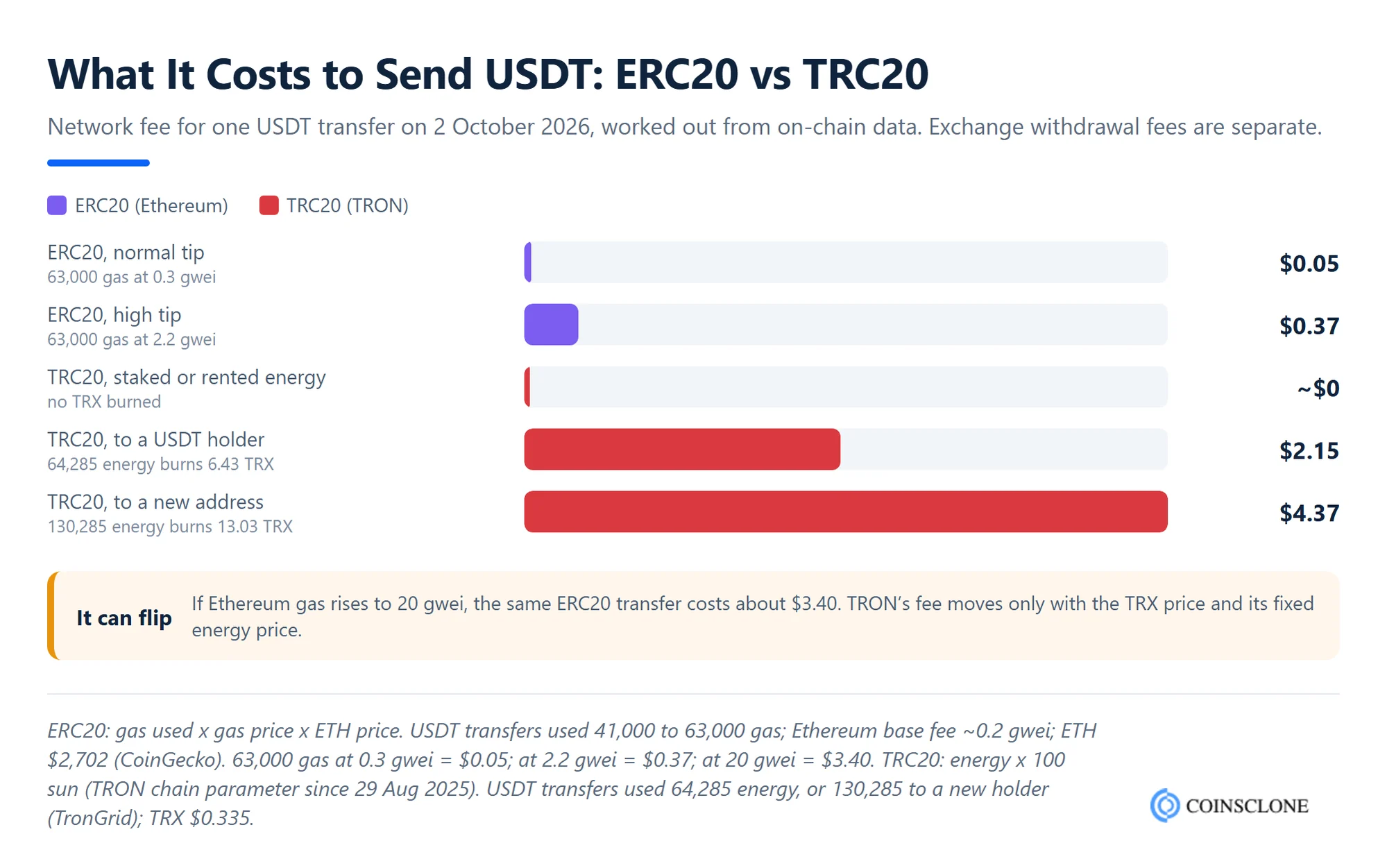
So which is cheaper? Right now, an ERC20 transfer usually costs less than a TRC20 transfer that burns TRX. But that can flip. If Ethereum gas rises to 20 gwei, the same ERC20 transfer costs about $3.40. TRON’s fee, by contrast, only moves with the TRX price and the energy price that its Super Representatives set. They cut it from 210 to 100 sun in August 2025.
TRON users also have ways to pay less. Staking TRX earns a daily energy quota, and many wallets rent energy from stakers for less than the burn cost. Since 2025, GasFree services in wallets like TronLink also let users pay the fee in USDT instead of TRX. Keep in mind that exchanges set their own withdrawal fees, which can differ from the network cost.
Similarities of ERC20 and TRC20 Tokens
ERC20 and TRC20 are standards, not single tokens, and they share the same core design. Both include:
- Total supply: Each token states how many units exist in total.
- Balance check: Anyone can look up the token balance of any address.
- Transfer: Holders can send tokens straight to another address.
- Approve and transferFrom: A holder can let an app, such as a DEX, move a set amount on their behalf. This is what makes DeFi work.
- Event logging: Both emit Transfer and Approval events, so wallets and explorers can track every move.
- Fungible units: Each unit is worth the same as any other, just like dollars.
Because the interface is the same, a business can launch the same token on both chains, as Tether does with USDT. Each chain gets its own contract, though, so the two versions are separate tokens.
How to Check if Your USDT is ERC20 or TRC20
USDT on TRON and USDT on Ethereum are worth the same, but they are not the same token on-chain. Before you send or receive, check which network you are using. There are three quick ways.
- Look at the address. A wallet address that starts with T is a TRON (TRC20) address. One that starts with 0x is an Ethereum (ERC20) or other EVM address.
- Check the network label. Exchanges and wallets show the network on deposit and withdrawal screens, often as “TRX (TRC20)” or “ETH (ERC20)”. Pick the one that matches the receiver.
- Look up the transaction. Paste the address or transfer ID into Tronscan for TRON or Etherscan for Ethereum. The explorer that finds it tells you the network.
A good habit for large amounts is to send a small test first, confirm it arrives, then send the rest.
What Happens If You Send USDT to the Wrong Network?
Most wallets block the obvious mistake, because a T address and a 0x address look so different. Most mix-ups happen on exchanges, when a user withdraws on one network to a deposit address set up for the other.
Whether you can get the funds back depends on who controls the receiving address:
- Your own self-custody wallet: The same recovery phrase often controls addresses on both chains. Import it into a wallet that supports the other network, such as TronLink for TRON, and the funds may appear there.
- An exchange deposit address: Contact support at once with the transfer ID. Some exchanges can recover wrong-network deposits for a fee, and many cannot.
- Someone else’s wallet: Only the owner of that address can move the funds, so you need their help.
The safest rule is simple: always match the network to what the receiver asks for.
Which is Better ERC20 or TRC20 Token?
Neither standard is better in every case. Each wins in a different setting.
ERC20 is better when you need the widest support. It works with the most wallets, exchanges, DeFi apps, custodians and audit firms. It also lets your token move to Ethereum layer 2s for even lower fees. In 2026, its transfer fees are often lower than TRC20’s.
TRC20 is better when you need fast, predictable USDT transfers. Final settlement in about a minute and fees that do not spike with demand suit payments, remittances and exchange transfers. TRON also holds the largest pool of USDT, so many users already have TRC20 balances.
Below, we sum up the main benefits of each.
Benefits of Choosing ERC20 Token Standard
- Widest reach: ERC20 is the most supported token standard, from hardware wallets to the largest exchanges.
- Deep DeFi access: Your token can plug into lending, trading and staking apps on Ethereum and its layer 2s.
- Strong security record: Ethereum has a large, open validator set and the most mature audit and tooling market.
- Low fees in 2026: With gas near 0.2 gwei, a transfer often costs only a few cents.
Benefits of Choosing TRC20 Token Standard
- Fast finality: Transfers become final in about one minute, with a new block every 3 seconds.
- Predictable fees: Costs depend on fixed energy rules, and staking TRX can remove them almost entirely.
- Large USDT user base: TRON carries more USDT than any other chain, so payment users are already there.
- Easy move from Ethereum: The TVM runs Solidity, so ERC20 contracts and skills carry over.
Community and Adoption
The adoption and community support of a blockchain affect how far a token can reach. Both Ethereum and TRON have large, active communities, but their strengths differ.
ERC20 Community and Adoption
- Wide adoption: ERC20 is the base layer for most DeFi, stablecoins and tokenized assets. Major issuers like Circle and big asset managers launch on Ethereum first.
- Big builder base: Ethereum has the largest pool of smart contract coders, auditors and tools, so building and hiring are easier.
TRC20 Community and Adoption
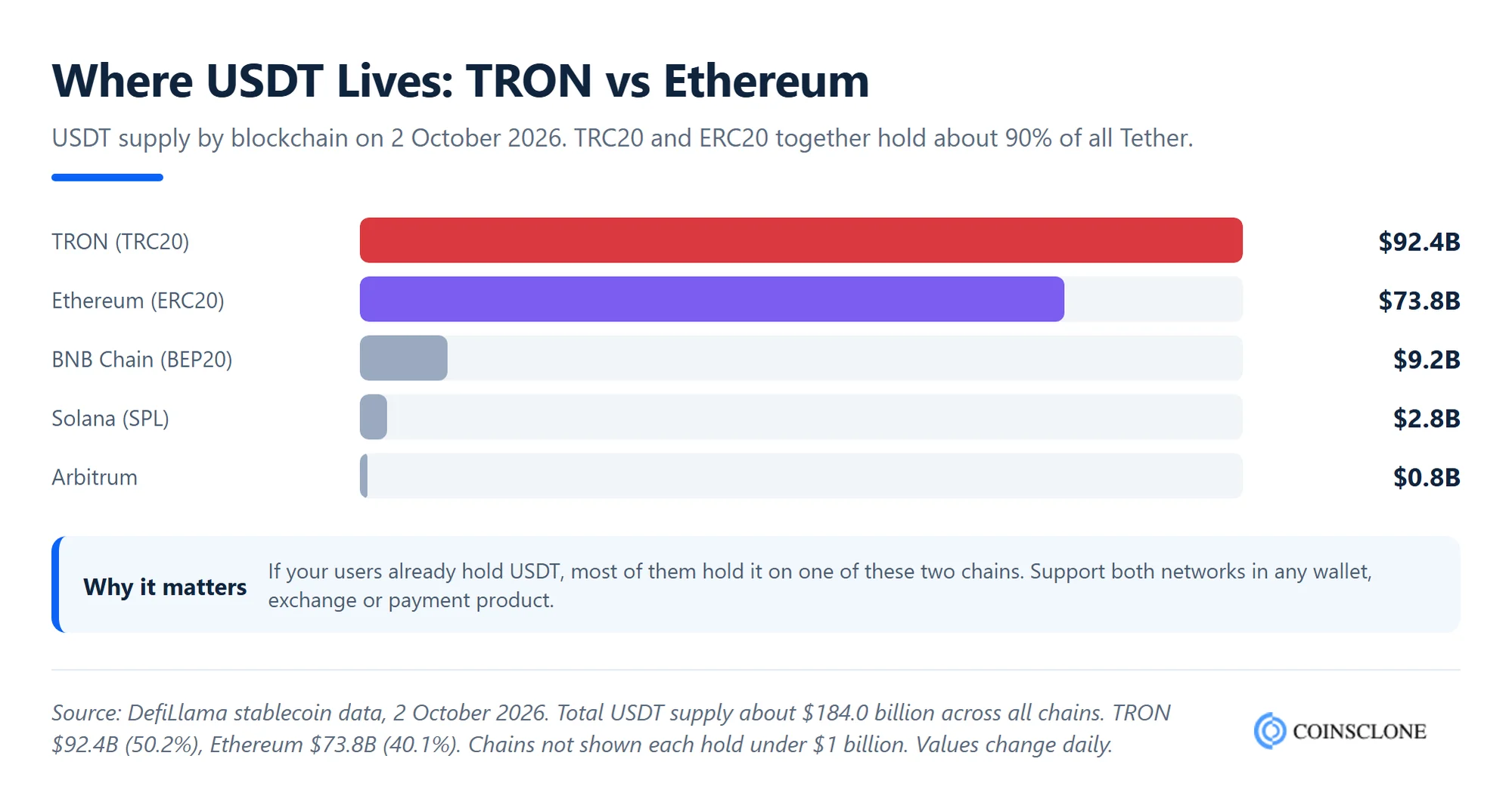
- Payments hub: TRON’s growth comes mostly from USDT. About $92.4 billion of USDT sits on TRON, just over half of all USDT, per DefiLlama’s stablecoin data in October 2026.
- Active user base: Many traders and businesses use TRC20 USDT for daily transfers, so TRON wallets and exchange support are widespread.
Which Standard Should You Launch Your Token On?
If you are building a token rather than sending one, the choice comes down to who your users are and what the token must do. Start at the top of this decision tree and stop at the first yes.
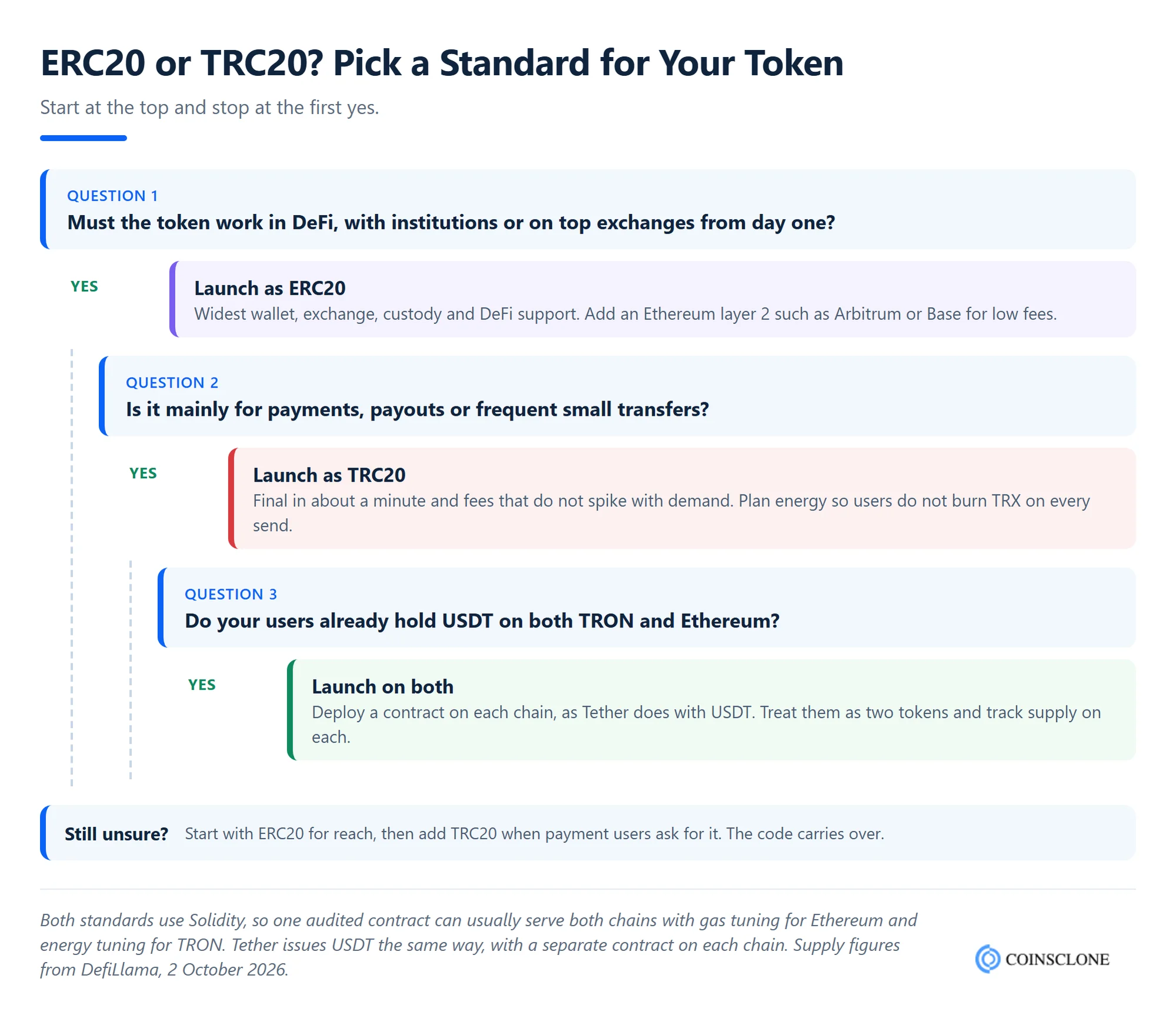
A common path in 2026 is to start on one chain and add the other later. Since both use Solidity, one audited code base can serve both, with gas tuning for Ethereum and energy tuning for TRON. For a standard token, Coinsclone quotes 1 to 2 weeks for the contract and launch, 3 to 5 weeks with vesting and distribution, and 6 to 10 weeks with payment features or a utility layer.
Coinsclone builds both. Our crypto token development company team creates ERC20, TRC20 and multi-chain tokens, with audits and launch support included.
Summary
ERC20 and TRC20 tokens share the same core design, but they run on very different chains. ERC20 gives you the widest support, the deepest DeFi market and, in 2026, very low fees. TRC20 gives you fast finality, predictable costs and the largest USDT user base.
For users, the main rule is to match the network to the receiver every time. For founders, the right standard depends on your audience and use case. Many projects launch on both. Crypto tokens are used for listing, raising funds, payments and rewards, so choose the chain that fits your business goals and your users.
Why Choose Us?
Coinsclone is a trusted crypto token development company. We have been building crypto products since 2018, with 350+ platforms delivered for 200+ clients across 20 industries. Our developers, testers and project managers create your tokens without hassle, and our support team is there 24/7.
We create both TRC20 and ERC20 tokens, from the smart contract and audit to listing support and wallet setup. Our team stays with you from the first plan to launch day. Talk to our business team for a scoped plan and timeline.
Frequently Asked Questions
Is ERC20 the same as TRC20?
No. ERC20 is the token standard of Ethereum, and TRC20 is the token standard of TRON. They use the same core functions, but they run on different blockchains with different fees, speeds and address formats. A token on one chain is not the same token on the other.
Are TRC20 USDT and ERC20 USDT the same?
They are worth the same, since Tether backs both 1:1 with the US dollar. On-chain, though, they are separate tokens with separate contracts. You can swap one for the other on an exchange, but you cannot send one straight to the other’s network.
Which is cheaper, TRC20 or ERC20?
In October 2026, an ERC20 USDT transfer costs about $0.03 to $0.40, while a TRC20 transfer that burns TRX costs about $2.15 to $4.50. TRC20 becomes the cheaper option if you stake TRX or rent energy, or if Ethereum gas climbs above roughly 13 to 20 gwei when the receiver already holds USDT.
Can I send TRC20 to an ERC20 address?
You should not. Most wallets will reject a 0x address on the TRON network. If funds do end up on the wrong network, recovery depends on who controls the receiving address. You can often recover them from your own self-custody wallet, but exchange deposits may be lost.
How do I know if my USDT is ERC20 or TRC20?
Check the address. A TRON (TRC20) address starts with T, and an Ethereum (ERC20) address starts with 0x. Your exchange or wallet also shows the network name on the deposit and withdrawal screens.
How long does a TRC20 or ERC20 transfer take?
A TRC20 transfer shows up in about 3 seconds and is final in about one minute. An ERC20 transfer shows up in about 12 seconds and is fully final in about 13 minutes. Exchanges may credit deposits sooner or later, based on their own rules.
Why do I need TRX or ETH to send USDT?
USDT is a token, so it cannot pay network fees itself. On Ethereum, the fee is paid in ETH. On TRON, it is paid in energy and bandwidth, which you get by staking TRX or by burning TRX. Some wallets now offer GasFree transfers that take the fee in USDT instead.
ERC20 vs TRC20: Which Token Standard Fits Your Project Best?
Crypto Token Development — done right.
- ERC20 (Ethereum):Proven, secure, and widely supported for DeFi and ICOs.
- TRC20 (Tron):Faster, lower fees, and ideal for high-volume transactions.
- Smart Contract Ready:Both support custom logic, staking, and DApp integration.
- Cross-Chain Flexibility:Launch tokens on Ethereum or Tron — your choice, your market.
See how ERC20 and TRC20 compare side by side — from cost and speed to ecosystem and liquidity.
Book a Free Consultation to discover which blockchain suits your token project best — Ethereum or Tron — and launch in just 2–4 weeks.