
TRC20 token development is how a business creates its own token on the TRON blockchain. TRON holds about half of the world’s USDT, so a TRC20 token lands in a network that millions of wallets, exchanges and payment apps already use. Fees are flat, a new block lands each 3 seconds, and the code is plain Solidity, the same language used for tokens on Ethereum.
This guide explains what the work involves, which features to pick before launch, what it really costs in TRX and in dollars, and how a token goes from idea to TRON mainnet. It uses live network data from October 2026, so the fee figures match what you will pay today.
In this guide:
- What the TRC20 standard is, and why it replaced TRC10 for new tokens.
- The features you must decide before deployment, because most cannot be added later.
- How energy works for your token holders, and how to make transfers cheaper for them.
- Real launch costs: network fees in TRX, audit prices and build budgets for 2026.
- A step-by-step launch path, plus a decision tree to choose your build route.
See How Our Experts Can Launch Your TRC20 Token Faster.
TRC20 Token Development — done right.
- Faster Launch: Create your TRC20 token on the Tron network 90% faster with our ready-to-deploy framework.
- Smart Contracts: Secure, audited, and fully compliant TRC20 standards — no coding required.
- Customization: Your brand, tokenomics, logo, and utility — 100% tailored to your vision.
- Earning Potential: Enable staking, DeFi integration, and seamless DEX listings for instant liquidity.
See a free live demo of your TRC20 token project in just 48 hours — before you invest a cent.
Book a Free Demo to discover how our TRC20 Token Development Services can take you from concept to launch in just 2–4 weeks.
What is TRC20 Token Development?
TRC20 token development is the process of creating a digital token on the TRON blockchain using the TRC20 standard. The standard is a fixed set of functions that every TRC20 contract must offer, so any TRON wallet, exchange or app can read balances and move tokens in the same way.
Per TRON’s docs, each TRC20 token needs six functions and two events:
| Part | What it does |
| totalSupply | Returns how many tokens exist |
| balanceOf | Returns the balance of one address |
| transfer | Sends tokens from the caller to another address |
| approve | Lets another address (such as a DEX) spend up to a set amount |
| transferFrom | Moves tokens on someone’s behalf, within the approved amount |
| allowance | Shows how much a spender may still move |
| Transfer and Approval events | Log every transfer, mint, burn and approval so wallets can track them |
Name, symbol and decimals are not required, but all real tokens set them. On top of this base, you add your own rules: fixed or mintable supply, burning, vesting, pausing and more.
TRC20 tokens are mostly used for payments, in-app tokens, DeFi apps, voting and stablecoins. The best known example is Tether. About $92.4 billion of USDT sits on TRON, around half of all USDT in circulation, per DefiLlama on 2 October 2026. That is the main reason businesses pick TRON: their users already hold TRX and TRC20 tokens.
TRC20 vs TRC10: Which TRON Token Standard Should You Use?
TRON has two fungible token standards. TRC10 is the older one. It is built into the chain itself, so it needs no smart contract, but it also cannot hold any custom logic. TRC20 is a smart contract, which means you control every rule.
| Point | TRC10 | TRC20 |
| How it is created | System-level asset, no contract | Solidity smart contract on the TRON Virtual Machine |
| Custom logic (vesting, pause, blacklist) | Not possible | Fully supported |
| Fee to create | 1,024 TRX issue fee (TRON chain parameter) | About 50 to 100 TRX of energy and bandwidth, less with staked energy |
| DeFi and DEX support | Limited | Native on SunSwap, JustLend and most TRON apps |
| Status in 2026 | Legacy | The standard new projects use |
In short, TRC20 is the right choice for almost every new token. TRC10 only makes sense for a very simple points token that will never need new rules. If you are weighing TRON against Ethereum instead, our ERC20 vs TRC20 comparison covers fees, speed and reach side by side.
Our TRC20 Token Development Approaches
There are three ways to put a TRC20 token on TRON. Coinsclone offers the two that suit a real business, and it helps to know the third so you can judge it fairly.
TRC20 Token Development from Scratch
This means building a TRC20 smart contract from the ground up on the TRON blockchain. The token logic, supply model, transfer rules and access controls are all set by your project’s exact needs. This suits projects that need full control over how the token works, such as vesting for backers or rules for a licensed asset.
Hire TRC20 Token Developers
You can hire token developers from Coinsclone to handle the design, build and launch of your TRC20 token. Our coders handle the smart contract, features, testing and launch, based on your project scope. Businesses often choose this when they need the skills without running the whole project in-house.
No-Code Token Generators
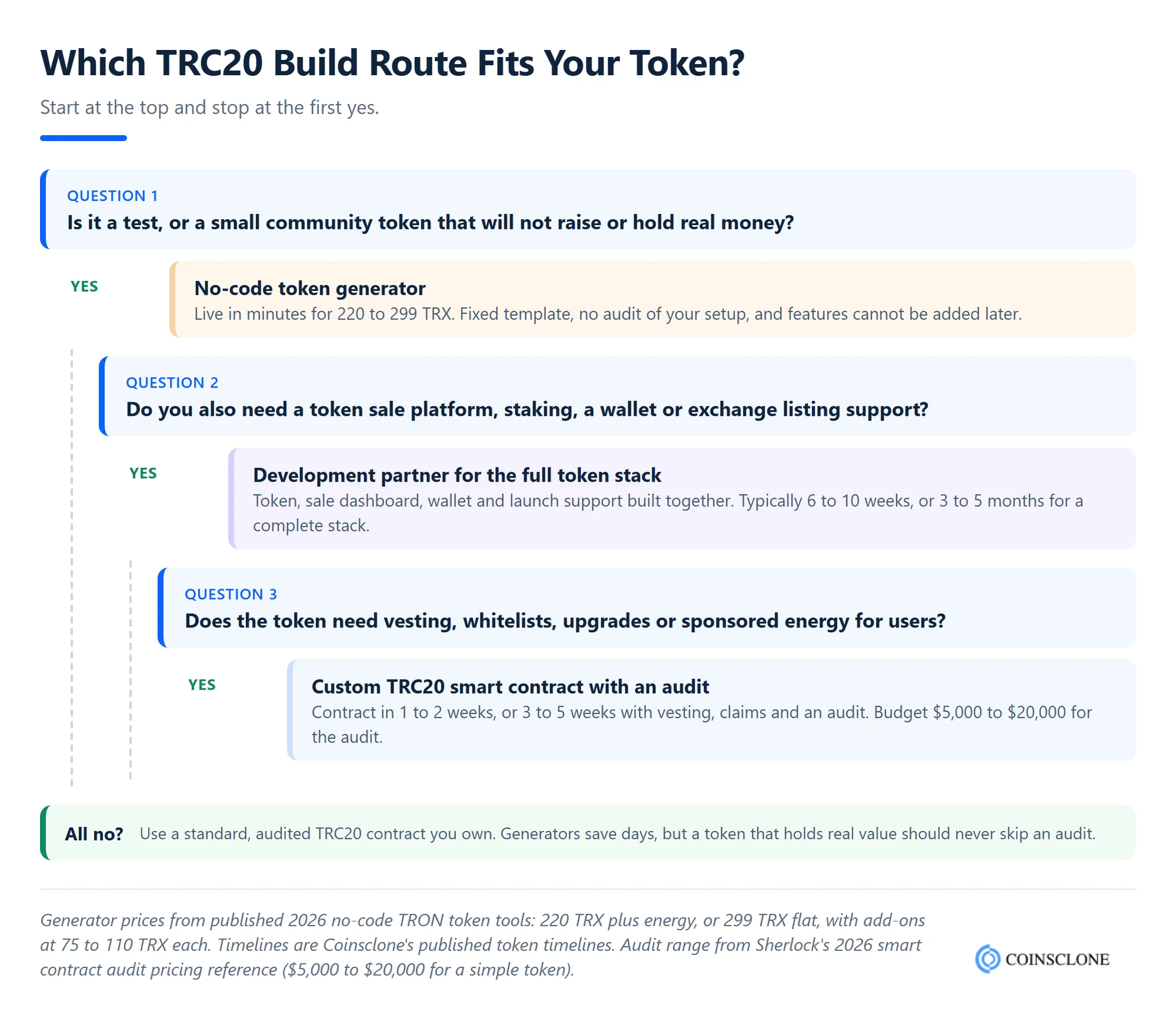
Online generators let anyone deploy a basic TRC20 token from a form in a few minutes. Published 2026 prices run from 220 TRX plus energy to 299 TRX flat, with extras such as burn, mint or pause at 75 to 110 TRX each. They work for tests and simple community tokens. However, you get a template you cannot change, no audit of your own setup, and often no clear owner controls. Once deployed, a missing feature means a new token.
The decision tree below shows which route fits your project.
Core Features of Our TRC20 Token Development
Plan these features before you deploy. A TRC20 contract cannot be edited after launch unless you build it with an upgrade path, so each feature below is a choice you make up front.
Custom Token Name: Each TRC20 token gets its own name that clearly stands for your brand or platform. This builds trust and a clear identity within the TRON ecosystem.
Symbol and Decimals: We set the token symbol and decimals to suit how you will use it. USDT on TRON uses 6 decimals, while many utility tokens use 18. The right setting keeps prices exact, mainly for small payments and busy transfer flows.
Adjustable Total Supply Options: Tokens can launch with a fixed supply or a supply that can grow. A fixed supply signals scarcity, while an adjustable one suits rewards and payment tokens.
Minting and Burning Functionality: Minting creates new tokens, while burning removes tokens from circulation for good. Together, they let you match supply to real demand.
Admin Control: Only approved roles can run key actions such as minting, pausing or upgrades. We use role-based access and multisig wallets, so no single lost key can take over the token.
Pause and Resume Token Transfers: This lets you halt transfers for a short time during an emergency, an upgrade or an attack. It protects holders while you fix the problem.
Whitelist and Blacklist Control: These lists let you limit who can hold or move the token. They help you block known bad addresses and meet compliance rules for regulated tokens.
Vesting and Lock-up Mechanisms: Vesting and lock-ups control when tokens unlock for investors, team members or partners. This stops sudden sell-offs and builds market confidence.
Upgrade Support: We can build TRC20 tokens with a proxy design that can be upgraded. This allows future fixes and features without moving holders to a new contract. Since upgrades are powerful, we always tie them to multisig control and a time delay.
Cross-dApp Integration Capability: Our TRC20 tokens work smoothly with TRON wallets such as TronLink, DeFi platforms such as SunSwap, and exchanges. This means wider use, better liquidity and easier growth.
Benefits of Creating a TRC20 Token
Startups pick TRC20 tokens for clear, down-to-earth reasons. Here are the main benefits.
1. Speed and Scale: TRON makes a new block every 3 seconds, and its builder docs cite room for more than 2,000 transfers per second. Transfers are final in about a minute, which suits payments and busy apps.
2. Steady Costs: TRON sets the price of energy by a network vote, not by an auction. Since 29 August 2025, one unit of energy costs 100 sun (0.0001 TRX). As a result, your users’ fees do not spike when the network gets busy, and you can cut them further by staking or renting energy, as explained below.
3. Proven Standard: The TRC20 interface has powered USDT, USDD, JST, SUN and many more tokens for years. Wallets and exchanges already know how to handle it. Keep in mind that the standard is proven, but each contract still needs its own testing and audit.
4. Easy for Ethereum Teams: TRC20 copies the ERC20 rules, and contracts are written in Solidity. Your team can reuse audited ERC20 code, such as OpenZeppelin libraries, with small changes. Note that the token itself lives only on TRON; moving it to Ethereum needs a bridge or a second contract.
5. Users Who Already Hold TRX: With around half of all USDT on TRON, millions of people already have TRON wallets and TRX for fees. That makes onboarding much easier than on a new chain.
How Energy and Fees Work for Your Token Holders
This is the part most guides skip, and it shapes how users feel about your token. Every TRC20 transfer is a smart contract call, so it uses energy as well as bandwidth.
- Bandwidth covers the size of the transaction. Each account gets 600 free bandwidth points a day, enough for about one token transfer.
- Energy covers the contract’s work. There is no free energy. The sender either uses energy from staked TRX or burns TRX at 100 sun per unit.
For scale, sending USDT, the busiest TRC20 token, uses about 64,285 energy to an address that already holds it and about 130,285 to a new holder. If the sender burns TRX, that is 6.43 TRX or 13.03 TRX, about $2.15 to $4.36 at a TRX price of $0.334 on 2 October 2026. A simple token with lighter code uses less.
Here is the good news for token issuers. TRON lets the contract deployer pay part or all of the energy for users. A setting called consume_user_resource_percent decides the split. At 100, users pay it all, as they do on Ethereum. At 0, your project pays, so holders can send your token without burning TRX. The TRON docs explain the full charging order.
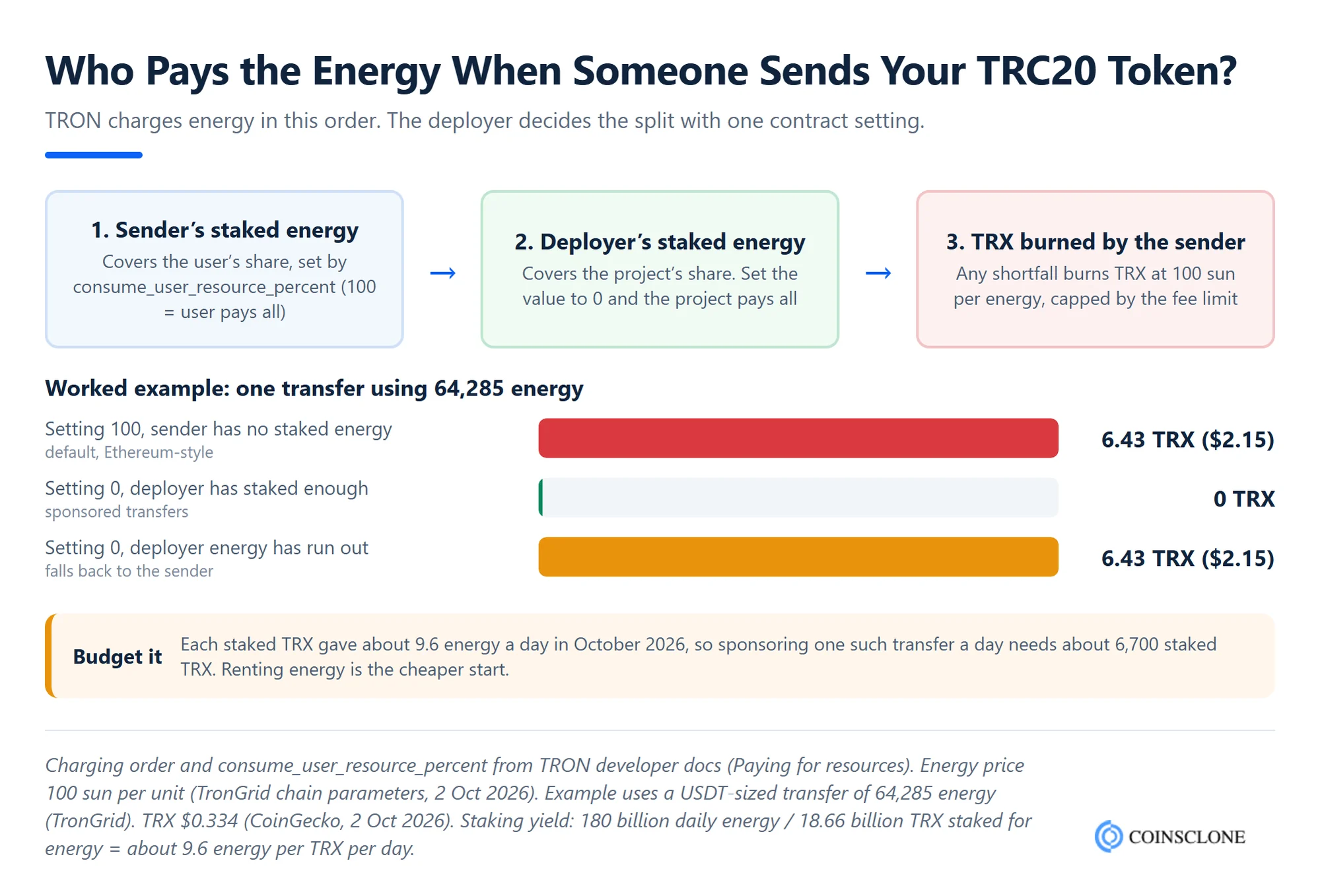
There is one catch. If the deployer’s staked energy runs out, the rest falls back to the user, who then burns TRX. So plan your energy budget before you switch on sponsored transfers. On 2 October 2026, each staked TRX yielded about 9.6 energy a day, worked from TRON’s network totals. That means sponsoring one USDT-sized transfer a day takes roughly 6,700 staked TRX. Many projects rent energy instead, or use fee sponsorship only for new users.
Use Cases of Our TRC20 Token Development
Our TRC20 token development is designed to support a wide range of use cases across the TRON ecosystem.
- ICOs and Token Sales: TRC20 tokens are commonly used for ICOs and token sales on the TRON blockchain. They work with TRON wallets and exchanges, and suit both public and private sales.
- DeFi Apps: TRC20 tokens can plug into staking, trading pools, lending and yield apps such as JustLend and SunSwap.
- Gaming and NFT Platforms: These tokens often serve as utility or reward tokens. They can power in-game economies, reward players or settle marketplace trades.
- Payments and Money Transfers: They suit payment gateways and apps that send money abroad. They make fast, low-cost transfers for peer-to-peer payments and store payouts, with no bank in the middle.
- Loyalty and Reward Programs: TRC20 tokens can work as reward points that are issued, sent and cashed in on your platform.
- Cross-Border Transactions: These tokens support value transfers across regions in about a minute, with fees that stay flat.
- DEX Listing: Once live, these tokens can trade on DEXs, swap with other assets and sit in trading pools.
- Voting and DAOs: These tokens can stand for voting power in a DAO, through a separate voting contract.
- Supply Chain and Tracking Solutions: Here, TRC20 tokens act as a value or reward layer rather than a data tracker. They can stand for credits, payments or incentives.
Bigger use cases such as DeFi, voting and supply chain apps need custom smart contracts and app logic built on top of the TRC20 standard.
Industries We Serve With Our TRC20 Token Development
- FinTech and Online Banking: TRC20 tokens give new money apps fast, low-fee payments and assets that follow coded rules.
- Payments and Money Transfer Firms: TRON tokens move value fast, at home and across borders.
- Online Stores and Marketplaces: TRC20 tokens can handle checkout payments, rewards and cashback.
- Gaming and Fun Apps: They power in-game coins, game items and player rewards on TRON.
- Media and Content Platforms: They support token-based payments, gated access and fan engagement.
- Real Estate and Large Projects: TRC20 tokens can stand for shares in a building or project, so more people can invest.
- Supply Chain and Logistics: They add payments and incentives to tracking workflows.
- Travel, Hotels and Transport: They power loyalty points, payments and access to online services.
- Power and Green Projects: They support token rewards, carbon credits and clean energy schemes.
- Business Software and SaaS: They bring tokens into business tools for payments, access and rewards.
Build Your Crypto Token on Tron Blockchain
Cost-effective, Premium Features, Customizable. Live Demo Available.
Step-by-Step Process of Our TRC20 Token Development
Here is how a TRC20 token moves from idea to TRON mainnet with our team.
1. Requirement Gathering
We begin by understanding your market, business goals, token purpose and target users. Together, we confirm the token type, its flow, compliance needs, integrations and long-term growth plans.
2. Token Design and Tokenomics
Next, we design the token structure and tokenomics. This covers total supply, decimals, who gets what, minting, burning and vesting, all matched to your business model. We also decide who pays energy for transfers, since that setting shapes user costs.
3. Smart Contract Build
Our blockchain engineers write the TRC20 contract in Solidity, pinned to one exact compiler version, as TRON advises. We build on audited libraries such as OpenZeppelin and use TronBox and TronWeb, the TRON versions of Truffle and ethers.js. The contract is tuned for low energy use and full support across TRON wallets, exchanges and dApps.
4. Testing on Testnet
The token then runs through unit tests and full user flows on TRON’s Shasta testnet, using free test TRX. For a token with real value, an independent security audit follows. Our team fixes each issue before the token goes to mainnet.
5. Mainnet Launch and Code Check
After testing, we deploy the token to TRON mainnet with a safe fee limit (the cap on TRX the deployment may burn). We then verify the source code on TRONSCAN, record the token’s logo, website and details, and check that it shows correctly in TronLink. Verified tokens earn more trust from users and exchanges.
6. Launch and Post-Launch Support
Once live, we help you fund a trading pool on a DEX such as SunSwap, move admin rights to a multisig wallet and lock team tokens. We then provide ongoing support, upgrades and monitoring as your token grows.
How Much Does TRC20 Token Development Cost?
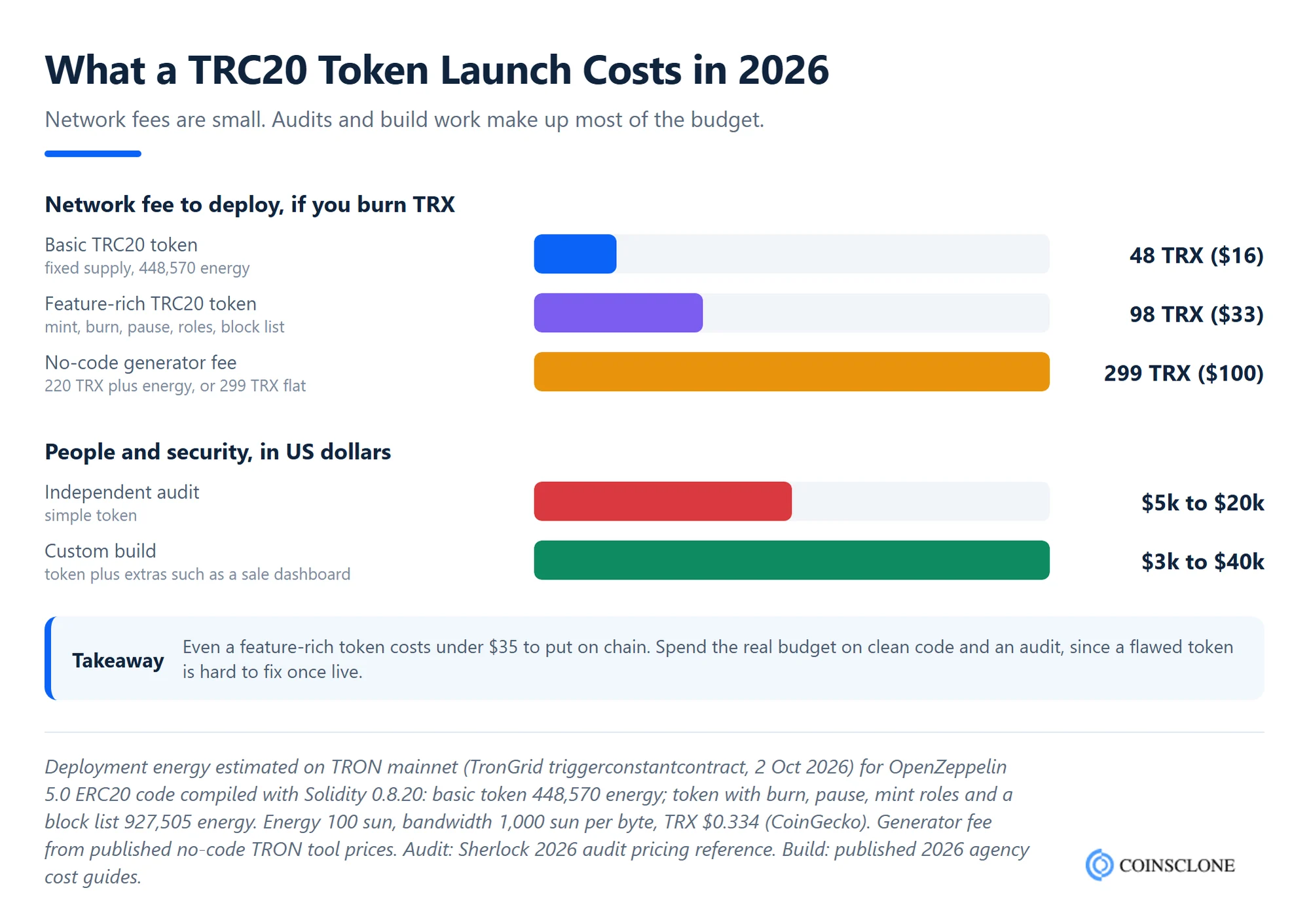
TRC20 token costs come in three layers: the network fee to deploy, the audit, and the build itself. The network part is small. The people and the security work make up most of the budget.
Network fees (paid in TRX): Deploying a contract burns energy based on its code size. We ran a mainnet estimate on 2 October 2026 for a basic token built on OpenZeppelin code. It needs about 448,600 energy, or roughly 48 TRX ($16) with bandwidth. A token with mint, burn, pause, admin roles and a block list needs about 927,500 energy, or roughly 98 TRX ($33). With staked or rented energy, only the bandwidth part, a few TRX, is left to pay. Either way, keep a few hundred spare TRX in the launch wallet, plus the TRX and tokens you plan to add to a trading pool.
Audit: An independent review for a simple token costs $5,000 to $20,000, per Sherlock’s 2026 audit pricing reference. Tokens with vesting, staking or upgrade logic sit at the top of that range or above it.
Build: Published 2026 agency cost guides put a custom TRC20 token at roughly $3,000 to $40,000. The final figure turns on features, audits and extras such as a token sale dashboard or a staking app.
How long does it take? Here are the time frames Coinsclone quotes for token work:
| Scope | Typical timeline |
| Token contract only | 1 to 2 weeks |
| Contract plus distribution (vesting, claims, allocations, audit) | 3 to 5 weeks |
| Contract plus utility layer (staking, integrations, governance, audit) | 6 to 10 weeks |
| Complete token stack (token, sale platform, wallet, dashboards) | 3 to 5 months |
For a fuller breakdown across chains, see our guide on the cost to create a crypto token.
TRC20 Token Security: Checks and Common Mistakes
A token is only as safe as its contract and the keys that control it. These are the mistakes we see most often, and how to avoid them.
- Single-key ownership: One private key that can mint or pause is a single point of failure. Move admin roles to a multisig wallet before launch.
- Unverified source code: Users and exchanges distrust tokens whose code is hidden. Publish and check the code on TRONSCAN right after launch.
- Loose build versions: TRON’s Solidity tool is not quite the same as the one for Ethereum. Pin the exact version and test on Shasta first.
- No energy plan: If users must burn several TRX per transfer, small payments stop making sense. Decide on energy sharing or rental before launch.
- Copycat names and symbols: Wallets and trackers flag tokens that mimic USDT or other big names. Pick a clear, original name and symbol.
- Features you forgot: Without an upgrade path, adding vesting or a pause later means a new token and a migration. Plan the full feature list up front.
What Makes Coinsclone the Authority on TRC20 Token Development?
Coinsclone, a trusted crypto token development company, builds TRC20 tokens with rich features, fast and without cutting corners. We have been building crypto products since 2018, with 350+ platforms delivered for 200+ clients across 20 industries. Our team has blockchain engineers, smart contract coders, testers and project leads.
As a leading Tron token development firm, we put your success first and offer support 24/7. We follow tested development standards and TRON network practices, so every token is secure and ready to scale. From smart contract design to mainnet launch, every phase gets the same care. We also build other TRON standards, such as TRC721 token development for NFTs, and we can still support legacy TRC10 assets. Our team connects your token to TRON dApps, wallets and exchanges, so it is ready for real-world use from day one.
Ready to launch on TRON? Share your token idea with Coinsclone, and we will map out the features, energy plan, timeline and launch steps for your TRC20 token.
Frequently Asked Questions
What is TRC20 token development?
TRC20 token development is the process of creating a custom token on the TRON blockchain using the TRC20 token standard. The standard defines how tokens are created, transferred and stored across wallets and decentralized apps. TRC20 tokens are mostly used for payments, in-app tokens, DeFi apps and stablecoins.
How does TRC20 token development work?
You write a Solidity smart contract that follows the TRC20 standard, test it on a TRON testnet such as Shasta, and then launch it on TRON mainnet. The contract manages token supply, transfers, balances and permissions. After deployment, the code is verified on TRONSCAN and the token is added to wallets and exchanges.
What is the difference between TRC20 and ERC20 tokens?
The main difference between TRC20 and ERC20 tokens is the blockchain they run on. TRC20 tokens run on TRON, with 3-second blocks and fees paid in TRX through energy and bandwidth. ERC20 tokens run on Ethereum and pay gas in ETH. Both use the same interface and Solidity code, but a token on one chain cannot move to the other without a bridge.
What is the difference between TRC10 and TRC20 tokens?
TRC10 tokens are built into the TRON chain and need no smart contract, so they are simple but cannot hold custom rules. TRC20 tokens are smart contracts, so they support features such as vesting, pausing and blacklists, and they work with TRON DeFi apps. TRC10 is a legacy standard, and new projects use TRC20.
How much does it cost to create a TRC20 token?
The network fee to launch a TRC20 token is about 50 to 100 TRX ($16 to $33) if you burn TRX for energy, and far less with staked or rented energy. No-code generators charge about 220 to 299 TRX. A custom, audited token costs roughly $3,000 to $40,000, with a simple audit alone at $5,000 to $20,000.
How much TRX do I need to deploy a TRC20 token?
Keep at least a few hundred TRX in the deploying wallet. The deployment itself burns energy based on the contract’s size, and you set a fee limit to cap the burn. You will also need TRX or USDT, plus your own tokens, if you plan to add liquidity on a DEX.
How long does TRC20 token development take?
A token contract alone takes about 1 to 2 weeks. Adding vesting, claims and an audit takes 3 to 5 weeks, and a token with staking or governance takes 6 to 10 weeks. A complete token stack with a sale platform and wallet takes 3 to 5 months.
Can I add features to a TRC20 token after deployment?
Only if you planned for it. A standard TRC20 contract cannot be changed once deployed. To add features later, the token must use an upgradeable proxy design, or you must launch a new contract and move holders to it.
What are TRC20 tokens commonly used for?
TRC20 tokens are mostly used for payments, money sent across borders, DeFi, in-app rewards, voting and stablecoins such as USDT.
What features can be added during TRC20 token development?
You can add a fixed or growing supply, burning, pausing, transfer limits, allow lists and block lists, vesting, admin roles and an upgrade path.
How secure is TRC20 token development?
A TRC20 token is secure when its smart contract follows the TRC20 standard, uses audited code and passes testing and an outside audit. Safety also turns on who holds the admin keys. A multisig wallet is best, and the source code should be public so anyone can check it.
Can a TRC20 token be listed on exchanges?
Yes. Anyone can create a liquidity pool for a TRC20 token on a TRON DEX such as SunSwap right after launch. Big central exchanges run their own reviews. They look for public code, an audit, real users and trading volume.
What does a TRC20 token development company do?
A TRC20 token development company designs, builds and deploys TRC20 smart contracts on the TRON blockchain. This covers token logic, token supply plans, features, testing, audits, code checks on TRONSCAN, and help with wallets, DEX pools and exchanges.
TRC20 Token Development — done right.
- Faster Launch: Create your TRC20 token on the Tron network 90% faster with our ready-to-deploy framework.
- Smart Contracts: Secure, audited, and fully compliant TRC20 standards — no coding required.
- Customization: Your brand, tokenomics, logo, and utility — 100% tailored to your vision.
- Earning Potential: Enable staking, DeFi integration, and seamless DEX listings for instant liquidity.
See a free live demo of your TRC20 token project in just 48 hours — before you invest a cent.
Book a Free Demo to discover how our TRC20 Token Development Services can take you from concept to launch in just 2–4 weeks.