
There are two ways to earn money with DeFi. You can put your crypto to work in DeFi apps and earn a yield, or you can build a DeFi platform and earn the fees users pay. This guide covers both. First, it walks through staking, lending, liquidity pools and vaults, with the real rates they paid on 16 October 2026. Then it shows how DeFi platforms themselves make money.
You will also see where each yield comes from, what can go wrong, and how to start small. We use live data from DefiLlama, not marketing ranges, so you can compare options with real numbers. As a result, you can judge for yourself which route, if any, fits your goals and your tolerance for risk.
In this guide:
- Six ways to earn as a user: staking, lending, liquidity pools, vaults, savings tokens and incentive programs.
- Real rates, dated: what top apps paid on 16 October 2026, with 30-day rates from DefiLlama.
- A worked loss example: how impermanent loss eats into a pool stake when prices move.
- The risks, in plain words: hacks, liquidation, de-pegs, lock-ups and taxes.
- The founder’s side: how DEXs, lenders, wallets and gateways turn user activity into income.
See How Our MVP System Can Help You Earn Money with DeFi
Earn Money with DeFi — multiple income streams through decentralized finance.
- MVP System : Learn and deploy real DeFi earning models 90% faster.
- DeFi-Ready Modules : Yield farming, staking, liquidity mining, and DAOs.
- Brand & Customization : Build your own income-generating DeFi ecosystem.
- Revenue Engine : Earn from fees, governance rewards, and yield distribution.
Get a free DeFi income demo in just 48 hours — before spending a cent.
Book a Free Demo to learn how you can earn money with DeFi using automated strategies launched within 8–12 weeks.
How To Earn Money With DeFi
DeFi, short for decentralized finance, is a set of apps that run on smart contracts instead of banks. Because there is no bank in the middle, users can lend, trade and stake directly, and the fees that a bank would keep go to the people who supply the money. That is the core of how you earn money with DeFi: you get paid for giving others what they need, such as cash to borrow, tokens to trade or help to run a network.
This guide is for learning only and is not financial advice. DeFi yields change daily, are never guaranteed, and you can lose some or all of the money you put in.
Here are the main ways people earn with DeFi in 2026.
1. Staking and Liquid Staking
Proof-of-stake chains such as Ethereum and Solana pay rewards to people who lock up coins to help secure the network. With liquid staking, you stake through a service like Lido or Jito and get a token back (stETH or JitoSOL) that keeps growing in value and that you can still use or sell.
- What it paid: Lido’s stETH earned about 2.3% a year on 16 October 2026, and Rocket Pool’s rETH about 2.1%. On Solana, JitoSOL paid about 4.6%, per DefiLlama yields.
- Where the yield comes from: new coins issued by the network plus transaction fees. Lido keeps 10% of rewards for node operators and its treasury.
- Main risks: the coin’s price can fall far more than the yield earns, and a staking token can trade below its coin in a rush to sell.
2. Lending Your Crypto
On lending apps such as Aave and Compound, you put tokens into a shared pool and borrowers pay you interest. Borrowers must pledge more than they borrow, so a loan is closed on its own if that pledge falls too far in value.
- What it paid: USDC lent on Aave V3 (Ethereum) earned about 3.8% on 16 October 2026, or 4.3% on a 30-day average. Compound V3 paid about 5.9% on USDC that day, and 4.7% over 30 days.
- Where the yield comes from: interest paid by borrowers. Rates rise when many people want to borrow and fall when the pool is full of idle cash.
- Main risks: smart contract bugs, bad debt if collateral crashes faster than it can be sold, and the rare case where a pool is fully borrowed and you must wait to withdraw.
If you want to compare lenders, our list of top DeFi lending platforms covers the leading options.
3. Adding Liquidity to a DEX
A decentralized exchange (DEX) like Uniswap needs pools of tokens so people can trade. When you add a pair of tokens to a pool, you become a liquidity provider (LP) and earn a share of each swap fee in that pool.
- What it paid: Uniswap V3’s USDC-ETH pool with a 0.05% fee showed about 17.6% a year in fees on 16 October 2026, but only 9.6% on a 30-day average. Fee income swings with trading volume.
- Where the yield comes from: traders’ swap fees.
- Main risks: impermanent loss, explained with numbers below. This cost can wipe out the fees when one token’s price moves a lot.
4. Yield Farming and Auto-Compounding Vaults
Yield farming means moving funds to wherever the best return is, often adding extra token rewards on top of fees or interest. Vaults from Yearn or Beefy do this for you: they claim rewards and reinvest them on a set schedule.
- What it pays: it varies by pool. Very high rates, sometimes hundreds of percent, almost always come from new reward tokens that lose value as farmers sell them.
- Where the yield comes from: the base fee or interest of the pool underneath, plus token rewards.
- Main risks: each extra layer adds another smart contract that can fail, and reward tokens can drop to near zero.
5. Stablecoin Savings Tokens
Some protocols issue savings tokens that grow in value against a dollar stablecoin. Examples include Sky’s sUSDS, Ethena’s sUSDe and Maple’s Syrup USDC.
- What it paid: on 16 October 2026, sUSDS paid about 3.8%, sUSDe about 4.9% and Syrup USDC about 5.2%, per DefiLlama.
- Where the yield comes from: each one is different. sUSDS passes on the Sky Savings Rate, sUSDe earns from futures funding rates and staked ETH, and Syrup USDC lends to vetted firms that pledge collateral.
- Main risks: a “stable” token is only as safe as the assets and strategy behind it. Funding rates can turn negative, and loans to firms can default.
6. Airdrops and Incentive Programs
New apps and blockchains sometimes reward early users with free tokens, known as airdrops, or pay extra rewards to attract liquidity. These have paid some users well in the past. However, there is no promise of a reward, many programs exclude users in some countries, and chasing them costs gas fees and time. So treat any airdrop as a bonus, never as income you can plan on.
What DeFi Pays in October 2026
Rates move every block, so a single number can mislead. The table below shows the rate on 16 October 2026 next to its 30-day average, which is a steadier guide.
| Way to earn | Example | Rate on 16 Oct 2026 | 30-day average | Main risk |
| Liquid staking (ETH) | Lido stETH | 2.3% | 2.2% | ETH price, token discount |
| Liquid staking (ETH) | Rocket Pool rETH | 2.1% | 2.2% | ETH price, token discount |
| Liquid staking (SOL) | JitoSOL | 4.6% | 4.8% | SOL price, token discount |
| Stablecoin lending | Aave V3 USDC | 3.8% | 4.3% | Smart contract, bad debt |
| Stablecoin lending | Compound V3 USDC | 5.9% | 4.7% | Smart contract, bad debt |
| Savings token | Sky sUSDS | 3.8% | 3.7% | Backing assets |
| Savings token | Ethena sUSDe | 4.9% | 4.9% | Negative funding rates |
| Savings token | Maple Syrup USDC | 5.2% | 5.2% | Borrower default |
| Liquidity pool | Uniswap V3 USDC-ETH (0.05%) | 17.6% | 9.6% | Impermanent loss |
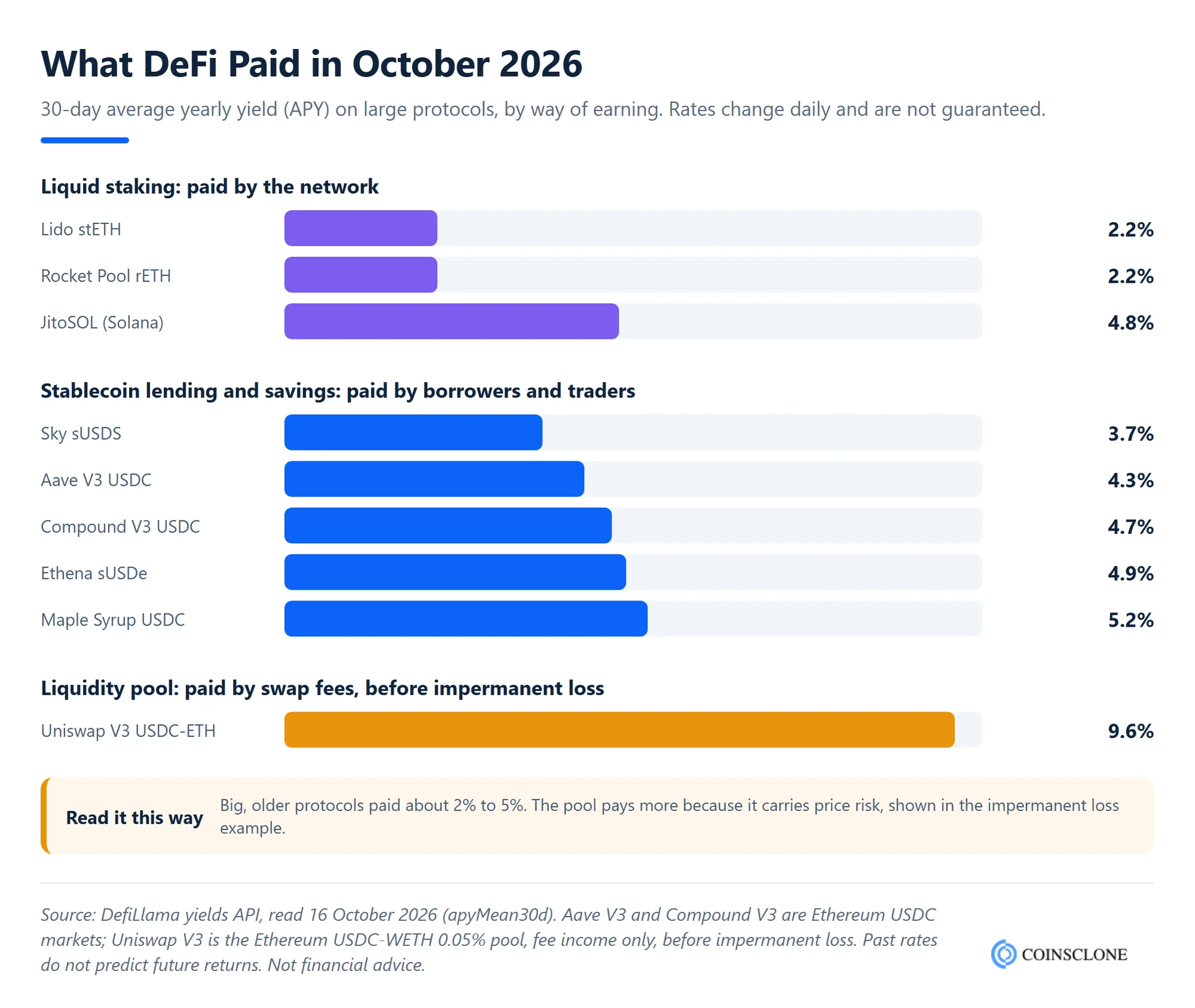
Two lessons stand out. First, the safer-looking options pay roughly 2% to 5% today, so a promise of 20% or more on a stablecoin should make you ask who pays it. Second, the only double-digit rate on the list is the liquidity pool, and that one carries the price risk shown in the next section.
Where DeFi Yield Comes From
Every real yield is paid by someone. Before you deposit, find the payer. In DeFi, there are five main sources:
- Borrowers: they pay interest to lenders on Aave, Compound and other apps.
- Traders: they pay swap fees that go to liquidity providers.
- The network: proof-of-stake chains pay stakers for securing them.
- Futures traders: when they pay funding to hold long positions, delta-neutral products like sUSDe collect it.
- Token rewards: protocols print their own tokens to attract deposits. This is the weakest source, because the payout is only worth what the token sells for.
So if you cannot name the payer, the yield is probably coming from new deposits or from printing tokens. In short, that is a warning sign, not an opportunity.
Risks of Earning Money With DeFi
DeFi removes the bank, but it also removes the deposit insurance and the help desk. Here are the risks to weigh before you start.
Impermanent Loss
When you provide two tokens to a pool, the pool keeps rebalancing them as prices move. If one token rises a lot, you end up holding less of it than if you had simply kept your tokens in a wallet. This gap is called impermanent loss, because it shrinks again if prices return to where they started.
Here is a worked example. Say you add $10,000 to a standard 50/50 ETH-USDC pool: $5,000 of ETH and $5,000 of USDC. Then the price of ETH doubles.
- If you had just held: your ETH is now worth $10,000, plus $5,000 of USDC, for $15,000.
- In the pool: the pool sold some ETH on the way up, so your share is worth about $14,142.
- The gap: about $858, or 5.7%, which your swap fees must cover before you come out ahead.
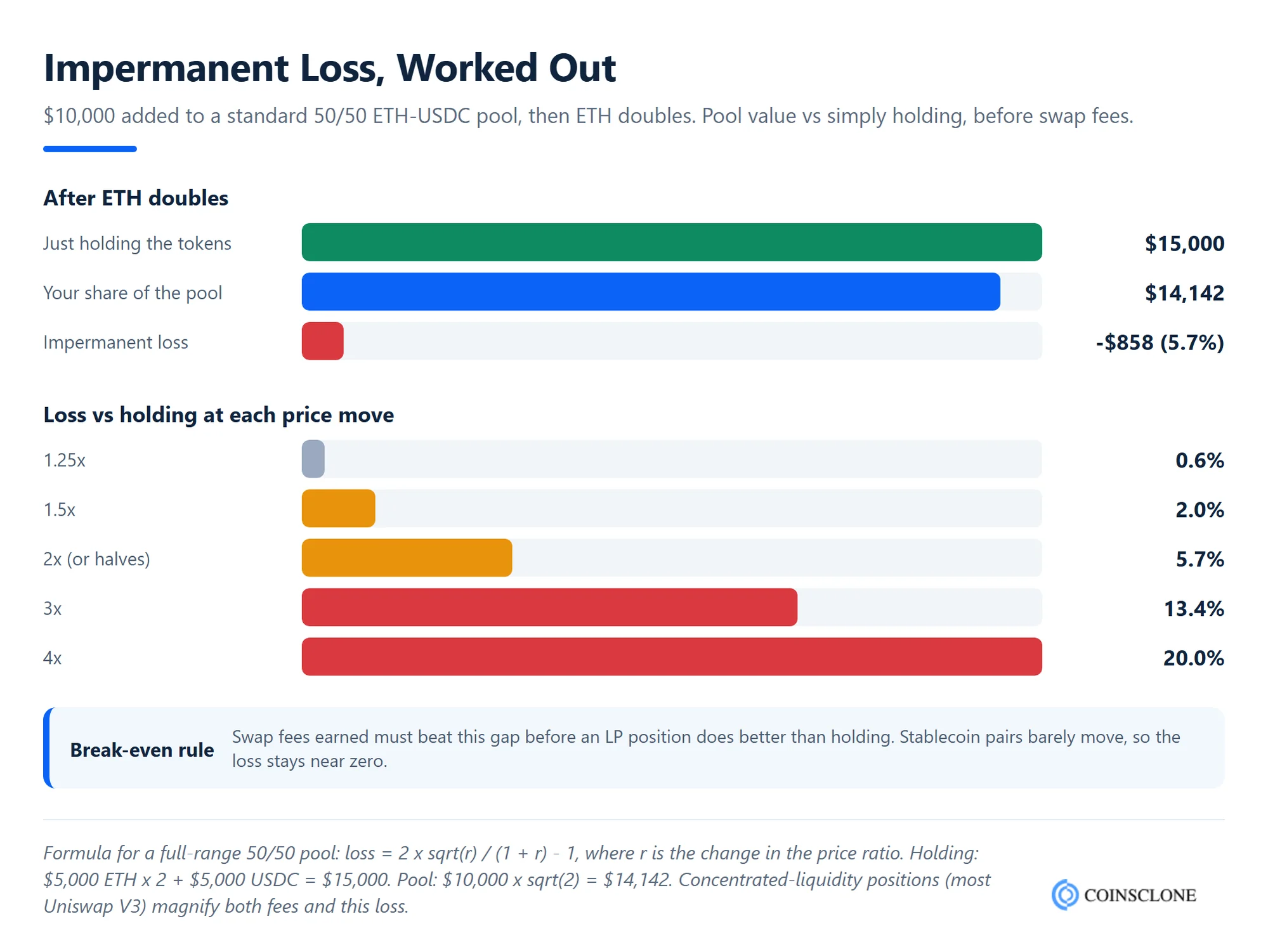
The bigger the move, the bigger the loss: about 2% for a 1.5x move, 13.4% for 3x and 20% for 4x. Narrow-range pools, like most Uniswap V3 ones, earn more fees but make this loss bigger too. On the other hand, pools of two stablecoins barely suffer from it, because their prices stay close.
Hacks and Smart Contract Bugs
Code runs the money in DeFi, so a single bug can drain a pool. DeFi lost about $2.24 billion across 285 hacks between 1 January and 1 October 2026, per the DefiLlama hacks list. Audits help, but they do not guarantee safety, and newer apps with less time in the market carry more risk.
Liquidation
If you borrow against your crypto, a price drop can push your loan past its limit. The app then sells your pledged coins to repay the loan, often with a fine on top. Keeping your loan well below the maximum gives you room when markets swing.
De-Pegs and Rug Pulls
A stablecoin or staking token can lose its link to the asset it tracks during a panic. Meanwhile, unnamed teams sometimes launch pools with huge rewards and then drain them. A team you cannot identify and a reward rate you cannot explain are both reasons to walk away.
Lock-Ups, Gas Fees and Taxes
Some staking and vault products make you wait days or weeks to withdraw. On Ethereum, gas fees can also eat a small deposit’s whole return. Finally, rewards are often taxed. In the US, for example, the IRS treats staking rewards as income once you control them, under Revenue Ruling 2023-14. Rules differ by country, so check with a local tax adviser.
How To Start Earning With DeFi Safely
If you decide to try DeFi, a slow and careful start protects you from most beginner mistakes.
- Learn with a small amount: start with money you can afford to lose completely.
- Use a self-custody wallet you control: keep your seed phrase offline and never share it. Our guide to the best crypto wallets compares the main options.
- Pick apps with a long record: check their age, audits, size and hack record on DefiLlama before you put money in.
- Find the payer: make sure you know whether the yield comes from borrowers, traders, the network or printed tokens.
- Prefer stablecoins or single assets first: they avoid impermanent loss while you learn.
- Track every reward: keep records for tax time, and review your positions at least weekly.
Above all, avoid anyone who promises a fixed or guaranteed return. In DeFi, no honest protocol can make that promise.
How DeFi Platforms Earn Money
The other way to earn money with DeFi is to own the platform. Each yield above is paid through an app, and most apps keep a slice of the flow. DeFi still holds about $90 billion in total value locked as of 15 October 2026, down from $156 billion a year earlier as token prices fell, per DefiLlama. Even so, users still pay fees every day. Here are the main platform types and how each one makes money. For a full list of models with fee data, see our guide to DeFi business ideas.
Decentralized Exchanges
The first business idea for many startups is a decentralized exchange (DEX). A DEX can reach users worldwide from day one, and it earns in several ways:
- Swapping Fees: the DEX charges a small fee on each swap, often 0.01% to 1% depending on the pool. Most of it goes to liquidity providers, and the DEX can keep a share. This is the main revenue source for a DEX.
- Token Buybacks: some DEXs use their fee income to buy back and burn their own token. PancakeSwap is a good example: in April 2025 it retired CAKE staking and veCAKE, and it now sends trading and product revenue to weekly CAKE buyback-and-burns.
- Launchpad Sales: a DEX can host token sales for new projects and charge the project a fee for access to its users.
- Paid Listings: some DEXs charge for featured listings or promotion. In turn, the DEX gains trust and new users.
DeFi Flash Loan Provider
Flash loans let a user borrow funds with no collateral, as long as the loan is repaid within the same transaction. If it is not repaid, the whole transaction is reversed, so the lender never loses the money. Aave and Uniswap are the best-known examples today.
Each flash loan pays a small fee. Aave V3 set its flash loan fee at 0.05% at launch, and its governance can change it, per the Aave docs. Uniswap offers the same idea as “flash swaps”, where the borrower pays the pool’s normal swap fee, which is 0.3% on Uniswap V2. Traders mostly use flash loans to profit from price gaps between markets. You can read how those bots work in our guide to flash loan arbitrage bot development. So, if you run a lending pool or DEX, adding flash loans gives you one more fee stream.
DeFi Payment Gateway
A DeFi payment gateway lets shops accept crypto and stablecoins. It costs less to run than a full exchange, and it earns money in these ways:
- Transaction Fees: the gateway charges a small fee on each payment, which may vary by token or volume.
- Premium or Subscription Fees: merchants pay for extras such as invoicing, payouts or detailed reports.
DeFi Aggregator
A DeFi aggregator brings many DeFi services into one screen. Users can find staking, yield farming and pool options in one place, and DeFi aggregators also give the owner a few ways to earn:
- Commission Fee: aggregators route users to DEXs, lending and staking apps, and some charge a small fee on each routed trade or deposit.
- Governance Tokens: some aggregators issue their own token for voting and rewards. If the platform grows and the token gains real use, the treasury that holds it benefits too.
- Partner Deals: aggregators also team up with other apps for paid slots and joint reward programs.
DeFi Wallet
Crypto wallets are needed for each DeFi trade. Users who want to hold their own assets choose self-custody DeFi wallets. You may wonder how a wallet makes money when the wallet itself is free. Here is how:
- Swap Fees: most wallets now include a built-in swap and add a small fee to each trade. This is their main income.
- Staking Fee: wallets that offer in-app staking keep a small share of the rewards.
- Promotions: partner deals and referral programs with other apps bring in extra income.
DeFi Lending and Staking Platform
Lending platforms let users borrow against their crypto for many purposes. Users who need cash without selling their coins get loans from these platforms.
- Interest Spread: the platform keeps a share of the interest borrowers pay, often called a reserve factor. This is the main revenue source for a DeFi lending and borrowing platform.
- Liquidation Fees: when a loan is closed because its backing fell too far, part of the fine goes to the platform.
- Staking Commission: staking platforms keep a share of rewards, as Lido does with its 10% fee. If you plan to launch one, see how to create a staking platform.
Why Build a DeFi Platform in 2026?
Many crypto business ideas exist, yet DeFi platforms offer a rare thing: income from each trade, loan or stake, from users all over the world. Stablecoins, tokenized assets and on-chain trading have all kept growing, even while total value locked fell with token prices. So demand for well-built DeFi apps is still strong.
To build one, you need a trusted DeFi development company. Check its experience, past projects, team size and security process before you sign. Above all, ask how it handles audits, because hacks are the fastest way for a DeFi business to fail.
Reason to Choose Coinsclone for DeFi Development Services
Coinsclone is a leading DeFi Development Company that builds all types of DeFi apps. Since 2018, we have delivered 350+ platforms for 200+ clients across 20 industries. We offer white-label solutions and clone scripts for DEXs, so you can launch faster without starting from scratch. For example, a white-label DEX takes about 5 to 7 weeks to launch, and a standard build about 10 to 14 weeks.
We also build DeFi smart contracts, aggregators, staking and lending platforms, and yield farming platforms. Our team offers 24/7 support and maintenance, so you can reach us at any time. To learn more, contact our team and get a free demo.
See How Our MVP System Can Help You Earn Money with DeFi
Earn Money with DeFi — multiple income streams through decentralized finance.
- MVP System : Learn and deploy real DeFi earning models 90% faster.
- DeFi-Ready Modules : Yield farming, staking, liquidity mining, and DAOs.
- Brand & Customization : Build your own income-generating DeFi ecosystem.
- Revenue Engine : Earn from fees, governance rewards, and yield distribution.
Get a free DeFi income demo in just 48 hours — before spending a cent.
Book a Free Demo to learn how you can earn money with DeFi using automated strategies launched within 8–12 weeks.
Frequently Asked Questions
Can you make money with DeFi?
Yes, people do earn money with DeFi through staking, lending, liquidity pools and savings tokens. In October 2026, the larger, longer-running options paid roughly 2% to 6% a year, per DefiLlama. However, returns are never guaranteed, and price drops, hacks or impermanent loss can turn a gain into a loss.
Is DeFi profitable in 2026?
It can be, but less dramatically than in 2021. Most of the very high yields of that era came from printed reward tokens. Today, real yields from borrowers, traders and staking sit in the low single digits on big, older apps, and higher rates tend to mean higher risk.
How do DeFi protocols make money?
They keep a share of the fees users pay. A DEX takes a cut of swap fees, a lending app keeps part of the interest, and a staking app keeps part of the rewards. Many also charge for flash loans and payments, and some use that income to buy back their own tokens.
Is DeFi lending or staking better?
Neither is better for everyone. Staking pays you in the coin you hold, so it suits people who already want long-term exposure to that coin. Lending stablecoins avoids price swings in the deposit itself, but it depends on borrowers and on the lending contract staying safe.
Is DeFi safe?
DeFi is riskier than a bank account. There is no deposit insurance, and DeFi lost about $2.24 billion to hacks in the first nine months of 2026. You can lower the risk by using older, audited protocols, starting small, and avoiding yields you cannot explain.
Are DeFi earnings taxed?
In many countries, yes. In the US, the IRS treats staking rewards as income when you gain control of them, and selling tokens can also trigger capital gains tax. Rules differ by country, so keep records and check with a local tax adviser.