
This guide explains DeFi token development from the first idea to launch day. It covers the main types of DeFi tokens and how a token earns its value. It also shows the chains to build on, the steps to create and launch one, and what it costs in 2026. It is written for founders and teams who want a token with a real job inside a lending, trading, staking or governance app.
By the end, you will know which token type fits your project, how to plan supply and unlocks, how to keep the contract safe, and what to budget. You will also see real numbers from live tokens such as UNI, AAVE and LINK, so you can plan with facts instead of guesses.
In this guide:
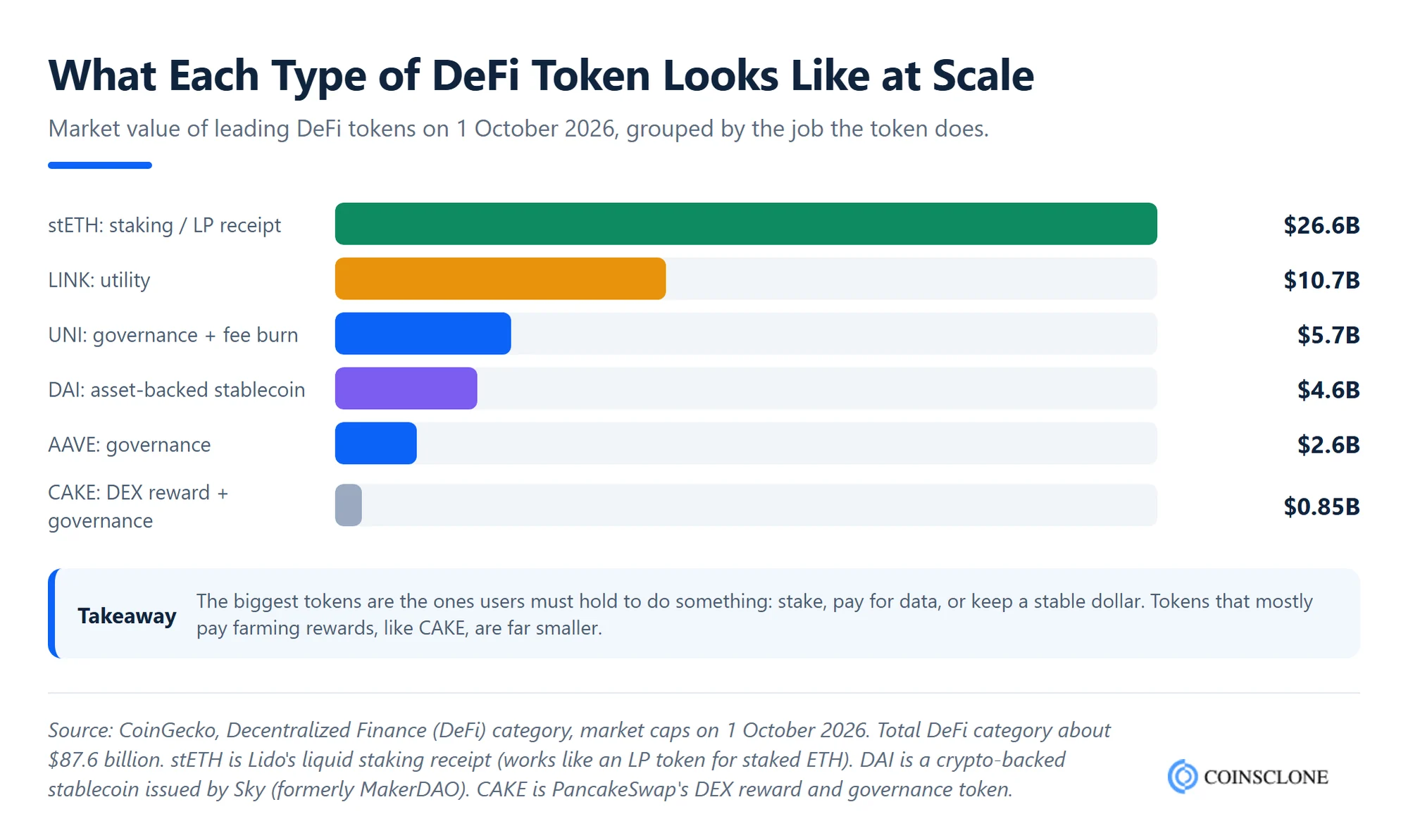
- The five types of DeFi tokens, with live examples and their size in October 2026
- How tokenomics works, using Uniswap’s real token split and its new fee switch as a worked example
- The 8 steps to create a DeFi token, plus a launch checklist for liquidity and listings
- Token standards and chains that matter in 2026, and the ones to skip
- Cost and time ranges, the 2026 rules, and where most hack losses come from
See How Our MVP System Can Help You Build a DeFi Token Faster
DeFi Token Development — power your project with custom tokenomics.
- MVP System : Create and deploy your DeFi token 90% faster with audited contracts.
- DeFi-Ready Modules : Reflection, liquidity, burn, and staking logic included.
- Brand & Customization : Set supply, rewards, and governance parameters.
- Revenue Engine : Earn from tokenomics, fees, and community incentives.
Get a free token demo in 48 hours — before investing a cent!
Book a Free Demo to see how our DeFi Token System can launch your crypto asset fast.
What Is DeFi Token Development?
DeFi token development is the work of designing, coding, testing and launching a token that powers a decentralized finance app. The token might let people vote, pay fees, earn rewards, prove they own a share of a pool, or hold a claim on a real asset. Smart contracts run all of it, so users deal with the app directly instead of a bank or broker.
A good DeFi token is more than a contract with a name and a supply. It also needs clear rules for how new tokens are made, who gets them, when they unlock, and how the app’s income reaches holders. Those rules are called tokenomics, and they decide whether a token lasts.
The market is large and active. DeFi apps held about $95 billion in user funds on 1 October 2026, according to DefiLlama’s TVL data. DeFi tokens themselves were worth about $88 billion in total that day, based on CoinGecko’s DeFi category.
Here is how a DeFi token differs from other crypto assets:
- DeFi token vs coin: A coin, such as BTC or ETH, runs its own blockchain. A DeFi token lives on an existing chain as a smart contract. Bitcoin is not a DeFi token, even though wrapped BTC is used inside DeFi apps.
- DeFi token vs security token: A security token stands for shares, debt or fund units. It must follow securities law from day one. Many DeFi tokens aim to be utility or voting tokens instead, but regulators judge each case on its facts.
- DeFi token vs meme token: A meme token has no job beyond trading. A DeFi token has a defined role inside a protocol, and its demand comes from that role.
Below, you will see what kinds of DeFi tokens exist, how they are built and why the design matters.
Types of DeFi Token Development
DeFi tokens come in a few main forms. Each one serves a different purpose inside a protocol. The type you pick shapes how users vote, pay, earn and add liquidity, so choose it before you write any code.
Governance Tokens
These tokens give holders a vote on protocol changes. Holders can decide fee levels, how the treasury is spent and which upgrades go live. They are the base of a DAO, a group run by its token holders. UNI (Uniswap) and AAVE (Aave) are the best-known examples. In 2026, more of them also share income through buybacks or burns, as the tokenomics section shows.
Utility Tokens
Utility tokens give access to a service inside a decentralized app (dApp). People use them to pay network or service fees, get discounts, or unlock premium features. LINK is a good example: apps pay node operators in LINK for price feeds and other data. A utility token’s value depends on how much people actually use the service behind it.
Asset-Backed Tokens
These tokens are a claim on something else. That might be another crypto asset or a real-world asset (RWA) like cash, gold, land or bonds. Stablecoins are the most common kind, built to hold a steady value. DAI is backed by crypto. RWA tokens, such as tokenized Treasury funds, bring outside value into DeFi through smart contracts and price feeds (oracles). RWA tokens usually need extra legal work, which we cover in our guide to RWA token development.
LP Tokens
When users add tokens to a decentralized exchange (DEX) pool, they receive liquidity provider (LP) tokens that show their share of the pool. LP tokens are the key part of Automated Market Makers (AMMs). They track each person’s share of trading fees, and users can stake them elsewhere to earn more. Liquid staking receipts such as Lido’s stETH work the same way for staked ETH.
Reward and Staking Tokens
Protocols pay these tokens to users who lock up assets or add liquidity. Often the reward token also has a vote or a utility role. They play a big part in a protocol’s tokenomics, because high rewards attract users fast but can flood the market with new supply. Good designs balance rewards with real income.
Each of these token types runs on a set of built-in functions. Before we look at those features, let us look at the part most guides skip: how a DeFi token actually earns its value.
DeFi Tokenomics: Supply, Allocation, Vesting and Value Capture
Tokenomics is the economic plan for your token. It answers four questions: how many tokens exist, who gets them, when they can sell, and why anyone would want to hold them. Get this wrong and even a perfect contract will fail.
Total Supply and Emissions
First, decide if your supply is fixed or growing. A fixed supply is simple and easy to trust. A growing supply, often called emissions, lets you pay rewards for years. Many teams mix the two: a fixed starting supply with a small, capped yearly increase. Uniswap, for example, minted 1 billion UNI at launch and planned a 2% yearly increase after four years.
Allocation and Vesting
Next, split the supply between users, the team, backers and advisors. Then set vesting, which means tokens unlock slowly over time. A common setup is a one-year “cliff” (nothing unlocks for 12 months) followed by monthly unlocks. Vesting stops early holders from selling all at once and crashing the price.
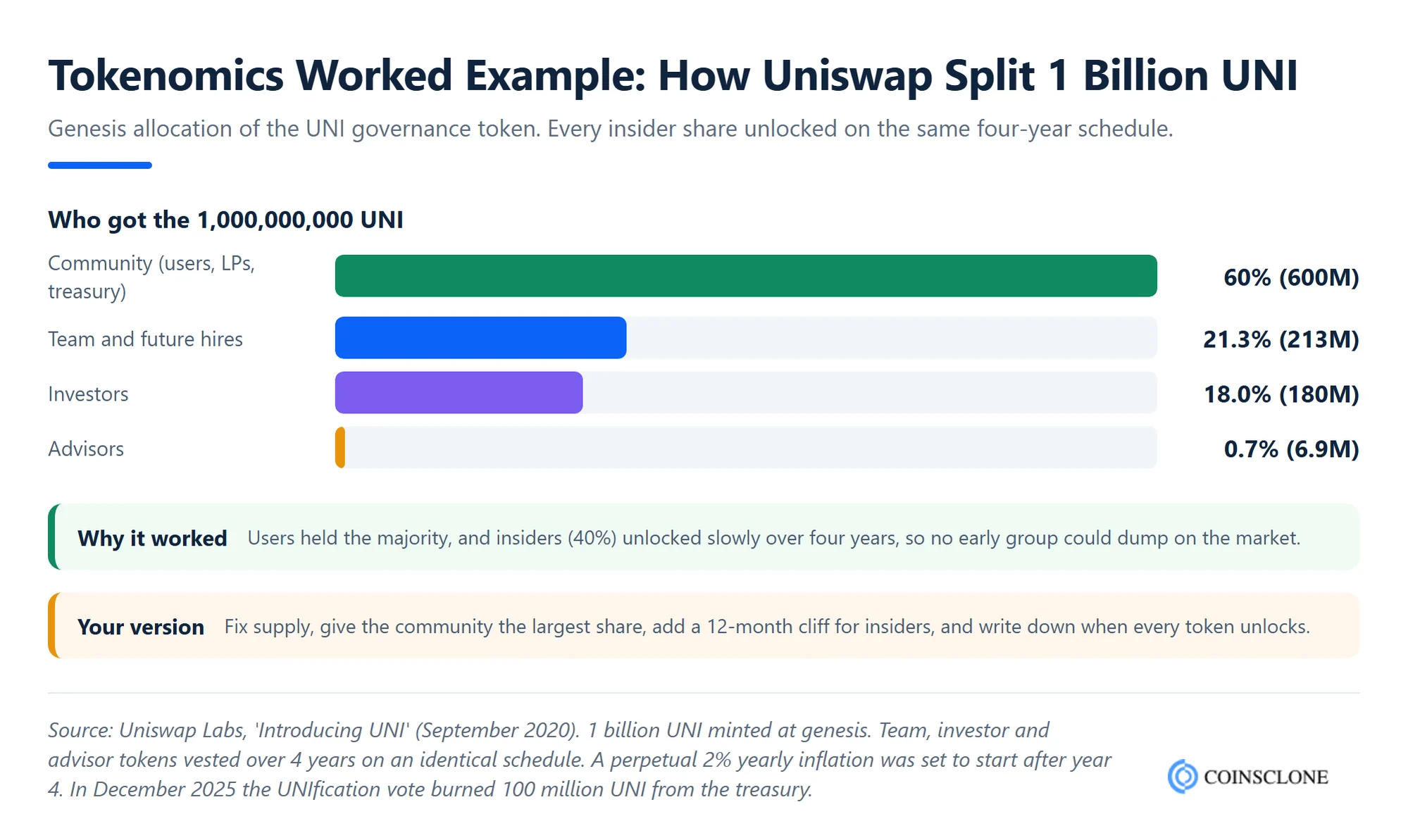
Uniswap’s own launch post is a useful model. It gave 60% to the community. All tokens for the team, backers and advisors unlocked on the same four-year plan. As a result, insiders could not sell ahead of users.
Value Capture: How Holders Benefit
This is where many DeFi tokens fall short. If the protocol earns fees but none of that income reaches the token, demand rests on hope. In 2026, most serious projects build a clear link between income and the token. There are three common ways to do it:
- Buyback and burn: The protocol uses its fees to buy tokens on the market and destroy them, so the supply shrinks.
- Staking rewards from real fees: Holders who stake receive a share of protocol income, paid in a stablecoin or ETH.
- Vote-escrow (ve) locking: Holders lock tokens for a set time to earn more votes and a bigger fee share. Longer locks get more weight.
The best-known case is Uniswap. After years of debate, its holders passed the UNIfication proposal, which went live on 28 December 2025. It burned 100 million UNI from the treasury and switched on protocol fees. Those fees now flow into a contract that can only release them when UNI is burned.
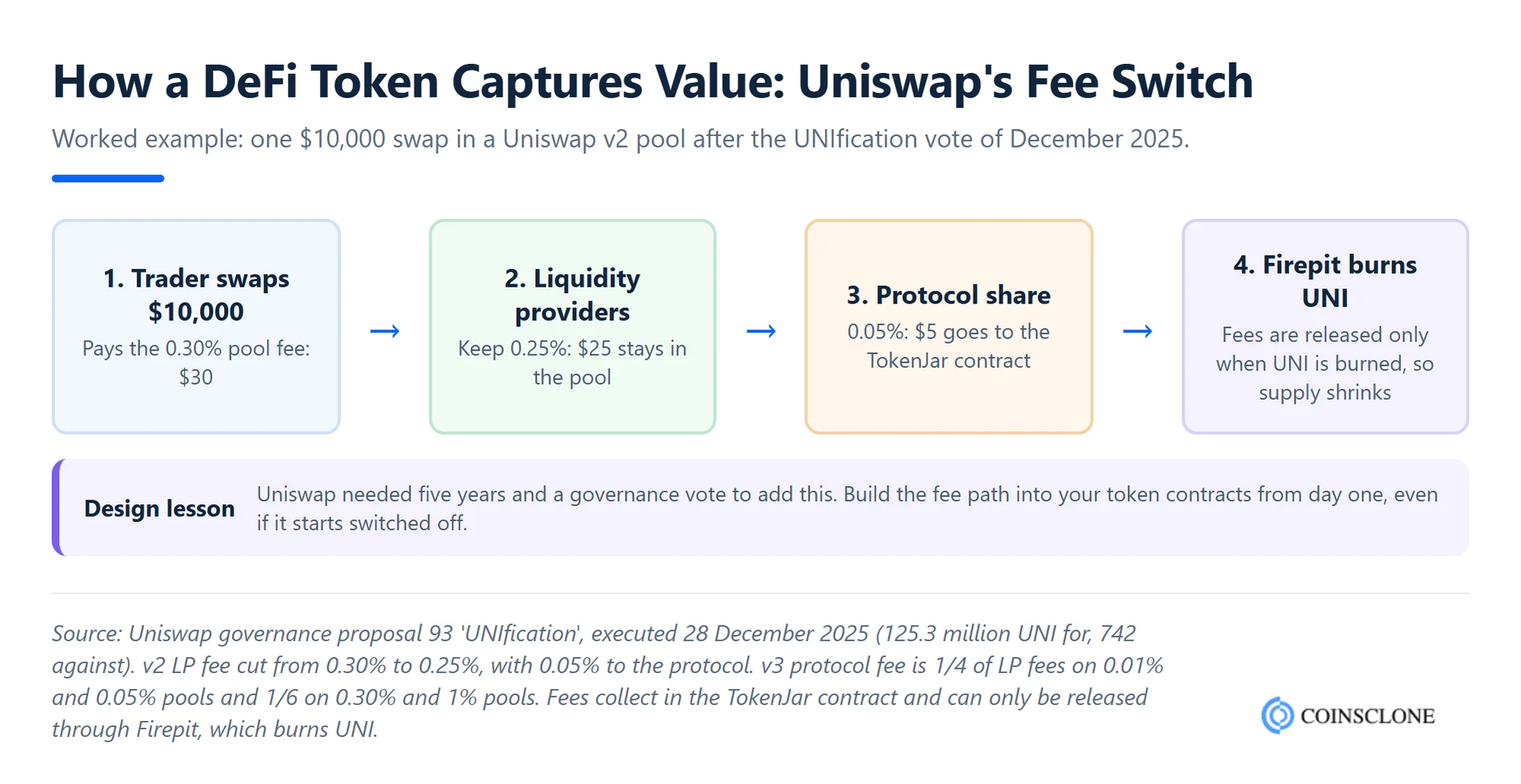
The lesson for your own token is simple. Write the path from income to holders into the contracts from day one, even if you switch it on later. Adding it after launch takes a governance fight, as Uniswap showed.
Core Features of Our DeFi Token Development
Our DeFi token development package comes with the features a modern app needs. Each one can be turned on or off to fit your tokenomics.
- Staking module: Users lock tokens in flexible or fixed-term pools and earn rewards.
- Liquidity pool setup: The token launches with paired pools on DEXs such as Uniswap or PancakeSwap.
- Voting system: Holders make proposals, hand their votes to others and vote. A time lock delays each change before it goes live.
- Burn mechanisms: Fixed burns, fee-funded buybacks or supply caps reduce the number of tokens over time.
- Multi-chain support: Run the token on Ethereum, BNB Chain, Base, Solana and more.
- Reward distribution: Rewards are paid automatically by formula, so no one has to send them by hand.
- Custom tokenomics: Supply, emissions, vesting and fee routing are all set to your plan.
- DAO integration: The token connects to a DAO treasury and voting system.
- Real-World Asset (RWA) support: Transfer rules, investor whitelists and oracle price feeds for tokens backed by real assets.
Security Features of DeFi Token Creation
Security is not a final check. It shapes every line of code. Crypto projects lost about $2.24 billion in 285 hacks from 1 January to 1 October 2026, per DefiLlama’s hack tracker, which counts DeFi apps, bridges, chains and a few exchanges. DeFi apps alone lost about $1.18 billion of that. The largest causes were stolen keys ($704 million), bridge and cross-chain bugs ($700 million) and weak access control ($369 million). Most of these were design and key-handling failures, not exotic code tricks.
That is why we build these protections into the token and the app around it:
- Multisig and time-locked admin keys: No single person can mint tokens, change fees or upgrade the contract. Changes wait in a public queue first.
- Locked liquidity: Pool tokens are locked for a set time, so the team cannot pull liquidity and run (a “rug pull”).
- Anti-bot and anti-front-running limits: Launch limits and fair trading rules stop bots from buying the whole first block.
- Safe oracle design: Price feeds come from trusted sources and use time-weighted prices, which makes them hard to fake.
- Proven code: We build on trusted open code such as OpenZeppelin Contracts. Then we run code scans and a manual audit.
- Platform protection: The dApp and admin panel get two-factor login (2FA), DDoS protection, rate limits and fraud alerts.
These core and security features form a strong base for any DeFi token. To help your project grow faster, we also offer a set of services around the token itself.
Our DeFi Token Development Services
Our services give you a complete, secure and market-ready setup for your DeFi project. They cover the token contract, the app, liquidity and voting.
Smart Contract Coding and Audits
We write secure, gas-efficient smart contracts for every token function, such as ERC-20 transfers, staking and vesting. Each contract goes through testing and an audit to remove weak spots before it goes live. Our DeFi smart contract development guide explains the process in more depth.
DeFi App and dApp Front End
We build simple front ends (dApps) where users can stake, swap, lend and vote. A clean interface matters, because most users judge a protocol by how easy it is to use.
Liquidity Pool and AMM Setup
We set up and tune Automated Market Makers (AMMs) so your token can trade from day one. As a result, users get deeper liquidity and fairer prices across DEXs.
Wallet Support
We connect popular self-custody wallets such as MetaMask, Trust Wallet and Phantom. Users keep full control of their funds while they use your dApp.
Cross-Chain Support
We add bridges and cross-chain messaging so your token can move between networks. This widens your reach, liquidity and user base. Because bridges were the second-largest source of crypto hack losses in 2026, we use proven bridge standards and strict rate limits.
DAO Setup
We build the smart contracts for your DAO. This allows open, community-led decisions by your token holders. When your token rests on solid tech, it also brings better business results. That is where the key benefits come in.
Business Benefits of a DeFi Token
Many startups want to know what they gain from creating a DeFi token. Here are the main benefits:
- Lower cost to issue and run: A token runs on an existing chain, so you do not pay for your own network.
- Built-in community: Holders who vote and stake become active users and promoters of your protocol.
- Use as collateral: Investors can use your token as collateral on DeFi lending platforms, which adds demand.
- No middlemen: You can issue and trade tokens without brokers, escrow agents or banks.
- Full transparency: Every transfer, burn and vote is public on the blockchain, which builds trust.
- Open to the world: Anyone with a wallet can use your token, from any country your rules allow.
- Fewer errors and less fraud: Smart contracts follow fixed rules, which cuts manual mistakes in payments and settlement.
- More liquidity: Each new token with a real use adds trading pairs and depth to the DeFi market.
Thanks to these benefits, many startups have already created DeFi tokens to grow their platforms. Now let us see where these tokens are used.
Use Cases of DeFi Token Development
DeFi tokens work across many kinds of finance apps. Here are the main ones.
DAOs
DAOs are groups run by their members instead of a board. Token holders vote on key money matters such as treasury spending, fundraising and rule changes. Even a small holder with one token can vote, though larger holders carry more weight. Our guide on how to start a DAO walks through the setup.
Lending and Borrowing
Lending apps such as Aave use tokens in two ways. Users post tokens as collateral to borrow. The app’s own token sets risk rules such as loan limits and interest rates.
Trading and Liquidity
DEX tokens such as UNI and CAKE govern the exchange and, more and more, share its fees. LP tokens track each provider’s share of the pool and its trading fees.
Asset Management
DeFi gives users full control over their funds. They can buy, sell and move digital assets while keeping their personal data private. Vault tokens built on the ERC-4626 standard let users hold one token that stands for a whole managed strategy.
Real-World Assets
Tokenized Treasury bills, private credit and real estate now plug into DeFi as collateral and yield sources. This is one of the fastest-growing areas in 2026, and it needs both token design and legal structure.
Rules and Compliance for DeFi Tokens
The rules for crypto tokens changed a lot in 2026. Compliance is no longer optional. It is part of professional token development, and it should shape your token design from the start.
- United States: In March 2026, the SEC and CFTC issued a joint guide that sorts crypto assets into five groups: commodities, collectibles, tools, stablecoins and securities. In August 2026, the SEC proposed Regulation Crypto Assets, with exemptions for raises of up to $5 million over four years or $75 million over 12 months. The CLARITY Act, the wider market structure bill, stalled after a 49 to 50 Senate vote on 15 September 2026.
- European Union: Under MiCA, most public token offers need a white paper sent to the national regulator first. Small offers to fewer than 150 people per country, or under EUR 1 million over 12 months, are exempt. Fully decentralized services fall outside MiCA, but most token issuers are not fully decentralized.
- Stablecoins: In the US, the GENIUS Act of July 2025 sets reserve and licensing rules for payment stablecoins. If your token is pegged to a currency, plan for these rules.
In practice, every DeFi token project should cover these four points:
- Token type: Decide if your token is a utility, governance or security token. Get legal advice in each country you target.
- Smart contract audits: An independent audit is now expected by users, exchanges and many regulators.
- Country checks: Block or restrict users from places where your token is not allowed.
- Open token distribution: Publish your allocation, vesting and treasury wallets so anyone can check them.
With the rules clear, the next step is to understand the cost and time it takes to bring your DeFi token to market.
How Much Does DeFi Token Development Cost?
The cost of a DeFi token is not a fixed price. It depends on the features, the chain, the audit and how much liquidity you plan to add. The code is often the smaller part of the budget.
| Cost item | Typical 2026 range | What pushes it up |
| Gas to deploy on Ethereum | About $1.50 | Gas spikes, many contracts, mainnet plus several L2s |
| Smart contract work | $5,000 to $50,000+ | Staking, vesting, governance, fee capture, cross-chain |
| Security audit | $5,000 to $15,000 basic; $40,000 to $150,000+ complex | Code size, new logic, a second audit firm |
| Legal review | $10,000 to $50,000 | Number of countries, token sale, RWA or security features |
| Starting DEX liquidity | $5,000 to $100,000 | Pairs, chains, how much price stability you want |
| Total | About $25,000 to $350,000+ | The sum of the low and high ends above |
Gas comes from the Etherscan gas tracker on 1 October 2026 (about 0.46 gwei with ETH near $2,690). The other ranges come from LearningCrypto’s 2026 token guide. A basic DeFi token is a standard ERC-20 or BEP-20 with minting, burning and transfers, and it sits near the low end. An advanced token adds staking, vesting, governance, fee capture or cross-chain support, and it moves toward the high end.
For a full breakdown by line item, see our guide on the cost to create a crypto token.
How Long Does It Take?
Time grows with scope. Coinsclone quotes these timelines for its own token work:
- Token contract only: 1 to 2 weeks
- Contract plus distribution (vesting, airdrops, sale): 3 to 5 weeks
- Contract plus a utility layer (staking, governance, fee capture): 6 to 10 weeks
- Complete token stack with dApp: 3 to 5 months
An outside audit and the fix-and-retest loop can add a few weeks to any of these. If you need a full protocol around the token, such as a DEX or lending market, plan on several months more.
Create a Top DeFi Tokens with Coinsclone
Cost-effective, Premium Features, Customizable. Live Demo Available.
How to Develop a DeFi Token: 8 Steps
Developing a DeFi token follows a clear order. Skipping a step, especially tokenomics or the audit, is the most common reason launches go wrong.
- Decide the purpose: Define what the token does in your protocol. Will it vote, pay fees, reward users or stand for an asset? Write down the problem it solves and who will use it.
- Design the tokenomics: Set the total supply, the rate of new tokens, the split, the unlock plan and the path from income to holders. Model what happens to price and supply over two to four years.
- Choose a blockchain: Pick a chain based on your users, fees and liquidity. The main options in 2026 are Ethereum, BNB Chain, Base, Arbitrum, Solana and Tron.
- Set the token details: Prepare the name, symbol, logo, total supply and decimals. Most tokens use 18 decimals on EVM chains.
- Write the smart contract: Build the token on a standard such as ERC-20, then add staking, vesting, governance or burn logic. Use audited libraries instead of writing everything from scratch.
- Test on a testnet: Deploy to a test network such as Sepolia and run every function. Try edge cases, high volumes and attack scenarios.
- Audit and fix: Run automated scans, then get an independent manual audit. Fix every finding and have the auditor check the fixes.
- Deploy and verify: Deploy to mainnet and publish the source code on the block explorer. Then hand admin rights to a multisig wallet with a time lock.
Following these steps, you can create a DeFi token that fits your business. Even so, working with an experienced team saves time and avoids costly mistakes. If you want a deeper walk-through of the contract side, read how to create a crypto token.
How to Launch a DeFi Token Successfully
Deploying a token does not list it anywhere. A new contract has no price and no market until you create one. Treat launch day as its own project with this checklist:
- Seed liquidity: Add your token and a paired asset (ETH, USDC or BNB) to a DEX pool. Thin pools mean wild price swings, so plan this budget early.
- Lock the LP tokens: Lock pool tokens in a public locker for months or years, and share the proof.
- Publish the facts: Share the verified contract address, audit report, allocation and vesting schedule in one place.
- List on trackers: Apply to price sites such as CoinGecko and CoinMarketCap once trading starts.
- Plan exchange listings: Centralized exchanges review volume, holders, audits and legal status before listing a token.
- Keep building: Launch staking, governance or fee sharing on a clear public roadmap, so demand comes from use and not only from hype.
Popular DeFi Token Standards
Token standards are the rule sets every token on a chain follows. They make sure wallets, DEXs and lending apps can read your token without custom work. Because DeFi tokens run on existing blockchains, you need to choose both the chain and the right standard.
| Chain | Main token standard | DeFi TVL (1 Oct 2026) | Best for |
| Ethereum | ERC-20 | $53.7 billion | Deepest liquidity, highest trust |
| Solana | SPL / Token-2022 | $6.6 billion | Fast, very low-cost trading apps |
| Base | ERC-20 | $6.4 billion | Low-fee apps with Ethereum security |
| BNB Chain | BEP-20 | $5.7 billion | Low fees and a large retail base |
| Tron | TRC-20 | $5.6 billion | Stablecoin payments, USDT flows |
| Arbitrum | ERC-20 | $1.4 billion | DeFi apps that need cheap Ethereum-style contracts |
TVL figures come from DefiLlama’s chain rankings. We build tokens on all of these chains, plus Polygon, Avalanche, Optimism, TON and Sui.
Ethereum DeFi Tokens
Ethereum is the most decentralized smart contract network and still holds more than half of all DeFi funds. Leading decentralized exchanges like Uniswap and lending apps such as Aave started on Ethereum. Layer 2 networks such as Base and Arbitrum use the same ERC standards, so one contract design can run on all of them.
ERC-20
ERC-20 is the standard for fungible tokens on Ethereum and every EVM chain. ERC stands for “Ethereum Request for Comment”. Nearly every DeFi token, from UNI to AAVE, is an ERC-20. Our ERC-20 token development page covers it in detail.
ERC-2612 (Permit)
ERC-2612 adds a “permit” function to ERC-20. Users can approve spending with a signed message instead of a separate transaction. This saves gas and makes swaps and deposits feel like one step.
ERC-4626
ERC-4626 is the standard for tokenized vaults. A user deposits an asset and gets a vault share token back. Yield vaults and lending markets use it so other apps can plug in without custom code.
ERC-1400 and ERC-3643
ERC-1400 and ERC-3643 are standards for security tokens and regulated RWA tokens. They add transfer rules and investor checks. They can also freeze or recover tokens when the law requires it.
ERC-721
ERC-721 is the standard for non-fungible tokens (NFTs). Each token is unique and cannot be swapped one-for-one. Uniswap v3 uses an ERC-721 token for each pool position.
ERC-1155
ERC-1155 is a multi-token standard. It allows both fungible and non-fungible tokens in a single smart contract, which suits games, reward points and bundles of assets.
Older Standards to Skip
ERC-223 and ERC-827 were early proposals to fix ERC-20 transfer issues. Neither won wide support from wallets or DEXs, so new DeFi projects should use ERC-20 with ERC-2612 instead.
BNB Chain Tokens
BNB Chain (once called Binance Smart Chain) was built by the Binance team for fast, low-cost apps such as decentralized exchanges like PancakeSwap. It uses a proof-of-staked-authority model with a set of validators, which keeps fees low.
BEP-20
BEP-20 is the standard for fungible tokens on BNB Chain. It mirrors ERC-20, so tools and audits carry over easily. CAKE, PancakeSwap’s token, is a BEP-20 token. Learn more on our BEP-20 token development page.
Tron DeFi Tokens
Tron is best known today for stablecoin transfers, as a large share of all USDT moves on it. Its native coin, TRX, pays for network resources when you create and use Tron tokens.
TRC-20
TRC-20 is the standard for fungible tokens on Tron and works much like ERC-20. It runs on the Tron Virtual Machine and supports full smart contract logic. Use TRC-20 for any new Tron DeFi token. The older TRC-10 standard is legacy and lacks the contract features DeFi needs.
TRC-721
TRC-721 is Tron’s standard for non-fungible tokens. Different kinds of digital collectibles, such as art and music, can be turned into NFTs through it.
Solana Tokens
Solana uses its own token rules, not ERC ones. Tokens are created through the SPL Token program, and the newer Token-2022 program adds built-in features such as transfer fees and interest-bearing tokens. Solana suits trading apps that need very fast, very cheap transactions.
Common Challenges in DeFi Token Development
Most new tokens do not last. More than half of all tokens listed on GeckoTerminal since mid-2021 had stopped trading by the end of 2025, per CoinGecko data reported by CoinDesk. DeFi tokens face a few problems again and again:
- No real demand: If the token has no job beyond trading, buyers leave once rewards end.
- Heavy emissions: High farming rewards bring users fast, but the new supply pushes the price down.
- Weak security: Stolen admin keys and unchecked upgrades caused the largest losses of 2026.
- Thin liquidity: Small pools make the price easy to move and scare off larger users.
- Unclear legal status: A token that looks like a security can be blocked by exchanges and regulators.
You can fix each of these risks at the design stage. Give the token a clear job, cap new supply, use multisig controls, set a liquidity budget and get legal advice early.
Why Choose Coinsclone for DeFi Token Development?
Many companies offer token development with only basic features. Coinsclone builds DeFi tokens as part of a complete product, with tokenomics, staking, governance and fee capture designed into the contracts from the start. Coinsclone is a DeFi development company that has been building since 2018. We have shipped 350+ platforms for 200+ clients in 20 industries.
We also offer the token as part of a wider package, such as a DEX, staking platform or lending app, so your token has a real home on launch day. We also build crypto exchanges, crypto payment gateways, NFT marketplaces and every kind of crypto token. If you are planning a DeFi token, our team can scope the tokenomics, chain and timeline with you before any code is written.
Frequently Asked Questions
What is a DeFi token?
A DeFi token is a digital asset on a blockchain that works through smart contracts. It lets users trade, lend, borrow, stake or vote inside decentralized finance apps without banks or other middlemen.
Is Bitcoin a DeFi token?
No. Bitcoin is a coin that runs its own blockchain, not a token on a DeFi protocol. Still, wrapped BTC on Ethereum and other chains is often used as collateral in DeFi apps.
What are RWA tokens in DeFi?
RWA tokens represent real-world assets such as Treasury bills, real estate, private credit or commodities on a blockchain. They let these assets be used in DeFi lending, staking and trading through smart contracts.
How does DeFi token development work?
It starts with the token’s purpose and tokenomics. Next, the team picks a blockchain and standard (such as ERC-20), writes and tests the smart contract, gets it audited, and deploys it. Finally, the team adds liquidity and launches the features that give the token a use.
What is the difference between governance tokens and utility tokens?
A governance token gives holders a vote on how the protocol is run, such as fees and treasury spending. A utility token gives access to a service, such as paying fees or unlocking features. Many DeFi tokens now do both.
Which blockchain is best for a DeFi token?
Ethereum offers the deepest liquidity and trust, with more than half of all DeFi funds. Base and Arbitrum cost less and still rely on Ethereum for safety. Solana suits fast trading apps, BNB Chain has low fees and many retail users, and Tron is strong for stablecoin payments.
Can I create a DeFi token without coding?
Yes, no-code token generators can create a basic token in minutes. However, they rarely include custom staking, vesting, governance or fee capture, and they do not replace an audit. For a token that a real protocol depends on, custom code and a review are the safer choice.
Does deploying a token list it on exchanges?
No. Deploying only creates the contract. To trade, you must add liquidity to a DEX pool. Price sites and centralized exchanges list tokens separately after their own review.
How much does it cost to create a DeFi token?
Gas to deploy a simple token on Ethereum was about $1.50 in October 2026. Once you add contract work, an audit, a legal review and starting liquidity, a basic DeFi token starts at about $25,000. Advanced tokens with staking, governance and fee capture can pass $200,000.
How long does it take to develop and deploy a DeFi token?
A token contract alone takes 1 to 2 weeks. Adding vesting and distribution takes 3 to 5 weeks, and a utility layer with staking or governance takes 6 to 10 weeks. A complete token stack with its own dApp takes 3 to 5 months.
Are there risks in DeFi token development?
Yes. Bugs, stolen keys and weak admin controls can lead to large losses, and crypto projects lost about $2.24 billion to hacks in the first nine months of 2026, per DefiLlama. Price swings and changing rules are also risks. Audits, multisig controls and early legal advice reduce them.
What makes a DeFi token successful long term?
It needs a real use in the protocol, a clear link from income to the token, fair unlocks, enough liquidity and strong security. Tokens that rely only on rewards and hype usually fade once emissions slow down.
See How Our MVP System Can Help You Build a DeFi Token Faster
DeFi Token Development — power your project with custom tokenomics.
- MVP System : Create and deploy your DeFi token 90% faster with audited contracts.
- DeFi-Ready Modules : Reflection, liquidity, burn, and staking logic included.
- Brand & Customization : Set supply, rewards, and governance parameters.
- Revenue Engine : Earn from tokenomics, fees, and community incentives.
Get a free token demo in 48 hours — before investing a cent!
Book a Free Demo to see how our DeFi Token System can launch your crypto asset fast.