
A SafeMoon clone script is ready-made code for a reflection token: a token that charges a small fee on each trade and shares part of it with every holder. This guide explains how the SafeMoon model works, what happened to SafeMoon itself, and which parts of the design are still safe to use in 2026.
SafeMoon is not a project to copy as it was. Its token passed $8 billion in market value in 2021, then its company went bankrupt and its CEO was sentenced to prison for fraud in February 2026. The reflection idea itself is simple and legal. What failed was how the founders handled liquidity and admin keys. A clone built today has to fix exactly those parts.
In this guide:
- How a SafeMoon-style 10% fee splits between holders and liquidity, with worked numbers
- The plain facts of SafeMoon’s collapse, from the 2023 hack to the 2026 sentence
- Five flaws in the original public contract, and the 2026 fix for each one
- How to list a reflection token on a DEX, and the legal points to check
- Real cost ranges and timelines for a SafeMoon-style token
See How Our MVP System Can Launch Your Reflection Token Ecosystem Faster
Safemoon Clone Script — Reflection-Based DeFi Token Development for the Next Generation.
- MVP System : Deploy your Safemoon-style reflection token in hours, not months
- Smart Contracts Ready:: Built-in reflection, auto-liquidity, and burn mechanisms
- Brand & Customization : Customize supply, name, and transaction fees as per your tokenomics.
- Revenue Engine : Earn from reflection rewards, token burns, and liquidity contributions.
Get a free branded demo of your Safemoon-like token in just 48 hours — before you invest
Book a Free Demo to learn how our Safemoon Clone Script can take you from concept to live DeFi token quickly.
What Is a SafeMoon Clone Script?
A SafeMoon clone script is a pre-built, tested smart contract package that copies the core mechanics of the SafeMoon token, so you can launch your own reflection token with your own name, supply and fee settings. The original SafeMoon token ran on BNB Smart Chain as a BEP-20 token. Its main features were a fee on every transfer, automatic rewards for holders and automatic top-ups to its trading pool.
Many guides describe SafeMoon as a decentralized exchange. That is only part of the story. SafeMoon started as a token in March 2021 and later added its own swap, bridge and wallet apps around it. So a full SafeMoon clone has two layers:
- The token layer: The reflection token contract, with its fees, rewards, liquidity logic and limits. This is the heart of the clone.
- The app layer (optional): A swap app built on a DEX like PancakeSwap, a bridge to other chains and a wallet that tracks reflection rewards.
Most projects need the token layer first. The swap, bridge and wallet make sense later, once the token has real users.
SafeMoon in 2026: What Happened and Where It Stands
Before you copy any part of SafeMoon, you should know how it ended. These facts come from US court and government records, as of 16 October 2026.
- 2021 rise: SafeMoon launched in March 2021 and grew to millions of holders and a market value of more than $8 billion within months, according to the IRS Criminal Investigation release on the case.
- March 2023 hack: A contract update left a burn function open to anyone. An attacker used it to drain about $8.9 million from the SFM/BNB pool.
- November 2023 charges: The SEC sued SafeMoon and three of its leaders. It said they took out more than $200 million in crypto and falsely told buyers the trading pool was “locked” (SEC Litigation Release No. 25888). US prosecutors in Brooklyn filed criminal charges the same day.
- December 2023 shutdown: SafeMoon US LLC filed for Chapter 7 bankruptcy in Utah. Chapter 7 closes a company and sells what it owns to pay its debts.
- 2025 verdicts: Former executive Thomas Smith pleaded guilty in February 2025. In May 2025, a jury found CEO Braden John Karony guilty of conspiracy to commit securities fraud, wire fraud and money laundering.
- February 2026 sentence: Karony was sentenced to 100 months in prison and ordered to forfeit about $7.5 million. Co-founder Kyle Nagy remains at large.
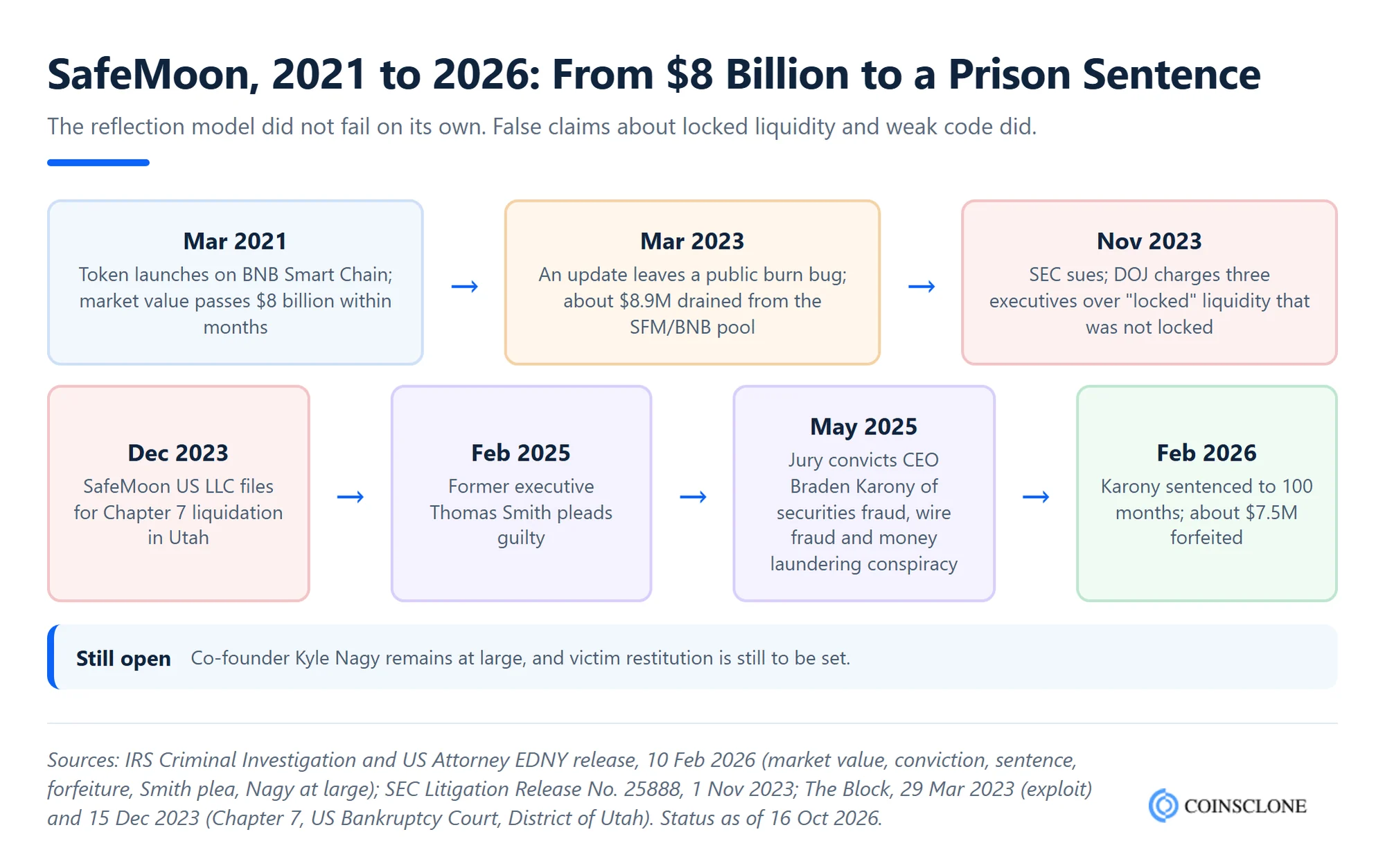
The key point for a founder is this: prosecutors did not charge anyone for building a reflection token. The case was about lying to investors. Insiders said the liquidity was locked when they could still reach it, and they used the money to buy homes and cars. So SafeMoon is a warning about trust and admin control, not proof that the token model is illegal. It is still not a current pick for investors, and you should never market your project as “the next SafeMoon”.
How the SafeMoon Token Model Works
The original SafeMoon contract is public on GitHub and was verified on BscScan on 1 March 2021. Its settings are a useful starting point, because almost every clone copies them:
| Setting | Original SafeMoon value | What it does |
| Total supply | 1 quadrillion tokens | A huge supply keeps the unit price tiny |
| Reflection fee | 5% of each transfer | Shared among all holders |
| Liquidity fee | 5% of each transfer | Added to the token/BNB pool |
| Max transaction | 0.5% of supply | Limits very large sells in one go |
| Swap threshold | 0.05% of supply | When the contract sells its fees into the pool |
Reflection: Rewards Without Claiming
Reflection is the part that made SafeMoon famous. Instead of sending tokens to each holder, which would cost a fortune in gas, the contract keeps two sets of books. One tracks “real” balances and one tracks “reflected” balances. When a fee is charged, the contract shrinks the reflected total. As a result, everyone’s share of the remaining supply grows a little, and their wallet balance goes up with no claim and no extra transaction.
Addresses can also be excluded from rewards. Projects usually exclude the trading pool, the burn address and exchange wallets, so rewards flow to real holders.
Auto-Liquidity: Fees That Deepen the Pool
The second 5% goes to the token contract itself. Once the contract holds enough tokens, it sells half for BNB and adds both halves to the trading pool. Over time, the pool gets deeper, so large trades move the price less.
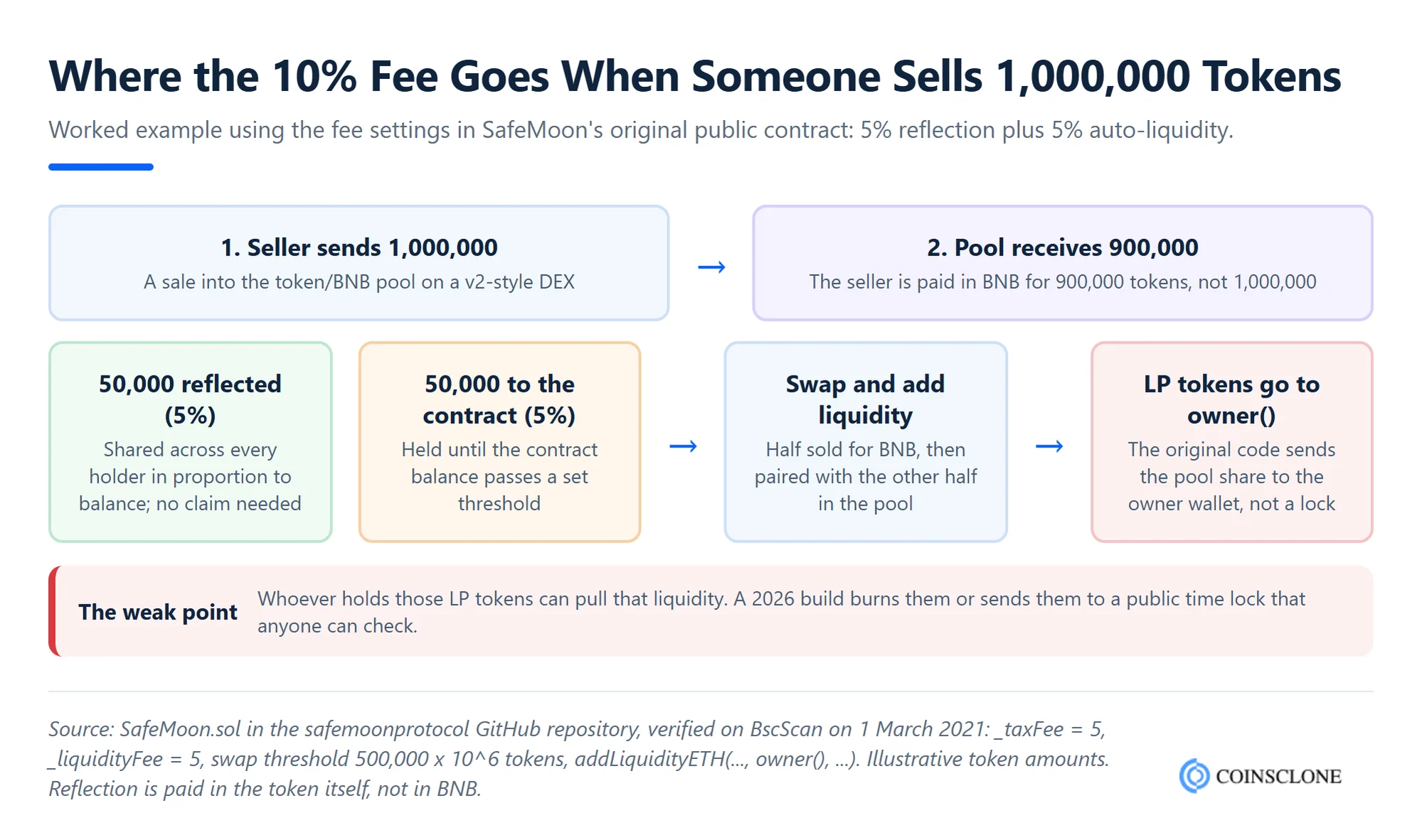
Notice the last step. In the original code, the pool tokens created by auto-liquidity went to the owner’s wallet. The contract’s own header comment says this liquidity is “locked forever”, but the code does not lock it. That gap between the promise and the code sits at the centre of the fraud case.
What a Reflection Token Can and Cannot Do Safely in 2026
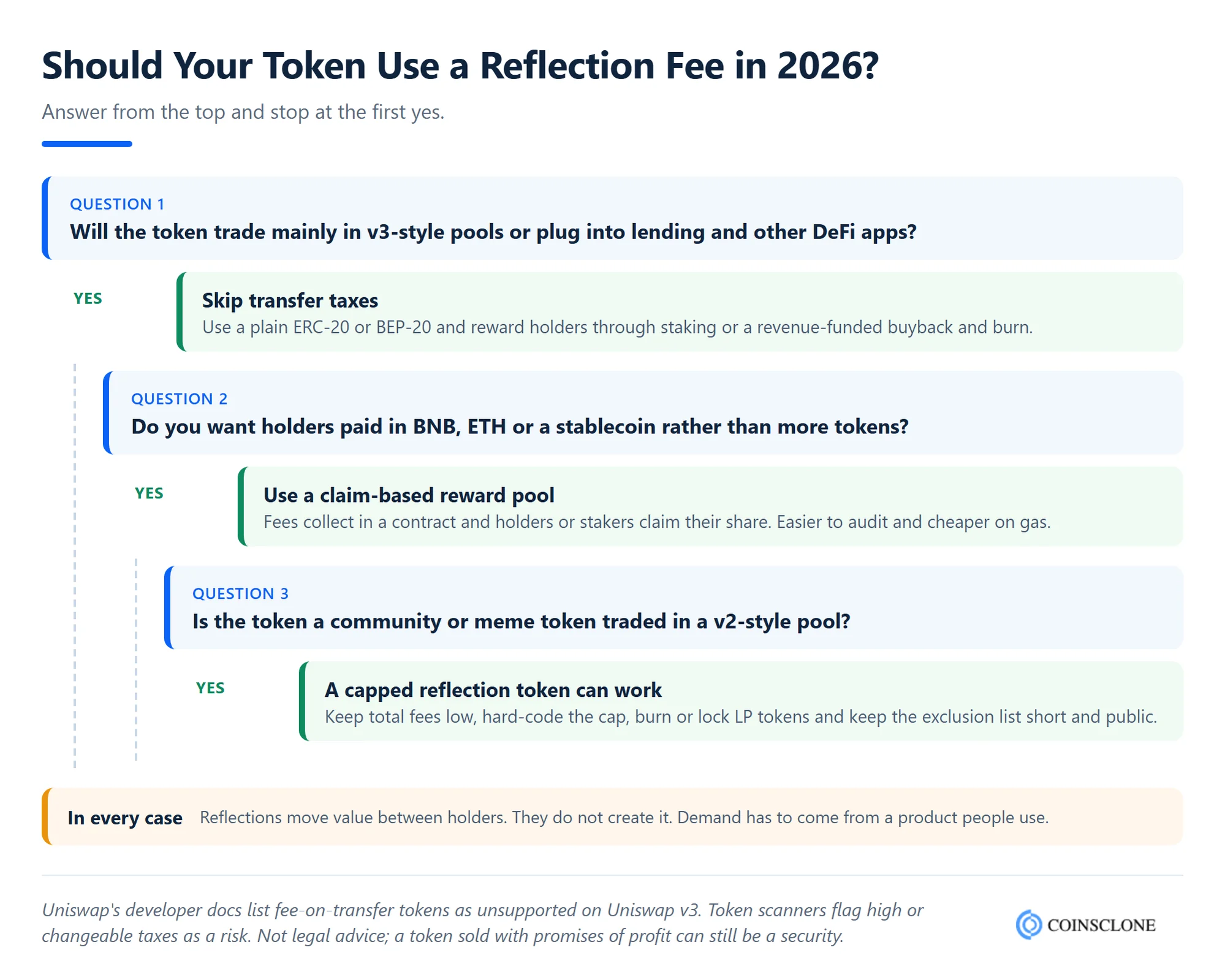
A reflection token is a narrow tool. It is good at a few things and bad at many others, so be clear about which side your project falls on.
What it can do well:
- Reward holding: Every trade pays long-term holders a little, with no staking step.
- Build liquidity slowly: Auto-liquidity deepens the pool from trading fees.
- Discourage fast flipping: A fee on each trade makes quick in-and-out trading costly.
- Suit community tokens: Meme and community tokens on v2-style pools are where this model still fits.
What it cannot do:
- Create demand: Reflections move value from traders to holders. They do not bring in new money. If trading stops, rewards stop too.
- Work on every DEX: Uniswap’s docs say fee-on-transfer tokens do not work right on Uniswap v3. Other DeFi apps that expect the amount sent to equal the amount received can break too, so your token may be shut out of parts of DeFi.
- Stay cheap at scale: Each transfer runs extra math. In the original design, the contract also loops over every excluded address on each transfer, so gas grows as the exclusion list grows.
- Pass scanners by default: Token scanners and wallets flag high taxes, fees the owner can change and hidden exemptions. If yours trips those checks, users see a warning before they buy.
If your goal is a lasting token with real use, a revenue-funded buyback and burn often works better than a transfer tax. Our guide to deflationary token development compares those burn models with live 2026 examples.
Five Flaws in the Original Contract, and the 2026 Fix
Most SafeMoon clones online copy the 2021 code line for line, flaws included. A safe clone changes these five things before launch.
- LP tokens sent to the owner: The original sends new pool tokens to the owner wallet. Fix: Burn them, or send them to a public time lock that anyone can check on the block explorer.
- Fees with no ceiling: The owner could set the reflection and liquidity fees to any number, which can turn a token into a trap where no one can sell. Fix: Hard-code a maximum total fee in the contract, so even the owner cannot go above it.
- A “lock” that hands control back: The original lock function gives up ownership for a set time, then lets the old owner take it back. Buyers may think ownership was renounced when it was not. Fix: Either renounce for real, or put admin powers behind a multi-signature wallet with a time lock and say so in public.
- Zero slippage on auto-liquidity: The contract sells its fees into the pool with no minimum price, so bots can trade around it and take value. Fix: Set sensible swap sizes and minimum outputs, and test them under busy trading.
- Risky upgrades: The 2023 hack came from an update that exposed a burn function. Fix: Ship a fixed contract, or route every upgrade through a time lock and a fresh audit.
The original contract is also marked “Unlicensed”, which means no one has been given clear rights to reuse it. A serious project should write its own code on audited libraries such as OpenZeppelin, rather than paste the 2021 file. Our guide on how to develop a smart contract explains that process step by step.
What are the Benefits of Using Safemoon Clone Script?
A well-built clone script still saves real time and money compared with writing everything from a blank page. Here is what you gain.
Faster Deployment
A tested reflection contract, swap screens and admin tools are already in place. Your team spends its time on tokenomics, branding and testing instead of rebuilding basic logic. That shortens the path to launch from months to weeks.
Cost-effective
Writing reflection math, auto-liquidity and fee limits from scratch takes many hours of senior coding time, plus extra audit work. A proven base cuts both. You pay mostly for the changes that make your token yours.
Reliability
Reflection math has known edge cases, such as rounding errors and the gas cost of long exclusion lists. A mature script has already been tested against them. With the five fixes above built in, you start from code that avoids SafeMoon’s mistakes.
No Need for Technical Skills
You do not need to read Solidity to launch. Our developers gather your needs, explain each choice in plain terms and keep you updated at every stage, from fee settings to the final audit.
Creates a Brand
A reflection token with clear rules, public locks and an honest roadmap stands out in a market full of copy-paste tokens. Trust is the brand. Transparent code and dashboards help you build it from day one.
Exclusive Features You Get with Our Safemoon Clone Script
Features play a major role in attracting users to a platform. Our script covers both the token layer and the optional SafeMoon-style apps.
Reflection Rewards
Holders earn a share of each trade fee in their wallet automatically. You choose the rate, and the contract can cap it in code so it can never be raised past a set limit.
Auto-Liquidity With Locked LP
Part of each fee goes into the trading pool. The pool tokens should be burned or time-locked, not sent to a private wallet as SafeMoon did.
Token Burn
An optional burn share sends tokens to a dead address, so supply falls over time. Only holders can burn their own tokens, which closes the hole behind the 2023 SafeMoon hack.
Anti-Whale Limits
Max transaction and max wallet limits slow down large dumps at launch. You can relax them later through a time-locked admin action.
Decentralized Architecture
Like the SafeMoon token, the clone runs on BNB Chain or another EVM chain. Users keep full control of their funds, and every transfer is recorded on the blockchain.
AMM and Crypto Liquidity Pools
An Automated Market Maker (AMM) prices trades from liquidity pools instead of an order book. Your token trades on PancakeSwap or any v2-style DEX, and the optional swap app uses the same pools.
Token Swapping
The optional swap app lets users trade your token for BNB or stablecoins in one screen, with the right slippage set for a taxed token.
Token Bridging
The optional bridge moves tokens between chains such as BNB Chain, Ethereum and Polygon. Bridges are a common hack target, so this module needs its own audit.
User-Friendly Interface
A clean wallet and dashboard show each holder’s balance, reflections earned and fees paid. Clear numbers build trust.
Apart from these, you can add:
- Connect wallet
- Multi-lingual assistance
- Syrup pools
- Multi-chain support
- Admin panel that needs more than one key to act
- Advanced user dashboard
- Rebalancing of pool ratios
- Community revenue sharing
- API Documentation
- Crypto staking and more
How to List a SafeMoon-Style Token on a DEX
Listing a reflection token takes more care than listing a plain token, because the fee changes how swaps behave.
- Deploy and verify: Deploy the contract and verify the source code on BscScan or the chain’s explorer, so anyone can read it.
- Create the pool: Add your token and BNB, or a stablecoin, to a v2-style pool on PancakeSwap. Your starting liquidity sets the opening price.
- Lock or burn the LP tokens: Do this at once, and share the lock link in public. This is the step SafeMoon’s founders claimed and did not do.
- Exclude the right addresses: Exclude the pool, the burn address and any exchange wallets from rewards, and publish the list.
- Tell users about slippage: Buyers need slippage a little above your total fee. Your swap app should set this for them.
- Run scanner checks: Check your token on common honeypot and token-risk scanners before launch, and fix any warnings.
What about large centralized exchanges? Most list tokens only after they show real use, audits and steady volume. A tax on every transfer also makes deposits and payouts harder for them to handle. So plan to start on DEXs, and treat a big exchange listing as a later goal.
Is It Legal to Launch a SafeMoon Clone?
Building a reflection token is legal in most countries. How you sell it is what decides the legal risk.
- United States: The SEC case against SafeMoon centred on false claims and an unregistered offering. The SEC staff said in a February 2025 statement on meme coins that most meme coins are not securities. However, a token sold with promises of profit from the team’s work can still be one.
- European Union: The MiCA rules require a white paper for public offers of most crypto tokens that are not stablecoins.
- Everywhere: Never call reflections “passive income” or promise returns. Be honest about who holds admin keys and where the liquidity sits.
Get legal advice in each market you target before you sell. It costs far less than fixing a problem after launch.
What is the Cost of Safemoon Clone Script?
Cost depends on how much you build around the token. Published 2026 agency cost guides put a basic custom BEP-20 token at about $5,000 to $15,000. A token with tax, reflection, vesting or staking logic runs about $15,000 to $50,000 or more. A security audit adds about $5,000 to $15,000 for a simple token, and $15,000 to $70,000 for complex contracts. Deploying the contract itself costs only cents in gas on BNB Smart Chain. For a full breakdown, see our guide on the cost to create a BEP20 token.
The main things that move the price are:
- Reflection, liquidity and burn logic, and how many fee types you combine
- Optional swap, bridge and wallet apps
- Staking, vesting or reward dashboards
- The depth of the audit (reflection math needs careful review)
- Legal and compliance work in your target markets
Timelines on the Coinsclone token development pages run as follows:
| Scope | Typical timeline |
| Token contract only (tests, verification, deployment) | 1 to 2 weeks |
| Token with vesting, distribution and liquidity | 3 to 5 weeks |
| Token with staking, governance and audit | 6 to 10 weeks |
A SafeMoon-style token usually lands in the middle row. Adding a custom swap app or bridge extends the plan.
If you run the optional swap and bridge apps, they can earn their own swap and bridge fees. Treat the token fee as a reward for holders, not as the business model.
How do you get started with Safemoon Clone Script?
Many script sellers still offer the 2021 SafeMoon code with only the name changed. Ask any provider these questions before you buy:
- Where do the LP tokens go, and how are they locked?
- Is there a hard cap on fees in the contract?
- Who holds admin keys, and is there a time lock?
- Has the reflection math been audited, and can you see the report?
- Has the token been tested on the DEX you plan to use?
If a provider cannot answer clearly, keep looking. A reliable path starts with a short tokenomics plan, then the contract, tests, audit, testnet launch and finally the mainnet pool.
Create a DeFi Token like Safemoon
Cost-effective, White-Label Solution, Premium Features, Customizable. Live Demo Available.
Why Choose Coinsclone for Building a DEX Future with Our Safemoon Clone Script?
Coinsclone is a crypto token development company and Decentralized Exchange Development Company. We have built blockchain products since 2018, with 350+ platforms delivered for 200+ clients across 20 industries. Our SafeMoon clone script keeps the parts of the model that still work, such as reflections, auto-liquidity and burns, and fixes the parts that failed. LP tokens are locked, fees are capped and admin powers sit behind multi-signature wallets.
We also build the products that give a token real demand, from DEXs and wallets to staking platforms and BEP20 tokens on BNB Chain. Talk to our team to plan a reflection token that holds up after launch, not just on launch day.
Frequently Asked Questions
What is a SafeMoon clone script?
A SafeMoon clone script is ready-made smart contract code that copies the SafeMoon token model: a fee on each transfer, reflection rewards for holders and automatic liquidity. It can also include SafeMoon-style swap, bridge and wallet apps. You set your own name, supply and fees.
How does a SafeMoon clone work?
Each transfer pays a fee. In the original design, 5% was shared among all holders through reflection and 5% was added to the trading pool. Holders see their balance grow with no claim step. A safe 2026 clone also locks the pool tokens and caps the fees.
Is SafeMoon still active?
The company behind it is not. SafeMoon US LLC filed for Chapter 7 bankruptcy in December 2023, and its former CEO got 100 months in prison in February 2026. SafeMoon should not be treated as a current project or investment.
Is it legal to launch a SafeMoon clone?
Building a reflection token is legal in most places. The SafeMoon case was about false claims to investors, not the token code. Avoid promising profits, be open about admin keys and liquidity, and get local legal advice. In the EU, MiCA requires a white paper for most public token offers.
How secure is a SafeMoon clone?
It is only as secure as its code and its admin setup. Copying the 2021 contract as-is brings its flaws with it. A secure clone locks LP tokens, caps fees, limits admin powers with multi-signature wallets and time locks, and passes an independent audit.
How to list a SafeMoon clone token on DEX exchanges?
Verify the contract, create a token/BNB or stablecoin pool on a v2-style DEX such as PancakeSwap, lock or burn the LP tokens, and tell buyers to set slippage a little above your total fee. Avoid Uniswap v3 style pools, which do not support fee-on-transfer tokens.
Can a SafeMoon clone be listed on major exchanges?
It is possible, but hard at launch. Major exchanges look for real use, audits and steady volume, and transfer taxes complicate their systems. Most reflection tokens start on DEXs.
How long will it take to develop a SafeMoon clone?
A token contract alone takes about 1 to 2 weeks. Adding liquidity setup and distribution takes 3 to 5 weeks. A full build with staking, governance and an audit takes 6 to 10 weeks. Custom swap or bridge apps add more time.
How much does it cost to create a DeFi token like SafeMoon?
Published 2026 agency cost guides put a token with tax or reflection logic at about $15,000 to $50,000 or more, plus about $5,000 to $15,000 for a simple audit. A basic token without custom logic costs less. Swap, bridge and wallet apps add to the total.
What’s the difference between a clone script and custom token development?
A clone script starts from a tested base that copies a known model, so it is faster and cheaper. Custom token development designs the token from scratch around your own rules. Many projects use a clone script as the base and customise the parts that matter, such as fees, locks and rewards.
See How Our MVP System Can Launch Your Reflection Token Ecosystem Faster
Safemoon Clone Script — Reflection-Based DeFi Token Development for the Next Generation.
- MVP System : Deploy your Safemoon-style reflection token in hours, not months
- Smart Contracts Ready:: Built-in reflection, auto-liquidity, and burn mechanisms
- Brand & Customization : Customize supply, name, and transaction fees as per your tokenomics.
- Revenue Engine : Earn from reflection rewards, token burns, and liquidity contributions.
Get a free branded demo of your Safemoon-like token in just 48 hours — before you invest
Book a Free Demo to learn how our Safemoon Clone Script can take you from concept to live DeFi token quickly.