
Decentralized exchanges (DEXs) handled about $310 billion in spot trades in the 30 days to 25 September 2026, according to DefiLlama, plus a fast-growing market in on-chain perpetual futures. Users trade straight from their own wallets, and smart contracts replace the company in the middle. For founders, that makes a DEX one of the most proven business models in crypto.
There are two main ways to launch one:
- Build your decentralized exchange from scratch, or
- Launch with a decentralized exchange script.
Both work, but a DEX script is the faster, lower-risk route for most startups, because the core contracts and screens are already built and tested. This guide explains what a decentralized exchange script includes, the types you can choose, the features and security that matter, and how to launch. For a view of the market leaders, see our list of the best decentralized exchanges.
See How Our MVP System Can Help You Launch a DEX Script Faster
Decentralized Exchange Script — your ready-to-deploy DeFi engine.
- MVP System : Launch your DEX script-based platform 90% faster with our prebuilt solution.
- DeFi-Ready Modules : Liquidity, staking, and swapping features — all blockchain-ready.
- Brand & Customization : Customize design, tokens, and protocol logic easily.
- Revenue Engine : Earn from transaction fees, staking pools, and yield farming.
Get a free DEX Script demo in 48 hours — before you invest!
Book a Free Demo to see how our DEX Script System can help you go live in 8-12 weeks.
What Is a Decentralized Exchange Script?
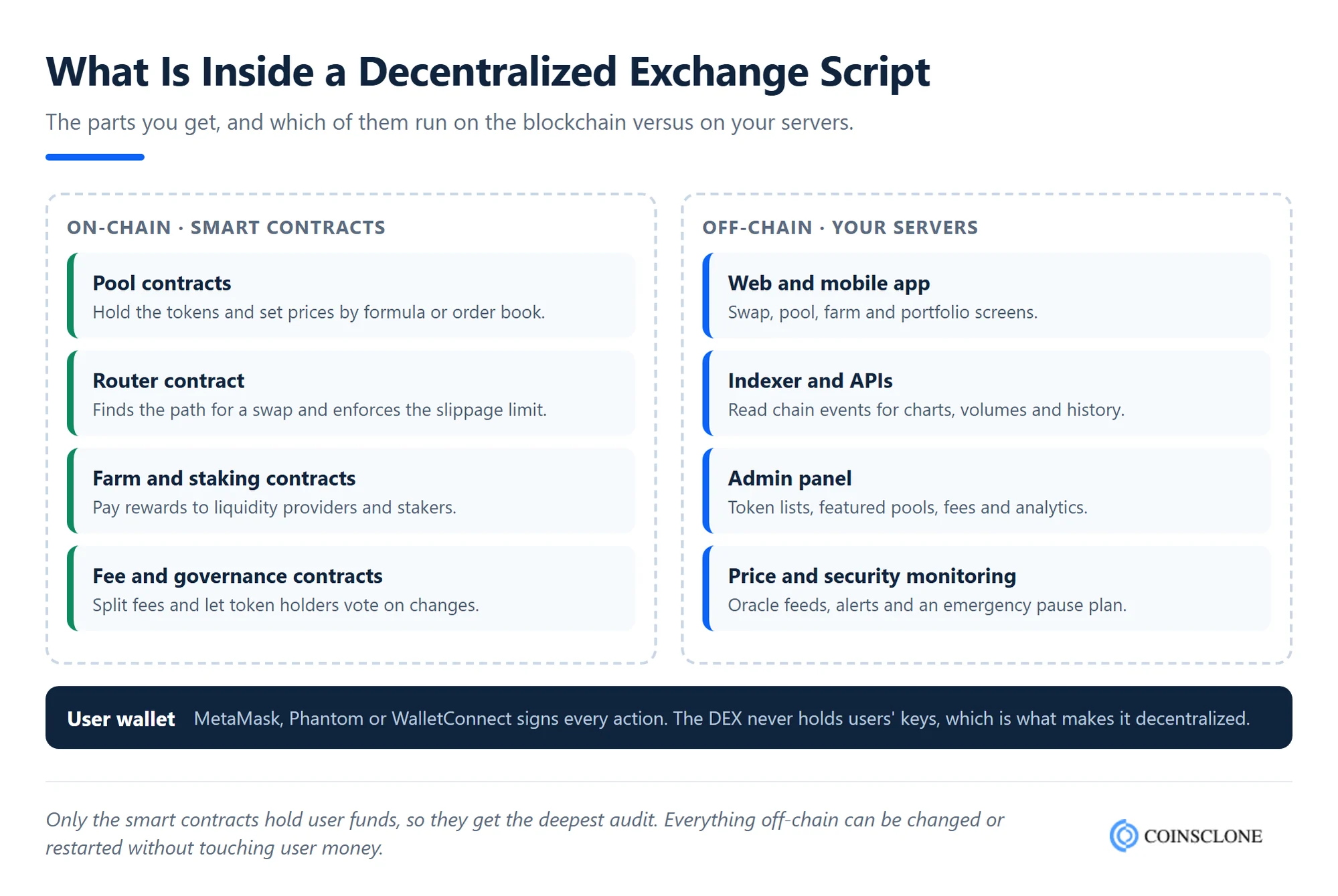
A decentralized exchange script is ready-made software for launching a full-featured DEX. It includes the smart contracts that hold liquidity and run swaps, the web and mobile app users trade on, and an admin panel for your team. You brand it, choose your chains and features, and launch.
At Coinsclone, we build and provide a tested, audited white label decentralized exchange. It is fully customisable and can be upgraded as your business grows.
Key highlights of the Coinsclone decentralized exchange script:
- Lower cost: you pay for customisation, not for rebuilding proven parts.
- Security first: audited contracts, tested code and monitoring.
- Built by specialists: blockchain, smart contract and UI/UX experts.
- Fast launch: go live in weeks, not months.
- 24/7 support: help before and after launch.
Types of Decentralized Exchange Scripts
Not every DEX works the same way. Pick the type that fits what your users will trade.
- AMM DEX script: users swap against liquidity pools priced by a formula. This is the model of Uniswap and PancakeSwap. Start from our Uniswap clone script or PancakeSwap clone script.
- Stableswap DEX script: pools built for coins with the same value, such as USDC and USDT, with very low slippage. See our Curve Finance clone script.
- Order book and perpetual DEX script: limit orders and leveraged futures, like dYdX and Hyperliquid. See our dYdX clone script and Hyperliquid clone script.
- Solana DEX script: fast, low-fee trading on Solana, like Raydium. See our Raydium clone script.
- Launchpad DEX script: new tokens launch on a bonding curve, then move to open trading, like Pump.fun. See our Pump.fun clone script.
- Aggregator script: finds the best price across many DEXs, like 1inch. See our 1inch clone script.
Want to track prices across all of them? A DEX Screener clone script adds real-time charts and token discovery.
Core and Security Features of Our Decentralized Exchange Script
Trading Features
- Token swaps: instant swaps from the user’s own wallet.
- Liquidity pools: users add tokens to pools and earn a share of fees.
- Concentrated liquidity: providers choose a price range to earn more per dollar.
- Yield farming: extra token rewards for liquidity providers.
- Staking: users lock tokens to earn rewards.
- Limit orders: trade at a set price, where the model supports it.
- Multi-hop routing: swaps route through several pools for a better price.
- Token support: list any token that meets your rules.
- Cross-chain support: deploy on several chains or add bridges.
Platform Features
- Wallet connection: MetaMask, Phantom, Trust Wallet and WalletConnect.
- Charts and analytics: prices, volume and pool data from an indexer.
- User-friendly interface: clear swap, pool and farm screens.
- Admin panel: token lists, featured pools, fee settings and reports.
- API documentation: for partners, aggregators and wallets.
- Governance module: token holders vote on fees and upgrades.
Security Features
- Audited smart contracts: reviewed by third-party auditors before launch.
- Slippage and deadline limits: protect users from bad fills.
- Emergency pause: a controlled way to stop contracts if an attack starts.
- Price oracle checks: protect against price manipulation.
- SSL, encryption and DDoS protection: for the app and servers.
- Two-factor authentication: for the admin panel.
These features come built into the DEX software, so you do not have to develop them yourself. That saves time, money and testing effort.
Why Security Matters Most in a DEX
In a DEX, the smart contracts hold the users’ money. A single bug can drain the pools. In November 2025, Balancer, one of the best-known DEXs, lost more than $100 million to an exploit in its pool contracts, and its company later closed.
That is why a DEX script should come with:
- Code that has already been used and audited
- A fresh audit of any changes you make
- Monitoring that alerts your team to unusual activity
- A clear plan for pausing contracts and informing users
Business Benefits of Our Decentralized Exchange Script
- Quick launch: go live in weeks instead of building for months.
- Lower cost: reuse tested contracts and screens.
- Customisable and scalable: add chains, pools and features as you grow.
- Stronger security: start from audited, proven code.
- No middleman: users trade directly through smart contracts.
- Automated market making: pools price trades on their own, day and night.
- Cross-chain reach: serve users on the chains they already use.
- Several revenue streams: earn from trading fees and more.
- User control: users keep their own keys and funds.
- Global access: anyone with a wallet can trade.
How a DEX Makes Money
A DEX earns mainly from a small fee on every swap. Most of that fee goes to liquidity providers, and the platform keeps a share, often called the protocol fee. Other income comes from token launches, featured listings, farms and, on perpetual DEXs, trading and funding fees.
PancakeSwap is a good example. In the last year it collected about $257 million in fees, kept about $86 million, and used most of that to buy back and burn its token. Read how PancakeSwap makes money for the full breakdown.
How to Launch a DEX With a Decentralized Exchange Script
- Pick your model and chain: AMM, stableswap, order book or launchpad, on the chains your users prefer.
- Design your token and fees: decide on swap fees, the protocol share and any reward token.
- Customise the script: brand, features, token lists and the admin panel.
- Audit: get the contracts, and any changes, audited by a third party.
- Test on a testnet: run a public test before real money is involved.
- Seed liquidity: plan how your first pools will be funded, with partners or reward programmes.
- Launch and grow: list with aggregators, partner with wallets, and market to your chain’s community.
How long does it take? Coinsclone’s published timelines are 5 to 7 weeks for a white label swap-and-farm DEX on one chain and 10 to 14 weeks for a standard multi-product DEX. Perpetual futures add six to twelve weeks and need their own audit. For a deeper guide, read how to create a decentralized exchange.
Technology Behind Our DEX Script
- Smart contracts: Solidity for EVM chains such as Ethereum, BNB Chain, Base and Arbitrum, and Rust for Solana.
- Testing: Foundry and Hardhat, with fuzz tests on pool maths.
- Frontend: React and Next.js, with ethers.js or viem for wallet connections.
- Indexing: subgraphs or a custom indexer for charts and history.
- Backend: Node.js APIs for token lists, analytics and admin tools.
- Hosting: cloud servers with a content delivery network for fast loading worldwide.
Why Choose Coinsclone for Your Decentralized Exchange Script?
Coinsclone has delivered more than 350 blockchain platforms for over 200 clients. We offer popular DEX clone scripts, including PancakeSwap, Uniswap, SushiSwap and more, each shaped to your requirements.
As a leading decentralized exchange development company, our team of blockchain developers, UI/UX designers and smart contract specialists delivers audited DEX scripts at a fair cost, without cutting corners on security. With 24/7 support after launch, we help your DEX grow safely.
See How Our MVP System Can Help You Launch a DEX Script Faster
Decentralized Exchange Script — your ready-to-deploy DeFi engine.
- MVP System : Launch your DEX script-based platform 90% faster with our prebuilt solution.
- DeFi-Ready Modules : Liquidity, staking, and swapping features — all blockchain-ready.
- Brand & Customization : Customize design, tokens, and protocol logic easily.
- Revenue Engine : Earn from transaction fees, staking pools, and yield farming.
Get a free DEX Script demo in 48 hours — before you invest!
Book a Free Demo to see how our DEX Script System can help you go live in 8-12 weeks.
Frequently Asked Questions
What is a decentralized exchange script?
It is ready-made software for launching a DEX. It includes the smart contracts, the trading app and an admin panel, which you brand and customise.
How long does it take to launch a DEX with a script?
A white label swap-and-farm DEX can launch in about 5 to 7 weeks. A standard multi-product DEX takes about 10 to 14 weeks, and perpetual futures add more time.
Is there an open source DEX I can use?
Yes, many DEXs publish their code, but licences vary. Some limit commercial copies for a period, and forks still need their own audit, branding and support. A licensed DEX script gives you tested code, customisation and a team behind it.
Which DEX script is best for my business?
An AMM script like Uniswap or PancakeSwap suits most token trading. Choose a stableswap script for stablecoins, an order book or perpetual script for leveraged trading, and a launchpad script for new token launches.
How secure is a decentralized exchange script?
A good script uses audited contracts, slippage limits, oracle checks and an emergency pause. Any changes you make must be audited again before launch.
How does a DEX make money?
Mainly from a share of the swap fee on every trade. DEXs can also earn from token launches, featured listings and, for perpetual DEXs, trading and funding fees.