
Spot trading crypto exchange development is the work of building a platform where people buy and sell crypto at the live market price and own the coins right away. There is no leverage, no expiry date and no contract. A buyer pays, the trade settles, and the coins land in the buyer’s wallet. That simple promise is why spot trading is where most new users start, and why a spot exchange is still the most common first step for crypto startups.
This guide explains how a spot trading platform works, from the order book to the matching engine and the wallets behind it. It then covers the main types of spot exchange, the features to build, how the business earns money, what it costs, how long it takes and which licences you need. Coinsclone has built crypto trading platforms since 2018, so we also show the fastest way to launch yours.
In this guide:
- What a spot exchange is, and how it differs from margin and futures trading
- The 2026 market: $891 billion of spot trades on centralized exchanges in August alone
- How one order moves through the order book and matching engine, with worked numbers
- The features, architecture and licences a spot trading platform needs
- Build routes, costs, timelines and the steps to launch
What Is Spot Trading Crypto Exchange Development?
Spot trading crypto exchange development means designing and building a platform that matches buyers and sellers of crypto at real-time prices. The word “spot” means the trade settles on the spot. When a trader buys 1 ETH, the platform moves 1 ETH into that trader’s account at once. In the same moment, it moves the payment to the seller.
A spot exchange has a few core parts. An order book lists every open buy and sell order. A matching engine pairs orders that agree on price. Wallets hold the coins, and a ledger keeps every balance correct. Around these sit the user app, the admin panel, KYC checks and the APIs that bring in prices and liquidity.
Who builds a spot exchange? Mostly crypto startups, fintech firms that want to add crypto, brokers, and regional players who want to serve a local market in its own language and currency. Each wants control over fees, listed coins, branding and user data.
Spot Trading vs Margin and Futures Trading
The easiest way to understand a spot platform is to compare it with the products it does not offer.
| Point | Spot trading | Margin trading | Futures and perps |
| What you get | The real coin, at once | The real coin, partly bought with borrowed funds | A contract on the price, not the coin |
| Leverage | None | Usually 3x to 10x | Often 20x to 100x or more |
| Most you can lose | What you paid | More than your deposit, so positions get closed | Your whole margin, fast |
| Liquidation risk | None | Yes | Yes |
| What the platform must build | Order book, matching engine, wallets | Spot plus lending and a risk engine | A full margin, funding and risk engine |
So a spot exchange is the simplest of the three to build and run. It also carries the least risk for users. That is why most exchanges launch spot first, then add margin trading or crypto derivatives once they have users and liquidity.
See How Our MVP System Can Launch Your Spot Trading Crypto Exchange Faster
Spot Trading Exchange Development — done right.
- MVP System : Launch your spot trading crypto exchange 90% faster.
- Order Books & Wallets : Fully integrated spot trading engine with real-time liquidity — no coding needed.
- Brand & Customization : Your interface, your pairs, your liquidity sources.
- Revenue Engine : Earn from maker-taker fees, token listings, and premium memberships.
Get a free branded demo of your spot trading exchange in just 48 hours — before spending a cent.
Book a Free Demo to see how our Spot Trading Exchange Software can take you from concept to live market in 8-12 weeks.
Why Build a Spot Trading Exchange in 2026?
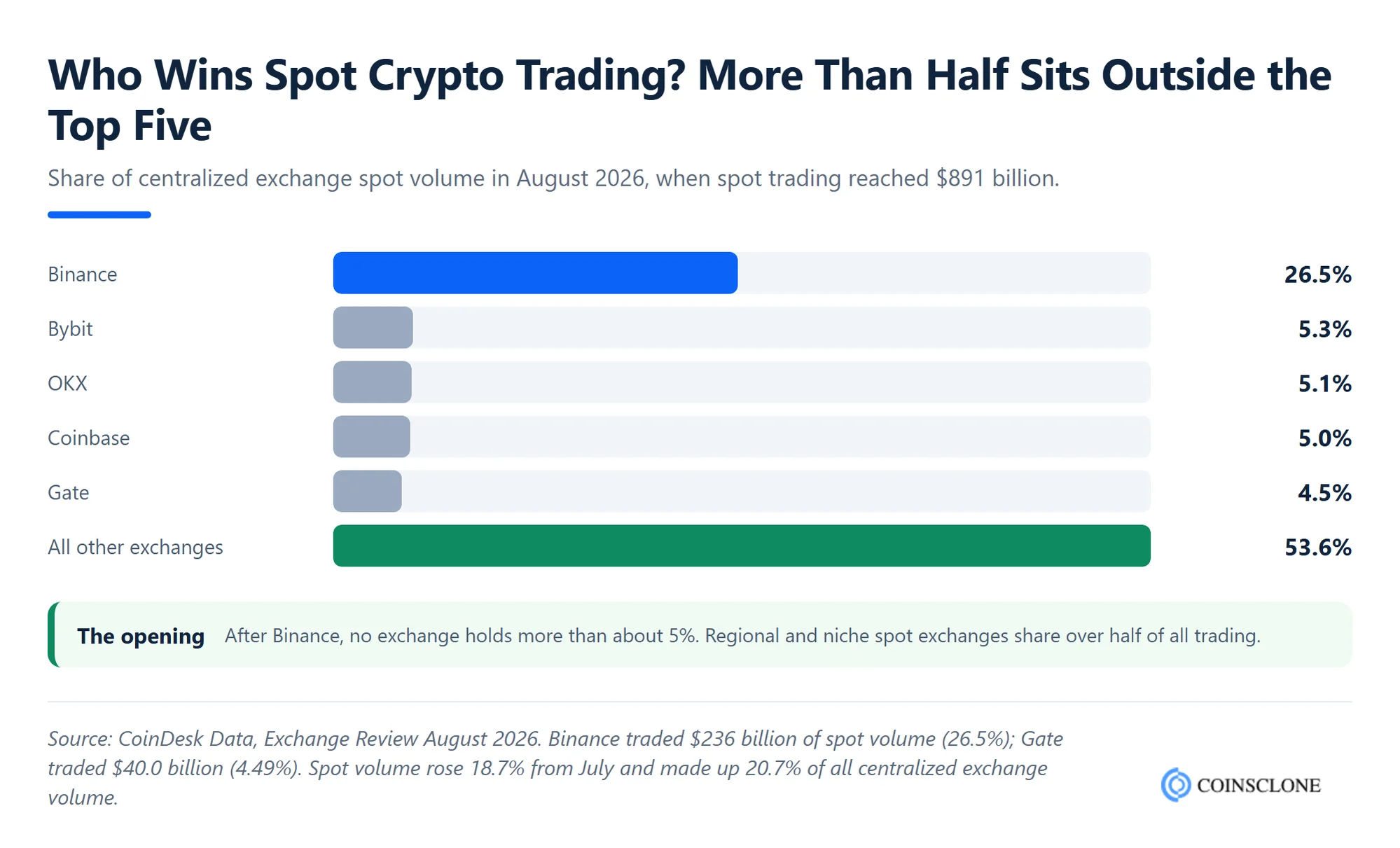
Spot trading is a large and active market, and it is growing again. In August 2026, centralized exchanges handled $891 billion in spot trades, up 18.7% from July, according to the CoinDesk Data exchange review for August 2026. That was 20.7% of all exchange volume; derivatives made up the rest.
Over a full quarter, the numbers are larger still. The top 10 centralized exchanges handled $1.95 trillion in spot trading in Q2 2026, according to CoinGecko. That was down from $2.70 trillion in Q1, which shows how volume rises and falls with prices.
Binance leads, but it does not own the market. It held 26.5% of spot volume in August 2026. Bybit, OKX, Coinbase and Gate each held about 4.5% to 5.3%. As a result, more than half of all spot trading took place outside the top five.
Three more trends make 2026 a good time to enter:
- More users: Global crypto owners reached 774 million in June 2026, up from 741 million at the end of 2025, says the Crypto.com market sizing report for H1 2026. That is 33 million new owners in six months.
- Banks and brokers are moving in: Charles Schwab announced spot Bitcoin and Ether trading in April 2026 and began rolling it out to US retail clients in May, charging 0.75% per trade. Brokers need spot trading software too.
- Clearer rules: In the US, spot crypto began trading on CFTC-registered exchanges in December 2025. In the EU, MiCA now gives one licence for all member states.
In short, demand is strong, but the leaders are big. A new spot exchange wins by serving a region, a niche coin list or a group of traders that the big names serve poorly.
How Does a Spot Trading Crypto Exchange Work?
On a centralized spot exchange, a trader first opens an account, passes KYC and deposits crypto or cash. From then on, every trade follows the same path:
- The trader places an order. It can be a market order (buy now at the best price) or a limit order (buy only at my price or better).
- The order book stores it. Limit orders that do not match right away wait in the book. These traders are called makers, because they make liquidity.
- The matching engine pairs orders. It matches the best price first, then the oldest order at that price. A trader whose order fills at once is a taker.
- The ledger settles the trade. Both balances update in the same instant, and the exchange takes its fee.
- The trader withdraws. Coins move from the exchange’s hot wallet to the trader’s own wallet.
Here is one trade with real numbers, using a 0.1% fee, the same rate Binance charges regular users on its spot fee schedule:
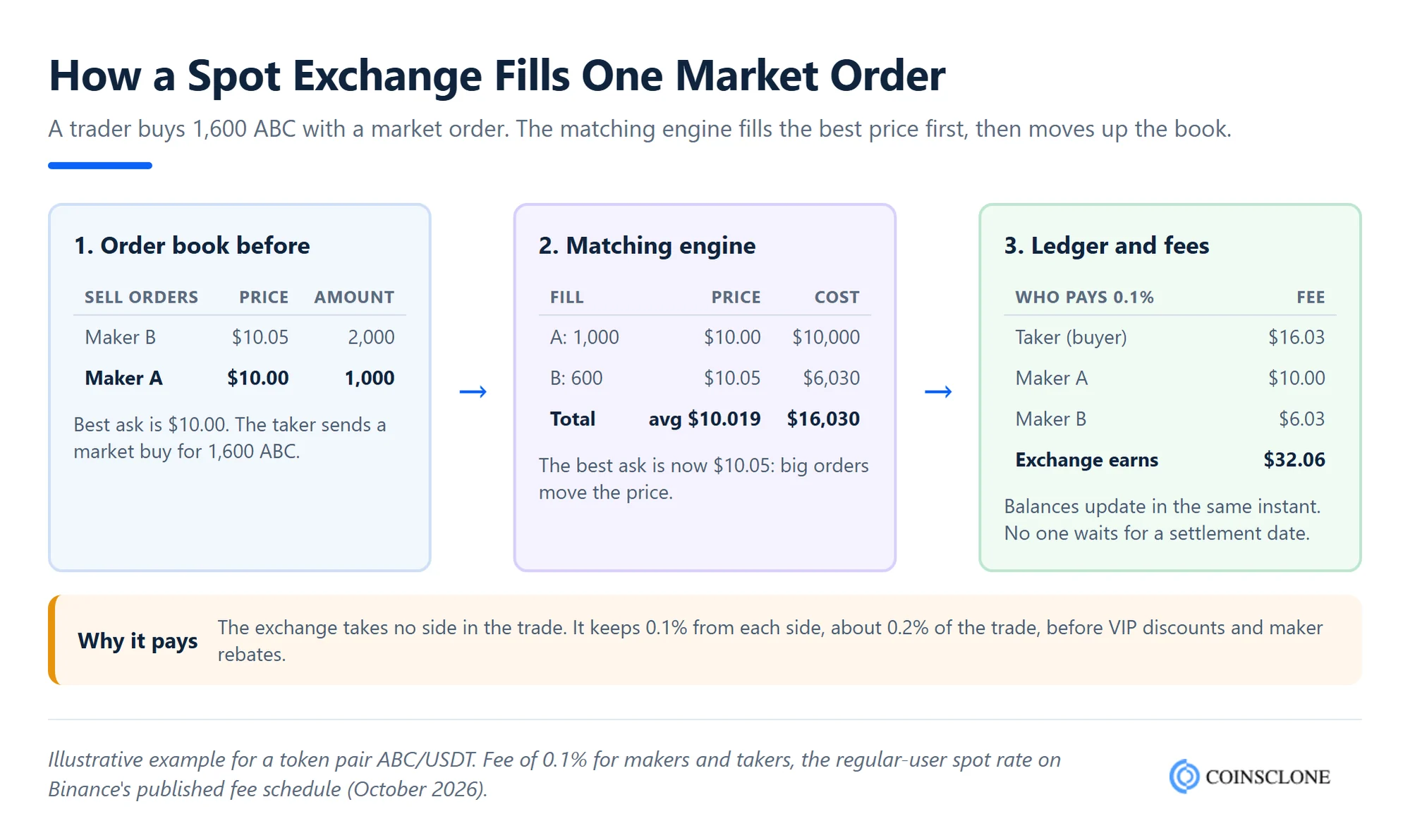
The key point is that the exchange never takes a side in the trade. It earns a small fee from both the buyer and the seller. So the more trades it matches, the more it earns.
Where Else Spot Trading Happens
Spot trades do not only happen on centralized exchanges. On a decentralized exchange (DEX), smart contracts do the matching, and users trade straight from their own wallets. On an over-the-counter (OTC) desk, large buyers and sellers agree a price directly, away from the public order book. Each of these is its own type of platform, as we explain next.
Types of Spot Trading Crypto Exchange
There are five common models. Each one suits a different audience and budget.
1. Centralized Spot Exchange (CEX)
The exchange holds user funds and runs the order book on its own servers. Binance, Coinbase and Kraken work this way. A CEX gives the fastest trading and the best user experience. However, it needs strong custody, KYC and a licence in most markets.
2. Decentralized Spot Exchange (DEX)
Trades run through smart contracts on a blockchain, and users keep their own keys. Some DEXs use an automated market maker (AMM) pool, while others run an on-chain order book. A DEX needs less licensing in many places, but its smart contracts must pass a security audit.
3. Hybrid Exchange
A hybrid exchange matches orders off-chain for speed but settles trades on-chain. As a result, users get CEX speed with more control over their funds.
4. Peer-to-Peer (P2P) Exchange
Buyers and sellers trade directly, often paying with local bank transfers or mobile money. The platform holds the crypto in escrow until the buyer pays. P2P works well in markets where banks do not serve crypto firms.
5. Over-the-Counter (OTC) Desk
In OTC trading, buyers and sellers agree a price directly, often through a broker or a request-for-quote screen. The price can sit above or below the market. OTC is the best way to move large amounts without pushing the public price up or down, so funds, miners and whales use it.
Many startups begin with a centralized spot exchange and add a P2P or OTC desk later. The core engine, wallets and admin panel can be shared.
Core Architecture of a Spot Trading Platform
Under the screens, a spot trading platform is a set of services that talk to each other in real time:
- Matching engine: The heart of the exchange. It pairs orders in microseconds using price-time priority.
- Order book service: Keeps the live list of bids and asks for every trading pair.
- Wallet and custody layer: Hot wallets for daily withdrawals and cold wallets for most of the funds. Multi-signature or MPC approvals protect large moves.
- Ledger: The single source of truth for every user balance. It must never be out of step with the wallets.
- Market data service: Streams prices, trades and charts to users through WebSocket feeds.
- Liquidity bridge: Connects your order books to outside exchanges or market makers, so a new platform has depth from day one.
- KYC, AML and risk: Checks identities, screens wallets and flags odd trading.
- Admin panel and APIs: Lets your team manage pairs, fees and users, and lets pro traders and bots connect.
Each service can scale on its own. So when trading spikes, you add capacity to the matching engine without rebuilding the whole platform.
Features of Spot Trading Crypto Exchange Development
When you create a spot trading crypto exchange, the right features help you win users and keep them. These twelve are the core set:
- User Dashboard: Shows balances, open orders, trade history and deposits in one place.
- Admin Dashboard: Lets your team set fees, list pairs, approve KYC and watch risk.
- Order Book: A live view of buy and sell orders, so traders can see depth before they trade.
- Order Types: Market, limit, stop-limit and OCO orders cover most trading styles.
- Extended Trade View: Pro charts with indicators, drawing tools and depth charts.
- Live Price Ticker: Real-time prices and 24-hour changes for every pair.
- KYC/AML: Identity checks and wallet screening that meet your licence rules.
- Support System: Tickets, chat and a help center, so users get answers fast.
- Multi-lingual: The app in your users’ own languages, which matters for regional exchanges.
- API Documentation: REST and WebSocket APIs for bots, market makers and pro traders.
- Referral Program: Rewards users who bring in friends, which lowers your user cost.
- Payment Gateway Integration: Card, bank and local payment rails, so users can buy crypto with cash.
Security belongs on this list too. Two-factor login, withdrawal whitelists, cold storage and regular penetration tests are now standard. These checks protect users and your licence alike.
Is Developing a Spot Trading Exchange Profitable?
Yes, if the exchange can attract steady trading volume. A spot exchange earns small fees on a very large number of trades. Here are the main revenue streams:
- Trading fees: The main income. Big exchanges charge about 0.1% per side; Binance charges 0.1%, or 0.075% when users pay in BNB.
- Withdrawal fees: A flat fee per withdrawal that covers network costs plus a margin.
- Listing fees: New projects pay to list their tokens.
- Fiat on-ramp fees: A markup when users buy crypto with cards or bank transfers.
- Premium tiers and APIs: Lower fees or faster data for paying pro traders.
- Staking and earn products: A share of the rewards on coins users stake through you.
Now some worked numbers. Suppose your exchange matches $5 million in spot trades a day and keeps an average of 0.1% after discounts. That brings in about $5,000 a day, or about $150,000 a month. On the other side of the ledger, you pay for hosting, staff, compliance and market makers. A market maker alone often costs $5,000 to $30,000 a month.
Volume, not code, decides profit. Therefore, plan your liquidity, coin list and marketing as carefully as you plan the software. For a full list of build and running costs, see our guide on the cost to develop a cryptocurrency exchange.
How to Create a Spot Trading Crypto Exchange?
For startups, building a spot trading exchange that works well under load is the hard part. With the right route and team, though, it becomes a clear, step-by-step job.
Who Should Build It?
There are two common ways to staff the build. The first is to hire freelance developers. This can work for small tasks, but freelancers often juggle many clients. If a better offer comes, they may move on, and your exchange is left half-built. An exchange also needs many skills at once: matching engines, wallets, security, compliance and UI.
The second way is to hire a spot trading crypto exchange development company. A good firm gives you one team with all those skills, a project manager and tested code. As a result, you can focus on licences, liquidity and sales while the team builds.
Choose Your Build Route
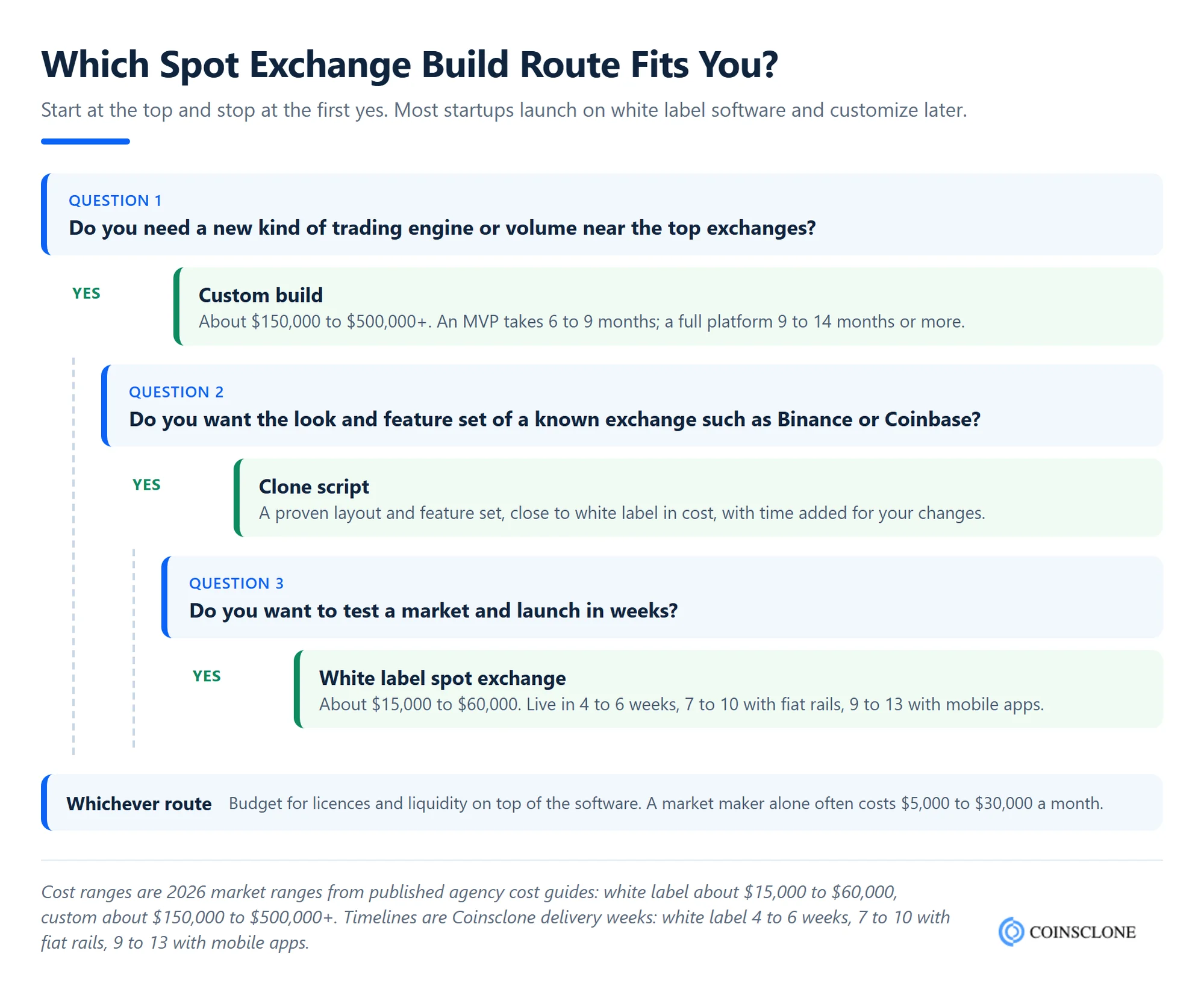
Next, pick the route that fits your budget and launch date:
| Route | Typical market cost | Time to launch | Best for |
| White label spot exchange | About $15,000 to $60,000 | 4 to 6 weeks (7 to 10 with fiat rails, 9 to 13 with mobile apps) | Startups that want to test a market fast |
| Clone script (Binance, Coinbase style) | Similar to white label, plus custom changes | About the same as white label, plus time for your changes | Founders who want a proven layout and feature set |
| Custom build | About $150,000 to $500,000+ | 6 to 9 months for an MVP, 9 to 14 months for a full platform | Funded teams with unique features or very high volume |
Cost ranges are 2026 market ranges from published agency cost guides; timelines are Coinsclone’s own delivery weeks.
A white label crypto exchange is the most common start. It comes with the matching engine, wallets and admin panel already built and tested, so you add your brand, fees and coin list.
Steps to Launch a Spot Trading Exchange
- Pick your market and model. Decide on the region, the users and the type of exchange: CEX, DEX, hybrid or P2P.
- Plan your licence. Talk to a lawyer early, because licences often take longer than the build.
- Choose the build route. White label for speed, custom for full control.
- Set up liquidity. Connect to outside order books or crypto liquidity providers so your books look deep on day one.
- Build and brand. Add your design, coin list, fees and payment rails.
- Test and audit. Run load tests, penetration tests and, for a DEX, smart contract audits.
- Launch and grow. Start with a small set of pairs, then add coins, apps and products as volume grows.
Security and Compliance for a Spot Exchange
Trust is the product a spot exchange really sells. Users will only deposit if they believe their funds are safe and the platform is legal.
Security basics: Keep most funds in cold storage. Use multi-signature or MPC approval for hot wallet moves. Add two-factor login, withdrawal whitelists and anti-phishing codes. Run penetration tests before launch and again after every major release.
Licensing: The licence depends on where your users live. Here are the main paths in 2026:
| Market | Licence or registration | Key point |
| United States | FinCEN money services business registration | Free at the federal level, but most states need a money transmitter licence; New York needs a BitLicense |
| European Union | MiCA crypto-asset service provider (CASP) | Own funds of €150,000 to run a trading platform; the transition period ended on 1 July 2026 |
| United Kingdom | FCA cryptoasset authorisation | Applications open from 30 Sept 2026; the new regime starts 25 Oct 2027 |
| Dubai | VARA Exchange Services licence | AED 100,000 (about $27,200) to apply |
Sources: MiCA Annex IV, the FCA’s gateway announcement and VARA Schedule 2. Checked October 2026.
KYC, AML checks and the Travel Rule apply in almost every market. So build them in from the start, rather than adding them after launch.
Final Verdict
Spot trading crypto exchange development is still one of the most practical ways to enter the crypto market. Spot trading is easy for users to understand, simpler to run than derivatives and carries no liquidation risk. In 2026, it also has a large, active market and clearer rules than ever before.
The software is only half the job, though. Liquidity, licences and a clear target market decide whether a spot exchange succeeds. For most startups, the best route is proven white label software, launched fast and then grown step by step.
Coinsclone is a leading provider of cryptocurrency exchange development services. Since 2018, our team has delivered 350+ platforms for 200+ clients across 20 industries. We build spot exchanges with a fast matching engine, secure wallets, pro charts and full admin control, all customized to your brand and market.
See How Our MVP System Can Launch Your Spot Trading Crypto Exchange Faster
Spot Trading Exchange Development — done right.
- MVP System : Launch your spot trading crypto exchange 90% faster.
- Order Books & Wallets : Fully integrated spot trading engine with real-time liquidity — no coding needed.
- Brand & Customization : Your interface, your pairs, your liquidity sources.
- Revenue Engine : Earn from maker-taker fees, token listings, and premium memberships.
Get a free branded demo of your spot trading exchange in just 48 hours — before spending a cent.
Book a Free Demo to see how our Spot Trading Exchange Software can take you from concept to live market in 8-12 weeks.
Frequently Asked Questions
What is spot trading crypto exchange development?
It is the process of building a platform where users buy and sell crypto at the live market price and own the coins at once. It covers the order book, matching engine, wallets, ledger, KYC, admin panel and user apps.
How is spot trading different from futures trading?
In spot trading, you buy the real coin and own it right away. In futures trading, you trade a contract on the coin’s price, often with leverage, and you never hold the coin. Spot losses are limited to what you paid, while futures positions can be liquidated.
Is spot trading safer than futures trading?
For most users, yes. Spot trading has no leverage, no funding fees and no liquidation, so the most a trader can lose is the amount invested. The coin can still fall in price, so spot trading is not risk-free.
How long does it take to build a spot trading exchange?
A white label spot exchange takes about 4 to 6 weeks, 7 to 10 weeks with fiat rails and 9 to 13 weeks with mobile apps. A custom build takes 6 to 9 months for an MVP and 9 to 14 months or more for a full platform.
What features does a spot trading platform need?
The core set is an order book, a matching engine, market and limit orders, wallets with cold storage, KYC/AML checks, live charts, an admin panel and APIs. Fiat payment rails, referrals and multi-language support help you grow.
How does a spot exchange get liquidity?
New exchanges connect their order books to larger exchanges through a liquidity bridge, or hire market makers to post buy and sell orders. As real users join, their own orders add to that depth.
Can I launch a white label spot trading exchange?
Yes. White label software comes with the core engine, wallets and admin panel already built. You add your brand, coins and fees, so you can launch in weeks rather than months.
How does a spot trading exchange make money?
Mainly from trading fees, which are often about 0.1% per trade at large exchanges. Other income comes from withdrawal fees, listing fees, fiat on-ramp markups, premium tiers and staking products.