

The business benefits of starting a crypto exchange come down to a few strong points. You earn a fee on each trade, you have many ways to earn beyond trading, you can reach users in any country, and you own the brand. This guide explains each benefit in plain terms and backs it with real 2025 and 2026 figures, so you can judge the idea on facts rather than hype.
You will also see how an exchange actually makes money, which type of exchange fits your plan, what can go wrong, and the fastest way to launch. By the end, you will know whether an exchange is a good fit for your business and what to plan for first.
In this guide:
- Nine business benefits of owning a crypto exchange, each with a real example.
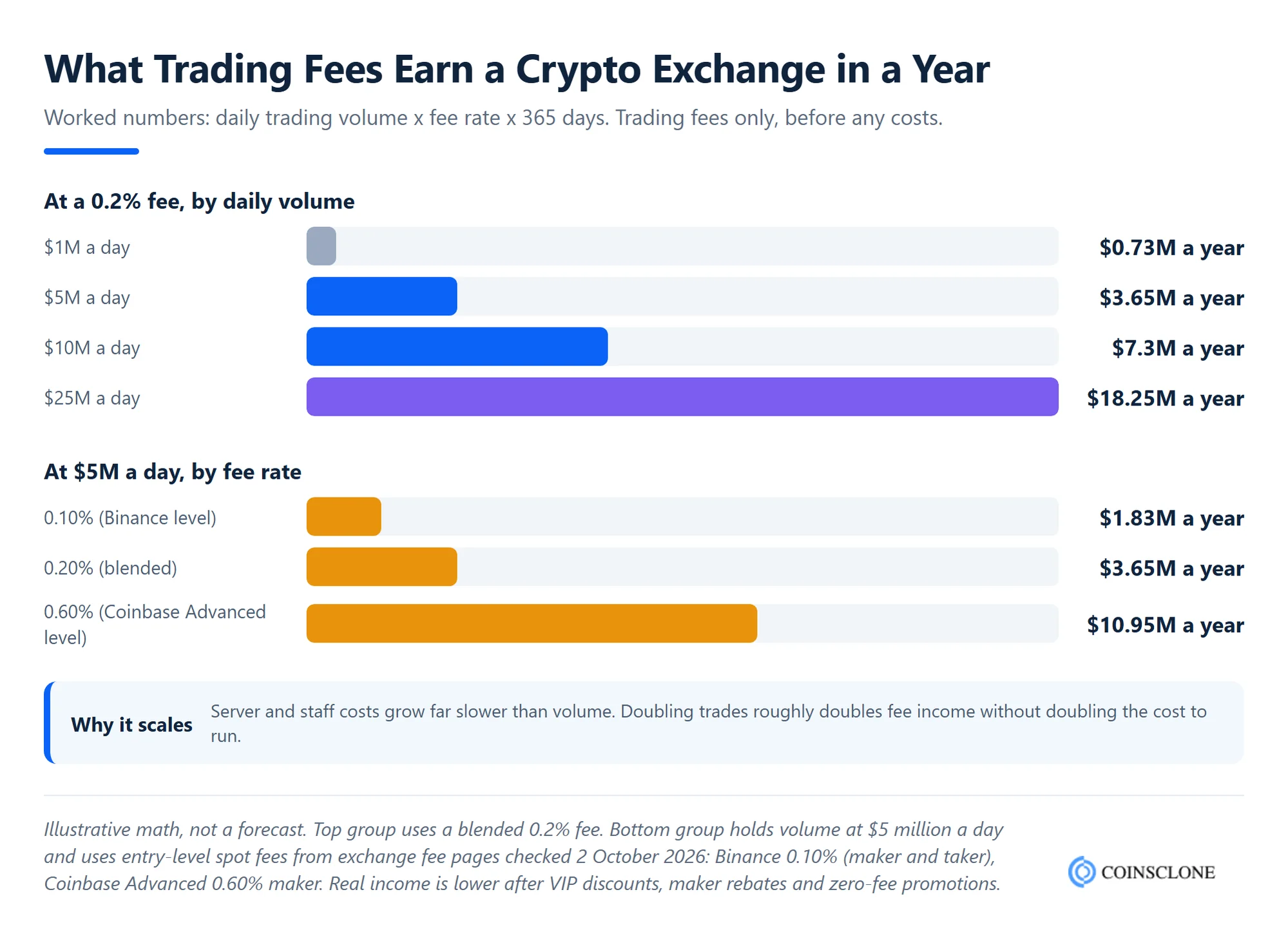
- Worked numbers: what a 0.2% trading fee earns at $1 million to $25 million of daily volume.
- Proof from Coinbase: how a big exchange earned $2.83 billion in 2025 from services, not trading.
- A decision tree to pick the right exchange type: CEX, DEX, P2P or hybrid.
- The honest downsides, such as licences, hacks and liquidity, and how to plan for them.
Discover the Benefits of Starting Your Own Crypto Exchange!
Take control of the crypto market — not just trade on it.
- High Profit Potential: Earn from trading fees, listings & token sales.
- Full Brand Ownership: Build your own trusted crypto brand.
- Market Control: List your own tokens & set your trading rules.
- Future-Proof Business: Tap into a trillion-dollar digital asset economy.
Get a free custom demo of your exchange idea — live in just 48 hours.
Book Your Free Demo and see how fast you can go from idea to launch.
Business Benefits of Starting a Crypto Exchange
Crypto trading is no longer a niche. The Crypto.com Market Sizing Report counted 741 million crypto owners in 2025, up from 659 million a year before. On 2 October 2026, CoinGecko showed about $97 billion of crypto traded in a single day. Every one of those trades runs through an exchange, and every exchange takes a fee.
We, at Coinsclone, build exchanges that help business owners reach this crypto audience and earn from it. So start with a sound cryptocurrency exchange business plan, then use the benefits below to shape it. Here are the main business benefits of the exchanges we build.
1. Quick Revenue Growth
Crypto exchanges make money from trading fees, withdrawals and token listings. The more users trade, the more the exchange earns. Unlike most businesses, an exchange can grow revenue fast once trading volume picks up, because each extra trade costs very little to process.
Here is a simple example. An exchange that handles $5 million of trades a day at a 0.2% fee earns about $10,000 a day, or roughly $3.65 million a year, from trading fees alone. For context, big exchanges charge new traders anywhere from 0.10% per trade on Binance spot to 0.60% (maker) and 1.20% (taker) on Coinbase Advanced. So with the right marketing and features, a new exchange can build a steady income stream in less time than most startups.
2. Build Brand Recognition
Launching a crypto exchange puts your brand in front of a fast-growing fintech audience. A platform that is easy to use, safe and well designed earns trust quickly. As a result, traders tell friends, and good reviews bring in more users at a low cost.
A strong brand also attracts partners, investors and token projects that want to list with you. Over time, it marks your business as a trusted player in the crypto market. That trust is worth more each year, because new users pick the names they already know.
3. Enhance Customer Loyalty
Staking rewards, referral bonuses and loyalty points keep users active on your exchange. In addition, safe and open operations build trust and long-term ties. Happy users also bring in others for free. In the end, loyal users mean steady trading and repeat income for your exchange.
Coinbase shows how far this can go. It ended 2025 with nearly 1 million paid Coinbase One subscribers, who pay a monthly fee for lower trading costs and other perks. That is income that does not depend on how much the market moves.
4. Expand Globally Easily
Crypto exchanges have no fixed borders. They run 24/7, so traders in every time zone can use them at any hour. This global reach brings a wide mix of users and more trading volume. Also, tie-ups with global payment gateways make it easy to accept users from many countries.
Still, going global does not mean there are no rules. Each country you serve may need its own licence or registration. The smart path is to launch in one or two markets you can license well, then add more. So a crypto exchange lets your firm chase large markets and grow fast, one region at a time.
5. Flexible Platform Customization
A well-planned cryptocurrency exchange architecture lets you shape the platform around your business goals. You can change trading pairs, the look and feel, staking features and security settings to suit your needs. As a result, your platform can stand out with features that others in the market do not offer.
Moreover, a modular build can grow with your users. You can add margin trading, futures, a launchpad or a mobile app later without starting over. This flexibility lets you follow market trends and keep the trading experience fresh.
6. Drive Long-Term Growth
Crypto keeps changing, and that gives new entrants room to build a lasting business. A good exchange can keep earning for years after launch. Still, the market moves fast, so you have to keep improving.
For example, you can add DeFi tools, a wallet, a launchpad or tokenized assets. Each new product gives users another reason to stay. The mix of good planning and quick reaction to the market pays off in your platform’s future growth.
7. Overcome Business Challenges
Blockchain tools bring strong security and automation, which cut manual work and reduce losses. Built-in compliance tools, such as KYC checks and transaction screening, also make it easier to meet the rules in different regions.
A scalable setup handles high trading volume and sudden market spikes. At the same time, clear records and reports build user trust and help settle disputes. With the right tools, an exchange can handle its daily, money and market risks safely.
8. Own Your Users, Data and Listings
When you trade on someone else’s exchange, they own the customer. When you run your own, you own the user list, the trading data and the listing decisions. That means you set your own fees, pick which tokens to list and decide which markets to enter.
This control matters for firms that already have users, too. A broker, fintech app or crypto community can keep its users inside its own brand instead of sending them to a rival exchange. In addition, the data shows you what users want next, which helps you plan new products.
9. Clearer Rules Now Work in Your Favor
A few years ago, unclear rules kept many firms away. In 2026 the picture is much clearer. In the EU, MiCA has applied to crypto service firms since 30 December 2024, and its transition period ended on 1 July 2026. In the US, the GENIUS Act set rules for stablecoins in July 2025. Also, FATF reported in July 2026 that 83% of the countries it surveyed have passed Travel Rule laws.
Clear rules raise the bar, but they also protect licensed players. A licensed exchange can win banks, payment partners and larger clients that avoid unlicensed ones. So the work you put into compliance becomes a real edge over newcomers that skip it.
How a Crypto Exchange Works and Makes Money
A cryptocurrency exchange is a digital platform where traders buy and sell cryptocurrencies like Bitcoin, using fiat money or other coins. The exchange sits between buyers and sellers. It matches their orders and makes sure each trade settles safely.
Crypto exchanges earn mainly from trading fees, where the buyer and the seller each pay a small fee per trade. On top of that, most exchanges earn from several other sources:
- Trading fees: a small percentage of every trade, often split into maker and taker fees.
- Withdrawal and network fees: a flat fee when users move coins off the exchange.
- Listing fees: token projects pay to get listed and promoted.
- Spreads and instant buy: a margin built into “buy now” prices, usually higher than trading fees.
- Staking commissions: a cut of the rewards that users earn when they stake coins.
- Margin, futures and lending: interest and funding fees from advanced traders.
- Subscriptions and cards: monthly plans, debit cards and premium tools.
The biggest exchanges show how much these extra streams matter. In 2025, Coinbase reported $7.18 billion of total revenue. Trading brought in $4.06 billion, about 59% of net revenue. Another $2.83 billion, or 41%, came from subscriptions and services, such as stablecoin income, staking and Coinbase One, as its 2025 annual report shows. You can read the full breakdown in our guide on how Coinbase makes money.
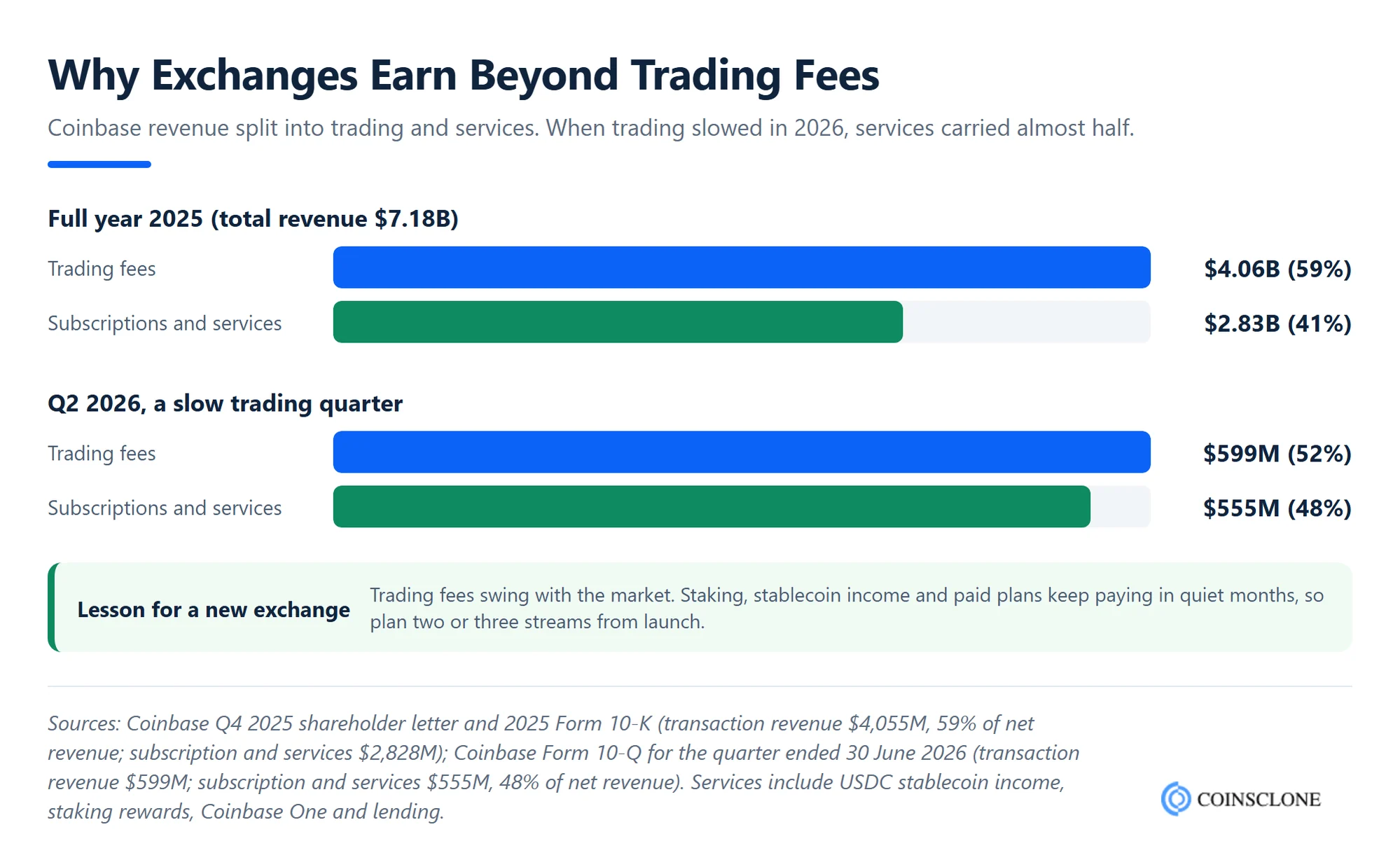
The lesson for a new exchange is simple. Trading fees rise and fall with the market, but services keep paying in quiet months. So plan for two or three income streams from the start, not just one.
Types of Cryptocurrency Exchanges
Owning a crypto exchange is one of the most talked-about business ideas in crypto. Exchanges come in several types, and each one suits a certain kind of user and business model. The type you choose decides which benefits you get, what licence you need and how you earn. Let’s look at each one briefly.
Centralized Exchange (CEX)
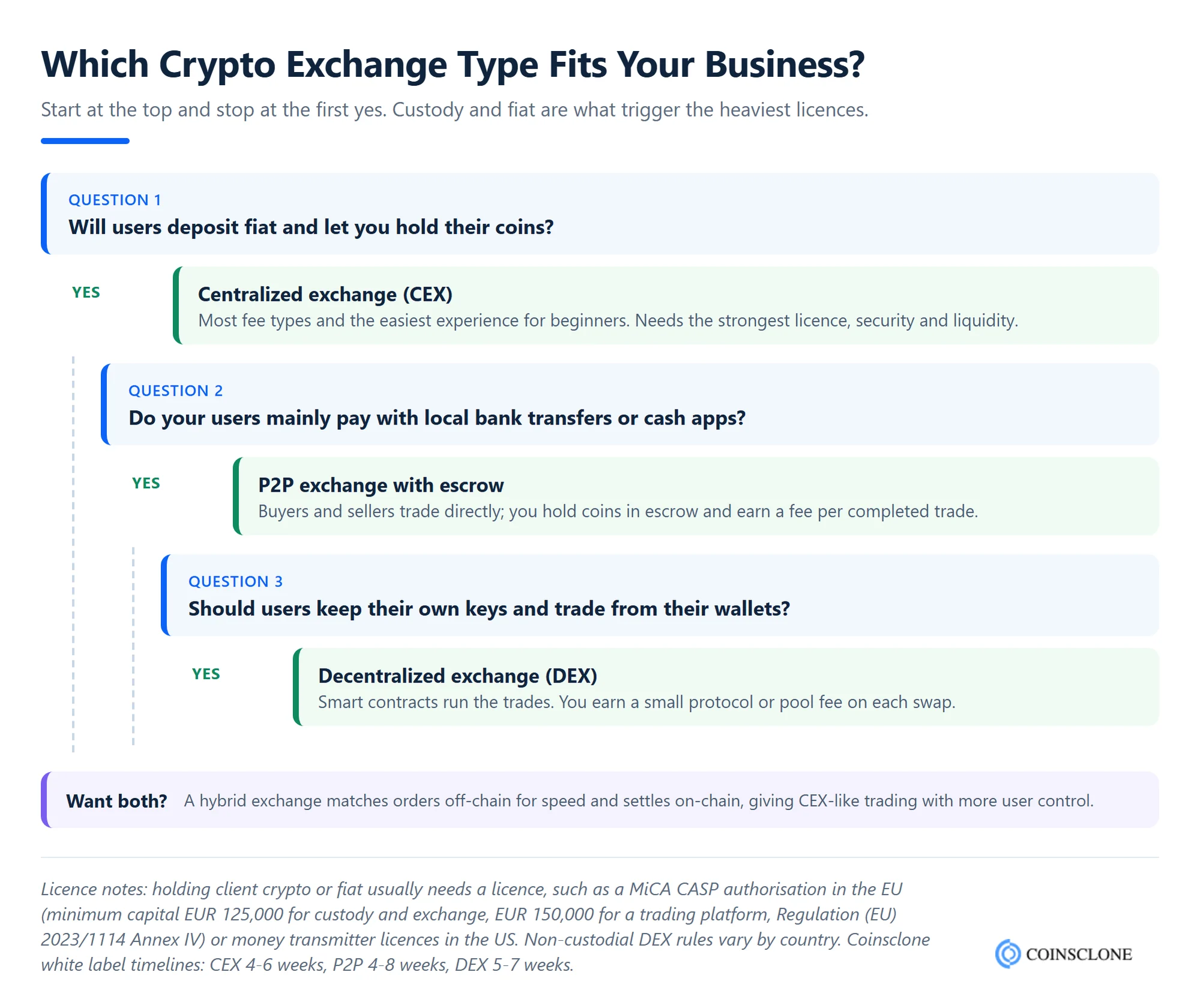
A centralized exchange is a platform where a company runs the trading and holds user funds. The exchange monitors and manages every trade to keep it safe and quick. They are easy to use and have deep order books and bank deposits, so beginners often pick them. A CEX also earns the most fee types, but holding user funds means it needs the strongest licence and security.
Decentralized Exchange (DEX)
A decentralized exchange lets users trade straight from their own wallets, without a company in the middle. Smart contracts handle the trades, so users keep full control of their coins. Many DEXs do not ask for KYC checks, which makes trading faster and more private. For the owner, the main income is a small pool or protocol fee on each swap. For example, Uniswap’s standard pool fee tiers run from 0.01% to 1% per trade.
Hybrid Exchange
Hybrid exchanges mix the best parts of centralized and decentralized exchanges. They usually match orders fast off-chain, like a CEX, and settle trades on-chain, like a DEX. This gives traders the speed and liquidity of a CEX with more control over their funds. As a result, they suit traders who want a balanced experience.
Peer-to-Peer (P2P) Exchanges
A Peer-to-Peer (P2P) exchange lets users trade coins with each other. The platform links buyers and sellers, and an escrow service holds the coins until the payment is confirmed. This keeps each trade safe. P2P exchanges work well in markets where bank links to crypto are weak, because users can pay with local methods.
Today, many crypto platforms also offer Spot, Margin and OTC trading to meet the needs of every kind of user. This lets traders trade quickly and safely, with more ways to profit. These are the different types of crypto exchanges. The decision tree below helps you pick the right one.
Who Benefits Most From Starting a Crypto Exchange?
An exchange is not the right move for every business. It works best when you already have users, a niche or a market that big exchanges serve poorly. These groups tend to gain the most:
- Fintechs and brokers: they already have users and KYC flows, so adding crypto trading keeps those users in-house.
- Regional first movers: local languages, local payment methods and a local licence can beat global giants in a single country.
- Token and Web3 communities: a project with a loyal following can run its own exchange or launchpad and keep the fees.
- Payment and money transfer firms: stablecoins and crypto swaps add new income to the money they already move.
- Institutional desks: OTC and API trading for large clients earn steady fees on big orders.
If you fit one of these groups, you start with users and trust, which are the two hardest things for a new exchange to earn.
Challenges to Plan for Before You Launch
The benefits are real, but so are the risks. Knowing them early helps you budget and plan. Here are the main ones:
- Licences and compliance: the rules differ by country. For example, MiCA asks a crypto trading platform to hold at least EUR 150,000 of capital. Read our crypto licence guide for the main regions.
- Security: Chainalysis found that $3.4 billion of crypto was stolen in 2025, including about $1.5 billion from Bybit in a single attack. Cold storage, multi-signature wallets and regular audits are a must.
- Liquidity: a new exchange with thin order books loses traders fast. That is why most new platforms link to liquidity providers or market makers from day one.
- Competition: big names hold a large share of trading. Binance alone had 38.7% of top-10 spot volume in Q2 2026, per the CoinGecko Q2 2026 report. So a new exchange needs a clear niche, not a copy of Binance.
- Market cycles: trading volume drops in slow markets. CoinGecko found top-10 spot volume fell 27.9% from Q1 to Q2 2026. Extra income streams soften that drop.
None of these is a reason to stop. They are reasons to plan well, pick the right market and choose a build partner that has handled them before.
White Label or Custom: The Fastest Route to These Benefits
How you build your exchange decides how soon you start earning. You have two main paths.
A white label exchange is a ready-made, tested platform that is branded and set up for you. It is the quickest way to market. Coinsclone launches a white label crypto exchange in 4 to 6 weeks, 7 to 10 weeks with fiat rails, and 9 to 13 weeks with mobile apps. Published 2026 agency cost guides put white label builds at roughly $30,000 to $100,000.
A custom exchange is built from scratch around your exact needs. It gives you full control, but it takes many months and costs more. The same guides put custom centralized exchanges at about $150,000 to $420,000 or more. For a full cost breakdown, see our guide on the cost to develop a cryptocurrency exchange.
For most startups, a white label launch followed by custom features is the best balance of speed, cost and control.
Will Crypto Exchange Development Be Profitable for Startups in 2026?
Yes, crypto exchange development can be a profitable venture in 2026, if you pick a clear niche, get licensed and plan for more than one income stream.
Crypto keeps moving toward wider use, with both people and institutions joining the market. Even so, 2026 has been a mixed year for prices, and Coinbase posted net losses from Q4 2025 to Q2 2026 even after earning $1.26 billion in 2025. In other words, profit depends on good planning, not on the market alone. Here is why it is still a smart business move:
- Growing Institutional Adoption: more banks and companies now trade and hold crypto, which adds volume and larger clients.
- Expanding Regulatory Support: clearer laws, such as MiCA in Europe and the GENIUS Act in the US, make it safer for licensed exchanges to grow.
- Rising Interest in Tokenized Assets: tokenized real-world assets bring new users and new trading pairs.
- Increased Focus on Cross-Border Payments: people use crypto and stablecoins for fast, low-cost transfers between countries.
- DeFi and Web3 Add-Ons: DeFi and Web3 features draw younger traders and add new income.
- High Market Demand for White-Label Solutions: many startups want ready-made exchanges, which shortens the time to launch.
- Emergence of New Trading Models: futures and options trading earn more from advanced traders. CoinGecko counted $12.7 trillion of perpetual futures volume on the top 10 exchanges in Q2 2026 alone.
- AI and Automation: AI spots fraud, answers support tickets and cuts costs.
The crypto market in 2026 is full of chances, but just starting an exchange is not enough. You need smart moves to grow your users, raise trading volume and reach new markets. Let’s look at some strategies.
Strategies to Scale Your Crypto Exchange Business
To grow your crypto exchange, focus on steps that bring in users, trading volume and global reach. The following approaches can help your exchange grow in a steady way:
Liquidity Partnerships
Working with a trusted liquidity provider keeps trading fast and smooth. It narrows price gaps and keeps your order books full, even when you have few users.
Referral Programs
Referral rewards push users to invite their friends. This is an easy way to spread your brand through word of mouth, and you only pay when a new user joins and trades.
Geographic Expansion
Expand your exchange into countries where crypto use is rising. Adding local languages, local payment options and the right local licence makes each new market easier to win.
APIs for Large Traders
Offer APIs so brokers, trading bots and investors can connect directly. This brings in large traders and raises your exchange’s trading volume.
Layer-2 Deployment
Use Layer-2 networks to speed up deposits and withdrawals and cut network fees. This improves the user experience and makes it easier for your platform to grow.
These strategies bring more users to your exchange and help it handle higher trading volume. They also open the door to new markets. In addition, good planning, solid tech and steady upgrades keep your platform in profit. This puts you in a strong spot in a crypto market that moves fast and stays competitive.
Final Thoughts!
A successful and profitable platform starts with the build partner you choose. Crypto exchanges have grown to the point where entering the market is a real chance for many businesses, if you plan it well. With the right partner, your platform can win users and earn steady profits.
As a leading Cryptocurrency Exchange Development Company, Coinsclone has been building crypto platforms since 2018. We have delivered 350+ platforms for 200+ clients across 20 industries. Our team builds crypto exchanges with advanced features, smooth user interfaces and strong security. Also, your platform will be ready for high-volume trading, global users and modern blockchain technology.
Our team also builds exchanges like Binance and Coinbase with our Web3 clone scripts. We help you plan for the growth steps and risks ahead. If you are ready to plan your exchange, starting a cryptocurrency exchange with us takes as little as 4 to 6 weeks with our white label route. Contact us and bring your crypto exchange platform to market on time.
Frequently Asked Questions
What are the main business benefits of starting a crypto exchange?
The main benefits are steady fee income from each trade and extra income from listings, staking and paid plans. You also get users from many countries, full control of your brand and user data, and room to add new products later. Clearer rules in 2026 also give licensed exchanges an edge over unlicensed ones.
Is launching a crypto exchange profitable for businesses?
It can be. An exchange with $5 million of daily volume at a 0.2% fee earns about $3.65 million a year in trading fees, before costs. Profit depends on volume, fees, licence costs and security spending. Exchanges that add services, as Coinbase did with $2.83 billion of service revenue in 2025, hold up better in slow markets.
How do crypto exchanges make money?
Crypto exchanges make money from trading, withdrawal and listing fees. They also earn from spreads on instant buys, a cut of staking rewards, margin and futures fees, and paid plans. Big exchanges also earn interest on stablecoin reserves and customer cash.
How much do crypto exchange owners make?
There is no fixed figure, because it depends on volume and costs. As a guide, $1 million of daily trades at a 0.2% fee brings in about $730,000 a year in fees, while $25 million a day brings in about $18 million. Running costs such as licences, liquidity, security and staff come out of that.
How does a crypto exchange help a business reach a global market?
Crypto trades 24/7 and works across borders, so an exchange can serve users in any time zone. With local languages, local payment methods and the right licence in each country, a business can expand market by market without opening branches.
What are the disadvantages of owning a crypto exchange?
The main downsides are licence costs and rules that change by country, and the risk of hacks. You also need liquidity from day one, you face big rivals, and income drops in slow markets. Good planning, solid security and extra income streams reduce each of these risks.
How long does it take to start a crypto exchange?
With a white label platform, Coinsclone can launch an exchange in 4 to 6 weeks, or 7 to 10 weeks with fiat rails and 9 to 13 weeks with mobile apps. A fully custom exchange usually takes several months. Licensing can add more time, depending on the country.
Discover the Benefits of Starting Your Own Crypto Exchange!
Take control of the crypto market — not just trade on it.
- High Profit Potential: Earn from trading fees, listings & token sales.
- Full Brand Ownership: Build your own trusted crypto brand.
- Market Control: List your own tokens & set your trading rules.
- Future-Proof Business: Tap into a trillion-dollar digital asset economy.
Get a free custom demo of your exchange idea — live in just 48 hours.
Book Your Free Demo and see how fast you can go from idea to launch.