

Looking for cryptocurrency business ideas that still make money in 2026? This guide lists 18 of them, from crypto exchanges and wallets to stablecoin payments, prediction markets and simple service businesses you can run with no code. For each idea, we explain what it is, how it earns, and what it takes to launch.
The crypto market is worth about $2.9 trillion today, but the money is not spread evenly. So we also show where fees truly flow, using live data from October 2026. Then we help you pick the idea that fits your budget, skills and taste for licences.
In this guide:
- 18 crypto business ideas, each with its revenue streams and launch path
- Which business models earned the most fees in the past 12 months, with real numbers
- A side-by-side table of revenue, licence load and launch time
- A simple decision tree to choose the right idea for you
- The 2026 rules to check before you launch
Turn Your Cryptocurrency Business Idea Into a Profitable Reality
Crypto Businesses — built faster, smarter, and ready to scale.
- MVP System : Validate your crypto business idea 90% faster.
- Ready Modules : Wallets, exchanges, tokens & staking — all pre-integrated.
- Custom Branding : Your logo, your design, your business model.
- Monetization Engine : Earn from trading, staking, NFTs, or DeFi services.
Get a free demo of your crypto business concept — designed and branded for you in 48 hours.
Book a Free Demo to see how our MVP System can turn your cryptocurrency business idea into a live, revenue-ready platform in just 8 – 12 weeks.
18 Cryptocurrency Business Ideas to Start in 2026
The crypto industry keeps changing, and some ideas from the 2021 boom have faded while others now earn billions. Here are the top cryptocurrency business ideas with real scope in 2026. Each one notes how it earns, so you can compare them before you commit.
1. Create a Cryptocurrency Exchange Platform
One of the most rewarding business ideas is building a crypto exchange. A crypto exchange is a platform where users trade coins, tokens and stablecoins. Creating a crypto exchange platform is a well-known model because it earns in many ways: trading fees, listing fees, payout fees, margin interest and paid plans. Traders swap about $97 billion worth of crypto every day, so even a small slice of that flow adds up.
Based on how they work, you can build several types of crypto exchanges:
- OTC exchange: Handles large, private trades between big buyers and the desk.
- P2P platform: Lets buyers and sellers trade directly, while the platform holds funds in escrow.
- Order book exchange: Matches buy and sell orders in real time through a trading engine.
- Derivatives exchange: Lets users trade futures and options on crypto prices.
- Margin trading platform: Lets users trade with funds borrowed from the exchange.
Starting an exchange is not hard if you begin with a ready-made core. The white label crypto exchange software is a tested, fully custom, ready-to-launch solution that cuts both cost and time. At Coinsclone, a white label exchange takes about 4 to 6 weeks, 7 to 10 weeks with fiat rails, and 9 to 13 weeks with mobile apps. Keep in mind that the licence often takes longer than the build.
2. Construct an NFT Marketplace
NFTs, or non-fungible tokens, are unique digital items that cannot be swapped one for one. They can stand for art, game items, tickets, memberships or even physical goods held in a vault. An NFT marketplace lets users mint, buy and sell them, and the owner earns listing fees, minting fees and a cut of each sale.
However, the market has changed since 2021. NFT marketplaces earned about $410 million in fees over the past 12 months, and most of it went to Telegram’s Fragment, a market for usernames and numbers. OpenSea’s Seaport earned about $25 million. So general art marketplaces are crowded, while focused ones still work. Tokenized trading card platforms such as Collector Crypt and Courtyard, for example, earned about $190 million combined.
So, when you launch an NFT marketplace, pick a clear niche such as tickets, game items, real-world cards and goods, or brand rewards. Our guide to NFT business ideas covers more niches that still pay.
3. Crypto MLM
Crypto MLM, or crypto multi-level marketing, uses a blockchain to run referral programs. Smart contracts track who referred whom and pay commissions in tokens, so payouts are automatic and visible on-chain. The platform owner can earn from sign-up fees, plan fees and a share of each commission.
That said, this is the riskiest idea on the list from a legal point of view. If members earn mainly by recruiting others rather than by selling a real product, regulators treat it as a pyramid scheme. In 2022, the SEC charged the founders and promoters of Forsage, a smart contract MLM that raised over $300 million. So only build a crypto MLM around a real product with real buyers, and get legal advice first.
4. Crypto Gaming (Play-To-Earn)
Crypto gaming lets players earn tokens or own in-game items as NFTs. Players can complete tasks, win battles or trade items with each other. The platform owner earns from item sales, trading fees, token swaps, staking and ads.
The early “play-to-earn” model, where players joined mainly to earn, faded after 2022 as token prices fell. Today, the games that last are fun first, with tokens and owned items as a bonus. So, if you build a crypto game, put gameplay first and keep the token economy simple. A GameFi clone script can speed up the launch while you focus on the game itself.
5. Start a DeFi Platform
DeFi (decentralized finance) platforms let users trade, lend, borrow and earn without a bank in the middle. Smart contracts hold the funds and apply the rules. DeFi apps held about $95 billion in total value on 1 October 2026. In the past 12 months, users paid about $3.15 billion in fees to DEXs, $2.03 billion to on-chain derivatives platforms and $1.65 billion to lending apps.
A decentralized exchange (DEX) is the most common place to start. With a DeFi exchange clone script, you can launch a DEX quickly. At Coinsclone, a white label DEX takes about 5 to 7 weeks, and a standard DEX with custom features takes about 10 to 14 weeks. Adding liquidity pools, yield farming and stablecoin swaps gives users more reasons to stay. For more models, see our DeFi business ideas.
6. Launch a Prediction Market Platform
A prediction market lets users buy and sell shares on the outcome of real events, such as elections, sports or economic data. Prices move with the crowd’s view, so the market works like a live forecast. This is the fastest-growing idea on the list. Monthly volume on Kalshi and Polymarket rose from $4.5 billion in September 2025 to $53 billion in July 2026, according to Pew Research.
The platform earns from trading fees, market creation fees and data sales. Polymarket earned about $426 million in fees over the past 12 months across its global and US apps. Rules matter here, though. In the US, Kalshi runs as a CFTC-regulated exchange, and several states have pushed back on sports contracts. If this idea fits you, our prediction market platform development team can help you plan the market types, the data feed that settles results, and the rules for each region.
7. Create a Crypto Wallet App
Every crypto user needs a wallet, so wallets are a steady business idea. Hence, many founders choose to create a crypto wallet as their first crypto product. Wallets earn mainly from in-app swaps, on-ramp referrals and staking. For example, MetaMask charges a 0.875% fee on swaps, and wallet apps earned about $150 million in fees over the past year, led by Phantom at about $95 million.
You can build two types of wallets:
- Custodial wallet: You hold the user’s keys. It is easier for beginners, but it usually needs a licence because you hold their money.
- Non-custodial wallet: Users hold their own keys. In the US, FinCEN’s 2019 guidance says providers of this kind of software are not money transmitters.
Support for many chains, a clean design and strong safety help you win users. At Coinsclone, a white label wallet takes about 3 to 5 weeks, and a custom wallet about 8 to 12 weeks.
8. Fantasy Sports App
Crypto has also entered sports through blockchain fantasy sports apps. Users build teams, join leagues and earn tokens or NFTs based on how real players perform. Owning player cards as NFTs also lets fans trade them between seasons.
The app owner earns from entry fees, sponsors, ads and NFT sales. Still, check local gaming laws before you launch. Paid contests count as gambling in many places, and India banned real-money online games, including paid fantasy sports, in 2025.
9. Crypto Trading Bot Development
Many new traders fear the swings of the crypto market and cannot watch prices all day. Trading bots solve this. They follow set rules, such as grid, DCA or arbitrage plans, and place trades 24/7 without emotion.
This is now a real business. Trading apps and Telegram trading bots earned about $750 million in fees over the past 12 months, led by Axiom and GMGN. So, if you build a crypto trading bot, you can earn from monthly plans, a small fee per trade or a share of profits. Clear rules, back-testing and honest risk notes build trust with users.
10. Create a Real Estate and RWA Tokenization Platform
Tokenization turns real assets into digital tokens that people can buy in small parts. Smart contracts handle ownership, payouts and voting, which cuts the admin work. Startups earn from listing fees, issuance fees, trading fees and yearly management fees.
The numbers show where demand sits today. Tokenized real-world assets (RWAs) on public chains are worth about $38.6 billion, led by US Treasury funds, private credit and gold. Real estate is only about $227 million of that. So real estate tokenization platform development is still early. That means fewer rivals, but you will need sound legal set-ups and local land rules in place.
11. Crypto Education Platform
The crypto market keeps drawing in new users and beginner traders, and most of them need help. A crypto education platform fills that gap with courses, guides, live classes and trading practice. It is one of the easiest ideas to start, because it needs no licence to hold funds.
You can earn from course fees, plans, brand sponsors and affiliate deals. As more people look for Web3 careers, courses on smart contracts, security and compliance are in high demand.
12. Crypto Tax and Accounting Service
Crypto tax is getting harder, and that creates a service business. In the EU, the DAC8 rules made crypto platforms report user trades to tax offices from 1 January 2026. In the US, brokers now send Form 1099-DA for crypto sales made from 2025 onward. So more traders and small firms need help to file correctly.
You can start as a service with a few skilled staff, then add software that pulls trades from wallets and exchanges. Revenue comes from filing fees, monthly bookkeeping plans and audit support for crypto firms.
13. Crypto Payment Gateway Development
A crypto payment gateway lets online shops accept crypto at checkout and settle in crypto or local money. More merchants now accept stablecoins because payments settle fast and cost less across borders. Hence, creating a crypto payment gateway is a strong idea for founders with a modest budget.
The gateway earns a small fee on each payment, plus setup fees, monthly plans and FX spreads. For a quick launch, you can adopt a white label crypto payment gateway that is ready-made and tested, then add your own brand and features. At Coinsclone, a standard gateway takes about 6 to 9 weeks, and 10 to 14 weeks with fiat settlement.
14. Stablecoin Issuance and Payment Rails
Stablecoins are the biggest money-maker in crypto right now. There are about $313 billion in stablecoins in use, led by USDT ($184 billion) and USDC ($74 billion). Issuers earn interest on the reserves they hold. Over the past 12 months, they took about $8.6 billion in fees, more than all DEXs put together.
Issuing your own stablecoin needs a licence and full reserves. In the US, the GENIUS Act, signed on 18 July 2025, sets those rules, and in the EU, MiCA does. So most startups build on top of the big stablecoins instead. They run payouts, payroll, shop payments, money transfers home or B2B bills. Our stablecoin development service covers both paths, from the token itself to the payment flows around it.
15. Whitepaper Creation and Tokenomics Service
Every token launch needs a clear whitepaper and a sound token plan. Buyers read the whitepaper to see what the project does. Then they check the tokenomics to see who gets which tokens and when. A weak token plan can sink a good project.
So you can offer whitepaper writing and tokenomics design as a service. Income comes from set-price packages or single jobs, such as token supply models, unlock plans and MiCA white papers for EU launches. The startup cost is low, but you need real skill in finance, writing and crypto rules.
16. Crypto Launchpad Development
A crypto launchpad helps new projects raise funds and find their first users. It offers token listing, staking for access, tiered sales and KYC checks. The launchpad acts as a bridge between token creators and buyers.
Launchpads earned about $1.04 billion in fees over the past 12 months, led by pump.fun at about $411 million. Most of that came from meme coin launches, so the model works, but it carries real risk if bad projects slip through. Strong project checks protect your name. With the right screening, crypto launchpad development can turn into a solid business that earns listing fees, a share of token sales and staking fees.
17. Decentralized Insurance Platforms
Decentralized insurance lets users buy cover with no broker in the way. Smart contracts collect premiums, hold the pool and pay claims based on set rules. Common cover types include smart contract hacks, stablecoin de-pegs, exchange failures and crop or flight delays.
The platform earns from premium fees, staking and liquidity fees, claim fees and partner deals. Crypto lost billions to hacks in 2025 and 2026, so demand for cover is real. The hard part is pricing risk well and keeping enough capital in the pool.
18. Crypto Marketing Services
Each crypto project needs users, so crypto marketing is a steady service to sell. Token launches, NFT drops, DeFi apps and exchange listings all need a plan. A crypto marketing agency helps projects reach the right people and build trust.
Services can include brand story, content, SEO, influencer campaigns, community building on Telegram, Discord and X, and launch PR. You earn from monthly retainers, campaign fees and, sometimes, a token share. Because crypto ads face strict rules on Google and Meta, agencies that know those rules have an edge.
Which Crypto Business Ideas Earn the Most in 2026?
Ideas sound good on paper, but fees show where users actually pay. The chart below uses DefiLlama data for the past 12 months. It tracks fees users paid to on-chain businesses, so it leaves out centralized exchanges, which report revenue in other ways.
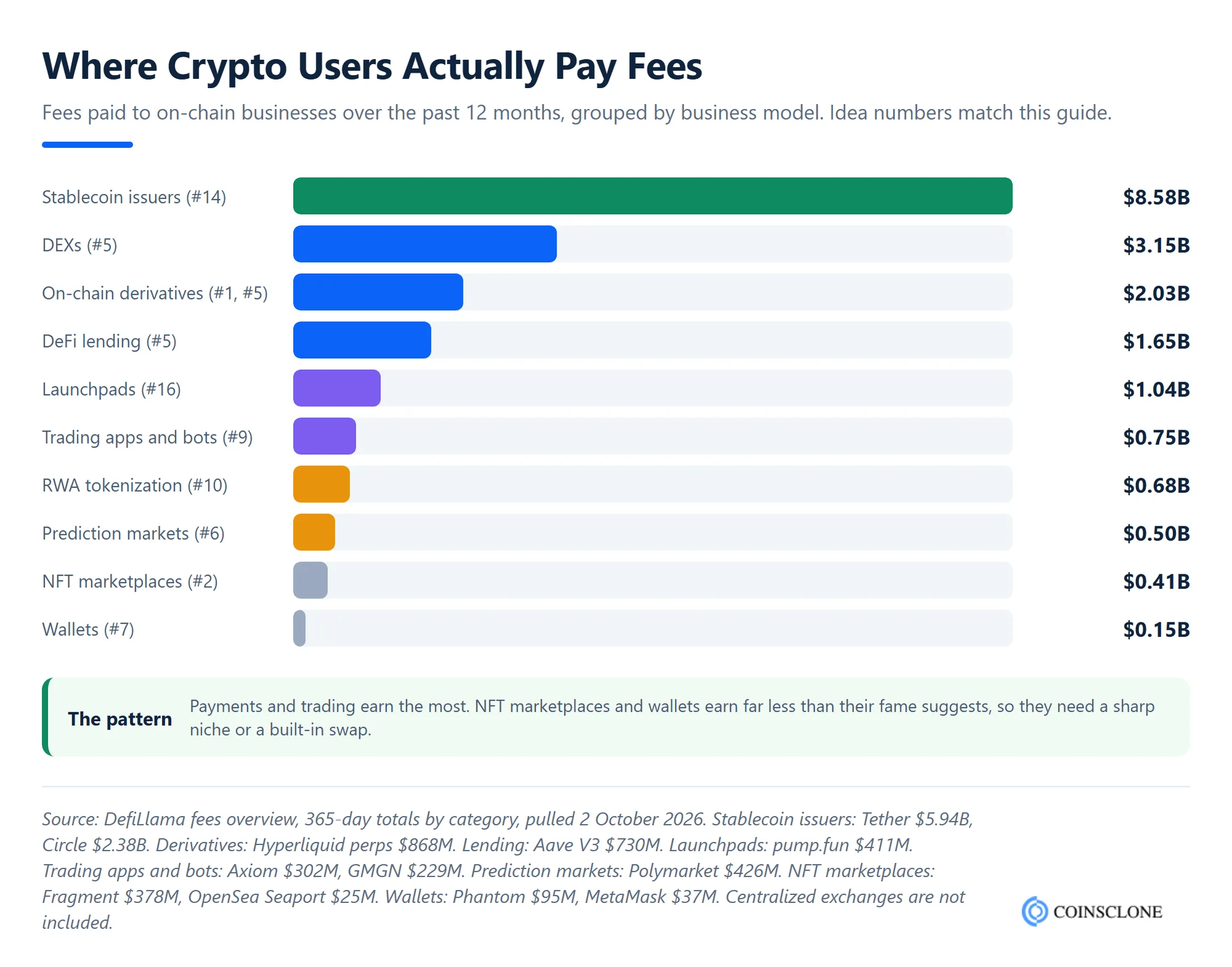
A few lessons stand out:
- Money follows payments and trading: Stablecoins, DEXs and derivatives earned the most. Payment and trading businesses have the deepest demand.
- Hype is not revenue: NFT marketplaces and wallets earn far less than their fame suggests, so they need a sharp niche or a swap feature to pay off.
- New niches move fast: Prediction markets and trading bots were small three years ago. Both now earn hundreds of millions a year.
Even so, centralized exchanges still make the most money of any crypto firm, which is why they lead this list. But they also carry the heaviest licence and security load.
Crypto Business Ideas Compared
This table puts the main ideas side by side. Launch times are the build times Coinsclone quotes for its ready-made products. Licences and audits can add more time.
| Business idea | Main revenue | Holds user funds? | Licence load | Typical launch time |
| Crypto exchange (white label) | Trading, listing, withdrawal fees | Yes | High | 4 to 6 weeks; 7 to 10 with fiat |
| P2P exchange | Escrow and trade fees | Yes, in escrow | High | 4 to 8 weeks (white label) |
| DEX | Swap fees, token listing | No | Medium | 5 to 7 weeks (white label) |
| Crypto wallet | Swap fees, on-ramp referrals | Only if custodial | Low to high | 3 to 5 weeks (white label) |
| Payment gateway | Per-payment fees, plans | Yes, if it settles | High | 6 to 9 weeks; 10 to 14 with settlement |
| Stablecoin payment rails | Payout and FX fees | Often | High | Scoped per project |
| Prediction market | Trading fees | Yes | High | Scoped per project |
| Launchpad | Listing fees, sale share | Briefly | Medium | Scoped per project |
| Trading bot | Plans, per-trade fees | No (API keys only) | Low | Scoped per project |
| RWA tokenization | Issuance and management fees | Often | High (securities) | Scoped per project |
| NFT marketplace | Sale and minting fees | No | Low to medium | Scoped per project |
| Education, marketing, tax, whitepaper | Service fees, plans | No | Low | Weeks, not months |
How to Choose the Right Crypto Business Idea
The best idea is the one you can fund, launch and run well, not the one with the biggest headline. Start with three questions: How much can you spend? Will you hold user money? And how much time can you give to licences and audits?

Next, test demand before you build. Talk to 10 to 20 likely users, check which competitors already serve them, and work out how you will get your first 1,000 users. Then pick your build path:
- White label: A tested core with your brand on top. It is the fastest and cheapest way to go live and test the market.
- Clone script: A copy of a proven platform’s features, such as a Binance-style exchange, that you can change to suit your plan.
- Custom build: Full control over every feature. It costs more and takes longer, so it suits funded teams with a clear edge.
Our step-by-step guide on how to start a crypto business walks through company setup, banking and launch in more detail.
Rules to Check Before You Launch
Crypto rules are tighter in 2026 than ever, and they decide which ideas you can run where. The general rule is simple: if you hold or move other people’s money, you need a licence.
- United States: Most firms that hold user funds register with FinCEN as a money services business (MSB) and need a money transmitter licence in each state. Stablecoin issuers follow the GENIUS Act. The CLARITY Act, which would set wider market rules, failed a key Senate vote on 15 September 2026.
- European Union: MiCA covers exchanges, custody and brokers. The transition period ended on 1 July 2026, so firms now need a full licence, with capital of EUR 50,000 to 150,000 based on the service. Our guide to launching a MiCA-compliant exchange covers this in depth.
- Travel Rule: Platforms must share sender and receiver details on transfers. The FATF found that 83% of surveyed countries had passed Travel Rule laws by July 2026, up from 73% a year earlier.
- Other hubs: Dubai licenses crypto firms through VARA, Singapore through MAS, and India requires registration with FIU-IND.
Service firms such as courses, marketing and tax advice face far lighter rules. That is why they suit first-time founders.
Crypto Business Ideas to Approach With Care
Some ideas still show up on many lists, but they are harder to make work in 2026:
- Crypto mining: After the April 2024 halving, each Bitcoin block pays 3.125 BTC. Mining now pays only at large scale with very cheap power.
- Crypto ATMs: Scams through crypto kiosks have led to fee caps and bans in several places. In the UK, for example, the FCA has not approved any crypto ATM operator, so running one there is illegal.
- Meme coins: Launching a token is cheap, but most new meme coins fade fast once the hype ends. A token with no use is not a business.
If you still want to build in one of these areas, plan for the legal and market risks from day one.
Where Can I Find a Reliable Crypto Exchange Development Company?
Among all these crypto startup ideas, a crypto exchange is still the strongest choice for most funded founders. It has many revenue streams, steady demand and room to grow into wallets, payments and DeFi later.
Coinsclone is a leading cryptocurrency exchange development company. Since 2018, we have delivered 350+ platforms for 200+ clients across 20 industries. We build exchanges that stand out with strong features, security and core functions. Our team offers white label software, clone scripts and custom builds, so you can launch on the path that fits your budget.
We also build the other ideas on this list, from wallets and payment gateways to DEXs, launchpads and prediction markets. Want more ideas beyond crypto trading? Browse our list of blockchain business ideas.
Do you want to turn your crypto business idea into a live platform? It is our pleasure to work with you!
Turn Your Cryptocurrency Business Idea Into a Profitable Reality
Crypto Businesses — built faster, smarter, and ready to scale.
- MVP System : Validate your crypto business idea 90% faster.
- Ready Modules : Wallets, exchanges, tokens & staking — all pre-integrated.
- Custom Branding : Your logo, your design, your business model.
- Monetization Engine : Earn from trading, staking, NFTs, or DeFi services.
Get a free demo of your crypto business concept — designed and branded for you in 48 hours.
Book a Free Demo to see how our MVP System can turn your cryptocurrency business idea into a live, revenue-ready platform in just 8-12 weeks.
Frequently Asked Questions
What is the most profitable crypto business?
By raw sales, crypto exchanges make the most money, because they earn trading, listing and payout fees on each trade. On-chain, stablecoin issuers earned the most fees in the past 12 months, about $8.6 billion, followed by DEXs and derivatives platforms. Profit still depends on your users, costs and licences.
Which crypto business is best for beginners?
Service firms are the easiest start: crypto courses, marketing, tax help and whitepaper writing. They need little money and no licence to hold funds. If you want a product, a non-custodial wallet or a trading bot is a good first step, since users keep control of their own money.
Can I start a crypto business without coding?
Yes. You can run a service firm, or team up with a build partner that codes and runs the platform while you focus on users, growth and the rules. White label software is built for this: the core is ready, and your team adds the brand and business rules.
Do I need a licence to start a crypto business?
It depends on whether you hold or move user funds. Exchanges, wallets that hold user keys, payment gateways and stablecoin issuers most often need a licence, such as a MiCA licence in the EU or state money licences in the US. Courses, promo work and self-custody wallet apps most often do not. Always check the rules in each country you serve.
Do I need to own cryptocurrency to start a crypto business?
No. You do not need to hold crypto to run a crypto business. Still, some models need crypto funds to work: a DEX or exchange needs trading funds, a stablecoin needs reserves, and a cover pool needs cash to pay claims.
Is a white label crypto platform cheaper than a custom build?
Usually, yes. A white label platform reuses a tested core, so it costs less and launches in weeks rather than months. For example, a Coinsclone white label exchange launches in about 4 to 6 weeks. A custom build makes sense when you need features no ready-made product offers.