

Crypto markets never close, and no person can watch every price, every hour. That is why so much trading is now done by bots. Exchanges build them to offer grid and arbitrage tools, market makers use them to keep order books full, and Telegram bots such as Maestro and Banana Gun let traders snipe new tokens from a chat window.
Cryptocurrency trading bot development is the work of building that software: the data feeds, strategy logic, risk controls and order execution that let a bot trade on its own. This guide covers the architecture every serious bot shares, the steps to build one, the types you can build, the features to include, and how trading bots make money.
Accelerate Your Crypto Trading Bot Development
Enterprise-grade Crypto Trading Bot Solutions — delivered efficiently.
- MVP Framework : Reduce development time by up to 90% with our proven system.
- Seamless Integrations : Pre-configured APIs for major exchanges.
- Custom Strategy Engine : Deploy algorithmic, AI-driven, or rule-based trading strategies with full flexibility.
- Monetization Options : Enable revenue through subscriptions, performance fees, or white-label licensing.
Request a free, branded demo within 48 hours — experience your trading bot before making any commitment.
Schedule a Consultation to learn how our Crypto Trading Bot Development can take you from concept to deployment in 8-12 weeks.
What Is Cryptocurrency Trading Bot Development?
Cryptocurrency trading bot development is the process of building automated software that trades crypto based on set rules. The bot reads market data, decides when to buy or sell, checks each order against risk limits, and sends it to the exchange through an API. It does this faster and more consistently than a person can.
Building a bot mixes software engineering with market knowledge. You need a clear strategy, clean code, careful testing and strong risk controls. Machine learning can improve some strategies, but it does not replace good testing. Getting the process right from the start avoids costly mistakes when real money is at stake.
Crypto Trading Bot Architecture
Every serious trading bot, from a simple grid bot to an AI system, shares the same core parts. Getting this architecture right is what separates a bot that runs for years from one that loses money on its first bad day.
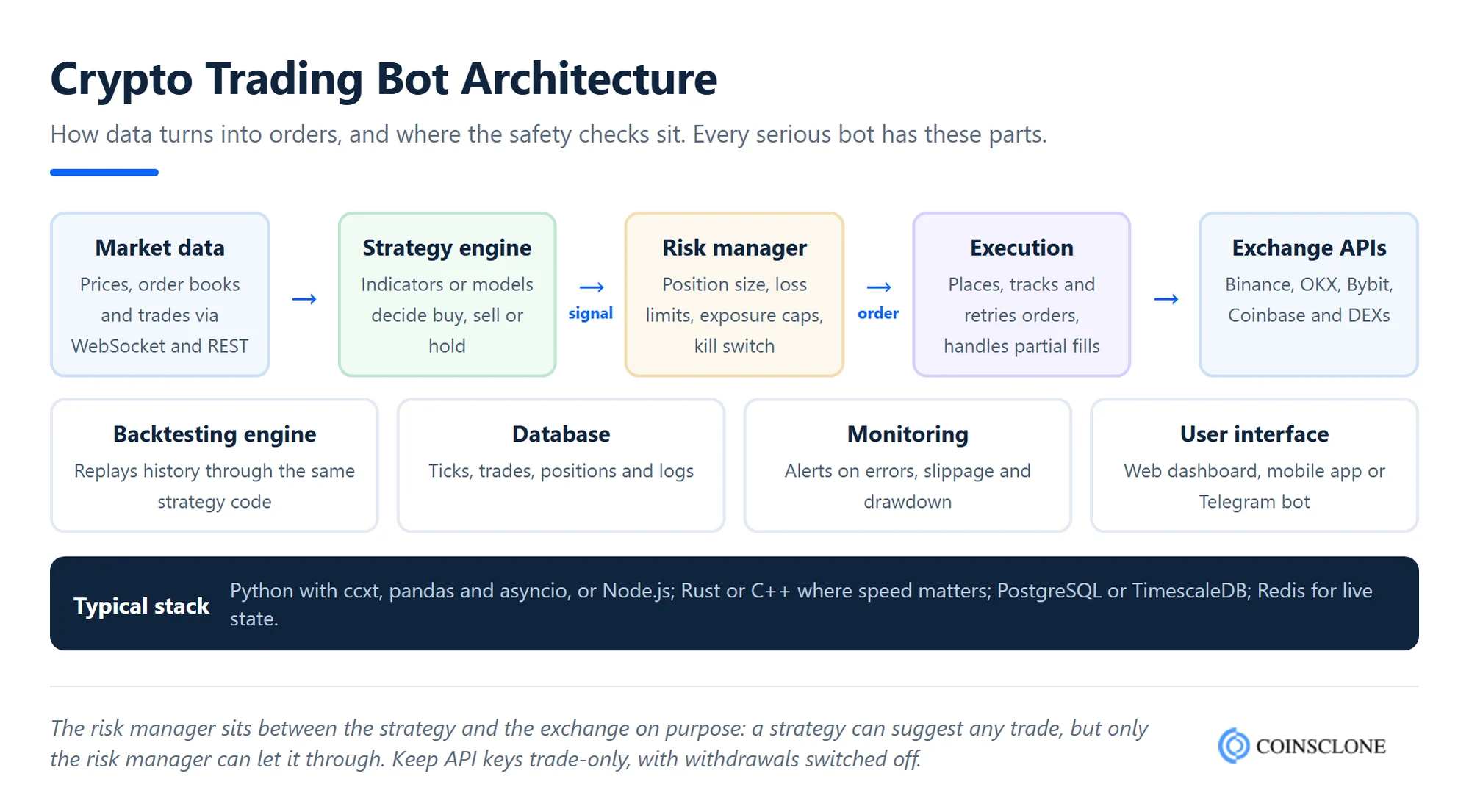
- Market data layer: streams prices, order books and trades from each exchange, usually over WebSocket, with REST as a backup.
- Strategy engine: turns data into signals using indicators, rules or machine learning models.
- Risk manager: checks every signal against position size, loss limits and exposure caps before it becomes an order. It also holds the kill switch.
- Execution engine: places orders, tracks fills, retries failures and handles partial fills.
- Backtesting engine: runs the same strategy code on past data, so tests match live behaviour.
- Storage and monitoring: a database for trades and logs, and alerts for errors, slippage and drawdowns.
- User interface: a web dashboard, mobile app or Telegram bot for users and admins.
A typical Python stack uses ccxt to connect to exchanges, pandas and NumPy for data, and asyncio for handling many streams at once. Teams that need more speed use Rust or C++ for the execution layer, with PostgreSQL or TimescaleDB for storage and Redis for live state.
How to Develop a Crypto Trading Bot in 7 Steps
1. Gather Requirements
Start with the basics: which markets and exchanges the bot will trade, what strategy it follows, who will use it, and how much risk is acceptable. Then pick your tools. Python and JavaScript are the most common languages, with libraries such as ccxt, pandas and NumPy, plus the exchange APIs for market data and order placement.
2. Choose the Type of Trading Bot
Each type of bot is built for a specific job. The most common are:
- Arbitrage bots: trade price gaps between exchanges or between spot and futures. See our list of the best crypto arbitrage bots and our guide to crypto arbitrage bot development.
- Grid bots: buy and sell at set price levels in a range.
- DCA bots: buy in small, regular amounts to smooth out price swings.
- Trend-following bots: trade in the direction of the market using indicators.
- Market-making bots: place buy and sell orders on both sides of the book to earn the spread and add liquidity.
- Scalping bots: make many small, fast trades.
- AI trading bots: use machine learning to spot patterns or adjust strategy settings.
- Copy trading systems: let users copy the trades of chosen traders automatically.
- Telegram trading bots: let users buy, sell and snipe new tokens from a chat, popular for fast-moving meme coins.
- Prediction market bots: trade event contracts on platforms such as Polymarket through their order book APIs.
For ready-made examples, see our list of the best crypto trading bots.
3. Design the Bot’s Architecture
Map each part of the architecture above to your strategy: where data comes from, how signals are made, what the risk limits are, and how orders are placed. Keep each part separate, so you can change the strategy without touching execution, or add an exchange without rewriting the strategy.
4. Design the UI and UX
Users need clear screens to set up bots, see performance and stop a bot in one tap. React and Angular are common for web dashboards, React Native for mobile apps, and a Telegram bot interface for trading from chat.
5. Build the Backend
The backend runs the core logic: data processing, strategy code, risk checks, order execution, API access and user accounts. It must handle many connections at once and recover cleanly from exchange outages.
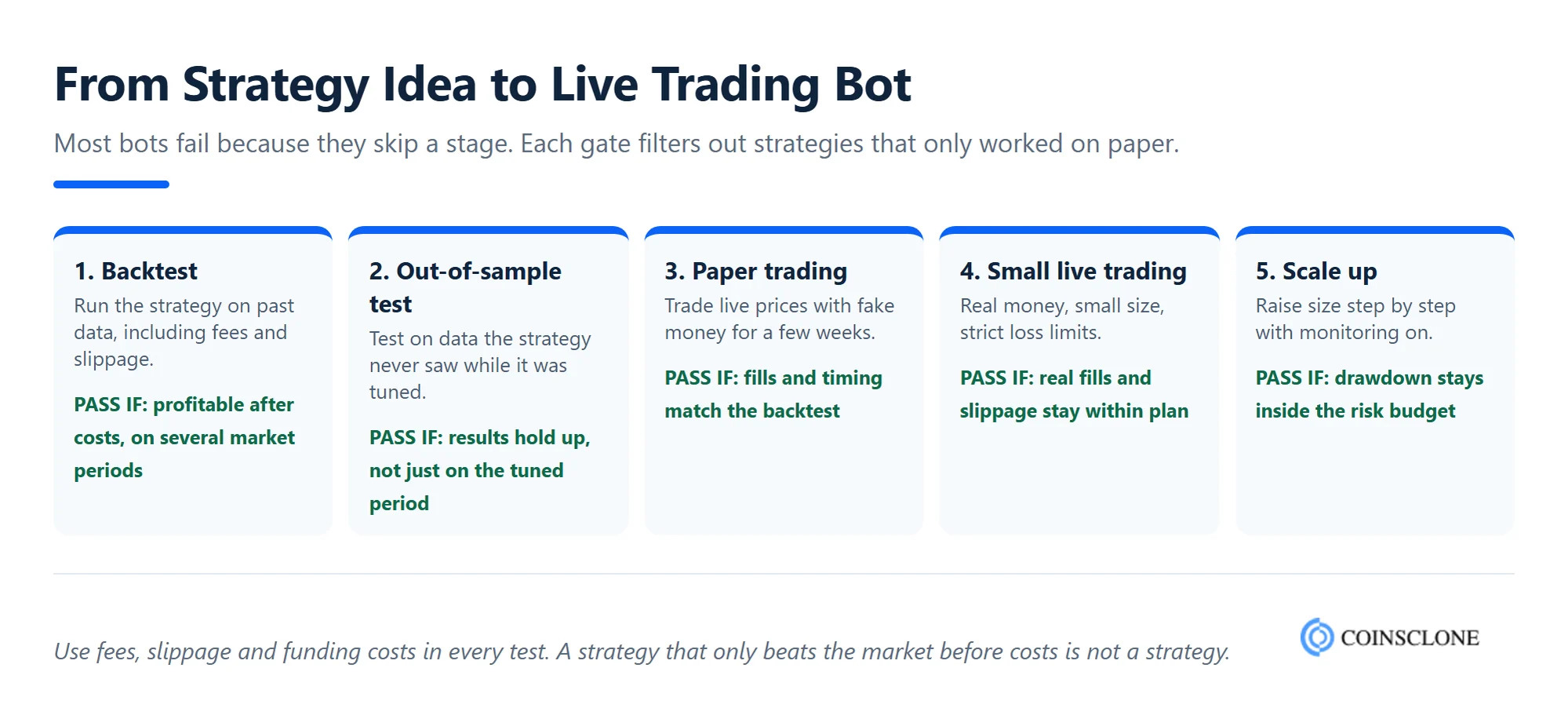
6. Test and Backtest
Testing is where most bots are made or broken. A strategy has to pass several stages before it touches real money.
7. Launch and Monitor
After testing, the bot goes live, starting small. The team watches performance, slippage and errors closely, and keeps updating the bot as markets and exchange APIs change. Regular security reviews keep API keys and user data safe.
Building a bot well takes both coding skill and market knowledge. That is why many businesses work with an experienced cryptocurrency trading bot development company.
Features of a Cryptocurrency Trading Bot
Core Features
- Automated trading: executes the strategy without manual input.
- Real-time monitoring: live prices, positions and profit and loss.
- Strategy library: grid, DCA, arbitrage and custom strategies.
- Multi-exchange support: one bot across several exchanges.
- Cross-platform access: web, mobile and Telegram.
- Liquidity management: smart order sizing for thin markets.
Advanced Features
- Backtesting and paper trading: test strategies before going live.
- Technical indicators: RSI, MACD, moving averages and more.
- Portfolio management: balance holdings across coins and exchanges.
- Copy trading: users follow top traders automatically.
- Notifications: alerts for trades, errors and targets.
- AI assistance: models that tune settings or flag market changes.
Security Features
- Secure API keys: trade-only permissions, withdrawals off, IP whitelisting.
- Encryption: keys and data encrypted at rest and in transit.
- Multi-factor authentication: for every user and admin.
- Activity logs: a full record of every action.
- Risk limits and kill switch: stop trading when limits are hit.
- Reports: performance and audit reports for users and admins.
Benefits of Crypto Trading Bot Development
Fast, Automated Trades
Bots act in milliseconds and never miss a signal because someone was asleep. That means fewer errors and steadier execution.
A Strategy for Every Market
With many bot types available, users can match the bot to the market: grid bots for sideways markets, trend bots for strong moves, and arbitrage bots for price gaps.
24/7 Trading
Crypto trades around the clock, and so do bots. Users in every time zone can trade at any hour, which builds trust in your platform worldwide.
Lower Trading Costs
Bots can use limit orders, split large trades and avoid emotional overtrading, which cuts fees and slippage.
New Revenue for Exchanges
Exchanges that offer built-in bots keep users trading on their platform and earn more trading fees, while market-making bots keep order books deep.
Better Over Time
Bots can be upgraded with new strategies, data sources and AI models as markets change.
How Does a Crypto Trading Bot Work?
- Collect data: the bot streams prices, volumes and order books from the exchange.
- Decide: the strategy engine checks whether its rules are met and creates a signal.
- Check risk: the risk manager checks position size, loss limits and exposure before approving the order.
- Execute: the bot sends the order through the exchange API and tracks the fill.
- Monitor: it updates positions, logs every step and alerts the team if anything goes wrong.
Revenue Model of a Crypto Trading Bot Business
- Subscriptions: monthly plans with more bots, exchanges or features.
- Profit share: a percentage of profits the bot makes for the user.
- Trading fees: exchanges earn fees on every bot trade.
- Per-trade fees: common for Telegram trading bots, which charge a small fee on each swap.
- Strategy marketplace: a cut of sales when traders sell strategies to others.
- Market-making services: fees from token projects that need liquidity.
- API access: paid access for developers and funds.
What Affects the Cost to Develop a Crypto Trading Bot?
The cost depends on your scope. The biggest factors are:
- The type of bot and the complexity of its strategy
- The number of exchanges and chains it connects to
- Whether it needs AI or machine learning models
- Data feeds, including paid historical data for backtesting
- Web, mobile or Telegram interfaces
- Security reviews and testing depth
- Ongoing hosting, monitoring and updates
A single-strategy bot for one exchange is a much smaller project than a multi-exchange platform with copy trading and AI. Share your scope with a development team to get an accurate quote. If you plan to offer bots inside your own exchange, our cryptocurrency exchange development company team can build both together.
Why Choose Coinsclone for Crypto Trading Bot Development?
Coinsclone is a cryptocurrency trading bot development company with a team of blockchain and trading system engineers. We have delivered more than 350 blockchain platforms for over 200 clients. We build arbitrage, grid, market-making, copy trading, AI and Telegram trading bots around your strategy and your users.
From requirements to launch and monitoring, our team guides you through every stage. We also build bots for prediction markets, alongside our Polymarket clone script. Talk to us to plan your trading bot.
Accelerate Your Crypto Trading Bot Development
Enterprise-grade Crypto Trading Bot Solutions — delivered efficiently.
- MVP Framework : Reduce development time by up to 90% with our proven system.
- Seamless Integrations : Pre-configured APIs for major exchanges.
- Custom Strategy Engine : Deploy algorithmic, AI-driven, or rule-based trading strategies with full flexibility.
- Monetization Options : Enable revenue through subscriptions, performance fees, or white-label licensing.
Request a free, branded demo within 48 hours — experience your trading bot before making any commitment.
Schedule a Consultation to learn how our Crypto Trading Bot Development can take you from concept to deployment in 8-12 weeks.
Frequently Asked Questions
What is crypto trading bot architecture?
It is the set of parts that make a bot work: a market data layer, a strategy engine, a risk manager, an execution engine, a backtesting engine, storage, monitoring and a user interface. The risk manager sits between the strategy and the exchange, so no order goes out unchecked.
How do I build a crypto trading bot?
Define your strategy and markets, design the architecture, build the data, strategy, risk and execution parts, then backtest, paper trade and go live with small amounts. Python with the ccxt library is a common starting point.
Which programming language is best for a crypto trading bot?
Python is the most popular, thanks to libraries like ccxt and pandas. JavaScript and Node.js are also common. For very fast strategies, teams use Rust, Go or C++.
How does a crypto trading bot work?
It collects market data, checks its strategy rules, passes each trade through risk checks, and sends approved orders to the exchange through an API, all automatically.
Can I build an AI crypto trading bot?
Yes. AI models can spot patterns, forecast short-term moves or tune strategy settings. They still need the same risk controls and careful testing as any other bot, because models can fail when markets change.
How do Telegram trading bots make money?
Most charge a small fee on every trade made through the bot. Some also offer paid premium features or earn from referrals.
What is a white label crypto trading bot?
It is a ready-made trading bot platform that you rebrand and offer to your own users, with the core strategies, dashboard and exchange connections already built.