
This guide explains celebrity NFT marketplace development in plain terms. You will learn what the platform is, how it works, and what it takes to build one in 2026. Turning fame into income is not new. For stars, that income comes from their work and their bond with fans. NFTs let them sell that bond straight to fans as collectibles, perks and events.
The market has changed a lot since the 2021 boom. So we also show what happened to the big star drops: which ones still work, and which ones ended in shutdowns or lawsuits. By the end, you will know which launch route fits your project, what features fans expect, and what a build costs.
In this guide:
- What a celebrity NFT marketplace is and how a drop, sale and resale work
- Where real celebrity NFT projects stand in October 2026, with dated status checks
- The features fans, stars and admins need, and the legal points to settle first
- Cost and time ranges for each build route, from white label to custom
- A simple chart to pick between an existing platform, your own store and your own marketplace
Launch Your Celebrity NFT Marketplace with Ease
Celebrity NFT Marketplace Development — designed for stars and influencers.
- Ready-to-Deploy : Start your branded NFT marketplace quickly with pre-built modules.
- Multi-Blockchain Support : Seamless integration with Ethereum, BSC, Polygon, and more.
- Fan-Centric Features : Tokenize exclusive collectibles, autographs, and virtual experiences.
- Monetization Engine : Earn from listings, auctions, and premium fan access.
See a Free Demo of your NFT marketplace in 48 hours — before you invest a cent.
Book a Free Call to discover how our Celebrity NFT Marketplace Development can turn your fanbase into a revenue-generating NFT platform in just 8–12 weeks.
Celebrity NFT Marketplace Development
Celebrity NFT marketplace development is the work of building a platform where stars turn their content into NFTs and sell them to fans. Show business is not like other trades. It is not tech, finance or banking, and fans value things in their own way. That is why NFTs fit it so well: they put a price on access, closeness and rare moments.
Imagine a musician who wants to record a song and publish it online. In the past, the musician was at the mercy of the studio. If the song took off, the musician got only a part of the profits. The deals were signed beforehand, and there was little the musician could change after that. NFTs change this by letting the artist sell straight to fans and set the rules for resales.
Now think of a photographer who shoots stars, which is a well-paid trade. Tabloids and websites have to come to the photographer for the rights to each photo, due to copyright laws. That brings in license fees. NFTs add another way to earn: a photo can be sold as a numbered edition, with proof of who owns which copy. Any later sale can send a royalty back to the photographer, as long as the market enforces it. The NFT does not replace the copyright license, though. It is a new product built on top of it.
So a celebrity NFT marketplace does three jobs. It proves that an item really comes from the star. It sells that item to fans in a way they find easy, often with a card. And it keeps paying the star when fans trade the item later. Cutting out middlemen is the reason stars try it. Keeping fans happy is the reason some of them stay.
Launch NFT Marketplace for Celebrities & Influencers in a Novel Way!
Worlwide Audience. Digital Legacy. High Earnings. One-time Investment.
What are NFTs, and How Do Celebrities Use Them?
NFTs (non-fungible tokens) are one-of-a-kind tokens stored on a blockchain. Each one has its own ID, so no two are the same, and anyone can check who owns it. An NFT is usually priced in the token of its chain. For example, an NFT sold on Ethereum is often priced in ETH, and one on BNB Chain in BNB. Many star platforms also show a dollar price and take card payments, so fans never touch crypto.
The idea is to put a clear value on items that are hard to price in the usual ways. Real artworks hang in galleries, sell at auction, and support whole business empires. NFTs are the crypto version of that, and stars use them for much more than art:
- Collectibles: Numbered trading cards, signed photos and video moments, like NBA Top Shot’s licensed highlights.
- Access passes: NFTs that unlock meet-and-greets, private streams, early tickets or members-only chats.
- Music and video: Song editions, new tracks and backstage clips sold straight to fans.
- Phygital items: An NFT linked to a real item, such as signed merch or sneakers, that the holder can claim.
- Social gifts: Small collectibles fans show on their profiles, as with Telegram gifts on the TON blockchain.
The market is smaller than in 2021, but it did not vanish. Total NFT sales fell 37% to about $5.63 billion in 2025, down from $8.9 billion in 2024, with an average sale of $96, according to CryptoSlam data. Buyers still spent about $183 million on NFTs in the 30 days to 16 October 2026, per CryptoSlam. In short, fans still buy, but they now pay for real perks, not hype.
If you’re interested in knowing what an NFT Marketplace is and how it works, check out our latest blog, NFT Marketplace Explained. It provides a clear understanding of this platform.
Where Celebrity NFT Platforms Stand in 2026
Most guides on this topic still list 2021 star platforms as if they were thriving. Many are gone. Here is where well-known star NFT projects stood when we checked on 16 October 2026:
| Project | What it was | Status (checked 16 Oct 2026) |
| Snoop Dogg on Telegram | About 1 million collectible gifts on TON | Sold out in about 30 minutes on 9 July 2025, about $12 million in sales |
| Trump Digital Trading Cards | $99 NFT cards sold on its own website, first series on Polygon | Site online; the America First Edition has ended, and holders are now offered $TRUMP meme tokens |
| NBA Top Shot | Licensed NBA video Moments on Flow | Active, with a 2025-26 season that added rookie autographs; 5% fee per sale |
| OneOf | Music and celebrity NFT drops | Site online with creator drops, including a Notorious B.I.G. collection |
| Autograph (Tom Brady) | Athlete and celebrity NFT platform | Dropped NFTs in late 2024, then merged with fitness firm Future in January 2025 |
| Momentica (HYBE and Dunamu) | K-pop photo and video collectibles | Closed quietly on 2 July 2025 |
| DraftKings Reignmakers | Athlete NFT fantasy game | Shut in 2024; $10 million class settlement agreed in 2025 |
| Nifty Gateway | Home of many 2021 celebrity drops | Closed in February 2026 |
What worked: drops inside apps fans already use
Snoop Dogg’s Telegram drop sold nearly 1 million gifts in about 30 minutes on 9 July 2025. Sales came to about $12 million, said Telegram’s boss, Pavel Durov. Fans bought with Telegram Stars inside the app. The items could be minted on TON and traded about three weeks later. Lesson: remove the wallet step at the start, and let fans show off what they own.
NBA Top Shot is still running in 2026. It keeps adding new things to collect, such as autographed rookie Moments and signed 1-of-1s. Lesson: fans stay when the product keeps giving them reasons to come back, not only new drops.
What faded: platforms built on hype
Autograph, co-founded by Tom Brady, raised over $200 million. It cut staff in 2023, relaunched without NFTs in late 2024, and merged with the fitness company Future in January 2025. Momentica, a K-pop photo card app from HYBE and Dunamu, opened in late 2022. It closed on 2 July 2025. Lesson: a famous name brings the first sale. A clear reason to hold brings the second.
What went to court: promises about profit
In 2022, buyers sued Yuga Labs and celebrity promoters such as Madonna, Paris Hilton and Justin Bieber over Bored Ape NFTs. A federal judge dismissed the case in September 2025, finding the NFTs were not shown to be securities, though the buyers could file again. A class action against Logan Paul over CryptoZoo was dismissed in late 2025, with his promises called “puffery”. DraftKings, by contrast, closed its athlete NFT game and agreed to a $10 million settlement. Lesson: even cases you win cost years. Sell fun and access, never future profit.
How a Celebrity NFT Marketplace Works
A star NFT market works much like any other NFT platform, with extra checks around the star. Here is the usual flow:
- Verify the star: The platform checks that the star, or their agency, owns the account and has the rights to the content.
- Mint the NFT: The team turns a photo, video, song or perk into an NFT, sets the edition size, and sets the royalty.
- List or drop: The NFT goes on sale at a fixed price, in an auction, or in a timed drop with a queue to stop bots.
- Fan buys: The fan pays by card or crypto. An embedded wallet is often created in the background with an email login.
- Smart contract settles: The contract moves the NFT to the fan and splits the payment between the platform and the talent side.
- Perks unlock: Holding the NFT opens gated content, events, chats or a claim on a real item.
- Resale: Fans trade the NFT, and the star earns a royalty on each resale, if the market enforces it.
The money side is where most first-time founders get surprised. The diagram below follows one drop and one resale.
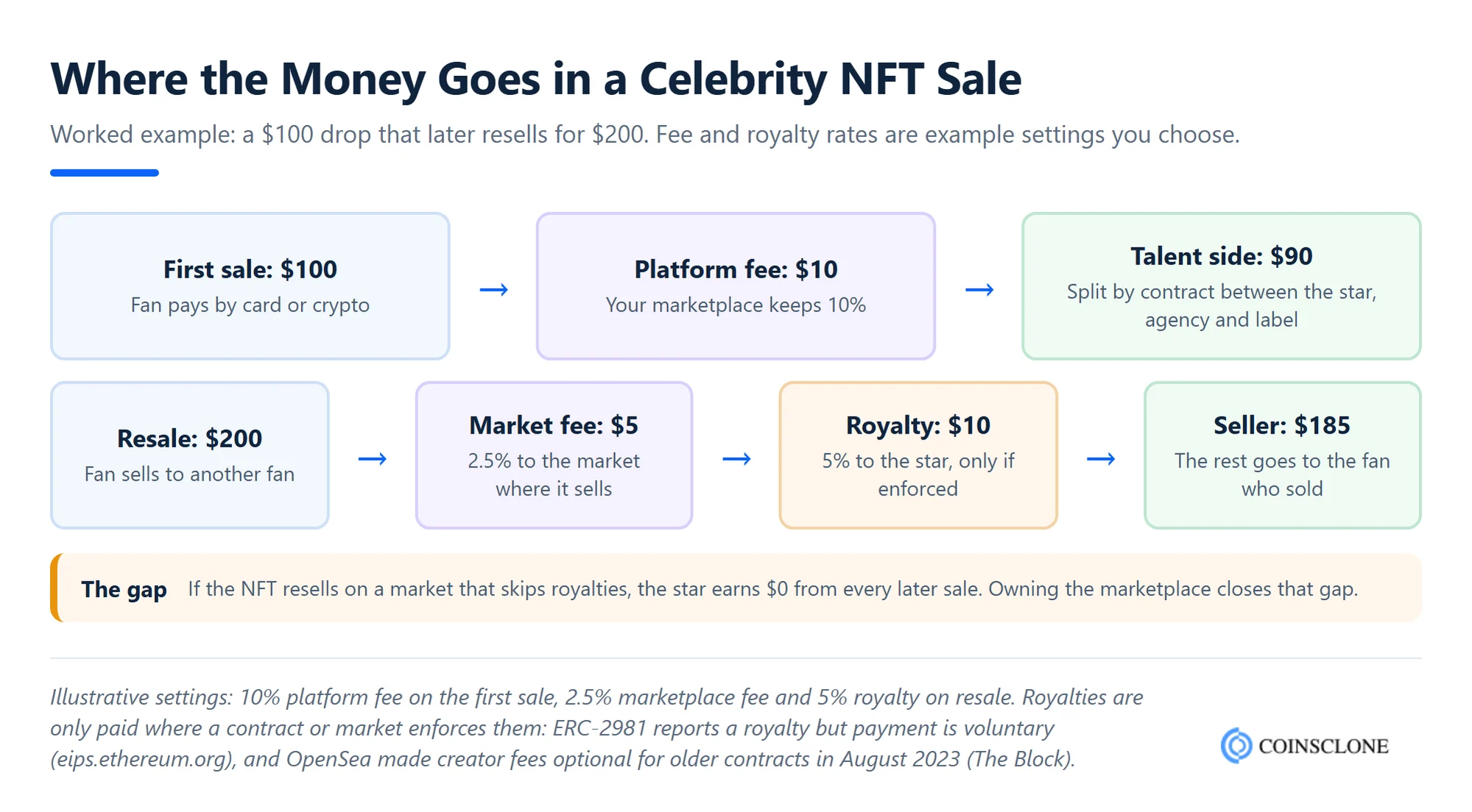
Royalties are the key point here. The ERC-2981 standard lets an NFT report its royalty, but payment is voluntary. In August 2023, OpenSea made creator fees optional for older contracts. So if royalties matter to your stars, enforce them in the contract and keep trading on your own platform. Our guide to popular NFT standards explains which standards can enforce them.
Which Launch Route Fits Your Celebrity NFT Project?
Not every star needs a full marketplace. Some projects do better with a single drop on a platform fans already use. Others need their own platform from day one. This decision tree helps you pick:
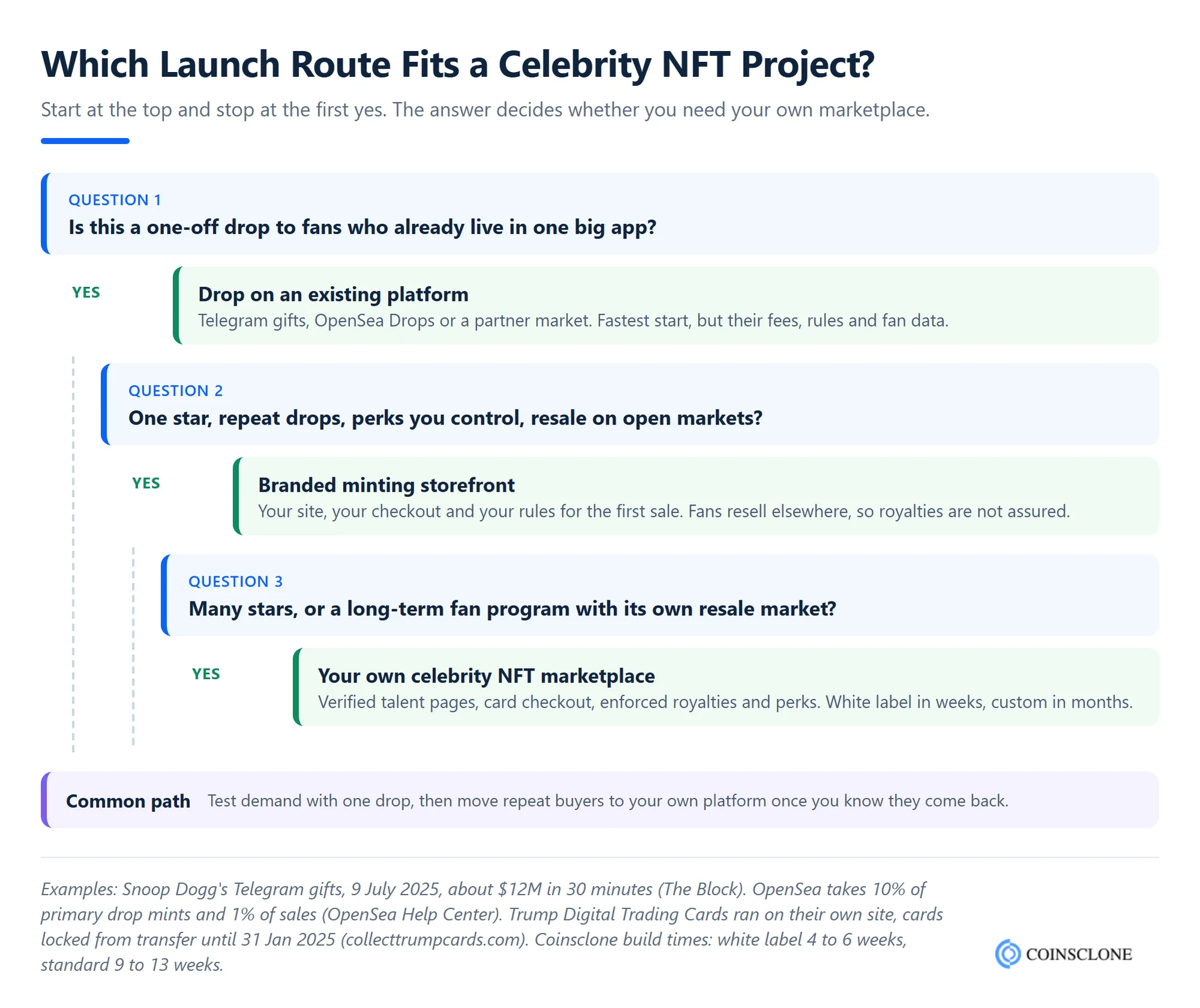
Here is how the three routes compare:
- Existing platform: The fastest start. OpenSea, for one, takes 10% of mints in a first-sale drop and 1% on sales, per the OpenSea Help Center. But you follow their rules, and they keep the fan data.
- Branded storefront: Your own site for first sales, like the Trump Digital Trading Cards site, which sold 45,000 cards at $99 in its first series. It even blocked transfers of one edition until 31 January 2025. Resales still happen on outside markets, though.
- Own marketplace: You control the first sale, the resale, the royalties, the perks and the fan data. This is the route for agencies, labels, sports clubs and fan apps that host many stars.
Must-Have Features of a Celebrity NFT Marketplace
Competitor guides list dozens of features. These are the ones that matter most for a star platform, grouped by who uses them.
For fans
- Email and social login: An embedded wallet is created for the fan, so there is no seed phrase on day one.
- Card and crypto checkout: Card payments widen the audience far beyond crypto users.
- Drop queues and limits: Fair queues, per-wallet caps and bot checks during hot drops.
- Collection page: A profile to show off owned items, with share links for social media.
- Perk access: Gated videos, chats, ticket presales and claims for physical merch.
- Resale market: Fixed-price listings, offers and auctions, with clear fees shown before each sale.
For stars and their teams
- Verified talent pages: A badge that proves the page is official, which protects fans from fakes.
- Drop studio: Tools to set edition sizes, prices, timing, perks and royalties without code.
- Money splits: Payments split by contract between the star, agency, label and charity partners.
- Fan insights: Data on who buys, who holds and who resells, to plan the next drop.
For the platform admin
- KYC and age checks: Know-your-customer checks for large buyers and age gates where content needs them.
- Takedown tools: A fast way to remove fake or unlicensed listings.
- Royalty rules: Contracts and market rules that make sure the star’s cut is paid on each resale.
- Fee and tax settings: Platform fees, payout rules and tax reports per country.
- Security: Audited smart contracts, two-step login and alerts for odd trades.
A broader set of features is covered in our guide on how to build an NFT marketplace.
What are the Benefits of a Celebrity NFT Marketplace?
Building a celebrity NFT marketplace is a rare chance to bring fans and their stars closer. It opens a new way to engage fans and a new source of income. For stars, these platforms are a way to earn from their brand by selling rare items, such as signed cards, limited art or online events. Fans, on the other hand, get rare and verified content that brings them closer to the star. Other key benefits for startups that build this type of platform are:
- Real demand: Fans still buy items that carry real perks, as Telegram and Top Shot show.
- Scalable business model: One platform can host many stars, teams or labels, each with their own drops.
- Global audience: Fans anywhere can buy, which is hard to do with physical merch.
- Long-term income: Repeat drops, memberships and perks build income beyond a single sale.
- Resale income: Your own market can make sure the star gets a cut of each resale, which outside markets may skip.
- First-party fan data: You learn who your real fans are, instead of renting that data from an app.
This model rewards both sides. Stars get a direct line to fans, and fans get items that unlock real access. When the perks are real, it is a win-win for both stars and their audiences.
Legal Points to Settle Before Launch
Most star NFT problems are legal, not technical. Settle these before the first drop:
- Name and face rights: Get a written license from the star for their name, face and voice, plus rights from any photographer, label or studio. Many US states protect a person’s likeness, and Tennessee’s ELVIS Act (2024) also covers AI voice copies.
- Securities risk: The US SEC now sees most NFTs as things people collect, not invest in. Its chair said so in a March 2026 interview, after a new SEC guide put NFTs in that group. But the SEC still looks at how each drop is sold. So never promise profits, buybacks or “investment” returns.
- Paid promotion: Stars who promote a drop should disclose that they are paid. Unclear promotion was at the center of the Bored Ape lawsuit.
- EU rules: The EU’s MiCA regulation leaves out unique NFTs. However, very large series or fractions of an NFT can fall inside it.
- Consumer terms: Explain what the buyer owns, what the perks are, how long they last, and what happens if the platform closes. Momentica and Nifty Gateway show that closures do happen.
Get a local lawyer to review your terms in every country you sell into. Our NFT marketplace revenue model guide also helps you set fees that stay on the right side of these rules.
How to Build a Celebrity NFT Marketplace: Step by Step
Here is the path we see work for star and fan platforms:
- Pick your niche: Music, sports, film, creators or a single star. Each needs different perks and rights deals.
- Sign the rights: Agree on the license, revenue splits and approval process with the stars and their teams.
- Choose the chain: Pick a chain with low fees and good wallet support, such as Polygon, Base, Solana, Flow or TON, based on where your fans are.
- Pick the build route: White label for speed, or custom for unique features. Both can be branded fully.
- Design the fan journey: Email login, card checkout, drop queues and perk access, tested with real fans.
- Audit and test: Audit the smart contracts and run a test drop on a test network before mainnet.
- Launch and grow: Start with one strong drop, then add more stars, memberships and resale features.
How Much Does a Celebrity NFT Marketplace Cost?
Cost depends on the build route, the features and the number of chains. These ranges come from published 2026 agency cost guides and match our NFT marketplace development cost breakdown:
| Build path | Typical cost (2026) | Best for |
| White label or clone script | $10,000 to $30,000 | Fast launch with standard features and your brand |
| Custom MVP | $20,000 to $45,000 | A first version with a few unique features |
| Mid-tier platform | $40,000 to $80,000 | Several stars, card checkout, perks and analytics |
| Enterprise, multi-chain | $80,000 to $150,000+ | Agencies, labels and clubs with many stars and chains |
Star platforms often sit higher in each range. Star checks, money splits, card payments and KYC all add work. Smart contract audits usually cost $5,000 to $25,000 more. Also plan for running costs: hosting, file storage, card fees, customer support and marketing for each drop.
Time matters as much as money. Coinsclone’s published build times for NFT markets are 4 to 6 weeks for a white label build and 9 to 13 weeks for a standard build on a proven model. Custom features, audits and mobile apps add time to either route.
Why Choose Coinsclone for Celebrity NFT Marketplace Development?
Stars, agencies and media firms are moving into Web3 to own their link with fans. Card checkout, email wallets and enforced royalties now make that possible without asking fans to learn crypto first. The hard part is building a platform that is safe, easy to use and ready for traffic spikes during big drops.
That is where we come in. Coinsclone has built crypto and blockchain products since 2018, with 350+ platforms delivered for 200+ clients across 20 industries. Our team handles smart contracts, wallets, payments and NFT markets on many chains. Our NFT Marketplace Development team also builds platforms for stars. We can build a platform for one star or a whole list of them.
We also offer White Label NFT Marketplace Software and other Clone Software Solutions to kickstart your NFT platform, such as OpenSea clone, Rarible clone and Blur clone, among others. If your stars come from music or sports, read our guides to NFT music marketplace development and NFT sports marketplace development.
Launch Your Celebrity NFT Marketplace with Ease
Celebrity NFT Marketplace Development — designed for stars and influencers.
- Ready-to-Deploy : Start your branded NFT marketplace quickly with pre-built modules.
- Multi-Blockchain Support : Seamless integration with Ethereum, BSC, Polygon, and more.
- Fan-Centric Features : Tokenize exclusive collectibles, autographs, and virtual experiences.
- Monetization Engine : Earn from listings, auctions, and premium fan access.
See a Free Demo of your NFT marketplace in 48 hours — before you invest a cent.
Book a Free Call to discover how our Celebrity NFT Marketplace Development can turn your fanbase into a revenue-generating NFT platform in just 8–12 weeks.
Frequently Asked Questions
What is a celebrity NFT marketplace?
A celebrity NFT marketplace is a platform where stars and creators make and sell NFTs straight to fans. These NFTs can be collectibles, private content, member passes or special fan events. The platform verifies that each item is official and lets fans resell it later.
How does a celebrity NFT marketplace work?
The star, or their team, mints NFTs and lists them on the platform. Fans buy them with a card or crypto, often through an email login that creates a wallet for them. Smart contracts track who owns what, take payments, split the money and pay the star a cut of each resale.
What features are important in a celebrity NFT marketplace?
Key features include verified star pages, NFT minting, card and crypto checkout, built-in wallets, drop queues, auctions, perks, money splits, royalty rules, KYC and an admin panel.
How much does celebrity NFT marketplace development cost?
Published 2026 agency cost guides put a white label NFT market at about $10,000 to $30,000 and a custom MVP at $20,000 to $45,000. A mid-tier platform costs $40,000 to $80,000, and an enterprise multi-chain build $80,000 to $150,000 or more. Star checks, money splits and card payments push costs toward the top of each range.
How long does it take to develop a celebrity NFT marketplace?
Coinsclone’s published build times for NFT markets are 4 to 6 weeks for a white label build and 9 to 13 weeks for a standard build. Custom features, contract audits and mobile apps add time, and a fully custom multi-chain platform can take several months.