
A SunSwap clone script is ready-made software for launching your own decentralized exchange (DEX) on the TRON blockchain, built on the same swap and liquidity pool model that made SunSwap the top DEX on TRON. This guide explains what the script is, how SunSwap works today, and what a TRON DEX needs to win traders in 2026.
You will also get SunSwap’s real numbers, its fee model, the TRON energy costs your users will pay, the licence rules for its code, and the steps, features and timelines for your own launch. By the end, you will know if a SunSwap-style DEX fits your plan and what it takes to build one.
In this guide:
- SunSwap’s October 2026 status: four versions live, about $635 million locked and $23.7 billion traded in the last 12 months.
- Why V3 and V4 pools, not the old V1 design, are the parts worth copying.
- A worked example of where a $10,000 swap fee goes.
- How TRON energy and bandwidth shape your swap costs and user experience.
- Features, security, licence rules, build steps and launch timelines.
See How Our MVP System Can Launch Your TRON-Based DEX Faster
SunSwap Clone Script — TRON-Based Decentralized Exchange Development Simplified.
- MVP System : Launch your SunSwap-like DEX 90% faster with our Solana-ready engine
- Liquidity & AMM: Pre-integrated swap and pool modules — no coding required.
- Brand & Customization : Your UI, your tokens, your TRON ecosystem.
- Revenue Engine : Earn from swap fees, liquidity rewards, and staking income.
Get a free branded demo of your SunSwap-like DEX in 48 hours — before you spend a cent.
Book a Free Demo to discover how our SunSwap Clone Script can help you go live on TRON in 8–12 weeks.
What Is a SunSwap Clone Script?
What strikes your mind when you hear the phrase SunSwap Clone Script? Most people think it is a copy of the SunSwap code. But it is not exactly what you think. A SunSwap Clone Script is a ready-to-launch DeFi exchange clone script built on the TRON network that copies SunSwap’s features and flow, not its brand.
SunSwap Clone Software holds all the core functions, security modules and plug-ins you need to run a TRON DEX: token swaps, liquidity pools, LP rewards, staking and a full admin panel. We can also call it a TRON-based DeFi exchange clone script. Because the core is already built and tested, you skip months of work and focus on your brand, your tokens and your users.
Furthermore, the best part of SunSwap Clone Software is the room to customize. You can change the visuals, features, fee split, pool types and more to fit your business plan. As a result, you get a DEX on TRON that is shaped around your own market, not a carbon copy.
Coinsclone offers a modern SunSwap Clone Script with the latest TRON features. It is affordable, responsive and ready for startups that plan to launch a DeFi exchange on TRON. Next, let us look at SunSwap itself, because its 2026 numbers show which parts are worth copying.
Overview of SunSwap: Status in October 2026
SunSwap is the leading DeFi exchange protocol on the TRON blockchain. It started life as JustSwap, which launched on 18 August 2020. In October 2021, SUN.io acquired JustSwap and upgraded it to SunSwap. Today it is the core of the SUN.io platform, next to the SunCurve stablecoin pools and the SunPump meme launchpad.
SunSwap is active and growing. It now runs four versions side by side:
| Version | Live since | Pool model | Swap fee | TVL (16 Oct 2026) |
| SunSwap V1 | Aug 2020 (as JustSwap) | TRX-to-token pools, not for new use | 0.3% | ~$51 million |
| SunSwap V2 | Dec 2021 | Any TRC-20 pair, constant product | 0.3% | ~$259 million |
| SunSwap V3 | Dec 2023 | Concentrated liquidity | 0.01%, 0.05%, 0.3% or 1% | ~$217 million |
| SunSwap V4 | Mar 2026 | Singleton pools with hooks | Same tiers, or dynamic up to 5% | ~$109 million |
Fee tiers come from the SUN.io trading fee docs. TVL and launch dates come from DefiLlama’s SunSwap V3 and SunSwap V4 pages, checked on 16 October 2026.
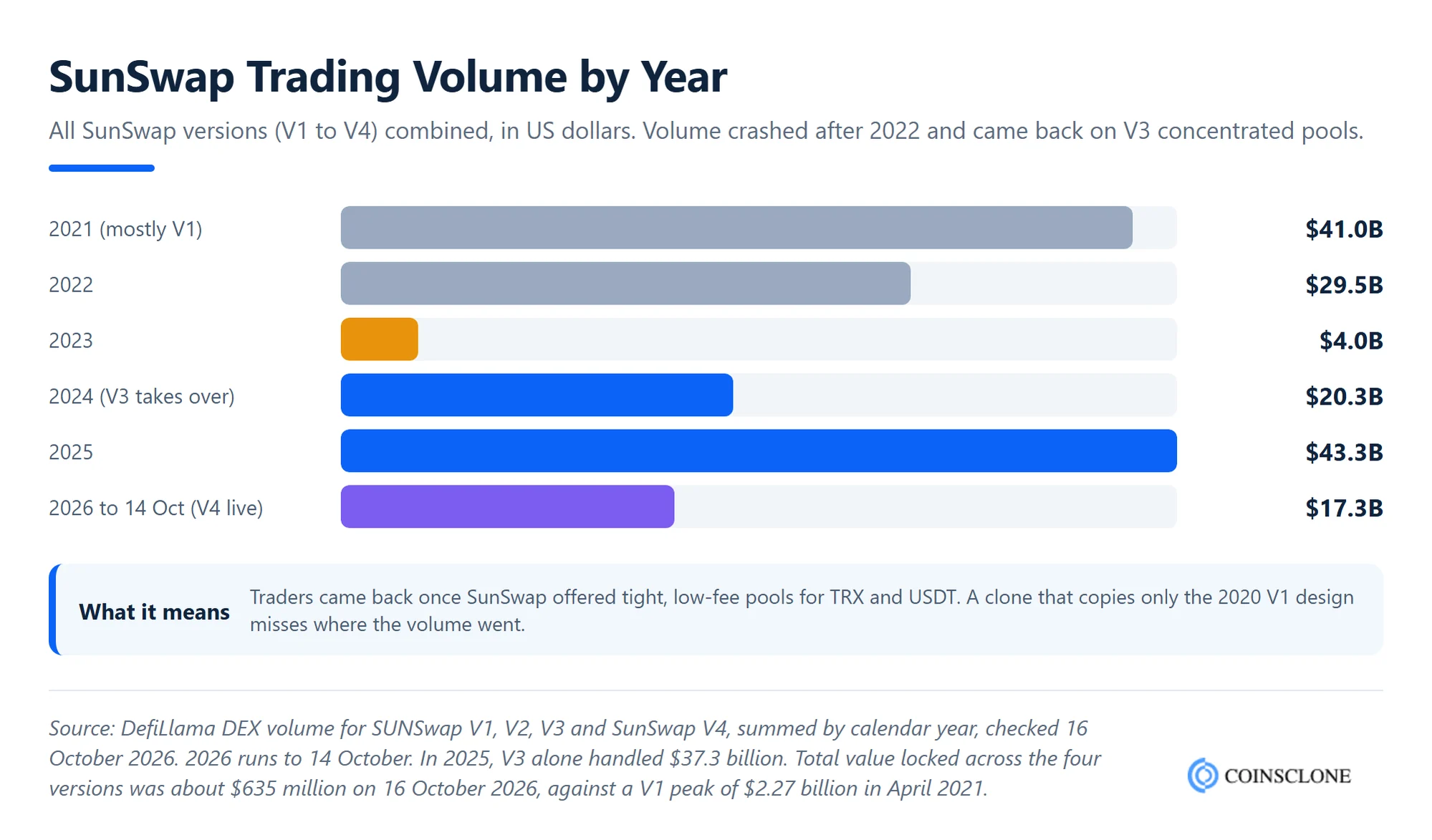
Together, the four versions held about $635 million in total value locked (TVL). That is well below the V1 peak of $2.27 billion in April 2021. Even so, trading is busier than ever. SunSwap handled about $43.3 billion in swaps in 2025, more than in 2021, and about $23.7 billion in the last 12 months. Most of that now runs through V3, which alone traded $19.4 billion in that period.
Here is what this means for your clone:
- TRON is a stablecoin chain. About $93 billion of USDT sat on TRON on 15 October 2026. TRON holds the second-largest stablecoin supply after Ethereum, so TRX and USDT pairs drive most swaps.
- SunSwap dominates TRON trading. In the 30 days to mid-October 2026, SunSwap’s four versions handled about 87% of the TRON DEX volume that DefiLlama tracks. A new DEX needs a clear niche, such as one token community, one region or one partner stablecoin.
- Low fees win. Volume came back in 2024 when V3 added tight 0.05% and 0.01% pools. Your clone should offer fee tiers, not one flat rate.
- Hooks are the new edge. V4 lets each pool run its own logic, such as dynamic fees or custom oracles. That is the newest feature to copy.
Now, let us dig deeper into how the clone works.
How Does SunSwap Clone Script Work?
Our SunSwap Clone Script works like the live SunSwap. It is a decentralized portal for swapping tokens and for creating liquidity, and it automates both through smart contracts on TRON. To understand it, you need to know two main functions: swapping and pooling.
Swapping
First, the user connects an external crypto wallet, such as TronLink. As the admin, you choose which wallets to support.
- Swap: Once connected, users can swap TRX for any listed TRC-20 token, or one TRC-20 token for another.
- Routing: A smart router finds the best path across your pools, so a USDT-to-token trade can hop through TRX if that gives a better price.
- Fees: For every swap, the user pays a liquidity provider fee. This is the main source of revenue for your DeFi exchange business.
Pooling
- Add liquidity: The pooling module lets users add two tokens to the pair they choose.
- LP rewards: In return, they get LP tokens (or a position NFT on concentrated pools) that track their share of the pool and its fees. Users can also stake these for extra rewards.
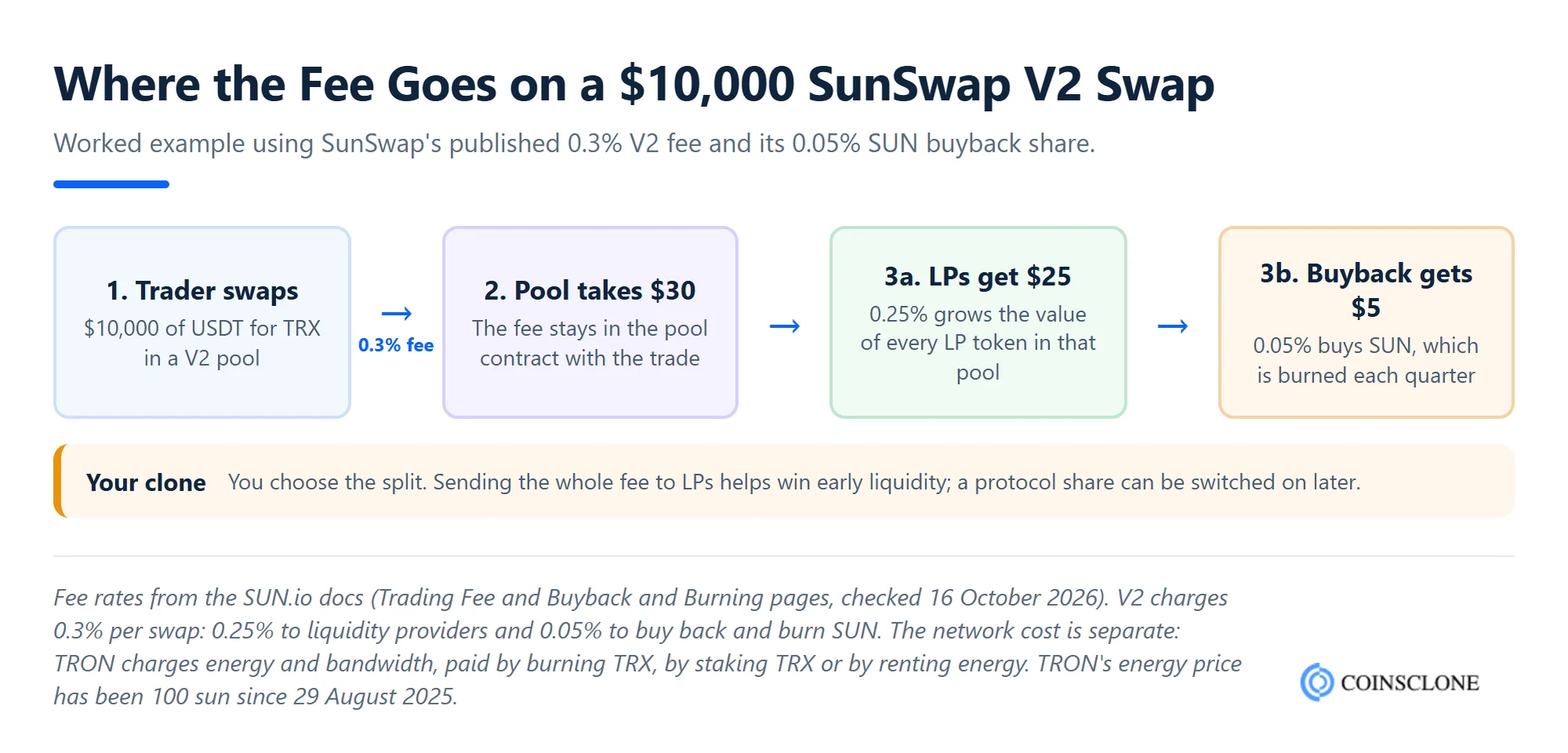
On SunSwap V2, the 0.3% fee splits into 0.25% for liquidity providers and 0.05% to buy back and burn SUN. Since 2 May 2026, SunSwap also sends one sixth of the fees from its main TRX/USDT 0.05% V3 pool to the same buyback. In your clone, you set this split yourself.
Which SunSwap Version Should Your Clone Copy?
Each SunSwap version suits a different business. Pick the model before you pick features, because it decides your contracts, your audit scope and your cost.
- V2-style (constant product): The simplest model. Every pool spreads liquidity across all prices, like Uniswap V2. It suits a new token community or a small DEX that wants easy LP tokens and simple farming.
- V3-style (concentrated liquidity): LPs pick a price range, so the same money gives much deeper liquidity near the market price. It suits TRX/USDT and stablecoin pairs, where most TRON volume sits.
- V4-style (singleton with hooks): One contract manages all pools, which cuts the energy cost of creating pools and of multi-hop swaps. Hooks add custom logic per pool, such as dynamic fees. It also pairs native TRX directly, with no wrapped WTRX step. It is the most flexible model, but it needs the deepest audit.
Most new projects launch with V2 and V3 pools together, then add V4 hooks once volume grows. If you also want a meme launchpad like SunPump, you can pair the DEX with a Pump.fun clone script adapted to TRON, so new tokens graduate straight into your pools.
TRON Energy and Bandwidth: The Cost Your Users Feel
TRON does not charge gas like Ethereum. Instead, every transaction uses bandwidth for its data and every smart contract call, such as a swap, uses energy. Users cover these by staking TRX, by renting energy, or by burning TRX at the network price.
That price matters. Under Proposal #104, TRON cut its energy price from 210 sun to 100 sun on 29 August 2025. According to imToken’s fee notice, a plain USDT transfer fell from about 13.5 TRX to about 6.4 TRX for a user who burns TRX. A swap uses more energy than a transfer, so the cost per trade is higher.
For your clone, this means:
- Show the energy cost before the user signs, so no one is surprised.
- Cut energy use in your contracts. V4’s singleton and flash accounting exist for exactly this reason.
- Offer energy help. You can stake TRX and delegate energy to users, or partner with an energy rental service, then recover the cost through a small fee.
If you need a refresher on how TRON tokens and fees differ from Ethereum, see our guide on ERC-20 vs TRC-20 tokens.
Core Features of Our SunSwap Clone Script
Without the right features, no one can run a successful DeFi exchange business. That is why features play a main part in any DeFi exchange. We at Coinsclone include all the latest features in the clone script to make it stand out from the crowd.
Here is the list of features you get in our White Label SunSwap Clone Software.
- Token swap: Instant swaps between TRX and TRC-20 tokens.
- Automated market maker: Constant product and concentrated liquidity pools.
- Fee tiers: 0.01%, 0.05%, 0.3% and 1% pools, set per pair.
- Smart router: Best-price routing across all your pools.
- Staking and farming: Reward LPs with your own token.
- Pooling: Add and remove liquidity with clear position views.
- Multiple wallet support: TronLink and other TRON wallets.
- Price charts: Live charts, pool stats and APR data.
- Multi-lingual support: Serve users in their own language.
- Transaction history: A full record of swaps, pools and rewards.
Tokens supported: Your clone works with TRX and any TRC-20 token, including USDT, USDD and community tokens. TRC-10 is a legacy standard, so we build new token support around TRC-20. If you plan to launch your own token with the DEX, our TRON token development team can build both.
SunSwap clone app: We also deliver Android and iOS apps with the same swap, pool and staking features, linked to mobile TRON wallets.
Security Features of Our SunSwap Clone Script
The safety of the platform is our major concern, so we at Coinsclone build strong security into your SunSwap Clone platform.
- Inbuilt security APIs
- Audited, immutable smart contracts
- Multi-layered security options
- Slippage limits and deadline checks on every swap
- Protection against cross-site request forgery (CSRF)
- Protection against DDoS
- End-to-end SSL encryption
- Admin keys held in multisig wallets
You get all these features as a complete package in our SunSwap Clone Script. Apart from these, you can also adjust the features and other security aspects to fit your business needs.
Security Risks to Plan For
Clone scripts save time, but every DEX still faces real risks. Plan for these from day one:
- Fake SunSwap sites: Several lookalike “SunSwap support” pages already rank in search results. Your brand will face the same, so publish your official links, use a clear domain and warn users never to share their seed phrase.
- Smart contract bugs: Pool and router bugs are the main way AMM DEXs lose funds. Get an independent audit before launch and again after any major change.
- Hook risk: V4 hooks can run any code during a swap. Review and allowlist hooks before they touch user funds.
- Admin key risk: Keep upgrade and fee keys in a multisig with a time delay.
- Price oracle risk: If you add lending or farming that reads pool prices, use time-weighted prices so one large trade cannot move them.
Can You Fork SunSwap’s Code? The Licence Question
SunSwap’s newer contracts are public. The SunSwap V4 core repository on GitHub carries a GPL-2.0-or-later licence notice in its contract files, and several files credit PancakeSwap, whose code V4 builds on. GPL is a copyleft licence. It allows reuse, but it comes with duties to share source code for software you distribute.
In practice, this means:
- Do not use SunSwap’s name or logo. Copying the brand is both a legal and a trust problem.
- Check every file’s licence before you reuse it, since repositories can mix licences.
- Get legal advice on your exact use of GPL code.
Our clone script is our own build of the SunSwap model, so you get a clean codebase under your own brand.
Business Benefits of Using SunSwap Clone Script
- Faster launch: Our white label SunSwap Clone Script goes live in about 5 to 7 weeks, against 10 to 14 weeks for a standard custom DEX build.
- Dashboards: It comes with a clear user dashboard and a first-class admin dashboard.
- Full control: As the owner, you manage the admin portal and control every function, security module, fee and pool from one place.
- White label: Your brand, your domain and your token, with no trace of SunSwap.
- Token support: It supports an unlimited number of TRC-20 tokens.
- Built for DeFi users: The swap flow is familiar to TRON traders, so you can attract users fast.
- Tested code: Our blockchain team builds and tests the script, so you do not need to start from a blank page.
- Wide customization: You can change everything from the visuals to the backend logic, so you get a DEX on TRON that fits your taste.
- Lean setup: A multi-tier design keeps server costs low and limits the damage of any single attack.
- Wallets: It works with many TRON wallets.
You get all these benefits with our white-label SunSwap Clone Software. After seeing them, you need to follow certain steps for building a DeFi exchange using a SunSwap Clone Script. So, let us jump in.
Steps to Develop a Decentralized Exchange on Tron Blockchain Using SunSwap Clone Script
As already said, SunSwap Clone Software lets you launch a TRON-based DeFi exchange quickly. But even with a ready-made script, you need to plan a few key points before you build a DeFi exchange on TRON.
Here are 10 important steps to follow.
- Set your niche: Come up with a clear business idea, such as a stablecoin DEX, a token community DEX or a DEX with its own launchpad.
- Study SunSwap: Look at all four SunSwap versions and decide which pool models you need.
- Research the market: Check which TRON tokens and pairs lack good liquidity today.
- Find the gaps: List SunSwap’s weak points for your audience and fix them in your DEX.
- Check the law: Rules differ by country, and some countries restrict crypto trading. Check the laws where you plan to launch, and get legal advice on token listings and user access.
- Plan your budget: Cover the build, the audit, seed liquidity and launch rewards.
- Pick features: List the core features and security modules for your SunSwap Clone Exchange.
- Test on Nile: Run a full beta on TRON’s Nile testnet, then get an independent audit.
- Launch on TRON: Deploy your DEX like SunSwap on TRON mainnet with the help of Coinsclone.
- Promote it: Finally, market your DEX to your target crypto audience and reward early liquidity providers.
By following these steps, you can start a decentralized exchange on the TRON blockchain using SunSwap Clone Software.
What Drives the Cost of a SunSwap Clone?
A SunSwap clone costs much less than a scratch build, but the final price depends on scope. The biggest cost drivers are:
- Pool types: V2-style pools only, or V2 plus V3 concentrated liquidity, or V4 hooks on top.
- Tokenomics: A plain swap DEX costs less than one with farming, staking, buyback and governance.
- Extra products: A meme launchpad, a stablecoin swap module or a mobile app each add contracts and testing.
- Audit: Published 2026 audit price guides put a simple token audit at roughly $5,000 to $15,000, with complex DeFi systems costing far more.
- Liquidity: Seed liquidity and launch rewards often cost more than the software itself.
- Energy: If you sponsor user energy, budget for the TRX you stake or the energy you rent.
For a fixed quote, share your pool list, token plan and launch markets with our team.
See How Our MVP System Can Launch Your TRON-Based DEX Faster
SunSwap Clone Script — TRON-Based Decentralized Exchange Development Simplified.
- MVP System : Launch your SunSwap-like DEX 90% faster with our Solana-ready engine
- Liquidity & AMM: Pre-integrated swap and pool modules — no coding required.
- Brand & Customization : Your UI, your tokens, your TRON ecosystem.
- Revenue Engine : Earn from swap fees, liquidity rewards, and staking income.
Get a free branded demo of your SunSwap-like DEX in 48 hours — before you spend a cent.
Book a Free Demo to discover how our SunSwap Clone Script can help you go live on TRON in 8–12 weeks.
Why Choose Coinsclone For SunSwap Clone Script?
To get high-quality, error-free SunSwap Clone Software, you need a trusted script provider. Coinsclone has been building since 2018, with 350+ platforms delivered for 200+ clients across 20 industries. That record comes from the quality, scale, speed and reliability we put into every clone script.
We build all kinds of DeFi exchange clone scripts, and our SunSwap Clone Script is designed for startups and growing crypto businesses. Our skilled blockchain team delivers the SunSwap Clone Script on time and to your exact needs.
If you plan to create a DeFi exchange on TRON at a fair cost, Coinsclone is the right decentralized exchange development company for your DEX business. We also offer these popular DeFi exchange clone scripts:
- PancakeSwap Clone Script
- Uniswap Clone Script
- BakerySwap Clone Script
- SushiSwap Clone Script
- 1inch Exchange Clone Script
Share your requirements and get a free live demo now.
Frequently Asked Questions
What is SunSwap?
SunSwap is the largest decentralized exchange on the TRON blockchain. It began as JustSwap in August 2020 and was renamed SunSwap after SUN.io acquired it in October 2021. It now runs four versions, V1 to V4, and handled about $43.3 billion in swaps in 2025, according to DefiLlama.
Is SunSwap the same as JustSwap?
Yes. SunSwap is the upgraded JustSwap. SUN.io acquired JustSwap in October 2021 and relaunched it as SunSwap, and the original JustSwap pools now run as SunSwap V1.
What fees does SunSwap charge?
SunSwap V1 and V2 charge 0.3% per swap. On V2, 0.25% goes to liquidity providers and 0.05% buys back and burns SUN. V3 and V4 pools use 0.01%, 0.05%, 0.3% or 1% tiers, and V4 pools can also use dynamic fees capped at 5%. Users also pay TRON network energy and bandwidth.
What is the SUN token used for?
SUN is the governance token of the SUN.io platform. Holders can lock it for 6 months to 4 years to get veSUN, which votes on pool mining weights, boosts mining rewards up to 2.5x and earns a share of stablecoin pool fees. Part of the platform’s fees also buys back and burns SUN each quarter.
How long does it take to launch a SunSwap clone?
With our white label SunSwap Clone Script, you can launch in about 5 to 7 weeks. A standard build with more custom work takes about 10 to 14 weeks. Audits and seed liquidity planning can add time.
Can I copy SunSwap’s code directly?
SunSwap’s V4 contracts are public under a GPL-2.0-or-later notice, which allows reuse but carries source-sharing duties. You cannot use SunSwap’s name or logo. A clone script built from your own codebase avoids both problems. Get legal advice before you reuse any open-source contract.
Which tokens can a SunSwap clone support?
A SunSwap clone supports TRX and any TRC-20 token, such as USDT and USDD, plus your own token. TRC-10 is a legacy standard, so new DEXs focus on TRC-20.
Can I add other chains to my SunSwap clone later?
Yes. The script is modular, so you can add BNB Chain, Ethereum or other EVM chains later. Each new chain needs its own contracts, testing and audit.