
“The evolution of NFTs depends on the networks that power them.”
So where do people actually trade NFTs on the Solana blockchain in 2026? The short answer is Magic Eden and Tensor, which handle most Solana NFT trading between them. But the map changed a lot this year. OpenSea and Rarible both added Solana NFTs, Exchange Art closed, and Magic Eden dropped every chain except Solana.
This guide ranks the eight Solana NFT marketplaces that are live today, shows which one fits which kind of user, and covers the data tools, wallets and fees around them. If you are a founder planning your own platform, the second half explains what the winners do well.
Launch Your Platform on Leading Solana NFT Marketplaces
NFT Marketplace Development — fast, low-cost, and scalable.
- Solana-Powered: Build on top of Solana like Magic Eden, Solanart, and Solsea.
- High-Speed Transactions: Benefit from lightning-fast processing and minimal fees.
- Custom Ecosystem: Fully branded platform, with your NFTs, tokenomics, and UI.
- Creator & Collector Ready: Built-in royalty, auctions, and advanced trading features.
See a free branded demo of your NFT marketplace in 48 hours — before you invest a cent.
Book a Free Demo to explore how Solana NFT Marketplaces can accelerate your platform launch in just 8–12 weeks.
8 Best Solana NFT Marketplaces in 2026
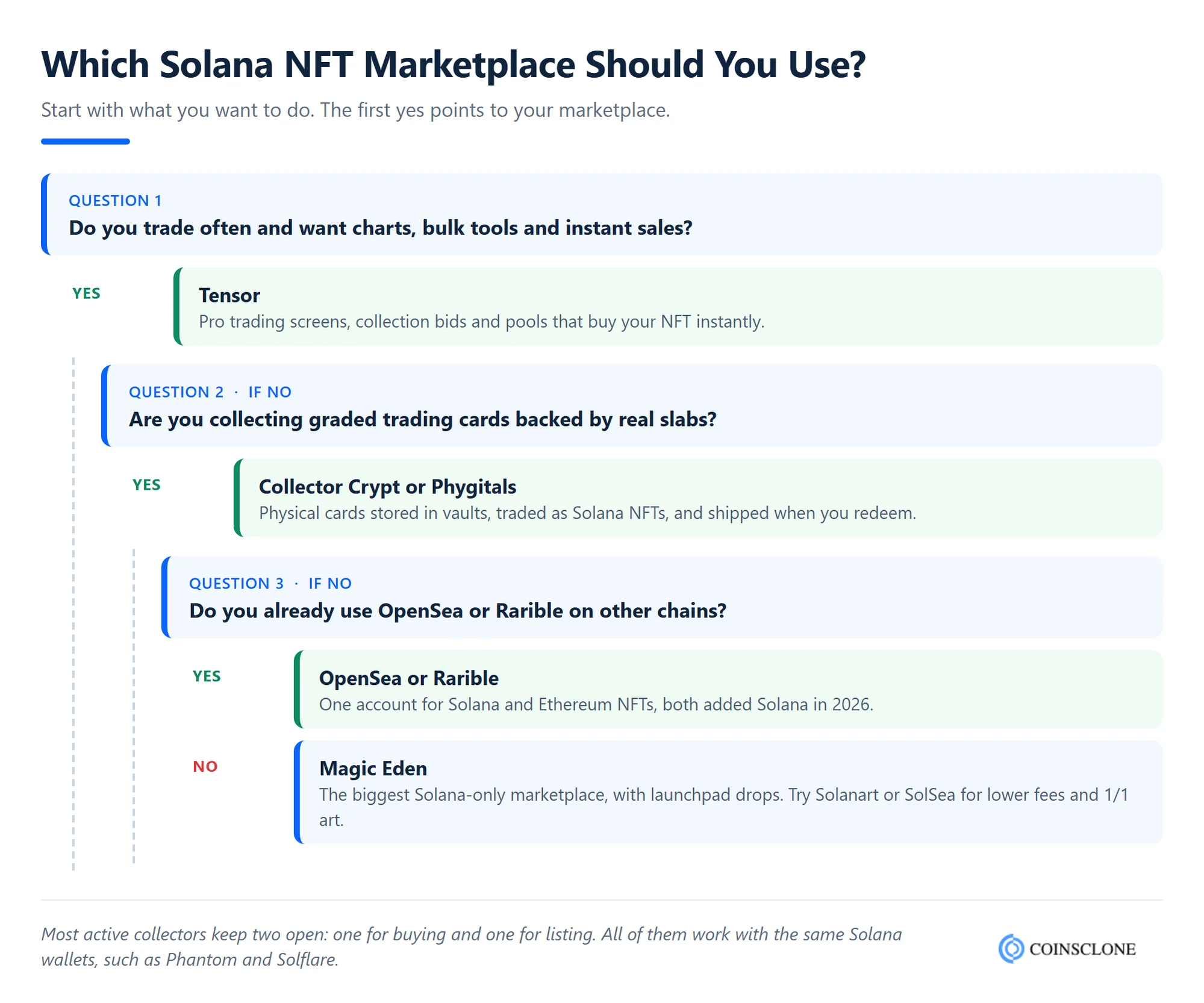
Each marketplace below was checked as live in September 2026. They are ordered by how much Solana NFT trading they handle, with specialist platforms after the big three.
| Marketplace | Best for | Standout feature |
| Magic Eden | Most collectors | Largest Solana-only catalogue and launchpad |
| Tensor | Active traders | Pro charts, bulk tools and instant-sell pools |
| OpenSea | Multi-chain users | Solana NFTs next to Ethereum and 25+ other chains |
| Rarible | Creators who want royalties | Royalty enforcement on Solana |
| Collector Crypt | Trading card collectors | Graded cards stored in vaults, traded as NFTs |
| Phygitals | Card pack buyers | Digital packs of real graded cards |
| Solanart | Low-fee trading | Editable fees and NFT loans |
| SolSea | 1/1 art and licensing | Licences embedded in each NFT |
1. Magic Eden
Magic Eden is the largest NFT marketplace built for Solana. It launched in 2021 and grew by making buying, selling and minting simple for everyday collectors. Its launchpad runs curated drops, so many new Solana collections start here.
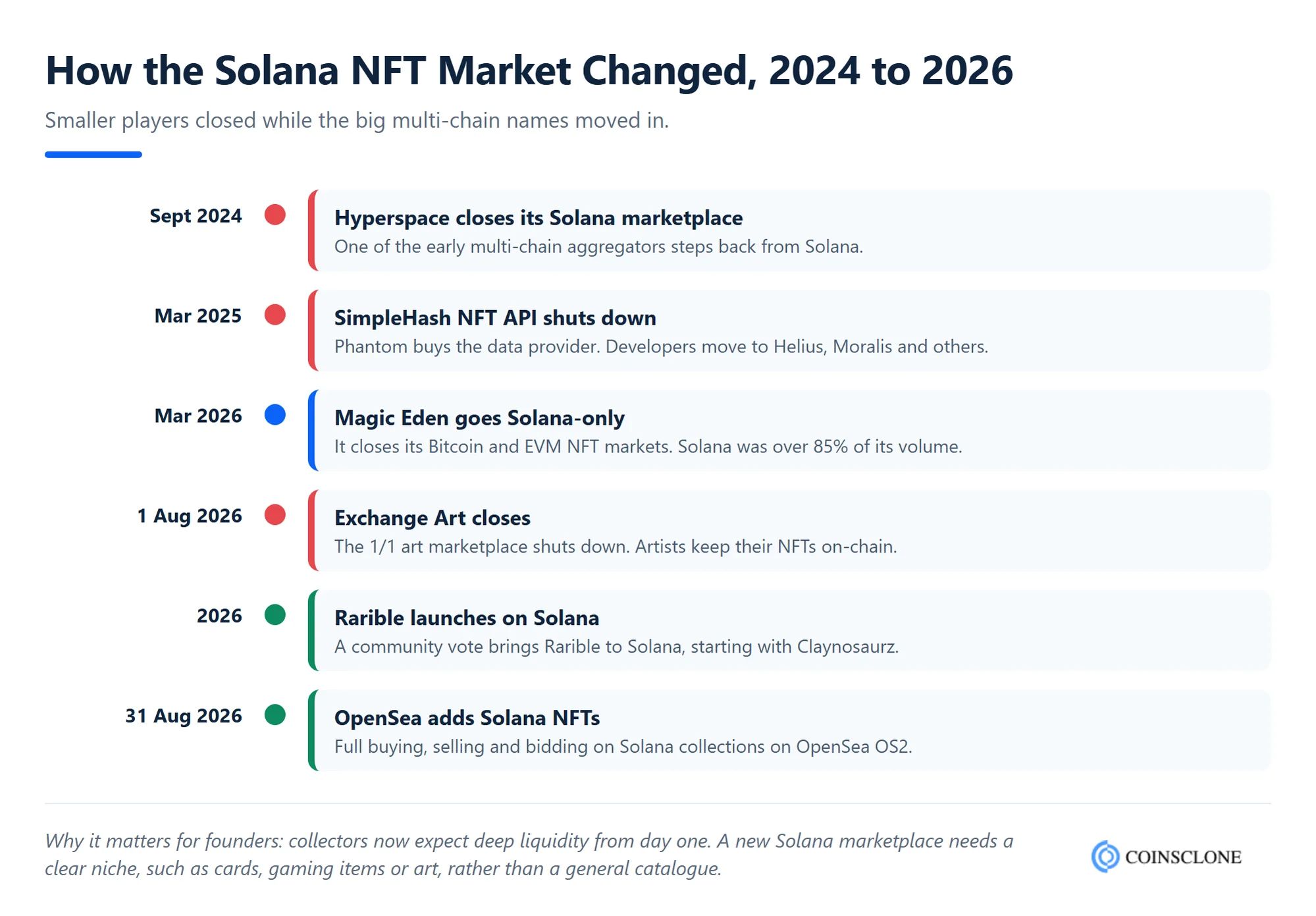
In February 2026 Magic Eden announced it would close its Bitcoin and EVM NFT markets and its multi-chain wallet. Solana made up more than 85% of its volume, so the company went back to its roots. Non-Solana trading ended on 9 March 2026.
Key Features
- Launchpad: curated NFT drops with support from listing to launch.
- Creator tools: royalty settings and collection management.
- Solana focus: every product now centres on Solana collections.
- Simple interface: easy for first-time collectors to find, buy and list.
Launch your NFT Marketplace similar to Magic Eden with the Magic Eden Clone Script.
2. Tensor
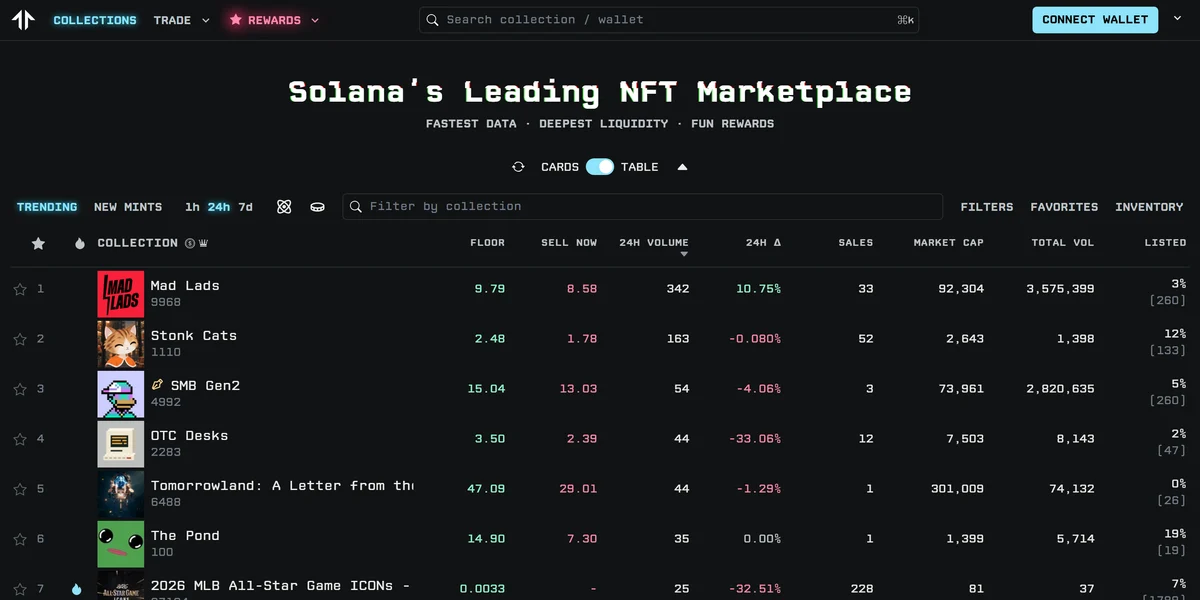
Tensor is a Solana NFT marketplace built for traders who buy and sell often. It shows live price charts, order depth and sales data for each collection. Traders can place collection-wide bids and use pools that buy an NFT the moment someone lists it, which makes selling fast.
Tensor and Magic Eden have traded the lead back and forth for two years. Tensor tends to win on active wallets, while Magic Eden wins on casual buyers.
Key Features
- Pro trading screen: real-time charts, floor prices and order book views.
- Bulk tools: buy or list many NFTs at once.
- Instant sell: sell straight into bids or pools without waiting for a buyer.
- Data first: rarity, holder and sales stats on every collection.
3. OpenSea
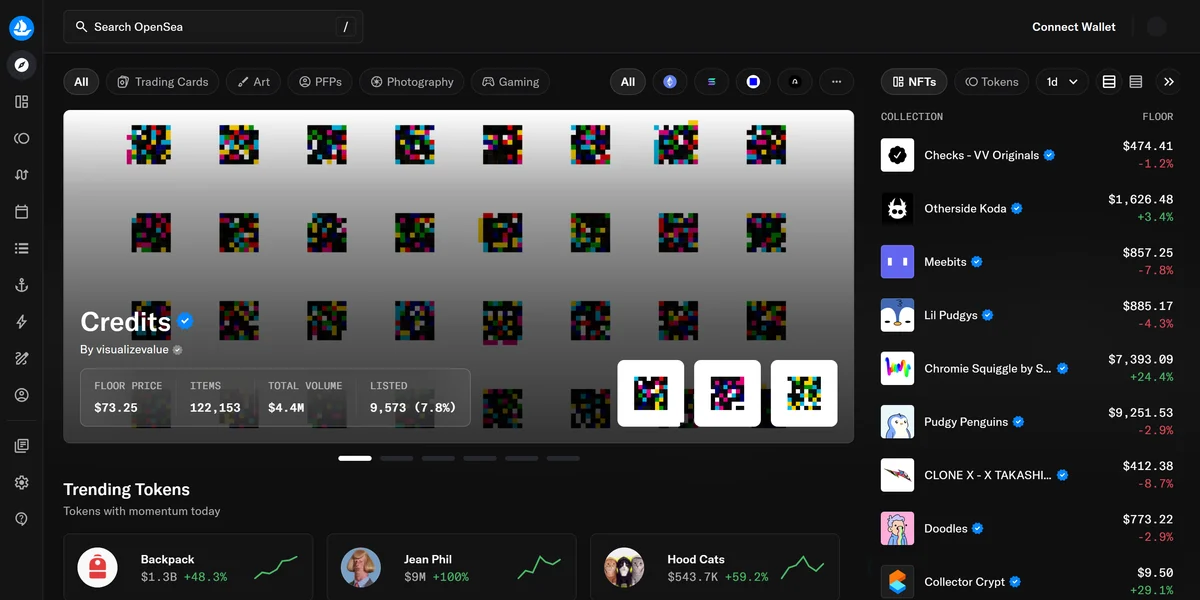
OpenSea is the best-known NFT marketplace in the world, built first on Ethereum. After trying Solana in 2022 and dropping it, OpenSea added full Solana NFT trading to its OS2 platform on 31 August 2026. Collectors can now buy, sell and bid on Solana collections such as Mad Lads and Claynosaurz next to NFTs from more than 25 other chains.
Key Features
- Multi-chain: Solana NFTs and tokens in the same account as Ethereum ones.
- Huge audience: the largest group of NFT buyers of any marketplace.
- Flexible listings: fixed price, offers and auctions.
- Wallet support: works with Phantom and other popular Solana wallets.
Launch your NFT Marketplace similar to OpenSea with the OpenSea Clone Script.
4. Rarible
Rarible is a multi-chain NFT marketplace and protocol owned by its community. After a governance vote by RARI holders, Rarible launched on Solana in 2026, starting with Claynosaurz. Solana now sits next to Ethereum, Base and MegaETH on the site, with its own Explore, Mint and Gacha pages.
Its main selling point for Solana creators is royalty enforcement, which makes sure artists are paid on resales.
Key Features
- Royalty enforcement: creators earn on secondary sales.
- Solana pages: separate Explore, Mint and Gacha sections for Solana.
- Community owned: RARI holders vote on big decisions.
- Custom storefronts: projects can build branded marketplaces on Rarible.
Launch your NFT Marketplace similar to Rarible with the Rarible Clone Script.
5. Collector Crypt
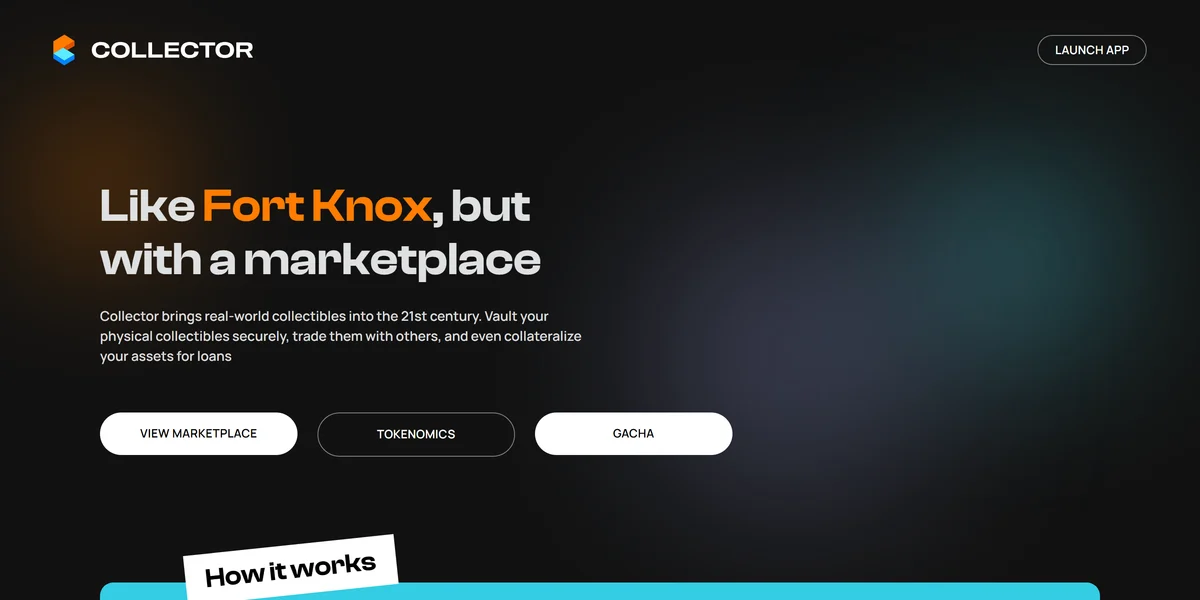
Collector Crypt is a Solana marketplace for real trading cards. Owners send graded cards to insured vaults run by names like PSA, and each card becomes an NFT that can be traded in seconds. You can also borrow against a card or ask for the physical card to be shipped.
Tokenized cards became one of the busiest corners of Solana NFTs in 2025 and 2026, which is why OpenSea named Collector Crypt among its launch collections.
Key Features
- Vaulted cards: real graded cards held in insured storage.
- Fast trading: swap cards without shipping them each time.
- Loans: use a card as collateral.
- Gacha packs: open random packs of real cards.
6. Phygitals
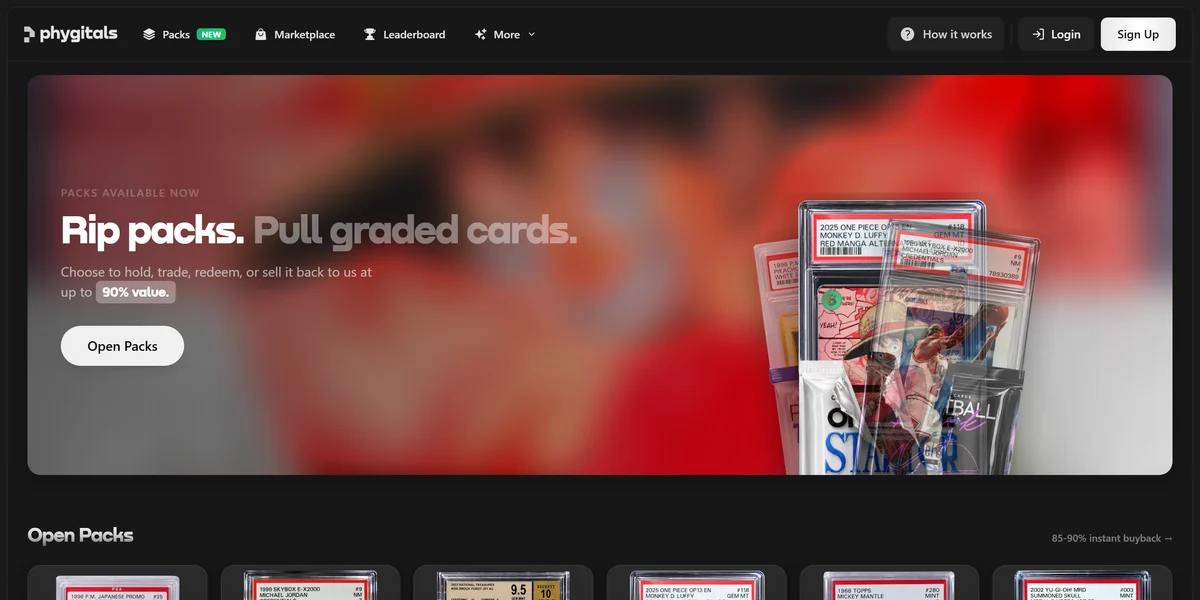
Phygitals sells digital packs that contain real graded cards, from Pokémon to sports and One Piece. Each pull is a card vaulted with graders such as PSA or Fanatics. You can hold it, trade it on the marketplace, ship it home, or sell it back for up to 90% of its value.
Key Features
- Pack opening: provably fair pulls with public odds.
- Instant buyback: sell a card back for 85% to 90% of its value.
- Marketplace: trade pulled cards with other collectors.
- Redemption: ship the physical slab worldwide.
7. Solanart
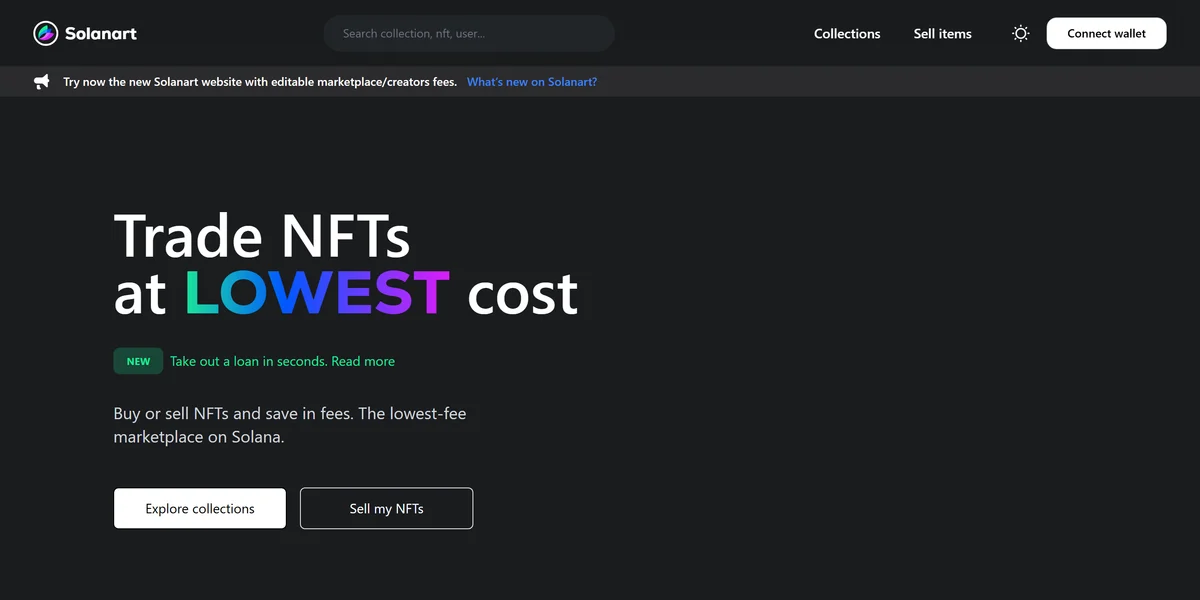
Solanart was the first NFT marketplace on Solana, and it is still running. Today it competes on price. It calls itself the lowest-fee marketplace on Solana and lets collections set their own marketplace and creator fees. It also offers quick loans against NFTs and on-chain chat between buyers and sellers.
Key Features
- Low fees: editable marketplace and creator fees.
- NFT loans: borrow against NFTs in seconds.
- Launchpad: tools to launch a new collection.
- On-chain chat: message buyers and sellers directly.
Launch your NFT Marketplace similar to Solanart with the Solanart Clone Script.
8. SolSea
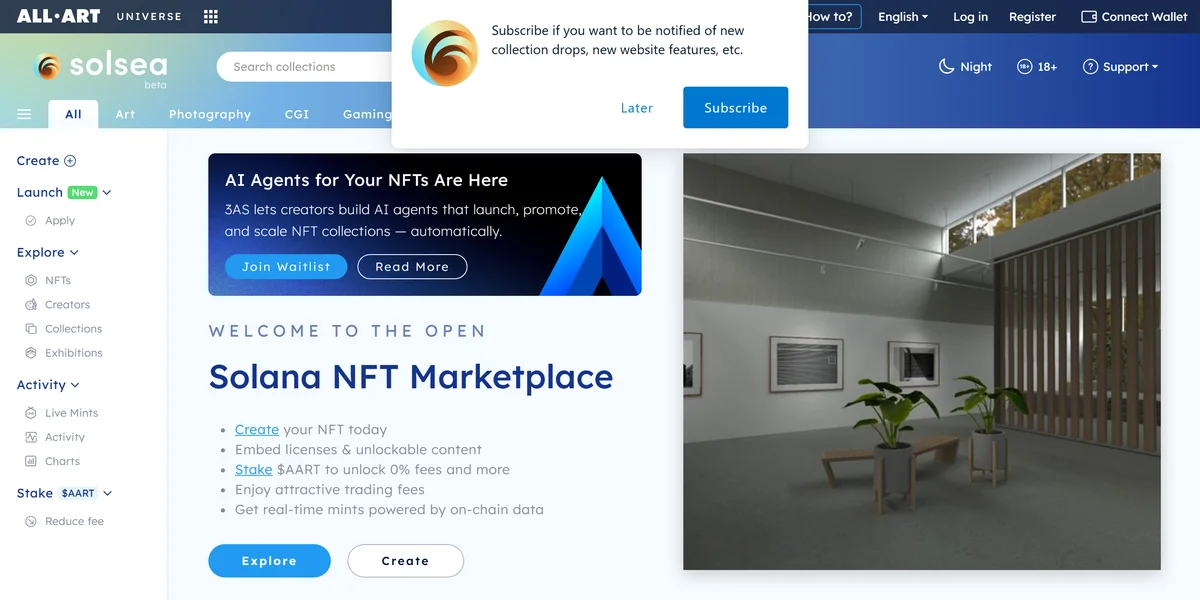
SolSea is an open Solana NFT marketplace from the All.Art team. Its big idea is licensing: creators can embed a copyright licence and unlockable content in each NFT, so buyers know exactly what rights they get. Holders who stake the AART token can trade with 0% fees.
Key Features
- Embedded licences: usage rights travel with the NFT.
- Unlockable content: extras only the owner can see.
- Zero-fee option: stake AART to cut trading fees to 0%.
- Direct minting: create NFTs without another tool.
Launch your NFT Marketplace similar to SolSea with the SolSea Clone Script.
Solana NFT Marketplaces That Closed or Changed
Older lists still name platforms that no longer work the way they did. Check before you move NFTs anywhere:
- Exchange Art closed on 1 August 2026 after a long slump in on-chain art sales. The NFTs stay on Solana and can be moved to any other marketplace.
- Fractal now runs a games portal rather than an NFT marketplace.
- Hyperspace shut its Solana marketplace in September 2024.
- Magic Eden still trades Solana NFTs, but its Bitcoin and EVM markets are gone.
How to Buy an NFT on Solana
Buying a Solana NFT takes a few minutes:
- Get a Solana wallet: install Phantom, Solflare or Backpack and save the recovery phrase offline.
- Add SOL: buy SOL on an exchange and send it to your wallet address. Keep a little extra for fees.
- Connect to a marketplace: open Magic Eden, Tensor or another marketplace above and connect your wallet.
- Check the collection: look for the verified badge, the floor price and recent sales.
- Buy or bid: buy at the listed price, or place a lower offer and wait.
- Approve in your wallet: the NFT arrives in your wallet within seconds.
Solana fees are a fraction of a cent for most trades, so small purchases make sense here in a way they rarely do on Ethereum.
Is There a Solana DEX for Trading NFTs?
Not quite. Solana DEXs such as Jupiter and Raydium trade tokens, not NFTs. But Tensor works in a similar way for NFTs: traders add SOL to pools that buy and sell NFTs at set prices, so there is always someone to trade with. That is the closest thing to a DEX for Solana NFTs.
Many Solana wallets now combine both worlds. Phantom, Solflare and Backpack let you swap tokens and view and send your NFTs in one app, then connect to any marketplace to trade.
Solana NFT Data and API Providers
Developers, analysts and traders who need Solana NFT data use a different set of tools from collectors:
- Helius DAS API: one interface for NFT metadata, owners, collections and compressed NFTs on Solana. It powers many large Solana apps.
- Magic Eden and Tensor APIs: listings, sales and floor prices straight from the two largest marketplaces.
- Moralis: multi-chain NFT APIs that cover Solana and Ethereum together, useful for cross-chain apps.
- Bitquery: historical Solana NFT trades and transfers for analytics.
SimpleHash, once a popular cross-chain NFT API, shut down in March 2025 after Phantom bought it. If an older guide recommends it, pick one of the tools above instead.
Why Build a Solana NFT Marketplace in 2026?
Solana suits NFT marketplaces for practical reasons, not hype. For startups, the question is less about whether to launch and more about which network can grow with their users.
High Throughput and Scalability
Solana handles thousands of transactions a second. Minting, bidding and transfers can all run at once, so a busy drop does not slow the whole platform down.
Low Transaction Costs
Fees stay low even when the network is busy. Creators can mint and list often, collectors can trade small items, and founders can charge competitive fees and still earn.
Fast and Smooth User Experience
Trades confirm in seconds. That makes an NFT marketplace feel like a normal website, which matters when you want people new to crypto to stay.
Compressed NFTs for Large Collections
Solana’s compressed NFTs store data in a way that cuts minting costs sharply. This makes very large collections practical, such as game items, tickets or loyalty rewards.
Secure, Smart Contract-Driven Design
Smart contracts handle royalty splits, escrow and ownership transfer. No middleman is needed, and every trade follows the same rules.
Strong Liquidity and Connected Tools
Solana wallets, DeFi apps and aggregators all talk to each other. A new marketplace can plug into this and reach buyers from day one.
Key Takeaways for Startups Building a Solana NFT Marketplace
The winners and the closures above teach clear lessons. Founders should think about position, users and long-term growth, not just technology.
Pick a Niche
Exchange Art’s closure shows how hard a general or art-only marketplace can be. The fastest growth in 2026 came from niches like trading cards. Pick one segment, such as gaming items or collectibles, and build the best tools for it.
Put Speed and Ease First
Users expect trades to feel instant and simple. A clean interface with clear steps keeps new users coming back.
Plan for Liquidity From Day One
Tensor proved that pools and bids keep a market alive. Plan partnerships, rewards and aggregator links so there is always someone to trade with.
Add Other Chains Only When Users Ask
Magic Eden’s retreat to Solana is a warning. Start on Solana, grow a strong base, and add other networks only when there is real demand.
Choose Your Revenue Model Early
Look at different NFT marketplace revenue models, such as trading fees, featured listings and launchpad services. Keep fees fair enough that users stay.
Make Security a Feature
Audited smart contracts, verified creators and clear policies build trust, and trust keeps users.
Conclusion
Solana is now a proven home for NFT trading, but the market rewards focus. The big three, Magic Eden, Tensor and OpenSea, own general trading, while newer players win in niches like tokenized cards. For founders, success comes from a clear niche, deep liquidity and a smooth experience.
Coinsclone is an NFT marketplace development company that helps startups turn that plan into a working platform. We build custom Solana NFT marketplaces, and ready-made NFT marketplace clone scripts when speed matters. You get guidance from business plan to launch. For a wider view of the market, see our list of the best NFT marketplaces across all chains.
Launch Your Platform on Leading Solana NFT Marketplaces
NFT Marketplace Development — fast, low-cost, and scalable.
- Solana-Powered: Build on top of Solana like Magic Eden, Solanart, and Solsea.
- High-Speed Transactions: Benefit from lightning-fast processing and minimal fees.
- Custom Ecosystem: Fully branded platform, with your NFTs, tokenomics, and UI.
- Creator & Collector Ready: Built-in royalty, auctions, and advanced trading features.
See a free branded demo of your NFT marketplace in 48 hours — before you invest a cent.
Book a Free Demo to explore how Solana NFT Marketplaces can accelerate your platform launch in just 8–12 weeks.
Frequently Asked Questions
What is the platform where users can trade NFTs on the Solana blockchain?
Magic Eden and Tensor are the two main platforms for trading NFTs on Solana. Magic Eden suits most collectors, while Tensor suits active traders. OpenSea and Rarible also support Solana NFTs as of 2026.
Which is the best Solana NFT marketplace?
Magic Eden is the best all-round choice for most collectors. Tensor is best for frequent traders, and Collector Crypt is best for tokenized trading cards.
Which platforms offer cross-chain NFT trading that includes Solana?
OpenSea and Rarible both let you trade Solana NFTs alongside Ethereum and other chains. Magic Eden no longer does, because it closed its Bitcoin and EVM markets in March 2026.
Can I buy an NFT with SOL?
Yes. Every Solana NFT marketplace prices NFTs in SOL. You need SOL in a Solana wallet such as Phantom to pay for the NFT and the small network fee.
What are the best data providers for Solana NFTs?
Helius, through its DAS API, is the most widely used source of Solana NFT data. Magic Eden and Tensor offer marketplace APIs for listings and sales, while Moralis and Bitquery cover cross-chain and historical data.
Are there Solana wallets with built-in NFT access?
Yes. Phantom, Solflare and Backpack show your NFTs, let you send them and swap tokens, and connect to any Solana marketplace in one tap.