
This guide explains NFT ticketing marketplace development from first idea to launch. You will see how an NFT ticket works, the ticket problems it fixes, where the big names stand in 2026, the features fans and hosts expect, the new resale laws, and what a build costs. Key facts are dated and linked, so you can check them yourself.
The short story: NFT tickets did not replace normal tickets, and the hype of 2021 is gone. But the core idea still works. A ticket that carries its own rules can stop fakes, cap resale prices and pay the host each time a ticket is sold again. With new laws now capping resale prices, that matters more than ever.
In this guide:
- How an NFT ticket moves from mint to check-in, step by step
- The 2026 status of Ticketmaster’s NFT work, OPEN (formerly GET Protocol), GUTS Tickets and YellowHeart
- A simple test to pick your model: add-on NFTs, digital twin tickets or a full marketplace
- Features, new resale rules, blockchain choice, cost ranges and build time
- How Coinsclone builds an NFT ticketing marketplace, step by step
Build a Secure NFT Ticketing Marketplace Fast
NFT Ticketing Marketplace Development — create your event ticketing platform with blockchain security.
- Smart Contract Automation: Issue and validate tickets instantly.
- Secondary Market Support: Enable safe resale and trading of tickets.
- Access Control Features: Use QR codes and biometric validation.
- Revenue Streams: Earn from ticket sales, royalties, and subscriptions.
See a free branded demo of your NFT marketplace in 48 hours — before you invest a cent.
Book a Free Demo to discover how NFT Ticketing Marketplace Development can help you launch in just 8–12 weeks.
What Is NFT Ticketing Marketplace Development?
NFT ticketing marketplace development is the process of building a platform where event tickets are issued, bought, sold and traded as NFTs. The events could be concerts, sports games, talks, festivals, comedy shows or online events. Each ticket is a one-of-a-kind token on a blockchain, so nobody can copy it, and every change of owner is recorded.
A smart contract runs the ticket. It issues tickets, takes payments, handles refunds and enforces resale rules without manual work. So the hard part of the build is not the token itself. Instead, it is getting the rules, the payments, the check-in app and the legal side right, while keeping the buying flow as simple as a normal ticket site.
How an NFT Ticket Works
Here is the full life of one NFT ticket. Notice that the event host’s rules stay attached to the ticket at every step, even after the first sale.
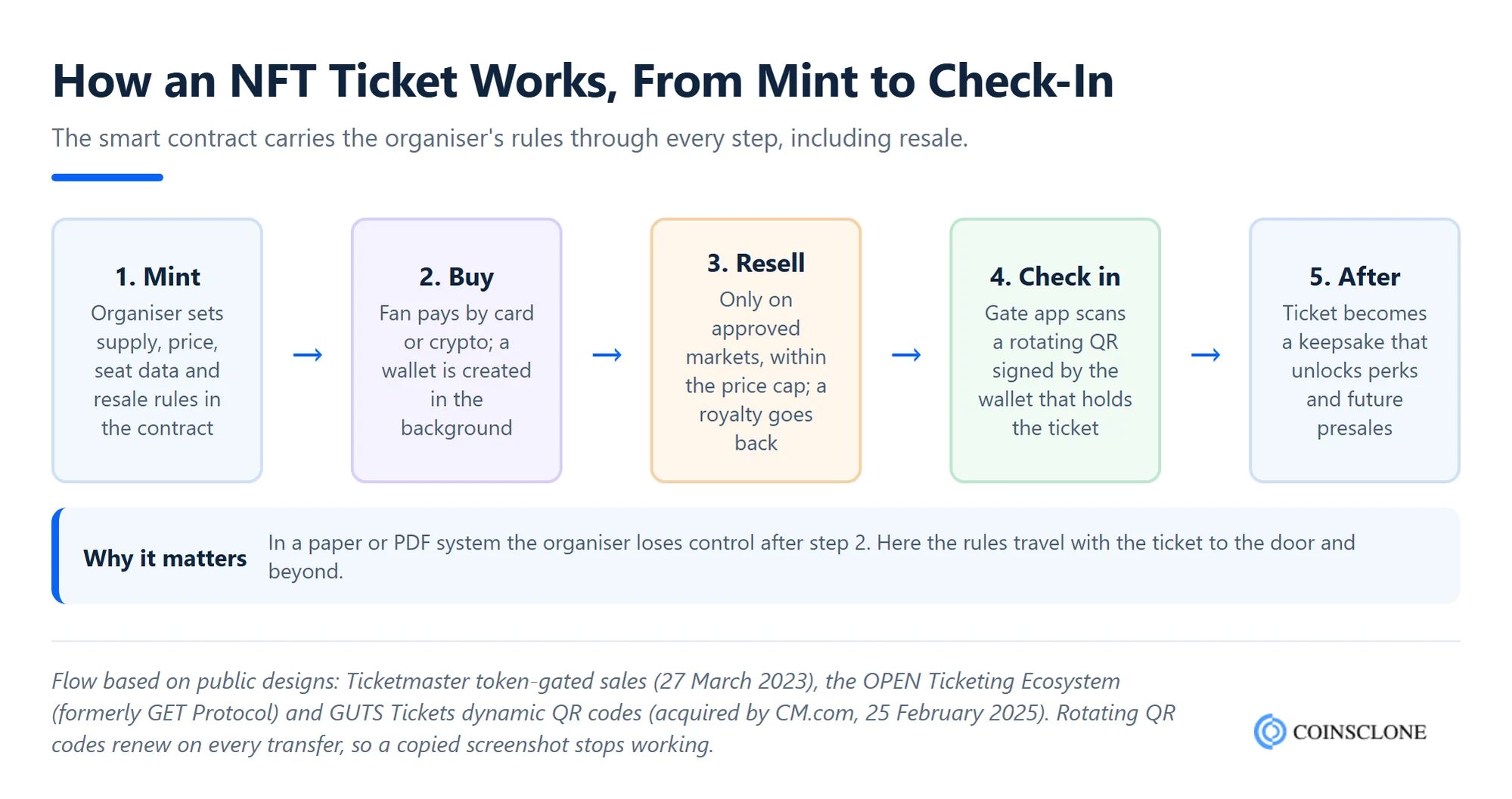
Mint: The host creates the tickets in a smart contract with the supply, seat data, price and resale rules.
Buy: The fan pays by card or crypto. Good platforms create a wallet in the background, so fans do not need to know anything about crypto.
Resell: If the fan cannot attend, they resell inside approved markets. The contract enforces the price cap and sends a royalty back to the host.
Check in: At the gate, staff scan a QR code that changes over time and is tied to the wallet holding the ticket. A screenshot of an old code will not work.
After the event: The ticket stays in the wallet as a keepsake. It can unlock perks, discounts or early access to the next show.
The Ticketing Problems NFT Tickets Fix
Event ticketing has three old problems, and they cost fans and hosts real money.
Fake and duplicate tickets: A PDF or screenshot can be sold many times. Fans only find out at the gate.
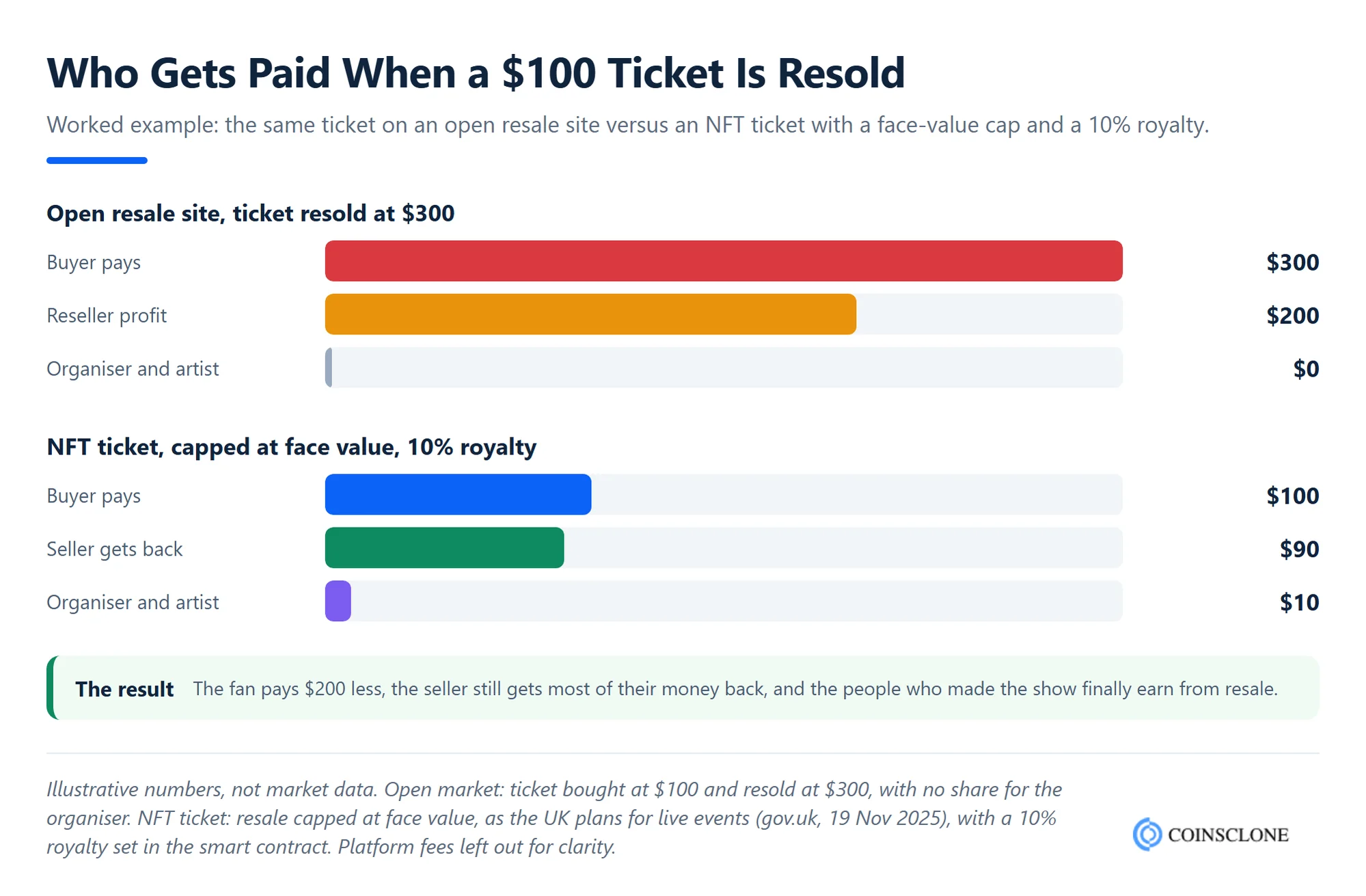
Scalping: Bots buy tickets in seconds and resell them at several times the price. The fan pays more, and the host and artist get nothing from the markup.
No data after the first sale: Once a ticket is resold on another site, the host often does not know who is coming.
NFT tickets answer all three. The blockchain proves which ticket is real and who holds it. The smart contract can cap the resale price and pay the host a cut each time it is sold again. And because every transfer is on record, the host always knows who holds each ticket.
The worked example below shows what this means for one ticket.
NFT Ticketing in 2026: Where the Big Names Stand
Before you build, it helps to know what happened to the early players. Here is their status as of 16 October 2026.
Ticketmaster: Ticketmaster never turned its main tickets into NFTs. Instead, it uses NFTs as add-ons. In August 2022 it said it had minted over 5 million NFTs on Flow through partners, including keepsakes for more than 70,000 Super Bowl LVI ticket holders. Then, on 27 March 2023, it launched token-gated sales, starting with Avenged Sevenfold. Here, fans who hold a set NFT in a wallet like MetaMask unlock presales and better seats.
The size of the prize: Normal ticketing is still huge. Live Nation, Ticketmaster’s parent, sold 90.1 million fee-bearing tickets in the second quarter of 2026, worth $10.4 billion, on total revenue of $7.7 billion. Even a small slice of that market is a large business.
OPEN (once GET Protocol): The old GET Protocol site now points to the OPEN Ticketing Ecosystem, the name it took in March 2024. OPEN says its system has issued millions of onchain tickets since 2016. It runs on Base, Polygon, Solana, Tezos and Sophon, and its OPN token powers each ticket.
GUTS Tickets: GUTS was the Dutch ticket seller built on that same technology. On 25 February 2025, CM.com announced it had bought GUTS Tickets. Its blockchain tickets use QR codes that renew with every transfer, so a resold or copied code stops working. The founders kept working on OPEN.
YellowHeart: YellowHeart sold NFT tickets and NFT albums from 2021, including shows at the MGM Grand in 2022. Today its website no longer loads (checked 16 October 2026), and we found no product news since 2022. Treat it as inactive.
The wider NFT market: NFT sales fell to $5.63 billion in 2025, down 37% from $8.9 billion in 2024, according to CryptoSlam data. Art and other NFT sales cooled, but a ticket is not like art. It has a real use, so its value does not depend on hype.
The lesson: The winners hide the crypto. Fans see a normal app, pay by card and show a QR code. The blockchain works in the background to stop fakes and control resale.
Which NFT Ticketing Model Fits Your Events?
There is more than one way to use NFTs in ticketing. So before you plan features, pick the model that fits your rights and your fans.
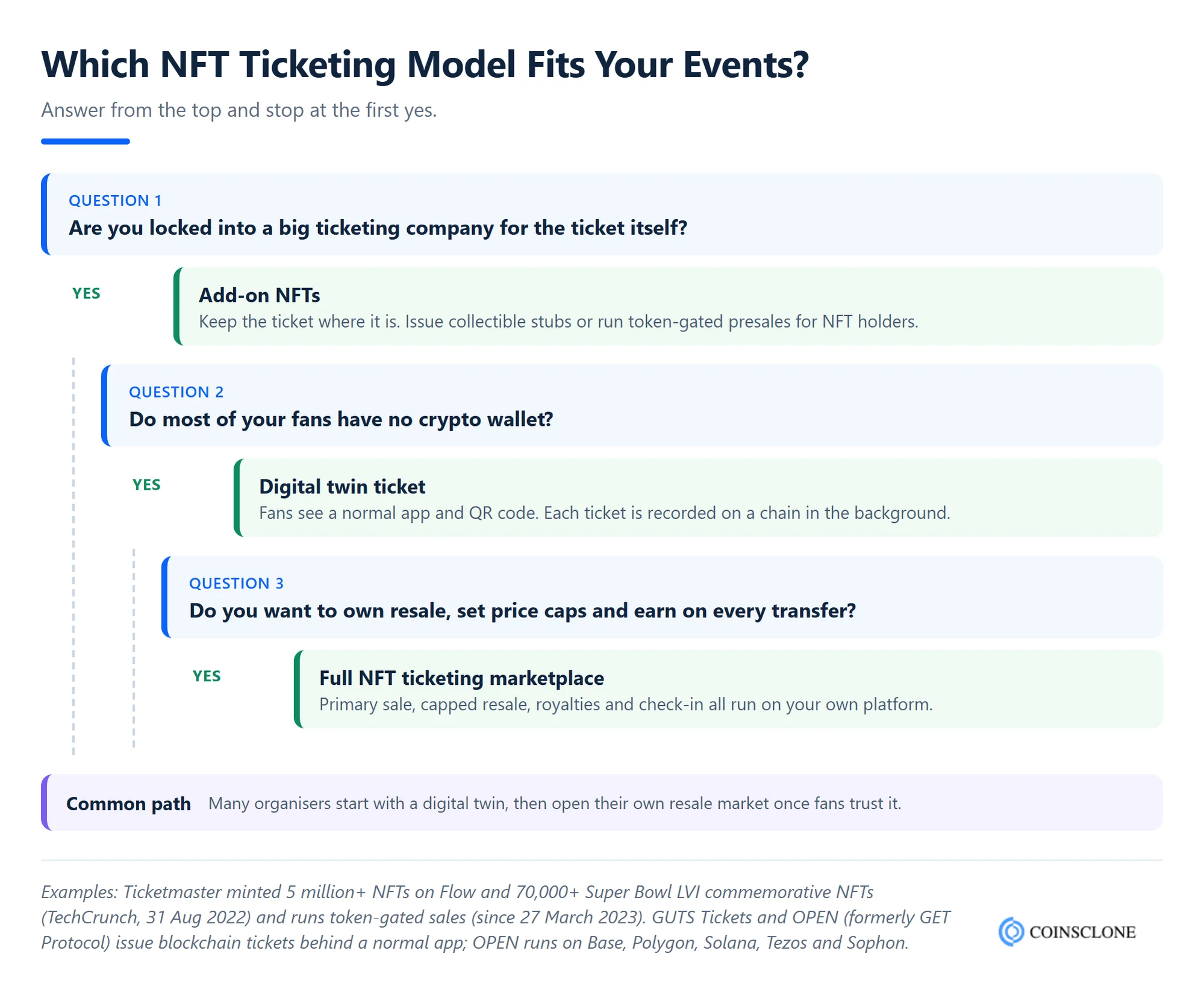
Add-on NFTs: You keep your current ticket seller and add keepsake NFTs or token-gated presales. This is the lowest risk, and it works well as an NFT loyalty program.
Digital twin tickets: Each normal ticket has a twin record on a blockchain. Fans see nothing new, but you get proof of each ticket and control over resale. GUTS and OPEN work this way.
Full NFT ticketing marketplace: You run the first sale, the resale market, royalties and check-in on your own site. This takes the most work, but you own the fan data and earn on every resale.
Potential Users of the NFT Ticketing Marketplace Platform
NFT ticketing marketplaces serve a wide base of users. Each group needs something different, so let us take a closer look.
Event Organizers
Event organizers run concerts, sports games, talks, festivals and more. They create NFT tickets with the time, venue, seat, entry rules and resale terms. NFT tickets can also prove who attended, offer perks and give access to special services.
Token Holders
Token holders are the fans who buy NFT tickets. They may be fans, collectors or long-time backers. The NFT ticketing system lets them buy tickets, keep them as collectibles and resell them within the host’s rules.
Artists and Performers
Artists and stage acts use NFT tickets to reach their fans directly. They may be sports stars, singers, comics or stage acts. With NFT tickets, they can sell exclusive passes to their fans and earn a share when tickets are resold. Sports teams can go further with an NFT sports marketplace for cards and match moments.
Also read*:* How can NFTs in music add strength to musicians?
Secondary Markets
Secondary markets include resale sites, PR firms, fan groups and brand partners. They help promote ticket sales and bring in new buyers. This also covers brand promotions, business events, reward programs and fan clubs.
As you can see, each user group has a different goal. So your NFT ticketing marketplace has to serve all of them at once. Let us look at the features that make this possible.
Features of the NFT Ticketing Marketplace Platform
Here are the features an NFT ticketing marketplace needs to win both hosts and fans.
Blockchain-Based Security
A blockchain is a shared digital ledger that stores NFT tickets safely. Each ticket has one owner on record, so a fake or duplicate ticket is easy to spot and reject.
Automated Ticket Issuance
A smart contract issues tickets for each event on its own. It can be set up to deliver tickets with different seats, prices and perks for each event. A well-tested NFT smart contract is the core of the whole platform.
Resale Rules Engine
This is the feature that sets NFT tickets apart. The host sets the rules once: a price cap, a royalty on each resale, a limit on how many times a ticket can move, and a cut-off time before the event. The contract then enforces them on every sale.
Card Payments and Easy Wallets
Most fans do not own a crypto wallet. So the site should accept card payments and create a wallet for each fan in the background, with a normal email login. Fans who already use crypto can still connect their own wallet.
Enhanced User Experience
The marketplace should feel like any good ticket site. Fans should be able to search events, pick seats, share tickets with friends and family, and get reminders before the show.
Transparent Information
Each NFT ticket should show clear details about the event, its perks and its entry rules. Because the blockchain record cannot be changed, fans can trust what they see.
Ticket Access and Validation
A QR code that changes every few seconds, tied to the wallet that holds the ticket, makes the gate check fast and safe. The scanner app should also work offline for a short time, in case the venue’s internet is weak.
Links to Your Current Tools
Many hosts already use a box office, a CRM or a payment provider. Good platforms connect to these through APIs, so the NFT layer works alongside current tools instead of replacing them.
Built for Big Sale Days
A popular show can bring hundreds of thousands of fans at the same minute. The platform needs a queue, bot checks and a chain with low fees and fast confirmations, so minting does not slow down at peak times.
Analytics Dashboard
Hosts need live data on sales, resales, royalties and check-ins. This helps them price future shows and reward their most loyal fans.
Community Support
Community support keeps your site up to date based on user reviews and feedback. Social sharing and help forums build trust in your NFT ticketing marketplace.
Legal and Compliance
KYC and AML checks help the site meet legal rules where needed. Along with that, build clear refund, resale and cancel rules into both the terms and the contract. The next section covers the new laws in more detail.
These are the key features to include. Together, they keep the site fast, safe and easy to use. Coinsclone’s team helps you pick the right mix for your events and budget.
Resale Rules and Laws to Plan For in 2026
Ticket resale is now a hot topic for lawmakers. This is good news for NFT ticketing, because a smart contract can enforce the rules automatically.
UK resale price cap: On 19 November 2025, the UK said it will make it illegal to resell live event tickets above their first price. Only fees you cannot avoid, such as service charges, may be added. Resale platform fees will also be capped. The plan needs a new law, and no start date has been set yet.
US all-in pricing: Since 12 May 2025, the FTC Rule on Unfair or Deceptive Fees requires live event ticket sellers to show the total price, including fees, up front. Your checkout must show the full price from the first screen.
Know your customer: If fans can cash out resale money or hold crypto on your site, you may need KYC and AML checks. The rules differ by country, so check them before launch.
Consumer rights: Refunds for cancelled events must work the same way as for normal tickets. Build the refund flow into the contract, not as an afterthought.
The key point is simple. Build your resale rules as settings, not fixed code. Then, when a country changes its law, you update a setting instead of rebuilding the site.
Which Blockchain Should You Use?
The right blockchain keeps fees low and check-in fast. Here is what to look for.
Low fees: Fans should never see a gas fee on a ticket. Layer 2 networks such as Base and sidechains such as Polygon keep the cost of each mint very small, so the site can pay it.
Speed: Big sale days need fast checks. Solana and Polygon are common picks for high volume. OPEN, for example, runs on Base, Polygon, Solana, Tezos and Sophon.
Wallet support: Pick a chain that works with easy email wallets, so fans can sign up in seconds.
Proven use: Ticketmaster used Flow for keepsake NFTs and Ethereum NFTs for token-gated sales. A chain with real event use has fewer surprises.
Many teams build on one chain first and add more later. Our guide to NFT marketplace development cost explains how each extra chain affects the budget.
Business Benefits of NFT Ticketing Marketplace Development
Here is why NFT ticketing makes business sense in 2026.
Room to Grow: Ticketing is a large market, and new resale laws push hosts toward tools that can enforce price caps. NFT tickets do this by design, which gives your site a clear reason to exist.
Many Ways to Earn: An NFT ticket business earns in many ways, much like the NFT Marketplace revenue model. Here are the main ways to earn:
- Ticket sales
- Transaction fees
- Commissions
- A fee on each resold ticket, plus reward plans
- Subscription services
- Partnerships and sponsorships
- Earnings from collectible trading
Branding and Community Benefits: A strong base of fans, hosts and partners builds your name. Over time, it also brings more business partners to your site.
Long-Term Value: NFT tickets turn a one-time sale into a lasting link with each fan. Each ticket in a wallet is a direct line for future offers, presales and rewards.
Value-Added Services: The platform can also sell merchandise and promote partner events. As a result, you can earn steady income from partners.
Ownership and Security: NFT tickets prove who owns each ticket and that it is real. This builds trust, protects your brand and keeps you ahead of other ticket sellers.
These benefits are real, but they depend on a good build. A clear development plan is the best way to get them.
How Much Does NFT Ticketing Marketplace Development Cost?
There is no single price. The cost depends on your model, your features, the number of chains and how much legal and security work you need. Based on published 2026 agency cost guides, and in line with our other NFT marketplace guides, here are typical market ranges:
| Build type | Typical cost range | What you get |
| White label NFT marketplace | $10,000 to $30,000 | Rebranded platform, standard minting and resale, one chain |
| Custom MVP | $20,000 to $45,000 | Your own design, resale rules, card payments, check-in app |
| Mid-tier platform | $40,000 to $80,000 | Several event types, dashboards, box office and CRM links |
| Enterprise platform | $80,000 to $150,000 or more | Multi-chain, large on-sales, advanced analytics, full audit |
Ticketing builds often sit in the middle of each range. They add a gate scanner app, a rotating QR system and fiat payments that a plain NFT store does not need. Also plan for running costs such as hosting, wallet services, payment fees and a smart contract audit.
Build time: Coinsclone’s NFT marketplace development page lists 4 to 6 weeks for a white label marketplace and 9 to 13 weeks for a standard build. The ticketing parts, such as the check-in app and resale rules, add time to both.
How to Develop an NFT Ticketing Marketplace with Coinsclone?
Coinsclone builds your NFT ticketing marketplace in six clear steps. Building since 2018, we have delivered 350+ platforms for 200+ clients across 20 industries.
Ideation
In this phase, our business team gathers all your needs. This covers the goal of the project, your events, budget, time frame and more. Then we list what is needed and prepare a plan.
Preparing a Roadmap
Based on your needs, we prepare an outline for the design and build. This covers the tech stack, the blockchain, the ticketing model, the features, the resale rules and the security plan.
Designing
Design starts once you approve the plan. This covers the user screens, the ticket design, the APIs and the links to your other tools. We send the design to you for approval.
Development
This is the core of the build. Here we build the smart contracts, the minting flow, the resale market, the payment and wallet links, and the gate check-in app.
Testing
Once the build is ready, our test team checks the whole platform. This includes load tests for big on-sales, a security check of the smart contracts and fixing every bug we find.
Deployment
This is the final step. Our team launches the NFT ticketing marketplace on your chosen servers and blockchain, then supports you through your first events.
Transform your events with our cutting-edge NFT Ticketing Marketplace!
Unique Tickets. Verifiable assets. High Transparency. Get a Free Demo.
Summing Up
NFT ticket sales are no longer about hype. It is about fixing real problems: fake tickets, scalpers and lost resale income. The early players show that the model works best when the crypto stays in the background and the rules travel with the ticket. With new resale laws in the UK and all-in pricing in the US, a ticket that enforces its own rules is a strong business idea.
Success still depends on the right model, the right chain and a careful build. As a leading NFT Marketplace Development company, Coinsclone can guide you from the first idea to your first sold-out show. Talk to our experts about your NFT ticketing marketplace today.
Build a Secure NFT Ticketing Marketplace Fast
NFT Ticketing Marketplace Development — create your event ticketing platform with blockchain security.
- Smart Contract Automation: Issue and validate tickets instantly.
- Secondary Market Support: Enable safe resale and trading of tickets.
- Access Control Features: Use QR codes and biometric validation.
- Revenue Streams: Earn from ticket sales, royalties, and subscriptions.
See a free branded demo of your NFT marketplace in 48 hours — before you invest a cent.
Book a Free Demo to discover how NFT Ticketing Marketplace Development can help you launch in just 8–12 weeks.
Frequently Asked Questions
What is an NFT ticketing marketplace?
An NFT ticketing marketplace is a blockchain-based platform where event tickets are issued and managed as NFTs. These digital tickets prove who owns them and can be safely bought, sold or passed on through the blockchain.
How does an NFT ticketing marketplace work?
Event organizers mint tickets as NFTs and sell them through the marketplace. Each ticket is recorded on the blockchain. Fans buy, store and transfer tickets with digital wallets, often created for them in the background, and show a rotating QR code at the gate.
Can NFT tickets be transferred or resold?
Yes, NFT tickets can be transferred or resold, based on the rules set when they are created. The smart contract can cap the resale price, limit transfers and pay the host a royalty. Every change of owner is recorded on the blockchain.
How much does NFT ticketing marketplace development cost?
The cost depends on the site’s scope and how custom it is. Published 2026 agency cost guides put a white label NFT marketplace at about $10,000 to $30,000 and a custom MVP at $20,000 to $45,000. A mid-tier platform costs $40,000 to $80,000, and an enterprise build $80,000 to $150,000 or more.
How long does it take to develop an NFT ticketing marketplace?
Coinsclone’s published build times are 4 to 6 weeks for a white label NFT marketplace and 9 to 13 weeks for a standard build. Ticketing features such as a gate check-in app, resale rules and card payments add time to both.
Which blockchains are best for an NFT ticketing platform?
Pick a chain with low fees, fast confirmations and easy wallets. Polygon, Base and Solana are common choices. OPEN, for example, runs on Base, Polygon, Solana, Tezos and Sophon, while Ticketmaster used Flow for its keepsake NFTs.
Can an NFT ticketing platform integrate with existing ticketing or payment systems?
Yes. A digital twin setup links each normal ticket to an NFT through APIs, so hosts can keep their box office, CRM and card payment provider. Fans see a normal app, and the blockchain works in the background.
How does an NFT ticketing platform handle large-scale events?
It uses a virtual queue, bot checks and a low-fee chain that can mint many tickets per second. The platform should also pay gas for fans and load test the system before any big on-sale.