
This guide explains NFT fashion marketplace development in 2026: what the platform is, how a fashion NFT sale works, and the three ways to build one. You will see the features designers and buyers expect, the revenue model, the rules to check before launch, and what a build costs and how long it takes.
The fashion NFT market looks very different from the 2021 boom. Some famous projects closed or changed course, while brands moved toward NFTs that link to real clothes and prove a product is genuine. So this guide uses current facts, shows what the closures teach, and helps you pick a model that can last.
In this guide:
- What a fashion NFT platform is and the five kinds of fashion NFTs it can sell
- How a phygital sale works, with a worked example of who gets paid on the first sale and on resale
- Which fashion NFT model fits your brand, and what happened to RTFKT, The Fabricant and DRESSX
- The three build routes, with Coinsclone’s published delivery times and current market cost ranges
- The rules on rights, refunds and product passports to settle before you list a single item
Build a Trend-setting NFT Fashion Marketplace Platform
NFT Fashion Marketplace Development — empower designers to showcase and trade digital fashion assets.
- Virtual Wearables: Create and sell exclusive digital apparel for metaverse users.
- Brand Customization: Launch a marketplace styled around your unique brand.
- Web3 Monetization: Enable creators to earn through NFT sales and royalties.
- Secure Trading System: Facilitate safe, transparent NFT transactions globally.
See a free branded demo of your NFT marketplace in 48 hours — before you invest a cent.
Book a Free Demo to discover how NFT Fashion Marketplace Development can help you launch in just 8–12 weeks.
What Is NFT Fashion Marketplace Development?
NFT fashion marketplace development is the process of designing, building and launching a platform where fashion NFTs are created, minted, listed, bought, sold and traded on a blockchain. A fashion NFT can be an online outfit, a sneaker for an avatar, a token tied to a real garment, or a certificate that proves a handbag is genuine.
The platform is built for people in the fashion business: designers, brands, resale shops, stylists and their buyers. It lets them sell online goods, prove who owns each item, keep supply limited and pay creators again when items are resold. If you are new to the basics, our guide on what an NFT marketplace is and how it works is a good first read.
What Can You Sell on an NFT Fashion Marketplace?
A fashion marketplace usually supports more than one type of NFT. Here are the five most common, and what each one gives the buyer:
| Fashion NFT type | What the buyer gets | Good for |
| Digital wearable | A 3D outfit or sneaker to use on an avatar, in AR filters or in games | Digital-first designers and game tie-ins |
| Phygital NFT | A token plus the right to claim the matching real item | Limited drops and luxury pieces |
| Product passport | A token that proves a real item is genuine and records its history | Luxury brands, resale and repair |
| Membership or access pass | Early access to drops, events or private sales | Brand loyalty and community |
| Design file or collectible | A sketch, pattern or 1 of 1 artwork from a designer | Designers selling their creative work |
The best platforms in 2026 mix these types. For example, a buyer may get a jacket NFT that also unlocks a copy for their avatar.
3 Ways to Build an NFT Fashion Marketplace
Our build process mixes new ideas, room to grow and your business goals. We combine clear planning, modern blockchain tools and simple design. The result is a fashion NFT platform that is safe, ready to scale, good value and built to last.
Custom Build From Scratch
We design and build NFT fashion marketplaces from scratch, shaped around your business goal and creative vision. This approach gives you full control of the platform’s structure, branding, features, blockchain and safety layers. As a result, you can launch a platform that truly reflects your brand and supports your long-term growth.
White Label NFT Fashion Marketplace Software
Our White Label NFT Marketplace Software is a fast, proven and low-cost way to enter online fashion. It is fully tested, ready to scale and easy to customise, and it includes NFT trading, minting and payment features. So you can go live sooner, spend less time on the build and keep daily running simple.
Hire NFT Developers
When you hire blockchain developers, you get a full-time team of NFT experts who build a fashion marketplace around your brand. They write and test your smart contracts, connect wallets, make the platform easy to use and tune the platform as it grows. This route suits brands that have a product team but need blockchain skills.
How Does Our NFT Fashion Marketplace Work?
The fashion NFT marketplace we build is a secure online platform where your users trade fashion NFTs in the open. It combines smart contracts, a blockchain network and wallet tools so every sale is clear and traceable.
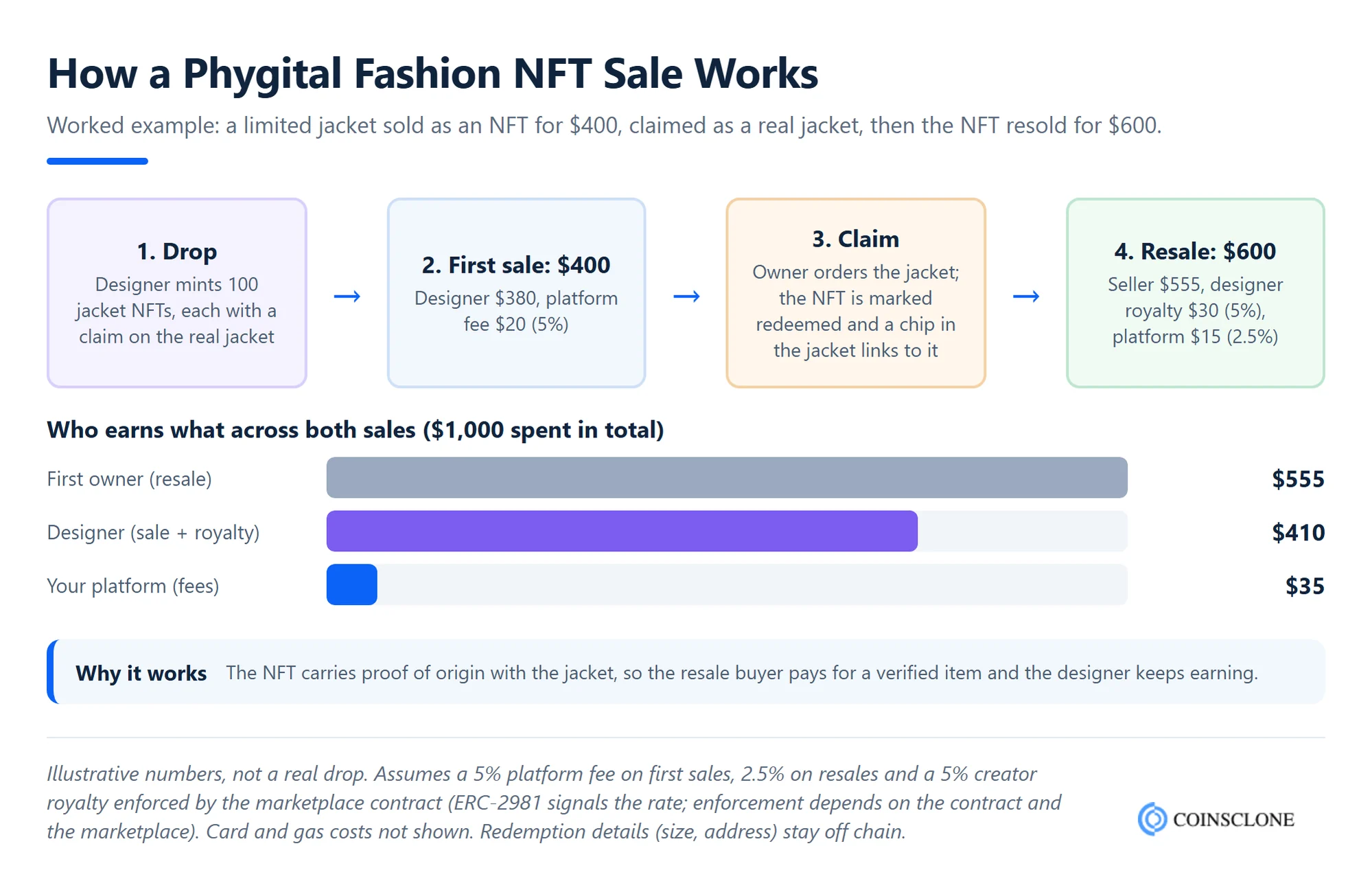
- NFT Creation and Minting: Designers upload a 3D file, image or product record. They then set the price, edition size and royalty rate, and a smart contract mints the NFT.
- Listing Fashion NFTs: Once minted, each NFT goes into a collection. Buyers can then search, filter and preview it, often in 3D or through an AR try-on.
- Connect Wallet and Buy: Buyers connect a crypto wallet, or sign in with email and an embedded wallet, and pay in ETH, POL, USDC or by card through an on-ramp. After payment, the NFT moves to the buyer’s wallet.
- Smart Contract Payouts: The smart contract splits the payment at once. The designer gets their share, the platform takes its fee and ownership is recorded on chain.
- Redeem or Wear: For phygital items, the owner can claim the real garment. For online wearables, they can use the item on supported apps, games or AR filters.
This flow lets designers earn from their work while buyers get proof that what they own is real. The diagram below shows the most common fashion model in 2026, the phygital sale, with worked numbers for the first sale and a resale.
Which Fashion NFT Model Fits Your Brand?
Before you plan features, pick the model your platform will lead with. This choice drives your smart contracts, your rules and your costs. Use the tree below and stop at the first yes.
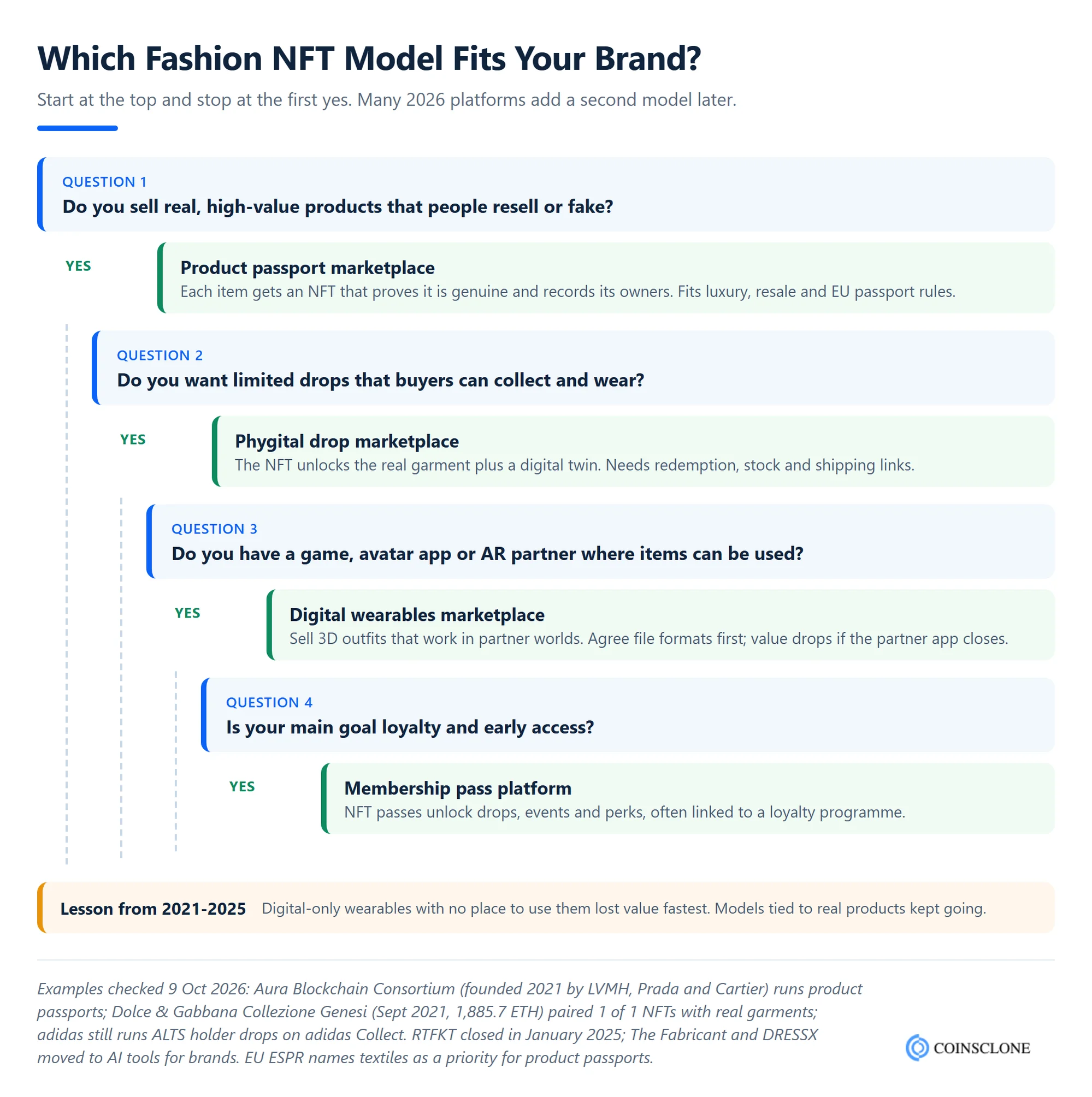
In short, brands that sell real goods get the most from passports and phygital drops. Here, the NFT adds value to something people already want to buy. Online-only wearables work best when a partner app or game lets people use them.
Key Features of Our NFT Fashion Marketplace
Our fashion NFT platform comes with strong features built for real users and large brands. They help users trade safely and enjoy the whole shopping experience.
User Features
- Search and Browse: Users can explore drops, filter by brand, size or chain, and find trending items with ease.
- Wallet Integrations: Users can buy and manage NFTs through popular crypto wallets, or use an embedded wallet that opens with an email login.
- Minting for Creators: Designers can mint and publish fashion NFTs, and set edition sizes and resale fees.
- Buy, Sell and Auction System: Users can buy NFTs right away, make offers or join timed auctions for limited drops.
- Showrooms: Personal profiles let users show off the NFTs they own.
- Many Ways to Pay: Users can pay with crypto, stablecoins or a card through a payment partner.
Fashion-Specific Features
These are the features that set a fashion marketplace apart from a general NFT store:
- 3D Preview and AR Try-On: Buyers can spin a 3D model or see the item on themselves through the phone camera before they buy.
- Phygital Claims: Owners claim the real item through a simple form. The NFT is then marked as redeemed so the same item cannot be claimed twice.
- Authenticity Check: An NFC chip or QR code on the real garment links to its NFT, so a buyer can scan it and confirm it is genuine.
- Size and Shipping Data: Redemption forms collect size and address details off chain, so private data never goes on the blockchain.
- Wearables That Travel: Export files in formats that partner games, avatar apps and AR filters accept.
Admin Features
- Admin Dashboard: A central control panel to watch platform activity, users and sales.
- User Roles: Manage users, their access and their roles, such as designer, brand or buyer.
- NFT Listing Moderation: Approve, reject or manage NFT listings to keep quality high and fakes out.
- Fee Settings: Set fees, royalty rates and payout rules for all sales.
- Page and Drop Control: Pick featured drops, banners and promos from the dashboard.
- Reports: Track sales, trends and user habits in one place.
- Claim and Stock Tracking: See which phygital NFTs are claimed and link them to your stock and shipping tools.
Security Features
- Smart Contract Payouts: Pays out sales and resale fees the same way every time, with no manual steps.
- Two-Factor Login (2FA): Adds an extra lock to logins and account access.
- Data Encryption: Keeps user data and sale details away from people who should not see them.
- Secure Wallet Authentication: Stops users from linking unauthorised wallets and blocks fraud.
- Blockchain Verification: Proves where every NFT came from and who has owned it.
- DDoS and Fraud Protection: Shields the platform from DDoS attacks, bots and other harmful activity.
Many of these features run through the NFT standards you choose. Our guide to popular NFT standards explains when to use ERC-721, ERC-1155 and the royalty standard ERC-2981.
Popular Fashion NFT Projects and Where They Stand in 2026
The first wave of fashion NFTs taught the industry a lot. Some projects that once led the space have closed or changed course, while others found a lasting use. Here is where the best-known names stand as of October 2026:
| Project | What it was | Status in October 2026 |
| RTFKT (Nike) | Digital sneakers and avatars, bought by Nike in 2021 | Closed: wind-down announced December 2024, web3 services ended by January 2025 |
| Nike .SWOOSH | Nike’s own web3 platform for virtual creations | The swoosh.nike address now sends visitors to Nike’s SNKRS launch page |
| Dolce & Gabbana Collezione Genesi | Nine 1 of 1 pieces sold on UNXD, some with a real garment to claim | Sold for 1,885.7 ETH (about $5.65 million) in September 2021; a one-off drop, not an ongoing store |
| The Fabricant | Digital-only fashion house making wearables for avatars | Changed course: its site now offers AI design tools for fashion designers |
| DRESSX | Large store for digital clothes worn in AR and photos | Changed course: now sells AI and virtual try-on tools to fashion brands |
| Gucci Grail (10KTF) | Gucci outfits for owners of popular NFT avatars, March 2022 | A one-off drop; the 10KTF site is still online |
| adidas ALTS | The final phase of adidas “Into the Metaverse” | Still in use: adidas runs drops for ALTS holders on adidas Collect, including a FIFA Rivals tie-in |
The bigger NFT market cooled too. NFT sales fell to $5.63 billion in 2025, down 37% from $8.9 billion in 2024, according to CryptoSlam data. Foundation, a well-known art platform, went offline on 27 April 2026.
What These Changes Teach New Fashion Marketplaces
The lesson is not that fashion NFTs failed. Instead, the projects that lived on hype and resale prices struggled, while uses tied to real products kept going. Here is what that means for your build:
- Link NFTs to real value: A token that unlocks a real jacket, a repair service or proof of origin keeps its use after the hype fades.
- Do not rely on one income line: Platforms that earned mostly from first-sale fees were hit hardest when volume fell. Plan for fees, memberships and B2B services from day one.
- Hide the crypto: Email logins, embedded wallets and card payments let normal shoppers buy without learning about gas fees.
- Plan for the end: Store files on lasting storage such as IPFS or Arweave, so owners keep their items even if a partner app closes.
Business Benefits of an NFT Fashion Marketplace
We help brands, startups and founders build fashion NFT platforms that can grow. That way, they can open new income sources and reach buyers worldwide.
- New Income: Online items, NFT drops and phygital sets earn money beyond the clothes on your shelves.
- Global Reach: Reach users, creators and collectors in any country through one online platform.
- A Fresh Brand Image: Show your brand as a leader in online-first fashion and give fans a new way to connect.
- Support for Creators: Give designers new ways to earn and build loyal fans through your platform.
- Proof Against Fakes: Product passports help buyers spot counterfeits and give resale buyers more trust.
- Room to Scale: Build a platform that grows with users, traffic and sales without slowing down.
With our help, you build an online home for new ideas and steady brand growth in Web3 fashion.
How Our NFT Fashion Marketplace Makes Money
Our NFT fashion platform comes with built-in ways to earn. They help you make steady money as the platform grows.
- Transaction Fees: Take a share of every NFT sale or trade on the platform. This is the main, steady source of income for most platforms.
- Minting Fees: Charge creators and brands to mint their fashion NFTs on the blockchain.
- Listing Fees: Sell premium or featured listing spots to creators and brands who want more views.
- Creator Royalties: Let creators earn a share each time their NFT is resold, paid out by smart contracts.
- Paid Plans: Offer plans with early access to drops, sales reports and better seller tools.
- Brand Partnerships: Work with brands on co-branded drops and sponsored collections.
- Claim and Service Fees: Charge for shipping, made-to-measure fitting or repair services linked to phygital NFTs.
One point to plan for: royalties are only paid where something enforces them. Many large NFT marketplaces make creator earnings optional unless the contract enforces them. So if royalties matter to your designers, enforce them in your contracts and keep trading on your own platform. Our post on how an OpenSea clone makes money breaks down fee models in more detail.
Cost to Build an NFT Fashion Marketplace
The exact cost depends on several factors: the build route, the blockchain, the number of chains, fashion features such as 3D and AR try-on, and the smart contract audit. Choosing a ready-made white label base instead of a full custom build saves the most time and money.
Here is how the three routes compare. Times are Coinsclone’s own published build times. Costs come from 2026 agency price guides:
| Factor | White Label | Standard Build | Custom Build |
| Coinsclone launch time | 4 to 6 weeks, or 7 to 10 weeks with creator minting | 9 to 13 weeks | 6 to 11 months for a custom multi-chain build |
| Typical market cost | Often $10,000 to $50,000+ | Often $50,000 or more | Often $150,000 to $250,000+ |
| Best for | Brands that want to test the market fast | Startups with a clear feature list | Large brands with their own model and scale needs |
| Trade-off | Less room to change core functions | Moderate control and cost | Highest control, cost and time |
Fashion features add to the bill. A 3D viewer, AR try-on, phygital claims and NFC or QR tags each add design and test work. On top of the build, plan for a code audit, hosting, file storage, card payment fees and marketing. For a full line-by-line view, read our guide on NFT marketplace development cost.
Rules to Settle Before You Launch
Fashion NFTs touch design rights, consumer law and, in Europe, new product data rules. Settle these points with a lawyer in your main markets before launch:
- Design and Brand Rights: Only list items whose design, logo and images the seller owns or has licensed. Add a takedown process for copied work, because counterfeits move online too.
- Clear Buyer Terms: State in plain words what the buyer gets. Does the NFT include the real item, a digital file, a licence to use the design, or only a collectible?
- Phygital Refunds and Shipping: When an NFT comes with a real garment, normal shop rules on returns, delivery and safety can apply to that item.
- No Profit Promises: Do not sell NFTs as a way to make money or hint that their price will rise. In many countries, that can turn a collectible into a product that needs a finance licence.
- Payments and KYC: If you take card or bank payments, or hold funds for users, payment and anti-money-laundering rules may apply. Many platforms use a licensed payment partner for this.
- EU Product Passports: The EU’s new product design law (ESPR) came into force in July 2024. It puts clothing near the top of the list for product passports. Rules for textiles are expected from about 2027. A blockchain passport, like those run by the Aura Blockchain Consortium that LVMH, Prada and Cartier founded, can prepare your platform for that change.
Our Step-by-Step Build Process
A successful NFT fashion marketplace needs a clear, well-planned process. Each step matters for safety, scale and ease of use. At Coinsclone, we follow a set process that turns your idea into a working platform.
1. Requirements and Planning: First, we learn your goals, target buyers, features and budget. This helps us set the project scope, pick the right blockchain and the right fashion NFT model, and list any technical needs.
2. UI and UX Design: Our design team creates clean, attractive screens for creators and buyers. We focus on dashboards, product galleries and 3D previews, so browsing and buying feel easy.
3. Smart Contract Development: We write safe, clear smart contracts for minting, sales, resale fees and phygital claims. These contracts handle payments and transfers on their own, so users can trust every sale.
4. Marketplace Platform Development: Next, we build the front end, the back end and the blockchain links. We add NFT trading and auctions, wallet support, payments and any links to your stock and shipping systems.
5. Testing and Quality Checks: We test the platform to find and fix bugs, check security and confirm the smart contracts work as planned. An outside code audit is part of this step.
6. Launch and Support: Finally, we launch your platform on your chosen blockchain. After launch, you get ongoing support and updates to stay competitive in Web3 fashion.
This process keeps your platform secure, ready to grow and easy to use for creators, buyers and admins alike.
Top Blockchains for Our NFT Fashion Marketplace
At Coinsclone, we build on leading blockchains that offer fast sales, low fees and links to other networks. Here are the chains fashion brands use most:
Ethereum: Ethereum is the main chain for NFTs, and it has a huge pool of skilled builders. It supports the two main NFT standards: ERC-721 for unique items and ERC-1155 for editions. So it suits both 1 of 1 couture and larger drops.
Polygon: Polygon is a network linked to Ethereum that cuts fees and speeds up sales. That makes it a good fit for low-priced wearables and large editions. UNXD, the luxury store behind the Dolce & Gabbana drop, ran on Polygon.
Planning to launch your NFT fashion marketplace on Polygon? Build it faster with our Polygon NFT Marketplace Development Service.
Base: Base is a low-fee Ethereum network built by Coinbase. Its simple wallet tools help brands reach shoppers who have never used crypto.
Solana: Solana handles many sales very quickly and at a low cost. Its speed suits busy drops and live trading of online fashion items.
BNB Smart Chain: BNB Smart Chain is a low-cost option with fast blocks and full smart contract support. It is a good fit for reaching a large crypto audience, especially in Asia.
Flow: Flow is a blockchain made for consumer apps and NFTs. It is easy for builders and users, which suits brands that want fun, hands-on fashion apps.
Avalanche: Avalanche is a fast chain that confirms sales in seconds and uses little energy. Its speed, safety and custom networks make it a solid choice for a fashion platform.
Want to create an NFT marketplace on Avalanche for your business? Start your journey with our skilled professionals.
Pick the right chain, or support a few, and you give creators, brands and buyers a smooth ride as your platform grows.
Create Your NFT Marketplace for New Era of Fashion!!
Fostering Niche. Authentic Branding. Wide Exposure. Higher Profitability.
Why Choose Coinsclone to Build Your NFT Fashion Marketplace?
Coinsclone is a trusted NFT marketplace development company. We build safe fashion platforms that you can shape around your brand. We have been building blockchain products since 2018, and we have delivered 350+ platforms for 200+ clients across 20 industries.
We cover NFT fashion marketplace development from the first idea to support after launch, shaped around your brand. Coinsclone can launch a white label NFT fashion marketplace in 4 to 6 weeks, or build a custom platform around your own model. Along the way, we keep the focus on speed, safety and ease of use for your buyers. Talk to our team to plan your fashion marketplace today.
Frequently Asked Questions
What is NFT fashion?
NFT fashion is clothing, shoes or accessories sold as non-fungible tokens on a blockchain. The NFT can be an online outfit for an avatar, a token tied to a real garment, or a certificate that proves a real item is genuine. The blockchain records who owns each piece.
What can I do with a fashion NFT?
It depends on the item. You can wear an online outfit in some games, avatar apps or AR filters. With a phygital NFT, you can claim the real garment. And with a passport NFT, you can prove a luxury item is real before you resell it. Some fashion NFTs also unlock early access to drops, events or member perks.
What is a phygital NFT?
A phygital NFT links a token on a blockchain to a real product. The buyer owns the NFT and can claim the real item, such as a jacket or sneakers. Often an NFC chip or QR code on the item links back to the NFT, so anyone can check that it is genuine.
Which fashion brands use NFTs?
Big names include Nike (through RTFKT, which closed in early 2025), Dolce & Gabbana, Gucci and adidas. adidas still runs drops for owners of its ALTS NFTs. Luxury groups such as LVMH, Prada and Cartier use blockchain product passports through the Aura group.
Why should fashion brands invest in NFT marketplaces?
NFT platforms give fashion brands new income from online items, phygital drops and resale fees. They also help fight counterfeits, build a loyal community and reach buyers worldwide. The best results come when NFTs add real value to products people already want.
Can NFT fashion marketplaces work with the metaverse?
Yes. Many fashion NFT platforms let buyers use online outfits in virtual worlds, games and AR apps. This works best when you agree file formats with partner platforms early, because each world has its own rules for 3D items. Our Decentraland clone script shows how a virtual world handles wearables.
How can startups benefit from NFT fashion marketplace development?
Startups can use a ready-made white label base to enter the NFT fashion space quickly and at a lower cost. These come with tested features and blockchain links, so the team needs little tech know-how to launch.
Can we customise an NFT fashion marketplace to match our brand?
Absolutely. Our fashion platforms are easy to adapt. You control the design, features and smart contract rules, so the platform reflects your brand’s vision.
How much does it cost to develop an NFT fashion marketplace?
Published 2026 agency cost guides put a white label NFT marketplace at about $10,000 to $50,000+, a standard build at $50,000 or more, and a custom build at $150,000 to $250,000+. Fashion features such as 3D try-on and phygital redemption, extra chains and a code audit raise the cost.
How long does it take to develop an NFT fashion marketplace?
Coinsclone’s published timelines are 4 to 6 weeks for a white label build, or 7 to 10 weeks with creator minting. A standard build takes 9 to 13 weeks, and a custom multi-chain build takes 6 to 11 months. Your feature list and audit schedule can change the final date.
Build a Trend-setting NFT Fashion Marketplace Platform
NFT Fashion Marketplace Development — empower designers to showcase and trade digital fashion assets.
- Virtual Wearables: Create and sell exclusive digital apparel for metaverse users.
- Brand Customization: Launch a marketplace styled around your unique brand.
- Web3 Monetization: Enable creators to earn through NFT sales and royalties.
- Secure Trading System: Facilitate safe, transparent NFT transactions globally.
See a free branded demo of your NFT marketplace in 48 hours — before you invest a cent.
Book a Free Demo to discover how NFT Fashion Marketplace Development can help you launch in just 8–12 weeks.