
This guide covers the 10 NFT business ideas that still have paying users in 2026. For each idea, you will see what it is, a live example that we checked this month, how it makes money and who it suits. We also show where NFT buyers spend money right now, what a launch costs and the rules to plan for.
The NFT market is not the 2021 boom any more. Sales are lower, and some well-known platforms have closed. Even so, buyers spent about $183 million on NFTs in the 30 days to 16 October 2026, according to CryptoSlam. So the real question is not “are NFTs dead?” but “which NFT business still works?” That is what this guide answers.
In this guide:
- 10 NFT business ideas with live examples, real fees and the platforms that have closed.
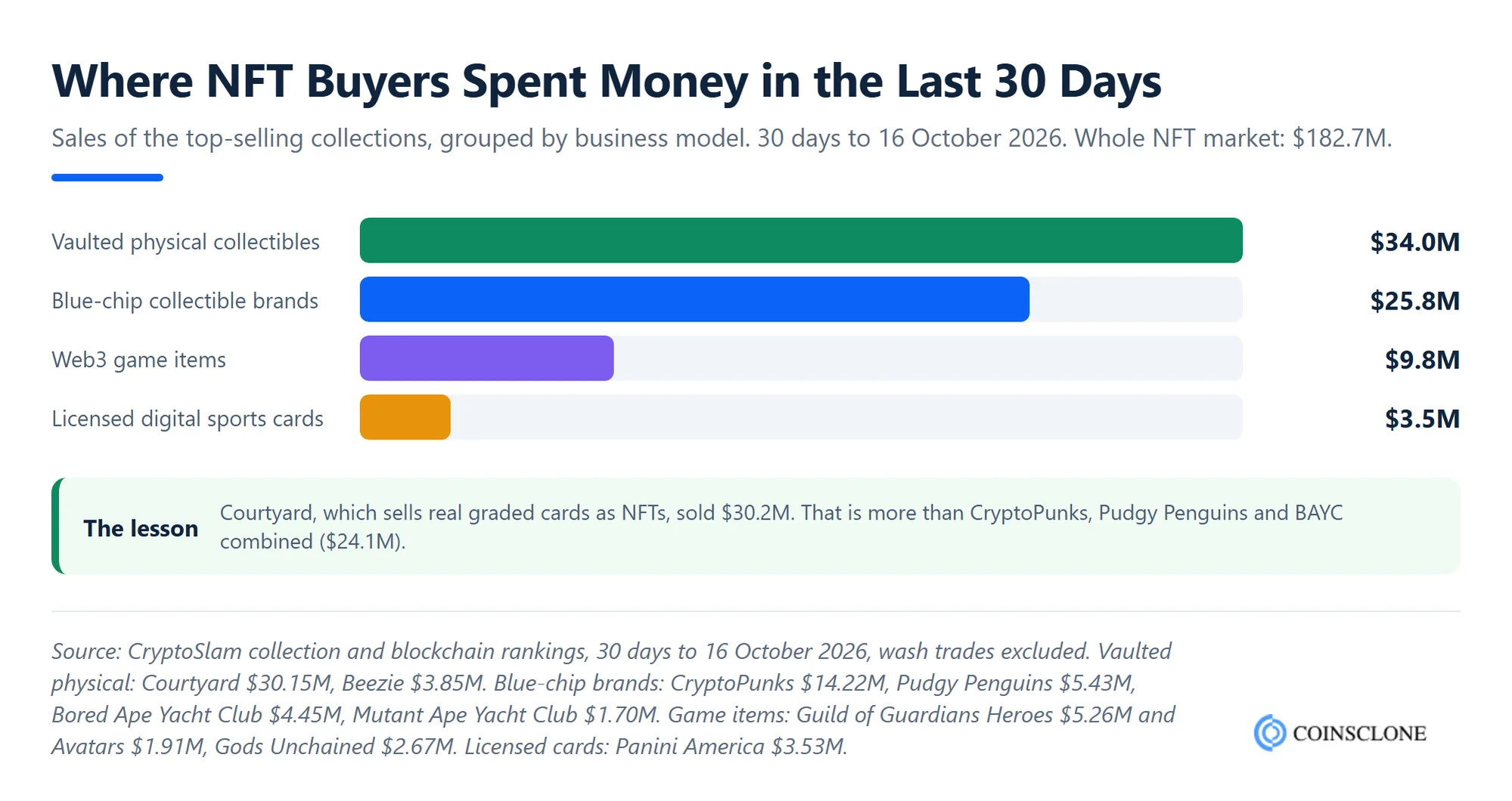
- Where the money is: a chart of 30-day NFT sales by business model, led by vaulted trading cards.
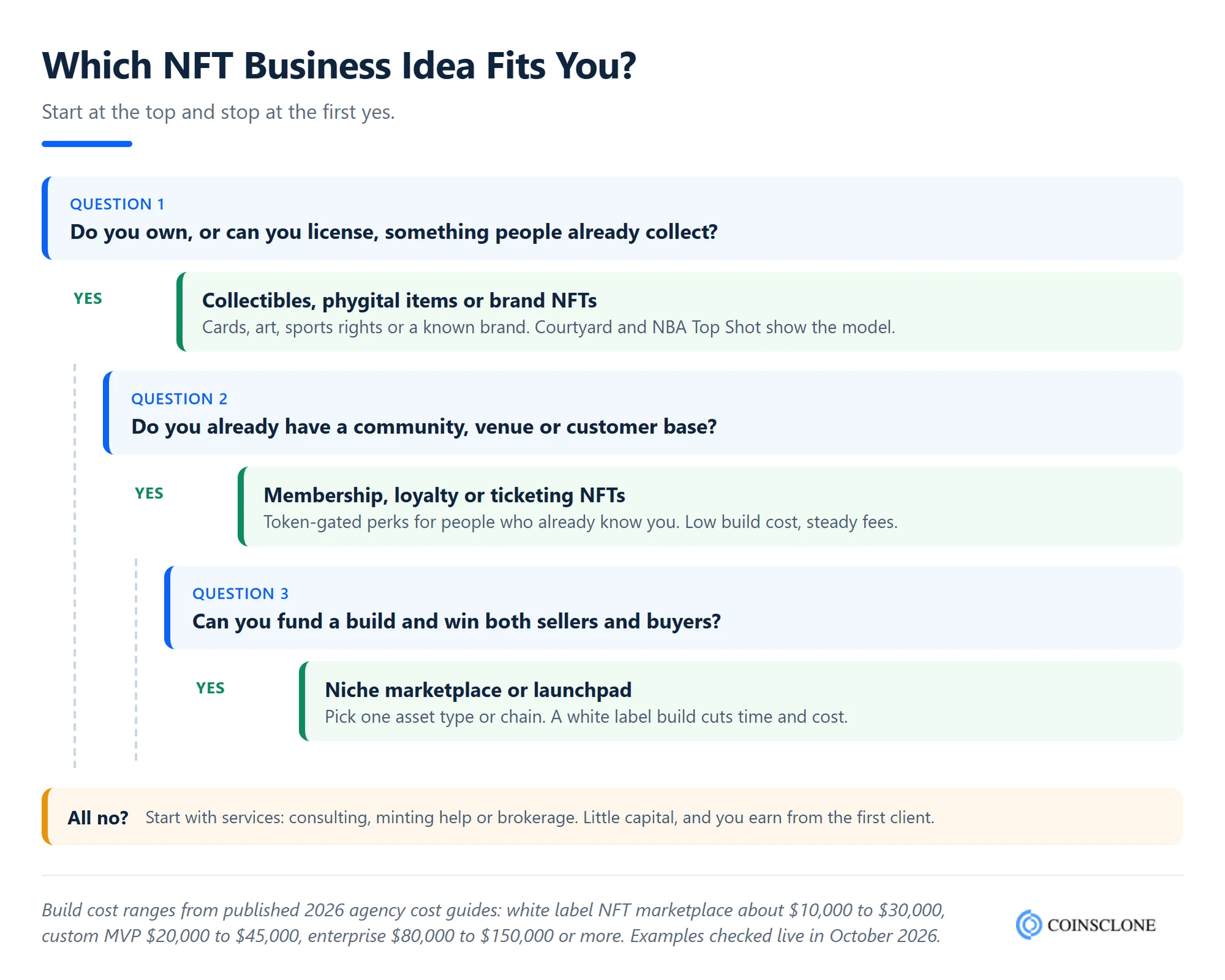
- How to choose: a comparison table and a simple decision tree.
- How to start: six steps, cost ranges, and the risks and rules that matter in 2026.
Turn Profitable NFT Business Ideas into Reality — Start Building Today
NFT Business Development — made easy for entrepreneurs.
- 10+ Lucrative Models : Explore top NFT business ideas.
- Ready-Made Solutions : Launch NFT marketplaces or galleries 90% faster.
- Brand & Customization : Your design, your tokens, your NFT ecosystem.
- Revenue Engine : Monetize via trading fees, royalties, and exclusive drops.
See a free branded demo of your NFT business in 48 hours — before you invest a cent.
Book a Free Demo to discover how our NFT Business Ideas can help you launch a scalable platform in just 8–12 weeks.
Top 10 NFT Business Ideas to Start in 2026
Are you ready to explore the NFT business ideas that still make money? We picked the ten below because each one has live platforms and real buyers today. For each idea, you will find example platforms, revenue streams and who it suits best.
- Create Your Own NFT Marketplace
- Develop & Launch NFT Art Gallery Platform
- Launch NFT Launchpad Platform
- Build NFT Gaming Platform
- Launch NFT Music Platform
- Start Selling NFT Collectibles, Including Physical-Backed Ones
- Develop NFT Real Estate Platform
- Provide NFT Membership Access Service
- Start NFT Brokerage and Lending Services
- Start NFT Consulting Services
1. Create Your Own NFT Marketplace
An NFT marketplace is the backbone of the NFT world. It lets users mint, list, buy, sell and auction NFTs in one place. Most marketplaces now run on more than one chain, such as Ethereum, Polygon, Base and Solana, so users can trade where fees are lowest. A good marketplace also needs simple minting, smart search, auctions and a way to pay creator royalties.
The big lesson of 2026 is focus. General marketplaces are hard to beat, but a marketplace built for one niche, such as trading cards, music or a single chain, can still win loyal users.
Example Platforms
- OpenSea: The largest NFT marketplace by all-time volume. It charges a 1% fee on sales and 10% on first-sale drop mints. It added Solana NFT trading at the end of August 2026.
- Rarible: A multi-chain marketplace where creators set their own royalty rates. A company called IMPOSSIBLE bought the Rarible brand in 2026, while the RARI token and its voting stay with the RARI Foundation. It added Solana in August 2026.
Revenue Streams
- A fee on each trade.
- Fees on first-sale drops and featured listings.
- Premium tools for creators and pro traders.
Ideal for
- Founders who can bring both sellers and buyers to a niche.
- Teams with blockchain skills or a reliable build partner.
- Creator communities that want their own trading home.
A marketplace links creators and buyers, so it earns on each sale while it builds a community. If you want to launch one, Coinsclone offers NFT Marketplace development with your brand, chains and fee settings.
2. Develop and Launch NFT Art Gallery Platform
An NFT art gallery brings the idea of an art show online, with blockchain proof of who owns each piece. Galleries pick the art, host timed drops and run auctions. Many add 3D or virtual rooms so collectors can walk through a show. Spotlight sections help new artists get seen next to known names.
This idea needs care. Online art sales fell to $9.2 billion in 2025, their lowest level since 2019, even as global art sales grew 4% to $59.6 billion, per the Art Basel and UBS Global Art Market Report 2026. Two big digital art platforms, Nifty Gateway and Foundation, closed in early 2026. The galleries that last have a strong hand-picked brand or a loyal niche.
Example Platforms
- SuperRare: A curated marketplace for single-edition digital art, with auctions and offers on each piece.
- Art Blocks: A platform for generative art, where code creates each piece at mint and stores it on-chain, as its docs explain.
Revenue Streams
- Commissions on art sales.
- Paid exhibition slots for artists.
- Paid passes for collectors.
Ideal for
- Curators and digital artists with a strong eye and network.
- Founders who want to promote new talent.
- Art communities that already gather online.
A gallery wins on taste and trust, not on volume. So keep costs lean, store the art so it outlives your platform, and plan more than one income line.
3. Launch NFT Launchpad Platform
An NFT launchpad helps creators and brands release a new collection. It handles the smart contract, the mint page, allowlists, timed phases and payment. Some launchpads also vet projects first, so buyers trust the drops they list. Others let creators deploy and own their own contracts.
Keep NFT launchpads apart from token launchpads such as DAO Maker, which sell new crypto tokens rather than NFTs. DAO Maker is still online, but its sales have slowed and its token is down more than 99%. So an NFT launchpad should focus on brands and creators with real fans.
Example Platforms
- OpenSea Drops: Creators run primary sales on OpenSea, which takes 10% of each mint.
- Manifold: A creator studio where artists deploy and own their own smart contracts.
Revenue Streams
- A share of each primary sale.
- Setup fees for vetted or managed launches.
- Paid placement for featured drops.
Ideal for
- Teams that work with brands, artists or game studios.
- Founders who can vet projects and protect buyers.
- Marketplaces that want a steady flow of new collections.
A launchpad earns most when it helps good projects reach buyers. Coinsclone builds NFT launchpad platforms with mint pages, allowlists and fee controls.
4. Build NFT Gaming Platforms
NFT games turn in-game items into tokens that players truly own. Players can trade swords, cards or characters with real-world value. Strong games put fun first and treat NFTs as a feature, not the whole point.
Game items still sell. On Immutable, a chain built for Web3 games, players bought about $10.1 million of NFTs in the 30 days to 16 October 2026, per CryptoSlam blockchain rankings. Still, the sector is harder than in 2021. The Sandbox, for example, cut about half its staff in August 2025 when Animoca Brands took control.
Example Platforms
- Axie Infinity: A creature battle game with its own market, which takes a 4.25% fee on trades. In February 2026 it launched bAXS, a reward token players spend inside the game.
- Guild of Guardians: A mobile role-playing game on Immutable. Its hero NFTs sold about $5.3 million in the same 30 days, per CryptoSlam.
Revenue Streams
- Commissions on NFT trades.
- In-game purchases and upgrades.
- Ads and brand deals.
Ideal for
- Game studios that already know how to build fun games.
- Founders targeting gaming and esports fans.
- Teams that can balance an in-game economy.
By blending fun with real ownership, NFT games keep players coming back. In turn, that loyalty creates an active market for items.
5. Launch NFT Music Platform
NFT music platforms let artists sell songs, albums or fan perks straight to listeners. Smart contracts can pay royalties to every artist on a track. Holders may get early releases, backstage access or a vote on what comes next.
This is one of the hardest NFT ideas in 2026, so go in with clear eyes. Sound.xyz, once the best-known music NFT site, went offline on 16 January 2026, and its team moved to a new app called Vault.fm. Catalog also stopped new uploads and purchases. The music platforms that last mix NFTs with streaming and fan tools.
Example Platforms
- Audius: A community-run music streaming platform. Its February 2026 update added free uploads, paid lossless downloads, fan clubs and remix contests.
- Vault.fm: The new app from the former Sound.xyz team, built around live group chats between artists and fans.
Revenue Streams
- Commissions on music and fan pass sales.
- Premium subscription fees.
- Collaborations with record labels.
Ideal for
- Independent musicians who want direct income from fans.
- Labels testing new fan products.
- Founders who can bring artists and listeners on day one.
By building direct links between artists and fans, music platforms can create a fairer way to share royalties. The ones that last give fans a reason to stay beyond the first sale.
6. Start Selling NFT Collectibles, Including Physical-Backed Ones
NFT collectibles are rare digital items that fans collect and trade. Scarcity, brand deals and fun features like packs and rewards keep fans engaged. In 2026, the type that grows fastest is backed by a real item. Here, a real item, such as a graded trading card, sits in a secure vault, and the NFT is the claim on it. The owner can trade it in seconds or redeem the real card.
This model now leads the whole market. Courtyard sold about $30.2 million of NFTs in the 30 days to 16 October 2026, more than CryptoPunks, Pudgy Penguins and Bored Ape Yacht Club combined, per CryptoSlam.
Example Platforms
- Courtyard: Sells real graded cards as NFTs on Polygon. It charges 0% on peer-to-peer resales and earns on pack sales instead.
- NBA Top Shot: Officially licensed NBA video highlights on the Flow chain, still active with a 2025-26 season. It charges a 5% fee on resales.
- CryptoPunks: The pioneer pixel art collection. In May 2025, Yuga Labs sold the CryptoPunks rights to the nonprofit Infinite Node Foundation.
Revenue Streams
- Limited-edition and pack sales.
- Licensing deals with brands and leagues.
- Secondary market trading fees, plus vaulting and shipping fees for physical items.
Ideal for
- Card shops, sports brands and owners of collectible rights.
- Businesses that want deeper fan engagement.
- Developers who can build packs, games and rewards.
By reaching both casual fans and serious collectors, a collectibles business can keep sales flowing all year. If sports is your niche, read our guide to NFT sports marketplace development.
7. Develop NFT Real Estate Platform
NFT real estate platforms turn property into tokens, both virtual land and real buildings. Virtual land lives inside a metaverse world. Real property tokens represent a deed, a share of a building or the right to rental income. Smart contracts make transfers clear and fast, and 3D tours help buyers see what they get.
Be realistic about virtual land. On 2 October 2026, the cheapest Decentraland parcel sold for about 0.035 ETH, or roughly $94, per CoinGecko. Real property tokens have more demand, but they come with property law, tax and investor rules.
Example Platforms
- Decentraland: A live metaverse world where users buy, build on and rent out virtual land.
- Propy: A US platform for property title and escrow. It ran its first NFT-linked US home sale in 2022.
Revenue Streams
- Sales commissions.
- Fees for renting out and running property.
- Premium listing and subscription plans.
Ideal for
- Real estate firms exploring blockchain.
- Teams that build virtual worlds.
- Investors looking for new ways to trade property.
Running the real asset matters as much as the token. In Detroit, a court put an outside manager in charge of about 700 homes held by the token issuer RealT in 2026, as Michigan Public reported. Our guide to NFT real estate marketplace development explains how to plan for this.
8. Provide NFT Membership Access
NFT membership platforms use tokens as keys to private content, events and communities. They can offer tiers, event check-in and perks like discounts and early access. Since the pass lives in the member’s wallet, members can also sell it when they leave.
Example Platforms
- Bored Ape Yacht Club: Holders get access to events and a club run by Yuga Labs. The collection still sold about $4.4 million in the 30 days to 16 October 2026, per CryptoSlam. Yuga named a new CEO in April 2026.
- Friends With Benefits (FWB): A token-gated social club for creators that is still active, and ran a 2026 member survey.
Revenue Streams
- Membership fees.
- Brand collaborations for perks.
- Renewal and upgrade charges.
Ideal for
- Event hosts who run private groups.
- Clubs and creators with loyal fans.
- Shops and brands that want loyal customers.
This model works best when the perks are real and the club existed before the NFT. As a result, members stay for the value, not for price swings.
9. Start NFT Brokerage and Lending Services
NFT brokerage services help buyers and sellers trade high-value NFTs safely. A broker finds buyers, checks that pieces are real, sets fair prices and handles the transfer. Many brokers now add NFT-backed loans, so owners can borrow against a valuable NFT instead of selling it.
The lending side has shrunk, so plan for a small, expert market. NFT lending volume fell 97% from its January 2024 peak of nearly $1 billion to about $50 million in May 2025, according to DappRadar. At that point, Gondi held 54.2% of all open loans.
Example Platforms
- Gondi: A peer-to-peer NFT lending protocol where lenders set their own terms. It leads the NFT lending market.
- Blend: Blur’s lending product. It will stop matching new loans on 12 November 2026, when the blur.io website also closes.
Revenue Streams
- Brokerage fees on each deal.
- A share of loan interest or origination fees.
- Paid market reports and valuation services.
Ideal for
- Money advisers who want to add NFTs.
- Experts in art, cards or blue-chip collections.
- Firms that serve big collectors.
For a startup, trust is the product. Clear pricing, safe custody and honest valuations set a broker apart. If you want to add loans, Coinsclone builds NFT lending platforms with collateral checks and repayment logic.
10. Start NFT Consulting Services
NFT consulting firms help brands and creators use NFTs well. They plan launches, pick the right chain and token standard, set up royalties and handle marketing. Good consultants also check legal and tax issues, and they plan what happens if a project ends.
Brands need this advice. Starbucks closed its Odyssey NFT loyalty program in March 2024, and Nike shut down its RTFKT digital sneaker brand at the end of January 2025. Both show how much planning a brand launch needs, including a fair exit for holders.
What Clients Pay For
- Launch strategy: Which product, which chain and which audience to target first.
- Technical setup: Smart contracts, royalties, wallets and marketplace listings.
- Rules and exits: Legal checks, tax set-up and a plan for holders if the project winds down.
Revenue Streams
- Consulting fees.
- Monthly retainers for ongoing help.
- Training and workshops.
Ideal For
- Businesses that want to use NFTs for branding and revenue.
- Agencies adding Web3 to their services.
- Creators who need expert help to enter the NFT market.
NFT consulting needs little capital, so you can earn from your first client. By closing the knowledge gap, consultants help brands avoid costly mistakes and find the uses that really work.
NFT Business Ideas Compared
The table sums up each idea side by side. Capital is a rough guide: low means mostly people and tools, high means a full platform build and funds to grow both sides of a market.
| NFT business idea | How it earns | Live example and fee | Capital needed | Main risk |
| NFT marketplace | Fees on every trade | OpenSea, 1% per sale | High | Winning buyers and sellers |
| Art gallery | Commissions, curation | SuperRare, curated sales | Medium | Weak online art sales |
| Launchpad | Share of first sales | OpenSea Drops, 10% of mints | Medium | Bad projects hurt trust |
| Gaming platform | Item sales, trade fees | Axie Infinity, 4.25% | High | Game must be fun first |
| Music platform | Sales, fan passes | Audius, paid downloads | Medium | Several shutdowns in 2026 |
| Collectibles and phygital | Packs, licences, fees | Courtyard, 0% resale, earns on packs | Medium to high | Licences and vault costs |
| Real estate | Commissions, rent | Decentraland, Propy | High | Property and investor law |
| Membership access | Pass sales, renewals | Friends With Benefits | Low to medium | Perks must stay real |
| Brokerage and lending | Deal fees, interest | Gondi | Medium | Small, shrinking lending market |
| Consulting | Fees, retainers | Brand advisory work | Low | Depends on your expertise |
Is an NFT Business Still Worth Starting in 2026?
Yes, if you pick the right model. The NFT market is smaller than at its peak, but it is still large and it has moved to new places. Here is what the data shows.
- The market shrank, then settled: Total NFT sales fell 37% to about $5.63 billion in 2025, down from $8.9 billion in 2024, with an average sale of $96, according to CryptoSlam data.
- It still moves real money: Buyers spent $182.7 million on NFTs in the 30 days to 16 October 2026, across about 135,000 buyers and 3.2 million transactions, per CryptoSlam.
- Ethereum still leads: It made up $81.1 million of those sales. Polygon came next with $33.9 million, then Bitcoin with $21.5 million and Solana with $7.0 million.
- Physical-backed items are the growth story: Courtyard alone sold $30.2 million in that period, the most of any collection.
- Weak players are gone: Nifty Gateway and Foundation closed in early 2026, Sound.xyz went offline, and blur.io closes on 12 November 2026. Even DappRadar, a major NFT data site, shut down in November 2025.
In short, speculation has cooled, but real uses keep growing. That is good news for founders, because a focused NFT business with real value now faces fewer copycats.
How NFT Businesses Make Money
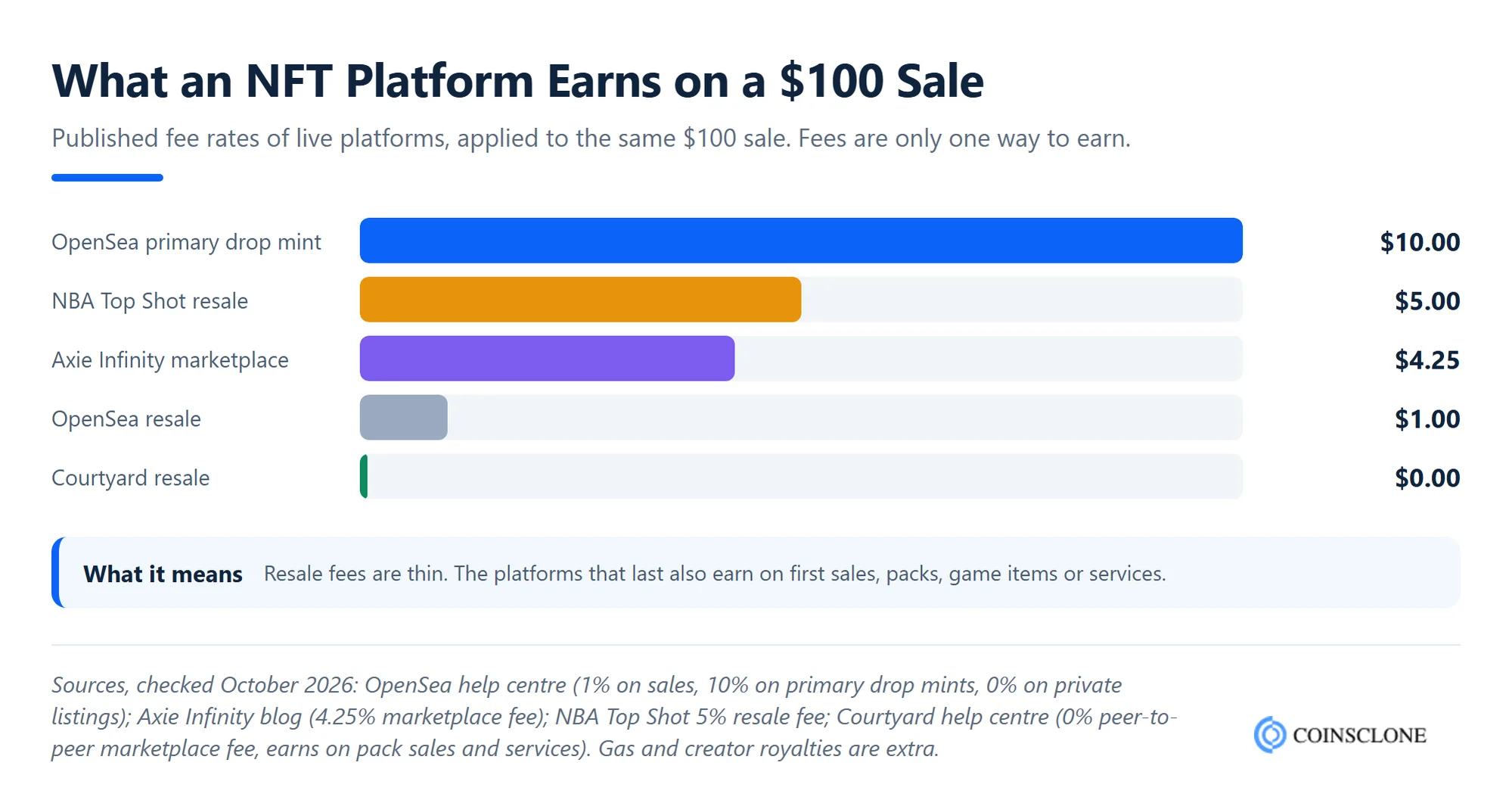
Most NFT businesses earn from a mix of the same few streams. However, the fee on each resale is usually small, so the strongest platforms add other income on top.
- Trading fees: A cut of each sale, often between 0% and 5%.
- First-sale fees: A larger share of new drops and mints, such as OpenSea’s 10%.
- Packs and products: Selling packs, passes or game items directly, as Courtyard does.
- Services: Vaulting, grading, consulting, data and premium tools.
- Royalties: Creator earnings on resales, where the contract and marketplace enforce them.
What is the Best NFT Business Idea for Startups, and How to Get Started?
For most startups, a niche NFT marketplace is still the strongest NFT business idea. It earns on every trade, and it can serve one group better than the giants do, such as card collectors, music fans or gamers on one chain. As NFTs spread into collectibles, gaming, tickets and real assets, each of these niches needs a trusted place to trade.
However, the best idea for you depends on what you already have. If you own a brand or collectible rights, sell collectibles first. If you have a community, start with memberships. If you have little capital, start with consulting and build later. The decision tree below helps you choose.
With multiple options available for building an NFT Marketplace platform, it’s easy to feel unsure about which approach to choose. To help you make the right decision, here’s a guide >>> How to Build an NFT Marketplace.
No matter which approach you choose, the right build partner matters. Coinsclone has delivered 350+ platforms for 200+ clients across 20 industries since 2018, so we can help you build a secure NFT platform that grows with your users.
How to Start an NFT Business in 6 Steps
Starting an NFT business follows the same path for most ideas. Here are the steps in order.
- Pick one niche: Choose one asset type, one audience and one chain. A narrow start is easier to win.
- Check real demand: Look at live sales on CryptoSlam for your niche, and talk to the buyers you want to serve.
- Choose your model: Decide how you will earn, whether through trading fees, first sales, packs, passes or services.
- Plan the rules: Get legal advice on securities, gambling, tax and consumer law in each country you serve.
- Build and audit: Use a white label base or a custom build, then get the smart contracts audited before launch.
- Launch with supply: Line up creators, items or games before day one, so buyers find something worth buying.
How Much Does It Cost to Start an NFT Business?
The cost depends on the idea. A consulting or brokerage business can start with little more than a website, legal set-up and your time. A platform costs far more. Published 2026 agency cost guides put a white label NFT marketplace at about $10,000 to $30,000, a custom first version at $20,000 to $45,000, and an enterprise multi-chain platform at $80,000 to $150,000 or more.
On top of the build, plan for a smart contract audit, hosting, marketing and the funds to attract your first sellers and buyers. Our full breakdown of NFT marketplace development cost shows where each dollar goes.
Risks and Rules to Plan For
Every NFT business idea carries risk. Plan for these from the start.
- Fake volume: Wash trading inflates some markets. CryptoSlam flagged $84.8 million of the $118.7 million in Polygon NFT sales in the 30 days to 16 October 2026 as wash trades. So build checks that spot self-trading.
- Securities claims: If NFTs are sold as investments, buyers may sue. Dapper Labs settled a US case over NBA Top Shot Moments for $4 million.
- Gambling law: Packs and prize games can count as gambling. The UK Gambling Commission has charged Sorare with running gambling without a licence.
- EU crypto rules: The EU’s MiCA regulation leaves out truly unique NFTs. However, NFTs sold in large series or as fractions can fall inside its rules.
- Platform risk: Platforms close. Store art and metadata on lasting storage, and give holders a clear exit plan.
- Royalties are optional on many markets: Do not build your whole income on resale royalties unless your contracts enforce them.
Ready to Start your NFT Business?
Reach Our Highly Trained Team and Launch you Success Journey
Kickstart your NFT Business with Coinsclone!
Coinsclone is a leading NFT development company that builds secure, scalable and feature-rich NFT platforms. Since 2018, we have delivered 350+ platforms for 200+ clients across 20 industries. Our team adds multi-chain support, safe payment options and easy-to-use designs, so creators and collectors enjoy your platform from day one.
Our end-to-end service covers every stage, from planning to launch and support. So whether you want a marketplace, a launchpad, a collectibles store or a membership platform, trust Coinsclone to turn your NFT business idea into a working product.
Frequently Asked Questions
What is an NFT business?
An NFT business is a company that earns money from non-fungible tokens. It might run a marketplace, sell collectibles, build NFT games, issue membership passes or offer services such as consulting and brokerage. Most earn from trading fees, first sales, packs or service fees.
How do I start an NFT business?
Pick one niche and check that buyers already spend money in it. Then choose how you will earn, get legal advice, build and audit your platform, and line up creators or items before launch. A white label build is the fastest way to start a platform.
Can you still make money with NFTs in 2026?
Yes, but the easy money of 2021 is gone. Buyers spent about $183 million on NFTs in the 30 days to 16 October 2026, per CryptoSlam. Businesses with real value, such as physical-backed cards, licensed collectibles and games, earn the most today.
Are NFTs dead?
No. NFT sales fell 37% to about $5.63 billion in 2025, and some platforms closed. Yet millions of NFTs still trade each month, and new uses such as vaulted trading cards are growing. The speculative boom is over, not the technology.
What is the NFT business model?
The NFT business model is how a company earns from NFTs. The common streams are a fee on each trade, a share of first sales, pack or pass sales, and services such as vaulting, data or consulting. The strongest businesses combine two or more of these.
How much does it cost to start an NFT business?
It ranges from a few thousand dollars for a consulting service to $150,000 or more for a custom multi-chain platform. Published 2026 agency cost guides put a white label NFT marketplace at about $10,000 to $30,000.
Turn Profitable NFT Business Ideas into Reality — Start Building Today
NFT Business Development — made easy for entrepreneurs.
- 10+ Lucrative Models : Explore top NFT business ideas.
- Ready-Made Solutions : Launch NFT marketplaces or galleries 90% faster.
- Brand & Customization : Your design, your tokens, your NFT ecosystem.
- Revenue Engine : Monetize via trading fees, royalties, and exclusive drops.
See a free branded demo of your NFT business in 48 hours — before you invest a cent.
Book a Free Demo to discover how our NFT Business Ideas can help you launch a scalable platform in just 8–12 weeks.