
This guide explains MPC wallet development from the ground up. You will learn how an MPC crypto wallet splits a private key into shares, how those shares sign a payment without ever forming the full key, and how this model compares with normal and multisig wallets. We also cover the choices that shape every build: the signing protocol, where each key share lives, and how users get their funds back after losing a phone.
By the end, you will know which kind of MPC wallet fits your business, what it takes to build one, and what it costs in 2026. If you plan to launch fast, you will also see how a white label MPC wallet cuts the build from months to weeks.
In this guide:
- What MPC wallet development is, and how a key-share wallet signs a payment step by step
- How MPC compares with normal wallets, multisig wallets and smart accounts
- How to choose a signing protocol and a key-share setup for your users
- The real risks, from code flaws to fake approval screens, and how to design them out
- 2026 cost ranges and timelines, from a 3 to 5 week white label launch to a full custom build
What Is MPC Wallet Development?
MPC wallet development is the work of building a crypto wallet that uses multi-party computation (MPC) to protect the private key. In an MPC crypto wallet, the private key never sits in one place. Instead, the wallet creates separate key shares and gives them to different parties, such as the user’s phone, a server and a backup. To send funds, enough of those parties work together to make one valid signature. At no point does anyone hold the whole key.
Think of it as a vault with several locks, where each lock holder only has one key. A thief who breaks into one place gets one share, and one share alone is useless. This removes the single point of failure behind many wallet losses, such as a stolen seed phrase or a hacked server.
An MPC wallet build joins three parts: shared signing, split key storage and a rules layer that decides who must sign off on what. Done well, users get bank-like safety with a simple app. Many MPC wallets let people sign in with email or Face ID and never see a 12-word seed phrase.
That is why exchanges, payment firms, DeFi apps and banks now rely on MPC. For example, Fireblocks says its MPC platform has secured $16 trillion in crypto payments across more than 200 chains. Businesses choose Coinsclone’s crypto wallet development services to build the same kind of wallet under their own brand.
See How Our MVP System Can Launch Your MPC Crypto Wallet Faster
MPC Crypto Wallet Development — done right.
- MVP System : Launch your MPC-based crypto wallet 90% faster.
- Secure Modules : Pre-built wallets, multi-party computation security, and token management—no coding needed.
- Brand & Customization : Your design, your tokens, your rules.
- Revenue Engine : Earn from transaction fees, staking, and integrated services.
Get a free branded demo of your MPC crypto wallet in 48 hours — before you invest a cent.
Book a Free Demo to discover how our MPC Crypto Wallet Development Company can take you from idea to live wallet in just 8–12 weeks.
How Does an MPC Crypto Wallet Work?
An MPC wallet works in two stages. First, it creates the key shares. Then, every time a user sends funds, the share holders sign together.
Stage 1, making the key: the parties run a process called distributed key generation (DKG). Each party ends up with its own secret share and the same public address. Because the key is born in pieces, it never exists in full, not even for a moment.
Stage 2, signing: when a user taps Send, the wallet checks the request against its rules. Then each party uses its share to compute a partial signature, and the parties swap messages for a few rounds. The result is one normal signature that the blockchain accepts like any other. As a result, an MPC payment looks the same on-chain as a payment from a basic wallet, and it costs the same gas.
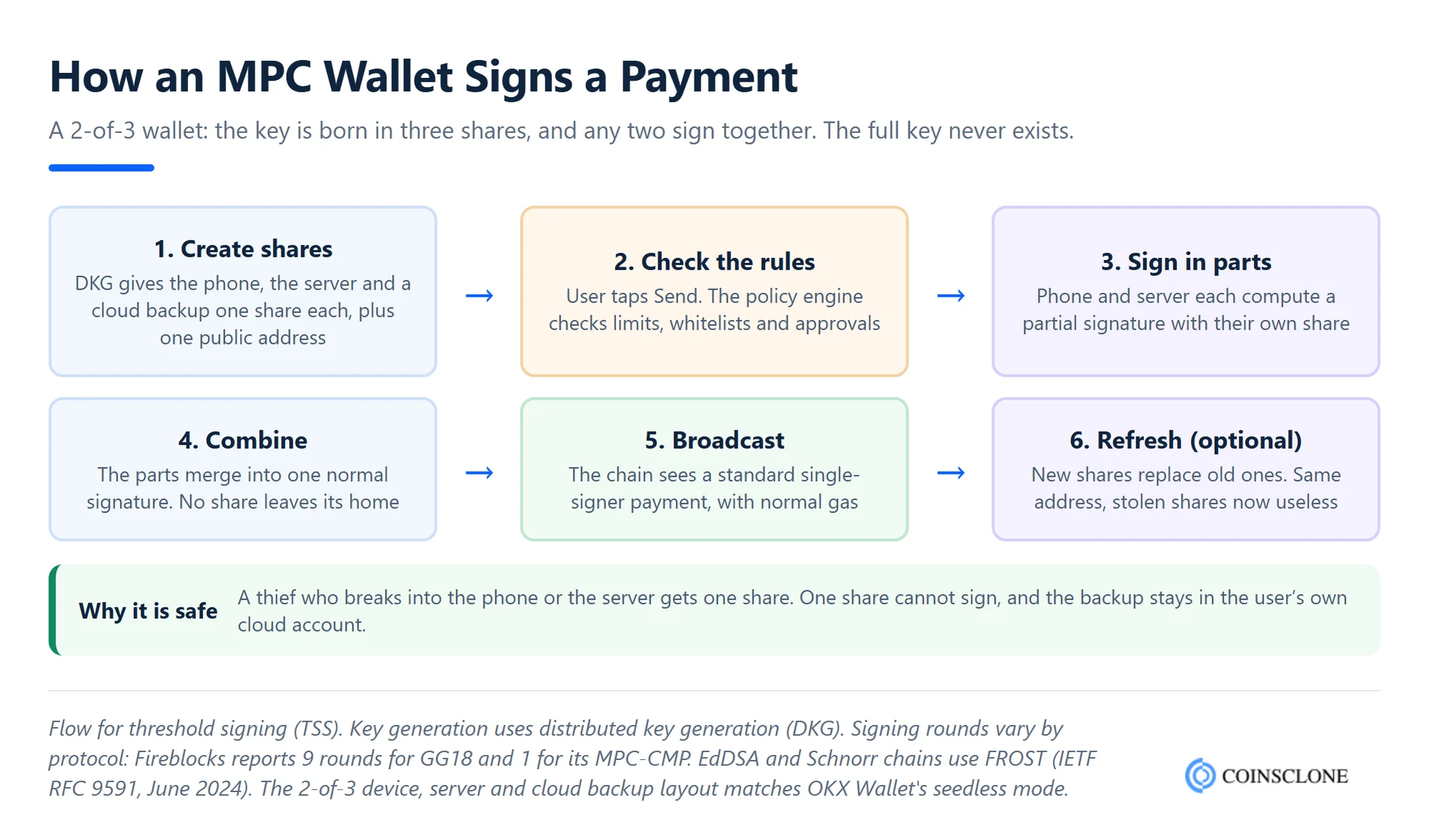
Most MPC wallets use a “threshold” rule written as t-of-n. For instance, a 2-of-3 wallet makes three shares, and any two can sign. So if one share is lost or stolen, the wallet still works, and the thief still cannot move funds.
Better MPC wallets can also run a share refresh. This replaces every share with a new set while the address stays the same. After a refresh, an old or stolen share is worthless.
Why Choose an MPC Crypto Wallet Over Traditional Crypto Wallets?
Traditional crypto wallets rely on a single private key or seed phrase. Whoever holds it owns the funds, and whoever loses it loses the funds. MPC crypto wallets, however, spread key control across several parties. Even if one share is exposed, your digital assets stay safe.
Advantages of MPC Wallets:
- No single point of failure: no device, server or person ever holds the full key.
- Cross-chain support: the same MPC engine can sign for Bitcoin, Ethereum, Solana and other chains.
- Team control: firms and DAOs can ask for two or more sign-offs before any payment leaves.
- Lower fees than multisig: the chain sees one signature, so there is no extra on-chain cost per signer.
- Flexible rules: you can add or remove signers without moving funds to a new address.
- DeFi and dApp access: users can stake, lend and swap from the same wallet.
MPC vs Multisig vs Traditional Wallets
Let’s compare a normal crypto wallet, a multisig wallet and an MPC crypto wallet side by side.
| Feature | Traditional Crypto Wallet | Multisig Wallet | MPC Crypto Wallet |
| Private Key Management | Single private key | Several full keys, one per signer | Key shares spread across parties; no full key exists |
| Where the Rule Lives | Not needed | On-chain, in a smart contract or script | Off-chain, in the MPC protocol and policy engine |
| Security Risk | Single point of failure | Low, but each signer key is a full key | Very low, if the MPC code is well built and audited |
| Transaction Approval | One user approves | Several signatures on-chain | Parties compute one signature together |
| On-Chain Cost | Normal | Higher, grows with signers | Normal, same as a single signature |
| Blockchain Support | Any chain | Chain-specific (Safe on EVM chains, native on Bitcoin) | Most chains, by signature type |
| Transparency | Simple | High, anyone can verify signers on-chain | Lower, rules are not visible on-chain |
| Best Suited For | Individual users | DAOs and teams that want on-chain proof | Exchanges, fintechs, consumer apps, custodians |
Note that MPC is not “always safer” than multisig. Multisig gives public, on-chain proof of who signed. MPC gives lower fees, more chains and easier recovery. Many firms use both: MPC for daily hot wallets and multisig for the treasury.
How to Choose an MPC Protocol and Key-Share Setup
This is the most important design choice in MPC wallet development, and most guides skip it. Two decisions shape the whole build.
1. Pick the Signing Protocol
Each chain uses one type of signature, and each type needs its own MPC protocol:
- ECDSA chains (Bitcoin, Ethereum and EVM chains, Tron): older wallets used GG18 and GG20. Newer builds use faster, safer designs such as CGGMP or DKLs. For example, Fireblocks says its MPC-CMP protocol signs in 1 round, against 9 rounds for GG18.
- EdDSA and Schnorr chains (Solana, Aptos, Sui, Bitcoin Taproot): use FROST, which the IETF published as a standard in RFC 9591 in June 2024.
Key point: never write MPC cryptography from scratch. Use a trusted, well-tested code base and get it audited. In August 2023, Fireblocks researchers disclosed BitForge, a set of flaws in GG18, GG20 and Lindell17 code used by more than 15 wallet providers, blockchains and open-source projects. Fireblocks warned them 90 days before going public so they could patch, but the lesson stands: the code matters as much as the math.
2. Pick Where Each Key Share Lives
The share setup decides who controls the funds, how recovery works and which rules apply to you.
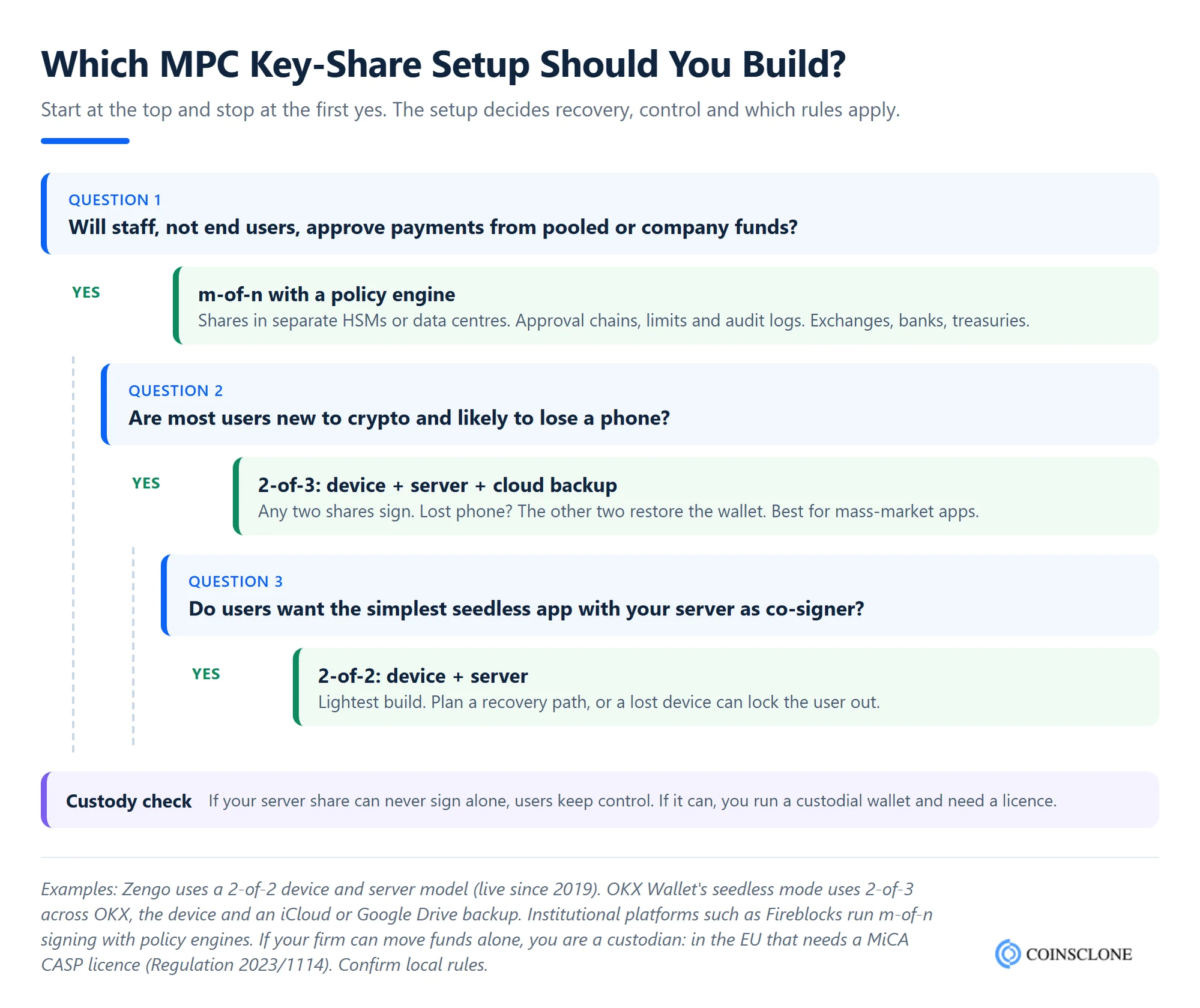
- 2-of-2 (device + server): the user’s phone holds one share and your server holds the other. Zengo, a consumer MPC wallet since 2019, made this model popular, and it says no Zengo wallet has ever been hacked or phished.
- 2-of-3 (device + server + backup): a third share sits in the user’s iCloud or Google Drive, so any two can sign. OKX Wallet’s seedless mode uses this layout. It makes “I lost my phone” a five-minute fix.
- m-of-n with a policy engine: used by exchanges, banks and custodians. Shares sit in different data centres or in secure hardware (HSMs). Rules set caps, safe address lists and sign-off chains.
Custody check: MPC describes how signing works, not who owns the funds. If your firm can move funds on its own, you run a custodial wallet. That often needs a licence, such as an EU CASP licence under MiCA. If you hold a share but cannot sign alone, your wallet is closer to self-custody. Always confirm with a lawyer in each market.
Coinsclone’s MPC Wallet Development Services
At Coinsclone, we offer full MPC crypto wallet development services shaped around your needs and ideas. Whether you’re a startup or a large firm, we have a wallet that fits.
Services We Offer:
- White Label MPC Wallet: a fully branded, ready-to-launch MPC wallet you can take live in weeks.
- Multi-Chain MPC Wallet: manage Bitcoin, Ethereum, BNB Chain, Solana, Tron and more from one app.
- Wallet-as-a-Service (WaaS): offer your users secure wallets through an API or SDK inside your own product.
- DeFi-Integrated MPC Wallet: add staking, lending and swaps straight into your MPC crypto wallet.
- Custody Wallets for Firms: m-of-n signing, sign-off flows and audit logs for funds, banks and big firms.
- Mobile and Web Wallets: smooth access on iOS, Android, browser and desktop.
White Label MPC Wallet vs Custom Build vs WaaS
There are three ways to launch, and each fits a different business:
- Wallet-as-a-Service SDK: fastest to start, but you pay per user each month and depend on the provider’s key servers. Big players have been changing hands: Stripe bought Privy in 2025, and Fireblocks bought Dynamic.
- White label MPC wallet: a tested MPC core with your brand, chains and features. Coinsclone launches white label wallets in 3 to 5 weeks, and you own the product.
- Custom MPC wallet: your own protocol choices, policy engine and features. A custom Coinsclone wallet takes 8 to 12 weeks.
Most startups start with white label, prove demand, then add custom features. If you need a seedless consumer app, our Zengo wallet clone is a ready base, and our white label crypto wallet covers broader multi-chain needs.
Key Features of Our MPC Wallet Solution
A strong MPC wallet is not just about the key. Here is what our solutions include:
- Distributed Key Management: keys are born in shares through DKG and stored on separate devices and nodes.
- Share Refresh and Recovery: rotate shares on a schedule and restore access after a lost phone, with no seed phrase.
- Many Chains and Coins: hold and trade crypto, stablecoins and NFTs on many chains.
- Rules Engine: spending caps, safe address lists, time locks and sign-off by more than one person.
- Strong Sign-In: biometrics, passkeys, multi-factor checks and device binding.
- Clear Signing Screens: plain-language previews of every payment, so users see what they approve.
- White Label Branding: your design, your tokens, your rules.
- DeFi and dApp Access: WalletConnect, swaps, staking and lending inside the app.
- WaaS and API Access: add wallet functions to your existing app or platform.
- Compliance Tools: KYC, wallet screening, Travel Rule messaging and full audit logs.
How Our MPC Crypto Wallet Development Process Works
Our MPC crypto wallet process blends security, flexibility and scale. Here are the steps:
- Scope and Plan: we learn your goals, your users, your chains and who will hold the keys.
- Architecture and Tech Stack Design: we pick the MPC protocol, the t-of-n setup, where each share lives and the backend design. This also covers HSMs or secure enclaves for server shares and the policy engine.
- UI/UX Design: we design simple screens for sign-up, getting a wallet back and approving payments. Good recovery screens matter more in MPC wallets than anywhere else.
- Build: we code the backend, the MPC signing service, node links and the phone and web apps. Then we connect swaps, staking and fiat on-ramps.
- Test and Audit: hack tests, a review of the MPC math, code audits and load tests. Learn more in our guide to crypto wallet security.
- Deployment: we launch your MPC crypto wallet with monitoring, alerts and key-share backups in place.
- Support and Feature Updates: we patch libraries, refresh shares, add chains and ship new features as you grow.
Challenges in MPC Wallet Development (and How to Solve Them)
MPC removes the single key, but it brings its own risks. Plan for these from day one:
- Code flaws in the protocol: as BitForge showed, a missing proof check can leak a full key. Fix: use audited, current libraries and have a cryptography firm review your build.
- Fake signing screens: in February 2025, thieves stole about $1.5 billion from Bybit. They swapped the screen its staff used to sign a multisig payment. The math held, but the people were tricked. Fix: show each payment in plain words, test-run it first, and check it on a second device.
- Server downtime: if your server share is offline, users cannot sign. Fix: run the signing service across regions and keep a 2-of-3 backup path.
- Weak recovery: if a user loses a share and you never set up a backup, the funds are gone. Fix: design recovery first, then test it with real users.
- Speed: signing needs several network rounds, so it is slower than one local signature. Fix: newer one-round protocols and nearby servers keep signing under a second or two.
Use Cases and Industries Served by Our MPC Wallet Solutions
Our MPC wallets serve many kinds of business:
- Fintech and Banking: sign-off by more than one person for company and client funds.
- Crypto Exchanges and Custodians: large hot and warm wallets with spread-out key control.
- Payment Gateways: merchant wallets that sign payouts without a single key on a server.
- DeFi Apps and DAOs: safe fund moves and staking sign-offs.
- Consumer Apps and Games: seedless wallets that let users sign in with email or Face ID.
- Large Firms: follow the rules while keeping crypto safe.
Benefits of Launching an MPC Crypto Wallet
Demand for MPC wallets keeps rising, because users want strong security without the stress of a seed phrase. For startups and firms, this opens a clear business case.
Robust Security
MPC wallets remove the single key that hackers target. This builds trust, and trust is what makes users store real money in your app.
No One Sees the Whole Key
Each party only sees its own share. Neither your server nor the user’s device ever learns the full key, which cuts the risk of insider theft and fraud.
No Lost-Phrase Disasters
In a 2-of-3 setup, losing one share does not lock anyone out. The other two shares can still sign, refresh the set and move the user to a new device.
Easy Backup
Backups are built into the design. A user’s backup share can sit in their own cloud account, encrypted, ready for the day they need it.
Simple for Beginners
Users can sign in with email, a passkey or Face ID, just like a banking app. So crypto beginners feel at home, and that drives sign-ups.
Several Ways to Earn
MPC wallets can earn from swap fees, staking commissions, on-ramp revenue and premium plans. Our guide on how crypto wallets make money covers each model.
Best MPC Wallets of 2026
Studying live products is the best way to shape your own business model. Here are some leading MPC wallets in 2026:
Zengo: the first big consumer MPC wallet, live since 2019. It uses a 2-of-2 setup with no seed phrase, and Zengo says no Zengo wallet has ever been hacked or phished. Create your Zengo Wallet Clone and give your users password-free crypto security.
Fireblocks: the leading MPC platform for institutions. Exchanges, banks and payment firms use its MPC-CMP signing, policy engine and wallet APIs.
OKX Wallet: offers a seedless mode that splits the key into three shares across OKX, the user’s device and a cloud backup.
Coinbase Developer Platform: gives apps embedded and server wallets so they can add crypto payments without building key storage themselves.
Cobo and Safeheron: MPC custody and wallet platforms for funds, exchanges and Web3 firms, with policy controls and audit logs.
Also Read: Know the Best Crypto Wallets in the Market
You can take any of these MPC wallets as a business model. However, many founders worry about the cost, so here is what an MPC wallet costs in 2026.
MPC Wallet Development Cost and Timeline in 2026
MPC wallets cost more than basic wallets, because the signing service, key-share storage and audits are extra work. Published 2026 market estimates put a custom MPC wallet MVP at about $80,000 to $150,000, a mid-level product at $150,000 to $300,000, and enterprise custody at $300,000 or more.
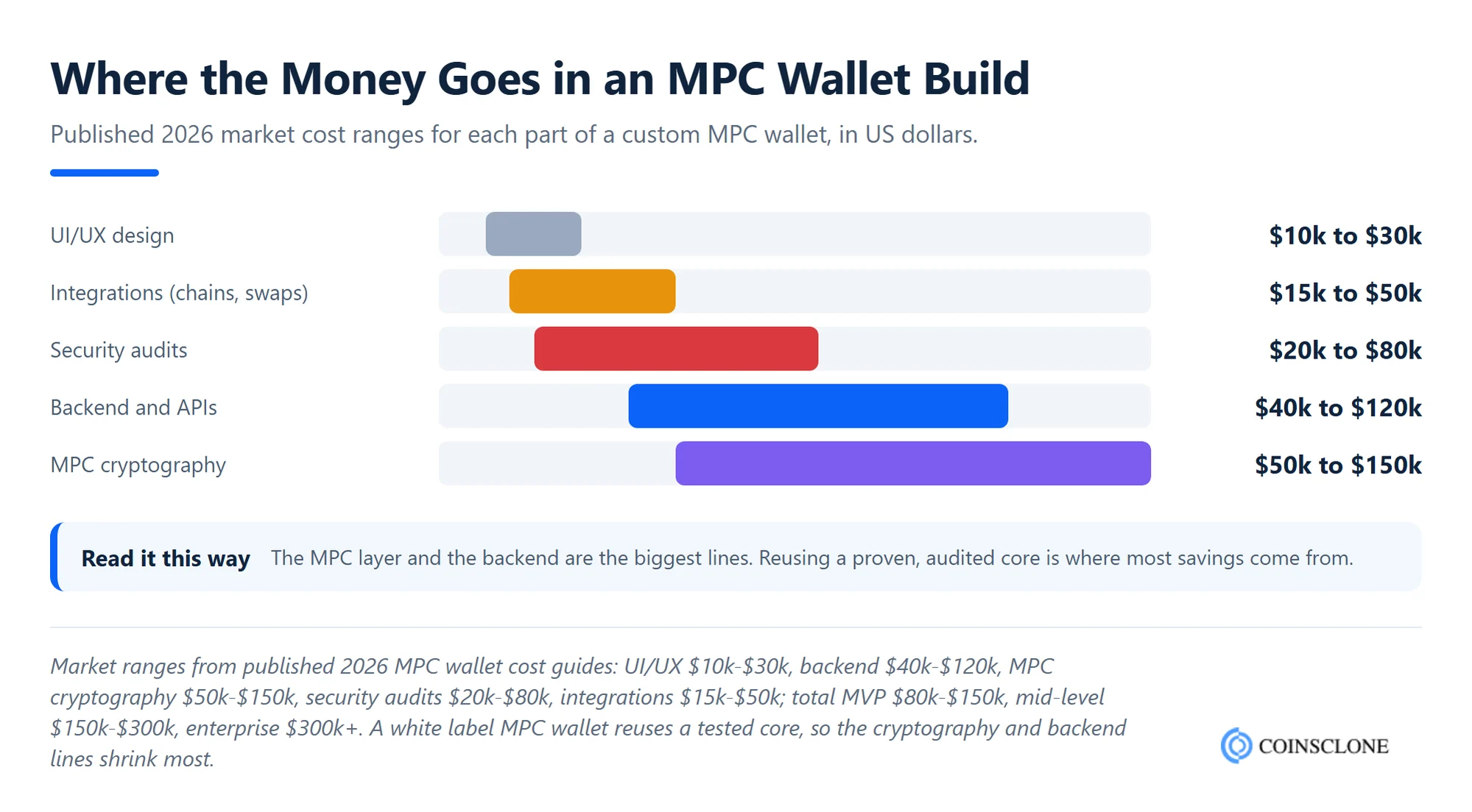
The biggest cost driver is the MPC layer itself. Next come the number of chains, the policy engine, compliance tools and the depth of your audits. Plan also for running costs: servers for the signing service, node or RPC fees, monitoring and yearly audits.
A white label MPC wallet cuts both cost and time, because the hard parts are already built and tested. Here is how long each path takes:
| Build Path | Typical Timeline |
| Wallet-as-a-Service SDK in your app | Days to a few weeks, plus monthly per-user fees |
| Coinsclone white label MPC wallet | 3 to 5 weeks |
| Coinsclone custom MPC wallet | 8 to 12 weeks |
| Enterprise custody platform (market) | 6 months or more |
For a full breakdown, read our guide on how much it costs to create a crypto wallet.
Why Choose Coinsclone as Your MPC Wallet Development Company?
Coinsclone is a leading crypto wallet development company that builds secure wallets at a fair cost. Our team of blockchain coders, designers and testers knows what it takes to run a wallet that holds real money. We pair technical skill with a deep grasp of crypto security:
- Building blockchain products since 2018, with 350+ platforms delivered.
- 200+ clients across 20 industries.
- In-house teams that build wallets and MPC signing.
- Fast launches: white label wallets in 3 to 5 weeks, custom wallets in 8 to 12 weeks.
- White label wallets with bank-grade security and built-in KYC tools.
If you want a seedless, multi-chain MPC wallet under your own brand, Coinsclone can design, build and launch it with you, from protocol choice to app store release.
Other Related Contents to know, Custodial Wallet Vs Non-Custodial Wallets: Know the Differences!
Frequently Asked Questions
What is an MPC wallet?
An MPC wallet is a crypto wallet that splits its private key into shares held by different parties, such as a phone, a server and a backup. The parties sign payments together, so the full key never exists in one place.
Is an MPC wallet safe?
Yes, when it is built well. No single device or server can be hacked to steal the key. However, safety depends on audited MPC code, a solid recovery setup and clear signing screens, since bugs and tricked users are the main risks.
MPC wallet vs multisig wallet: what’s the difference?
A multisig wallet uses several full keys and checks their signatures on-chain through a smart contract or script. An MPC wallet uses shares of one key and creates a single signature off-chain. So MPC is cheaper and works on more chains, while multisig is easier to verify publicly.
Is an MPC wallet custodial or non-custodial?
It can be either. MPC only describes how signing works. If the provider can move funds alone, it is custodial. If the user keeps enough shares to sign and recover without the provider, it is non-custodial.
What happens if I lose my phone with an MPC wallet?
In a 2-of-3 setup, you use your server share and your cloud backup share to restore the wallet on a new phone. A share refresh then makes the lost phone’s share useless. In a 2-of-2 setup without a backup, recovery depends on how the provider designed it.
How long does MPC wallet development take?
With Coinsclone, a white label MPC wallet takes 3 to 5 weeks and a custom MPC wallet takes 8 to 12 weeks. Big custody platforms for banks often take six months or more.
How much does MPC wallet development cost?
Published 2026 market estimates range from about $80,000 to $150,000 for a custom MPC wallet MVP, up to $300,000 or more for enterprise custody. A white label MPC wallet costs less. Contact us for a quote based on your features.
Can an existing wallet be upgraded to MPC?
Yes. Users keep their old funds, and the app creates new MPC addresses and moves balances across. You can also run both models side by side during the switch.
Which blockchains can your MPC wallets support?
Bitcoin, Ethereum, BNB Chain, Polygon, Tron, Solana and other EVM and non-EVM chains, based on your needs. ECDSA chains use protocols such as CGGMP or DKLs, and EdDSA chains such as Solana use FROST.
See How Our MVP System Can Launch Your MPC Crypto Wallet Faster
MPC Crypto Wallet Development — done right.
- MVP System : Launch your MPC-based crypto wallet 90% faster.
- Secure Modules : Pre-built wallets, multi-party computation security, and token management—no coding needed.
- Brand & Customization : Your design, your tokens, your rules.
- Revenue Engine : Earn from transaction fees, staking, and integrated services.
Get a free branded demo of your MPC crypto wallet in 48 hours — before you invest a cent.
Book a Free Demo to discover how our MPC Crypto Wallet Development Company can take you from idea to live wallet in just 8–12 weeks.