

If you plan to launch your own token, the people who write the code matter more than the idea. This guide shows you how to hire crypto token developers step by step: what to ask, which skills to check, what it costs in 2026 and how long a token takes to build.
A token contract is short, but it holds real money the day it goes live, and a live contract cannot be quietly fixed. So the goal is not just to find a coder. It is to find a team that plans the token, tests it, gets it audited and hands you the keys safely.
In this guide:
- A 7-step process to hire crypto token developers, from scope to a paid test task.
- The skills and tools a good token developer uses in 2026, by chain.
- Real 2026 rates, audit costs and a worked budget for two token sizes.
- Build times by scope, red flags to avoid and the questions to ask before you sign.
Hire Expert Token Developers — Build Your Token Fast & Securely
Token Development — done right.
- Multi-Chain Expertise: ERC20, TRC20, BEP20, and custom blockchain tokens.
- Smart Contract Precision: Secure, audited, and fully compliant code.
- Custom Utility & Governance Tokens: Tailored to your project goals.
- End-to-End Support: From token creation to deployment and listing.
Get your fully functional token developed in just days — no technical experience needed.
Book a Free Consultation to discover how our expert token developers can bring your blockchain vision to life faster.
How to Hire Crypto Token Developers
Here are the seven steps to follow before you choose a crypto token developer. Take them in order, because each one makes the next step easier.
1. Frame your token business needs
Be clear on your business plan before you talk to any developer. Tokens are built for many reasons, such as raising funds, rewards, voting, payments inside an app or a listing on an exchange. Each reason leads to a different contract, so write yours down first.
Then fix the basics at the start:
- Chain: Ethereum, BNB Chain, Solana, Tron, Base or some other chain.
- Token type: a utility, voting, reward, stable, security or NFT token.
- Supply: fixed or mintable, with or without a burn.
- Sale and release: a presale, an airdrop, locked shares for the team and backers, or a DEX pool.
- Extra features: staking, fees, governance voting or a claim page.
Share this plan with the developer before you ask for a quote. A clear brief gets you a clear price.
2. Choose how you will hire
You can hire a freelancer, hire in-house or work with a token development company. A freelancer suits a small, fixed task. An in-house hire suits a long roadmap. A company suits a full launch, since it brings the coder, tester, designer and audit lead as one team. We compare all three in the table further down.
3. Get a consultation
Study the market and shortlist a few teams. Look for years of work on tokens, sound tech skills and a record of live contracts you can check on a block explorer. Agree on the cost, the scope and the key people at this stage to avoid confusion later.
Get the contact details of the tech team head for later reference. Also, do not blindly trust a “crypto token developer for hire” banner. Crypto still has many scammers. Thieves took more than $3.4 billion in crypto in 2025 up to early December, Chainalysis reports, so check every claim.
4. Check their tech skills
Ask for a GitHub profile, past contract addresses and any audit reports their code has passed. Make sure they know the language of your chain: Solidity for Ethereum and other EVM chains, or Rust for Solana. They should also know the front end and the tools used to test and deploy contracts. The full skills list is in the next section.
5. Test with a small paid task
A short paid task tells you more than any interview. For example, ask the developer to write a token with a vesting schedule and tests, or to review a sample contract and list its risks. Many hiring platforms now build a trial into the deal. For example, Lemon.io offers a paid, no-risk trial of up to 20 hours.
6. Keep communication open and clear
Stay in touch with your token developers while they build. Ask for a weekly demo on a testnet and a shared task board. This way, technical issues get sorted out early, and you always know where the work stands.
7. Plan for the audit, launch and support
Ask who will arrange the external audit and who fixes what the auditor finds. Also ask how the keys will be handed over. Admin powers, such as minting or pausing, should sit on a multisig wallet that you control, not on one person’s laptop.
Finally, make sure support and maintenance are part of the quote. As your project grows, you may want staking, a bridge to another chain or new features. A team that already knows your code can add them faster and with less risk.
These are the main things to check before you hire a crypto token developer. Next, let’s see whether you need one at all, and what kind.
Why Should You Hire Crypto Token Developers For Token Creation?
You can deploy a basic token with a no-code token generator in a few minutes. So why hire a developer? Because most real projects need more than a basic token. Here are the main benefits:
- End-to-end support: Crypto token developers plan the supply, write the contracts, test them and help with the launch. A token generator stops once the token is live.
- Custom logic: Vesting, presales, staking, fees and voting need custom code that generators do not offer, or offer only in fixed forms.
- Better security: A skilled developer writes tests, fixes risky patterns before the audit and sets up safe admin controls.
- Cost control: Good coders reuse tested, open-source parts, such as OpenZeppelin Contracts, rather than write all the code from scratch. This keeps the cost down.
That said, not every token needs the same team. The decision tree below helps you match your project to the right kind of help.
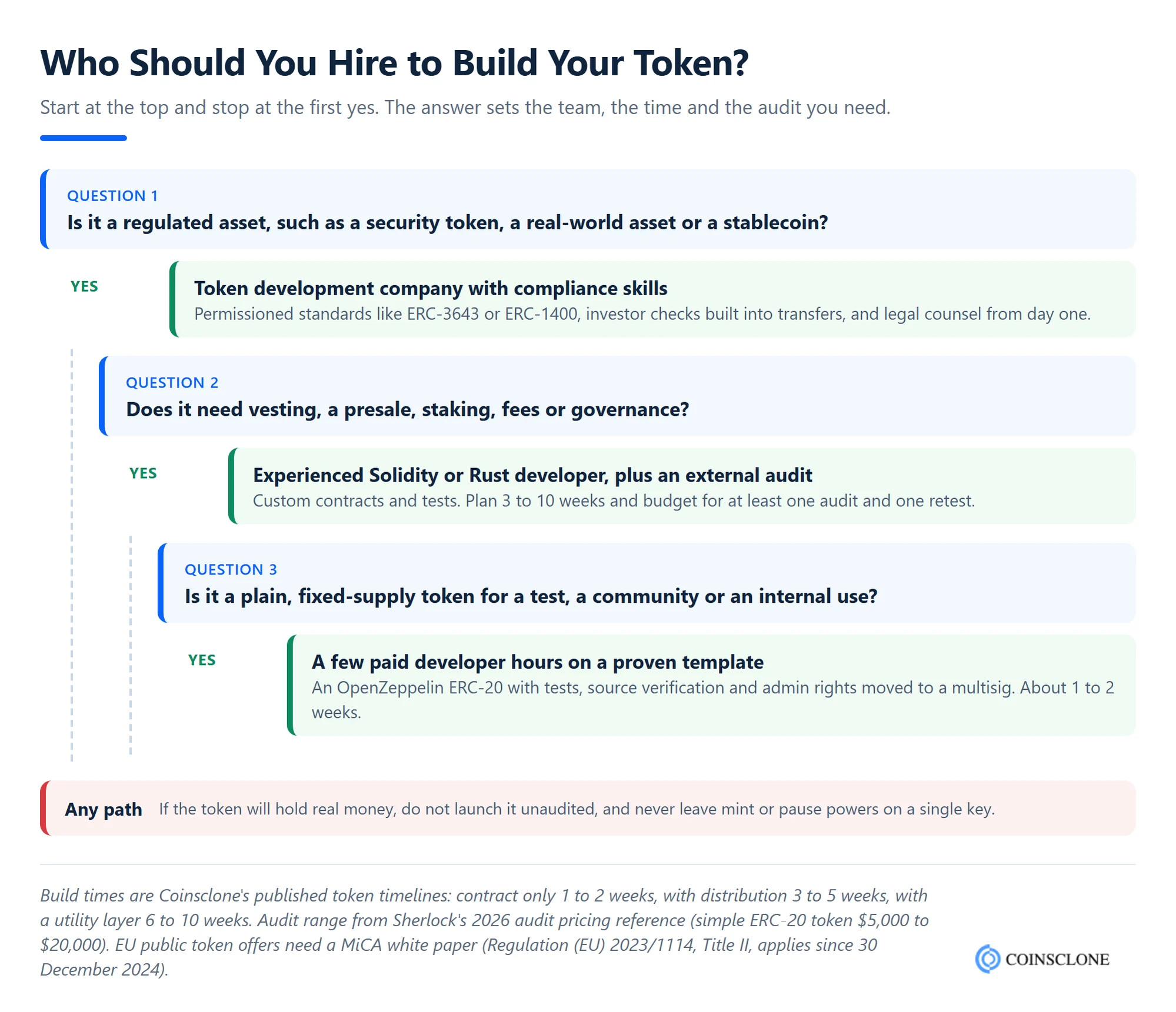
Freelancer, In-House or Token Development Company?
Each hiring option has its place. The right one depends on the size of your token project and how long the work will last.
| Option | Best for | Strengths | Watch out for |
| Freelance token developer | A small, fixed task, such as a simple token or a contract review | Fast to start, low cost for short work | No backup if they leave; you manage the audit and launch yourself |
| In-house developer | A long roadmap with steady token work | Full focus, deep product knowledge | Hiring can take 4 to 8 weeks; you pay salary even when the work slows |
| Token development company | A full launch with tokenomics, vesting, audit and listing prep | A whole team, set timelines, audit managed for you | Higher cost per hour; check their past launches carefully |
For broader blockchain roles, such as exchange or wallet developers, see our guide to hiring blockchain developers.
Skills to Look for in a Crypto Token Developer
A strong token developer combines coding skill with a security mindset. Look for these skills when you review profiles and run interviews:
- Smart contract languages: Solidity for EVM chains such as Ethereum, BNB Chain, Polygon and Base. Rust for Solana programs.
- Token standards: ERC-20 for fungible tokens, ERC-721 and ERC-1155 for NFTs, BEP-20 on BNB Chain, TRC-20 on Tron, and SPL or Token-2022 on Solana. For regulated assets, ERC-3643 or ERC-1400.
- Testing tools: Foundry or Hardhat for unit tests, fuzz tests and gas reports.
- Security tools: Slither or a like code scanner, plus a solid grasp of common bugs such as reentrancy and weak access rules.
- Web3 libraries: ethers.js, viem or web3.js, so the token works with wallets and your app.
- Tokenomics: supply, vesting and emission plans that hold up after launch, not just on launch day.
- Safe launch: code checked on the explorer, admin rights on a multisig and time locks on key functions.
One warning sign: some older guides still list Truffle or Embark as key tools. Consensys retired Truffle in 2023, so a developer who only knows it may not have kept up.
The table below shows what to ask for on each popular chain.
| Chain | Token standard | Language | Common tools |
| Ethereum, Base, Arbitrum, Polygon | ERC-20, ERC-721, ERC-1155 | Solidity | Foundry, Hardhat, OpenZeppelin |
| BNB Chain | BEP-20 | Solidity | Foundry, Hardhat, OpenZeppelin |
| Tron | TRC-20 | Solidity (TVM) | TronBox, TronWeb |
| Solana | SPL Token, Token-2022 | Rust | Anchor, Solana CLI |
Questions to Ask Before You Hire
Good questions show you how a developer thinks, not just what they know. Here are the ones worth asking:
- Past work: Which tokens have you built? Can you share the contract addresses?
- Security: How do you protect a token from reentrancy, overflow and admin key theft?
- Testing: What test coverage do you aim for, and do you use fuzz tests?
- Audits: Have your contracts passed an external audit? Can we read the report?
- Gas: How do you keep transfer and claim costs low for users?
- Launch: How will you deploy, verify the source and pass admin rights to our multisig?
- After launch: What support do you offer, and how fast do you respond to an incident?
Red Flags When You Hire Token Developers
Watch for these signs before you sign a contract:
- No live work: They cannot show a single deployed contract or GitHub repo.
- No tests: They plan to skip testing or say an audit is “not needed”.
- Key control: They want to keep the admin or minting keys after launch.
- Hidden code: They will not verify the source code on the block explorer.
- Big promises: They promise listings on top exchanges or a set token price.
- Odd payment terms: They ask for full payment up front in crypto, with no milestones.
How Much Does It Cost To Hire Crypto Token Developers?
The cost to hire a crypto token developer in 2026 depends on experience, region and how you hire. Here are typical rates from the hiring market:
| Experience or source | Typical rate |
| Junior, 0 to 2 years (Arc 2026 guide) | $20 to $50 per hour |
| Mid-level, 2 to 5 years (Arc) | $50 to $100 per hour |
| Senior, 5+ years (Arc) | $100 to $250+ per hour |
| Vetted senior on Lemon.io | From $55 per hour |
| In-house in India (Glassdoor, Oct 2026) | Median base about INR 7.4 lakh a year |
However, the hourly rate is only part of the budget. Any token that holds real value also needs an external audit. Sherlock’s 2026 audit pricing reference puts a simple ERC-20 token audit at $5,000 to $20,000. Each extra audit pass costs $5,000 to $20,000 more, and a Solana audit costs 25% to 40% more.
So, for a small token, the audit can cost more than the code itself. The worked example below shows how the two add up.
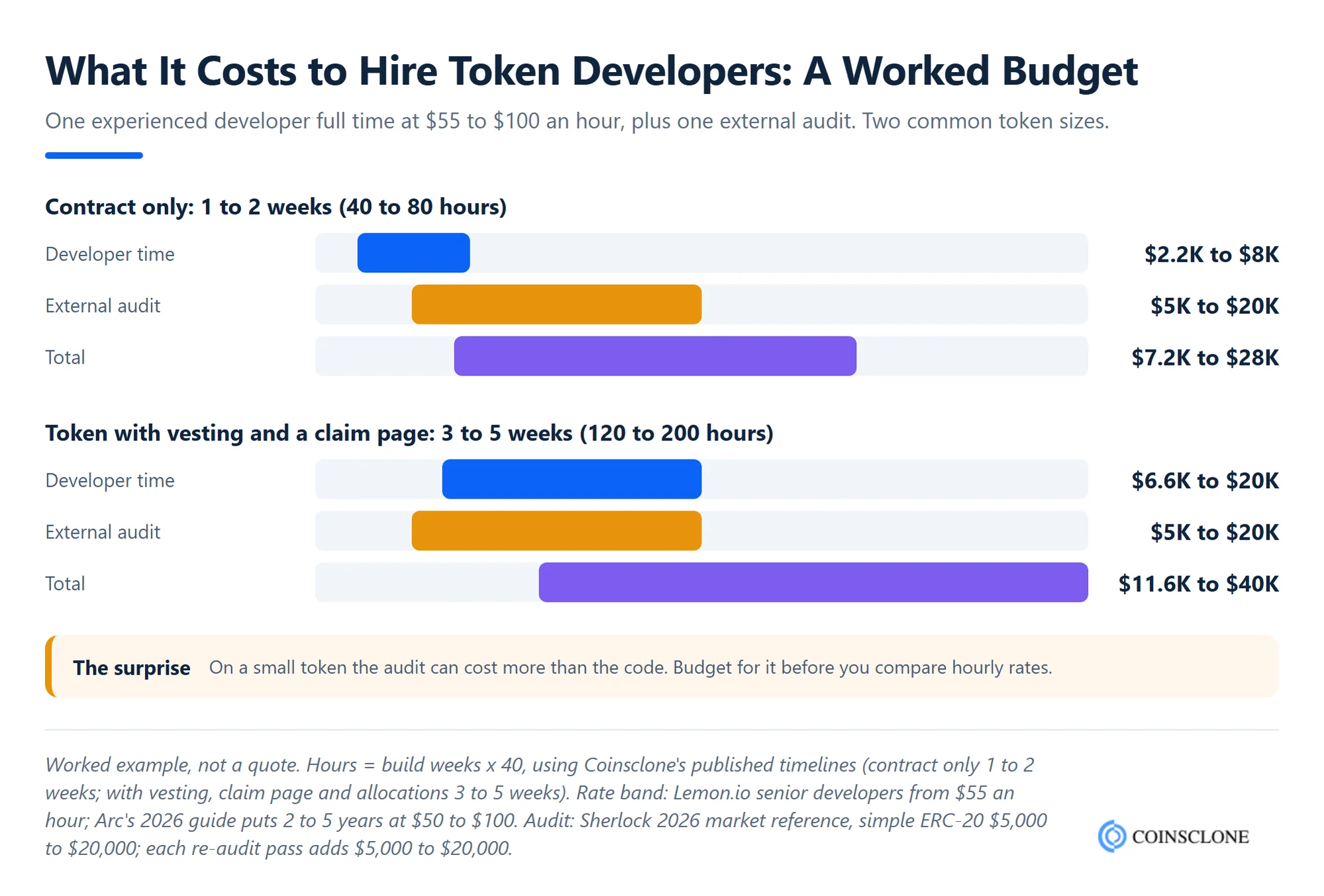
Several factors push the cost up or down:
- Scope: Vesting, staking and governance each add contracts, tests and audit time.
- Chains: Every extra chain is separate work, with its own standard and tools.
- Experience: Senior developers cost more per hour but often finish faster and with fewer audit findings.
- Outside tools: Paid scan tools, node access and alerts add small monthly costs.
- Launch extras: Claim pages, dashboards and listing prep add front-end work.
For a full breakdown of the price of building a token, read our guide on the cost to create a crypto token.
How Long Does It Take to Build a Crypto Token?
Time depends on scope more than on the chain. These are the build times Coinsclone publishes for its token projects:
| Scope | Build time | What it includes |
| Contract only | 1 to 2 weeks | Token, tests, source verification and mainnet launch |
| Contract plus distribution | 3 to 5 weeks | Vesting, claim page, allocations and audit |
| Contract plus utility layer | 6 to 10 weeks | Staking, product integration, governance and audit |
| Complete token stack | 3 to 5 months | Several contracts, dashboards, multi-chain reach and a DAO layer |
The external audit and its fix-and-retest loop set the floor on these times. Complex unlock plans and extra chains add more. If you also want to learn the build steps yourself, see our guide on how to create a crypto token.
Finally, check the rules where you plan to sell. In the EU, the MiCA regulation has required a crypto-asset white paper for most public token offers since 30 December 2024. Your developer is not your lawyer, so bring in legal advice early.
Why Should You Hire Crypto Token Developers From Coinsclone?
As a leading crypto token development company, Coinsclone has been building since 2018. We have delivered 350+ platforms for 200+ clients across 20 industries. Our token developers have built many kinds of tokens to fit each client’s needs.
Here is how we work on a token project:
- Demand first: We plan the reason to hold your token before we size the supply.
- Tested code: Every contract gets automated tests, gas reports and manual review.
- Audit managed: We arrange the external audit, fix the findings and get them checked again.
- Your keys: Minting, pausing and treasury powers move to your own multisig before launch.
- Modern stack: Solidity, Rust, Foundry, Hardhat, OpenZeppelin, ethers.js and Web3.js.
Coinsclone can ship a contract-only token in 1 to 2 weeks, and a token with vesting, a claim page and an audit in 3 to 5 weeks.
Some of our crypto token creation services are listed here.
Services Offered By Our Crypto Token Developers
Our wide range of crypto token creation services includes:
- Ethereum Token Creation: Our team creates ERC-20 tokens and NFTs on Ethereum and its layer 2 chains, like Base and Arbitrum, for token sales, rewards and voting.
- Tron Token Creation: We build TRC-20 tokens on Tron, which offers fast transfers and low fees.
- BNB Token Creation: Our developers create BEP-20 tokens on BNB Chain, one of the most used networks for new tokens.
- Solana Token Creation: We build SPL and Token-2022 tokens for projects that need high speed and very low fees.
- DeFi Token Solutions: We build governance, staking and reward tokens for DeFi platforms on any major chain.
- NFT Development: Our team turns your digital and real-world assets into NFTs.
- BRC-20 Token Creation: We create BRC-20 tokens on the Bitcoin network at a fair cost.
Contact our business team to design your crypto token today!
Hire Expert Token Developers — Build Your Token Fast & Securely
Token Development — done right.
- Multi-Chain Expertise: ERC20, TRC20, BEP20, and custom blockchain tokens.
- Smart Contract Precision: Secure, audited, and fully compliant code.
- Custom Utility & Governance Tokens: Tailored to your project goals.
- End-to-End Support: From token creation to deployment and listing.
Get your fully functional token developed in just days — no technical experience needed.
Book a Free Consultation to discover how our expert token developers can bring your blockchain vision to life faster.
Frequently Asked Questions
How much does it cost to hire a crypto token developer?
Rates run from about $20 an hour for a junior developer to $100 to $250 an hour for a senior one, based on Arc’s 2026 guide. Vetted senior developers on Lemon.io start at $55 an hour. Add $5,000 to $20,000 for an external audit of a simple token.
Can I hire someone to create a crypto token for me?
Yes. You can hire a freelancer, an in-house coder or a token development company. For a token that will hold real money, choose someone who writes tests, arranges an external audit and hands the admin keys to you at launch.
What skills should a crypto token developer have?
A good token developer knows Solidity for EVM chains or Rust for Solana, the main token standards, and testing tools such as Foundry or Hardhat. They should also know common security bugs, token supply design and safe launch steps, such as a multisig for admin keys.
How long does it take to create a crypto token?
A simple contract-only token takes 1 to 2 weeks. A token with vesting and a claim page takes 3 to 5 weeks, and one with staking and governance takes 6 to 10 weeks. A complete token stack can take 3 to 5 months. The audit loop sets the minimum time.
Do I need a smart contract audit for my token?
If the token will hold or move real value, yes. A deployed contract cannot be quietly fixed, so an audit is your last check before launch. A simple ERC-20 audit costs about $5,000 to $20,000 in 2026.
Should I hire a freelancer or a token development company?
A freelancer works well for a small, fixed task, such as a basic token or a code review. For a full launch, a full-service team is safer. It brings coders, testers and the audit as one group, with set dates.