
ERC1155 token development is how teams build one smart contract that holds many kinds of tokens at once. A single ERC-1155 contract can run a game’s gold coins, its 5,000 health potions and its one-of-a-kind sword, all side by side. That is why the standard powers blockchain games, NFT editions, event tickets and even prediction market shares. This guide explains how ERC-1155 works, how it compares with ERC-20 and ERC-721, and what it costs to build one in 2026.
You will also see our own gas test, run on Ethereum on 16 October 2026, which shows where ERC-1155 really saves money and where it does not. Then we walk through the build steps, the security traps to avoid and the use cases that still work today.
In this guide:
- How it works: Token IDs, batch calls and the receiver check, with a worked game example.
- Real gas numbers: Giving a player 100 items costs 99% less when the items share one token ID.
- The right standard: A short decision tree for ERC-20, ERC-721, ERC-1155 and the newer ERC-6909.
- A clear build plan: Seven steps from idea to mainnet, plus the security checks that matter.
- Budget and timing: Market cost ranges and typical build times for an ERC-1155 project.
See How Our MVP System Can Launch Your Multi-Token Project Faster
ERC1155 Token Development — done right.
- MVP System: Build and deploy ERC1155 multi-token standards 90% faster.
- Smart Contract Ready: Fully audited, secure, and gas-efficient token architecture.
- Customization: One platform for your fungible & non-fungible assets.
- Revenue Engine: Enable trading, staking, and NFT marketplace integrations.
See a free demo of your ERC1155 project in 48 hours — before you invest a cent.
Book a Free Demo to discover how our ERC1155 Token Development Company can take you from idea to launch in just 2–4 weeks.
What Is ERC1155 Token Development?
ERC1155 token development is the work of designing, coding, testing and launching smart contracts that follow the ERC-1155 Multi Token Standard. These contracts run on Ethereum and on chains that use the same code, such as Polygon, BNB Chain, Arbitrum, Base and Avalanche.
ERC-1155 is not a draft or a niche idea. It is a Final standard on eips.ethereum.org, created in June 2018. Witek Radomski, then CTO of the gaming firm Enjin, wrote it with five co-authors. Their goal was simple. Games needed thousands of item types, and deploying a new contract for each one was slow and costly.
So ERC-1155 lets a single contract hold any mix of:
- Fungible tokens: Coins or points where every unit is the same, like ERC-20 tokens.
- Non-fungible tokens (NFTs): Items with a supply of one, like ERC-721 tokens.
- Semi-fungible tokens: Copies of the same item, such as 500 tickets for one concert. If you want to go deeper on this third type, read our guide to semi-fungible token development.
An ERC1155 token development team builds that contract, plus the parts around it: the metadata, the minting rules, the admin controls and the links to wallets and marketplaces.
How an ERC1155 Token Works
Every item in an ERC-1155 contract is just a token ID. The contract stores balances as “this wallet holds this many of this ID”. As a result, the total supply of an ID decides how it behaves. A supply of one makes it an NFT. A supply of a million makes it a coin.
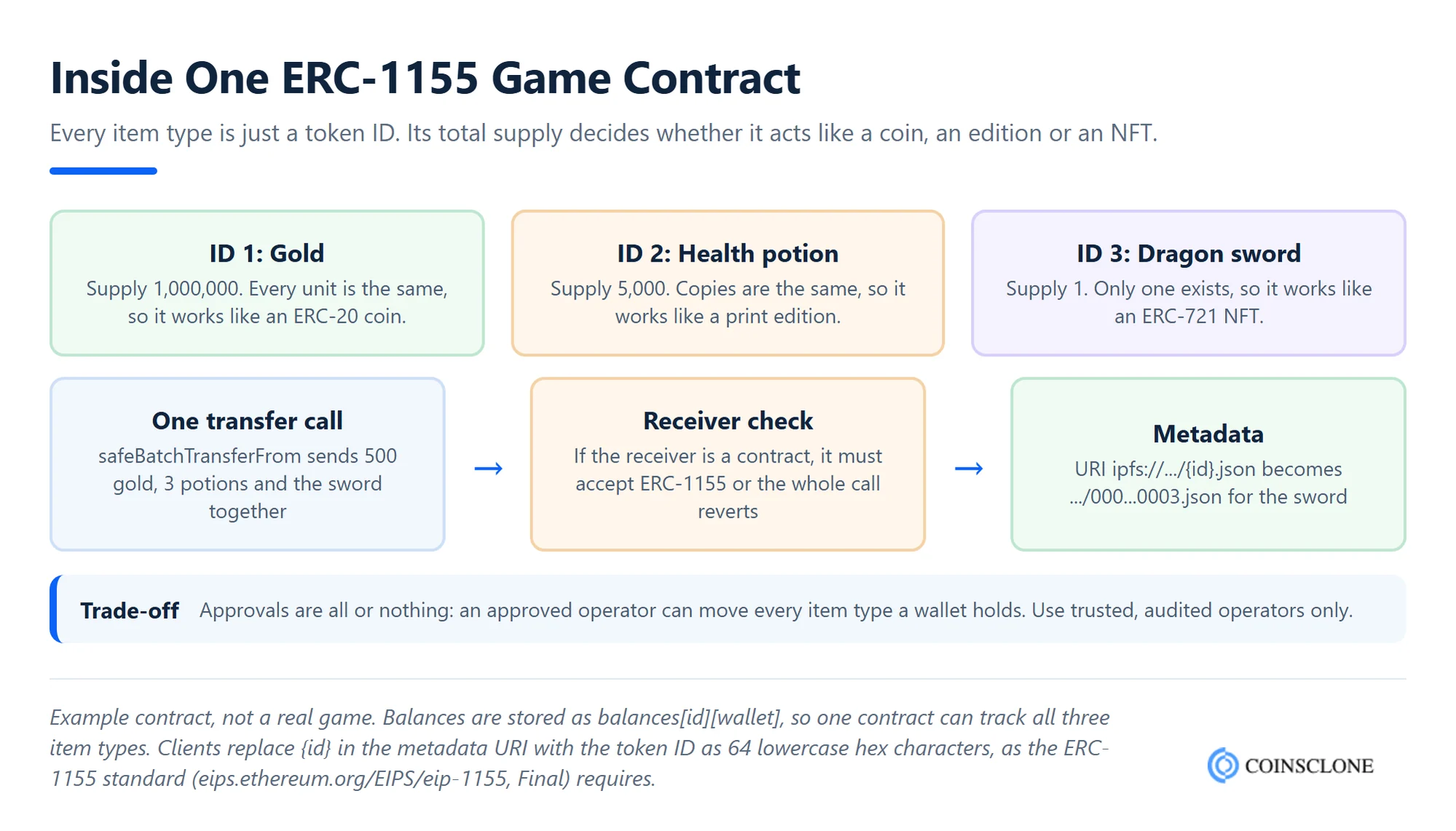
The standard defines a small set of functions that every ERC-1155 contract must have:
- safeTransferFrom: Sends an amount of one token ID to another address.
- safeBatchTransferFrom: Sends many token IDs and amounts in one call.
- balanceOf and balanceOfBatch: Read one balance, or many balances at once.
- setApprovalForAll and isApprovedForAll: Let a marketplace or other app move a wallet’s tokens.
- uri: Returns the metadata link for each token ID.
Two rules make ERC-1155 different from older token standards. First, the receiver check. If tokens go to a smart contract, that contract must confirm it can handle ERC-1155 tokens, or the whole transfer fails. This stops tokens from getting stuck in contracts that cannot move them. Second, the shared metadata link. One link with an {id} placeholder serves every token, and wallets swap in each token’s ID. In short, you never need to store thousands of separate links on-chain.
ERC1155 vs ERC721 vs ERC20
Most projects choose between these three Ethereum standards. Here is how they compare on the points that affect your build.
| Point | ERC-20 | ERC-721 | ERC-1155 |
| Token types per contract | One fungible token | Many unique NFTs | Any mix of coins, NFTs and editions |
| Batch transfers in the standard | No | No | Yes |
| Receiver check for contracts | No | Only on safe transfers | Yes, on every transfer |
| Owner lookup per token | Not needed | Yes (ownerOf) | No, balances only |
| Approvals | Per amount | Per token or all | All or nothing per operator |
| Best for | Coins, governance, payments | 1-of-1 art, deeds, unique assets | Games, editions, tickets, multi-asset apps |
Not sure which one fits? This decision tree covers the common cases, including ERC-6909, a leaner multi-token standard that reached Final status.
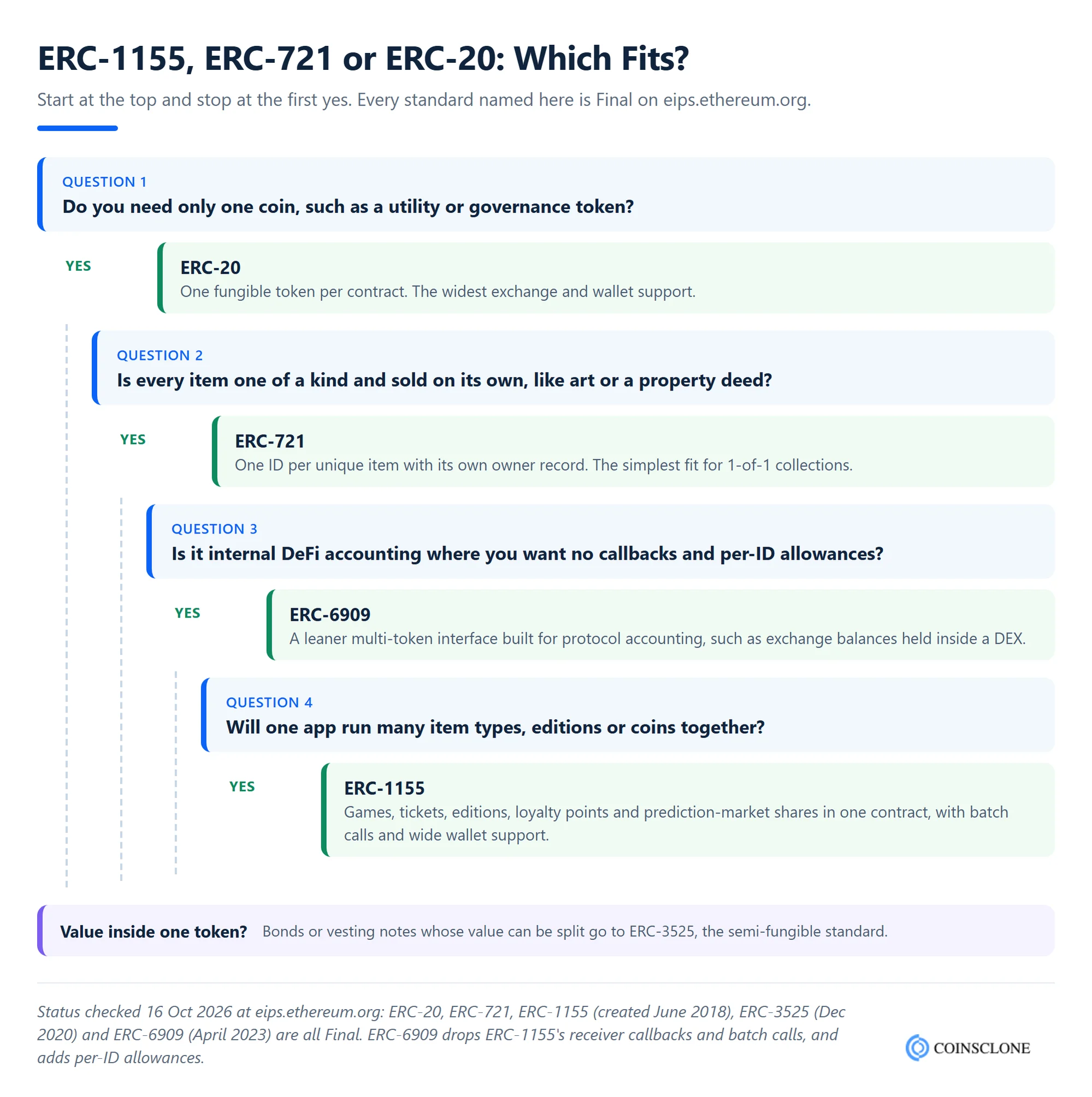
If your project is a single collection of unique art, our guide to ERC721 token development is the better starting point.
Our ERC1155 Token Development Approaches
Every business has its own needs, goals and use cases when it creates an ERC-1155 token. To meet them, we offer two flexible ways to work with us.
ERC-1155 Token Development from Scratch
We provide end-to-end ERC-1155 token development, backed by deep skill in the crypto field. Our team builds your token from the ground up, so it fits your token logic, utility, scale and business plan. We handle each stage, from planning the token types to launching safe smart contracts.
This approach suits you if you want a long-term, enterprise-grade ERC-1155 setup without trading off quality or speed.
Hire ERC-1155 Token Developers
Our ERC-1155 token developers support businesses that already run a platform and need to move faster on a tight deadline. They work with your in-house team to add features such as batch minting, batch transfers, gas tuning, stronger security and smooth links to your app. Hiring our developers helps you cut internal costs while you ship faster and stay flexible.
Features and Functions of ERC1155 Token Development
The main reason ERC-1155 exists is to fix the limits of older token standards. Here are the features that make it useful in real projects.
Batch Transfer: One call can send many token types to one address. For example, a game can send 500 gold, three potions and a sword together.
Batch Balance: Apps can read many balances in one call. As a result, wallets and game screens load faster.
Mint and Burn: You can create new tokens when needed and burn spare ones to control supply. Batch minting creates many token types in one transaction.
Lower Gas for Shared Items: Copies that share one token ID cost almost nothing extra to mint or send. Our test below shows a 99% saving for 100 copies of one item.
Safe Transfer Rule: The receiver check blocks transfers to contracts that cannot handle ERC-1155 tokens. This prevents tokens from being locked forever by mistake.
One Metadata Link: A single URI template serves the metadata for every token ID, which keeps storage costs low.
On top of these, a good build adds access control, pause switches, royalties through ERC-2981 and supply tracking. These extras come from audited libraries, so they add safety without much new code.
How Much Gas Does ERC1155 Save?
Many guides claim ERC-1155 cuts gas fees by “up to 90%”. However, few of them show a test. So we measured it ourselves on Ethereum mainnet on 16 October 2026, using audited OpenZeppelin contracts. The task: give one player 100 game items.
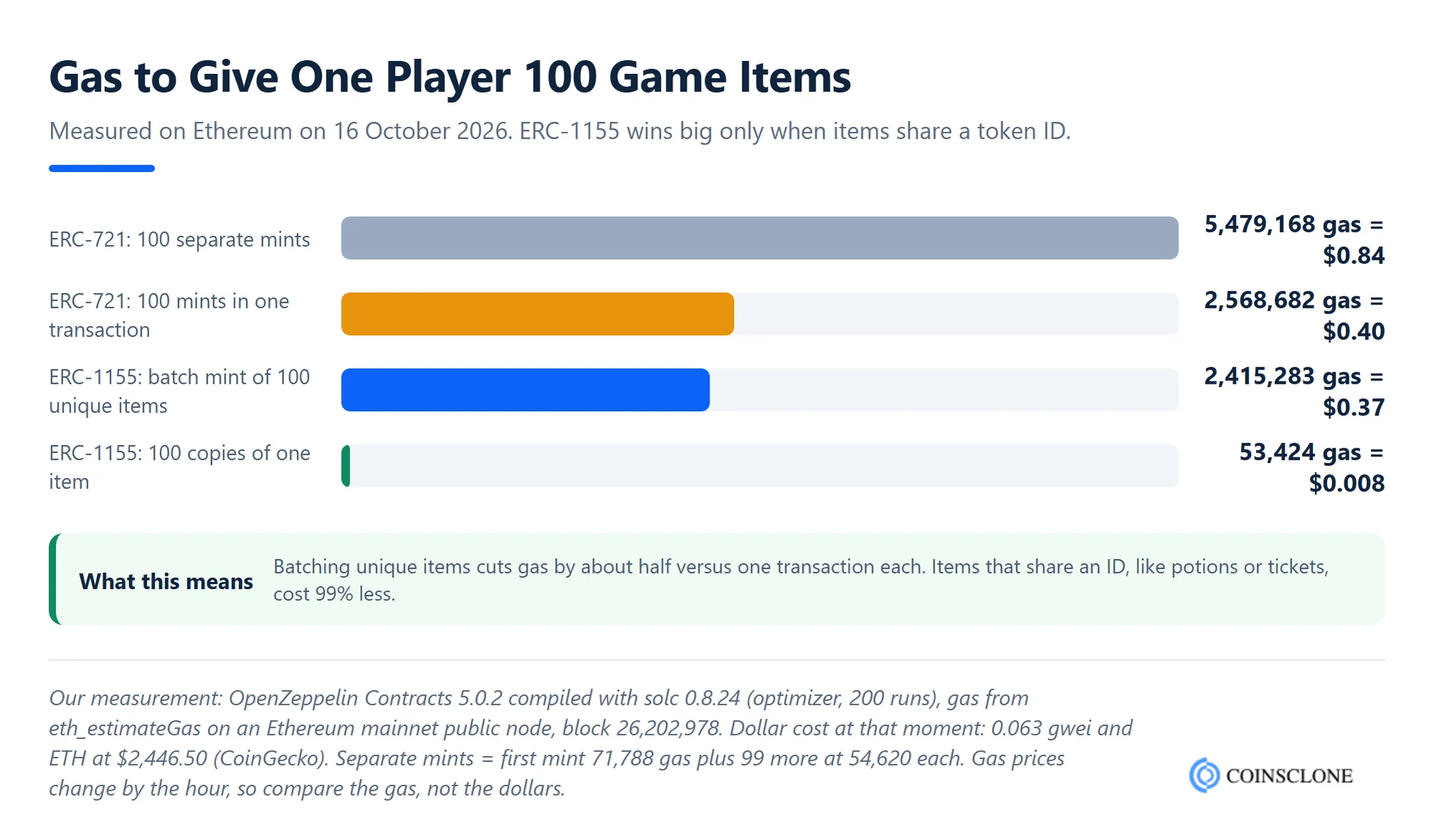
Here is what the numbers tell you:
- Batching helps, but it is not magic. An ERC-1155 batch mint of 100 unique items used 56% less gas than 100 separate ERC-721 mints. Yet it was only 6% cheaper than an ERC-721 contract that mints 100 items in one loop.
- Shared IDs are where ERC-1155 shines. Minting 100 copies of one item took 53,424 gas, which is 99% less than 100 separate NFTs. The same holds for transfers: moving 100 copies of one item took 57,262 gas.
- One contract replaces two. Deploying one ERC-1155 contract took 1,256,995 gas. A separate ERC-20 plus ERC-721 pair took 1,687,845 gas, so you save about a quarter.
On the same day, Ethereum gas sat near 0.063 gwei, so even the most costly route cost under a dollar. Gas prices swing with demand, though, and a busy day can multiply these costs many times over. Therefore, the safest plan is to design your token IDs so that common items share an ID. Most games and ticket systems also launch on low-fee chains like Polygon, where the same 100 separate mints cost about 12 cents on the same day.
Benefits of Creating an ERC1155 Token
Many teams see ERC-1155 as the most flexible token standard on Ethereum. Here is what it brings to a business.
Loyalty and Reward Programs: A brand can run points, badges, vouchers and rare rewards from one smart contract. That makes the program cheaper to run and easier to manage.
Single Smart Contract: You can turn real items such as gold, art and rare cards into NFTs, and run coins next to them. One contract maintains both kinds.
Gaming Industry: Players need both coins and gear, such as swords, armour and skins. With ERC-1155, the coins are fungible token IDs and rare gear is an NFT, all in one place.
Support for DAOs: A DAO can issue voting tokens, member badges and one-time rights from the same contract, since ERC-1155 supports all three token types.
Fewer Lost Tokens: The safe transfer rule stops tokens from being sent to contracts that cannot use them. Note that it cannot undo a transfer to a wrong wallet address, so apps should still check addresses before sending.
Thanks to these benefits, ERC-1155 is also the usual choice for semi-fungible token development.
Use Cases of an ERC1155 Token
1. Gaming: In crypto games, weapons, shields and tools are often tokens. When players need many items at once, ERC-1155 batch transfers move them in a single transaction. This is still the standard’s biggest use case.
2. Tickets and Vouchers: ERC-1155 tokens can stand for event tickets, travel vouchers, gift cards and similar passes. Each ticket tier is one token ID with its own supply, which makes issuing and checking tickets simple.
3. Collectibles and Editions: Artists and brands use ERC-1155 for open editions and limited prints of art, music, video and sports moments. Each token ID can carry the artist’s name, the release year and edition details in its metadata.
4. Prediction Markets: This is a newer, fast-growing use. Polymarket, one of the biggest crypto prediction markets, issues its YES and NO shares as ERC-1155 tokens on Polygon. It uses the Gnosis Conditional Token Framework to do it. Each market outcome is simply another token ID. Coinsclone builds this model through its Polymarket clone script.
5. Digital Assets: ERC-1155 tokens can stand for shares in songs, patents, rights and other assets. For shares sold as securities, though, teams often pick a rule-based standard such as ERC-3643.
6. Memberships and Access: Tokens can act as member passes or access keys that unlock content, perks or data. A wallet that holds the right token ID gets in.
Who Uses ERC-1155 in 2026?
The standard has a long track record, and its users have changed over time.
- Enjin, whose team created ERC-1155, moved its NFTs to its own Enjin Blockchain. It took a snapshot of its Ethereum ERC-1155 tokens on 8 December 2023 and mirrored around 200 million NFTs to the new chain. If you want a gaming asset platform of your own, see our Enjin clone script.
- Polymarket runs its outcome shares on ERC-1155, as noted above.
- NFT marketplaces and wallets mostly support ERC-1155 next to ERC-721, so prints and game items show up without extra work.
Industries We Assist with ERC1155 Token Development
Gaming Platforms: ERC-1155 tokens support both fungible and non-fungible assets in one system. Players truly own their in-game items, can trade them safely and, where games agree, use them in more than one game.
NFT Marketplaces: On NFT marketplaces, ERC-1155 makes it simple to create and trade many kinds of items, such as art, music and virtual land. Clear on-chain ownership builds trust in each item.
Digital Collectibles: Fans can own, trade and show items such as rare art, trading cards and limited prints. Each token ID stands for one distinct item or edition.
Prediction Markets and Ticketing: Outcome shares and ticket tiers fit ERC-1155 well, since each one is a token ID with its own supply.
How To Create ERC1155 Token: A Step-by-Step Guide
Here are the seven key steps we follow to build an ERC-1155 token.
- Define the Purpose: Clearly set out why you need an ERC-1155 token and how it fits your business goals. Decide whether it will power game items, NFTs, tickets, vouchers or digital ownership.
- Design the Token Structure: Plan the token IDs and decide which are fungible, non-fungible or semi-fungible. Set the supply for each ID, the metadata layout and the URI template. Group common items under shared IDs to save gas.
- Choose the Right Team: Pick an ERC-1155 token development team with real smart contract and audit experience, or decide what your in-house team can handle.
- Pick the Features: Choose the features your platform needs, such as batch minting, batch transfers, royalties, supply tracking, pause controls, access roles and wallet support.
- Write the Smart Contract: Write the contract in Solidity on top of OpenZeppelin’s audited ERC-1155 code. It must include every core function the standard asks for, from single and batch transfers to balances, approvals and metadata.
- Test and Audit: Deploy to a testnet such as Sepolia and test every function, including transfers to contracts. Then run an audit to find and fix bugs before real money is at stake.
- Launch and Deploy: Deploy the contract to mainnet, verify the code on the chain’s block explorer and move admin keys into a multisig wallet. Then connect the tokens to your app, wallets and marketplaces.
After launch, the contract address on the block explorer is what wallets and marketplaces use to find your tokens.
ERC1155 Security Risks and Limits
ERC-1155 is safe when it is built well, but it has its own traps. Plan for these before you write code.
- All-or-nothing approvals: One approval lets an app move every token a wallet holds, of every type. A bad or hacked operator can drain a whole inventory, so only approve audited contracts.
- Reentrancy through the receiver check: The receiver check calls the other contract during a transfer. Contracts that update balances after that call can be attacked. Follow the checks-effects-interactions order and add reentrancy guards.
- No owner list per token: The standard tracks balances, not owners, so you cannot ask the contract who holds an item. Use an indexer or emit clear events if your app needs holder lists.
- Metadata hosting: If the metadata server goes down, items lose their names and images. Store metadata on IPFS or Arweave and pin it.
- Admin key risk: Whoever controls the mint role can create unlimited tokens. Keep that role in a multisig wallet and log every change.
ERC1155 Token Development Cost
Gas is the small part of the bill. As our test shows, deploying an ERC-1155 contract on Ethereum cost about 19 cents on 16 October 2026. The real cost sits in the build, the audit and the app around the token.
Published 2026 agency cost guides put a standard ERC-20 or BEP-20 token at about $5,000 to $15,000 to build, and a feature-rich token with staking or vesting at about $20,000 to $80,000. Guides that price ERC-1155 projects on their own range from about $5,000 for a simple contract to $25,000 or more once you add royalties, upgrades and a mint site. Published 2026 audit price guides put a simple token audit at roughly $5,000 to $15,000, with complex systems far higher.
Four things drive the price most:
- Contract scope: Simple mint and transfer logic costs far less than custom game economies, crafting or upgradeable contracts.
- Chain choice: Deploying to one chain is simpler than a multi-chain launch with bridges.
- Audit depth: The more custom code you add on top of standard libraries, the larger the audit.
- The app around it: A mint site, marketplace link or game backend often costs more than the token itself.
On timing, our NFT token development team needs 2 to 4 weeks for a collection contract with a mint site, metadata and an audit. Adding holder perks such as gated access takes 5 to 8 weeks. For a full budget, read our guide to the cost to create a crypto token.
Why Choose Coinsclone for ERC1155 Token Development?
Coinsclone is a leading crypto token development company that helps startups and large firms reach their goals and stay ahead in a fast market. We have been building since 2018 and have delivered 350+ platforms for 200+ clients across 20 industries. Our team builds secure smart contracts, blockchain software modules and custom decentralized apps on Ethereum and other major chains.
Along with our Ethereum token development services, we build ERC-20 coins, ERC-721 NFTs and ERC-1155 setups for games, tickets, prints and prediction markets. Every contract is tested on a testnet and checked for security before launch.
Ready to build an ERC-1155 token that your users will actually use?
Connect with our blockchain experts today and get started!
Frequently Asked Questions
1. What does an ERC1155 Token Development company do?
An ERC1155 token development company designs and deploys smart contracts that follow the ERC-1155 standard. Each contract can hold coins, NFTs and copies of the same item side by side. The team also builds the metadata, minting rules, audits and app links. Games, NFT prints and item stores often use it.
2. What is ERC1155 token development?
ERC1155 token development is the process of creating tokens with the ERC-1155 Multi Token Standard on Ethereum or another EVM chain. Unlike ERC-20 or ERC-721, ERC-1155 supports many asset types in a single contract. That makes it efficient for apps that need batch transfers or a mix of coins and items.
3. How is ERC1155 different from ERC20 and ERC721?
ERC-20 handles one fungible token per contract, and ERC-721 handles unique NFTs. ERC-1155 combines both ideas in one contract and adds batch transfers. In our test, minting 100 copies of one ERC-1155 item used 99% less gas than minting 100 separate ERC-721 NFTs. For 100 unique items, the saving was much smaller.
4. Why is ERC1155 used in blockchain games and metaverse projects?
Games need huge numbers of items, many of them identical. ERC-1155 manages weapons, skins, currencies and collectibles under one contract, and items that share a token ID cost almost nothing extra to mint or move. This keeps fees low and inventories simple.
5. Is ERC1155 secure?
ERC-1155 is a Final Ethereum standard and is secure when built on audited code. Safety depends on the build. You need tight admin roles, guards on the receiver check, few operator approvals and a full audit before launch.
6. Can ERC1155 tokens be used for NFTs?
Yes. Any ERC-1155 token ID with a supply of one is an NFT. The same contract can also hold editions and fungible tokens, which suits limited-edition art, event tickets and game items.
7. Which blockchains support ERC1155 tokens?
ERC-1155 works on Ethereum and on most chains that run the same code, such as Polygon, BNB Chain, Arbitrum, Base and Avalanche. Projects can reuse one contract design across all of them.
8. What are some popular dApps that use ERC-1155?
Polymarket issues its prediction market outcome shares as ERC-1155 tokens on Polygon. Enjin, whose team created the standard, ran its game items on Ethereum ERC-1155 before moving to its own chain in late 2023. Many NFT edition drops and blockchain games also use it.
9. How does ERC-1155 improve scalability?
It cuts the number of contracts and transactions an app needs. One contract replaces many, batch calls group transfers together, and identical items share a single token ID. As a result, apps with thousands of item types stay cheaper and easier to manage.
10. How do I find an ERC-1155 token’s contract address?
The contract address is created when the contract is deployed. You can find it in the deploy record on the chain’s block explorer, such as Etherscan. Your wallet or marketplace also shows it in the token details.
11. Is ERC-1155 the future of NFTs?
ERC-1155 is the best fit for prints, game items and apps with many token types. ERC-721 is still the simpler choice for 1-of-1 sets. Both are Final standards and both are widely supported, so the right pick depends on your project rather than on trends.
See How Our MVP System Can Launch Your Multi-Token Project Faster
ERC1155 Token Development — done right.
- MVP System:Build and deploy ERC1155 multi-token standards 90% faster.
- Smart Contract Ready:Fully audited, secure, and gas-efficient token architecture.
- Customization:One platform for your fungible & non-fungible assets.
- Revenue Engine:Enable trading, staking, and NFT marketplace integrations.
See a free demo of your ERC1155 project in 48 hours — before you invest a cent.
Book a Free Demo to discover how our ERC1155 Token Development Company can take you from idea to launch in just 2–4 weeks.