
ERC token standards are the shared rules that every token on Ethereum follows, such as ERC-20 for fungible tokens, ERC-721 for NFTs and ERC-1155 for multi-token contracts. Only the ones marked Final on the official Ethereum ERC list are settled. The rest are drafts or ideas that can still change. These rules are the reason a new token works in MetaMask, trades on Uniswap and shows up on Etherscan on day one.
But not every “ERC standard” you read about is a real, finished standard. Some are final and used by thousands of projects. Some are still drafts. And some popular names, like ERC-1400, were never accepted as official standards at all. This guide lists the top 10 ERC token standards in 2026 with the official status of each one, shows which one fits your project, and flags the older standards to avoid.
In this guide:
- The 10 Ethereum ERC standards that matter in 2026, with their status checked on 26 October 2026
- Which standard to pick for a coin, an NFT, a game, a stablecoin or a real-world asset
- ERC-1400 vs ERC-3643, and how an ERC-1400 token is built
- The new Ethereum token standards to watch, and the old ones to skip
- What it costs to build a token on an ERC standard
See How Our ERC Token Standards Can Power Your Blockchain Project
ERC Token Development — done right.
- All Major Standards:ERC20, ERC721, ERC1155 & more — fully compliant and customizable.
- Smart Contract Perfection:Secure, gas-optimized, and audit-ready token contracts.
- Integration Ready:Seamless deployment with DEXs, wallets, and DeFi protocols.
- Custom Branding:Your name, your rules — tokenomics, supply, and utility built to fit your vision.
Get a free demo of your ERC-based token — see it live on testnet before deployment.
Book a Free Demo to discover how our experts can take your token from concept to mainnet in just 2–4 days.
Top 10 ERC Token Standards in 2026
Here are the ERC standards that matter most for projects in 2026:
- ERC-20: fungible tokens
- ERC-721: non-fungible tokens (NFTs)
- ERC-1155: multi-token contracts
- ERC-2612: permit (gasless approvals)
- ERC-4626: tokenized vaults
- ERC-3643: regulated security and RWA tokens
- ERC-1400: security token standard
- ERC-4337: account abstraction
- ERC-2981: NFT royalties
- ERC-6551: token-bound accounts
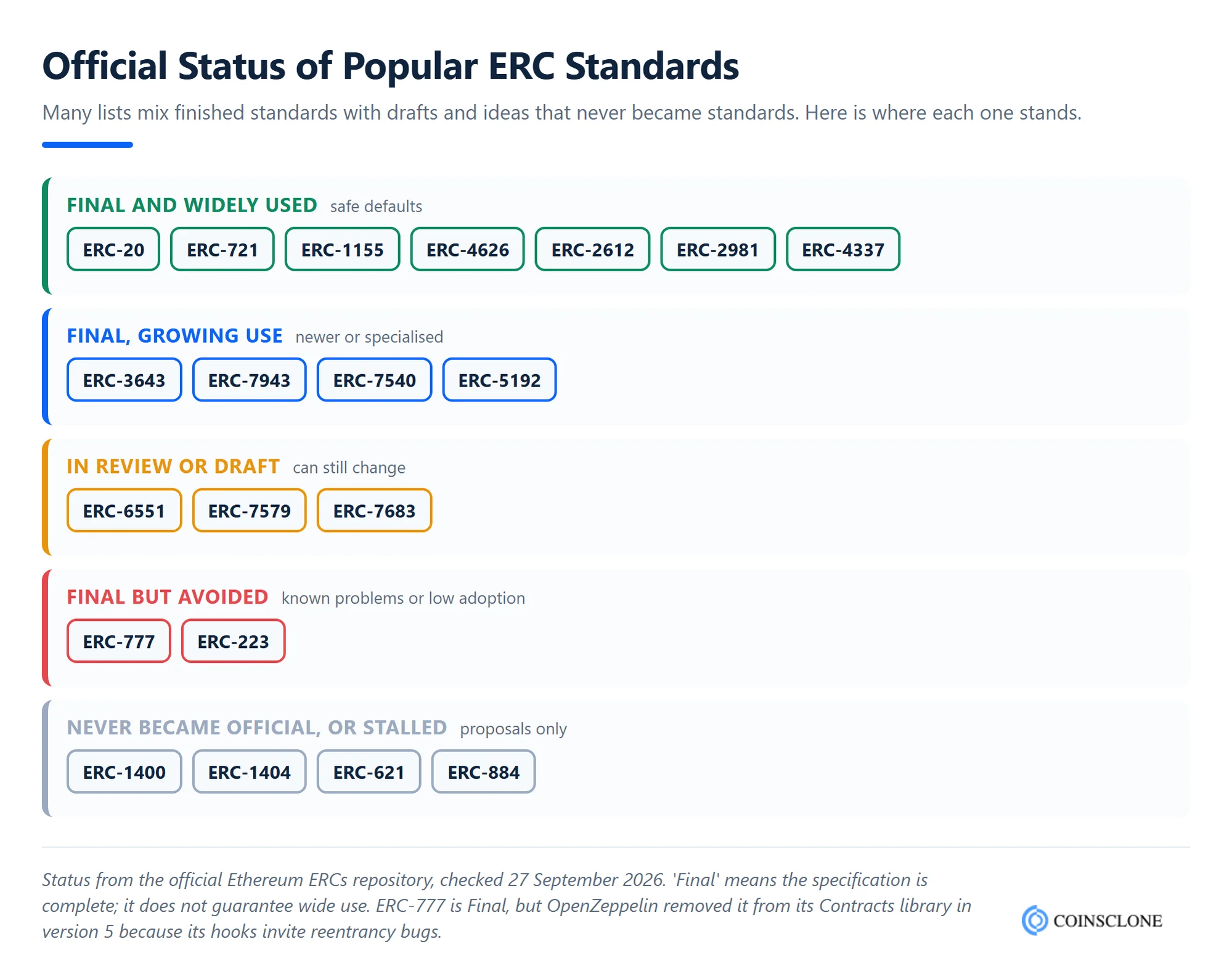
Before we look at each one, here is the official status of the standards you will hear about most:
1. ERC-20 Token Standard
ERC-20 is the standard for fungible tokens, where every unit is identical, like dollars. It was proposed in 2015 and is the most widely used token standard in crypto. Stablecoins such as USDT and USDC, and governance tokens such as UNI and AAVE, are all ERC-20 tokens on Ethereum.
Every ERC-20 token has six core functions: totalSupply, balanceOf, transfer, approve, allowance and transferFrom. It also has a name, a symbol and a decimals value. On top of these, you choose features such as a fixed or mintable supply, burning or pausing.
Best for: App tokens, voting tokens, stablecoins, reward points and payment tokens.
Want to build one? Follow our step-by-step guide to create an ERC20 token, browse the ERC20 tokens list, or work with an ERC20 token development company.
2. ERC-721 Token Standard
ERC-721 is the standard for non-fungible tokens (NFTs). Each token has a unique ID, so no two are the same. This makes it ideal to prove who owns a single item, such as a piece of art, a ticket, a pass or a domain name.
CryptoPunks came before the standard, but most famous NFT collections since, such as Bored Ape Yacht Club, use ERC-721. ENS domain names are also ERC-721 tokens.
Best for: Art, collectibles, tickets, member passes, certificates and domain names. Learn more about ERC721 token development.
3. ERC-1155 Token Standard
ERC-1155 is the multi-token standard. One contract can hold many token types, and each type can be fungible, like gold coins in a game, or unique, like a rare sword. You can send many tokens in a single batch transfer, which saves gas.
This makes ERC-1155 a favourite for games, editions and bundles, where a project needs thousands of items without deploying thousands of contracts.
Best for: Blockchain games, NFT editions, in-game items and event tickets in several tiers. See our ERC1155 token development services.
4. ERC-2612: Permit (Gasless Approvals)
ERC-2612 is an add-on to ERC-20, not a new token type. Normally, before an app like a DEX can move your tokens, you must send an “approve” transaction and pay gas. With ERC-2612, you sign a message instead, and the approval happens in the same transaction as the trade.
This saves a transaction and gives users a smoother flow. USDC and many newer tokens support it, and most new ERC-20 tokens should include it.
Best for: Any new ERC-20 token that will be used in DeFi or payments.
5. ERC-4626: Tokenized Vaults
ERC-4626 is the standard for yield-bearing vaults. When you deposit tokens into a vault, you receive vault shares, which are ERC-20 tokens that stand for your part of the vault. ERC-4626 sets standard functions for deposit, withdraw, mint and redeem, so any DeFi app can plug into any vault.
A newer add-on, ERC-7540, adds support for vaults where deposits and withdrawals take time, such as vaults that hold real-world assets.
Best for: Yield vaults, lending markets, staking products and tokenized funds.
6. ERC-3643: Regulated Security and RWA Tokens
ERC-3643, also known as T-REX (Token for Regulated EXchanges), is the leading final standard for regulated tokens. It links each wallet to a checked identity, so a token can only move between investors who meet the rules, such as KYC checks or country limits. The issuer can also freeze or recover tokens when the law requires it.
This makes ERC-3643 a strong choice for tokenized shares, bonds, funds and real estate. A newer final standard, ERC-7943 (uRWA), offers a lighter shared interface for rule checks on real-world asset tokens. See our ERC-7943 RWA tokenization page for how it works in practice.
Best for: Security tokens and real-world asset tokenization. See our ERC3643 token development and RWA token development services.
Create Your Crypto Token Today!
Cost-effective, White-Label Solution, Premium Features, Customizable. Live Demo Available.
7. ERC-1400: Security Token Standard
ERC-1400 is a set of security token rules first put forward in 2018 by a group led by Polymath. It built on Polymath’s older ST-20 design. It covers split balances (for example, locked and unlocked shares), transfer limits and legal documents.
It is important to know that ERC-1400 was never accepted as an official ERC. It lives only as a GitHub thread and as code that some security token platforms use. That is why it is not on eips.ethereum.org at all. That makes it a real option, but for new projects, ERC-3643 is usually the better-supported choice. We compare the two in the ERC-1400 vs ERC-3643 section below.
Best for: Security token platforms that already run ERC-1400 code. Learn about ERC1400 token development.
8. ERC-4337: Account Abstraction
ERC-4337 is not a token standard. It is the standard for smart contract wallets, often called account abstraction. It lets wallets do things plain wallets cannot, such as social recovery, paying gas in stablecoins, sponsored gas and batching several actions into one click. It works without any change to Ethereum itself, through a shared EntryPoint contract.
In May 2025, the Pectra upgrade added EIP-7702, which is now Final. It lets ordinary wallets borrow these smart account features too. Together, they are changing how people hold and use tokens.
Best for: Wallets, games and apps that want a simple, gas-free user experience.
9. ERC-2981: NFT Royalties
ERC-2981 is an add-on for NFTs that lets a collection state its royalty: who should be paid and what share of each sale. Marketplaces can read this in a standard way.
Note that ERC-2981 only publishes the royalty. It cannot make a market pay it, and many markets now let buyers skip it.
Best for: NFT drops that want each market to see the same royalty.
10. ERC-6551: Token-Bound Accounts
ERC-6551 gives every NFT its own wallet. The NFT can then own other tokens and NFTs. For example, a game character NFT can carry its own items, and when you sell the character, the items go with it.
ERC-6551 is still in Review status, so its details can change, but games and online ID projects already use it.
Best for: Games, reward clubs and online ID. See our ERC-6551 token development services.
ERC Token Standards List: Comparison Table
| Standard | Token type | Official status | Main use |
| ERC-20 | Fungible | Final | Currencies, utility and governance tokens |
| ERC-721 | Non-fungible | Final | NFTs, tickets, domain names |
| ERC-1155 | Multi-token | Final | Games, editions, bundles |
| ERC-2612 | ERC-20 add-on | Final | Gasless approvals |
| ERC-4626 | Vault shares (ERC-20) | Final | Yield vaults, tokenized funds |
| ERC-3643 | Permissioned token | Final | Securities, RWAs |
| ERC-1400 | Security token family | Never an official ERC | Security tokens |
| ERC-4337 | Smart accounts | Final | Wallets, gas sponsorship |
| ERC-2981 | NFT add-on | Final | Royalty details |
| ERC-6551 | NFT accounts | Review | Games, identity |
Status checked at eips.ethereum.org on 26 October 2026.
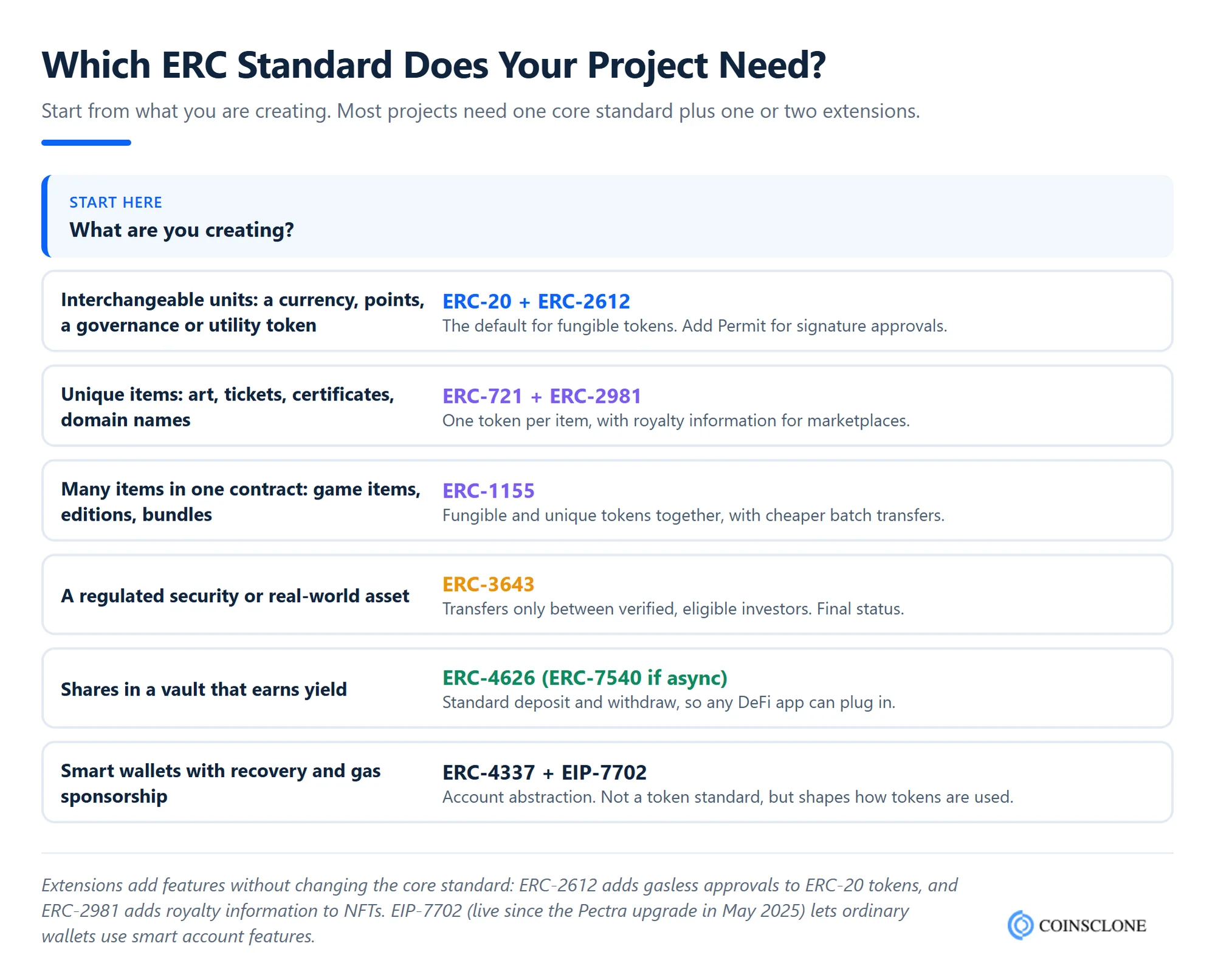
Which ERC Standard Should Your Project Use?
Most projects need one core standard plus one or two add-ons. Start from what you are creating:
Which ERC Standard Do Stablecoins Use?
Stablecoins use ERC-20, almost always with add-ons for signed approvals and payments. USDC, for example, supports ERC-2612 permit and ERC-3009 “transfer with authorization”, which lets a payment app move funds from a signed message. Most fiat-backed stablecoins also add freeze and blocklist functions so the issuer can meet its legal duties. Our guide on how to launch a stablecoin covers the rest of the setup.
Which ERC Standards Are Used for NFTs?
NFTs use ERC-721 for one-of-a-kind items and ERC-1155 for editions or game items. On top of these, four add-ons are common:
- ERC-2981 (Final): royalty details that markets can read
- ERC-4907 (Final): rentals, where a “user” can hold an NFT for a set time without owning it
- ERC-5192 (Final): soulbound NFTs that cannot be moved, for badges and credentials
- ERC-6551 (Review): a wallet for each NFT
Which Standard Fits a Unique Record That Should Not Be Traded?
Use ERC-721 when each item is one of a kind, such as a policy, a licence or a pass. Lock it with ERC-5192 if it must never change hands. This came up in an r/ethdev thread on insurance policies in August 2025, where replies agreed that ERC-1155 adds nothing when items are never traded. Keep private details off-chain and store only a reference or hash in the token.
What Are ERC Token Standards?
ERC stands for Ethereum Request for Comments. An ERC is a proposal that sets out rules for apps and tokens on Ethereum. When a proposal is reviewed and accepted, it becomes a standard that any developer can follow.
A token standard defines the functions every token of that type must have. For example, every ERC-20 token has the same functions to check a balance and to send tokens. Because every wallet, exchange and DeFi app knows these functions, any token that follows the standard works with all of them.
ERCs are one kind of Ethereum Improvement Proposal (EIP). Core EIPs change the Ethereum protocol itself, like EIP-7702 did in the Pectra upgrade. ERCs are app-level standards, such as token formats and wallet interfaces, and they need no network upgrade.
How Does an ERC Become a Standard?
An ERC becomes a standard when its authors move it through Draft, Review and Last Call to Final, after open debate on the Ethereum Magicians forum. Editors check the format, but no one votes it in. A proposal that stops moving for six months is marked Stagnant, and its authors can also withdraw it.
How Many ERC Standards Are There?
There are about 630 numbered ERCs, but only 147 are Final. On 26 October 2026, the official ERC list showed 147 Final, 19 in Last Call, 61 in Review, 231 Drafts, 162 Stagnant and 10 Withdrawn. In practice, a dozen or so carry almost all real token activity.
Are ERC Standards Enforced On-Chain?
No. A standard is a shared interface, and nothing on Ethereum checks that a contract follows it. A token can claim to be ERC-20 and still behave in odd ways. USDT on Ethereum, for example, does not return a true or false value from its transfer function, so apps use safe wrappers to handle it. Always test and audit a token against the standard before launch.
Is ETH an ERC-20 Token?
No. ETH is Ethereum’s native coin, used to pay gas, and it came before any token standard. When an app needs ETH in ERC-20 form, it uses WETH (wrapped ether), which you can swap one for one with ETH.
Do ERC Standards Work on Other Blockchains?
Yes, on every EVM chain. Base, Arbitrum, Optimism, Polygon and BNB Chain all run the same ERC-20, ERC-721 and ERC-1155 code, so a token built to an ERC standard deploys there with little or no change. BNB Chain calls its version BEP-20, and Tron’s TRC-20 is modelled on ERC-20, as our ERC20 vs TRC20 guide explains.
Why ERC Token Standards Matter
- Compatibility: A standard token works with every wallet, exchange and app that supports the standard.
- Security: Standard code, such as OpenZeppelin’s audited contracts, has been tested by thousands of projects.
- Faster builds: You build on proven rules instead of designing a token from zero.
- Easier listings: Exchanges and data sites already know how to handle standard tokens.
ERC-1400 vs ERC-3643: Which Security Token Standard?
For a new security token in 2026, ERC-3643 is usually the better choice, because it is a Final ERC with ID checks built in. ERC-1400 still makes sense if your platform, transfer agent or exchange already runs on ERC-1400 code.
| ERC-1400 | ERC-3643 | |
| Official status | Never an official ERC (GitHub issue #1411) | Final |
| Who can hold it | Rules set in the token’s own checks | Only wallets with a valid on-chain identity |
| Split balances | Yes, through partitions | No; one balance per wallet |
| Legal documents | Yes, built in | Handled outside the token |
| Forced moves and recovery | Yes, by a controller | Yes, by an agent |
| Base token | ERC-20 compatible | ERC-20 compatible |
A common mix-up is that ERC-3643 replaced or renamed ERC-1400. A July 2025 Ethereum Stack Exchange question even calls it “ERC-3643 (formerly ERC-1400)”. That is not right: they are separate designs from different teams. The same question asks about ERC-1155 for real-world assets. ERC-1155 has no identity or transfer rules, so it suits game items, not regulated securities.
What Is in the ERC-1400 Specification?
The ERC-1400 security token standard is made of four smaller parts that work together:
- ERC-1410: partitions, so one wallet can hold locked, unlocked or class A and class B shares of the same token
- ERC-1594: core security token functions, including checks that tell a sender why a transfer would fail
- ERC-1643: legal papers, so you can attach a share offer’s terms with a hash
- ERC-1644: controller actions, so a regulated party can force a transfer under a court order
How to Create an ERC-1400 Token
To create an ERC-1400 token, you start from tested open-source ERC-1400 code, set its share classes, admins and transfer rules, then deploy it. The steps look like this:
- Set the legal structure first: who may hold the token, in which countries, and with what lock-up periods.
- Pick a tested base: start from a maintained ERC-1400 code base rather than writing the four parts from zero.
- Define partitions: for example, “locked” and “unlocked”, or one per share class.
- Add your checks: link transfers to an allowlist or a KYC provider, and name the controller who can force moves.
- Attach papers: store a hash of your legal papers with ERC-1643.
- Test, audit and deploy: run every transfer case on a testnet, get an audit, then go live.
If you are starting fresh, run the same steps on ERC-3643 instead. Coinsclone builds both through its security token development services.
Older ERC Standards to Avoid in New Projects
Many lists still recommend these standards. Here is what actually happened to them:
ERC-777
ERC-777 was designed as a better ERC-20, with “hooks” that let contracts react when they receive tokens. Those hooks turned out to create reentrancy risks, and they played a part in DeFi hacks, such as the attacks on imBTC pools in 2020. It is still Final on paper. But ethereum.org now marks it “not recommended”, and OpenZeppelin dropped it from version 5 of its smart contract code. Use ERC-20, with ERC-2612 if you need better approvals.
ERC-223
ERC-223 was proposed in 2017 to stop tokens from getting stuck when sent to a contract that cannot handle them. With ERC-20, such tokens are not burned, but they can be lost for good. ERC-223 is now a final standard, but few wallets, exchanges or apps support it, so it is rarely the right choice. Read more in our ERC223 token development guide.
ERC-621 and ERC-884
ERC-621 proposed functions to raise or lower an ERC-20 token’s supply. It never became an official standard, and the same result is easy to reach with ERC-20 mint and burn functions. ERC-884 was an idea for share tokens under Delaware company law. It is marked Stagnant. For regulated shares today, ERC-3643 is the better-supported option.
ERC-1404
ERC-1404 is a “simple restricted token” proposal that adds transfer checks to ERC-20. It never became an official ERC, although some security token issuers used it. For new regulated tokens, ERC-3643 is again the safer path.
New Ethereum Token Standards in 2026
The newest Final standards are ERC-7943 for real-world assets and ERC-7540 for slow-settling vaults, while account, payment and AI agent standards are still drafts. Here is the 2026 shortlist, with status as of 26 October 2026:
- ERC-7943 (Final): A universal interface for real-world asset tokens.
- ERC-7540 (Final): Asynchronous vaults for real-world assets and funds.
- ERC-5192 (Final): Minimal soulbound tokens that cannot be moved, used for credentials and badges. See soulbound token development.
- EIP-7702 (Final): Not an ERC but a core upgrade, live since Pectra in May 2025, that gives normal wallets smart account features.
- ERC-3009 (Draft): Signed “transfer with authorization” payments. USDC already supports it, and it powers many gasless and agent payment flows.
- ERC-7579 (Draft): Modular smart accounts, so wallet features can be added as plug-ins.
- ERC-7683 (Draft): Cross-chain intents, a shared format for “do this on another chain” orders.
- ERC-7802 (Draft): Mint and burn rules for tokens that live natively on several chains.
- ERC-8004 (Draft): ID and trust records for AI agents, a hot topic in an r/ethtrader thread in early 2026.
Drafts can still change, so build on them only when you accept that risk, and plan an upgrade path.
How Much Does It Cost to Build a Token on an ERC Standard?
A basic custom ERC-20 or ERC-721 token costs about $5,000 to $15,000 to build with a team, and $15,000 to $50,000 or more once you add vesting, staking, governance or compliance logic. These ranges come from published 2026 agency cost guides. Deploying the contract itself costs only a few dollars or less in gas on most EVM chains; the audit and the custom logic are where the money goes.
Regulated ERC-3643 or ERC-1400 tokens sit at the top of that range, because they need identity checks, an admin panel and a deeper audit. Lock-ups for team and investor tokens are a common extra; our guide to a token vesting smart contract shows how they work. For a full breakdown, see the cost to create a crypto token.
Build Your Token on the Right ERC Standard With Coinsclone
Choosing the right standard is the first technical decision in any token project. It decides which wallets and apps support your token, which rules you can enforce and how much gas your users pay.
Coinsclone offers Ethereum token development on all the main ERC standards, from ERC-20 coins and ERC-721 NFTs to ERC-3643 security tokens and ERC-4626 vaults. We build on audited code, add only the features you need, and deploy on Ethereum and other EVM chains such as Base, Arbitrum, Polygon and BNB Chain. Since 2018, Coinsclone has delivered 350+ blockchain platforms for 200+ clients across 20 industries.
See How Our ERC Token Standards Can Power Your Blockchain Project
ERC Token Development — done right.
- All Major Standards:ERC20, ERC721, ERC1155 & more — fully compliant and customizable.
- Smart Contract Perfection:Secure, gas-optimized, and audit-ready token contracts.
- Integration Ready:Seamless deployment with DEXs, wallets, and DeFi protocols.
- Custom Branding:Your name, your rules — tokenomics, supply, and utility built to fit your vision.
Get a free demo of your ERC-based token — see it live on testnet before deployment.
Book a Free Demo to discover how our experts can take your token from concept to mainnet in just 2–4 days.
Frequently Asked Questions
What are ERC token standards?
They are shared rules for tokens on Ethereum. Each standard defines the functions a token must have, so it works with every wallet, exchange and app that supports that standard.
What does ERC stand for?
ERC stands for Ethereum Request for Comments. Each ERC is one kind of EIP, and it sets the rules for apps and tokens.
What is the difference between an EIP and an ERC?
Every ERC is an EIP, but not every EIP is an ERC. Core EIPs, such as EIP-7702, change how the Ethereum network works and need a network upgrade. ERCs, such as ERC-20, set rules for apps and tokens and need no upgrade.
What is the most popular ERC token standard?
ERC-20, the standard for fungible tokens. Most stablecoins, voting tokens and app tokens on Ethereum use it.
What is the difference between ERC-20, ERC-721 and ERC-1155?
ERC-20 tokens are identical and can be swapped one for one. ERC-721 tokens are each unique. ERC-1155 lets one contract hold both kinds, with cheaper batch transfers.
Is ERC-1400 an official standard?
No. ERC-1400 was proposed in 2018 but never accepted as an official ERC, which is why it is not listed on eips.ethereum.org. It is still used by some security token platforms. ERC-3643 is a Final standard for regulated tokens.
Is ERC-3643 the same as ERC-1400?
No. They are two different security token designs. ERC-3643 is Final and checks each holder’s on-chain identity. ERC-1400 is an older set of rules that was never made official. It adds split balances and legal papers.
What is the difference between ERC-4337 and EIP-7702?
ERC-4337 creates new smart contract wallets without changing Ethereum, while EIP-7702 lets an existing wallet, controlled by a private key, borrow smart wallet code. This was asked on r/ethereum in January 2025. The two work together: a 7702 wallet can use the same 4337 bundlers and gas sponsors.
What is the newest Ethereum token standard?
Recent Final standards include ERC-7943 for real-world asset tokens and ERC-7540 for asynchronous vaults. ERC-3009 (payments), ERC-7579 (modular smart accounts), ERC-7683 (cross-chain intents) and ERC-8004 (AI agents) are newer but still drafts.
What is EIP-2612 permit?
EIP-2612 (also listed as ERC-2612) is an ERC-20 add-on that lets users approve spending by signing a message, so they skip a second transaction and its gas.
Which ERC standard should I use for a real-world asset token?
ERC-3643 is the leading Final standard for regulated assets, because only checked, eligible investors can receive it. ERC-7943 and ERC-7540 can add a shared RWA interface and asynchronous vaults.